1Z0-478 Exam Details
-
Exam Code
:1Z0-478 -
Exam Name
:Oracle SOA Suite -
Certification
:Oracle Certifications -
Vendor
:Oracle -
Total Questions
:78 Q&As -
Last Updated
:Dec 07, 2021
Oracle 1Z0-478 Online Questions & Answers
-
Question 11:
View the Exhibit.
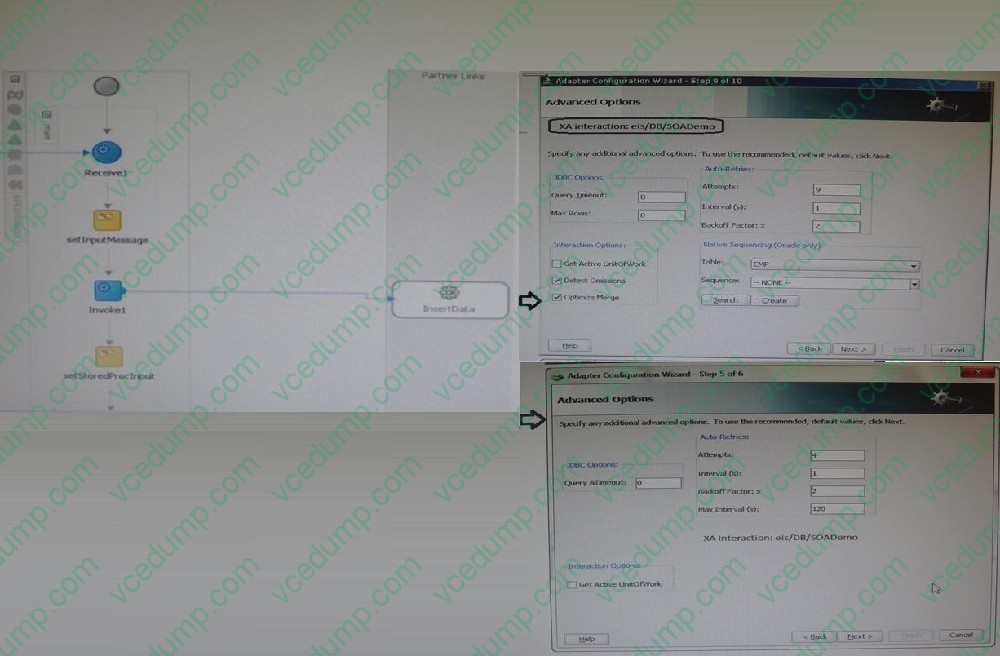
You have modeled a SOA composite with a single BPEL process component. Both of the invoke activities in the BPEL process use the same XA connection factory: eis/DB/SOADemo. The InsertData partnerlink inserts a new record in the
DEPT table in the database. The storeproc_validate partner link calls a stored procedure that validates this newly inserted record.
Which statement is true about the composite?
A. Invoke1 is capable of detecting omitted XML elements in the input payload and throwing a bindingFault to the caller
B. If invoke1 encounters a primary key constraint violation on insert, the invocation retires a total of 4 times with a starting interval of 1 and a back-off factor of 2.
C. Invoke1 and invoke2 use the same underlying JDBC connection to the database.
D. If invoke2 interaction fils, the insert from Invoke1 is also rolled back. -
Question 12:
Over a period of time, you have deployed three versions (1.0, 1.1, and 1.2) of a SOA application X to a three-node SOA cluster. All versions of X subscribes to a business event named createCustomer and instantiate a new BPEL process Y on receiving the event.
At runtime, how many SOA composite instances are generated when createCustomer business event is fired?
A. 1
B. 3
C. 9 -
Question 13:
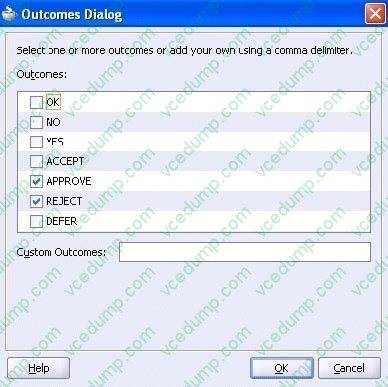
How are task outcomes processed in a BPEL process?
A. Each path out of the human task activity has a condition in which you specify the outcome that causes that path to be followed.
B. With onMessage or pick activities that receive the outcome from the human workflow engine.
C. With a switch containing a case for each outcome of interest plus an optional otherwise case after the human task activity.
D. With a switch containing one case for each possible outcome after the human task. -
Question 14:
What does service abstraction do?
A. It hides the implementation details of a service. Including the location of the service, the interface, and the idempotence of the operations.
B. It creates services quickly and easily for a variety of back-end technologies.
C. It translates and transforms messages.
D. It mediates security models. -
Question 15:
An invoke activity in a BPEL process is dehydrated _____. (select two)
A. immediately after execution if idempotent is set to True
B. before execution if idempotent is set to True
C. immediately after execution if idempotent is set to False
D. before execution if idempotent is set to False -
Question 16:
In a design session, a colleague makes the following comments about cluster support for Oracle SOA Suite 11g application. Which two statements are correct?
A. A cluster appears to clients as multiple WebLogic Server instances
B. The server instances in a cluster must all run on the same machine.
C. You can scale a cluster by adding machines to the cluster to host additional server instances.
D. Server instances in a cluster can run different versions of WebLogic Server.
E. You can create it cluster by using WLST, the WebLogic Server Administration Console or Enterprise Manager Fusion Middleware Control.
F. For management purposes, you can split a cluster across multiple domains. -
Question 17:
View the Exhibit.
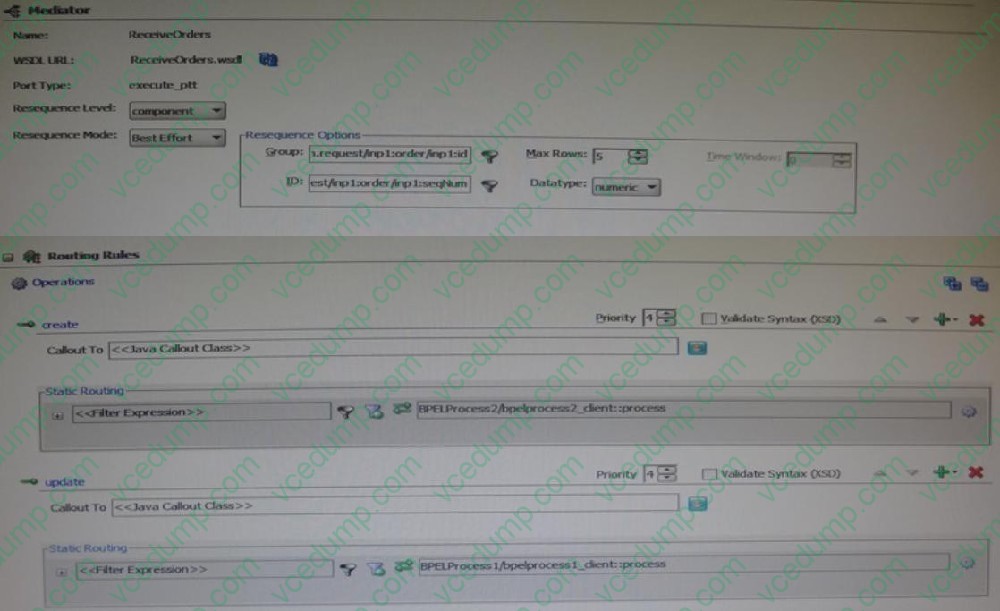
A user has configured Mediator M1 to receive and route product Information from System X into its internal applications in chronological order. For each product1 M1 receives one create number of "update" events from an AQ Queue via a JMS adapter. M1 can receive updates to the product at any time of day. The user claims that incoming messages for each product are received and processed in the correct chronological order 95% of the time. However, the messages are being processed out of order 5% of the time. This results in critical errors in the target systems. The user expects all messages pertaining to a product to be unconditionally processed In the order of arrival at M1.
What causes this discrepancy?
A. The user is running on a four node SOA cluster and has not configured the inbound JMS adapter to be a singleton.
B. The user is running a single-node SOA environment but has configured the number of inbound adapter threads to be a value greater than 1.
C. The given Mediator configuration does not address this sequencing requirement.
D. The user has configured resequencer worker threads to a value greater than 1 for the Mediator service engine. -
Question 18:
Suppose that you pass some data from a process variable as a parameter into a human task. The variable is then updated at a later time in a parallel stream of execution in the BPEL process while the human task still executing (that is, before is auctioned by the assignee)
What does the assignee see after opening the task in the workspace and looking at the parameter?
A. The parameter contains the values of the process variable as it was when the task was created.
B. The parameter contains the values of the process variable as it is at the current time (that is, when the user opened the human task in the workspace).
C. The parameter is empty, and the task must be restarted to pick up the new values of the processes variable.
D. It is not possible to determine from the information. -
Question 19:
Which statement is true about how the BPEL Process Manager works?
A. If the transaction property for a synchronous BPEL process is set to requiresNew transaction, a new transaction is created for the execution and the existing transaction (if there is one) is suspended.
B. If the transaction property for an asynchronous BPEL process is set to required, the BPEL process joins a caller's transaction (if there is no one) or creates a new transaction (if there is no transaction)
C. If the delivery policy for a synchronous BPEL process is set to sync, the instance-initiating message is not temporarily saved in the delivery layer.
D. If the delivery policy for a synchronous BPEL process is set to async.persist, messages to the system are saved in the delivery store before being picked up by the service engine. -
Question 20:
Which two are beneficial results of a successful SOA governance initiative?
A. Maintains a direct connection between business objectives and the production and consumption of services
B. Provides technical standards for the creation of web services.
C. Prevents the proliferation of services of questionable utility, reliability and business value
D. Develops strategy maps and value-chain analyses that help define business requirements
Related Exams:
-
1Z0-020
Oracle8i: New Features for Administrators -
1Z0-023
Architecture and Administration -
1Z0-024
Performance Tuning -
1Z0-025
Backup and Recovery -
1Z0-026
Network Administration -
1Z0-034
Upgrade Oracle9i/10g OCA to Oracle Database OCP -
1Z0-036
Managing Oracle9i on Linux -
1Z0-041
Oracle Database 10g: DBA Assessment -
1Z0-052
Oracle Database 11g: Administration Workshop I -
1Z0-053
Oracle Database 11g: Administration II
Tips on How to Prepare for the Exams
Nowadays, the certification exams become more and more important and required by more and more enterprises when applying for a job. But how to prepare for the exam effectively? How to prepare for the exam in a short time with less efforts? How to get a ideal result and how to find the most reliable resources? Here on Vcedump.com, you will find all the answers. Vcedump.com provide not only Oracle exam questions, answers and explanations but also complete assistance on your exam preparation and certification application. If you are confused on your 1Z0-478 exam preparations and Oracle certification application, do not hesitate to visit our Vcedump.com to find your solutions here.