1z0-338 Exam Details
-
Exam Code
:1z0-338 -
Exam Name
:Oracle Exadata Database Machine and Cloud Service 2017 Implementation Essentials -
Certification
:Oracle Certifications -
Vendor
:Oracle -
Total Questions
:84 Q&As -
Last Updated
:Jul 14, 2026
Oracle 1z0-338 Online Questions & Answers
-
Question 41:
Storage indexes are unique to Exadata Database Machine and their primary goal is to reduce the amount of I/O required to service I/O requests for Exadata Smart Scan. Put the following steps in order:
1.
The Exadata cell services software conducts I/O requests on 1 MB storage regions.
2.
cellsrv checks the high and low values, and determines that the storage region does not contain any values that meet the predicate.
3.
The database is started.
4.
Physical I/O to the region is bypassed if the query selection falls outside the high/low storage index storage.
5.
A query is issued against the MYOBJ_CTRL table that has a predicate OBJECT_ID=1500.
6.
A subsequent query is issued against the MYOBJ_CTRL table that has a predicate OBJECT_ID=2234.
7.
The MYOBJ_STATE'S region index is populated with high and low values for the OBJECT_ID column during the l/O request.
A. 3, 5, 1, 7, 6, 2 and 4
B. 3, 7, 1, 5, 6, 2, and 4
C. 3, 7, 5, 2, 1, 6, and 4
D. 3. 6, 1, 7, 2, 5, and 4
E. 3, 5, 2, 1, 6, 7, and 4 -
Question 42:
Which statement explains the difference between Normal and High redundancy ASM failure groups?
A. Normal redundancy protects the DATA diskgroup, whereas High redundancy protects the RECO diskgroup.
B. Normal redundancy (best practice) provides protection against two simultaneous disk failures, whereas High redundancy provides protection against a single disk failure or an entire storage server failure.
C. High redundancy gives more usable storage, whereas Normal redundancy provides better I/O performance.
D. Normal redundancy protects from disk failure when a cell is offline or being updated, whereas High redundancy protects the system when all the cells are offline.
E. Normal redundancy tolerates a single cell failure, whereas High redundancy tolerates a two-cell failure. -
Question 43:
The Exadata compute node, exadbs04, has been having issues for some time. The server had to be repaired and you just received a new server. Your LVM snapshot was corrupt and now the compute node must be re-imaged with an Oracle Support installation image.
Which three tasks must be performed in order to re-image the compute node? (Choose three.)
A. Create a CELLBOOT USB Flash Drive by using an external USB drive.
B. Mount the LVM backup image across the network and recover the system.
C. Remove exadbs04 from the RAC cluster and all associated Oracle Homes from the central inventory.
D. Reboot the new server by using a bootable recovery image from the external USB drive.
E. Reconfigure all site-specific settings (host name, IP addresses, NTP server, and so on). -
Question 44:
To patch an Exadata cloud instance, you need to run the exadbcpatchmulti command as root from the compute node. exadbcpatchmulti uses the exadbcpatch.cfg file to provide information about the location of files related to patching operations as well as additional parameters related to these operations.
What is the purpose of the sw_bkup_needed=1 parameter that can be set in the exadbcpatch.cfg file?
A. creates a backup of the patch in case of an error in the patching routine
B. performs a backup of each Oracle home directory before a patch is applied
C. forces the software to create a backup of the exadbpatch.cfg file
D. adds a dialog box that prompts for a backup before the patch can be applied
E. creates a backup of the Oracle database data files -
Question 45:
Which two statements are true about CellCLI? (Choose two.)
A. CellCLI can be used to back up the Exadata storage cells or make a bootable disk to restore the cell.
B. With a simple CellCLl command, you can synchronize changes to all the storage cells in the Exadata realm.
C. Using CellCLI, you can stop and start the ASM instances that are using the grid disks on the Exadata storage cell.
D. Using a CellCLI command, you can change the SNMP subscribers or add multiple SNMP subscribers.
E. Using a CellCLI command, you can see whether grid disks are being used by ASM or not. -
Question 46:
There are many different ways to load data into database tables.
Which method does Oracle strongly recommend?
A. generic connectivity via ODBC or JDBC
B. database gateways to open systems and mainframes
C. Oracle GoldenGate
D. Oracle Data Pump
E. SQL*Loader import
F. data loading via external tables -
Question 47:
What are two value propositions for using the Oracle Configuration Manager (OCM) on Exadata? (Choose two.)
A. automatic resolution of configuration issues without customer intervention
B. improved access to best practices and Oracle knowledge base
C. fewer SRs to open
D. guaranteed better performance
E. faster issue resolution -
Question 48:
You are measuring the I/O savings provided by storage indexes for Table A. One of your scripts displays the I/O sayings as a result of the storage indexes. Which two statements are true? (Choose two.)
A. The accumulated I/O saved by the storage index is 1.68 MB.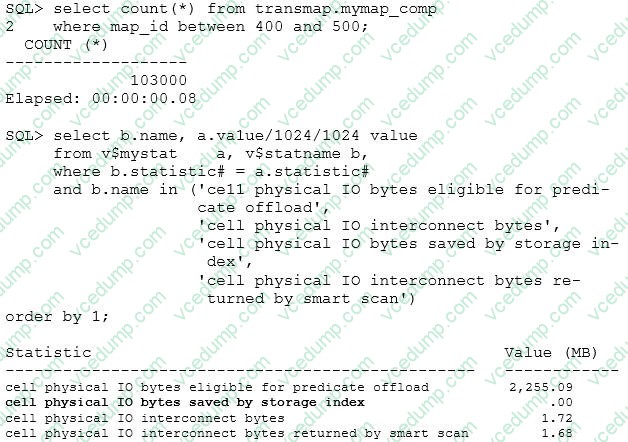
B. The storage indexes reduced the amount of physical I/O bytes significantly for this query.
C. Since the database was started, no queries were run against this table with the same predicate.
D. The storage index data is not on the Cell Server's region index memory structures yet because this predicate has not been used.
E. The storage indexes were disabled by using the DISABLE_STORAGE_INDEX parameter. -
Question 49:
How would you ensure that batch jobs don't impact the performance of online queries that use the same database?
A. Configure resource plans by using the I/O Resource Manager on the storage cells, giving priority to query workloads.
B. Configure and enable Parallel Query.
C. Deploy Instance Caging to control batch jobs.
D. Build a Database Resource Management Plan, giving priority to query workloads.
E. Configure IORM to disable Flash Cache usage for batch workloads. -
Question 50:
What are the three Flash Cache prioritization levels that can be set via the CELL_FLASH_CACHE command? (Choose three.)
A. PINNED
B. LOG
C. NONE
D. KEEP
E. DEFAULT
Related Exams:
-
1Z0-020
Oracle8i: New Features for Administrators -
1Z0-023
Architecture and Administration -
1Z0-024
Performance Tuning -
1Z0-025
Backup and Recovery -
1Z0-026
Network Administration -
1Z0-034
Upgrade Oracle9i/10g OCA to Oracle Database OCP -
1Z0-036
Managing Oracle9i on Linux -
1Z0-041
Oracle Database 10g: DBA Assessment -
1Z0-052
Oracle Database 11g: Administration Workshop I -
1Z0-053
Oracle Database 11g: Administration II
Tips on How to Prepare for the Exams
Nowadays, the certification exams become more and more important and required by more and more enterprises when applying for a job. But how to prepare for the exam effectively? How to prepare for the exam in a short time with less efforts? How to get a ideal result and how to find the most reliable resources? Here on Vcedump.com, you will find all the answers. Vcedump.com provide not only Oracle exam questions, answers and explanations but also complete assistance on your exam preparation and certification application. If you are confused on your 1z0-338 exam preparations and Oracle certification application, do not hesitate to visit our Vcedump.com to find your solutions here.