1Z0-221 Exam Details
-
Exam Code
:1Z0-221 -
Exam Name
:Oracle 11i inventory management fundamentals -
Certification
:Oracle Certifications -
Vendor
:Oracle -
Total Questions
:165 Q&As -
Last Updated
:Oct 18, 2021
Oracle 1Z0-221 Online Questions & Answers
-
Question 91:
What is true about reorder-point planning?
A. is used for sub-inventory items
B. is an optional field for all items
C. is a required field for all items
D. is required for all non-forecasted items
E. is required for all forecasted items -
Question 92:
Which three statements are true regarding inventory transactions? (Choose three.)
A. Transaction types identify certain transactions to be included in historical usage calculations for ABC analysis or forecasting.
B. The user can define new transaction actions.
C. A transaction source type is the combination of a transaction type and a transaction action.
D. Transaction types are used to classify a transaction for reporting and querying purposes.
E. The user can define new source types. -
Question 93:
Which four attributes are item-defining attributes? (Listed first is the functional area, followed by the item defining attribute.) (Choose four.)
A. Advanced Pricing / Invoice Enabled
B. Costing/ Costing Enabled
C. Order Management / Customer Orderable
D. MPS/MRP Planning/ Planning Method
E. Purchasing / Purchased
F. Inventory / Inventory Item -
Question 94:
Which is a typical hierarchy in a multiorganization model (top down)?
A. business group, legal entity, operating unit, set of books, inventory organization
B. business group, legal entity, set of books, operating unit, inventory organization
C. business group, set of books, legal entity, operating unit, inventory organization
D. business group, operating unit, legal entity, set of books, inventory organization
E. business group, operating unit, set of books, legal entity, inventory organization
F. business group, set of books, operating unit, legal entity, inventory organization -
Question 95:
At what level can you generate cycle count requests and perform cycle counting under a single cycle count name?
A. 3 only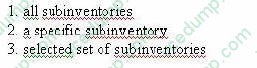
B. 1 or 2 or 3
C. 1 only
D. 2 only -
Question 96:
When you set up a subinventory, you have to set up accounts for the subinventory. From which account does the Expense Account default?
A. Expense Accrual Account from the Intercompany Relations setup form
B. Expense Account from the Valuation Accounts region of the Organization parameters form
C. The Expense Account setup on the Purchasing page of the Item Master Record
D. Default Cost Group that the system assigns when setting up the organization
E. Expense Accounts Payable Accrual account on the Receipt Accounting page of the Purchasing Options form -
Question 97:
Identify four steps or best practices that take place related to a physical inventory. (Choose four.)
A. If you enable dynamic tag entry for your physical inventory, enter counts for any item and stock-keeping unit combination without a pre-generated tag number.
B. Discard unused or blank tags at the end of your inventory.
C. Ensure that no transaction activity occurs in a particular location until after you have taken your snapshot.
D. Clear the Pending Transactions and the transactions in the Transactions Open Interface, before taking a snapshot of inventory quantity.
E. Do not ship or receive items during the physical inventory.
F. Ensure that no transaction activity occurs in a particular location until after you have entered your accounts, or better still, until after you have performed your adjustments.
G. Ensure that normal transaction activity can occur in each location during the physical inventory. -
Question 98:
Items in the Length category are defined with the primary Unit of Measure (UOM) as "Each". These items are purchased in UOM as Roll, and sold in UOM as Box. Quantity is the UOM class for Each, Roll and Box units of measure. Each is the base unit for the Quantity UOM class. Every item in the Length category has its own conversion factor when it is converted from Roll to Box. What setup is needed to transact these items for generating purchase orders, and the issue and receipt of material?
A. standard conversion between Box to Each and Roll to Each and interclass conversion between Box to Each and Roll to Each for the items in Length category
B. interclass conversion between Box to Each and Roll to Each for every item in Length category
C. intraclass conversion between Box to Each and Roll to Each for every item in Length category
D. intraclass conversion between Box to Roll for the items in Length category
E. standard conversion between Box to Each and Roll to Each
F. standard conversion between Box to Roll
G. standard conversion between Box to Each and Roll to Each and intraclass conversion between Box to Each and Roll to Each for the items in Length category -
Question 99:
View the Exhibit.
You are setting up Oracle Inventory for a new client. The organizational structure consists of one set of books, two legal entities, and three operating units.
The three operating units have three, one and two inventory organizations respectively. What is the total number of Oracle Inventory instances required to model this structure? Exhibit:
A. 2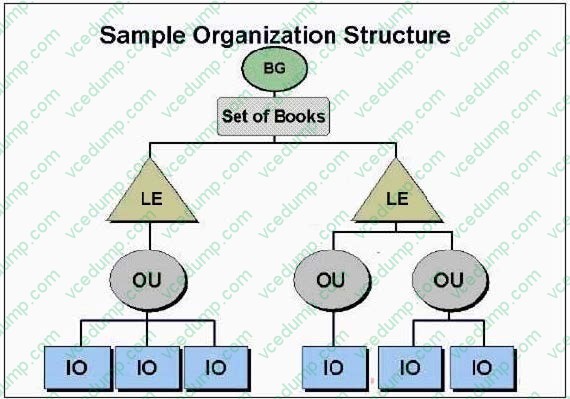
B. 3
C. 1
D. 6 -
Question 100:
Which two statements are true regarding Oracle Inventory replenishment methods? (Choose two.)
A. Reorder point planning can be performed at the subinventory level.
B. Min-Max planning considers lead time and is not based on demand projections.
C. Kanban represent replenishment signals that are manual.
D. Replenishment counting enables you to perform counts for non-tracked subinventories, and then direct Inventory to check these counts against the minimum quantities that you have specified.
Related Exams:
-
1Z0-020
Oracle8i: New Features for Administrators -
1Z0-023
Architecture and Administration -
1Z0-024
Performance Tuning -
1Z0-025
Backup and Recovery -
1Z0-026
Network Administration -
1Z0-034
Upgrade Oracle9i/10g OCA to Oracle Database OCP -
1Z0-036
Managing Oracle9i on Linux -
1Z0-041
Oracle Database 10g: DBA Assessment -
1Z0-052
Oracle Database 11g: Administration Workshop I -
1Z0-053
Oracle Database 11g: Administration II
Tips on How to Prepare for the Exams
Nowadays, the certification exams become more and more important and required by more and more enterprises when applying for a job. But how to prepare for the exam effectively? How to prepare for the exam in a short time with less efforts? How to get a ideal result and how to find the most reliable resources? Here on Vcedump.com, you will find all the answers. Vcedump.com provide not only Oracle exam questions, answers and explanations but also complete assistance on your exam preparation and certification application. If you are confused on your 1Z0-221 exam preparations and Oracle certification application, do not hesitate to visit our Vcedump.com to find your solutions here.