1Z0-149 Real Exam Questions

Oracle Database Program with PL/SQL

65 questions available · Page 1 of 7

Updated Exam DumpsVerified AnswersPass Guarantee

Get Complete Exam Dumps
Question 1 Multiple choice

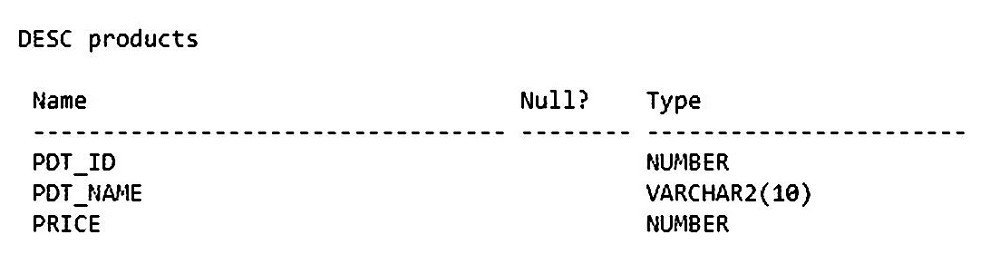
Sequence S and table PRODUCTS exist in your schema.

Examine the table description:

Now, examine this block of code:
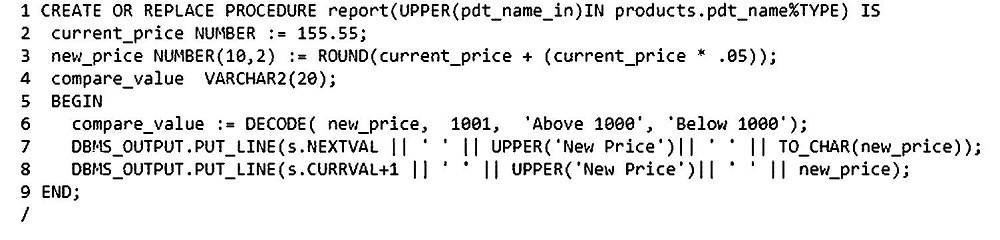
Which two lines each result in a compilation error? (Choose two.)

  1. A

    line 1

  2. B

    line 6

  3. C

    line 8

  4. D

    line 2

  5. E

    line 3

  6. F

    line 7

Show answer and explanation

Correct answers: A, B

Question 2 Multiple choice

Which three statements can process a dynamic multi-row query? (Choose three.)

  1. A

    DECLARE

  2. B

    OPEN

  3. C

    INTO

  4. D

    OPEN-FOR

  5. E

    FETCH

  6. F

    WHEN

  7. G

    CLOSE

Show answer and explanation

Correct answers: D, E, G

Question 3 Multiple choice

Which two are true about the PLSQL_CODE_TYPE parameter? (Choose two.)

  1. A

    Changing the parameter setting automatically changes the setting for existing PL/SQL library units.

  2. B

    The default value is NATIVE.

  3. C

    If set to NATIVE, programs are stored in platform dependent machine code.

  4. D

    It can use the REUSE SETTINGS clause to recompile a program unit without changing to the current session settings.

  5. E

    If set to NATIVE, programs are stored in a PL/SQL bytecode format.

Show answer and explanation

Correct answers: C, D

Question 4 Multiple choice

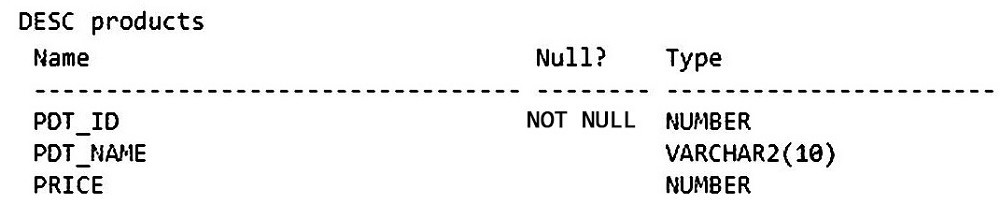
Examine this table in the SH schema:

Now, examine this code:
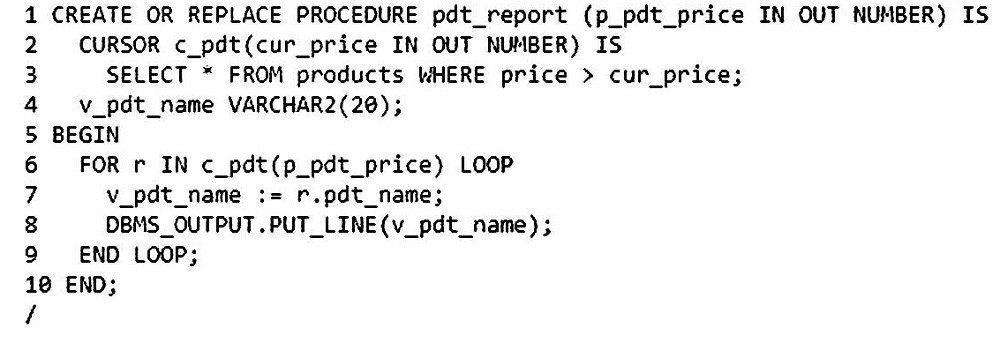
Which two changes are required to ensure that PDT_REPORT executes successfully? (Choose two.)

  1. A

    In line 1, change IN OUT mode to IN mode.

  2. B

    In line 2, change IN OUT mode to IN mode.

  3. C

    In line 3, replace CUR_PRICE with P_PDT_PRICE in the query condition.

  4. D

    In line 1, add the default parameter DEFAULT 2000.

  5. E

    In line 6, replace P_PDT_PRICE parameter name with CUR_PRICE.

  6. F

    In line 2, add the default parameter DEFAULT 2000.

Show answer and explanation

Correct answers: B, D

Question 5 Single choice

Examine the SH.PRODUCTS table:

A row exists in SH.PRODUCTS with PDT_ID = 1.

Now, examine this code and output executed by SH:
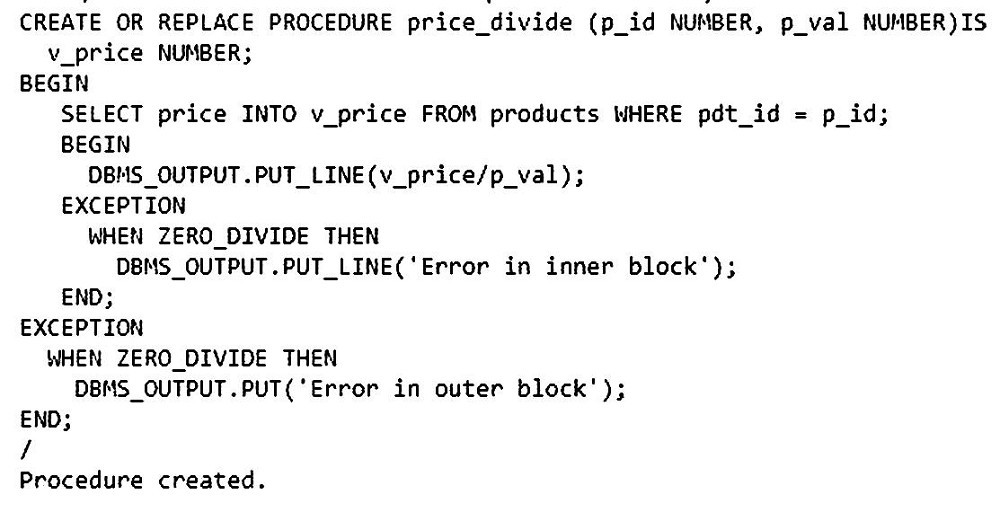
Now, examine this block of code:
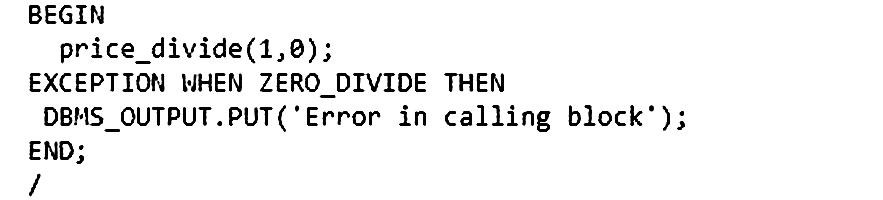
Which error message(s) does it display on execution by user SH?

  1. A

    Error in inner block

  2. B

    Error in inner block Error in outer block

  3. C

    Error in inner block Error in calling block

  4. D

    Error in inner block Error in outer block Error in calling block

Show answer and explanation

Correct answer: A

Question 6 Single choice

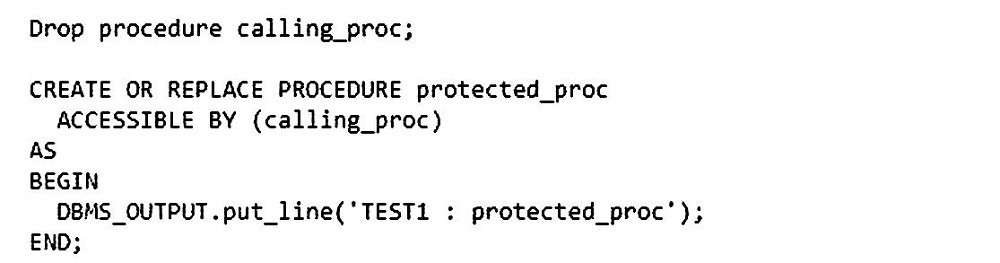
Examine these statements:

Which is true?

  1. A

    It will result in a compilation error for protected_proc because calling_proc does not exist.

  2. B

    It will result in a compilation error for protected_proc because calling_proc must be prefixed with the schema name.

  3. C

    It will result in a successful compilation because objects referenced in an ACCESSIBLE BY clause are not checked at compile time.

  4. D

    With adequate privileges, PROTECTED_PROC procedure can be called by other programs apart from CALLING_PROC.

Show answer and explanation

Correct answer: A

Question 7 Single choice

In which type of trigger can :OLD and :NEW identifiers be used?

  1. A

    ROW

  2. B

    AFTER SUSPEND

  3. C

    AFTER STATEMENT

  4. D

    BEFORE STATEMENT

Show answer and explanation

Correct answer: A

Question 8 Multiple choice

Which three statements are true about passing parameters to subprograms? (Choose three.)

  1. A

    PL/SQL assigns values to actual parameters in subprograms with unhandled exceptions.

  2. B

    IN parameters passed to subprograms act like constants, to which values cannot be assigned by the subprogram.

  3. C

    IN OUT parameters pass initial values to subprograms and return values updated by subprograms to the caller.

  4. D

    The actual parameter must be a variable when calling a subprogram with an OUT parameter.

  5. E

    IN parameters passed to subprograms act like variables, to which values can be assigned by the subprogram.

  6. F

    OUT parameters returning values to calling subprograms act like constants in the called subprogram.

  7. G

    Actual parameters corresponding to IN OUT formal parameters can be constants or expressions.

Show answer and explanation

Correct answers: B, C, D

Question 9 Multiple choice

Which two are valid MODIFIER values for the PLSQL_WARNINGS parameter? (Choose two.)

  1. A

    DISABLE

  2. B

    ENABLE

  3. C

    ERROR

  4. D

    ALL

  5. E

    SEVERE

Show answer and explanation

Correct answers: D, E

Question 10 Multiple choice

Which two are true about collections and RECORD types? (Choose two.)

  1. A

    A variable of RECORD type can contain fields of another RECORD type or any collection type.

  2. B

    Only associative arrays and nested tables can have elements of RECORD type.

  3. C

    All collections and RECORD types can be defined in PL/SQL blocks, packages, or at the schema level.

  4. D

    Collections and RECORD types are always dense.

  5. E

    All collections and RECORD types can be stored in table columns.

  6. F

    VARRAYS, nested tables and each field in %ROWTYPE type variables have a default value of null.

Show answer and explanation

Correct answers: B, F