1Z0-148 Exam Details
-
Exam Code
:1Z0-148 -
Exam Name
:Oracle Database: Advanced PL/SQL -
Certification
:Oracle Certifications -
Vendor
:Oracle -
Total Questions
:243 Q&As -
Last Updated
:May 28, 2026
Oracle 1Z0-148 Online Questions & Answers
-
Question 121:
Examine the EMP table:
CREATE TABLE EMP (EMPNO NUMBER(4) NOT NULL, ENAME VARCHAR2(10));
Examine this PL/SQL procedure:
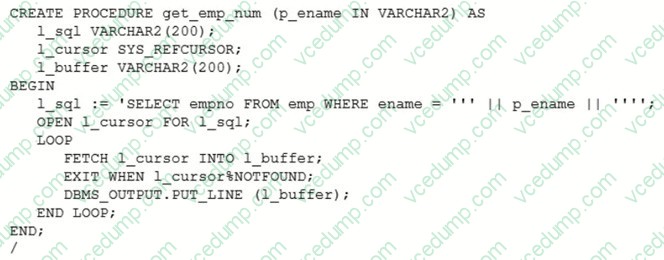
Which is the correct replacement for the assignment to variable l_sql to avoid SQL injection?
A. l_sql := 'SELECT empno FROM emp WHERE ename = ''' || SYS.DBMS_ASSERT.NOOP (p_ename) || '''';
B. l_sql := 'SELECT empno FROM emp WHERE ename = ' || SYS.DBMS_ASSERT.QUALIFIED_SQL_NAME (p_ename);
C. l_sql := 'SELECT empno FROM emp WHERE ename = ' || SYS.DBMS_ASSERT.SIMPLE_SQL_NAME (p_ename);
D. l_sql := 'SELECT empno FROM emp WHERE ename = ' || SYS.DBMS_ASSERT.ENQUOTE_LITERAL (p_ename);
E. l_sql := 'SELECT empno FROM emp WHERE ename = ''' || SYS.DBMS_ASSERT.QUALIFIED_SQL_NAME (p_ename) || ''''; -
Question 122:
The EMPLOYEES table exists in your schema and has columns LAST_NAME of data type VARCHAR2 and DEPARTMENT_ID of data type NUMBER.
There are six employees in DEPARTMENT_ID, 20.
Examine this code:
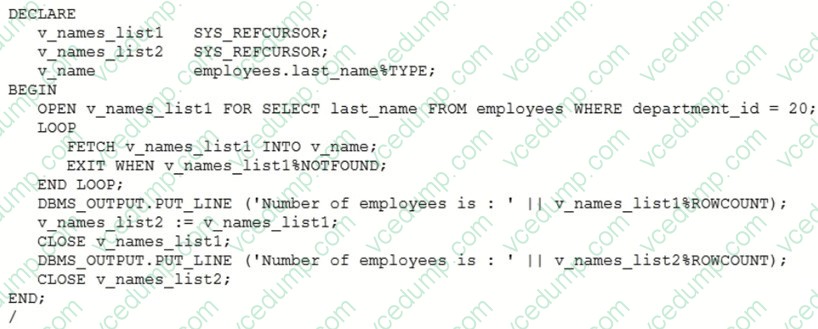
What will be the outcome on execution?
A. The execution of this code will fail with an invalid cursor error and not display either output message.
B. The number of employees will be displayed as six for both output messages.
C. The number of employees will be displayed as six for the first output message and zero for the second output message.
D. The number of employees will be displayed as six for the first output message and an invalid cursor error will be thrown instead of displaying the second output message. -
Question 123:
Examine these statements:
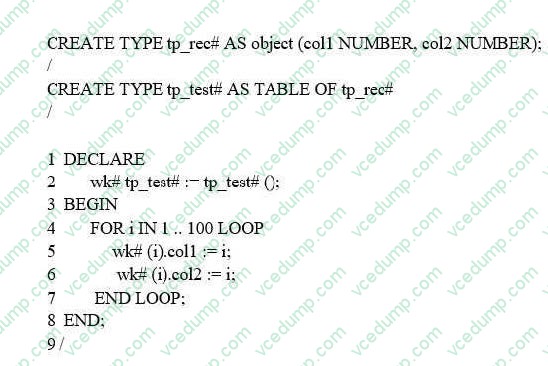
Which two corrections will allow this anonymous block to execute successfully?
A. Add wk# .NEXT; before the 7thline.
B. Add i PLS_INTEGER; before the 3rdline.
C. Add wk#. EXTEND (1); before the 5thline.
D. Change line #2 to wk# tp_test# := tp_test# (tp_rec# ());
E. Replace lines 5 and 6 with wk# (i) := tp_rec# (i, i); -
Question 124:
Which two statements are correct in Oracle Database 12c?
A. For native compilation, PLSQL_OPTIMIZE_LEWVEL should be set to 2.
B. Native compilation is the default compilation method
C. Native compilation should be used during development.
D. Natively compiles code is stored in the SYSTEM tablespace.
E. To change a PL/SQL object from interpreted to native code, set the PLSQL_CODE_TYPE to NATIVE and recompile it. -
Question 125:
Which two statements will raise an exception? (Choose two.)
A. SELECT DBMS_ASSERT.SIMPLE_SQL_NAME ('"10_Employees"') FROM dual;
B. SELECT DBMS_ASSERT.SIMPLE_SQL_NAME ('Employees@my_dblink') FROM dual;
C. SELECT DBMS_ASSERT.SIMPLE_SQL_NAME (' Emp_Dept_information_table ') FROM dual;
D. SELECT DBMS_ASSERT.SIMPLE_SQL_NAME ('Employee_Department_information_table') FROM dual;
E. SELECT DBMS_ASSERT.SIMPLE_SQL_NAME ('Employees@') FROM dual; -
Question 126:
Which two statements are true about associative arrays and nested tables? (Choose two.)
A. Only associative arrays can hold an arbitrary number of elements.
B. Only associative arrays can use numbers and strings for subscripts.
C. Both associative arrays and nested tables can hold an arbitrary number of elements.
D. Both associative arrays and nested tables can use numbers and strings for subscripts. -
Question 127:
Which three statements are correct when using collections? (Choose three.)
A. Associative arrays may be used when you need to process information of unknown volume.
B. Nested tables should be used when the index values are non-sequential.
C. Use associative arrays when you need numeric and string indices.
D. Varrays should be used when you need to pass the collection as a parameter.
E. Do not use nested tables when you need to delete elements.
F. Nested tables may be used when there is no predefined upper bound for index values. -
Question 128:
You execute the following command in the user session: SQL> ALTER SESSION SET PLSQL_DEBUG=true; Which statement is true about the effect of the command?
A. All PL/SQL blocks that are executed subsequently in the session are traced.
B. It enables all PL/SQL blocks that are compiled subsequently in the session for tracing.
C. Only anonymous PL/SQL blocks that are executed subsequently in the session are traced.
D. It enables only named PL/SQL blocks that are executed subsequently in the session for tracing. -
Question 129:
Which statements are true about temporary LOBs? (Choose all that apply.)
A. They can be created only for CLOB and NCLOB data.
B. They can be accessed only by the user who creates them.
C. They generate more redo information than persistent LOBs.
D. They exist for the duration of the session in which they are created.
E. They are stored temporarily in the default tablespace of the user who creates them. -
Question 130:
Which two blocks of code execute successfully?
A. DECLARE TYPE tab_type IS TABLE OF NUMBER; my_tab tab_type; BEGIN my_tab (1) :=1; END;
B. DECLARE TYPE tab_type IS TABLE OF NUMBER; my_tab tab_type := tab_type(2); BEGIN my_tab(1) :=55; END;
C. DECLARE TYPE tab_type IS TABLE OF NUMBER; my_tab tab_type; BEGIN my_tab. EXTEND (2); my_tab (1) := 55; END;
D. DECLARE TYPE tab_type IS TABLE OF NUMBER; my_tab tab_type; BEGIN my_tab := tab_type (); my_tab (1) := 55; END;
E. DECLARE TYPE tab_type IS TABLE OF NUMBER my_tab tab_type := tab_type (2, NULL, 50); BEGIN my_tab.EXTEND (3, 2); END;
Related Exams:
-
1Z0-020
Oracle8i: New Features for Administrators -
1Z0-023
Architecture and Administration -
1Z0-024
Performance Tuning -
1Z0-025
Backup and Recovery -
1Z0-026
Network Administration -
1Z0-034
Upgrade Oracle9i/10g OCA to Oracle Database OCP -
1Z0-036
Managing Oracle9i on Linux -
1Z0-041
Oracle Database 10g: DBA Assessment -
1Z0-052
Oracle Database 11g: Administration Workshop I -
1Z0-053
Oracle Database 11g: Administration II
Tips on How to Prepare for the Exams
Nowadays, the certification exams become more and more important and required by more and more enterprises when applying for a job. But how to prepare for the exam effectively? How to prepare for the exam in a short time with less efforts? How to get a ideal result and how to find the most reliable resources? Here on Vcedump.com, you will find all the answers. Vcedump.com provide not only Oracle exam questions, answers and explanations but also complete assistance on your exam preparation and certification application. If you are confused on your 1Z0-148 exam preparations and Oracle certification application, do not hesitate to visit our Vcedump.com to find your solutions here.