Oracle 1Z0-1054-22 Online Practice
Questions and Exam Preparation
1Z0-1054-22 Exam Details
Exam Code
:1Z0-1054-22
Exam Name
:Oracle Financials Cloud: General Ledger 2022 Implementation Professional
Certification
:Oracle Certifications
Vendor
:Oracle
Total Questions
:131 Q&As
Last Updated
:May 25, 2026
Oracle 1Z0-1054-22 Online Questions &
Answers
Question 81:
You want to define an allocation rule where segment values are constants for rules and formulas. What should you do?
A. Never use the Outer Point of View (POV) B. Always use the Outer Point of View (POV) C. Specify Run Time Prompts (RTP) D. Only specify segment values in formulas
A. Never use the Outer Point of View (POV)
Explanation/Reference:
"The outer point of view is used to specify segment values that are constant for rules and formulas. If you use a parent value in the outer point of view, it must have a Constant segment type." Therefore, if you want to define an allocation rule where segment values are constants for rules and formulas, you should never use the outer POV.
Question 82:
The Cloud Client wants to add a global branding logo and more predefined transactional attributes to the journal approval email notification.
Which two Business Intelligence catalog objects should you copy (or customize) and edit? (Choose two.)
A. Output type B. The layout-Template C. The Data Model D. The Data Source E. The Sub_Template
B. The layout-Template C. The Data Model
Explanation/Reference:
To add a global branding logo and more predefined transactional attributes to the journal approval email notification, you should copy (or customize) and edit the layout template and the data model. The layout template is a file that defines the appearance and content of the notification, such as text, images, tables, or charts. The data model is a file that defines the data sources and queries that provide data for the notification, such as predefined transactional attributes. You can copy (or customize) and edit the layout template and the data model using Oracle Analytics Publisher reports. You do not need to copy (or customize) and edit the output type, as this is a setting that determines the format of the notification output, such as HTML or PDF. You do not need to copy (or customize) and edit the data source, as this is a component of the data model that specifies where data for the notification comes from, such as an SQL query or an XML file. You do not need to copy (or customize) and edit the sub template, as this is a file that contains reusable content or logic that can be referenced by multiple layout templates.
Reference: Oracle Financials Cloud: General Ledger 2022 Implementation Professional Objectives-Configure Workflow Approvals and Notifications 12
Question 83:
You want to monitor the close process of all your financial subledgers and ledgers. How can you quickly obtain this information?
A. Use the Manage Accounting Periods page to view the status of all subledgers and ledgers B. Access each subledgers' calendar and General Ledger's Manage Accounting Periods page to view the status of each period C. Run Closing Status reports D. Use Close Monitor in General Accounting Dashboard
D. Use Close Monitor in General Accounting Dashboard
Explanation/Reference:
"Close Monitor provides a centralized place to monitor and manage your close process across subledgers and ledgers. You can view the status of each subledger and ledger period, drill down to subledger details, and take action on open periods." Therefore, this is the best way to quickly obtain information about the close process of all your financial subledgers and ledgers.
Question 84:
You just submitted the Accounting Configuration. What two things must happen before you can enter journals? (Choose two.)
A. You must re-deploy the chart of accounts B. A Data Access Set with full read/write access to the ledger is automatically created C. You must define a Data Access Set to obtain full read/write access to ledgers in the Accounting Configuration D. You must assign the job role and data security context to each user
B. A Data Access Set with full read/write access to the ledger is automatically created D. You must assign the job role and data security context to each user
Explanation/Reference:
you must assign the job role and data security context to each user after you submit the Accounting Configuration. This enables users to access the ledger and perform tasks based on their roles. Therefore, option D is correct. A Data Access Set with full read/write access to the ledger is automatically created after you submit the Accounting Configuration. This allows users to enter and post journals to the ledger. Therefore, option B is correct. Option A is incorrect because you don't need to re-deploy the chart of accounts after you submit the Accounting Configuration. Option C is incorrect because you don't need to define a Data Access Set to obtain full read/write access to ledgers in the Accounting Configuration. A Data Access Set is automatically created for you.
Question 85:
Users with the General Accountant job role have reported that they are unable to access the UK Ledger.
They require read/write access to the full ledger. The Accounting configuration completed successfully.
What should you do to allow access to the ledger?
A. Assign the security context value of UK Ledger to the user/role combination. B. Create a Data Access Set that allows access to the UK Ledger. C. Assign the General Accounting Manager role to those users. D. Assign the UK reference set to the user/role combination.
B. Create a Data Access Set that allows access to the UK Ledger.
Explanation/Reference:
According to Oracle documentation2, you should create a Data Access Set that allows access to the UK Ledger to allow users with the General Accountant job role to access the UK Ledger. A Data Access Set is a security feature that defines the ledgers and balancing segment values that a user can access. You can assign Data Access Sets to users or roles using the Manage Data Access for Users page. Therefore, option B is correct. Option A is incorrect because assigning the security context value of UK Ledger to the user/role combination does not enable access to the ledger. Option C is incorrect because assigning the General Accounting Manager role to those users does not enable access to the ledger. Option D is incorrect because assigning the UK reference set to the user/role combination does not enable access to the ledger.
Question 86:
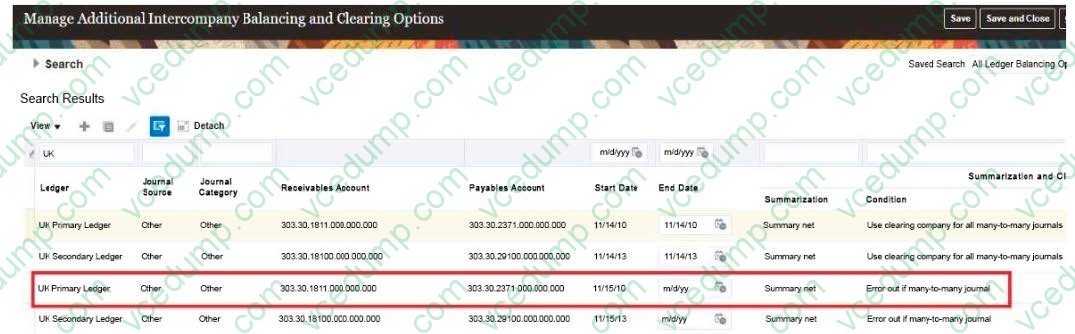
When will Intercompany processing balance a journal using the accounts identified here for the UK Ledger?
A. when there is a many-to-many journal and you want to use a clearing company B. when the journal is not balanced by the primary balancing segment value (BSV) C. when the journal is balanced by the primary BSV but not by second or third BSV D. when the journal is balanced by second balancing segment value
C. when the journal is balanced by the primary BSV but not by second or third BSV
Explanation/Reference:
Intercompany processing will balance a journal using the accounts identified here for the UK Ledger when the journal is balanced by the primary balancing segment value (BSV) but not by second or third BSV. A BSV is a segment in the chart of accounts that identifies a legal entity or business unit for which financial statements are prepared and balanced. A primary BSV is required for every ledger and is used to balance journal entries within a ledger. A secondary or tertiary BSV is optional and is used to balance journal entries across different dimensions other than the primary BSV, such as fund or region. Intercompany processing is a feature that enables intercompany transactions between different legal entities or business units within the same enterprise. Intercompany processing uses intercompany balancing rules to generate intercompany receivables and payables accounts for cross-ledger or cross-BSV journals. Intercompany processing will balance a journal using the accounts identified here for the UK Ledger when the journal is balanced by the primary BSV but not by second or third BSV, as this indicates that there is an intercompany transaction between different legal entities or business units within the UK Ledger that requires intercompany balancing. Intercompany processing will not balance a journal using the accounts identified here for the UK Ledger when there is a many-to-many journal and you want to use a clearing company, as this is a scenario that involves multiple legal entities or business units across different ledgers that requires a separate clearing company ledger to perform intercompany balancing. Intercompany processing will not balance a journal using the accounts identified here for the UK Ledger when the journal is not balanced by the primary BSV, as this is an invalid scenario that violates the accounting rules and prevents posting of the journal. Intercompany processing will not balance a journal using the accounts identified here for the UK Ledger when the journal is balanced by second balancing segment value, as this is an incomplete scenario that does not specify whether the journal is also balanced by primary and third BSV.
Reference: Oracle Financials Cloud: General Ledger 2022 Implementation Professional Objectives-Configure and Process Intercompany 12
Question 87:
You want to process multiple allocations at the same time. What feature do you use?
A. RuleSets B. Formulas C. General Ledger journal entries D. Point of View (POV)
A. RuleSets
Explanation/Reference:
you can use RuleSets to process multiple allocations at the same time. A RuleSet is a group of allocation rules that you can run together. Therefore, option A is correct. Option B is incorrect because formulas are used to define the basis of allocation, not to process multiple allocations. Option C is incorrect because General Ledger journal entries are used to record transactions, not to process multiple allocations. Option D is incorrect because Point of View (POV) is used to specify the source and target of allocation, not to process multiple allocations.
Question 88:
You need to create a boardroom ready month-end reporting package for an upcoming Audit Committee meeting. You have 10 Financial Reports that you want to share with executives and auditors that are nicely formatted.
What are the two Oracle recommended ways to accomplish this? (Choose two.)
A. Use BI Publisher to configure the reports and then use bursting to email the reports to the executives and Audit Committee B. Using Workspace, assemble multiple reports into a book that can be printed and viewed individually as an entire book C. Create a Smartview report, where the various sheets represent the different Financial Statements and send them the spreadsheet D. Use a report batch to run reports at a specific time to create a set of snapshot reports E. Use OTBI to create multiple reports that you save to a folder that only the users can access
B. Using Workspace, assemble multiple reports into a book that can be printed and viewed individually as an entire book D. Use a report batch to run reports at a specific time to create a set of snapshot reports
Explanation/Reference:
According to Oracle documentation1, the two Oracle recommended ways to create a boardroom ready month-end reporting package for an upcoming Audit Committee meeting are using Workspace and using a report batch. Workspace enables you to assemble multiple reports into a book that can be printed and viewed individually or as an entire book. A report batch enables you to run reports at a specific time to create a set of snapshot reports. Therefore, options B and D are correct. Option A is incorrect because BI Publisher is not a tool to create financial reports. Option C is incorrect because Smartview is not a tool to create financial reports. Option E is incorrect because OTBI is not a tool to create financial reports.
Question 89:
During implementation, a consultant accidentally designated the cost center segment as the natural account. Values have already been assigned and journals have been posted.
Select the process that allows you to change the qualifier back to cost center qualifier.
A. Create a new chart of accounts. B. Delete the segment and create a new segment with the correct qualifier. C. Change and save the segment qualifier. D. Delete the chart of accounts and create a new one.
C. Change and save the segment qualifier.
Explanation/Reference:
The process that allows you to change the qualifier back to cost center qualifier after a consultant accidentally designated the cost center segment as the natural account is to change and save the segment qualifier. You can change the segment qualifier using the Manage Chart of Accounts Structures task in Setup and Maintenance. You can only change segment qualifiers before deploying flexfield metadata changes for validation and activation. You do not need to create a new chart of accounts, as this is not necessary and will increase complexity and maintenance. You do not need to delete the segment and create a new segment with the correct qualifier, as this will affect existing values and journals. You do not need to delete the chart of accounts and create a new one, as this will affect existing structures and instances. Reference: Oracle Financials Cloud: General Ledger 2022 Implementation Professional Objectives-Define Chart of Accounts 12
Question 90:
You have three ledgers that use the same chart of accounts with one intercompany payable and one intercompany receivable account.
The chart of accounts also has an intercompany segment.
Each ledger has one legal entity assigned to it and each legal entity is associated with one balancing segment value.
At what level should you define the default intercompany balancing rule?
A. Primary balancing segment rule B. Chart of Accounts rule C. Legal entity level rule D. Ledger level rule
B. Chart of Accounts rule
Explanation/Reference:
According to Oracle documentation2, you should define the default intercompany balancing rule at the chart of accounts level when you have three ledgers that use the same chart of accounts with one intercompany payable and one intercompany receivable account. The chart of accounts level rule applies to all ledgers that share the same chart of accounts. Intercompany balancing rules are used to generate the accounts required to balance journals that are out of balance by legal entity or primary balancing segment values. Therefore, option B is correct. Option A is incorrect because the primary balancing segment level rule applies only to journals that are out of balance by primary balancing segment values within a ledger. Option C is incorrect because the legal entity level rule applies only to journals that are out of balance by legal entity within a ledger. Option D is incorrect because the ledger level rule applies only to journals that are out of balance by ledger.
Nowadays, the certification exams become more and more important and required by more and more
enterprises when applying for a job. But how to prepare for the exam effectively? How to prepare
for the exam in a short time with less efforts? How to get a ideal result and how to find the
most reliable resources? Here on Vcedump.com, you will find all the answers.
Vcedump.com provide not only Oracle exam questions,
answers and explanations but also complete assistance on your exam preparation and certification
application. If you are confused on your 1Z0-1054-22 exam preparations
and Oracle certification application, do not hesitate to visit our
Vcedump.com to find your solutions here.