1Z0-1054-20 Exam Details
-
Exam Code
:1Z0-1054-20 -
Exam Name
:Oracle Financials Cloud: General Ledger 2020 Implementation Essentials -
Certification
:Oracle Certifications -
Vendor
:Oracle -
Total Questions
:55 Q&As -
Last Updated
:Jul 15, 2026
Oracle 1Z0-1054-20 Online Questions & Answers
-
Question 1:
Which two statements are true regarding the Intercompany Reconciliation Report? (Choose two.)
A. You can only drill down to the general ledger journal and then from there to the subledger journal entry.
B. This report can be run using an additional currency and conversion rate that converts all amounts into a common currency for comparison.
C. This report displays only the reconciled transactions. You need to further process automatic reconciliation to reconcile the unreconciled transactions.
D. This report includes Ledger balancing lines generated when the primary balancing segment value (BSV) is in balance, but either the second or third BSVs are not.
E. This report displays the intercompany receivables and intercompany payables balances in summary for a period. -
Question 2:
You create an invoice for USD 100 that is matched to a purchase order of USD 100. You validate the invoice to consume the budget and reduce funds available. And then later, you cancel the invoice. What happens to funds available when you cancel an invoice that requires budgetary control?
A. The budget and funds available will increase by USD 100
B. Funds available will change when the invoice is approved
C. The funds reserved for the purchase order is reinstated while the invoice expenditure is reversed by USD 100
D. The budget will increase by USD 100 and the funds available will decrease by USD 100 -
Question 3:
Your client has been using Budgetary Control for six months. Now, they want to use the Spend Authorization.
After opting in the new feature Spend Authorization with Budgetary Control, what additional three actions need to be accomplished to activate this feature? (Choose three.)
A. Enable Payment Request Subtypes
B. Rebuild the GL Balances Cube
C. Create a Payment Process Profile
D. Rebuild the Budgetary Control Cube
E. Enable spend authorization -
Question 4:
Which two statements are true regarding how Intercompany Balancing Rules are defined? (Choose two.)
A. All ledgers engaged in an intercompany transaction must share the same chart of accounts to define balancing rules
B. You can only define balancing rules for different journal's sources. You cannot define balancing rules for different journal categories
C. You can define different rules for different charts of accounts, ledgers, legal entities, and primary balancing segment values
D. You can define different balancing rules for different combinations of journal sources, journal categories, and transaction types -
Question 5:
You want to achieve multi-step cascading allocations, which feature do you use?
A. RuleSets
B. Formulas
C. Point of View (POV)
D. General Ledger journal entries -
Question 6:
Your company has complex consolidation requirements with multiple general ledger instances. You are using Oracle Hyperion Financial Management to consolidate the disparate General Ledgers. You can typically map segments between your general ledger segment to a Hyperion Financial Management segment, such as Company to Entity, Department to Department, and Account to Account.
What happens to segments in your source general ledger, such as Program, that cannot be mapped to Hyperion Financial Management?
A. Data is summarized across segments that are not mapped to Hyperion Financial Management
B. Errors occur for unmapped segments. You must map multiple segments from source general ledgers to the target segment in Hyperion Financial Management
C. No data is transferred
D. The unmapped segments default to future use segments in Hyperion Financial Management -
Question 7:
Which AMX builder method is most effective in routing the journals to the Accounting Manager when his subordinate, The General Accountant, enters a journal?
A. Approval Groups
B. Dynamic Approval Groups
C. Supervisory level approval
D. Management Chain approval -
Question 8:
Your enterprise structure has one ledger and two business units. Business unit one wants to enable budgetary control for Requisitioning only in Procure-to-Pay Business Functions and business unit two wants to enable budgetary control for Payable Invoicing only in Procure-to-Pay Business Functions.
Which two statements are correct? (Choose two.)
A. Define budgetary control at ledger level and only encumbrance controls at the business units.
B. While defining control for business unit two, enable control at Requisitioning and define the exceptions to only include invoicing.
C. Define budgetary control at ledger level with Budgetary Control Exceptions for each business unit.
D. While defining control for business unit one, disable control for Procurement, Expense Management, Payable Invoicing, and Receiving.
E. While defining control for business unit one, enable control at purchasing and define the exceptions to only include requisitioning.
F. Define control for business unit two to disable control for Requisitioning, Procurement, Expense Management, and Receiving. -
Question 9:
You entered the following information in the Companies and Legal Entities tab of the Rapid Implementation Spreadsheet:
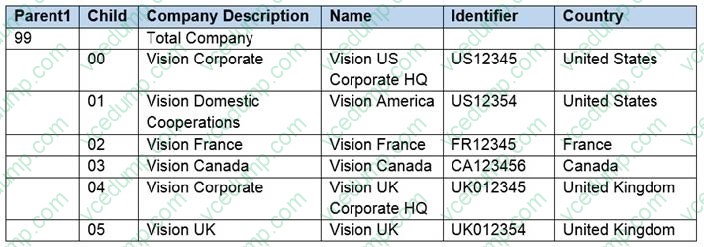
Assuming currency is left blank in the Ledger worksheet, how many Ledgers will the process create?
A. 6
B. 3
C. 4
D. 5 -
Question 10:
You want to be notified of anomalies in certain account balances in real time. What is the most efficient way to do this?
A. Create an Account Group using Account Monitor
B. Use Account Inspector
C. Open a Smart View file saved on your desktop
D. Perform an account analysis online
Related Exams:
-
1Z0-020
Oracle8i: New Features for Administrators -
1Z0-023
Architecture and Administration -
1Z0-024
Performance Tuning -
1Z0-025
Backup and Recovery -
1Z0-026
Network Administration -
1Z0-034
Upgrade Oracle9i/10g OCA to Oracle Database OCP -
1Z0-036
Managing Oracle9i on Linux -
1Z0-041
Oracle Database 10g: DBA Assessment -
1Z0-052
Oracle Database 11g: Administration Workshop I -
1Z0-053
Oracle Database 11g: Administration II
Tips on How to Prepare for the Exams
Nowadays, the certification exams become more and more important and required by more and more enterprises when applying for a job. But how to prepare for the exam effectively? How to prepare for the exam in a short time with less efforts? How to get a ideal result and how to find the most reliable resources? Here on Vcedump.com, you will find all the answers. Vcedump.com provide not only Oracle exam questions, answers and explanations but also complete assistance on your exam preparation and certification application. If you are confused on your 1Z0-1054-20 exam preparations and Oracle certification application, do not hesitate to visit our Vcedump.com to find your solutions here.