1Z0-067 Exam Details
-
Exam Code
:1Z0-067 -
Exam Name
:Upgrade Oracle9i/10g/11g OCA to Oracle Database 12c OCP -
Certification
:Oracle Certifications -
Vendor
:Oracle -
Total Questions
:264 Q&As -
Last Updated
:Jul 12, 2026
Oracle 1Z0-067 Online Questions & Answers
-
Question 71:
Examine the resources consumed by a database instance whose current Resource Manager plan is displayed.
SQL> SELECT name, active_sessions, queue_length, consumed_cpu_time, cpu_waits, cpu_wait_time FROM v$rsrc_consumer_group; Which two statements are true?
A. An attempt to start a new session by a user belonging to DSS_QUERIES fails with an error.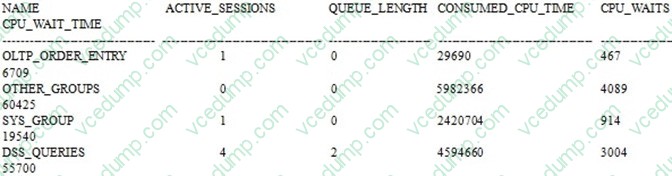
B. An attempt to start a new session by a user belonging to OTHE_GROUPS fails with an error.
C. The CPU_WAIT_TIME column indicates the total time that sessions in the consumer group waited for the CPU due to resource management.
D. The CPU_WAIT_TIME column indicates the total time that sessions in the consumer group waited for the CPU due to I/O waits and latch or enqueue contention.
E. A user belonging to the DSS__QUERIES resource consumer group can create a new session but the session will be queued. -
Question 72:
For which two requirements would you use the Database Resource Manager?
A. limiting the CPU used per database call
B. specifying the maximum number of concurrent sessions allowed for a user
C. specifying the amount of private space a session can allocate in the shared pool of the SGA
D. limiting the degree of parallelism of operations performed by a user or group of users
E. specifying an idle time limit that applies to sessions that are idle and blocking other sessions -
Question 73:
You notice performance degradation in your production Oracle 12c database. You want to know what caused this performance difference.
Which method or feature should you use?
A. Database Replay
B. Automatic Database Diagnostic Monitor (ADDM) Compare Period report
C. Active Session History (ASH) report
D. SQL Performance Analyzer -
Question 74:
In your database, there are tablespaces that were read-only when the last backup was taken. These tablespaces have not been made read/write since then. You want to perform an incomplete recovery on the database by using a backup control file.
What precaution must you take for the read-only tablespaces before performing an incomplete recovery?
A. All the read-only tablespaces should be taken offline.
B. All the read-only tablespaces should be restored separately.
C. All the read-only tablespaces should be renamed to have the MISSINGnnnn format.
D. All the read-only tablespaces should be made online with logging disabled. -
Question 75:
You created a database with DBCA by using one of the Oracle supplied templates.
Which is the default permanent tablespace for all users except DBSNMP and OUTLN?
A. USERS
B. SYSTEM
C. SYSAUX
D. EXAMPLE -
Question 76:
You execute the commands to configure settings in RMAN:
RMAN> CONFIGURE DEVICE TYPE sbt PARALLELISM 1;
RMAN> CONFIGURE DEFAULT DEVICE TYPE TO sbt;
RMAN> CONFIGURE DATAFILE BACKUP COPIES FOR DEVICE TYPE sbt TO 2;
RMAN> CONFIGURE ARCHIVELOG BACKUP COPIES FOR DEVICE TYPE sbt TO 2;
RMAN> CONFIGURE DATAFILE BACKUP COPIES FOR DRVICE TYPE DISK TO 2;
Then you issue the following command to take a backup:
RMAN> BACKUP DATABASE PLUS ARCHIVELOG;
Which statement is true about the execution of these commands? (Choose the best answer.)
A. It backs up the data files and archived logs to media, making two copies of each data file and archived logs.
B. It backs up two copies each of the data files to disk and media, and two copies of archived logs to media.
C. The backup terminates because the backup destination for disk is not specified in the BACKUP command.
D. It backs up the data files and archived logs, making one copy of each data file and archived log on disk and media. -
Question 77:
You specified the warning and critical thresholds for a locally managed tablespace to be 60% and 70%, respectively.
From the tablespace space usage metrics, you find that the space usage has reached the specified warning threshold value, but no alerts have been generated.
What could be the reason for this?
A. The event parameter was not set.
B. The sql_trace parameter is set to false.
C. Enterprise Manager was not used.
D. The statistics_level parameter is set to basic.
E. The t:kid_statistics parameter is set to false. -
Question 78:
Examine the commands executed to monitor database operations:
$> conn sys/oracle@prod as sysdba
SQL> VAR eid NUMBER
SQL>EXEC :eid := DBMS_SQL_MONITOR.BEGlN_OPERATION('batch_job',FORCED_TRACKING=>'Y');
Which two statements are true?
A. Database operations will be monitored only when they consume a significant amount of resource.
B. Database operations for all sessions will be monitored.
C. Database operations will be monitored only if the STATISTICS_LEVEL parameter is set to TYPICAL and CONTROL_MANAGEMENT_PACK_ACCESS is set DIAGNISTIC + TUNING.
D. Only DML and DDL statements will be monitored for the session.
E. All subsequent statements in the session will be treated as one database operation and will be monitored. -
Question 79:
You notice that the performance of your production 24x7 Oracle 12c database has significantly degraded. Sometimes, you are not able to connect to the database instance because it hangs. How can you detect the cause of the degraded performance?
A. by performing emergency monitoring using Real-Time Automatic Database Diagnostic Monitor (ADDM) to fetch data directly from SGA for analysis
B. by running ADDM to fetch information from the latest Automatic Workload Repository (AWR) snapshots
C. by using Active Session History (ASH) data and performing hang analysis
D. by running ADDM in diagnostic mode -
Question 80:
In a database supporting an OLTP workload, tables are frequently updated on both key and non-keycolumns.
Reports are also generated by joining multiple tables.
Which table organization or type would provide the best performance for this hybrid workload?
A. heap table with a primary key index
B. external table
C. hash clustered table
D. global temporary table
E. index clustered table
Related Exams:
-
1Z0-020
Oracle8i: New Features for Administrators -
1Z0-023
Architecture and Administration -
1Z0-024
Performance Tuning -
1Z0-025
Backup and Recovery -
1Z0-026
Network Administration -
1Z0-034
Upgrade Oracle9i/10g OCA to Oracle Database OCP -
1Z0-036
Managing Oracle9i on Linux -
1Z0-041
Oracle Database 10g: DBA Assessment -
1Z0-052
Oracle Database 11g: Administration Workshop I -
1Z0-053
Oracle Database 11g: Administration II
Tips on How to Prepare for the Exams
Nowadays, the certification exams become more and more important and required by more and more enterprises when applying for a job. But how to prepare for the exam effectively? How to prepare for the exam in a short time with less efforts? How to get a ideal result and how to find the most reliable resources? Here on Vcedump.com, you will find all the answers. Vcedump.com provide not only Oracle exam questions, answers and explanations but also complete assistance on your exam preparation and certification application. If you are confused on your 1Z0-067 exam preparations and Oracle certification application, do not hesitate to visit our Vcedump.com to find your solutions here.