1Z0-067 Exam Details
-
Exam Code
:1Z0-067 -
Exam Name
:Upgrade Oracle9i/10g/11g OCA to Oracle Database 12c OCP -
Certification
:Oracle Certifications -
Vendor
:Oracle -
Total Questions
:264 Q&As -
Last Updated
:Jul 12, 2026
Oracle 1Z0-067 Online Questions & Answers
-
Question 111:
Examine the output from v$DIAG_INFO:
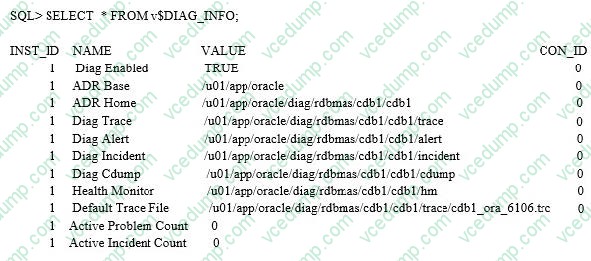
Which statement is true about the Automatic Diagnostic Repository (ADR)?
A. The SQL trace file for a session is stored in Diag Trace
B. The text alert log is available in Diag Trace
C. The XML version of the alert log is available in Diag Trace
D. An Automatic Database Diagnostic Management (ADDM) report is generated and stored in the Health Monitor whenever an incident occurs -
Question 112:
Examine the command to duplicate a database:
RMAN> DUPLICATE TARGET DATABASE TO cdb PLUGGABLE DATABASE pdb1, pdb5;
Which two statements are true about the DUPLICATE command?
A. The SPFILE is copied along with the data files of the pluggable databases (PDBs).
B. The root and the seed database in the container database (CDB) are also duplicated.
C. A backup of pdb1 and pd5 must exist before executing the command.
D. The duplicate command first creates a backup, and then duplicates the PDBs by using the backup.
E. An auxiliary instance must be started with the initialization parameter ENABLE_PLUGGABLE_DATABASE set to TRUE. -
Question 113:
You want to capture column group usage and gather extended statistics for better cardinality estimates for the customers table in the SH schema.
Examine the following steps:
1. Issue the SELECTDBMS_STATS. CREATE_EXTENDED_STATS(`SH', 'CUSTOMERS')from dual statement.
2.Execute the dbms_stats.seed_col_usage (null,`SH',500) procedure.
3.Execute the required queries on the customers table.
4.Issue the select dbms_stats.reportwcol_usage(`SH', 'customers') from dual statement.
Identify the correct sequence of steps.
A. 3, 2, 1, 4
B. 2, 3, 4, 1
C. 4, 1, 3, 2
D. 3, 2, 4, 1 -
Question 114:
Which two statements are true about Resource Manager plans for individual pluggable databases (PDB plans) in a multitenant container database (CDB)?
A. If no PDB plan is enabled for a pluggable database, then all sessions for that PDB are treated to an equal degree of the resource share of that PDB.
B. In a PDB plan, subplans may be used with up to eight consumer groups.
C. If a PDB plan is enabled for a pluggable database, then resources are allocated to consumer groups across all PDBs in the CDB.
D. If no PDB plan is enabled for a pluggable database, then the PDB share in the CDB plan is dynamically calculated.
E. If a PDB plan is enabled for a pluggable database, then resources are allocated to consumer groups based on the shares provided to the PDB in the CDB plan and the shares provided to the consumer groups in the PDB plan. -
Question 115:
Which statement is true regarding the creation of nested plans using the Oracle Resource Manager?
A. Only one nested subplan is allowed per parent plan
B. The plans can be nested up to four levels.
C. Nested plans only control resources used by recursive SQL
D. Nested plans control only the degree of parallelism and I/O requests
E. Each nested plan gets a proportion of the CPU resources assigned to its parent group. -
Question 116:
Which three statements are true about Scheduler Windows? (Choose three.)
A. Only one window can be open at one time.
B. Consumer groups are associated with windows.
C. Windows work with job classes to control resource allocation.
D. A database service name must be provided during window creation.
E. The Resource Manager can automatically start windowed jobs or change resource allocation among windowed jobs. -
Question 117:
LDAP_DIRECTORY_SYSAUTH is set to YES.
Users requiring DBAs access have been granted the sysdba enterprise role in Oracle Internet Directory(OID).
SSL has been configure for the database and OLD and the password file has been configured for the database.
User scott with sysdba privilege tries to connect remotely using this command:
$sqlplusscott/tiger@DB0l As sysdba where DB01 is the net service name.
Which authentication method will be attempted first?
A. authentication by password file
B. authentication by using certificates over SSL
C. authentication by using the Oracle Internet Directory
D. authentication by using the local OS of the database server -
Question 118:
Examine the commands executed in CDB$ROOT of your multitenant container database (CDB) that has multiple pluggable databases (PDB):
SQL> CREATE ROLE c ##role1 CONTAINER-ALL;
SQL> GRANT CREATE SESSION, CREATE TABLE TO c##role1 CONTAINER'ALL;
SQL>CREATE USER c##admin IDENTIFIED BY orcl123;
SQL>GRANT c##role1 TO c##admin CONTAINER=ALL;
SQL> GRANT SELECT ON DBA_USERS to c##role1 CONTAINER*ALL;
Which statement is true about granting the select privilege on the DBA_users view to the c##ROLE1role?
A. The command fails and gives an error because object privileges cannot be granted to a common user.
B. The command fails because container is not set to current.
C. The command succeeds and the common user c##admin can create a session and query the DBA_users view in CDB$ROOT and all the PDBs.
D. The command succeeds and the common user c##admin can create a session in CDB$ROOT and all the PDBs, but can only query the dba_users view in CDB$ROOT
E. The command succeeds and the common user c##admin can create a session and query the DBA users view only in CDB$ROOT -
Question 119:
Which three statements are true about the database instance startup after an instance failure?
A. The RECO process recovers the uncommitted transactions at the next instance startup.
B. Online redo log files and archived redo log files are required to complete the rollback stage of instance recovery.
C. Uncommitted changes are rolled back to ensure transactional consistency.
D. The SMON process automatically performs the database recovery.
E. Media recovery is required to complete the database recovery.
F. Changes committed before the failure, which were not written to the data files, are re-applied. -
Question 120:
Which two statements are true regarding SecureFile lobs?
A. The amount of undo retained is user controlled.
B. They can be used only for nonpartitioned tables.
C. Fragmentation is minimized by using variable-sized chunks.
D. They support random reads and writes of encrypted LOB data.
Related Exams:
-
1Z0-020
Oracle8i: New Features for Administrators -
1Z0-023
Architecture and Administration -
1Z0-024
Performance Tuning -
1Z0-025
Backup and Recovery -
1Z0-026
Network Administration -
1Z0-034
Upgrade Oracle9i/10g OCA to Oracle Database OCP -
1Z0-036
Managing Oracle9i on Linux -
1Z0-041
Oracle Database 10g: DBA Assessment -
1Z0-052
Oracle Database 11g: Administration Workshop I -
1Z0-053
Oracle Database 11g: Administration II
Tips on How to Prepare for the Exams
Nowadays, the certification exams become more and more important and required by more and more enterprises when applying for a job. But how to prepare for the exam effectively? How to prepare for the exam in a short time with less efforts? How to get a ideal result and how to find the most reliable resources? Here on Vcedump.com, you will find all the answers. Vcedump.com provide not only Oracle exam questions, answers and explanations but also complete assistance on your exam preparation and certification application. If you are confused on your 1Z0-067 exam preparations and Oracle certification application, do not hesitate to visit our Vcedump.com to find your solutions here.