1Z0-063 Exam Details
-
Exam Code
:1Z0-063 -
Exam Name
:Oracle Database 12c: Advanced Administration -
Certification
:Oracle Certifications -
Vendor
:Oracle -
Total Questions
:276 Q&As -
Last Updated
:May 25, 2026
Oracle 1Z0-063 Online Questions & Answers
-
Question 191:
Your database is running in archivelog mode and a nightly backup of the database, along with an autobackup of the control file, is taken by using RMAN. Because of a media failure, the SPFILE and the control files are lost. Examine the steps to restore the SPFILE and the control file to mount the database:
1.
Set DBID of the target database in RMAN.
2.
Start the database instance by using the startup force nomount command in RMAN.
3.
Restore the control files from the backup.
4.
Mount the database.
5.
Restore the SPFILE from the autobackup.
6.
Create a PFILE from the recovered SPFILE.
7.
Restart the instance in nomount state. Identify the required steps in the correct order.
A. 1, 2, 5, 3, 6, 4
B. 1, 2, 3, 5, 6, 4
C. 2, 1, 5, 7, 3, 4
D. 2, 1, 5, 6, 7, 4, 3 -
Question 192:
Which three conditions must be met before you Virtual Private Catalog (VPC) can be created and used by an Administrator? (Choose three.)
A. A base recovery catalog must exist.
B. The owner of the VPC cannot own recovery catalog.
C. At least one target database should be registered in the recovery catalog.
D. The REGISTER DATABASE privilege should be granted to the virtual catalog owner.
E. The DBA role must be granted to the virtual catalog owner. -
Question 193:
You execute the RMAN commands:
RMAN> BACKUP VALIDATE DATABASE; RMAN> RECOVER CORRUPTION LIST;
Which task is performed by these commands?
A. Corrupted blocks, if any, are repaired in the backup created.
B. Only those data files that have corrupted blocks are backed up.
C. Corrupted blocks in the data files are checked and repaired before performing the database backup.
D. The database is checked for physically corrupt blocks and any corrupted blocks are repaired. -
Question 194:
Examine the resources consumed by a database instance whose current Resource Manager plan is displayed.
SQL> SELECT name, active_sessions, queue_length,
consumed_cpu_time, cpu_waits, cpu_wait_time
FROM v$rsrc_consumer_group;
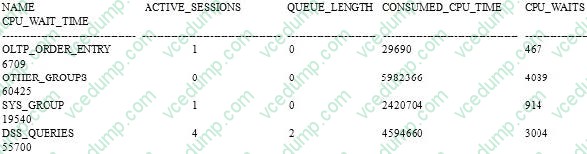
Which two statements are true? (Choose two.)
A. An attempt to start a new session by a user belonging to DSS_QUERIES fails with an error.
B. An attempt to start a new session by a user belonging to OTHE_GROUPS fails with an error.
C. The CPU_WAIT_TIME column indicates the total time that sessions in the consumer group waited for the CPU due to resource management.
D. The CPU_WAIT_TIME column indicates the total time that sessions in the consumer group waited for the CPU due to I/O waits and latch or enqueue contention.
E. A user belonging to the DSS__QUERIES resource consumer group can create a new session but the session will be queued. -
Question 195:
Examine the RMAN commands:
RMAN> CONNECT TARGET "sbu@prod AS SYSBACKUP";
RMAN> CONNECT AUXILIARY "sbu@dup_db AS SYSBACKUP";
RMAN> DUPLICATE TARGET DATABASE TO dup_db
FROM ACTIVE DATABASE PASSWORD FILE SECTION SIZE 400M;
Which statement is true about the DUPLICATE command?
A. It fails because there is no connection to a recovery catalog.
B. It succeeds only if the target database is in MOUNT state.
C. It succeeds and creates multisection backup sets that are used for active database duplication.
D. It fails because no parallel channels are allocated for the auxiliary database. -
Question 196:
You are connected to a recovery catalog and target database. You execute the command:
RMAN> CATALOG START WITH `/disk1/backups';
Which statement is true?
A. Only valid data file copies, existing in the /disk1/backups directory, are cataloged.
B. Only valid backup pieces and archived logs, existing in the /disk1/backups directory, are cataloged.
C. It lists all the data file copies, backup pieces, and achieved logs cataloged in the recovery catalog in the /disk1/backups directory and its subdirectories.
D. It lists and catalogs all valid data file copies, backup pieces, and archived logs that exist in all directory paths with the prefix /disk1/backups and their subdirectories. -
Question 197:
Examine this parameter in a database's PFILE:
DB_CREATE_FILE_DEST = '/u01/app/oracle/oradata/'
You execute this command:
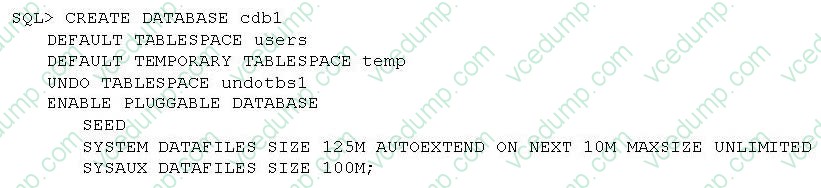
Which three are true after successful database creation? (Choose three.)
A. Local Undo is enabled.
B. The files created for both the root and seed databases use Oracle Managed Files (OMF).
C. PDB$SEED is open read-only.
D. PDB$SEED is mounted.
E. USERS will be the default tablespace for PDB$SEED.
F. CDB$ROOT is open read/write. -
Question 198:
Your database has a table CUSTOMERS that contains the columns CUST_NAME, AMT_DUE, and OLD_STATUS. Examine the commands executed and their output:
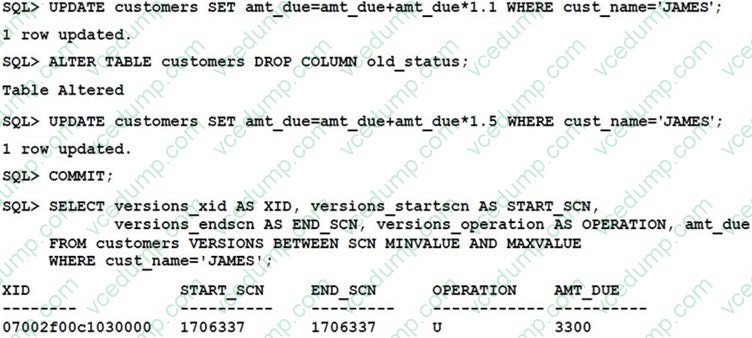
Why is it that only one update is listed by the Flashback Version Query?
A. Supplemental logging is not enabled for the database.
B. The undo data that existed for versions of rows before the change to the table structure is invalidated.
C. The DB_FLASHBACK_RETENTION_TARGET parameter is set to a lower value and the undo data pertaining to the first transaction is flushed out.
D. Undo retention guarantee is not enabled.
E. Flashback Data Archive is full after the first update statement. -
Question 199:
You are performing regular backups of your production database by using a recovery catalog.
You add two new tablespaces to your production database after performing a backup. They must be included in future backups.
Which action should you perform?
A. Synchronize the recovery catalog with the target database control file.
B. Create a new database incarnation record.
C. Add the tablespaces in the recovery catalog by using the CATALOG command.
D. Synchronize all the physical data files with the logical records in the recovery catalog by using the CROSSCHECK command. -
Question 200:
You issue the command:
SQL> ALTER DATABASE BACKUP CONTROLFILE TO TRACE;
Which statement is true about the command?
A. It creates a copy of the control file and stores it in the location specified in the diagnostic_dest initialization parameter.
B. It creates a file that contains the SQL statement, which is required to re-create the control file.
C. It updates the alert log file with the location and contents of the control file.
D. It creates a binary backup of the control file.
Related Exams:
-
1Z0-020
Oracle8i: New Features for Administrators -
1Z0-023
Architecture and Administration -
1Z0-024
Performance Tuning -
1Z0-025
Backup and Recovery -
1Z0-026
Network Administration -
1Z0-034
Upgrade Oracle9i/10g OCA to Oracle Database OCP -
1Z0-036
Managing Oracle9i on Linux -
1Z0-041
Oracle Database 10g: DBA Assessment -
1Z0-052
Oracle Database 11g: Administration Workshop I -
1Z0-053
Oracle Database 11g: Administration II
Tips on How to Prepare for the Exams
Nowadays, the certification exams become more and more important and required by more and more enterprises when applying for a job. But how to prepare for the exam effectively? How to prepare for the exam in a short time with less efforts? How to get a ideal result and how to find the most reliable resources? Here on Vcedump.com, you will find all the answers. Vcedump.com provide not only Oracle exam questions, answers and explanations but also complete assistance on your exam preparation and certification application. If you are confused on your 1Z0-063 exam preparations and Oracle certification application, do not hesitate to visit our Vcedump.com to find your solutions here.