1Z0-061 Exam Details
-
Exam Code
:1Z0-061 -
Exam Name
:Oracle Database 12c: SQL Fundamentals -
Certification
:Oracle Certifications -
Vendor
:Oracle -
Total Questions
:339 Q&As -
Last Updated
:Oct 10, 2022
Oracle 1Z0-061 Online Questions & Answers
-
Question 301:
Which two statements are true regarding the USING clause in table joins? (Choose two.)
A. It can be used to join a maximum of three tables.
B. It can be used to restrict the number of columns used in a NATURAL join.
C. It can be used to access data from tables through equijoins as well as nonequijoins.
D. It can be used to join tables that have columns with the same name and compatible data types. -
Question 302:
You need to create a table named ORDERS that contain four columns:
1.
AN ORDER_ID column of number data type
2.
A CUSTOMER_ID column of number data type
3.
AN ORDER_STATUS column that contains a character data type
4.
A DATE_ORDERED column to contain the date the order was placed.
When a row is inserted into the table, if no value is provided when the order was placed, today's date should be used instead.
Which statement accomplishes this?
A. CREATE TABLE orders (order_id NUMBER (10), customer_id NUMBER (8), order_status VARCHAR2 (10), date_ordered DATE = SYSDATE);
B. CREATE TABLE orders (order_id NUMBER (10), customer_id NUMBER (8), order_status VARCHAR2 (10), date_ordered DATE DEFAULT SYSDATE);
C. CREATE OR REPLACE TABLE orders (order_id NUMBER (10), customer_id NUMBER (8), order_status VARCHAR2 (10), date_ordered DATE DEFAULT SYSDATE);
D. CREATE OR REPLACE TABLE orders (order_id NUMBER (10), customer_id NUMBER (8), order_status VARCHAR2 (10), date_ordered DATE = SYSDATE);
E. CREATE TABLE orders (order_id NUMBER (10), customer_id NUMBER (8), order_status NUMBER (10), date_ordered DATE = SYSDATE);
F. CREATE TABLE orders (order_id NUMBER (10), customer_id NUMBER (8), order_status NUMBER (10), date_ordered DATE DEFAULT SYSDATE); -
Question 303:
Examine the structure of the DEPARTMENTS table:
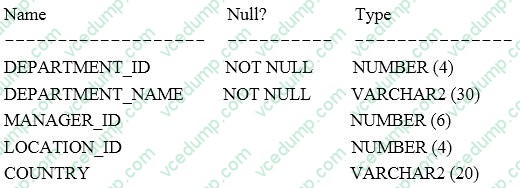
You execute the following command:
SQL> ALTER TABLE departments
SET UNUSED (country);
Which two statements are true? (Choose two.)
A. Synonyms existing om the DEPARTMENTS table would have to be re-created.
B. Unique key constraints defined on the COUNTRY column are removed.
C. Views created on the DEPARTMENTS table that include the COUNTRY column are automatically modified and remain valid.
D. Indexes created on the COUNTRY column exist until the DROP UNUSED COLUMNS command is executed.
E. A new column, COUNTRY, can be added to the DEPARTMENTS table after executing the command. -
Question 304:
A SELECT statement can be used to perform these three functions:
Which set of keywords describes these capabilities?
A. difference, projection, join
B. selection, projection, join
C. selection, intersection, join
D. intersection, projection, join
E. difference, projection, product -
Question 305:
You want to create an ORD_DETAIL table to store details for an order placed having the following business requirement:
1) The order ID will be unique and cannot have null values.
2) The order date cannot have null values and the default should be the current date.
3) The order amount should not be less than 50.
4) The order status will have values either shipped or not shipped.
5) The order payment mode should be cheque, credit card, or cash on delivery (COD).
Which is the valid DDL statement for creating the ORD_DETAIL table?
A. CREATE TABLE ord_details(ord_id NUMBER(2) CONSTRAINT ord_id_nn NOT NULL,ord_date DATE DEFAULT SYSDATE NOT NULL,ord_amount NUMBER(5, 2) CONSTRAINT ord_amount_minCHECK (ord_amount > 50),ord_status VARCHAR2(15) CONSTRAINT ord_status_chkCHECK (ord_status IN ('Shipped', 'Not Shipped')),ord_pay_mode VARCHAR2(15) CONSTRAINT ord_pay_chkCHECK (ord_pay_mode IN ('Cheque', 'Credit Card','Cash On Delivery')));
B. CREATE TABLE ord_details(ord_id NUMBER(2) CONSTRAINT ord_id_uk UNIQUE NOT NULL,ord_date DATE DEFAULT SYSDATE NOT NULL,ord_amount NUMBER(5, 2) CONSTRAINT ord_amount_minCHECK (ord_amount > 50),ord_status VARCHAR2(15) CONSTRAINT ord_status_chkCHECK (ord_status IN ('Shipped', 'Not Shipped')),ord_pay_mode VARCHAR2(15) CONSTRAINT ord_pay_chkCHECK (ord_pay_mode IN ('Cheque', 'Credit Card','Cash On Delivery')));
C. CREATE TABLE ord_details(ord_id NUMBER(2) CONSTRAINT ord_id_pk PRIMARY KEY,ord_date DATE DEFAULT SYSDATE NOT NULL,ord_amount NUMBER(5, 2) CONSTRAINT ord_amount_minCHECK (ord_amount >= 50),ord_status VARCHAR2(15) CONSTRAINT ord_status_chkCHECK (ord_status IN ('Shipped', 'Not Shipped')),ord_pay_mode VARCHAR2(15) CONSTRAINT ord_pay_chkCHECK (ord_pay_mode IN ('Cheque', 'Credit Card','Cash On Delivery')));
D. CREATE TABLE ord_details(ord_id NUMBER(2),ord_date DATE NOT NULL DEFAULT SYSDATE,ord_amount NUMBER(5, 2) CONSTRAINT ord_amount_minCHECK (ord_amount >= 50),ord_status VARCHAR2(15) CONSTRAINT ord_status_chkCHECK (ord_status IN ('Shipped', 'Not Shipped')),ord_pay_mode VARCHAR2(15) CONSTRAINT ord_pay_chkCHECK (ord_pay_mode IN ('Cheque', 'Credit Card','Cash On Delivery'))); -
Question 306:
View the Exhibit and examine the structure of the PRODUCTS, SALES, and SALE_SUMMARY tables.
SALE_VW is a view created using the following command:
SQL>CREATE VIEW sale_vw AS
SELECT prod_id, SUM(quantity_sold) QTY_SOLD
FROM sales GROUP BY prod_id;
You issue the following command to add a row to the SALE_SUMMARY table:
SQL>INSERT INTO sale_summary
SELECT prod_id, prod_name, qty_sold FROM sale_vw JOIN products
USING (prod_id) WHERE prod_id = 16;
What is the outcome?
A. It executes successfully.
B. It gives an error because a complex view cannot be used to add data into the SALE_SUMMARY table.
C. It gives an error because the column names in the subquery and the SALE_SUMMARY table do not match.
D. It gives an error because the number of columns to be inserted does not match with the number of columns in the SALE_SUMMARY table. -
Question 307:
View the Exhibit and examine the structure of the PROMOTIONS table.
Using the PROMOTIONS table, you need to find out the names and cost of all the promos done on 'TV' and 'internet' that ended in the time interval 15th March '00 to 15th October '00.
Which two queries would give the required result? (Choose two.)
A. SELECT promo_name, promo_costFROM promotionsWHERE promo_category IN ('TV', 'internet') ANDpromo_end_date BETWEEN '15-MAR-00' AND '15-OCT-00';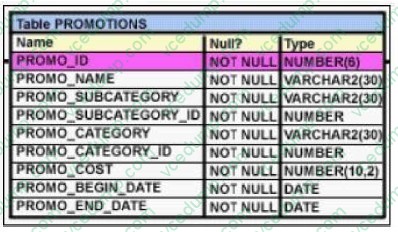
B. SELECT promo_name, promo_costFROM promotionsWHERE promo_category = 'TV' OR promo_category ='internet' AND promo_end_date >='15-MAR-00' OR promo_end_date
C. SELECT promo_name, promo_costFROM promotionsWHERE (promo_category BETWEEN 'TV' AND 'internet') AND(promo_end_date IN ('15-MAR-00', '15-OCT-00'));
D. SELECT promo_name, promo_costFROM promotionsWHERE (promo_category = 'TV' OR promo_category ='internet') AND (promo_end_date >='15-MAR-00' AND promo_end_date -
Question 308:
You need to design a student registration database that contains several tables storing academic information.
The STUDENTS table stores information about a student. The STUDENT_GRADES table stores information about the student's grades. Both of the tables have a column named STUDENT_ID. The STUDENT_ID column in the STUDENTS table is a primary key.
You need to create a foreign key on the STUDENT_ID column of the STUDENT_GRADES table that points to the STUDENT_ID column of the STUDENTS table. Which statement creates the foreign key?
A. CREATE TABLE student_grades (student_id NUMBER(12), semester_end DATE, gpa NUMBER(4, 3), CONSTRAINT student_id_fk REFERENCES (student_id) FOREIGN KEY students(student_id));
B. CREATE TABLE student_grades(student_id NUMBER(12), semester_end DATE, gpa NUMBER(4, 3), student_id_fk FOREIGN KEY (student_id) REFERENCES students(student_id));
C. CREATE TABLE student_grades(student_id NUMBER(12), semester_end DATE, gpa NUMBER(4, 3), CONSTRAINT FOREIGN KEY (student_id) REFERENCES students(student_id));
D. CREATE TABLE student_grades(student_id NUMBER(12), semester_end DATE, gpa NUMBER(4, 3), CONSTRAINT student_id_fk FOREIGN KEY (student_id) REFERENCES students(student_id)); -
Question 309:
View the Exhibit and examine the structure of the EMPLOYEES table.
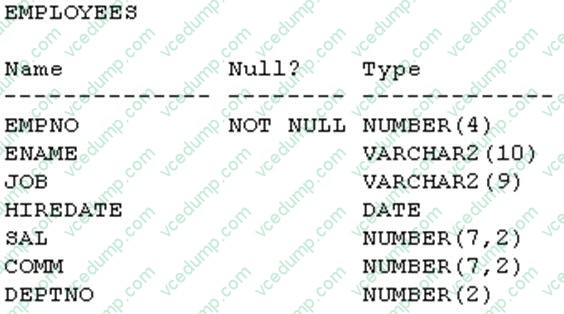
Examine the data in the ename and hiredate columns of the employees table:
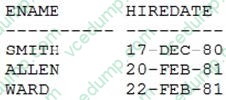
You want to generate a list of user IDs as follows:
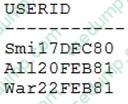
You issue the following query:

What is the outcome?
A. It executes successfully and gives the correct output.
B. It executes successfully but does not give the correct output.
C. It generates an error because the REPLACE function is not valid.
D. It generates an error because the SUBSTR function cannot be nested in the CONCAT function. -
Question 310:
Which create table statement is valid?
A. Option A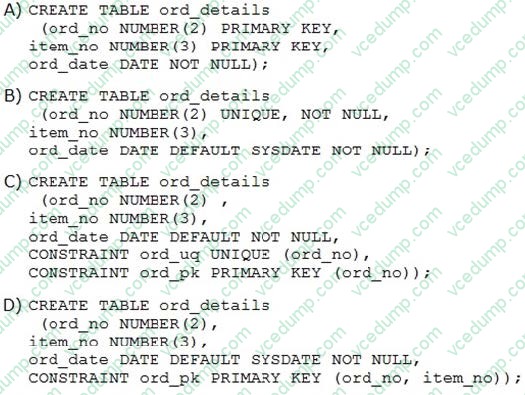
B. Option B
C. Option C
D. Option D
Related Exams:
-
1Z0-020
Oracle8i: New Features for Administrators -
1Z0-023
Architecture and Administration -
1Z0-024
Performance Tuning -
1Z0-025
Backup and Recovery -
1Z0-026
Network Administration -
1Z0-034
Upgrade Oracle9i/10g OCA to Oracle Database OCP -
1Z0-036
Managing Oracle9i on Linux -
1Z0-041
Oracle Database 10g: DBA Assessment -
1Z0-052
Oracle Database 11g: Administration Workshop I -
1Z0-053
Oracle Database 11g: Administration II
Tips on How to Prepare for the Exams
Nowadays, the certification exams become more and more important and required by more and more enterprises when applying for a job. But how to prepare for the exam effectively? How to prepare for the exam in a short time with less efforts? How to get a ideal result and how to find the most reliable resources? Here on Vcedump.com, you will find all the answers. Vcedump.com provide not only Oracle exam questions, answers and explanations but also complete assistance on your exam preparation and certification application. If you are confused on your 1Z0-061 exam preparations and Oracle certification application, do not hesitate to visit our Vcedump.com to find your solutions here.