1Z0-061 Exam Details
-
Exam Code
:1Z0-061 -
Exam Name
:Oracle Database 12c: SQL Fundamentals -
Certification
:Oracle Certifications -
Vendor
:Oracle -
Total Questions
:339 Q&As -
Last Updated
:Oct 10, 2022
Oracle 1Z0-061 Online Questions & Answers
-
Question 201:
You created an ORDERS table with the following description:
Exhibit:
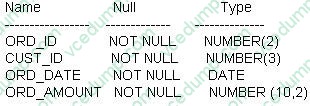
You inserted some rows in the table. After some time, you want to alter the table by creating the PRIMARY KEY constraint on the ORD_ID column. Which statement is true in this scenario?
A. You cannot add a primary key constraint if data exists in the column
B. You can add the primary key constraint even if data exists, provided that there are no duplicate values
C. The primary key constraint can be created only a the time of table creation
D. You cannot have two constraints on one column -
Question 202:
Examine the description of the EMP_DETAILS table given below:
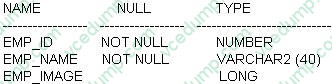
Which two statements are true regarding SQL statements that can be executed on the EMP_DETAIL table? (Choose two.)
A. An EMP_IMAGE column can be included in the GROUP BY clause
B. You cannot add a new column to the table with LONG as the data type
C. An EMP_IMAGE column cannot be included in the ORDER BY clause
D. You can alter the table to include the NOT NULL constraint on the EMP_IMAGE column -
Question 203:
You work as a database administrator at ABC.com. You study the exhibit carefully. Exhibit:
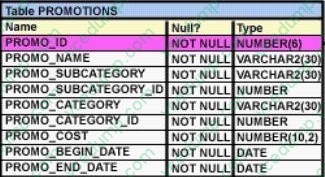
Which two SQL statements would execute successfully? (Choose two.)
A. UPDATE promotionsSET promo_cost = promo_cost+ 100WHERE TO_CHAR(promo_end_date, 'yyyy') > '2000';
B. SELECT promo_begin_dateFROM promotionsWHERE TO_CHAR(promo_begin_date, 'mon dd yy')='jul 01 98';
C. UPDATE promotionsSET promo_cost = promo_cost+ 100WHERE promo_end_date > TO_DATE(SUBSTR('01-JAN-2000', 8));
D. SELECT TO_CHAR(promo_begin_date, 'dd/month')FROM promotionsWHERE promo_begin_date IN (TO_DATE('JUN 01 98'), TO_DATE('JUL 01 98')); -
Question 204:
View the Exhibit and examine the data in the PROMO_CATEGORY and PROMO_COST columns of the PROMOTIONS table.

Evaluate the following two queries:
SQL>SELECT DISTINCT promo_category to_char(promo_cost)"code" FROM promotions
ORDER BY code;
SQL>SELECT DISTINCT promo_category promo_cost "code"
FROM promotions ORDER BY 1;
Which statement is true regarding the execution of the above queries?
A. Only the first query executes successfully.
B. Only the second query executes successfully.
C. Both queries execute successfully but give different results.
D. Both queries execute successfully and give the same result. -
Question 205:
What is true about the WITH GRANT OPTION clause?
A. It allows a grantee DBA privileges.
B. It is required syntax for object privileges.
C. It allows privileges on specified columns of tables.
D. It is used to grant an object privilege on a foreign key column.
E. It allows the grantee to grant object privileges to other users and roles. -
Question 206:
View the Exhibit and examine the structure of the PROMOTIONS, SALES, and CUSTOMER tables.
You need to generate a report showing the promo name along with the customer name for all products that were sold during their promo campaign and before 30th October 2007.
You issue the following query:
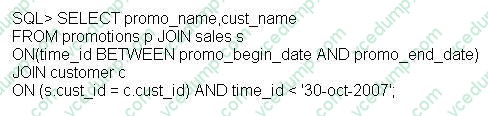
Which statement is true regarding the above query?
A. It executes successfully and gives the required result.
B. It executes successfully but does not give the required result.
C. It produces an error because the join order of the tables is incorrect.
D. It produces an error because equijoin and nonequijoin conditions cannot be used in the same SELECT statement. -
Question 207:
View the Exhibit and examine the data in the PROMO_NAME and PROMO_END_DATE columns of the promotions table, and the required output format.

Which two queries give the correct result?
A. Option A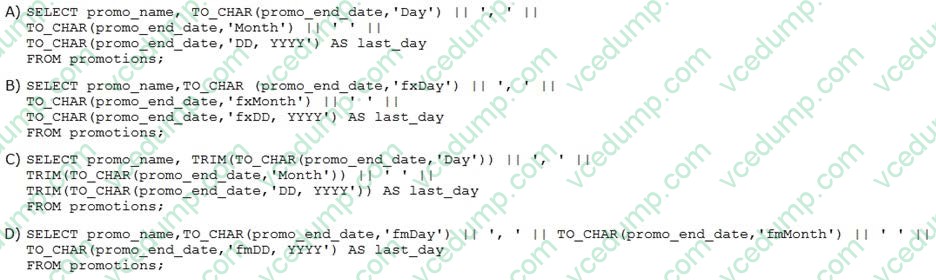
B. Option B
C. Option C
D. Option D -
Question 208:
Which two statements are true regarding savepoints? (Choose two.)
A. Savepoints are effective only for COMMIT.
B. Savepoints may be used to ROLLBACK.
C. Savepoints can be used for only DML statements.
D. Savepoints are effective for both COMMIT and ROLLBACK.
E. Savepoints can be used for both DML and DDL statements. -
Question 209:
Which object privileges can be granted on a view?
A. none
B. DELETE, INSERT, SELECT
C. ALTER, DELETE, INSERT, SELECT
D. DELETE, INSERT, SELECT, UPDATE -
Question 210:
You issue the following command to drop the products table:
SQL> DROP TABLE products;
Which three statements are true about the implication of this command? (Choose three.)
A. All data along with the table structure is deleted.
B. A pending transaction in the session is committed.
C. All indexes on the table remain but they are invalidated.
D. All views and synonyms remain but they are invalidated.
E. All data in the table is deleted but the table structure remains.
Related Exams:
-
1Z0-020
Oracle8i: New Features for Administrators -
1Z0-023
Architecture and Administration -
1Z0-024
Performance Tuning -
1Z0-025
Backup and Recovery -
1Z0-026
Network Administration -
1Z0-034
Upgrade Oracle9i/10g OCA to Oracle Database OCP -
1Z0-036
Managing Oracle9i on Linux -
1Z0-041
Oracle Database 10g: DBA Assessment -
1Z0-052
Oracle Database 11g: Administration Workshop I -
1Z0-053
Oracle Database 11g: Administration II
Tips on How to Prepare for the Exams
Nowadays, the certification exams become more and more important and required by more and more enterprises when applying for a job. But how to prepare for the exam effectively? How to prepare for the exam in a short time with less efforts? How to get a ideal result and how to find the most reliable resources? Here on Vcedump.com, you will find all the answers. Vcedump.com provide not only Oracle exam questions, answers and explanations but also complete assistance on your exam preparation and certification application. If you are confused on your 1Z0-061 exam preparations and Oracle certification application, do not hesitate to visit our Vcedump.com to find your solutions here.