1Z0-052 Exam Details
-
Exam Code
:1Z0-052 -
Exam Name
:Oracle Database 11g: Administration Workshop I -
Certification
:Oracle Certifications -
Vendor
:Oracle -
Total Questions
:285 Q&As -
Last Updated
:Jul 11, 2026
Oracle 1Z0-052 Online Questions & Answers
-
Question 21:
Examine these SQL statements and their output:
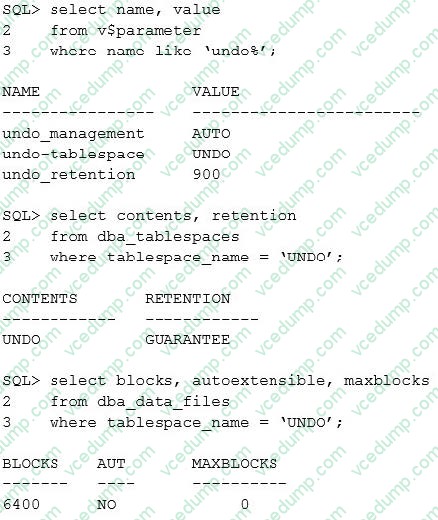
Which two are true? (Choose two.)
A. Transactions will wait until free space becomes available in the UNDO tablespace when they have failed to allocate space
B. Inactive UNDO will be retained for at least 15 minutes
C. Active UNDO will be retained as long as needed by the transactions
D. Expired UNDO will be retained as long as possible within the limits of the current size of the UNDO tablespace
E. The UNDO tablespace will grow automatically if there is not enough space to retain active UNDO -
Question 22:
The TRANS_SUMMARY table contains product-wise transaction details that get updated with every transaction in the system. Each row has cumulative transaction details of a single product and every product is identified by a product code, which is the primary key.
As part of the archival process, the company wants to transfer the rows in the TRANS_SUMMARY table to the TRANS_SUMMARY_DUP table at the end of every quarter of the year. Along with existing products, the company deals with many new products during every quarter.
Which method is best suited for this quarterly data transfer?
A. Using the MERGE command
B. Using the SQL*Loader utility
C. Using the correlated UPDATE command
D. Using the INSERT command to perform bulk operation -
Question 23:
You are working on a new Oracle Database 11g server, where only the software is installed and no database is created. You plan to create a database on this server using the Database Configuration Assistant (DBCA). Some of the requirements set for your database creation task are:
1.
Configure the database to operate in shared server mode.
2.
Disable automatic maintenance tasks such as optimizer statistics collection.
3.
Configure a naming method to help the remote user connect to the database instance.
4.
Use Automatic Storage Management (ASM) for storing the database files.
5.
Configure daily database backup to flash recovery area.
6.
Configure Enterprise Manager Database Control to manage the database. Which of these requirements can be met while creating the database?
A. 4 and 6
B. 2, 3, 4, and 6
C. 1, 2, 4, 5, and 6
D. 1, 2, 3, 4, 5, and 6 -
Question 24:
The database instance has the following parameter setting:
OS_AUTHENT_PREFIX = OPS$
OS_ROLES = FALSE
REMOTE_OS_AUTHENT = FALSE
REMOTE_OS_ROLES = FALSE
TIMED_OS_STATISTICS = 0
You have a local operating system user SKD. You create a database user OPS$SKD, and then assign external authentication. The user OPS$SKD has the CREATE SESSION privilege.
What would you achieve by the above process?
A. The database user OPS$SKD will be able to administer the database.
B. The authentication detail for the database user OPS$SKD is recorded in the password file.
C. The local operating system user SKD will be able to access the database instance without specifying the username and password.
D. The database user OPS$SKD has to login with the password of the local operating system user SKD to access the database instance. -
Question 25:
The user SCOTT owns the CUST table that is placed in the SALES tablespace. The user SCOTT opens a session and executes commands as follows:
SQL> INSERT INTO cust VALUES(101, 'JACK');
1 row created.
SQL> INSERT INTO cust VALUES(102, 'SMITH');
1 row created.
As a DBA, you execute the following command from another session:
ALTER TABLESPACE sales READ ONLY;
Which statement is true regarding the effect of this command on the transaction in Scott's session?
A. The command fails as a transaction is still pending.
B. The transaction in Scott's session is rolled back and the tablespace becomes readonly.
C. The command waits and the user SCOTT can execute data manipulation language (DML) statements only as part of the current transaction.
D. The command hangs until all transactions on the objects in the tablespace commit or rollback, and then the tablespace is placed in readonly mode. -
Question 26:
Which two statements are true regarding B-tree index? (Choose two.)
A. The leaf blocks in the index are doubly linked.
B. The leaf node stores a bitmap for each key value.
C. The rows with NULL value in key columns also have entries in the index.
D. The deletion of a row from the table causes a logical deletion in index leaf block and the space becomes available for the new leaf entry. -
Question 27:
In which situation would you use static database registration for a listener?
A. When multiple databases are to be registered with the listener
B. When DBAs need to connect remotely to start up the database instance
C. When users need to connect the database instance using the host naming method
D. When the database instance that is to be registered with the listener is configured in shared server mode -
Question 28:
Which action is automatically performed as part of the Incident Packaging Service in Enterprise Manager Support Workbench?
A. invoking the Data Recovery Advisor and SQL Repair Advisor
B. gathering metadata from the Automatic Diagnostic Repository (ADR)
C. Creating a service request with My Oracle Support
D. invoking the SQL Test Case Builder -
Question 29:
Your database is using Automatic Memory Management.
Which two SGA components must be managed manually? (Choose two)
A. keep buffer pool
B. shared pool
C. redo log buffer
D. default buffer cache
E. large pool -
Question 30:
Examine the following command that is used to create a table:

Which two statements are true about the effect of the above command? (Choose two.)
A. A CHECK constraint is created on the OID column
B. A NOT NULL constraint is created on the OID column
C. The ORDERS table is the only object created in the USERS tablespace
D. The ORDERS table and a unique index are created in the USERS tablespace
E. The ORDERS table is created in the USERS tablepsace and a unique index is created on the OID column in the SYSTEM tablespace
Related Exams:
-
1Z0-020
Oracle8i: New Features for Administrators -
1Z0-023
Architecture and Administration -
1Z0-024
Performance Tuning -
1Z0-025
Backup and Recovery -
1Z0-026
Network Administration -
1Z0-034
Upgrade Oracle9i/10g OCA to Oracle Database OCP -
1Z0-036
Managing Oracle9i on Linux -
1Z0-041
Oracle Database 10g: DBA Assessment -
1Z0-052
Oracle Database 11g: Administration Workshop I -
1Z0-053
Oracle Database 11g: Administration II
Tips on How to Prepare for the Exams
Nowadays, the certification exams become more and more important and required by more and more enterprises when applying for a job. But how to prepare for the exam effectively? How to prepare for the exam in a short time with less efforts? How to get a ideal result and how to find the most reliable resources? Here on Vcedump.com, you will find all the answers. Vcedump.com provide not only Oracle exam questions, answers and explanations but also complete assistance on your exam preparation and certification application. If you are confused on your 1Z0-052 exam preparations and Oracle certification application, do not hesitate to visit our Vcedump.com to find your solutions here.