1Z0-050 Exam Details
-
Exam Code
:1Z0-050 -
Exam Name
:Oracle Database New Features for Administrators -
Certification
:Oracle Certifications -
Vendor
:Oracle -
Total Questions
:183 Q&As -
Last Updated
:Dec 15, 2021
Oracle 1Z0-050 Online Questions & Answers
-
Question 51:
You are managing the APPPROD database as a DBA. You plan to duplicate this database in the same system with the name DUPDB.
You issued the following RMAN commands to create a duplicate database:
RMAN> CONNECT target sys/sys@APPPROD
RMAN> DUPLICATE TARGET DATABASE TO dupdb FROM ACTIVE DATABASE DB_FILE_NAME_CONVERT '/oracIe/oradata/prod/1, '/scratch/oracIe/oradata/dupdb/1 SPILE PARAMETER_VALUE_CONVERT'/oracle/oradata/prod/1, '/scratch/oracIe/oradata/dupdb/1 SET SGA_MAX_SIZE = '300M1 SET SGA_TARGET = '250M' SET LOG_FILE_NAME_CONVERT '/oracle/oradata/prod/redo/', '/scratch/oracIe/oradata/dupdb/redo/1;
Which three are the prerequisites for the successful execution of the above command? (Choose three.)
A. The source database should be open.
B. The target database should be in ARCHIVELOG mode if it is open.
C. RMAN should be connected to both the instances as SYSDBA
D. The target database backups should be copied to the source database backup directories.
E. The password file must exist for the source database and have the same SYS user password as the target. -
Question 52:
Which is the source used by Automatic SQL Tuning that runs as part of the AUTOTASK framework?
A. SQL statements that are part of the AWR baseline only
B. SQL statements based on the AWR top SQL identification
C. SQL statements that are part of the available SQL Tuning Set (STS) only
D. SQL statements that are available in the cursor cache and executed by a user other than SYS -
Question 53:
You want to track and store all transactional changes to a table over its lifetime. To accomplish this task, you enabled Flashback Data Archive with the retention of 5 years. After some time, the business requirement changed and you were
asked to change the retention from 5 years to 3 years. To accomplish this, you issued the following command:
ALTER FLASHBACK ARCHIVE fla1 MODIFY RETENTION 3 YEAR;
What is the implication of this command?
A. The command produces an error because the retention time cannot be reduced.
B. All historical data older than three years is purged from the flashback archive FLA1.
C. All historical data is purged and the new flashback data archives are maintained for three years.
D. All historical data is retained but the subsequent flashback data archives are maintained for only three years. -
Question 54:
Following is the list of locations in random order where oranfstab can be placed.
1 ./etc/mtab 2 .$ORACLE_HOME/dbs/oranfstab 3 ./etc/oranfstab
What is the sequence in which Direct NFS will search the locations?
A. 1,2,3
B. 3,2, 1
C. 2,3, 1
D. 1,3,2 -
Question 55:
You are managing an Oracle Database 11 g database. You want to take the of size 100 TB on tape drive, but you have tape drives of only 10 GB each, quickly and efficiently?
A. intrafile parallel backup
B. parallel image copy backup
C. backup with MAXPIECESIZE configured for the channel
D. parallel backup with MAXPIECESIZE configured for the channel -
Question 56:
You are managing an Oracle Database 11 g instance with ASM storage. You lost an ASM disk group DATA. You have RMAN backup of data as well as ASM metadata backup. You want to re-create the missing disk group by using the ASMCMD md_restore command. Which of these methods would you use to achieve this? (Choose all that apply.)
A. Restore metadata in an existing disk group by passing the existing disk group name as an input parameter.
B. Restore the disk group with changed disk group specification, failure group specification, disk group name, and other disk attributes.
C. Restore the disk group with the exact configuration as the backed-up disk group, using the same disk group name, same set of disks, and failure group configurations.
D. Restore the disk group with the exact configuration as the backed-up disk group, using the same disk group name, same set of disks, failure group configurations, and data on the disk group. -
Question 57:
View the Exhibit that sets the threshold for the Current Open Cursors Count metric.
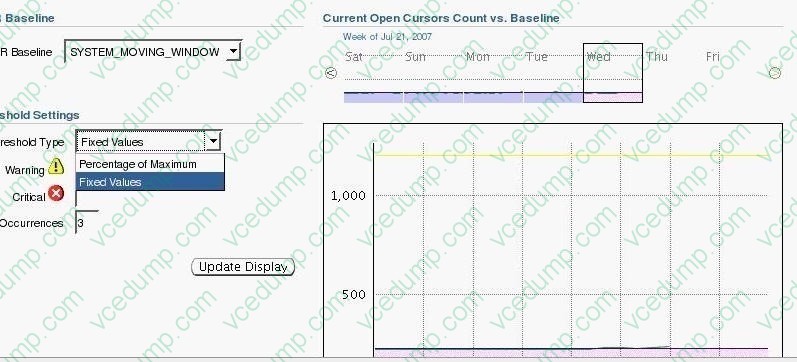
Why is the Significance Level threshold type not available in the threshold setting?
A. because AWR baseline is not enabled
B. because Current Open Cursors Count is not a basic metric
C. because the STATISTICS_LEVEL parameter is set to BASIC
D. because the AWR baseline is a system-defined moving window baseline -
Question 58:
Which statements are true regarding the creation of an incident package file by using the EM Workbench Support? (Choose all that apply.)
A. You can add SQL test cases to the incident package,
B. You can add or remove the trace files to the package.
C. You cannot create an incremental incident package when the physical files are purged from the ADR.
D. You can create the incremental incident package ZIP file for new or modified diagnostic information for the incident package already created. -
Question 59:
View the following SQL statements:
Transaction T1
INSERT INTO hr.regions VALUES (5,'Pole'); COMMIT;
Transaction T2
UPDATE hr.regions SET region_name='Poles' WHERE region_id = 5; COMMIT;
Transaction T3
UPDATE hr.regions SET region_name='North and South Poles' WHERE regionjd = 5;
You want to back out transaction T2. Which option would you use?
A. It is possible, but transaction T3 also backs out.
B. It is possible with the NOCASCADE_FORCE option.
C. It is possible with the NONCONFLICT_ONLY option.
D. It is not possible because it has conflicts with transaction T3. -
Question 60:
Examine the following values of the Initialization parameters In the database having the SID ORCL:
BACKGROUNDJDUMP_DEST=/u01/app/oracle/product/11.1.0/db_1/bdump USER_DUMP_DEST=/u01/ app/oracle/product/11.1.0/db_1/udump CORE_DUMP_DEST=/u01/app/oracle/product/11.1.0/db_1/cdump DIAGNOSTIC_DEST=
The environment variables have the following value:
ORACLE_BASE=/u01 /app/oracle
ORACLE_HOME=/u01/app/oracle/product/11.1.0/db_1
What is the location of the Automatic Diagnostic Repository (ADR) home?
A. /u01/app/oracle
B. $ORACLE_HOME/log
C. $ORACLE_HOME/bdump
D. /u01/app/oracle/product/11.1.0/db_1
Related Exams:
-
1Z0-020
Oracle8i: New Features for Administrators -
1Z0-023
Architecture and Administration -
1Z0-024
Performance Tuning -
1Z0-025
Backup and Recovery -
1Z0-026
Network Administration -
1Z0-034
Upgrade Oracle9i/10g OCA to Oracle Database OCP -
1Z0-036
Managing Oracle9i on Linux -
1Z0-041
Oracle Database 10g: DBA Assessment -
1Z0-052
Oracle Database 11g: Administration Workshop I -
1Z0-053
Oracle Database 11g: Administration II
Tips on How to Prepare for the Exams
Nowadays, the certification exams become more and more important and required by more and more enterprises when applying for a job. But how to prepare for the exam effectively? How to prepare for the exam in a short time with less efforts? How to get a ideal result and how to find the most reliable resources? Here on Vcedump.com, you will find all the answers. Vcedump.com provide not only Oracle exam questions, answers and explanations but also complete assistance on your exam preparation and certification application. If you are confused on your 1Z0-050 exam preparations and Oracle certification application, do not hesitate to visit our Vcedump.com to find your solutions here.