1Z0-050 Exam Details
-
Exam Code
:1Z0-050 -
Exam Name
:Oracle Database New Features for Administrators -
Certification
:Oracle Certifications -
Vendor
:Oracle -
Total Questions
:183 Q&As -
Last Updated
:Dec 15, 2021
Oracle 1Z0-050 Online Questions & Answers
-
Question 121:
Which client requests to the database can be captured as a part of the workload capture? (Choose all that apply.)
A. flashback query
B. distributed transactions
C. logging in and logging out of sessions
D. all DDL statements having bind variables
E. direct path load of data from external files -
Question 122:
What recommendations does the SQL Access Advisor provide for optimizing SQL queries? (Choose all that apply.)
A. selection of SQL plan baselines
B. partitioning of tables and indexes
C. creation of index-organized tables
D. creation of bitmap, function-based, and B-tree indexes
E. optimization of materialized views for maximum query usage and fast refresh -
Question 123:
You issued the following RMAN command to back up the database:
RMAN> RUN{ ALLOCATE CHANNEL c1 DEVICE TYPE Sbt BACKUP DATABASE TAG quarterly KEEP FOREVER RESTORE POINT FY06Q4;}
Which two statements are true regarding the backup performed? (Choose two.)
A. Archived redo log files are backed up along with data files
B. Only data files are backed up and a restore point named FY06Q4 is created.
C. Archived log files are backed up along with data files, and the archived log files are deleted.
D. The command creates a restore point named FY06Q4 to match the SCN at which this backup is consistent. -
Question 124:
To control the execution of a server process when it is receiving bad packets from a potentially malicious client, you set the
EC_PROTOCOL_ERROR_FURTHER_ACTION initialization parameter as follows:
SQL> ALTER SYSTEM SET SEC_PROTOCOL_ERROR_FURTHER_ACTION = Drop.10;
What is the significance of this setting?
A. It terminates the client connection after 10 bad packets and the client cannot reconnect to the same instance.
B. It terminates the client connection after 10 bad packets but the client can still reconnect, and attempt the same operation again.
C. It terminates the client connection 10 seconds after receiving a bad packet and the client cannot reconnect to the same instance.
D. It terminates the client connection after receiving a bad packet and the client can reconnect to the same instance after 10 minutes. -
Question 125:
Which statements describe the capabilities of the DBMS_NETWORK_ACL_ADMIN package? (Choose all that apply.)
A. It can be used to allow the access privilege settings for users but not roles.
B. It can be used to allow the access privilege settings for users as well as roles.
C. It can be used to control the time interval for which the access privilege is available to a user.
D. It can be used to selectively restrict the access for each user in a database to different host computers.
E. It can be used to selectively restrict a user's access to different applications in a specific host computer. -
Question 126:
SQL> EXECUTE
DBMS_WORKLOAD_REPOSITORY.CREATE_BASELINE_TEMPLATE(START_TI ME=> TO_TIMESTAMP(SYSDATE+2),
END_TIME=>TO_TIMESTAMP(SYSDATE+10),
BASELINE_NAME=>'Mybase4',
TEMPLATE_NAME=>'Mytemp4l,
EXPIRATION=>NULL);
Which statement is true about the effect of the above command?
A. It creates a baseline template that never expires.
B. It produces an error because no snapshot information is provided to create the baseline.
C. It creates a baseline template that expires after the Automatic Workload Repository (AWR) retention period.
D. It creates a repeating baseline template that repeats after the Automatic Workload Repository (AWR) retention period. -
Question 127:
The INVJHISTORY table is created using the command:
SQL>CREATE TABLE INV_HISTORY
(inv_no NUMBER(3),
inv_date DATE,
inv_amtNUMBER(10,2))
partition by range (inv_date)
interval (numtoyminterval(1 ,'month'))
(partition pO values less than (to_date(l01-01-2005llldd-mm-yyyy1)), partition p1 values less than (to_date ('01-01-2006','dd-mm-yyyy')));
The following data has been inserted into the INVJHISTORY table :
INV_NO INV_DATE INV_AMT 1 30-dec-2004 1000 2 30-dec-2005 2000 3 1-feb-2006 3000 4 1-mar-2006 4000 5 1-apr-2006 5000
You would like to store the data belonging to the year 2006 in a single partition and issue the command:
SQL> ALTER TABLE inv_history MERGE PARTITIONS FOR(TO_DATE(l15-feb-2006l,ldd-mon-yyyy,)),FOR(TO_DATE(l15-apr-20061)) INTO PARTITION sys_py;
What would be the outcome of this command?
A. It executes successfully, and the transition point is set to "l-apr-20061.
B. It executes successfully, and the transition point is set to '15-apr-2006'.
C. It produces an error because the partitions specified for merging are not adjacent.
D. It produces an error because the date values specified in the merge do not match the date values stored in the table. -
Question 128:
View the Exhibit to examine the Automatic Database Diagnostic Monitor (ADDM) tasks.
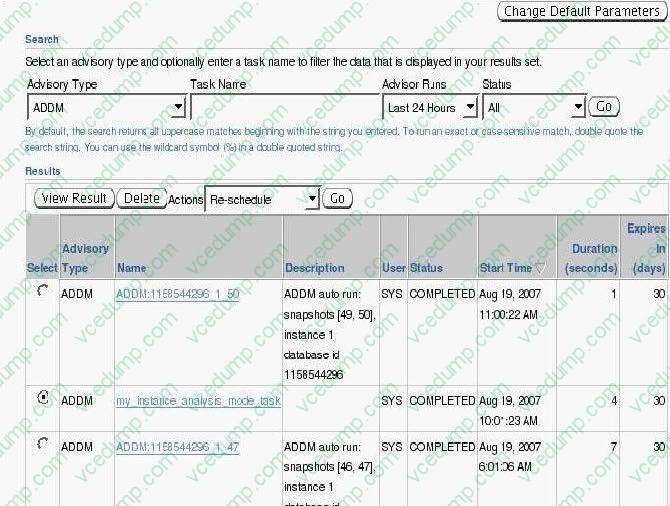
You executed the following commands:
SQL> VAR tname VARCHAR2(60);
SQL> BEGIN
:tname := lmy_instance_analysis_mode_task,;
DBMS_ADDM .INSERT_SEGMENT_DIRECTIVE(:tname ,lSg_directivel ,'SCOTT1); END;
Which statement describes the consequence?
A. The ADDM task is filtered to suppress the Segment Advisor suggestions for the SCOTT schema.
B. The ADDM task is filtered to produce the Segment Advisor suggestions for the SCOTT schema only.
C. The PL/SQL block produces an error because the my_instance_analysis_mode_task task has not been reset to its initial state.
D. All subsequent ADDM tasks including my_instance_analysis_mode_task are filtered to suppress the Segment Advisor suggestions for the SCOTT schema. -
Question 129:
You are managing an Oracle Database 11 g instance with ASM storage. The ASM instance is down. To know the details of the disks in the DATA disk group ,, you issued the following ASMCMD command:
ASMCMD> lsdsk-l -d DATA
Which statement is true regarding the outcome of this command?
A. The command succeeds but it retrieves only the disk names.
B. The command produces an error because the ASM instance is down.
C. The command succeeds but it shows only the status of the ASM instance.
D. The command succeeds and retrieves information by scanning the disk headers based on an ASMJDISKSTRING value. -
Question 130:
In your database, the RESULT_CACHE_MODE parameter has been set to MANUAL in the initialization parameter file.
You issued the following command:
SQL>SELECT /*+ RESULT_CACHE 7 sale_categoiy, sum(sale_amt) FROM sales GROUP BY sale_categoiy;
Where would the result of this query be stored?
A. PGA
B. large pool
C. shared pool
D. database buffer cache
Related Exams:
-
1Z0-020
Oracle8i: New Features for Administrators -
1Z0-023
Architecture and Administration -
1Z0-024
Performance Tuning -
1Z0-025
Backup and Recovery -
1Z0-026
Network Administration -
1Z0-034
Upgrade Oracle9i/10g OCA to Oracle Database OCP -
1Z0-036
Managing Oracle9i on Linux -
1Z0-041
Oracle Database 10g: DBA Assessment -
1Z0-052
Oracle Database 11g: Administration Workshop I -
1Z0-053
Oracle Database 11g: Administration II
Tips on How to Prepare for the Exams
Nowadays, the certification exams become more and more important and required by more and more enterprises when applying for a job. But how to prepare for the exam effectively? How to prepare for the exam in a short time with less efforts? How to get a ideal result and how to find the most reliable resources? Here on Vcedump.com, you will find all the answers. Vcedump.com provide not only Oracle exam questions, answers and explanations but also complete assistance on your exam preparation and certification application. If you are confused on your 1Z0-050 exam preparations and Oracle certification application, do not hesitate to visit our Vcedump.com to find your solutions here.