101 Exam Details
-
Exam Code
:101 -
Exam Name
:Application Delivery Fundamentals -
Certification
:F5 Certifications -
Vendor
:F5 -
Total Questions
:699 Q&As -
Last Updated
:May 30, 2026
F5 101 Online Questions & Answers
-
Question 211:
Which two can be a part of a pool's definition? (Choose two.)
A. rule(s)
B. profile(s)
C. monitor(s)
D. persistence type
E. load balancing mode -
Question 212:
A BIG-IP Administrator is trying to send traffic to a server on the same subnet and sees an incomplete in the BIG-IP devices ARP table. What could cause the incomplete status?
A. BIG-IP device connection is half-duplex
B. Router does not have a default gateway
C. Firewall is blocking ICMP
D. Server's switch connection is in the wrong VLAN -
Question 213:
Why is BIG-IP ASM ideally suited to protect against layer 7 attacks, including HTTP and HTTPS/SSL traffic, when compared to an intrusion prevention system (IPS)?
A. An intrusion prevention system (IPS) is based on Packet Filtering.
B. An IPS doesn't have the visibility into HTTPS traffic. it doesn't understand what applications are in the network.
C. An IPS only focus on operating system attacks; it doesn't understand what application are in the network.
D. An IPS can only look at overall traffic patterns; it doesn't understand what applications are in the network. -
Question 214:
Administrators can customize APM to resemble other internal Web applications in the organization.
A. True
B. False -
Question 215:
Which of the following statements are incorrect regarding protection of web services? (Choose two.)
A. The BIG-IP ASM System checks to ensure web services use cookies.
B. The BIG-IP ASM System parses XML requests and XML responses.
C. The BIG-IP ASM System checks to ensure XML documents are well formed.
D. The BIG-IP ASM System uses attack signatures to enforce negative security logic.
E. The BIG-IP ASM System checks for XML syntax, schema validation, and WSDL validation. -
Question 216:
A BIG-IP has two SNATs, a pool of DNS servers and a virtual server configured to load balance UDP traffic to the DNS servers. One SNAT's address is 64.100.130.10; this SNAT is defined for all addresses. The second SNAT's address is 64.100.130.20; this SNAT is defined for three specific addresses, 172.16.3.54, 172.16.3.55, and 172.16.3.56. The virtual server's destination is 64.100.130.30:53. The SNATs and virtual server have default VLAN associations. If a client with IP address 172.16.3.55 initiates a request to the virtual server, what is the source IP address of the packet as it reaches the chosen DNS server?
A. 64.100.130.30
B. 172.16.3.55
C. 64.100.130.20
D. 64.100.130.10 -
Question 217:
Which three of the following are benefits of adding WebAccelerator to the network infrastructure? (Choose three.)
A. It adds a layer, security to a Web site
B. It speeds up a secure Web site
C. It reduces the need to purchase additional bandwidth
D. It analyzes Web content, and caches and compresses it accordingly
E. It improves the performance, large object file transfers -
Question 218:
When using a redundant pair of LTMs, it is most advantageous to use them in an Active/Active scenario because this provides additional load balancing capabilities.
A. True
B. False -
Question 219:
An LTM has the 3 virtual servers, 2 SNATs, four self IP addresses defined, and the networks shown in the exhibit. Selected options for each object are shown below. Settings not shown are at their defaults. Assume port exhaustion has not been reached.
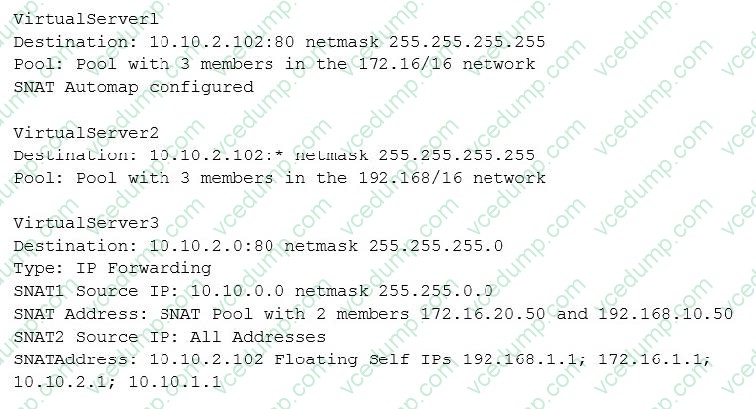
A connection attempt is made with a source IP and port of 10.10.100.50:2222 and a destination
IP and port of 10.10.2.10:80. When the request is processed, what will be the source and destination IP addresses?
A. The request will be droped.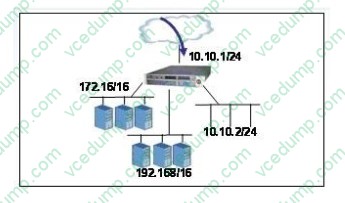
B. Source IP: 10.10.2.1; Destination IP: 10.10.2.10
C. Source IP: 10.10.2.102; Destination IP 10.10.2.10
D. Source IP: Either 172.16.20.50 or 192.168.10.50; Destination IP: 10.10.2.10
E. Source IP: 10.10.2.1; Destination IP: pool in the 172.16/16 network C -
Question 220:
When using SNAT, which additional IP addresses will the BIG-IP system change? (Choose two.)
A. The source IP address on the client to BIG-IP request packet.
B. The source IP address on the BIG-IP to pool member request packet.
C. The destination IP address on the BIG-IP to pool member request packet.
D. The source IP address on the BIG-IP to client response packet.
E. The destination IP address on the BIG-IP to client response packet.
F. The destination IP address on the pool member to BIG-IP response packet.
Related Exams:
-
101
Application Delivery Fundamentals -
201
TMOS Administration -
301A
BIG-IP LTM Specialist: Architect, Set up and Deploy -
301B
BIG-IP Local Traffic Manager (LTM) Specialist: Maintain & Troubleshoot -
302
BIG-IP DNS Specialist -
303
BIG-IP ASM Specialist -
402
F5 Cloud Solutions -
771-101
Application Delivery Fundamentals -
F50-506
F5 FirePass 600 V5 -
F50-531
BIG-IP v10.x LTM Essentials V10.x
Tips on How to Prepare for the Exams
Nowadays, the certification exams become more and more important and required by more and more enterprises when applying for a job. But how to prepare for the exam effectively? How to prepare for the exam in a short time with less efforts? How to get a ideal result and how to find the most reliable resources? Here on Vcedump.com, you will find all the answers. Vcedump.com provide not only F5 exam questions, answers and explanations but also complete assistance on your exam preparation and certification application. If you are confused on your 101 exam preparations and F5 certification application, do not hesitate to visit our Vcedump.com to find your solutions here.