SOA-C02 Exam Details
-
Exam Code
:SOA-C02 -
Exam Name
:AWS Certified SysOps Administrator - Associate (SOA-C02) -
Certification
:Amazon Certifications -
Vendor
:Amazon -
Total Questions
:657 Q&As -
Last Updated
:Oct 14, 2025
Amazon SOA-C02 Online Questions & Answers
-
Question 451:
A company hosts a web portal on Amazon EC2 instances. The web portal uses an Elastic Load Balancer (ELB) and Amazon Route 53 for its public DNS service. The ELB and the EC2 instances are deployed by way of a single AWS CloudFormation stack in the us-east- 1 Region. The web portal must be highly available across multiple Regions.
Which configuration will meet these requirements?
A. Deploy a copy of the stack in the us-west-2 Region. Create a single start of authority (SOA) record in Route 53 that includes the IP address from each ELB. Configure the SOA record with health checks. Use the ELB in us-east-1 as the primary record and the ELB in us-west-2 as the secondary record.
B. Deploy a copy of the stack in the us-west-2 Region. Create an additional A record in Route 53 that includes the ELB in us-west-2 as an alias target. Configure the A records with a failover routing policy and health checks. Use the ELB in us-east-1 as the primary record and the ELB in us-west-2 as the secondary record.
C. Deploy a new group of EC2 instances in the us-west-2 Region. Associate the new EC2 instances with the existing ELB, and configure load balancer health checks on all EC2 instances. Configure the ELB to update Route 53 when EC2 instances in us-west-2 fail health checks.
D. Deploy a new group of EC2 instances in the us-west-2 Region. Configure EC2 health checks on all EC2 instances in each Region. Configure a peering connection between the VPCs. Use the VPC in us-east-1 as the primary record and the VPC in us-west-2 as the secondary record. -
Question 452:
A company is storing media content in an Amazon S3 bucket and uses Amazon CloudFront to distribute the content to its users. Due to licensing terms, the company is not authorized to distribute the content in some countries. A SysOps
administrator must restrict access to certain countries.
What is the MOST operationally efficient solution that meets these requirements?
A. Configure the S3 bucket policy to deny the GetObject operation based on the S3:LocationConstraint condition.
B. Create a secondary origin access identity (OAI). Configure the S3 bucket policy to prevent access from unauthorized countries.
C. Enable the geo restriction feature in the CloudFront distribution to prevent access from unauthorized countries.
D. Update the application to generate signed CloudFront URLs only for IP addresses in authorized countries. -
Question 453:
A company is planning to host its stateful web-based applications on AWS A SysOps administrator is using an Auto Scaling group of Amazon EC2 instances The web applications will run 24 hours a day 7 days a week throughout the year The company must be able to change the instance type within the same instance family later in the year based on the traffic and usage patterns.
Which EC2 instance purchasing option will meet these requirements MOST cost- effectively?
A. Convertible Reserved Instances
B. On-Demand instances
C. Spot instances
D. Standard Reserved instances -
Question 454:
A SysOps administrator must create an IAM policy for a developer who needs access to specific AWS services. Based on the requirements, the SysOps administrator creates the following policy:
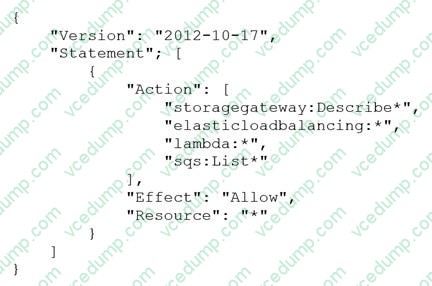
Which actions does this policy allow? (Select TWO.)
A. Create an AWS Storage Gateway.
B. Create an IAM role for an AWS Lambda function.
C. Delete an Amazon Simple Queue Service (Amazon SQS) queue.
D. Describe AWS load balancers.
E. Invoke an AWS Lambda function. -
Question 455:
A company is creating a new multi-account environment in AWS Organizations.
The company will use AWS Control Tower to deploy the environment. Users must be able to create resources in approved AWS Regions only.
The company must configure and govern all accounts by using a standard baseline configuration
Which combination of steps will meet these requirements in the MOST operationally efficient way? (Select TWO.)
A. Create a permission set and a custom permissions policy in AWS IAM Identity Center (AWS Single Sign-On) for each user to prevent each user from creating resources in unapproved Regions.
B. Deploy AWS Config rules in each AWS account to govern the account's security compliance and to delete any resources that are created in unapproved Regions.
C. Deploy AWS Lambda functions to configure security settings across all accounts in the organization and to delete any resources that are created in unapproved Regions.
D. Implement a service control policy (SCP) to deny any access to AWS based on the requested Region.
E. Modify the AWS Control Tower landing zone settings to govern the approved Regions. -
Question 456:
A company stores data in Amazon S3 buckets that are provisioned in three separate AWS Regions. The data is copied from the S3 buckets to the data center over the public internet using a VPN. The SysOps administrator notices that, occasionally, the transfers take longer than usual, and determines the issue is congestion within the company's ISP network.
What is the MOST cost-effective approach the administrator can take to ensure consistent transfer times from S3 to the data center?
A. Establish an AWS Direct Connect link to each Region. Create a private virtual interface over each link.
B. Establish an AWS Direct Connect link to each Region. Create a public virtual interface over each link.
C. Establish an AWS Direct Connect link to one of the Regions. Create a private virtual interface over that link.
D. Establish an AWS Direct Connect link to one of the Regions. Create a public virtual interface over that link. -
Question 457:
To configure central configuration for Security Hub in an AWS Organization, the SysOps administrator must ensure it's set up centrally.
A. Enable Security Hub in the organization's management account. Configure Security Hub central configuration.
B. Enable Security Hub in the organization's management account. Configure and integrate AWS Trusted Advisor. Configure Security Hub from an opt-in Region.
C. Delegate an AWS account that is not the organization's management account as the Security Hub administrator. Configure Security Hub central configuration.
D. Delegate an AWS account that is not the organization's management account as the Security Hub administrator. Configure and integrate AWS Trusted Advisor. Configure Security Hub from an opt-in Region. -
Question 458:
A SysOps administrator needs to design a disaster recovery (DR) plan for an application on AWS. The application runs on Amazon EC2 instances behind an Application Load Balancer (ALB). The instances are in an Auto Scaling group. The application uses an Amazon Aurora PostgreSQL database. The recovery time objective (RTO) and recovery point objective (RPO) are 15 minutes each.
Which combination of steps should the SysOps administrator take to meet these requirements MOST cost-effectively? (Choose two.)
A. Configure Aurora backups to be exported to the DR Region.
B. Configure the Aurora cluster to replicate data to the DR Region by using the Aurora global database option.
C. Configure the DR Region with an ALB and an Auto Scaling group. Use the same configuration as in the primary Region.
D. Configure the DR Region with an ALB and an Auto Scaling group. Set the Auto Scaling group's minimum capacity, maximum capacity, and desired capacity to 1.
E. Manually launch a new ALB and a new Auto Scaling group by using AWS CloudFormation during a failover activity. -
Question 459:
A Sysops administrator launches an Amazon EC2 instance from a Windows Amazon Machine Image (AMI). The EC2 instance includes additional Amazon Elastic Block Store (Amazon EBS) volumes. When the instance is launched, none of the additional Amazon Elastic Block Store (Amazon EBS) volumes are initialized and ready for use through a drive letter. The SysOps administrator needs to automate the EBS volume initialization.
Which solution will meet these requirements in the MOST operationally efficient way?
A. Create an Amazon EventBridge rule. Configure an AWS Systems Manager Automation runbook as a target of the EventBridge rule to initialize the disks after an EC2 instance launch event.
B. Create an AmazolkventBridge rule. Configure an AWS Lambda function as a target of the EventBridge rule to initialize the drives after the AMI is launched.
C. Create an AWS Config rule to automatically initialize the EBS volumes on Windows EC2 instances.
D. Add the secondary volume configuration to the DriveLetterMappingConfig.json file. Configure the InitializeDisks.ps1 Windows PowerShell script to run at launch. Create a new AMI from the running EC2 instance. -
Question 460:
A company's SysOps administrator manages a fleet of Windows Amazon EC2 instances that run in a single AWS account. The instances have a tag that includes a key of "OS" and a value of "Windows." The company uses AWS Systems Manager to patch the instances.
The company has installed the Amazon CloudWatch agent on the instances, but the configuration is inconsistent. The SysOps administrator needs to reconfigure every instance to use the same predefined CloudWatch configuration.
Which combination of steps will meet these requirements? (Choose two.)
A. Store the CloudWatch agent configuration file in an Amazon S3 bucket.
B. Store the contents of the CloudWatch agent configuration file in Systems Manager OpsCenter.
C. Store the contents of the CloudWatch agent configuration file in Systems Manager Parameter Store.
D. Create a Systems Manager State Manager association to run the AmazonCloudWatch-ManageAgent Systems Manager Run Command document. Select Systems Manager as an optional configuration source. Target the instances based on tag values.
E. Create a Systems Manager State Manager association to run the AmazonCloudWatch-ManageAgent Systems Manager Run Command document. Configure the document to use the S3 bucket location as the configuration source. Target the instances based on tag value.
Related Exams:
-
AIF-C01
Amazon AWS Certified AI Practitioner (AIF-C01) -
AIP-C01
AWS Certified Generative AI Developer - Professional -
ANS-C00
AWS Certified Advanced Networking - Specialty (ANS-C00) -
ANS-C01
AWS Certified Advanced Networking - Specialty (ANS-C01) -
AXS-C01
AWS Certified Alexa Skill Builder - Specialty (AXS-C01) -
BDS-C00
AWS Certified Big Data - Speciality (BDS-C00) -
CLF-C02
AWS Certified Cloud Practitioner (CLF-C02) -
DAS-C01
AWS Certified Data Analytics - Specialty (DAS-C01) -
DATA-ENGINEER-ASSOCIATE
AWS Certified Data Engineer - Associate (DEA-C01) -
DBS-C01
AWS Certified Database - Specialty (DBS-C01)
Tips on How to Prepare for the Exams
Nowadays, the certification exams become more and more important and required by more and more enterprises when applying for a job. But how to prepare for the exam effectively? How to prepare for the exam in a short time with less efforts? How to get a ideal result and how to find the most reliable resources? Here on Vcedump.com, you will find all the answers. Vcedump.com provide not only Amazon exam questions, answers and explanations but also complete assistance on your exam preparation and certification application. If you are confused on your SOA-C02 exam preparations and Amazon certification application, do not hesitate to visit our Vcedump.com to find your solutions here.