SOA-C02 Exam Details
-
Exam Code
:SOA-C02 -
Exam Name
:AWS Certified SysOps Administrator - Associate (SOA-C02) -
Certification
:Amazon Certifications -
Vendor
:Amazon -
Total Questions
:657 Q&As -
Last Updated
:Oct 14, 2025
Amazon SOA-C02 Online Questions & Answers
-
Question 261:
A Sysops administrator needs to configure automatic rotation for Amazon RDS database credentials. The credentials must rotate every 30 days. The solution must integrate with Amazon RDS. Which solution will meet these requirements with the LEAST operational overhead?
A. Store the credentials in AWS Systems Manager Parameter Store as a secure string. Configure automatic rotation with a rotation interval of 30 days.
B. Store the credentials in AWS Secrets Manager. Configure automatic rotation with a rotation interval of 30 days.
C. Store the credentials in a file in an Amazon S3 bucket. Deploy an AWS Lambda function to automatically rotate the credentials every 30 days.
D. Store the credentials in AWS Secrets Manager. Deploy an AWS Lambda function to automatically rotate the credentials every 30 days. -
Question 262:
A company hosts a web application on an Amazon EC2 instance. The web server logs are published to Amazon CloudWatch Logs. The log events have the same structure and include the HTTP response codes that are associated with the
user requests. The company needs to monitor the number of times that the web server returns an HTTP 404 response.
What is the MOST operationally efficient solution that meets these requirements?
A. Create a CloudWatch Logs metric filter that counts the number of times that the web server returns an HTTP 404 response.
B. Create a CloudWatch Logs subscription filter that counts the number of times that the web server returns an HTTP 404 response.
C. Create an AWS Lambda function that runs a CloudWatch Logs Insights query that counts the number of 404 codes in the log events during the past hour.
D. Create a script that runs a CloudWatch Logs Insights query that counts the number of 404 codes in the log events during the past hour. -
Question 263:
A SysOps administrator must configure a resilient tier of Amazon EC2 instances for a high performance computing (HPC) application. The HPC application requires minimum latency between nodes. Which actions should the SysOps administrator take to meet these requirements? (Select TWO.)
A. Create an Amazon Elastic File System (Amazon EPS) file system Mount the file system to the EC2 instances by using user data
B. Create a Multi-AZ Network Load Balancer in front of the EC2 instances
C. Place the EC2 instances in an Auto Scaling group within a single subnet
D. Launch the EC2 instances into a cluster placement group
E. Launch the EC2 instances into a partition placement group -
Question 264:
A company that uses AWS Organizations has an organization that contains several AWS accounts. A SysOps administrator needs to implement controls to prevent an account from leaving the organization.
Which solution will meet these requirements?
A. Create a service control policy (SCP) that denies the LeaveOrganization action. Apply the SCP to the root organizational unit (OU).
B. Create a service control policy (SCP) that denies the RemoveAccountFromOrganization action. Apply the SCP to the root organizational unit (OU).
C. Deploy an AWS Lambda function in each member account to remove any Organizations permissions when a user is created.
D. Turn on AWS Config. Set up the account-part-of-organizations managed rule. Configure the rule to run every hour. -
Question 265:
A company has a new requirement stating that all resources in AWS must be tagged according to a set policy.
Which AWS service should be used to enforce and continually identify all resources that are not in compliance with the policy?
A. AWS CloudTrail
B. Amazon Inspector
C. AWSConfig
D. AWS Systems Manager -
Question 266:
A SysOps administrator notices that the cache hit ratio for an Amazon CloudFront distribution is less than 10%. The SysOps administrator needs to increase the cache hit ratio for the distribution, improve network performance, and reduce the load on the origin.
Which combination of actions should the SysOps administrator take to meet these requirements? (Choose two.)
A. Enable CloudFront Origin Shield for the required AWS Regions.
B. Change the viewer protocol policy to use HTTPS only.
C. Add a second origin. Create an origin group that includes both origins. Activate CloudFront origin failover.
D. Turn on automatic compression of objects in the cache behavior settings.
E. Increase the CloudFront TTL values in the cache behavior settings. -
Question 267:
A company's financial department needs to view the cost details of each project in an AWS account. A SysOps administrator must perform the initial configuration that is required to view cost for each project in Cost Explorer.
Which solution will meet this requirement?
A. Activate cost allocation tags. Add a project tag to the appropriate resources.
B. Configure consolidated billing. Create AWS Cost and Usage Reports.
C. Use AWS Budgets. Create AWS Budgets reports.
D. Use cost categories to define custom groups that are based on AWS cost and usage dimensions. -
Question 268:
A database is running on an Amazon RDS Mufti-AZ DB instance. A recent security audit found the database to be out of compliance because it was not encrypted. Which approach will resolve the encryption requirement?
A. Log in to the RDS console and select the encryption box to encrypt the database
B. Create a new encrypted Amazon EBS volume and attach it to the instance
C. Encrypt the standby replica in the secondary Availability Zone and promote it to the primary instance.
D. Take a snapshot of the RDS instance, copy and encrypt the snapshot and then restore to the new RDS instance -
Question 269:
A company has a large on-premises tape backup solution. The company has started to use AWS Storage Gateway. The company created a Tape Gateway to replace the existing on-premises hardware. The company's backup engineer noticed that some of the backup jobs that were supposed to write to AWS failed to run because of a "Not Enough Space" error.
The company does not want these failures to happen again. The company also wants to consistently have enough tape available on AWS.
What is the MOST operationally efficient way for a SysOps administrator to meet these requirements?
A. Create an AWS Lambda function that runs on an hourly basis and checks how many tapes have available space. If the available tapes are below a certain threshold, provision more.
B. Install the Amazon CloudWatch agent on the on-premises system. Push the log files to a CloudWatch log group. Create an AWS Lambda function that creates more tapes when the "Not Enough Space" error appears. Create a metric filter and a metric alarm that launches the Lambda function.
C. Create an additional Tape Gateway with its own set of tapes. Configure Amazon Simple Notification Service (Amazon SNS) to send a notification to the backup engineer if the tapes that are associated with the primary Tape Gateway do not have available space.
D. Configure tape auto-create on the Tape Gateway. In the auto-create settings, configure a minimum number of tapes, an appropriate barcode prefix, and a tape pool. -
Question 270:
A company has attached the following policy to an IAM user:
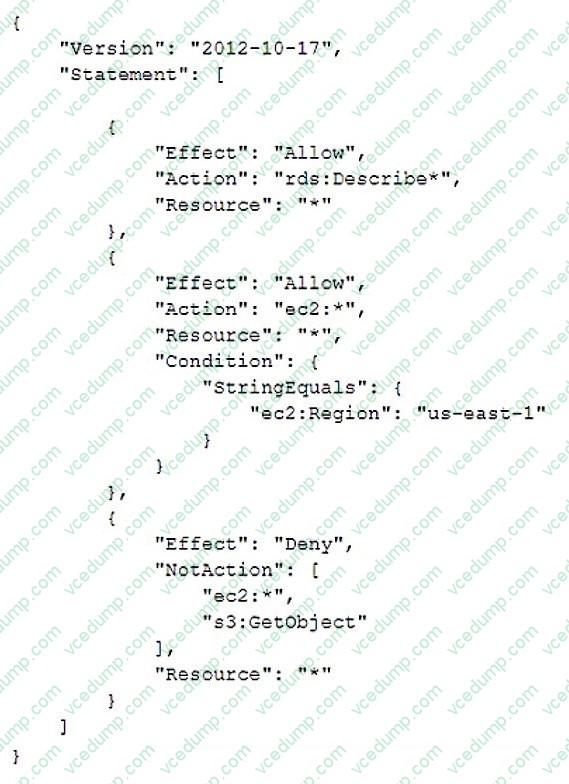
Which of the following actions are allowed for the IAM user?
A. Amazon RDS DescribeDBInstances action in the us-east-1 Region
B. Amazon S3 Putobject operation in a bucket named testbucket
C. Amazon EC2 Describe Instances action in the us-east-1 Region
D. Amazon EC2 AttachNetworkinterf ace action in the eu-west-1 Region
Related Exams:
-
AIF-C01
Amazon AWS Certified AI Practitioner (AIF-C01) -
AIP-C01
AWS Certified Generative AI Developer - Professional -
ANS-C00
AWS Certified Advanced Networking - Specialty (ANS-C00) -
ANS-C01
AWS Certified Advanced Networking - Specialty (ANS-C01) -
AXS-C01
AWS Certified Alexa Skill Builder - Specialty (AXS-C01) -
BDS-C00
AWS Certified Big Data - Speciality (BDS-C00) -
CLF-C02
AWS Certified Cloud Practitioner (CLF-C02) -
DAS-C01
AWS Certified Data Analytics - Specialty (DAS-C01) -
DATA-ENGINEER-ASSOCIATE
AWS Certified Data Engineer - Associate (DEA-C01) -
DBS-C01
AWS Certified Database - Specialty (DBS-C01)
Tips on How to Prepare for the Exams
Nowadays, the certification exams become more and more important and required by more and more enterprises when applying for a job. But how to prepare for the exam effectively? How to prepare for the exam in a short time with less efforts? How to get a ideal result and how to find the most reliable resources? Here on Vcedump.com, you will find all the answers. Vcedump.com provide not only Amazon exam questions, answers and explanations but also complete assistance on your exam preparation and certification application. If you are confused on your SOA-C02 exam preparations and Amazon certification application, do not hesitate to visit our Vcedump.com to find your solutions here.