SAP-C02 Exam Details
-
Exam Code
:SAP-C02 -
Exam Name
:AWS Certified Solutions Architect - Professional (SAP-C02) -
Certification
:Amazon Certifications -
Vendor
:Amazon -
Total Questions
:874 Q&As -
Last Updated
:Jul 12, 2026
Amazon SAP-C02 Online Questions & Answers
-
Question 471:
A company's solutions architect is reviewing a new internally developed application in a sandbox AWS account.
The application uses an AWS Auto Scaling group of Amazon EC2 instances that have an IAM instance profile attached Part of the application logic creates and accesses secrets from AWS Secrets Manager The company has an AWS Lambda function that calls the application API to test the functionality
The company also has created an AWS CloudTrail trail in the account
The application's developer has attached the SecretsManagerReadWnte AWS managed IAM policy to an IAM role.
The IAM role is associated with the instance profile that is attached to the EC2 instances.
The solutions architect has invoked the Lambda function for testing
The solutions architect must replace the SecretsManagerReadWnte policy with a new policy that provides least privilege access to the Secrets Manager actions that the application requires.
What is the MOST operationally efficient solution that meets these requirements?
A. Generate a policy based on CloudTrail events for the IAM role Use the generated policy output to create a new IAM policy Use the newly generated IAM policy to replace the SecretsManagerReadWnte policy that is attached to the IAM role
B. Create an analyzer in AWS Identity and Access Management Access Analyzer Use the IAM role's Access Advisor findings to create a new IAM policy Use the newly created IAM policy to replace the SecretsManagerReadWnte policy that is attached to the IAM role
C. Use the aws cloudtrail lookup-events AWS CLI command to filter and export CloudTrail events that are related to Secrets Manager Use a new IAM policy that contains the actions from CloudTrail to replace the SecretsManagerReadWnte policy that is attached to the IAM role
D. Use the IAM policy simulator to generate an IAM policy for the IAM role Use the newly generated IAM policy to replace the SecretsManagerReadWnte policy that is attached to the IAM role -
Question 472:
A company runs a popular web application in an on-premises data center. The application receives four million views weekly. The company expects traffic to increase by 200% because of an advertisement that will be published soon. The company needs to decrease the load on the origin before the increase of traffic occurs. The company does not have enough time to move the entire application to the AWS Cloud.
Which solution will meet these requirements?
A. Create an Amazon CloudFront content delivery network (CDN). Enable query forwarding to the origin. Create a managed cache policy that includes query strings. Use an on-premises load balancer as the origin. Offload the DNS querying to AWS to handle CloudFront CDN traffic.
B. Create an Amazon CloudFront content delivery network (CDN) that uses a Real Time Messaging Protocol (RTMP) distribution. Enable query forwarding to the origin. Use an on-premises load balancer as the origin. Offload the DNS querying to AWS to handle CloudFront CDN traffic.
C. Create an accelerator in AWS Global Accelerator. Add listeners for HTTP and HTTPS TCP ports. Create an endpoint group. Create a Network Load Balancer (NLB), and attach it to the endpoint group. Point the NLB to the on-premises servers. Offload the DNS querying to AWS to handle AWS Global Accelerator traffic.
D. Create an accelerator in AWS Global Accelerator. Add listeners for HTTP and HTTPS TCP ports. Create an endpoint group. Create an Application Load Balancer (ALB), and attach it to the endpoint group. Point the ALB to the on-premises servers. Offload the DNS querying to AWS to handle AWS Global Accelerator traffic. -
Question 473:
A solutions architect needs to provide AWS Cost and Usage Report data from a company's AWS Organizations management account.
The company already has an Amazon S3 bucket to store the reports
The reports must be automatically ingested into a database that can be visualized with other toots.
Which combination of steps should the solutions architect take to meet these requirements? (Select THREE )
A. Create an Amazon EventBridge (Amazon CloudWatch Events) rule that a new object creation in the S3 bucket will trigger
B. Create an AWS Cost and Usage Report configuration to deliver the data into the S3 bucket
C. Configure an AWS Glue crawler that a new object creation in the S3 bucket will trigger.
D. Create an AWS Lambda function that a new object creation in the S3 bucket will trigger
E. Create an AWS Glue crawler that me AWS Lambda function will trigger to crawl objects in me S3 bucket
F. Create an AWS Glue crawler that the Amazon EventBridge (Amazon CloudWatCh Events) rule will trigger to crawl objects m the S3 bucket -
Question 474:
A company is launching a new web application on Amazon EC2 instances. Development and production workloads exist in separate AWS accounts.
According to the company's security requirements, only automated configuration tools are allowed to access the production account. The company's security team wants to receive immediate notification if any manual access to the production AWS account or EC2 instances occurs.
Which combination of actions should a solutions architect take in the production account to meet these requirements? (Select THREE.)
A. Turn on AWS CloudTrail logs in the application's primary AWS Region Use Amazon Athena to queiy the logs for AwsConsoleSignln events.
B. Configure Amazon Simple Email Service (Amazon SES) to send email to the security team when an alarm is activated.
C. Deploy EC2 instances in an Auto Scaling group Configure the launch template to deploy instances without key pairs Configure Amazon CloudWatch Logs to capture system access logs Create an Amazon CloudWatch alarm that is based on the logs to detect when a user logs in to an EC2 instance
D. Configure an Amazon Simple Notification Service (Amazon SNS) topic to send a message to the security team when an alarm is activated
E. Turn on AWS CloudTrail logs for all AWS Regions. Configure Amazon CloudWatch alarms to provide an alert when an AwsConsoleSignin event is detected.
F. Deploy EC2 instances in an Auto Scaling group. Configure the launch template to delete the key pair after launch. Configure Amazon CloudWatch Logs for the system access logs Create an Amazon CloudWatch dashboard to show user logins over time. -
Question 475:
A company is in the process of implementing AWS Organizations to constrain its developers to use only Amazon EC2, Amazon S3, and Amazon DynamoDB. The developers account resides in a dedicated organizational unit (OU). The solutions architect has implemented the following SCP on the developers account:
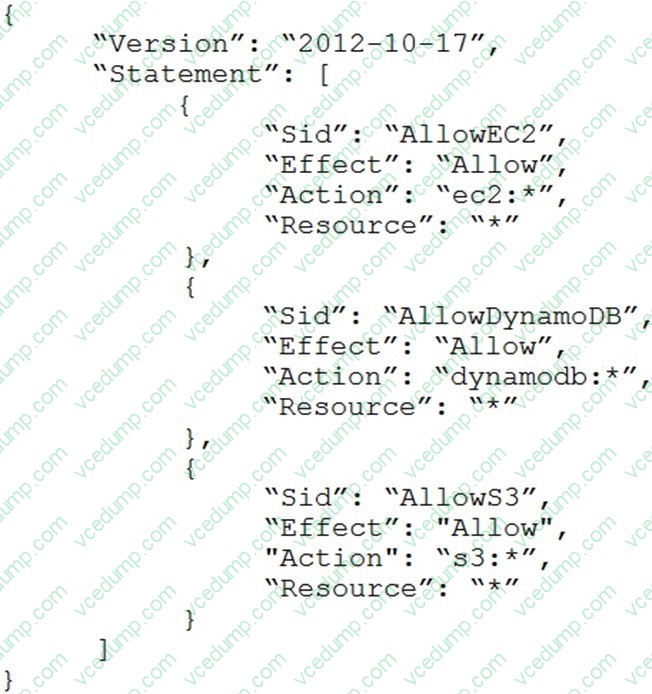
When this policy is deployed, IAM users in the developers account are still able to use AWS services that are not listed in the policy.
What should the solutions architect do to eliminate the developers' ability to use services outside the scope of this policy?
A. Create an explicit deny statement for each AWS service that should be constrained.
B. Remove the FullAWSAccess SCP from the Developer account's OU.
C. Modify the FullAWSAccess SCP to explicitly deny all services.
D. Add an explicit deny statement using a wildcard to the end of the SCP. -
Question 476:
A company is using an Amazon EMR cluster to run its big data jobs.
The cluster's jobs are invoked by AWS Step Functions Express Workflows that consume various Amazon Simple Queue Service (Amazon SQS) queues.
The workload of this solution is variable and unpredictable Amazon CloudWatch metrics show that the cluster's peak utilization is only 25% at times and that the cluster sits idle the rest of the time
A solutions architect must optimize the costs of the cluster without negatively impacting the time it takes to run the various jobs.
What is the MOST cost-effective solution that meets these requirements?
A. Modify the EMR cluster by turning on automatic scaling of the core nodes and task nodes with a custom policy that is based on cluster utilization Purchase Reserved Instance capacity to cover the master node.
B. Modify the EMR cluster to use an instance fleet of Dedicated On-Demand Instances for the master node and core nodes, and to use Spot Instances for the task nodes. Define target capacity for each node type to cover the load.
C. Purchase Reserved Instances for the master node and core nodes Terminate all existing task nodes in the EMR cluster
D. Modify the EMR cluster to use capacity-optimized Spot Instances and a diversified task fleet. Define target capacity for each node type with a mix of On-Demand Instances and Spot Instances. -
Question 477:
A company is changing the way that it handles patching of Amazon EC2 instances in its application account. The company currently patches instances over the internet by using a NAT gateway in a VPC in the application account.
The company has EC2 instances set up as a patch source repository in a dedicated private VPC in a core account. The company wants to use AWS Systems Manager Patch Manager and the patch source repository in the core account to patch the EC2 instances in the application account. The company must prevent all EC2 instances in the application account from accessing the internet.
The EC2 instances in the application account need to access Amazon S3, where the application data is stored. These EC2 instances need connectivity to Systems Manager and to the patch source repository in the private VPC in the core account.
Which solution will meet these requirements?
A. Create a network ACL that blocks outbound traffic on port 80. Associate the network ACL with all subnets in the application account. In the application account and the core account, deploy one EC2 instance that runs a custom VPN server. Create a VPN tunnel to access the private VPC. Update the route table in the application account.
B. Create private VIFs for Systems Manager and Amazon S3. Delete the NAT gateway from the VPC in the application account. Create a transit gateway to access the patch source repository EC2 instances in the core account. Update the route table in the core account.
C. Create VPC endpoints for Systems Manager and Amazon S3. Delete the NAT gateway from the VPC in the application account. Create a VPC peering connection to access the patch source repository EC2 instances in the core account. Update the route tables in both accounts.
D. Create a network ACL that blocks inbound traffic on port 80. Associate the network ACL with all subnets in the application account. Create a transit gateway to access the patch source repository EC2 instances in the core account. Update the route tables in both accounts. -
Question 478:
A company plans to deploy a new private Intranet service on Amazon EC2 instances inside a VPC. An AWS Site-to-Site VPN connects the VPC to the company's ort-premises network. The new service must communicate with existing on-premises services. The on-premises services are accessible through the use of hostnames that reside in the company example DNS zone. This DNS zone is wholly hosted on premises and is available only on the company's private network.
A solutions architect must ensure that the new service can resolve hostnames on the company.example domain to integrate with existing services.
Which solution meets these requirements?
A. Create an empty private zone in Amazon Route 53 for company.example. Add an additional NS record to the company's on-premises company.example zone that points to the authoritative name servers for the new private zone in Route
B. Turn on DNS hostnames for the VPC. Configure a new outbound endpoint with Amazon Route 53 Resolver. Create a Resolver rule to forward requests for company.example to the on-premises name servers.
C. Turn on DNS hostnames for the VPC. Configure a new inbound resolver endpoint with Amazon Route 53 Resolver. Configure the on-premises DNS server to forward requests for company.example to the new resolver.
D. Use AWS Systems Manager to configure a run document that will install a hosts file that contains any required hostnames. Use an Amazon Event8ndge (Amazon CloudWatch Events) rule lo run the document when an instance is entering the running state. -
Question 479:
A solutions architect at a large company needs to set up network security tor outbound traffic to the internet from all AWS accounts within an organization in AWS Organizations. The organization has more than 100 AWS accounts, and the accounts route to each other by using a centralized AWS Transit Gateway. Each account has both an internet gateway and a NAT gateway tor outbound traffic to the internet.
The company deploys resources only into a single AWS Region. The company needs the ability to add centrally managed rule-based filtering on all outbound traffic to the internet for all AWS accounts in the organization. The peak load of outbound traffic will not exceed 25 Gbps in each Availability Zone.
Which solution meets these requirements?
A. Create a new VPC for outbound traffic to the internet. Connect the existing transit gateway to the new VPC. Configure a new NAT gateway. Create an Auto Scaling group of Amazon EC2 instances that run an open-source internet proxy for rule-based filtering across all Availability Zones in the Region. Modify all default routes to point to the proxy ' s Auto Scaling group.
B. Create a new VPC for outbound traffic to the internet. Connect the existing transit gateway to the new VPC. Configure a new NAT gateway. Use an AWSNetwork Firewall firewall for rule-based filtering. Create Network Firewall endpoints in each Availability Zone. Modify all default routes to point to the Network Firewall endpoints.
C. Create an AWS Network Firewall firewall for rule-based filtering in each AWS account. Modify all default routes to point to the Network Firewall firewalls in each account.
D. In each AWS account, create an Auto Scaling group of network-optimized Amazon EC2 instances that run an open-source internet proxy for rule-based filtering. Modify all default routes to point to the proxy ' s Auto Scaling group. -
Question 480:
A global company has a mobile app that displays ticket barcodes. Customers use the tickets on the mobile app to attend live events. Event scanners read the ticket barcodes and call a backend API to validate the barcode data against data in a database. After the barcode is scanned, the backend logic writes to the database's single table to mark the barcode as used.
The company needs to deploy the app on AWS with a DNS name of api.example.com. The company will host the database in three AWS Regions around the world.
Which solution will meet these requirements with the LOWEST latency?
A. Host the database on Amazon Aurora global database clusters. Host the backend on three Amazon Elastic Container Service (Amazon ECS) clusters that are in the same Regions as the database. Create an accelerator in AWS Global Accelerator to route requests to the nearest ECS cluster. Create an Amazon Route 53 record that maps api.example.com to the accelerator endpoint
B. Host the database on Amazon Aurora global database clusters. Host the backend on three Amazon Elastic Kubernetes Service (Amazon EKS) clusters that are in the same Regions as the database. Create an Amazon CloudFront distribution with the three clusters as origins. Route requests to the nearest EKS cluster. Create an Amazon Route 53 record that maps api.example.com to the CloudFront distribution.
C. Host the database on Amazon DynamoDB global tables. Create an Amazon CloudFront distribution. Associate the CloudFront distribution with a CloudFront function that contains the backend logic to validate the barcodes. Create an Amazon Route 53 record that maps api.example.com to the CloudFront distribution.
D. Host the database on Amazon DynamoDB global tables. Create an Amazon CloudFront distribution. Associate the CloudFront distribution with a Lambda@Edge function that contains the backend logic to validate the barcodes. Create an Amazon Route 53 record that maps api.example.com to the CloudFront distribution.
Related Exams:
-
AIF-C01
Amazon AWS Certified AI Practitioner (AIF-C01) -
AIP-C01
AWS Certified Generative AI Developer - Professional -
ANS-C00
AWS Certified Advanced Networking - Specialty (ANS-C00) -
ANS-C01
AWS Certified Advanced Networking - Specialty (ANS-C01) -
AXS-C01
AWS Certified Alexa Skill Builder - Specialty (AXS-C01) -
BDS-C00
AWS Certified Big Data - Speciality (BDS-C00) -
CLF-C02
AWS Certified Cloud Practitioner (CLF-C02) -
DAS-C01
AWS Certified Data Analytics - Specialty (DAS-C01) -
DATA-ENGINEER-ASSOCIATE
AWS Certified Data Engineer - Associate (DEA-C01) -
DBS-C01
AWS Certified Database - Specialty (DBS-C01)
Tips on How to Prepare for the Exams
Nowadays, the certification exams become more and more important and required by more and more enterprises when applying for a job. But how to prepare for the exam effectively? How to prepare for the exam in a short time with less efforts? How to get a ideal result and how to find the most reliable resources? Here on Vcedump.com, you will find all the answers. Vcedump.com provide not only Amazon exam questions, answers and explanations but also complete assistance on your exam preparation and certification application. If you are confused on your SAP-C02 exam preparations and Amazon certification application, do not hesitate to visit our Vcedump.com to find your solutions here.