C8010-241 Exam Details

  • Exam Code
    :C8010-241
  • Exam Name
    :IBM Sterling Order Management V9.2 Solution Design
  • Certification
    :IBM Certifications
  • Vendor
    :IBM
  • Total Questions
    :54 Q&As
  • Last Updated
    :Jul 07, 2026

IBM C8010-241 Online Questions & Answers

  • Question 1:

    Which two of the following statements are TRUE about Customer profiles in Sterling Order Management?

    A. Customers can be hierarchical in nature reflecting the various departments within an organization.
    B. PCI regulations prohibit the storage of preferred payment method along with the Customer profile in Sterling.
    C. In order to ensure uniqueness of the CustomerID field, Customer profiles should be created and managed only within Sterling.
    D. Customer profiles are mandatory for orders to be processed within Sterling as sourcing rules are driven by customer's geography.
    E. Customer profiles can be managed external to Sterling, and Sterling can fetch the profile details from the external system on an as-needed basis.

  • Question 2:

    Which of the following Sterling Call Center business requirements CANNOT be implemented using the out of the box application?

    A. Monitor orders for FTC compliance.
    B. Schedule appointments for delivery items.
    C. Initiate returns and refunds to customers immediately, if required.
    D. Retrieve a WebSphere Commerce shopping cart from the Sterling Call Center.

  • Question 3:

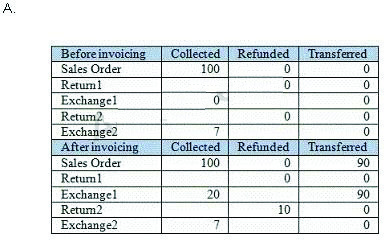
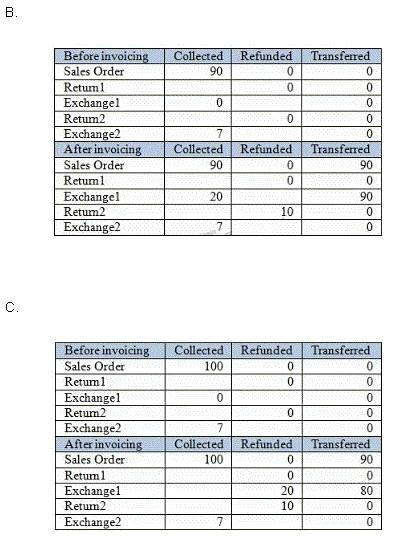
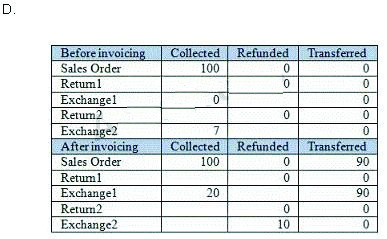
    A customer orders two lines, Item1 for $10 and Item2 for $90. The customer soon decides he wanted the updated model instead, and Return1 and Exchange1 were created for Item2 with a value of $110 as a regular exchange.

    Item1 was a gift and the recipient of the gift returned it for an alternate item of $7 value. Return2 and Exchange2 were created for Item1 with a value of $7 as an advanced pre-paid exchange.

    The items are received at the warehouse at the same time.

    Assuming the payment processing APIs are run, which of the following choices provides the correct details for:

    -Transferred, Collected and Refunded amounts, and

    -

    what the amounts were before and after the returns are invoiced?

    A. Exhibit A
    B. Exhibit B
    C. Exhibit C
    D. Exhibit D

  • Question 4:

    A business wishes to populate additional information on items for which there is no corresponding field in yfs_item. This can be achieved in two ways: 1.by extending yfs_item table, or 2.by populating the additional information as attribute

    name and value pairs on the item.

    Which use case will result in the selection of option 1?

    A. The new information is required as a Filter attribute on a UI.
    B. The new information needs to be searchable using searchCatalogIndex API.
    C. The new information needs to be searched extensively using getItemList and related APIs.
    D. The new information needs to be used to configure and determine pricing and entitlement rules.

  • Question 5:

    Which of the following functionalities is NOT available in Sterling Store?

    A. Cycle Count
    B. Ship from store
    C. Backroom Pick
    D. Receive at store

  • Question 6:

    A business (B1) has its own inventory for items at its internal distribution centers (DC). The business has also on boarded its manufacturers (M1 and M2) on Sterling Order Management. M1 and M2 have their own ecommerce portals, and they have inventory at their own DC. The requirements above have been modeled as follows: ?B1 is enterprise / seller - with inventory organization as B1 ?M1 is enterprise / seller - with inventory organization as M1 ?M2 is enterprise / seller with inventory organization as M2 ?M1 and M2 are consumable inventory organizations for B1

    Which of the following statements is INCORRECT?

    A. M1 can view assigned demands for M1 DC.
    B. M1 can view unassigned demands for M1 and B1 enterprise orders.
    C. M2 can view unassigned demands for M2 enterprise orders.
    D. B1 can view assigned demands for B1 DC, M1 DC, and M2 DC.

  • Question 7:

    In a current implementation of Sterling Order Management, there is a business requirement to:

    1.print item labels with barcodes for item IDs

    2.generate and print Operational Reports for the Order Processing.

    Which two of the following are supported by Sterling Order Management to meet this requirement?

    A. Jasper Reports
    B. Crystal Reports
    C. Loftware Reports
    D. IBM Cognos Reports
    E. GNU Enterprise Reports

  • Question 8:

    Which three of the following are TRUE in a single instance multi-schema deployment?

    A. Additional schemas can be added to an existing enterprise.
    B. Ship nodes can be shared across enterprise in separate schemas.
    C. Enterprises upgrade independently, due to isolation of Transaction data.
    D. Enterprises can inherit rules from another enterprise within different Configuration schemas.
    E. Enterprises can inherit rules from another enterprise within this same Configuration schema.
    F. Application server monitoring/maintenance can be performed at an aggregate level across all schemas.

  • Question 9:

    A customer would like a purchase order (PO) to be "Created", but it should only treat 80% of future supply as available. This should happen until the PO receives a status update that indicates its been "Approved", at which point 90% of the future supply can be considered for promising. Future supply can be considered when scheduling orders but should not be considered when releasing the pick instructions to the fulfillment center. In order to model this requirement with MINIMAL custom logic, the solution design must:

    A. 1. Create an extended status of PO "Created" which is "Approved". 2. Create a new supply type corresponding to the "Inbound approved" status. 3. Map the PO status "Approved" to the supply type "Inbound approved" and status "Created" to supply type "Purchase order placed". 4. Set up the appropriate safety factor of 80% for supply type "Purchase order placed" and 90% for supply type "Inbound approved". 5. Use Inventory considerations to map the demand type corresponding to schedule transaction to future supplies. 6. Use Inventory considerations to map the demand type corresponding to release transaction to use only onhand supplies.
    B. 1. Create an extended status of PO "Created" which is "Approved". 2. Create a new supply type corresponding to the "Inbound approved" status. 3. Map the PO status "Approved" to the supply type "Inbound approved" and status "Created" to supply type "Purchase order placed". 4. Set up the appropriate safety factor of 80% for demand type "Scheduled" and 90% for demand type "Released". 5. Use Inventory considerations to map the demand type corresponding to schedule transaction to future supplies. 6. Use Inventory considerations to map the demand type corresponding to release transaction to use only onhand supplies.
    C. 1. Create an extended status of PO "Created" which is "Approved". 2. Create a new supply type corresponding to the "Inbound approved" status. 3. Map the PO status "Approved" to the supply type "Inbound approved" and status "Created" to supply type "Purchase order placed". 4. Use Inventory considerations to map the demand type corresponding to schedule transaction to future supplies. 5. Use Inventory considerations to map the demand type corresponding to release transaction to use only onhand supplies. 6. Implement the Supply corrections user exit to only show 80% or 90% of supply as applicable.
    D. 1. Create an extended status of PO "Created" which is "Approved". 2. Create a new supply type corresponding to the "Inbound approved" status. 3. Map the PO status "Approved" to the supply type "Inbound approved" and status "Created" to supply type "Purchase order placed". 4. Use Inventory considerations to map the demand type corresponding to schedule transaction to future supplies. 5. Use Inventory considerations to map the demand type corresponding to release transaction to use only onhand supplies. 6. Implement the Availability corrections user exit to only show 80% or 90% of supply as applicable.

  • Question 10:

    Which of the following configurations CANNOT be possible with the out of the box functions related to the authorization and settlement process?

    A. Control the number of times an authorization can be used.
    B. Specify the authorization that should be used for a specific settlement.
    C. Raise a notification for an unused authorization X hours prior to expiration.
    D. Determine whether an Authorization amount can exceed the Settlement amount.

Tips on How to Prepare for the Exams

Nowadays, the certification exams become more and more important and required by more and more enterprises when applying for a job. But how to prepare for the exam effectively? How to prepare for the exam in a short time with less efforts? How to get a ideal result and how to find the most reliable resources? Here on Vcedump.com, you will find all the answers. Vcedump.com provide not only IBM exam questions, answers and explanations but also complete assistance on your exam preparation and certification application. If you are confused on your C8010-241 exam preparations and IBM certification application, do not hesitate to visit our Vcedump.com to find your solutions here.