350-401 Exam Details
-
Exam Code
:350-401 -
Exam Name
:Implementing and Operating Cisco Enterprise Network Core Technologies (ENCOR) -
Certification
:CCIE Enterprise Wireless -
Vendor
:Cisco -
Total Questions
:1524 Q&As -
Last Updated
:Jul 18, 2026
Cisco 350-401 Online Questions & Answers
-
Question 791:
DRAG DROP
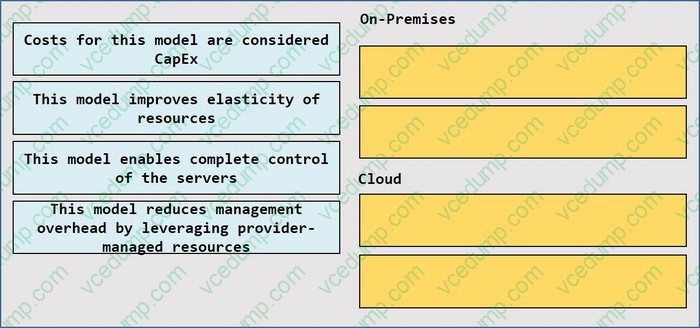
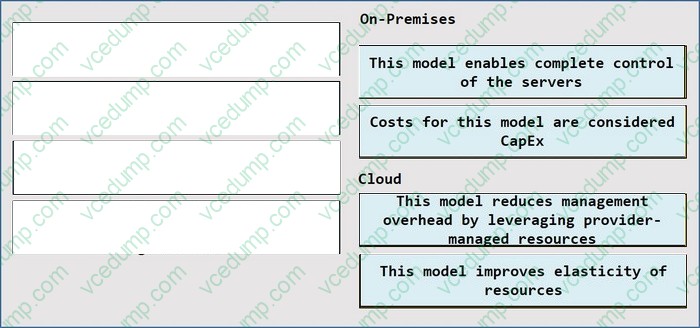
Drag and drop the characteristics from the left onto the infrastructure deployment models on the right.
Select and Place:
-
Question 792:
Refer to the exhibit.
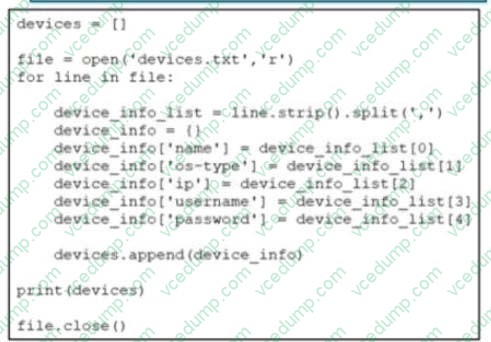
What is achieved when this Python script is executed?
A. Each device that is looped through in the devices.txt file is put into its own list that is appended to the parent dictionary.
B. Each device that is looped through in the devices.txt file is put into its own dictionary that is appended to the parent list.
C. All devices that are looped through in the devices.txt file are put into a list that is appended to the parent dictionary.
D. All devices that are looped through in the devices.txt file are put into a single dictionary that is appended to the parent list. -
Question 793:
What is an emulated machine that has dedicated compute, memory, and storage resources and a fully installed operating system?
A. host
B. mainframe
C. container
D. virtual machine -
Question 794:
You have configured router R1 with multiple VRF's in order to support multiple customer VPN networks.
If you wanted to see the best path for the 10.2.1.0.24 route in VRF Green, what command would you use?
A. show ip route vrf Green 10.2.1.0
B. show ip route 10.2.1.0 vrf Green
C. show route all 10.2.1.0
D. show ip route 10.2.1.0 Green -
Question 795:
Refer to the exhibit.
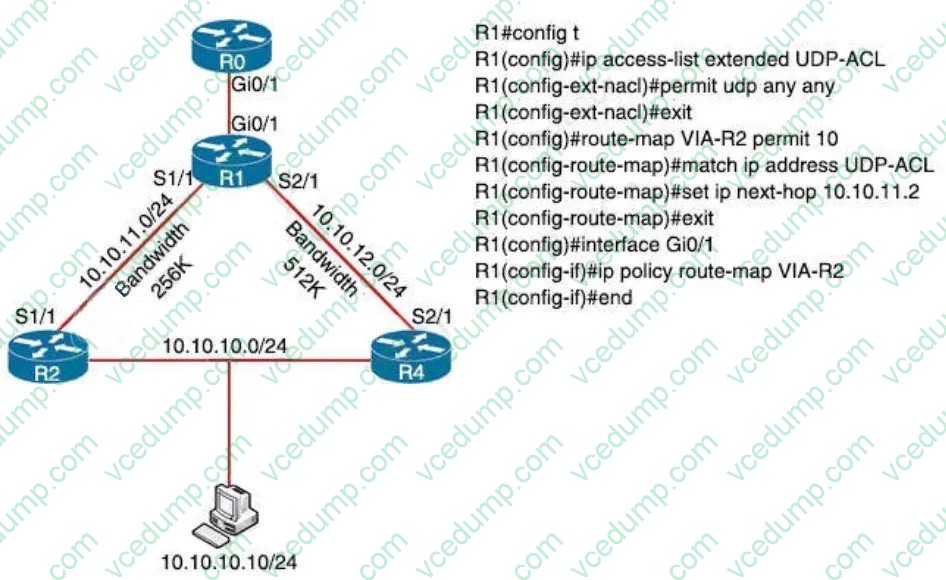
TCP traffic should be reaching host 10.10.10.10/24 via R2.
Which action resolves the issue?
A. Allow TCP in the access list with no changes to the route map.
B. Set IP next-hop to 10.10.12.2 under the route-map permit 10 to allow TCP traffic.
C. Add a permit 20 statement in the route map to allow TCP traffic.
D. TCP traffic will reach the destination via R2 without any changes. -
Question 796:
What are two benefits of YANG? (Choose two.)
A. It enables multiple leaf statements to exist within a leaf list
B. It collects statistical constraint analysis information.
C. It enforces configuration constraints.
D. It enforces configuration semantics.
E. It enforces the use of a specific encoding format for NETCONF -
Question 797:
Which statement about when you configure FlexConnect APs and you want to set up Cisco Centralized Key Management fast roaming is true?
A. FlexConnect groups are required for Cisco Centralized Key Management fast roaming to work with FlexConnect access points.
B. APs that are in the same FlexConnect group but associated to different WLCs support Cisco Centralized Key Management.
C. Cisco Centralized Key Management fast roaming among FlexConnect and non-FlexConnect access points is supported.
D. The FlexConnect access point must be in standalone mode to support Cisco Centralized Key Management. -
Question 798:
Which encryption hashing algorithm does NTP use for authentication?
A. SSL
B. MD5
C. AES128
D. AES256 -
Question 799:
Which characteristic distinguishes Ansible from Chef?
A. Ansible lacs redundancy support for the master server. Chef runs two masters in an active/active mode.
B. Ansible uses Ruby to manage configurations. Chef uses YAML to manage configurations.
C. Ansible pushes the configuration to the client. Chef client pulls the configuration from the server.
D. The Ansible server can run on Linux, Unix or Windows. The Chef server must run on Linux or Unix. -
Question 800:
SIMULATION
Guidelines
This is a lab item in which tasks will be performed on virtual devices.
1. Refer to the Tasks tab to view the tasks for this lab item.
2. Refer to the Topology tab to access the device console(s) and perform the tasks.
3. Console access is available for all required devices by clicking the device icon or using the tab(s) above the console window.
4. All necessary preconfigurations have been applied.
5. Do not change the enable password or hostname for any device.
6. Save your configurations to NVRAM before moving to the next item.
7. Click Next at the bottom of the screen to submit this lab and move to the next question.
8. When Next is clicked, the lab closes and cannot be reopened.
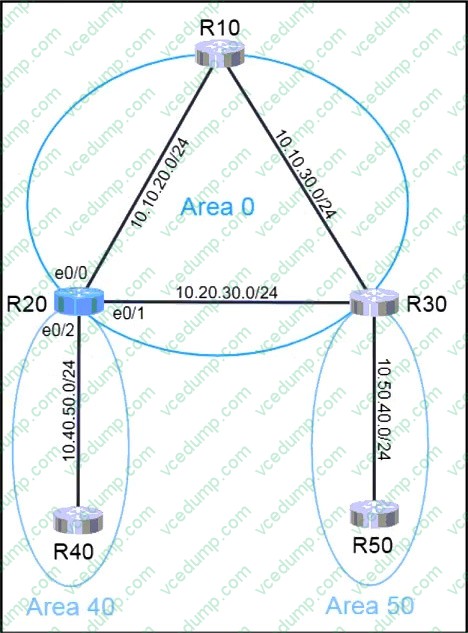
Topology
Tasks
OSPF is preconfigured on all devices except R20. Configure R20 to complete these tasks.
Task 1:
Configure OSPF according to the topology using these requirements:
1. Use Process ID 20.
2. Use Loopback0 for the Router ID.
3. Advertise all networks into OSPF.
- Do not use network statements under the OSPF process to accomplish this task.
Task 2:
Configure a /18 summary route for Area 40.
Advertise only Type 3 LSAs into Area 0.
R20
A. See the solution below in Explanation.
B. Place Holder
C. Place Holder
D. Place Holder
Tips on How to Prepare for the Exams
Nowadays, the certification exams become more and more important and required by more and more enterprises when applying for a job. But how to prepare for the exam effectively? How to prepare for the exam in a short time with less efforts? How to get a ideal result and how to find the most reliable resources? Here on Vcedump.com, you will find all the answers. Vcedump.com provide not only Cisco exam questions, answers and explanations but also complete assistance on your exam preparation and certification application. If you are confused on your 350-401 exam preparations and Cisco certification application, do not hesitate to visit our Vcedump.com to find your solutions here.