2016-FRR Exam Details
-
Exam Code
:2016-FRR -
Exam Name
:Financial Risk and Regulation (FRR) Series -
Certification
:GARP Certifications -
Vendor
:GARP -
Total Questions
:342 Q&As -
Last Updated
:Jun 27, 2026
GARP 2016-FRR Online Questions & Answers
-
Question 81:
Which one of the following four relationships should be used to price equity forwards or futures?
A. Equity forward or futures price = market equity price + (1 + risk-free rate ?expected dividend rate)t
B. Equity forward or futures price = market equity price x (1 - risk-free rate ?expected dividend rate)t
C. Equity forward or futures price = market equity price x (1 + risk-free rate ?expected dividend rate)t
D. Equity forward or futures price = market equity price + (1 + risk-free rate + expected dividend rate)t -
Question 82:
Bank Sigma takes a long position in the oil futures market that requires a 2% margin, i.e., the bank has to deposit 2% of the value of the contract with the broker. The futures contracts were priced at $50 per barrel (bbl) at inception, and rose by $5 to $55. The VaR on the position is estimated to be $10. What is the return on this transaction on a risk adjusted basis?
A. 50%
B. 10%
C. 500%
D. 20% -
Question 83:
Which of the following statements is a key difference between customer loans and interbank loans?
A. Customers are less credit-worthy than banks on average and hence yields are higher on average for customer loans as compared to interbank loans
B. Customer loans are of shorter duration than interbank loans
C. Customer loans are easier to sell than interbank loans
D. Interbank loans are more customized than commercial loans -
Question 84:
A risk manager has a long forward position of USD 1 million but the option portfolio decreases JPY 0.50 for every JPY 1 increase in his forward position. At first approximation, what is the overall result of the options positions?
A. The options positions hedge the forward position by 25%.
B. The option positions hedge the forward position by 50%.
C. The option positions hedge the forward position by 75%.
D. The option positions hedge the forward position by 100%. -
Question 85:
A bank owns a portfolio of bonds whose composition is shown below.
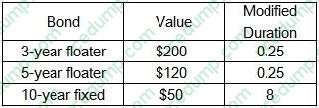
What is the modified duration of the portfolio?
A. 1.30
B. 8.5
C. 2.30
D. 0.5 -
Question 86:
Foreign exchange rates are determined by various factors. Considering the drivers of exchange rates, which one of the following changes would most likely strengthen the value of the USD against other foreign currencies?
A. The expected US inflation rate increases
B. The global demand for US products decreases
C. The economic performance in the US weakens
D. The US current account surplus increases -
Question 87:
Which one of the following areas does not typically report into a central operational risk function?
A. Business continuity planning
B. Information security
C. Geopolitical and strategic planning
D. Embedded operational risk coordinators or specialists or managers -
Question 88:
Which of the following factors can cause obligors to default at the same time?
I. Obligors may be harmed by exposures to similar risk factors simultaneously.
II. Obligors may exhibit herd behavior.
III. Obligors may be subject to the sampling bias.
IV.
Obligors may exhibit speculative bias.
A. I
B. II, III
C. I, II
D. III, IV
I. Obligors may be harmed by exposures to similar risk factors simultaneously. II. Obligors may exhibit herd behavior. III. Obligors may be subject to the sampling bias. IV. Obligors may exhibit speculative bias. -
Question 89:
To quantify the aggregate average loss for the credit portfolio and its possible constituent subportfolios, a credit portfolio manager should use the following metric:
A. Credit VaR
B. Expected loss
C. Unexpected loss
D. Factor sensitivity -
Question 90:
Which one of the following four statements about equity indices is INCORRECT?
A. Equity indices are numerical calculations that reflect the performance of hypothetical equity portfolios.
B. Equity indices do not trade in cash form, rather, they are meant to track the overall performance of an equity market.
C. Capitalization-weighted equity indices are not generally considered better to track the performance of an overall market.
D. Price-weighted equity indices give greater weight to shares trading at high prices.
Tips on How to Prepare for the Exams
Nowadays, the certification exams become more and more important and required by more and more enterprises when applying for a job. But how to prepare for the exam effectively? How to prepare for the exam in a short time with less efforts? How to get a ideal result and how to find the most reliable resources? Here on Vcedump.com, you will find all the answers. Vcedump.com provide not only GARP exam questions, answers and explanations but also complete assistance on your exam preparation and certification application. If you are confused on your 2016-FRR exam preparations and GARP certification application, do not hesitate to visit our Vcedump.com to find your solutions here.