A company wants to give its service agents a current view in Marketing Cloud of which journeys customers are in at any given time, so that agents can provide a more persona! and relevant experience if a customer contacts them. What approach should a Solution Architect recommend to fulfill this requirement?
-
A
Add the Journey Membership Lightning component from the Marketing Cloud Connect Managed Package to the Contact Page Layout.
-
B
Schedule a batch job in Salesforce to query Marketing Cloud for the contact membership status of all contacts in Journeys on a regular basis (for example, once per hour) and write this to the Contact record.
-
C
Develop a custom Lightning web component in Salesforce to query Marketing Cloud in real time to get Contact Journey membership.
-
D
Create a multi-select picklist on the contact record, and use the out-of-the-box Contact Update activities in Journey Builder to add or remove the name of the journey as they enter and exit.
Reveal answer details
Close answer details
Correct answerA
ExplanationThe Journey Membership Lightning component is a pre-built component that displays the journeys that a contact is in and their status in each journey. It can be added to the Contact Page Layout in Service Cloud using the Marketing Cloud Connect Managed Package, which enables integration between Service Cloud and Marketing Cloud.
References:
https://help.salesforce.com/s/articleView?id=sf.mc_co_journey_membership_lightning_component.htm&type=5
https://help.salesforce.com/s/articleView?id=sf.mc_co_marketing_cloud_connect.htm&type=5
Question 2
Multiple choice
An organization wants to add Service Cloud to their existing Salesforce Org currently hosting Sales Cloud.
They know that an integrated customer service experience is a key component of a successful long-term relationship with their customers. After doing some research they learned that the Service Cloud connector can help start their implementation and they are now ready to proceed. Which two functionality considerations should they be aware of when introducing the B2C Commerce to Service Cloud Connector into an existing Salesforce Org? Choose 2 answers
-
A
In order to implement the Service Cloud Connector it is necessary to enable Person Accounts, a change which cannot be reverted once implemented.
-
B
The Service Cloud Connector is distributed as a managed package that can be extended to meet client-specific needs but with core functionality that cannot be altered.
-
C
The Service Cloud Connector natively supports accounts and contacts, households, and multi-brand customer models.
-
D
The Service Cloud Connector provides a collection of Lightning and Visualforce components that display customer and order information within Service Cloud, which needs to be customized and deployed by a developer.
Reveal answer details
Close answer details
Correct answersA, B
ExplanationThe B2C Commerce to Service Cloud Connector is a solution that enables integration between B2C
Commerce and Service Cloud. It allows displaying customer and order information in Service Cloud, creating orders on behalf of customers, and synchronizing customer data between the two systems. When introducing the Service Cloud Connector into an existing Salesforce Org, the following functionality considerations should be aware of: In order to implement the Service Cloud Connector it is necessary to enable Person Accounts, a change which cannot be reverted once implemented. Person Accounts are a type of account in Salesforce that combines an account and a contact into a single record. The Service Cloud Connector requires Person Accounts to store customer information from B2C Commerce. Enabling Person Accounts is an irreversible change that affects the entire Salesforce Org and may have implications for other features or customizations. The Service Cloud Connector is distributed as a managed package that can be extended to meet client-specific needs but with core functionality that cannot be altered. A managed package is a collection of application components that can be installed from AppExchange or other sources. The Service Cloud Connector is a managed package that provides core functionality for integrating B2C
Commerce and Service Cloud. The core functionality cannot be modified or deleted, but it can be extended or customized using Apex code, Visualforce pages, or Lightning components.
Option C is incorrect because the Service Cloud Connector does not natively support accounts and contacts, households, and multi-brand customer models. It only supports person accounts as a customer model by default.
Option D is incorrect because the Service Cloud Connector provides a collection of Lightning components that display customer and order information within Service Cloud, which do not need to be customized or deployed by a developer.
References:
https://help.salesforce.com/s/articleView?id=sf.icx_b2c_overview.htm&type=5
https://help.salesforce.com/s/articleView?id=sf.accounts_person.htm&type=5
https://help.salesforce.com/s/articleView?id=sf.distribution_installing_packages.htm&type=5
Question 3
Multiple choice
A company has been using B2C Commerce for many years and recently decided to implement Service Cloud and Marketing Cloud. Currently, there are many issues with the integration between B2C Commerce and the legacy CRM, which means data is often out of Sav sync. Agencies currently manage the Marketing communication, and B2C Commerce is sending the messages. The main goal is to ensure Catksion that B2C Commerce can trigger multi-channel messaging via Marketing Cloud, leveraging the data the company has on customers to personalize the communication. Which three considerations should a Solution Architect keep in mind when recommending a migration strategy from the existing setup to the new one? Choose 3 answers
-
A
Customer data can be imported into Service Cloud from B2C Commerce and the legacy CRM without deduplication since Salesforce CDP can automatically merge duplicate records upon insert.
-
B
Service Cloud should be implemented before Marketing Cloud to ensure that the Salesforce Contact IDs can be used in Marketing Cloud as unique identifiers. Written
-
C
Customer data from B2C Commerce and the legacy CRM should be deduplicated before being imported into Service Cloud. Materials
-
D
Custom development work is required to connect B2C Commerce to Marketing Cloud and use the Salesforce Contact ID.
-
E
Marketing Cloud Connect should be configured to use an alternate external ID from Salesforce as the Contact Key to avoid duplicate contacts in Marketing Cloud.
Reveal answer details
Close answer details
Correct answersB, C, D
ExplanationB. Service Cloud should be implemented before Marketing Cloud to ensure that the Salesforce Contact IDs
can be used in Marketing Cloud as unique identifiers. This allows for a consistent and unified view of the customer across the Salesforce products and avoids duplicate contacts in Marketing Cloud.
C. Customer data from B2C Commerce and the legacy CRM should be deduplicated before being imported into Service Cloud. This ensures that there are no duplicate contacts in Service Cloud that could cause data quality issues or conflicts when syncing with Marketing Cloud.
D. Custom development work is required to connect B2C Commerce to Marketing Cloud and use the Salesforce Contact ID. This involves creating a service definition in B2C Commerce that points to Marketing Cloud's REST API and passing the Salesforce Contact ID as the contact key when triggering journeys or updating contact data. References:
https://help.salesforce.com/s/articleView?id=sf.mc_co_subscriber_key_migration.htm&type=5
https://developer.salesforce.com/docs/commerce/sfra/marketing-cloud/marketing-cloud-integration
Universal Containers (UC) is in the process of implementing a B2C Commerce site for their storefront, and Experience Cloud for their support and help desk. UC wants to ensure that there is a single login and data experience between the two sites while also being relatively seamless. Given the need for a single login experience, what should the primary system be for all authentication?
-
A
-
B
-
C
-
D
Reveal answer details
Close answer details
Correct answerA
ExplanationThis answer is correct because it is the primary system that should be used for all authentication between
B2C Commerce site and Experience Cloud site. Salesforce Identity can act as an identity provider (IDP) for both B2C Commerce and Experience Cloud, and it can provide a single login and data experience between the two sites. Salesforce Identity can also store customer profile data in a single place and sync it across systems.
References:
https://help.salesforce.com/s/articleView?id=sf.b2c_commerce_service_cloud_integration.htm&type=5
Refer to the exhibit. 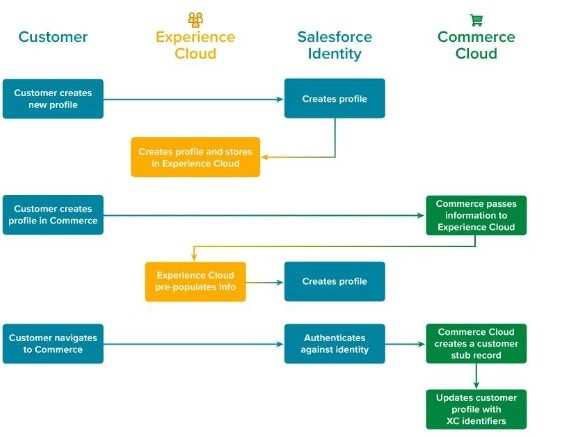 A beauty brand is planning to re-platform their existing website onto B2C Commerce. As part of the re-platform they will create a new social community where beauty insiders can view how-to videos, share tips, and favorite products. As part of the overall solution, the beauty brand is going to implement 82C
Commerce, Experience Cloud, and Salesforce Identity. Each beauty insider can store and update important profile and commerce information like email, phone number, beauty preferences, and saved addresses. Which application should a Solution Architect recommend to set up the primary profile after reviewing the workflow and attempting to minimize migration of customer profile data?
-
A
-
B
-
C
-
D
Reveal answer details
Close answer details
Correct answerD
ExplanationOption D is correct because B2C Commerce should be the system of record for the primary profile after reviewing the workflow and attempting to minimize migration of customer profile data. B2C Commerce is the first point of contact for customers who register an account before making their first purchase, and it can store and update important profile and commerce information like email, phone number, beauty preferences, and saved addresses. B2C Commerce can also integrate with Experience Cloud and Salesforce Identity to provide a consistent and secure user experience across the social community and the ecommerce site.
Option A is incorrect because Salesforce Identity should not be the system of record for the primary profile after reviewing the workflow and attempting to minimize migration of customer profile data. Salesforce Identity is mainly used for authentication and identity management purposes, not for storing and updating customer profile and commerce information. Salesforce Identity can also integrate with Experience Cloud and B2C Commerce to provide a single sign-on (SSO) experience for customers across the social community and the ecommerce site.
Option B is incorrect because Address book should not be the system of record for the primary profile after reviewing the workflow and attempting to minimize migration of customer profile data. Address book is not a system or an application, but rather a feature or a data element that can be stored and updated in B2C Commerce or other Salesforce clouds.
Option C is incorrect because Wishlist should not be the system of record for the primary profile after reviewing the workflow and attempting to minimize migration of customer profile data. Wishlist is not a system or an application, but rather a feature or a data element that can be stored and updated in B2C
Commerce or other Salesforce clouds.
References:
[Get Started with B2C Solution Architect Cert Prep - Trailhead] [Certification - B2C Solution Architect -
Trailhead] B2C Solution Architect Certification Guide | Salesforce Ben
Question 6
Multiple choice
A financial services firm with many high net-worth individuals Is about to implement Service Cloud, Marketing Cloud, and Salesforce Platform. Given the nature of the individuals, they are often required to adhere to financial regulations and civil procedures in regards to their data. This often requires restricting their data processing. Given that requirement, what are three considerations the financial services firm should be aware of when limiting data processing across these clouds? Choose 3 answers
-
A
Removing a data processing restricted contact within Marketing Cloud requires removing the restriction first before removing the contact
-
B
Consider deleting all of the customer data in order to adhere to the requirements.
-
C
Restricting data within Service Cloud requires contacting a Service Cloud account representative.
-
D
Export relevant customer data on Salesforce Platform so it is retained first before deleting or providing any data.
-
E
Restricting data within Marketing Cloud requires contacting a Marketing Cloud account representative.
Reveal answer details
Close answer details
Correct answersA, D, E
ExplanationThese are three considerations that the financial services firm should be aware of when limiting data processing across these clouds. Removing a data processing restricted contact within Marketing Cloud requires removing the restriction first before removing the contact, as deleting a restricted contact will result in an error message. Exporting relevant customer data on Salesforce Platform so it is retained first before deleting or providing any data is a best practice for complying with data requests or regulations.
Restricting data within Marketing Cloud requires contacting a Marketing Cloud account representative, as this feature is not available in the user interface.
A company currently uses B2C Commerce and Service Cloud for one of its storefronts. They are now considering implementing the 'Order on Behalf of flow. Which consideration must a Solution Architect keep in mind while implementing the 'Order on Behalf of flow?
-
A
The Service Cloud Connector is not available for guests or anonymous storefront shoppers. Use Order on Behalf with registered B2C Commerce customer accounts.
-
B
The Service Cloud Connector enables data synchronization through SOAP services using Service Cloud and B2C Commerce. REST services are not available for such data synchronization needs.
-
C
The Service Cloud Connector does not require B2C Commerce to be registered as a remote site as long as the Service Cloud org and B2C Commerce realm are in the same geographic region.
-
D
The Service Cloud Connector can work with any valid Service Cloud user. There is no specific need for an Integration User with administrative rights.
Reveal answer details
Close answer details
Correct answerA
ExplanationA is correct because the Service Cloud Connector only works with registered B2C Commerce customer accounts and does not support guests or anonymous storefront shoppers. The connector uses the customer ID to link the Service Cloud contact with the B2C Commerce customer profile.
B is incorrect because the Service Cloud Connector supports both SOAP and REST services for data synchronization between Service Cloud and B2C Commerce.
C is incorrect because the Service Cloud Connector requires B2C Commerce to be registered as a remote site in Service Cloud regardless of the geographic region. This is to allow outbound messages from Service Cloud to B2C Commerce.
D is incorrect because the Service Cloud Connector requires a dedicated Integration User with administrative rights in both Service Cloud and B2C Commerce. This user is used to authenticate and authorize the data synchronization between the two systems.
References:
https://documentation.b2c.commercecloud.salesforce.com/DOC1/topic/com.demandware.dochelp/ServiceCloud/ServiceCloudConnectorOverview.html
https://documentation.b2c.commercecloud.salesforce.com/DOC1/topic/com.demandware.dochelp/ServiceCloud/ServiceCloudConnectorDataSynchronization.html
https://documentation.b2c.commercecloud.salesforce.com/DOC1/topic/com.demandware.dochelp/ServiceCloud/ServiceCloudConnectorSetup.html
https://documentation.b2c.commercecloud.salesforce.com/DOC1/topic/com.demandware.dochelp/ServiceCloud/ServiceCloudConnectorUserSetup.html
Question 8
Multiple choice
Northern Trail Outfitters (NTO) has an ERP application where all customer orders are stored. There are millions of older records stored in the ERP application and some customers may have thousands of individual orders. Additionally, some orders contain personally identifiable information (PII) that, due to company policy, can only be stored in ERP. NTO would like the five most recent orders displayed on the account page in Salesforce. What are three justifications for using Salesforce Connect in this solution? Choose 3 answers
-
A
Accessing external data using workflows and triggers
-
B
Need access to all external data in near real-time
-
C
Integrating external data without writing custom code
-
D
The external data is changing frequently
-
E
Need real-time access to a small fraction of external data
Reveal answer details
Close answer details
Correct answersB, D, E
ExplanationSalesforce Connect is a feature that allows accessing and integrating external data from various sources without copying or storing it in Salesforce. Salesforce Connect uses external objects and external data sources to create a virtual data model that can be used in Salesforce applications and tools. The justifications for using Salesforce Connect in this solution are: Need access to all external data in near real-time. Salesforce Connect allows accessing external data from ERP or other systems in near real-time, without any delays or synchronization issues. This ensures that the data is always up-to-date and consistent across systems.
The external data is changing frequently. Salesforce Connect allows reflecting any changes or updates made to the external data in ERP or other systems immediately in Salesforce, without requiring any manual intervention or batch processes. This ensures that the data is always accurate and reliable across systems.
Need real-time access to a small fraction of external data. Salesforce Connect allows accessing only a small fraction of external data that is relevant and needed for a specific use case, such as displaying customer order history or details. This reduces network overhead and improves performance.
Option A is incorrect because accessing external data using workflows and triggers is not possible or supported with Salesforce Connect.
Option C is incorrect because integrating external data without writing custom code is not a justification for using Salesforce Connect, as it may require some custom code or configuration depending on the data source and use case.
References:
https://help.salesforce.com/s/articleView?id=sf.datacloud_connect_overview.htm&type=5
https://help.salesforce.com/s/articleView?id=sf.datacloud_connect_considerations.htm&type=5
A company wants to use Marketing Cloud to send customer electronic receipts that originate from its point of sale (POS) system. The company has a need for the receipt to be sent no more than 10 minutes after purchase and would like to track all email sends that are being placed to that customer, The Marketing Cloud Contact Key should be the Service Cloud Contact ID. What solution should a Solution Architect recommend to achieve this need?
-
A
Make an API call from the POS to Marketing Cloud to send the electronic receipt and then call Service Cloud to add the customer if they do not exist. Use an automation in Marketing Cloud nightly to remove any duplicate contacts that may be introduced with Marketing Cloud Connect.
-
B
Make an API call from the POS to Service Cloud to retrieve the Service Cloud Contact ID. If the customer does not exist, submit a POST to Service Cloud to create the Contact ID, then send the Contact ID to Marketing Cloud via an API to send the electronic receipt.
-
C
Make an API call from the POS to Service Cloud to add the customer if they do not exist; leverage a
custom object to send details to Marketing Cloud via Marketing Cloud Connect and synchronized data sources to send the electronic receipt.
-
D
Make an API call from the POS to Marketing Cloud te send the electronic receipt. No call is required to Service Cloud to fetch the Contact IO as this information is already available at the POS.
Reveal answer details
Close answer details
Correct answerD
ExplanationThis solution allows the company to send the electronic receipt in near real time using the Marketing Cloud Transactional Messaging API, which can handle high-volume and time-sensitive messages. The POS system already has the Service Cloud Contact ID for the customer, so there is no need to make an extra API call to Service Cloud to fetch it. The Service Cloud Contact ID can be passed as the Marketing Cloud Contact Key to ensure data consistency across the systems. References:
https://developer.salesforce.com/docs/commerce/sfra/marketing-cloud/transactional-messaging-api
https://help.salesforce.com/s/articleView?id=sf.mc_co_subscriber_key_migration.htm&type=5
Question 10
Single choice
A company currently provides service to its customers using a call center and spreadsheets, Because of the lack of systems, there is no ability to track how successful agents are. In addition, the ordering system cannot be easily accessed by service agents, costing valuable time and hurting customer satisfaction. What should a Solution Architect say to convince the company to shift to a connected B2C Solution approach?
-
A
Agents will have easy access to customer data to provide a better service experience when customers call in.
-
B
Agents will have a better interface using Service Cloud and B2C Commerce with Heroku.
-
C
Agents can utilize SSO to launch an `Order on Behalf of' storefront experience within the B2C
Commerce UI.
-
D
Agents' success rates will be better measured after helping the company define ROI KPIs together.
Reveal answer details
Close answer details
Correct answerA
ExplanationA connected B2C Solution approach is an approach that allows integrating B2C Commerce and Service Cloud to provide a seamless and omnichannel experience for customers across different touchpoints. A connected B2C Solution approach can provide various benefits, such as increased customer satisfaction, loyalty, retention, and revenue. To convince the company to shift to a connected B2C Solution approach, a Solution Architect should say the following: Agents will have easy access to customer data to provide a better service experience when customers call in. By integrating B2C Commerce and Service Cloud using features such as Service Cloud Connector or Salesforce Order Management, agents will be able to access customer and order information from B2C
Commerce directly in Service Console without switching between multiple systems. This will enable agents to answer customer questions more quickly and accurately, resolve issues more efficiently, and offer personalized recommendations or solutions.
Option B is incorrect because agents will not have a better interface using Service Cloud and B2C
Commerce with Heroku. Heroku is a platform that allows building, running, and scaling custom web applications using various languages and frameworks. Heroku is not directly related to creating a connected B2C Solution approach, although it can be used to extend or customize the functionality of B2C
Commerce or Service Cloud. Option C is incorrect because agents cannot utilize SSO to launch an `Order on Behalf of' storefront experience within the B2C Commerce UI. SSO is a feature that allows users to log
in to multiple applications or systems with the same credentials. SSO does not enable launching an `Order on Behalf of' storefront experience within the B2C Commerce UI, which is a feature that allows agents to create orders on behalf of customers using the storefront login. To enable this feature, the company needs to use Service Cloud Connector or Salesforce Order Management to integrate B2C Commerce and Service Cloud. Option D is incorrect because agents' success rates will not be better measured after helping the company define ROI KPIs together. Although this is a possible benefit of shifting to a connected B2C Solution approach, it is not the most convincing or compelling one for the company's situation. The company's main pain point is the lack of systems and access to customer and order data, which affects their service quality and customer satisfaction. Therefore, the most convincing argument for shifting to a connected B2C Solution approach is how it can improve the service experience for both agents and customers by providing easy access to customer data. References:
https://help.salesforce.com/s/articleView?id=sf.icx_b2c_overview.htm&type=5
https://www.salesforce.com/products/commerce-cloud/ecommerce/order-management/
https://help.salesforce.com/s/articleView?id=sf.sso_about.htm&type=5
Question 11
Single choice
Universal Containers (UC) is sending Invoice data from an external ERP system into their Salesforce org.
Management is worried about data storage in their org, and after some analyses, they have identified the ERP Invoice records responsible for over 40% of the data storage. Their current business process does not require a Salesforce user to edit these records, so they can be read-only. What recommendation should a Solution Architect make in order to reduce the storage size in Salesforce and still be able to access the ERP Invoice records in Salesforce?
-
A
Use Change Data Capture to sync Invoice records
-
B
Build a custom solution to view the ERP Invoice records in Salesforce
-
C
Use Platform Events to sync Invoice record changes
-
D
Use Salesforce Connect/External Objects (with custom Apex adapters)
Reveal answer details
Close answer details
Correct answerD
ExplanationThis answer is correct because it is a way to reduce the storage size in Salesforce and still be able to access the ERP Invoice records in Salesforce. Salesforce Connect/External Objects can be used to display external data in Salesforce without copying or storing it. Custom Apex adapters can be used to connect to any external system that has a web service API, such as an ERP system. References:
https://help.salesforce.com/s/articleView?id=sf.datacloud_connect.htm&type=5
https://developer.salesforce.com/docs/atlas.en-us.apexcode.meta/apexcode/apex_connector_intro.htm
Question 12
Single choice
Universal Containers (UC) wants to implement the right-to-be-forgotten requirement in their Salesforce org in order to be compliant with data privacy laws. This means that UC must delete, archive, or de-identify the data subject's PII in an org within 30 days of their request. What should a Solution Architect recommend to implement this requirement"*
-
A
Implement a custom solution that allows system administrators to run a job to obscure or delete the data in the request scope.
-
B
Create a team who can manually review these requests and delete or obscure the data from all relevant systems.
-
C
Recommend Salesforce Privacy Center to manage how the Salesforce org retains, deletes, anonymizes, and transfers customer data.
-
D
Implement a soft delete strategy by marking the data as "archived" or "deleted" without actually deleting it.
Reveal answer details
Close answer details
Correct answerC
ExplanationThis answer is correct because Salesforce Privacy Center is a tool that helps satisfy customer requests and data privacy laws related to the right-to-be-forgotten requirement. Salesforce Privacy Center allows admins to create policies that delete, archive, or de-identify the data subject's PII in an org within 30 days of their request, without additional development.
References:
https://help.salesforce.com/s/articleView?id=privacy_center.htm&type=5&language=en_US
Question 13
Multiple choice
A customer service team raised a new business requirement that requires a multi-cloud solution design between B2C Commerce, Service Cloud, and Marketing Cloud. A Solution Architect has been hired to lead the design of the multi-cloud solution. Which two actions should the Solution Architect take to accurately capture requirements and deliver the solution overview? Choose 2 answers
-
A
Include functional subject matter experts and technical resources across multiple discovery workshops, grouped by business function to ensure all requirements are captured.
-
B
Conduct discovery workshops and upon completion present the solution back to the design authority or executive stakeholders to validate the solution.
-
C
Conduct discovery workshops to create a user acceptance testing document and invite business owners, each cloud technical architect, and implementation development team.
-
D
Include the customer service team so that they can provide detailed user stories prior to the discovery workshops.
Reveal answer details
Close answer details
Correct answersA, B
ExplanationA is correct because including functional subject matter experts and technical resources across multiple discovery workshops, grouped by business function, is a best practice for capturing requirements and ensuring alignment across different stakeholders.
B is correct because conducting discovery workshops and presenting the solution back to the design authority or executive stakeholders is a best practice for validating the solution and obtaining feedback and approval.
C is incorrect because conducting discovery workshops to create a user acceptance testing document is not the purpose of discovery workshops. User acceptance testing documents are created after the solution design is finalized and approved.
D is incorrect because including the customer service team to provide detailed user stories prior to the discovery workshops is not necessary. User stories are created during the discovery workshops based on the business requirements and pain points identified by the stakeholders. References:
1: (https://trailhead.salesforce.com/content/learn/modules/om-salesforce-order-management/om-discovery-workshops)
2: (https://trailhead.salesforce.com/content/learn/modules/om-salesforce-order-management/om-user-acceptance-testing)
Question 14
Single choice
An organization is considering using the Lead object in Sales Cloud to track customers who have signed up for their newsletter. The goal is to add these customers to a Marketing Cloud nurture campaign. Once they make a purchase, the suggested design is to convert the Lead to a Contact record and associate the resulting Contact with a Marketing Cloud Subscriber. What recommendation should a Solution Architect make to avoid implementation challenges?
-
A
Ensure that the Marketing Cloud Contact associated with the Lead is updated to reference the Contact after conversion.
-
B
Avoid using the Lead object by creating Contacts with different Record Types for prospects.
-
C
Delete the Marketing Cloud Contact associated with the Lead object after conversion.
-
D
Add prospects who have not created an account or made a purchase to Marketing Cloud directly without creating a Lead.
Reveal answer details
Close answer details
Correct answerA
ExplanationThis option ensures that the Marketing Cloud Contact is linked to the correct Salesforce record after the Lead is converted to a Contact, and that the contact utilization is not affected by duplicate records. The other options can result in data loss, inconsistent reporting, or unnecessary complexity.
Question 15
Single choice
Universal Containers (UC) is working on an initial release of Service Cloud and B2C Commerce. The UC management team is excited about the new features and wants to go to market with the new solution as soon as possible even though the requirements are not completely mapped out. A Solution Architect is asked to evaluate when UC can go live with a new B2C Commerce site, automated chatbots, Einstein case classification, Service Cloud Voice, and analytics. How should a Solution Architect respond to the management team's request to help formulate a roadmap for these new capabilities?
-
A
Facilitate a workshop with the management team, applying the relationship design process to create a roadmap aligned to business objectives.
-
B
Facilitate a workshop with the development team and create a list of prioritized user stories that can then be used to create a detailed roadmap.
-
C
Ask to follow the management team for a week to gain a better understanding of how they work and what information they need to formulate their roadmap.
-
D
Ask each member of the management team about their top three concerns, and use it to formulate the roadmap.
Reveal answer details
Close answer details
Correct answerA
ExplanationThis answer is correct because it is a way to respond to the management team's request to help formulate a roadmap for these new capabilities using the relationship design process. The relationship design process is a method that centers relationships as the building blocks of business and social value. It is based on four mindsets that can help design products and services from a place of compassion: compassion, intention, courage, and reciprocity. By facilitating a workshop with the management team, applying the relationship design process, a Solution Architect can help create a roadmap that aligns with business objectives and builds customer trust.
References:
https://www.salesforce.com/blog/how-relationship-design-works/
Question 16
Single choice
An electronics company operates its website on B2C Commerce. The company recently decided to update its Customer Service portal from a homegrown solution to Service Cloud in order to take advantage of Assisted Order Placement through the `Order on Behalf of feature in the Service Cloud console. The company currently has 3 million customer records in its B2C Commerce database that need to be migrated into Service Cloud. How should a Solution Architect manage the export from B2C Commerce-and import the initial batch of customer records into Service Cloud in an efficient manner?
-
A
Use Business Manager to export and Data Loader to import the 3 million records into Service Cloud.
-
B
Use the Streaming API to push the 3 million customer records from B2C Commerce to Service Cloud.
-
C
Use the Salesforce REST API to import the 3 million records into Service Cloud.
-
D
Use the Commerce Cloud REST API to import the 3 million records into Service Cloud.
Reveal answer details
Close answer details
Correct answerA
ExplanationBusiness Manager is a web-based tool that allows B2C Commerce administrators to export customer data in CSV format. Data Loader is a desktop tool that allows Salesforce administrators to import data in CSV format into Service Cloud. This is an efficient way to migrate a large batch of customer records from one system to another.
References:
https://documentation.b2c.commercecloud.salesforce.com/DOC1/topic/com.demandware.dochelp/BusinessManager/BusinessManager.html
https://help.salesforce.com/s/articleView?id=sf.data_loader.htm&type=5
Question 17
Multiple choice
A financial services company wants to implement Service Cloud and Marketing Cloud. A number of profile attributes required for personalization in Marketing Cloud were identified as personally identifiable information (PII) and are too sensitive to be stored in Salesforce. Tokenized Sending was presented as a way to address these concerns. Which two implications should a Solution Architect consider if Marketing Cloud Connect is to be used for cloud integration? Choose 2 answers
-
A
The synchronized data extensions will include the token and all PII attributes
-
B
All emails will need to be sent through Marketing Cloud or Marketing Cloud Connect to avoid disruptions
-
C
The standard email address field for contacts and leads needs to be populated with a token
-
D
The token with all supporting attributes will need to be stored in Service Cloud
Reveal answer details
Close answer details
Correct answersA, C
ExplanationTokenized Sending is a feature in Marketing Cloud that allows sending messages with data that is too sensitive to store in Salesforce due to laws, regulations, or security policies. Tokenized Sending uses an API call to exchange data from an external system with Marketing Cloud at send time, without storing the data in Salesforce. Marketing Cloud Connect is a feature that enables integration between Marketing Cloud and other Salesforce clouds such as Service Cloud. When using Tokenized Sending with Marketing Cloud Connect, the following implications should be considered: The synchronized data extensions will include the token and all PII attributes. Synchronized data extensions are tables in Marketing Cloud that store data from other Salesforce clouds using data synchronization in Marketing Cloud Connect. When using Tokenized Sending, the synchronized data extensions will include the token as well as all personally identifiable information (PII) attributes such as name, email, phone, etc. The token will serve as the subscriber key and contact key in Marketing Cloud, while the PII attributes will be used for personalization and segmentation.
The standard email address field for contacts and leads needs to be populated with a token. When using Tokenized Sending, the standard email address field for contacts and leads in other Salesforce clouds needs to be populated with a token instead of an actual email address. The token resembles a standard email address but contains encrypted information about the subscriber. The token is used to exchange data with the external system at send time and send messages to the actual email address.
Option B is incorrect because not all emails need to be sent through Marketing Cloud or Marketing Cloud Connect to avoid disruptions when using Tokenized Sending. However, it is recommended to do so to ensure consistent tracking and deliverability data across clouds.
Option D is incorrect because the token with all supporting attributes does not need to be stored in Service Cloud when using Tokenized Sending.
The token and the attributes are stored in the external system and only exchanged with Marketing Cloud at send time.
References:
https://help.salesforce.com/s/articleView?id=sf.mc_overview_tokenized_sending1.htm&type=5
https://help.salesforce.com/s/articleView?id=sf.mc_co_tokenized_sending.htm&type=0
Question 18
Multiple choice
A Solution Architect is working on a project that will use Service Cloud and Marketing Cloud. The company is concerned about its service agents' productivity, since they will sometimes also require access to Marketing Cloud. The company wants the Solution Architect to implement a solution that lets agents authenticate and access all systems with the least possible clicks. The company wants agents to confirm their identity using multi-factor authentication (MFA) upon logging in to either system. Which three activities does the Solution Architect need to complete in order to meet the company's requirements? Choose 3 answers
-
A
Enable SSO on both Service Cloud and Marketing Cloud.
-
B
Define which system is acting as an identity provider (IDP).
-
C
Configure Marketing Cloud Connect,
-
D
Enable Active Directory Federation Services (ADFS) and Salesforce Event Monitoring on the identity provider (IDP).
-
E
Enable MFA on the identity provider (IDP).
Reveal answer details
Close answer details
Correct answersA, B, E
ExplanationOption A is correct because enabling SSO on both Service Cloud and Marketing Cloud is a necessary step to allow agents to authenticate and access all systems with the least possible clicks, as they only need to log in once with their credentials and then switch between systems seamlessly.
Option B is correct because defining which system is acting as an identity provider (IDP) is a necessary step to configure SSO between Service Cloud and Marketing Cloud, as it determines which system will verify the identity of the agents and issue authentication tokens for the other system.
Option E is correct because enabling MFA on the identity provider (IDP) is a necessary step to meet the company's requirement of confirming the identity of the agents using multi-factor authentication (MFA) upon logging in to either system. MFA adds an extra layer of security by requiring agents to enter a verification code or use another device besides their username and password.
Option C is incorrect because configuring Marketing Cloud Connect is not a necessary step to enable SSO between Service Cloud and Marketing Cloud, as it is used for data synchronization and integration purposes, not for authentication or access management.
Option D is incorrect because enabling Active Directory Federation Services (ADFS) and Salesforce Event Monitoring on the identity provider (IDP) are not necessary steps to enable SSO between Service Cloud and Marketing Cloud, as they are used for different purposes. ADFS is used for federating identities across different domains or organizations, while Salesforce Event Monitoring is used for tracking user activity and performance within Salesforce.
References:
[Get Started with B2C Solution Architect Cert Prep - Trailhead] [Certification - B2C Solution Architect -
Trailhead]
Question 19
Single choice
A company wants to integrate B2C Commerce and Service Cloud with Order Management so that customers who are shopping online can receive support from service agents during returns, exchanges, and payments. The company wants to send order and transaction information to Service Cloud so that agents have the most up-to-date information when providing service to customers. What capabilities of a B2C Commerce and Service Cloud integration can a service agent benefit from most?
-
A
Service agents leverage order cancellation but only with custom development.
-
B
Service agents leverage products, catalog, and inventory information directly in Service Cloud.
-
C
Service agents leverage order line items, shipment, and payment information in Service Cloud.
-
D
Service agents leverage the entire case history inside of B2C Commerce.
Reveal answer details
Close answer details
Correct answerC
ExplanationThis answer is correct because it describes the capabilities of a B2C Commerce and Service Cloud integration with Order Management that can benefit service agents most. By sending order and transaction information to Service Cloud, service agents can have a complete view of the customer's order history, status, and payment details, which can help them provide better service during returns, exchanges, and payments. References:
https://help.salesforce.com/s/articleView?id=sf.b2c_commerce_service_cloud_integration.htm&type=5
Question 20
Single choice
A US-based pet superstore wants to build a stronger relationship with their customers by offering an ominichannel, seamless experience at each customer interaction. Currently, they have over 1,500 stores, and numerous pet websites, services, and applications that are siloed, which is a major functional pain point. Recently, they purchased Service Cloud and B2C Commerce and want to integrate their systems as part of their digital transformation. Which design and approach should a Solution Architect recommend for a robust and scalable multi-cloud integration?
-
A
Implement an integration solution using an outbound messaging design pattern and Salesforce Connect as the integration approach, to connect the multiple clouds and on-premises applications.
-
B
Implement a custom integration solution using lightweight middleware tools like Jitterbit or Talend.
-
C
Build an application network by adopting an API-led connectivity approach that packages underlying connectivity and orchestration services as easily discoverable and reusable API building blocks.
-
D
Build multiple point-to-point application integrations connecting the multi-cloud and on-premises applications using SOA (Service-Oriented Architecture) and SOAP web services.
Reveal answer details
Close answer details
Correct answerC
ExplanationA multi-cloud integration is a solution that allows connecting and integrating data and applications across different cloud platforms and systems. A multi-cloud integration can provide various benefits, such as scalability, flexibility, resilience, and innovation. To design and implement a robust and scalable multi-cloud integration, a Solution Architect should recommend the following: Build an application network by adopting an API-led connectivity approach that packages underlying connectivity and orchestration services as easily discoverable and reusable API building blocks. An application network is a way of organizing applications, data, and devices into a network of reusable services that can be composed and recomposed to meet changing business needs. An API-led connectivity approach is a methodical way to connect data and applications through reusable and purposeful APIs that are developed to play a specific role: unlocking data from systems, composing data into processes, or delivering an experience. By building an application network using an API-led connectivity approach, the Solution Architect can enable a composable, connected, and automated solution that can leverage the capabilities of different cloud platforms and systems in a flexible and agile way.
Option A is incorrect because implementing an integration solution using an outbound messaging design pattern and Salesforce Connect as the integration approach is not suitable or scalable for a multi-cloud integration. An outbound messaging design pattern is a way of sending notifications from Salesforce to external systems when a record is created or updated. Salesforce Connect is a feature that allows accessing and integrating external data from various sources without copying or storing it in Salesforce.
These approaches are limited in functionality, performance, security, and reliability for a complex multi-cloud integration scenario.
Option B is incorrect because implementing a custom integration solution using lightweight middleware tools like Jitterbit or Talend is not optimal or sustainable for a multi-cloud integration. Lightweight middleware tools are software applications that provide basic integration capabilities, such as data transformation, routing, orchestration, etc. However, these tools are not designed for building an application network or supporting an API-led connectivity approach. They also require custom code or configuration that can increase the cost and complexity of the solution.
Option D is incorrect because building multiple point-to-point application integrations connecting the multi-cloud and on-premises applications using SOA (Service-Oriented Architecture) and SOAP web services is not advisable or scalable for a multi-cloud integration. Point-to-point integrations are direct connections between two applications or systems that are tightly coupled and hard to maintain. SOA is an architectural style that organizes applications into loosely coupled services that communicate through standardized interfaces. SOAP web services are protocols that allow exchanging structured data between applications using XML messages. However, these approaches are outdated and inefficient for a modern multi-cloud integration scenario. They also create complexity and fragility in the solution.
References:
https://www.mulesoft.com/resources/api/what-is-api-led-connectivity
https://www.mulesoft.com/resources/api/what-is-an-application-network
https://help.salesforce.com/s/articleView?id=sf.datacloud_connect_overview.htm&type=5
https://help.salesforce.com/s/articleView?id=sf.workflow_om_outboundmessaging.htm&type=5
Question 21
Multiple choice
A large cosmetics company is planning a customer marketing campaign this summer that allows early access to new product launches in exchange for consent to contact participants through text or email.
Future communications to those who 'opt-in' includes information on future product launches, store events, and holiday promotions. The company plans to offer a 'preference center' within the commerce experience, where authenticated users can opt-in or opt-out of various methods of direct communication. In which two ways should a Solution Architect define the appropriate systems and methods for user registration and communication preferences, and recommend where native platform functionality within each platform may need to be extended? Choose 2 answers
-
A
Allow cookie consent to auto-enable email and/or mobile communications directly to the customer.
-
B
Allow customers to unsubscribe via email with one click, and opt-in or opt-out of specific communication methods through a hosted preference center.
-
C
Use native B2C Commerce registration options during the browse and checkout experience, and extend these features to provide an opt-in or opt-out communication preference center on a secure page within the same storefront UI.
-
D
Implicitly enroll all customers in direct mobile communications during checkout, and allow customers to opt-in or opt-out of all services via email sent by Marketing Cloud.
Reveal answer details
Close answer details
Correct answersB, C
ExplanationOption B is correct because allowing customers to unsubscribe via email with one click is a best practice for email marketing and compliance with anti-spam laws, and allowing customers to opt-in or opt-out of specific communication methods through a hosted preference center is a way to provide more granular control and personalization for customers.
Option C is correct because using native B2C Commerce registration options during the browse and checkout experience is a way to capture customer information and consent, and extending these features to provide an opt-in or opt-out communication preference center on a secure page within the same storefront UI is a way to leverage the existing B2C Commerce platform and provide a consistent user experience.
Option A is incorrect because allowing cookie consent to auto-enable email and/or mobile communications directly to the customer is not a valid or sufficient way to obtain customer consent for direct marketing purposes, and may violate privacy laws and regulations.
Option D is incorrect because implicitly enrolling all customers in direct mobile communications during checkout is not a valid or sufficient way to obtain customer consent for direct marketing purposes, and may violate privacy laws and regulations. Additionally, allowing customers to opt-in or opt-out of all services via email sent by Marketing Cloud is not a user-friendly or secure way to manage customer preferences.
References:
[Certification - B2C Solution Architect - Trailhead] [Study for the B2C Solution Architect Certification |
Salesforce - Trailhead] [B2C Solution Architect Certification Guide | Salesforce Ben]
Question 22
Single choice
A company actively uses CI/CO processes for their Service Cloud implementation and is adding Marketing Cloud and Marketing Cloud Connect to their architecture. Under the current setup each developer has their own developer sandbox for development. Developers merge their changes into a sandbox for QA regularly, then once every week changes are moved to staging, and from staging to production instances. Which set up should a Solution Architect propose to support this development approach considering costs and data segregation?
-
A
Set up one Marketing Cloud instance with a business unit for production and one business unit for testing that is connected to all Developer sandboxes
-
B
Set up one Marketing Cloud instance for testing and one for production, where the testing instance is connected to the staging sandbox
-
C
Set up one Marketing Cloud instance for each sandbox in Service Cloud
-
D
Set up one Marketing Cloud instance for production and create a Marketing Cloud sandbox to connect to each of the Service Cloud sandboxes
Reveal answer details
Close answer details
Correct answerD
ExplanationA Marketing Cloud sandbox is a separate instance of Marketing Cloud that can be used for development, testing, and training purposes. A Marketing Cloud sandbox can be connected to a Service Cloud sandbox using Marketing Cloud Connect, which allows data synchronization and cross-cloud functionality. This option supports the CI/CO processes and data segregation for each Service Cloud sandbox. The other options are either not feasible or not cost-effective.
References:
https://help.salesforce.com/s/articleView?id=sf.mc_co_marketing_cloud_sandbox.htm&type=5
https://help.salesforce.com/s/articleView?id=sf.mc_co_marketing_cloud_connect.htm&type=5
Question 23
Multiple choice
An organization has separate support teams that work with customers based on their tier level. Tier levels are based on the amount of money a customer spends. The organization wants incoming support cases to automatically be routed to the correct team based on their tier level. Which two options should a Solution Architect configure to accomplish this? Choose 2 answers
-
A
-
B
-
C
-
D
Reveal answer details
Close answer details
Correct answersA, B
ExplanationA support case is a record that tracks a customer's question, problem, feedback, or request for service. A support case can be created manually by a user or automatically by an email, web form, chat, etc. A support case can be assigned to a user or a queue for further action or resolution. To automatically route incoming support cases to the correct team based on their tier level, a Solution Architect should configure the following: Assignment Rules: Assignment rules are rules that define how to assign cases to users or queues based on certain criteria or conditions. Assignment rules can help automate the case assignment process and ensure that cases are routed to the right people or teams based on their skills, availability, workload, etc.
Queues: Queues are lists of records that need to be worked on by multiple users or teams. Queues can help organize and prioritize workloads and distribute cases among users or teams based on their capacity or expertise.
Option C is incorrect because support processes are processes that define the stages or statuses that a case goes through from creation to closure. Support processes do not affect how cases are assigned to users or queues based on tier level.
Option D is incorrect because auto response rules are rules that define how to send automatic email responses to customers when cases are created or updated based on certain criteria or conditions. Auto response rules do not affect how cases are assigned to users or queues based on tier level.
References:
https://help.salesforce.com/s/articleView?id=sf.customize_case.htm&type=5
https://help.salesforce.com/s/articleView?id=sf.customize_supporthome.htm&type=5
https://help.salesforce.com/s/articleView?id=sf.queues_overview.htm&type=5
|