A 40-year-old male is returning to the office for a follow-up visit. He is told about his blood work results, which are consistent with leukemia. He is informed that he should receive a bone marrow biopsy for further clarification. While being presented with this information, he remains silent, peering, and staring intensely. When finished, he comments, "Doctors think they are so smart!" He then explains that he has been mistreated by physicians in the past and, in fact, has several malpractice suits pending. He feels that the biopsy was recommended only "because you want to use me in order to publish and further your career."
Based on the above, what is his most likely diagnosis?
-
A
antisocial personality disorder
-
B
narcissistic personality disorder
-
C
paranoid personality disorder
-
D
schizoid personality disorder
-
E
schizotypal personality disorder
Reveal answer details
Close answer details
Correct answerC
ExplanationThis patient clearly presents with a paranoid stance, although he is not overtly psychotic. Individuals with antisocial personality disorder are usually more dishonest, aggressive, and exploitative in their attitudes. Narcissistic patients may become easily offended by interactions when not feeling as though they are being treated as "special," but they do not display as much overt mistrust. Patients with schizoid and schizotypal personality disorders appear indifferent or odd, usually with a detached attitude.
Patients with paranoid personality disorder display a pervasive suspiciousness toward others, continuously feeling slighted and bearing grudges, not unusually in the form of litigiousness
The patient is a 28-year-old female medical student who is referred to the Office of Student Affairs due to receiving an incomplete on her surgery clerkship. Upon questioning, she admits to "sneaking out" of the operating room in order to avoid participating in surgeries. When confronted with her unprofessional behavior and expectations of the rotation, she claims to have significant anxiety revolving around the operating room. She states, "It's not that I mind the surgery itself, just the blood." She proceeds to reveal numerous instances of feeling dizzy, lightheaded, and even fainting when seeing blood. As a result, she has been unable to donate blood while in college or medical school and has, thus far, been able to "work around" drawing blood in other clerkships. Which of the following treatment modalities would be the most effective for this individual?
-
A
-
B
-
C
-
D
-
E
Reveal answer details
Close answer details
Correct answerB
ExplanationAgoraphobia is characterized by anxiety about being in places where escape might be difficult or help might not be available in the event that a panic attack occurs (e.g., crowds, bridges, standing in lines). GAD involves excessive worry about a number of events for at least 6 months. Panic disorder is diagnosed if there are recurrent, unexpected panic attacks along with concerns about having further attacks or about the consequences of having an attack (e.g., heart attack, losing control). Social phobia is characterized by a persistent dread of social or performance situations due to fears of acting in an embarrassing or humiliating way. This woman experiences symptoms consistent with a specific phobia, blood-injection- injury type (DSM IV-TR). Due to the sympathetic discharge, individuals with certain phobias, most notably social phobia, can sometimes be managed with the use of beta-blockers. This is particularly useful when a known exposure will occur. Beta-blockers could worsen the symptoms of blood-injury phobia, however, given the vasovagal nature of the response. Insightoriented and supportive therapies are not particularly helpful with treating phobias, as phobias usually require specific behavioral techniques. SSRIs can be efficacious in certain anxiety disorders, such as social phobia, panic disorder, and GAD; however, they are not useful for phobias such as
blood-injury type. Exposure therapy is considered to be the optimal treatment for phobias in general, especially specific phobias. In this therapy, the patient is exposed to particular phobic stimuli of an increasingly anxiety-provoking nature, and certain relaxation techniques are introduced.
A19-year-old male who moved to your city 3 months ago comes to your office complaining of dry cough for the past 23 months. Along with the cough, he has had some shortness of breath with exertion. He denies fever, chills, nausea, vomiting, wheezing, and sneezing. The cough occurs mostly in the morning and improves as the day goes on. He denies similar complaints in the past and has no history of allergies. He says that his father had eczema and an allergy to eggs.
You order a CXR. Which of the following are you most likely to find?
-
A
-
B
diffuse pulmonary congestion
-
C
increased bronchial wall markings
-
D
-
E
flattening of the diaphragms
Reveal answer details
Close answer details
Correct answerA
ExplanationThis patient is manifesting symptoms consistent with asthma. With the history of recently moving to a new area, along with a family history of allergies and eczema, his asthma may be further classified as allergic asthma. Episodic symptoms of cough, dyspnea, and wheezing are likely to occur. The diagnosis of asthma is made by demonstrating reversible airway obstruction. Airway obstruction is likely to be manifested by a reduction in the FEV1. An increase in the FEV1 of 15% after the use of a bronchodilator is the definition of reversibility. A CXR is most likely to be normal. Numerous cardiac conditions, such as CHF, cardiomyopathies, or pericardial effusions, may result in cardiomegaly on a CXR. Diffuse infiltrates may be seen with infections, interstitial lung disease, or other conditions. Flattened diaphragms would be consistent with prolonged obstructive lung disease, such as emphysema. The treatment of choice for the prevention of symptoms in all stages of asthma other than mild intermittent is inhaled steroid. All patients with asthma should also have a short-acting bronchodilator for acute symptomatic relief. A leukotriene modifier would be an alternative recommendation and might be a good addition to an inhaled steroid, as they also have FDA indications for patients with allergic rhinitis.
You see a 31/2-year-old child in the emergency department who has had fever for the past week. The parents relate that their son has some swollen glands, fever, and now seems to be getting a rash on his arms. On examination, you find an uncomfortable appearing young boy whose vital signs are normal with the exception of a temperature of 104. You note t hat he has a red posterior oropharynx with dry, cracked lips. His TMs are normal. He has mild conjunctival injection bilaterally without any discharge. His chest is clear, and his heart sounds are normal. He does not have any hepatosplenomegaly. His has a lacy, confluent macular rash on his chest and upper arms, with mild peeling of the tips of his fingers. What is the most worrisome complication of this disease?
-
A
-
B
-
C
cardiac valve dysfunction
-
D
-
E
Reveal answer details
Close answer details
Correct answerB
ExplanationKawasaki disease (mucocutaneous lymph node syndrome) is a disease of unclear etiology. The salient diagnostic features include fever for greater than 5 days, cervical lymph node greater than 1 cm, nonpurulent conjunctivitis, oral changes (cracking lips or "strawberry tongue"), polymorphous rash to the trunk, and changes to the hands and feet (peeling of the fingers or toes or edema of the hands or feet). This may be confused with group Abeta-hemolytic streptococcal pharyngitis, which usually is not associated with conjunctivitis. Coxsackie viral infection is commonly seen as the "hand-footmouth" disease, with shallow ulcers on the palms, soles, and in the mouth. There is nominal fever associated, and conjunctivitis is uncommon. Parvovirus B-19 (erythema infectiosum, "fifth disease") is commonly called "slapped cheek" disease because of the exanthem of bright red cheeks. Adenopathy and conjunctivitis are not features of this infection.
Acute phase reactions are often elevated late in the course of Kawasaki disease.
The most common blood test result would be a dramatically elevated platelet count. It is usually greater than 750,000 and can be greater than 1,000,000. An ESR is also likely to be elevated, not low. Apositive rapid strep test would lead one more toward acute GAS disease. The treatment of choice for Kawasaki disease is IVIG and aspirin. IVIG infusion is usually over 12 hours and will commonly result in rapid defervescence and clinical improvement. Treatment of Kawasaki disease is important as it will prevent long-term sequelae. A common side effect of IVIG is aseptic meningitis. Nearly a quarter of untreated children will develop coronary artery dilatation. This is most common cause of acquired heart disease in children younger than 5 years of age. The coronary artery dilatation can result in aneurysm formation and myocardial infarction.
Apatient is operated on with the presumptive diagnosis of acute appendicitis. However, at operation, the appendix and cecum are found to be normal. The terminal ileum though is red, edematous, and thickened with creeping of the mesenteric fat onto the ileum for a distance of approximately 30 cm. There is no dilation of the bowel proximal to the area of inflammation.
The remainder of the small bowel is normal. What is the appropriate operative procedure?
-
A
-
B
-
C
ileostomy proximal to the area of involvement
-
D
side-to-side ileotransverse colostomy
-
E
Reveal answer details
Close answer details
Correct answerB
ExplanationFrom the description, the diagnosis in this patient is acute regional enteritis. The incidental finding of regional enteritis in patients operated on for the presumed diagnosis of acute appendicitis is treated medically unless there is proximal obstruction. The risk of operating on patients with regional enteritis is the formation of a fistula and/or abscess, especially if the area to be resected is involved with the disease process. However, if the cecum and the appendix are not involved, it is advisable to perform an appendectomy. In this instance, it would be safe and eliminate acute appendicitis from the differential if his symptoms recurred.
A woman with type 1 diabetes is at increased risk for having a fetus with which of the following congenital anomalies?
-
A
-
B
-
C
-
D
-
E
Reveal answer details
Close answer details
Correct answerD
ExplanationIn general, women with diabetes mellitus are at increased risk for congenital abnormalities as well as spontaneous abortion, with the risk rising in direct relationship to the maternal hemoglobin A1C. The risk is particularly increased when the periconception hemoglobin A1C value exceeds 10%. In addition to congenital heart defects, which are increased approximately fivefold over the general population (2.5% vs. 0.5%), open neural defects are thought to be 10 times more common
A 70-year-old male presents with dysphagia, regurgitation of undigested food, and halitosis. You obtain a barium swallow study (see Figure). Which of the following is true regarding this condition? 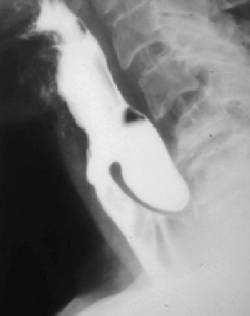
-
A
Esophagoscopy is a critical portion of the preoperative workup.
-
B
The diverticulum is situated posteriorly, just proximal to the cricopharyngeal muscle.
-
C
The diverticulum will involve all layers of the esophageal wall.
-
D
Treatment requires resection of the diverticulum.
-
E
Vocal cord paralysis is most likely secondary to a traumatic endotracheal intubation at the time of surgery.
Reveal answer details
Close answer details
Correct answerB
ExplanationPharyngoesophageal (Zenker's) diverticulum is the most common diverticulum of the esophagus, and is an example of a pulsion diverticulum. It is a false diverticulum and consists of the mucosa and submucosa protruding through the esophageal musculature. A true diverticulum would involve all three layers. It is situated posteriorly just proximal to the cricopharyngeal muscle, at a weak point in the esophagus. Symptoms include dysphagia, spontaneous regurgitation of undigested food/pills, noisy swallowing, and halitosis. The most serious complication of a Zenker's diverticulum is aspiration leading to pneumonia or a lung abscess. The diagnostic test of choice is a barium swallow. Both AP and lateral views are essential to estimate the size of the diverticulum and determine the side of deviation. Treatment mandates a cricopharyngeal myotomy in order to relieve the increased pressure at the upper esophageal sphincter that is responsible for the development of the diverticulum. Surgical management of the diverticulum itself could involve a resection or a diverticulopexy, which allows the pouch to spontaneously drain. Esophagoscopy with biopsy to rule out cancer is only indicated preoperatively if there is evidence of ulcers or mass defects on the barium swallow. EGD should be considered postoperatively because of a high association of GERD with Zenker's diverticula. Complications of surgery include infection, recurrence, vocal cord paralysis secondary to injury to the recurrent laryngeal nerve, and esophagocutaneous fistulas.
You have been asked to see a patient of one of your colleagues. He is a 67-year-old male with a long smoking history who has been having left foot pain at night. He tells you that dangling his feet over the bed relieves the pain. Previously, he had noted pain in his left calf with ambulation. Over the past several weeks, this pain has been worsening and the distance he could walk pain free had diminished. Which of the following is an indication for surgical revascularization?
-
A
pain in both calves when walking that relieves with rest
-
B
-
C
presence of a localized focus of arterial stenosis seen on angiogram
-
D
-
E
patient refusal to consider quitting smoking, as he has a greater risk of disease progression
Reveal answer details
Close answer details
Correct answerB
ExplanationThe symptoms described by the patient are classic for rest pain. Patients often experience pain at night while lying in bed, and the pain improves with dependent positioning of the affected extremity. Initial evaluation of this patient should be an arterial duplex study of the vessels of the affected leg. This noninvasive test can provide great detail on the extent of the disease and the location of hemodynamically significant obstruction. Furthermore, it will help determine if inflow obstruction is present in the aorta or iliac vessels. It is crucial in these patients to determine if the arterial obstruction involves the aortoiliac vessels or is confined to the lower extremity vasculature. After determining the location of the atherosclerotic lesion, you can proceed with a traditional angiogram, CT angiogram, or even an MRI/MRA to evaluate the vessels in order to plan your intervention. The management of peripheral arterial occlusive disease is determined in part by the severity of the symptoms. Patients with limbthreatening ischemia, indicated by rest pain, tissue necrosis, and nonhealing wounds, should be considered for revascularization. On the other hand, patients with intermittent claudication, usually described as an "ache" in the calf, should first be managed conservatively. This includes institution of lifestyle modifications such as smoking cessation, walking programs, and medical therapy with pentoxifylline or cilostazol. However, patients with severe intermittent claudication that is lifestyle limiting should be considered for surgical revascularization.
A34-year-old woman was found to have a 2-cm right thyroid nodule at the time of a well woman examination. The remainder of the thyroid was palpably normal and there were no lymph nodes palpable. There was no history of thyroid disease or radiation therapy to her head or neck. She was clinically euthyroid. Thyroid-stimulating hormone (TSH) was normal. Which of the following tests would be the most useful in establishing a specific diagnosis?
-
A
ultrasound of the thyroid
-
B
nuclear scan of the thyroid
-
C
-
D
fine needle aspiration of the nodule
-
E
Reveal answer details
Close answer details
Correct answerD
ExplanationIn evaluating a sporadic thyroid nodule in a patient who is euthyroid, it is critical to determine whether the nodule is malignant or benign. The most diagnostic test is the fine needle aspiration. Ultrasound will only distinguish between cystic and solid structures, and most nodules have some solid component. The nuclear scan will demonstrate a photopenic area in over 85% of patients. Neither these tests nor CT scan will reliably separate benign from malignant nodules. Thyroid antibody studies do not play a role in the evaluation of a thyroid nodule in a euthyroid patient. They are sometimes used in the evaluation of thyroiditis.
Question 10
Single choice
A 45-year-old male receives a cadaveric liver transplant for alcoholic cirrhosis. Postoperatively, the patient is taken to the surgical intensive care unit (SICU). There is concern for primary nonfunction of the allograft. Which of the following is a sign of this?
-
A
coagulopathy with an INR of 2
-
B
normalizing albumin level
-
C
hyperglycemia requiring an insulin drip
-
D
initial rise of transaminases
-
E
Reveal answer details
Close answer details
Correct answerA
ExplanationEarly clinical decline in a transplant patient is concerning for primary organ failure. This can be related to donor issues, technical issues, or donor organ ischemia. Signs of liver dysfunction include hypoglycemia (as the liver is unable to perform gluconeogenesis), coagulopathy with elevated prothrombin times, elevated ammonia levels, acid-base changes (unable to clear lactate via the Cori cycle), hyperkalemia, and oliguria. All liver transplant patients have an initial rise in transaminases which should decrease over the first 48 hours.
Question 11
Single choice
You are evaluating a journal article describing a test for the diagnosis of congestive heart failure (CHF). In the study described, 250 consecutive patients were given the test. Of the 250 subjects, 106 tested positive for CHF and 144 tested negative. All 250 subjects were then evaluated by expert cardiologists who were blinded to the results of the experimental test. These cardiologists determined that of the 106 persons who tested positive, 95 actually had CHF. Further, the cardiologists found that of the 144 who tested negative, 2 truly had CHF. What is the negative predictive value (NPV) of this test for the diagnosis of CHF?
-
A
-
B
-
C
-
D
-
E
Reveal answer details
Close answer details
Correct answerA
ExplanationExplanations:
Understanding the concepts of sensitivity, specificity, PPV, and NPV is crucial to interpreting diagnostic test results. Sensitivity is defined as the percentage of people who have a disease who test positive for that disease. Specificity is defined as the percentage of people who are free of a disease who test negative. These two concepts are considered characteristics of the specific test in question and are independent of the prevalence of the disease in the population. The PPVs and NPVs of a test are the test's clinical characteristics and these concepts are directly related to the prevalence of the disease in the population. The PPV is the percentage of people who have a positive test result who actually have the disease. Similarly, the NPV is the percentage of people who have a negative test result who don't have the disease. While the definitions may seem subtly different, the implications are significant. The usual way to calculate sensitivity, specificity, PPV, and NPV is with the table, using the following definitions 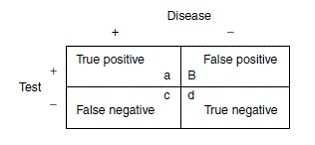 The definitions of sensitivity, specificity, PPV, and NPV would then be: Sensitivity = a/(a + c)
Specificity = d/(d + b)
PPV = a/(a + b)
NPV = d/(d + c)
The specific information in this question comes from an article describing a study of B-type natriuretic peptide (BNP) for the diagnosis of CHF. The data presented show that 106 persons tested positive using the BNP test. After comparison with the "gold standard," in this case, a review by expert cardiologists, 95 of these 106 were determined to truly have CHF. Therefore, 11 of the 106 were false positives and 95 were true positives. Similarly, 144 persons tested negative using the BNP test. Of these, 142 were confirmed as true negatives and 2 were determined to be false negatives.
Putting these numbers into a table reveals: 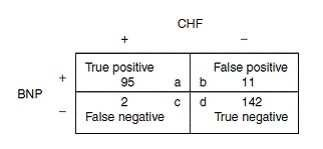 The calculations then become: Sensitivity = a/(a + c) = 95/(95 + 2) = 98%
Specificity = d/(d + b) = 142/(142 + 11) = 93%
PPV = a/(a + b) = 95/(95 + 11) = 90%
NPV = d/(d + c) = 142/(142 + 2) = 99%
Question 12
Single choice
The most likely cause of the pathologic findings in the spleen shown in Figure below is which of the following? 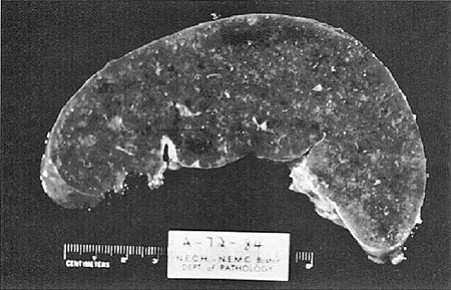
-
A
-
B
-
C
-
D
-
E
Reveal answer details
Close answer details
Correct answerA
ExplanationAmyloidosis is caused by the deposition of an abnormal proteinaceous material between cells. The majority of the cases are idiopathic, but a small percentage is secondary to chronic infection or inflammation, plasma cell dyscrasias, or immune diseases. One of the characteristic presentations of amyloidosis is splenic infiltration and splenomegaly caused by deposition of amyloid in the follicular regions. Grossly, the spleen has a diffuse, pink, glassy, waxy appearance with obliteration of the white pulp. Amyloid infiltration can also affect the kidneys, liver, and heart. Clinical symptoms are usually due to functional impairment of the diseased organ. The diagnosis of amyloidosis is made by tissue biopsy or, more recently, by fat-pad biopsy looking for amyloid deposits. With Congo red stain, amyloid appears red; with polarization, it shows an apple-green birefringence, which is diagnostic of amyloid.
Question 13
Single choice
A20-year-old male has had a recent wide local excision of a 1.5 mm melanoma from the right ankle. There is no evidence of metastatic disease. The most important prognostic factor for this patient is which of the following? Which of the following interventions is most appropriate in addition to wide local excision of the patient's melanoma?
-
A
sentinel lymph node biopsy
-
B
no further intervention is warranted
-
C
adjuvant therapy with interferon alpha-2 for 1 year
-
D
single-agent chemotherapy
-
E
complete lymph node dissection
Reveal answer details
Close answer details
Correct answerA
ExplanationIn patients who have melanoma that is confined to the skin (i.e., no evidence of metastatic disease), the most important prognostic factor is the Breslow histologic depth of the tumor. The age of the patient and location of the tumor also play a role in prognosis, but to a lesser degree. The forearm and leg tend to have a better prognosis; scalp, hands, feet, and mucous membranes have a worse prognosis. Older persons tend to have poorer prognoses, as well. Standard treatment
for melanoma involves surgical excision. Sentinel lymph node biopsy should also be performed in any patient who has a melanoma that is at least 1 mm thick. This aids in determining whether melanoma cells have metastasized to the local lymph node basin. If the sentinel lymph node biopsy is negative for melanoma cells, no further lymph node studies are necessary. However, a positive biopsy warrants complete lymph node dissection. In addition to this situation, complete lymph node dissection is indicated in the setting of clinical lymphadenopathy regardless of evident distant metastasis. High dose interferon alpha-2 therapy is aviable option for use as adjuvant therapy in patients at high risk for disease recurrence, having been shown to prolong periods of remission and possibly improve mortality. Single-agent chemotherapy is generally used in patients with stage IV melanoma and is considered more for palliative purposes.
Question 14
Single choice
A 32-year-old man who is HIV-positive was found to have Burkitt's lymphoma with diffuse bulky abdominal disease. He now reports to the hospital and is scheduled to begin chemotherapy. Admission laboratory studies show elevations of his uric acid at 15 mg/dL, serum phosphorus at 8.5 mg/dL, creatinine at 2.9 mg/ dL, and potassium at 6.1 mEq/L. What therapy is most likely to reverse the patient's metabolic abnormalities?
-
A
administration of intravenous saline with mannitol to try to keep urine output >2.5 L/day
-
B
-
C
administration of intravenous sodium bicarbonate to keep urinary pH >7.0
-
D
-
E
administration of the recombinant uricase enzyme rasburicase to lower uric acid levels
Reveal answer details
Close answer details
Correct answerD
ExplanationThis patient has tumor lysis syndrome (TLS), a group of metabolic derangements due to rapid cell turnover with release of intracellular contents, such as phosphate and potassium, and increased purine metabolism, leading to hyperuricemia.
It is usually seen after the initiation of cytotoxic chemotherapy, but occasionally occurs spontaneously in patients with bulky disease such as Burkitt's lymphoma. The uric acid crystallizes in the renal tubules and can cause oliguric renal failure.
Once renal failure has occurred, patients usually require hemodialysis until renal function recovers. Each of the other choices may be employed to prevent the development of TLS in high-risk patients prior to beginning chemotherapy
Question 15
Single choice
Which of the following patients is most likely to have symptoms of the carcinoid syndrome?
-
A
patient with carcinoid tumor localized to the appendix
-
B
patient with carcinoid tumor of the small intestine and a 3-cm nodule in the liver seen on CT scan
-
C
patient with an apple core lesion seen on barium enema
-
D
patient with adrenal mass and elevated levels of urinary vanillylmandelic acid(VMA)
-
E
patient with a retroperitoneal carcinoid tumor
Reveal answer details
Close answer details
Correct answerE
ExplanationCarcinoid syndrome is seen in less than 10% of patients with metastatic carcinoid disease. It is seen in patients with elevated serotonin levels, which is metabolized by the liver. Thus, only patients with massive hepatic metastasis or with tumors that bypass the hepatic filter--such as a retroperitoneal tumor--show symptoms. 5-Hydroxyindoleacetic acid (5-HIAA) levels can be tested in the urine to give the diagnosis (urinary vanillylmandelic acid [VMA] is indicative of a pheochromocytoma). An apple core lesion on the colon is most likely to be a large adenocarcinoma, which would not be associated with carcinoid symptoms. Common symptoms of carcinoid syndrome include flushing, diarrhea, right heart failure, and asthma.
Weight loss and liver failure are uncommon symptoms.
Question 16
Single choice
A 31-year-old (gravida 1, para 1) female had a forceps-assisted vaginal delivery 3 months ago. Her infant weighed 4250 g. During the delivery she sustained a fourth degree perineal injury that was repaired. She now complains of fecal incontinence and foul vaginal discharge when her stools are loose, which happens several days a week.
The most likely etiology for her fecal incontinence and foul vaginal discharge would be which of the following?
-
A
-
B
-
C
-
D
a retained vaginal foreign body
-
E
Reveal answer details
Close answer details
Correct answerE
ExplanationMaternal obstetric injury remains a major cause of rectovaginal fistula in women. For this patient, it is imperative to determine the presence or absence of a concomitant injury to the anal sphincter complex along with the possibility of a fistula.
Crohn's disease can be a cause of abdominal pain, diarrhea, anal abscess formation, and fecal incontinence. It would be very unlikely, and highly coincidental, for it to present in this manner. Perianal abscesses can lead to anal fistula formation and subsequent fecal incontinence, but most commonly present with exquisite pain. Fistulas and fecal incontinence would be later complications. Neither a vaginal hematoma nor a retained vaginal foreign body would result in fecal incontinence.
Question 17
Single choice
A24-year-old male medical student is admitted to the hospital for the evaluation of a 3-month history of bloody stools. The patient has approximately six blood stained or blood streaked stools per day, associated with relatively little, if any, pain. He has not had any weight loss, and he has been able to attend classes without interruption. He denies any fecal incontinence. He has no prior medical history. Review of systems is remarkable only for occasional fevers and the fact that the patient quit smoking approximately 8 months ago. A colonoscopy is performed and reveals a granular, friable colonic mucosal surface with loss of normal vascular pattern from the anal verge to the hepatic flexure of the colon.
Biopsies reveal prominent neutrophils in the epithelium and cryptitis with focal crypt abscesses, and no dysplasia. The patient is diagnosed with ulcerative colitis. In addition to an increased lifetime risk of colon cancer, the patient is also at increased risk for which of the following tumors?
-
A
-
B
-
C
-
D
-
E
Reveal answer details
Close answer details
Correct answerE
ExplanationOral corticosteroids are a mainstay of firstline treatment for moderate-to-severe ulcerative colitis. Starting doses of 40 mg PO daily of prednisone, with a slow taper, are often effective in reducing colonic inflammation, although some patients are unable to wean steroids or maintain remission once achieved. The patient does not have dysplasia in any biopsy specimens, nor does he have signs of systemic toxicity, so a colectomy would be premature. Oral metronidazole is ineffective in ulcerative colitis. Cortisone enemas would be helpful if the patient had isolated left-sided disease, but it is doubtful that enema therapy would reach his hepatic flexure. Intravenous cyclosporine would be used in severe colitis as a last measure before colectomy but this patient is not yet sick enough to warrant such therapy. PSC occurs in approximately 3% of patients with ulcerative colitis and is its major liver complication. It is a chronic inflammatory condition of the biliary tree. It can typically manifest with elevated alkaline phosphatase and bilirubin levels, and results in diffuse stricturing and pruning of the biliary tree. Wilson disease, hereditary hemochromatosis and alpha-1 antitrypsin deficiency are not associated with ulcerative colitis and are not cholestatic liver diseases. Primary biliary cirrhosis could account for these laboratory findings, but is rare in both males and patients with ulcerative colitis. Patients with PSC are at increased risk of developing cholangiocarcinoma but not the other liver tumors mentioned. Patients with celiac sprue are at increased risk for small bowel cancers (adenocarcinoma, lymphoma). Patients with FAP are at increased risk to develop desmoid tumors.
Question 18
Single choice
A 45-year-old male comes to your office for his first annual checkup in the last 10 years. On first impression, he appears overweight but is otherwise healthy and has no specific complaints. He has a brother with diabetes and a sister with high blood pressure. Both of his parents are deceased and his father died of a stroke at age 73. He is a long-standing heavy smoker and only drinks alcohol on special occasions. On physical examination, his blood pressure is 166/90 in the left arm and 164/88 in the right arm. The rest of the examination is unremarkable. He is concerned about his health and does not want to end up on medication, like his siblings.
Regarding your initial recommendations, which of the following would be most appropriate?
-
A
You should take no action and ask him to return to the clinic in 1 year for a repeat blood pressure check.
-
B
You should immediately start him on an oral antihypertensive medication and ask him to return to the clinic in 1 week.
-
C
You should advise him to stop smoking, start a strict diet and exercise routine with the goal of losing weight, and return to the clinic in 6 months.
-
D
You should consider starting a workup for potential causes of secondary hypertension.
-
E
You should screen him for diabetes and evaluate him for other cardiovascular risk factors before proceeding any further.
Reveal answer details
Close answer details
Correct answerE
ExplanationAlthough this is the first time that your patient has been noted to have an elevated blood pressure reading, given his family history and obesity, it is important to consider the coexistence of other cardiovascular risk factors. His evaluation should include, among other things, screening for DM and dyslipidemia along with an ECG. It is reasonable to ask the patient to submit himself to a strict diet (low in fat and salt) and to increase his exercise and activity, since these lifestyle modifications will likely result in weight loss, decreased blood pressure, and improve his risk profile for cardiovascular disease. Nonetheless, it is rarely enough to normalize blood pressure in all but the earliest stages of hypertension.
Provided that no other comorbidities exist, the patient should return to clinic in no more than 2 months for a repeat blood pressure check. There is no need to consider secondary causes of hypertension, given his age and presentation. You should not start antihypertensive medications until further evaluation is completed, and a second elevated reading confirms your diagnosis of hypertension. In the initial evaluation of hypertension (as per the Seventh Report of the Joint National Committee on Prevention, Detection, Evaluation, and Treatment of High Blood Pressure [JNC-7], 2003), it is important to evaluate the patient for end-organ damage. This should include the heart, kidneys, eyes, and nervous system.
It is recommended to obtain a urinalysis to assess for proteinuria, glucosuria, or hematuria; to obtain an ECG to evaluate the heart for potential hypertrophy or early signs of cardiovascular disease; to obtain a fasting lipid profile, particularly after the age of 35, to assess the cardiovascular risk profile; and to check the patient's renal function to assess for damage or dysfunction. Thyroid function tests are only indicated in the workup of secondary causes of hypertension. According
to the JNC-7, this patient's blood pressure falls into the stage 2 hypertension classification in which either systolic blood pressure (SBP) is at least 160 mmHg or diastolic blood pressure (DBP) is at least 100 mmHg. Stage 1 hypertension is characterized by a SBP of 140159 mmHg and a DBP of 9099 mmHg. Prehypertension is characterized by a SBP of 120139 mmHg and a DBP of 8089 mmHg. Normal blood pressure is characterized by a SBP of less than 120 mmHg and a DBP of less than 80 mmHg. In classifying a patient's blood pressure and determining appropriate therapy, the higher of the two categories corresponding to the SBP and DBP is the one that is used. Per JNC-7 guidelines, treatment of stage 2 hypertension should involve the consideration of a two-drug regimen initially. The goal blood pressure in patients with diabetes is a SBP less than 130 mmHg and a DBP less than 80 mmHg. An ACE inhibitor should be used as the drug class has been shown to slow the progression of diabetic nephropathy and reduce albuminuria. Thiazide diuretics, betablockers, and calcium channel blockers are appropriate choices to consider in this patient in addition to an ACE inhibitor.
Question 19
Single choice
A 34-year-old male undergoes an uneventful excision of a parathyroid adenoma. The following postoperative day, he complains of numbness around his lips. Which of the following is the most appropriate intervention?
-
A
-
B
intravenous rehydration with normal saline
-
C
intravenous magnesium sulfate infusion
-
D
-
E
reassurance and close observation
Reveal answer details
Close answer details
Correct answerA
ExplanationHungry bone syndrome refers to hypocalcemia following surgical correction of hyperparathyroidism in patients with severe, prolonged disease, as serum calcium is rapidly taken from the circulation and deposited into the bone. Symptoms usually occur within 2448 hours following parathyroidectomy, when calcium levels reach a nadir. Early symptoms include numbness and tingling in the perioral area, fingers, or toes. Advanced symptoms include nervousness, anxiety, and increased neuromuscular transmission evidenced by positive Chvostek's and Trousseau's signs, carpal pedal spasm, and hyperactive tendon reflexes. In severe cases, one may develop a prolonged QT interval on ECG. Patients who manifest any signs or symptoms of hypocalcemia always require intervention. In severely symptomatic patients, treatment should begin with intravenous calcium gluconate. Mildly symptomatic patients may be given oral calcium in the form of calcium lactate, calcium carbonate, or calcium gluconate. If hypocalcemia remains despite calcium supplementation, additional therapy with vitamin D may be needed. Supplemental calcium and vitamin D therapy should be continued until serum calcium levels return to normal
Question 20
Single choice
An autopsy is performed on an 82-year-old female diagnosed with Alzheimer disease. Which of the following is most likely to be found on evaluation of her brain?
-
A
-
B
-
C
-
D
-
E
Reveal answer details
Close answer details
Correct answerC
ExplanationSenile plaques are the most conspicuous histologic lesion also known as neuritic plaque, constitute a spherical deposit of A fragments (amyloid beta fragments) of variant degree length. They are surrounded by reactive astrocytes, microglia, and display alpha-synuclein immunoreactive neuronal process.
Question 21
Single choice
A 16-year-old sexually active woman is being seen in the emergency department. She is complaining of vaginal discharge. She has a temperature of 99.5, but is otherwise well. On pelvic examination, you see a mucopurulent cervical discharge with scant blood. Samples of the discharge are sent to the laboratory for culture. There are no cervical ulcers noted. She does not have any medical allergies. Which of the following is the most common sexually transmitted infection in adolescents?
-
A
herpes simplex virus (HSV)
-
B
-
C
-
D
human immunodeficiency virus (HIV)
-
E
Reveal answer details
Close answer details
Correct answerB
ExplanationThis young woman has cervicitis, but without evidence of pelvic inflammatory disease (PID). Chlamydia is the most common bacterial cause of sexually transmitted diseases in the United States and the most likely etiology of this patient's infection. Gonorrhea would be the next most likely cause and, frequently, there will be coinfection with the two pathogens. The simplest outpatient treatment for these two would be a single 1- g oral dose of azithromycin and a 125-mg IM dose of ceftriaxone. This regimen will ensure complete compliance, which is crucial. Treatment of her sexual partners would also be recommended. Another cause of cervicitis is trichomoniasis, for which metronidazole, either for 1 week of 500 mg bid or a single 2- g oral dose, would be recommended therapy. Of the suggested answers, option Ais the only one which would cover the two most common infectious agents.
Question 22
Single choice
You are called to see a newborn in the nursery because the nurse is concerned that the baby may have Down syndrome. What is the most common central nervous system (CNS) complication of Down syndrome?
-
A
-
B
-
C
-
D
-
E
Reveal answer details
Close answer details
Correct answerE
ExplanationThe most common finding in a newborn with Down syndrome is hypotonia. Other common findings include single palmar crease, flat facial profile, macroglossia, and wide space between the first and second toes. Hypotonia in the newborn period should prompt close evaluation and follow-up. Caf?au lait spots are associated with neurofibromatosis. High arched palates are associated with fragile X syndrome.
Ambiguous genitalia are commonly seen in CAH. Children with Down syndrome are at an increased risk for hypothyroidism. It may be hard to detect without routine laboratory screening as they will commonly have mental retardation and developmental delay as part of their syndrome.
Hypothyroidism may not be present in the immediate newborn period and requires, at a minimum, annual testing throughout the child's life. The other findings listed are not specifically associated with Down syndrome. Lens dislocation is commonly found with Marfan syndrome or homocysteinuria. Children with Down syndrome have an increased prevalence of duodenal atresia. Pyloric stenosis is uncommon to see in the newborn period. It tends to present with nonbilious vomiting usually after 24 weeks of age. Hirschsprung disease (aganglionosis coli) presents with constipation and failure to pass stool. Infants with Hirschsprung disease commonly will not pass stool in the first days of life. Biliary atresia is a progressive cause of jaundice in an infant. It is the most common cause of a cholestatic jaundice in the newborn period. Emesis is not typically associated with biliary atresia. Milk protein allergy is a common cause of bloody stools in the first few months of life, but does not have bilious emesis associated with it.
Question 23
Single choice
A 40-year-old woman presents with nausea, vomiting, and weakness. She has been amenorrheic since the birth of her last child 1 year ago and has not felt well since that time. On examination, she appears chronically ill, her thyroid is not palpable, and there is no galactorrhea. Laboratory studies on admission include: 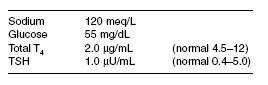 The most appropriate next step is to start treatment with which of the following?
-
A
-
B
-
C
-
D
-
E
Reveal answer details
Close answer details
Correct answerA
ExplanationThe patient has Sheehan syndrome, necrosis of the pituitary associated with childbirth. She has panhypopituitarism, but the most urgent hormone to replace is hydrocortisone. Thyroid hormone should not be replaced until after glucocorticoids are administered. The hyponatremia will correct with glucocorticoids and saline. The patient is not deficient in mineralocorticoids, as she does not have primary adrenal insufficiency; therefore, fludrocortisone is not indicated.
Question 24
Single choice
A 35-year-old 80-kg male was transported to the regional burn center at your hospital after suffering second-and third-degree burns from the eruption of a brush fire fueled with gasoline. He was intubated by EMS to secure his airway for transport. On arrival, he is found to have burns across his face, anterior neck, chest, and anterior abdomen, as well as bilateral circumferential upper extremity burns. What do you estimate the total body surface area (TBSA) of his burns to be?
-
A
-
B
-
C
-
D
-
E
Reveal answer details
Close answer details
Correct answerC
ExplanationBurn injuries can be very serious and very intimidating for the patient and physician alike. In an ER setting, the most efficient way to estimate the extent of the burn injury is to use the "rule of nines." In determining the percentage of the TBSA that is involved, it is important only to consider second-and third-degree burns in this calculation. In this system, the head and neck are 9%; each arm represents 9%; the anterior trunk, posterior trunk, and each lower extremity carry a value
of 18%; the genitalia are estimated to be 1%. For the patient in this question, the burns cover his anterior face and neck (4.5%), anterior trunk (18%), and bilateral upper extremities (18%) for a TBSA of approximately 40%. Having identified the extent of the thermal damage, it is critical to initiate resuscitation immediately. The thermal injury itself causes the release of many inflammatory mediators that result in a profound capillary leak. As a result of this profound increase in capillary permeability, the patient's intravascular volume and thus overall perfusion can drop rapidly and dramatically. In order to compensate, burn patients will require aggressive fluid resuscitation. Furthermore, as in any trauma situation, the fluid used in the initial resuscitation should be isotonic such as Ringer's lactate. The Parkland formula (4 mL/kg/%TBSA) is a common equation used to estimate the fluid needs in the first 24 hours for thermal injuries. Typically, one-half of this total volume is given in the first 8 hours. In this particular case, an 80-kg man with 40% TBSA burns would require 12.8 L of fluid in the first 24 hours. So for the first 8 hours, you would plan to run isotonic fluid at 800 mL/h.
Question 25
Single choice
A 32-year-old man comes to the office for his annual checkup. He is asymptomatic and his physical exam is normal. He reports that his father died of colon cancer at age 46 and his older brother was recently diagnosed with colon cancer at age 37. His paternal aunt was previously diagnosed and treated for endometrial cancer. He is concerned about his family history of malignancy and wants to discuss cancer screening. What would be the most appropriate recommendation at this time?
-
A
-
B
fecal occult blood testing, with referral for endoscopy if positive
-
C
-
D
screening colonoscopy starting at age 50
-
E
Reveal answer details
Close answer details
Correct answerC
ExplanationThe patient appears to be at risk for hereditaty nonpolyposis colon cancer (HNPCC) or Lynch syndrome. This autosomally dominant inherited cancer predisposition is characterized by colorectal cancer involving at least two generations, with one or more cases being diagnosed before age 50, and patients may have multiple primary cancers (affected women often also have endometrial or ovarian cancer). It is recommended that HNPCC family members undergo screening colonoscopy every two years beginning at age 25. The colon cancers in HNPCC often involve the proximal colon, so flexible sigmoidoscopy would be an insufficient tool for screening the at-risk bowel. HNPCC should be differentiated from familial adenomatous polyposis (FAP), another inherited colon cancer predisposition. This wellstudied and described autosomal dominant inherited condition is much less common than HNPCC. Affected patients develop thousands of adenomatous premalignant polyps, which are generally evenly distributed from cecum to anus and usually become evident between puberty and age 25. Because the polyps are so widespread and evenly distributed, proctosigmoidoscopy is usually a sufficient screening procedure for at-risk family members. When diagnosed with FAP, it is recommended that patients under prophylactic colectomy. If not treated surgically, almost all patients will develop colorectal cancer by age 40. Colonoscopy beginning at age 50 would be recommended for persons at average risk for colon cancer.
Question 26
Single choice
Which of the following can induce menstrual bleeding in a 21-year-old anovulatory, amenorrheic woman with PCOS?
-
A
administration of progestins
-
B
administration of estrogens
-
C
withdrawal of progestin therapy
-
D
withdrawal of estrogen therapy
-
E
Reveal answer details
Close answer details
Correct answerC
ExplanationApatient who is anovulatory due to PCOS would be expected to have normal estrogen production. However, without corpus luteum formation following ovulation there is no significant progesterone production. Therefore, the discontinuation of a period of progestin therapy would initiate menstrual flow
Question 27
Single choice
A 45-year-old woman presents with a slowly growing mass near the right jaw. You palpate a firm nodule in the parotid gland but find no adenopathy and no other abnormality on examination. A biopsy reveals both epithelial and stromal elements. What is the appropriate treatment for this lesion?
-
A
observation, as this is a benign lesion
-
B
external beam radiation therapy
-
C
excision with narrow margins
-
D
excision with a wide margin of normal tissue
-
E
Reveal answer details
Close answer details
Correct answerD
ExplanationPleomorphic adenoma (mixed tumor) is the most common tumor of the salivary glands. Pleomorphic adenoma is a benign neoplasm characterized by a mixture of epithelium and stromal elements. Two-thirds of all tumors of the major salivary glands and about half of those in the minor ones are pleomorphic adenomas. The tumor is nine times more frequent in the parotid than in the submandibular gland and usually arises in the superficial lobe of the parotid. It occurs most often in the middleaged people and shows a female preponderance. While it is a benign tumor, the recommended treatment is removal, as it will continue to grow and cause symptoms. Most authorities recommend wide local excisions, in an effort to reduce the risk of recurrence.
Question 28
Single choice
A 55-year-old male is brought to the ED, by ambulance, because of crushing chest pain radiating to his left shoulder and arm that started 1 hour ago. He has a history of hypertension, high cholesterol, and has smoked a pack of cigarettes a day for 30 years. He has never had symptoms like this before. While monitored in the ER, the patient's rhythm suddenly converts to ventricular tachycardia, and he becomes pulseless and unresponsive. Which of the following would be the most appropriate initial management of this situation?
-
A
-
B
synchronized cardioversion
-
C
-
D
-
E
Reveal answer details
Close answer details
Correct answerA
ExplanationThe clinical scenario described is classic for an acute MI. The patient has multiple risk factors, including smoking, hypertension, and elevated cholesterol. His symptoms of crushing chest pain radiating to the left arm is commonly seen in this setting. Often the first electrocardiographic sign of acute ischemia is the development of hyperacute T waves. The ECG will usually show S-T segment elevations in the area of the involved occluded vessel, with reciprocal S-T segment depressions in uninvolved areas. This can be followed by the eventual resolution of S-T segment abnormalities and the development of T wave inversions and Q waves. Diffuse P-R depressions are often the initial manifestation of pericarditis, a less common cause of acute chest pain. This often progresses to diffuse S-T segment elevations, the presence of which helps to distinguish pericarditis from the focal S-T elevations more classically associated with a thrombosed coronary artery. Q waves would be unlikely to occur within 1 hour of the onset of symptoms. In this clinical setting, a normal ECG, while possible, would be less likely to occur. Ventricular arrhythmias, both tachycardia and fibrillation, are recognized complications of acute MI. The presence of ventricular fibrillation or pulseless ventricular tachycardia should lead to the primary "ABCD" survey, as outlined in the American Heart Association's ACLS protocols. The mnemonic stands for airway, breathing, circulation, and defibrillation. Epinephrine, lidocaine, or amiodarone are reserved for the setting where defibrillation is ineffective. Synchronized cardioversion would be used in efforts to convert a patient's rhythm in the setting of a stable tachycardia.
Question 29
Single choice
An 86-year-old woman is brought to the emergency room by her daughter. The patient is a poor historian with limited insight. Her daughter understands that she has a history of high BP and is treated with an unknown medication. The patient has been living by herself in a retirement community. The daughter became concerned a year prior, when she noticed that her mother seemed more confused. She had attributed this to "old age," but 2 weeks ago she noticed an abrupt worsening in her condition. Her mother now has difficulty recognizing close relatives and remembering information. For the past 2 weeks, she has been getting lost, forgetting to turn off the stove, and has been unable to bathe herself. The daughter is concerned that she may inadvertently harm herself. Which of the following will be the most likely course of her illness?
-
A
-
B
-
C
-
D
-
E
Reveal answer details
Close answer details
Correct answerE
ExplanationThis is a case of dementia, vascular type (multiinfarct dementia), caused by poorly controlled hypertension. Atrophy of the caudate nucleus is seen in Huntington chorea, which accounts for the movement disorder and dementia that are seen in that illness. Dilated ventricles without atrophy are characteristic of normal pressure hydrocephalus (NPH), one of the potentially reversible causes of dementia. The triad seen in NPH consists of dementia, gait disturbance, and urinary incontinence. Pick's disease is a gradually progressing dementia, displaying marked but preferential atrophy of the frontal and temporal lobes of the brain. Generalized atrophy can often be seen with neuroimaging in Alzheimer dementia.
Vascular dementia classically will show lacunar infarcts of the white matter on MRI. With the exception of reversible causes (e.g., NPH, metabolic causes, or heavy metal toxicity), improvement is unusual in dementing illnesses. A rapid decline is common in dementias due to prion infection, such as Creutzfeldt-Jakob disease. Stable dementias are also unusual, most notably seen in dementia due to a head injury. Both Alzheimer's and Pick's dementias demonstrate a steady worsening of the illness over many years. The multiple small infarcts causing vascular dementia correspond to a stepwise deterioration in functioning of the patient
Question 30
Single choice
You are working in a community clinic on a Native American reservation. A mother brings in her 8- year-old son for an ophthalmic evaluation. On examination, you find bilateral corneal ulceration and decreased visual acuity. What is the most common infectious cause of blindness in the world?
-
A
-
B
-
C
Group A Streptococcus / Streptococcus pyogenes
-
D
-
E
Reveal answer details
Close answer details
Correct answerB
ExplanationThe most common infectious cause of blindness in the world is trachoma. Trachoma is the chronic effect of a C. trachomatis infection acquired in the perinatal period. The most common cause of blindness in the world is noninfectious
Question 31
Single choice
An 18-month-old boy is brought into the urgent care clinic by his mother who complains that he is "eating weird stuff." For the past few months since being able to walk, he has been found chewing and swallowing odd substances, such as hair, paper, and string. She has been more concerned since she recently noticed him eating clay from around the foundation of their apartment in the projects. His appetite has been affected because of this, and she is worried that he will become sick as a result. Determination of which of the following blood levels would be the most appropriate next step in the workup and management of this patient?
-
A
-
B
-
C
-
D
-
E
Reveal answer details
Close answer details
Correct answerE
ExplanationThis toddler has developed pica, the eating of nonnutritive substances. Decreased levels of folate may be associated with depression and dementia in adults but is not seen in cases of pica. Iron deficiency, a potential cause of pica, may present with eating of dirt. A lead level would be necessary to determine if the child were eating lead-based paint. Manganese levels have not been shown to be abnormal in pica. As zinc deficiency is another cause of pica, assessment of a zinc level is essential in children who consume clay (as is being done by the child in this case)
Question 32
Single choice
Which of the following produces the greatest increase in bone mineral density (BMD) in patients with osteoporosis?
-
A
-
B
-
C
-
D
-
E
Reveal answer details
Close answer details
Correct answerD
ExplanationTeriparatide is a recently approved recombinant form of parathyroid hormone that stimulates bone formation, rather than inhibiting resorption, and which is associated with a marked reduction in the incidence of bone fractures. Estrogen and the estrogen receptor modulator raloxifene, alendronate, and calcitonin all inhibit bone resorption and increase BMD, but the percent increase in bone density is less than occurs with teriparatide
Question 33
Single choice
The patient is a 52-year-old male presenting to the emergency room with complaints of severe leg pain. The patient states he has had ongoing left knee pain of 6 months' duration, unrelieved by NSAIDs but improved with vicodin. He denies any trauma but claims to have arthritis. His vital signs are stable. Physical examination of his knee demonstrates no significant findings except for decreased range of motion but with little effort. There is no swelling, erythema, or signs of trauma. An x-ray is obtained which is read as "normal," without evidence of arthritis. He asks for narcotic analgesics, but when he is offered a trial of NSAIDs and a referral to a specialty clinic, he becomes angry and walks out of the emergency room. Which of the following would be the most appropriate management should this patient return?
-
A
accusation regarding drug-seeking behavior
-
B
admission to a psychiatric facility
-
C
confrontation and further evaluation
-
D
notification of the police
-
E
referral to a psychiatrist
Reveal answer details
Close answer details
Correct answerC
ExplanationExplanations:
This case is a characteristic presentation for malingering. Consciously producing symptoms in order to assume the sick role is the motivation behind factitious disorder. There is no evidence of psychotic symptoms as would be seen in delusional disorder. Hypochondriasis involves the preoccupation with fears of having a serious illness rather than the focus on complaints of pain. The unconscious production of symptoms due to unconscious conflict is the hallmark of conversion disorder, which presents with a neurologic deficit. Malingering, which is not considered a mental illness, is defined as the intentional production of symptoms motivated by external incentives. These incentives may include such things as avoidance of work, military duty, and jail, or the acquisition of drugs (which is seen in the above case) (DSM IV-TR). In cases of suspected malingering, accusations or law enforcement involvement will likely result in further hostility and harm to any therapeutic alliance. Referral for admission to a mental health facility or to a psychiatrist may also have the same effect and is not warranted unless another mental illness or safety concerns are present. While limit setting is absolutely necessary with these individuals, a professional demeanor must be maintained. Gentle confrontation coupled\ with a focus on understanding their underlying problems (leading to their feigning illness) are the most helpful approaches. Amore complete evaluation may be necessary to determine whether or not there is an additional mental illness or substance dependence that will need to be treated.
Question 34
Single choice
A62-year-old male, who has been smoking two packs of cigarettes a day for the past 35 years, was found to have a 2.5 cm peripheral solitary nodule in the left upper lobe of lung. Thoracotomy with biopsy was performed and a picture of the biopsy findings is depicted in Figure below.
With the clinical information and the biopsy findings what would be the most likely diagnosis? 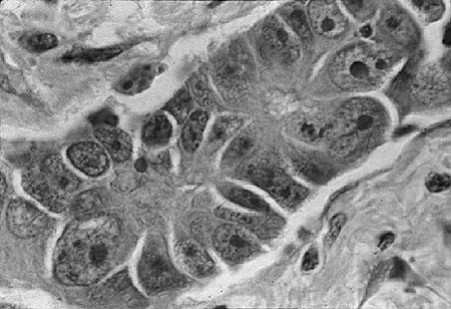
-
A
-
B
-
C
small cell anaplastic carcinoma
-
D
-
E
granulomatous inflammation.
Reveal answer details
Close answer details
Correct answerB
ExplanationThe incidence of adenocarcinoma of the lung has increased significantly in the last two decades and is now the most common form of lung cancer in women and, in some studies, also in men. There may be mixtures of histologic patterns in the same cancers and, therefore, the finding of squamous cell carcinoma is not infrequent. A recent classification that is more common for clinical use has been developed in response to the necessity for the different therapies. These two large groups are divided into small cell versus nonsmall cell carcinomas. On histologic examination, the adenocarcinomas can be divided into bronchial-derived adenocarcinoma and bronchioloalveolar carcinoma. This classification is based on histologic findings alone. The lesions, in general, are peripherally located and tend to be smaller. Adenocarcinoma, including the bronchioloalveolar variant, is the least frequently associated with a history of cigarette smoking. Special stains for mucin are frequently positive.
Question 35
Single choice
A third-year medicine resident has taken a trip to Guatemala to assist in a medical clinic for 2 weeks. After returning to work at the hospital, she faints during her grand rounds presentation of a case and is admitted to the teaching hospital where she works. She has a high temperature that cycles every few hours. The attending physician, a professor in her program, works her up for Dengue Fever and Malaria. Blood and urine laboratory tests are drawn and she receives many visitors from her concerned colleagues and coworkers. A fellow resident in her program, who is not directly involved in her care, reviews her chart and sees that her urine test came back positive for a pregnancy. Another resident sees him with the chart and asks, "So does she have Dengue or Malaria?" How should he respond to this request for information?
-
A
Order another pregnancy test to confirm.
-
B
Talk to the patient before sharing any information.
-
C
Refrain from sharing the test results with the other resident.
-
D
Share the information with the other resident in confidence.
-
E
Only share the information with the attending physician.
Reveal answer details
Close answer details
Correct answerC
ExplanationThe actions of the resident who reviewed the patient's chart were unethical. He is not involved in the case and the fact that he is a physician and colleague of the patient does not free him of the requirements that protect patient confidentiality, backed by federal regulations (see discussion of HIPAA above). He should not have pulled her chart. He would only be making matters worse by further violating the patient's right to confidentiality in sharing her results with the other resident.
The attending clinicians involved in the case are the only people who should have privileged access to the patient's sensitive health information.
Question 36
Single choice
A full-term baby boy was noted in the immediate neonatal period to fail to pass meconium. Progressive abdominal distention was noted. Multiple laboratory and clinical tests lead to a decision to perform a rectal biopsy.
The treatment of choice for Hirschsprung disease is which of the following?
-
A
-
B
colonoscopy with relief of the obstruction
-
C
-
D
-
E
Reveal answer details
Close answer details
Correct answerC
ExplanationHirschsprung disease usually manifests in the immediate neonatal period by failure to pass meconium, followed by obstructive constipation. Abdominal distention develops and, in general, a large segment of the colon is involved and distended. The incidence of Hirschsprung disease is 1 in 5000 live births, with an 80% male predominance in nonfamilial cases. There is no apparent difference in occurrence among races. A number of abnormalities have been associated with Hirschsprung disease, including Down syndrome (2- 3% of the cases), congenital heart disease, colonic atresia, and malrotation. The tissue diagnosis is made on the basis of an absence of ganglion cells in the submucosa and the myenteric plexus on a full-thickness rectal biopsy. Some surgeons prefer suction biopsy to full-thickness biopsy because it is easy to obtain the specimen and they can avoid scarring and fibrosis in the area. The other four choices are not applicable and can be ruled out on the basis of clinical history and an extremely low incidence of other pathologic conditions at the perinatal age. When suction biopsies are performed, the tissue sample for acetyl cholinesterase stain should be frozen as soon as possible. All of the other stains would not be helpful to identify ganglion cells. As soon as the diagnosis is confirmed with the rectal biopsy, a surgical procedure should be undertaken that consists of a resection of the aganglionic section of colon. All the other options are not the treatment of choice for this disease.
Question 37
Single choice
A husband and wife, both aged 30, come to the community health center for advice and evaluation prior to a month-long mission trip to central Africa. Both are in good health. She takes oral contraceptive pills and he is on no prescription medication. Review of their records shows that they have had all of the appropriate vaccinations for their ages, have completed a three dose hepatitis B series and had dT boosters 2 years ago. Their mission will involve building a school and health clinic in a rural area of Cameroon. Which of the following immunizations would be recommended prior to the trip?
-
A
-
B
-
C
-
D
-
E
Reveal answer details
Close answer details
Correct answerD
ExplanationEncounters with persons traveling to other countries are common in primary care or community health settings. The advice and interventions provided are dependent on where the person is going, what he or she will be doing, and for how long he or she will be there. The most accessible and up-to-date source of this information in the United States is at the Centers for Disease Control web site, which provides detailed recommendations on vaccinations, health, and safety risks involved in overseas travel. In this series of questions, the travelers are going to the region of central Africa and, more specifically, to a rural area of Cameroon. This is an area of the world where polio remains a risk. As most Americans have not been vaccinated against polio since childhood, booster immunization against polio is recommended. The injectable polio vaccine is recommended as it does not carry with it the risk of vaccine-induced disease that the oral (live virus) vaccine does. Smallpox has been eliminated as a naturally occurring disease, although it remains of importance in bioterrorism discussions. The smallpox vaccine is not necessary for travel to any part of the world, but is used by the military or medical first responders who may be exposed in the event of a biowarfare attack. The traveling couple is up-to-date on their dT status with boosters within the past 2 years. They have completed a series of both MMR and hepatitis B, which is felt to confer lifetime immunity. Malaria prevention is an important consideration for travel to many areas of the developing world. Different regimens may be used depending on the area to which the travel will occur. All regimens, however, require the institution of prophylaxis prior to travel and the continuation of prophylaxis for up to 4 weeks after completion of travel. This is due to the life cycle of organisms that cause the disease. Prevention of malaria also involves attempts to reduce one's risk of exposure to the Ixodes mosquito which can transmit the disease. This mosquito tends to be more active early in the morning and at dusk, and less active in the middle of the day. Wearing long sleeved clothing, using mosquito nets, and insect repellent is important. DEET-containing insect repellents are recommended as the most effective products available and are safe when used appropriately. The most common cause of injury during travel is motor vehicle accidents. The risk of injury is higher in many developing countries than in the United States due to poor roads, poor vehicle maintenance, lack of seat belts, and other issues. Very cautious driving and avoidance of driving after dark may help to reduce the risk somewhat. While swimming is an ideal exercise in such hot climates as central Africa, freshwater lake swimming should be avoided due to the risk of exposure to schistosomiasis. The Schistosoma species that cause this disease are endemic in standing freshwater bodies. Swimming or bathing in salt water or chlorinated swimming pools is safer. Traveler's diarrhea and exposure to foodborne pathogens is a common cause of illness during travel to developing countries. The guideline with food is to cook it, peel it, purify it, or forget it. Fruits that can be peeled, such as oranges or bananas, are generally safe to eat. Carbonated beverages are also safe. However, ice cubes made from local water supplies are a common, and sometimes ignored, source of infection. Water purification can be accomplished by boiling or by filtering through an absolute 1 m filter and then purifying with iodine. Filtering alone does not provide adequate protection. Salads that are not made of carefully cleaned vegetables should be avoided and salad dressings may also be contaminated. Meats that are well cooked and served hot would be considered less likely to transmit an infection. Finally, brushing one's teeth with unpurified water carries a significant risk of transmission of waterborne illness and should be avoided. Purified water or bottled water should be used instead.
Question 38
Single choice
A 50-year-old male presents to your office after reading an article on the Internet stating that a recent study showed that the drug finasteride can prevent prostate cancer. He asks you to prescribe this medication for him. You review the article and find the following information: a randomizedcontrolled trial of men over the age of 55 with normal prostate-specific antigen (PSA) readings was performed comparing finasteride and a placebo. At the end of the study, 18% of the men in the finasteride group and 24% of the men in the placebo group had developed prostate cancer. Further review of the article reveals that 6.4% of the men in the finasteride group and 5.1% in the placebo group developed high-grade prostate cancers. How many men need to take finasteride in order to have one excess case of high-grade prostate cancer (number needed to harm [NNH])?
-
A
-
B
-
C
-
D
-
E
Reveal answer details
Close answer details
Correct answerD
ExplanationExplanations:
The NNT is calculated by first determining the ARR for a specific outcome between two groups in a study. The ARR, or risk difference, is calculated by subtracting the percentage of subjects who develop an The outcome in the treatment group from the percentage who develop the outcome in the control group. outcome considered is the development of prostate cancer. This occurred in 24% of the control group and 18% of the finasteride group. The ARR is calculated as 24% - 18% = 6% or 0.06. The NNT is calculated as: NNT = 1/ARR. In this example, the NNT = 1/0.06 = 16.67, approximately 17. This suggests that for every 17 men who took finasteride there was one fewer case of prostate cancer. The NNH is calculated in exactly the same manner as the NNT. The only difference is that the outcome is adverse. In this study, highgrade prostate cancers occurred more often in the finasteride group than the placebo group; 6.4% of men who took finasteride and 5.1% who took a placebo developed high-grade prostate cancer. The risk difference, in this case an absolute risk increase, is 6.4% - 5.1% = 1.3% or 0.013.
The NNH = 1/absolute risk increase
= 1/0.013 = 77
Question 39
Single choice
A 65-year-old woman complains that she has become increasingly light-headed after playing golf. She also has had some cramping type pain in her left arm, which coincides with the episodes. She undergoes arteriogram and is found to have a stenotic lesion of her subclavian artery. Which of the following is true?
-
A
The stenotic lesion is distal to the take off of the vertebral artery.
-
B
It is unusual for these patients to have coronary artery disease as well.
-
C
The patient's light-headedness is caused by an incomplete Circle of Willis.
-
D
The operation of choice for this patient is a carotid-subclavian bypass.
-
E
Radial pulses in this patient will be equal bilaterally.
Reveal answer details
Close answer details
Correct answerD
ExplanationThis patient is presenting with subclavian steal syndrome, which is caused by subclavian stenosis proximal to the take off of the verterbral artery. Exertion of the extremity causes blood to be shunted away from the brain to the arm resulting in vertigo or even syncope. These patients usually have diminished radial pulses on the affected side and also have other evidence of atherosclerotic disease. A carotidsubclavian bypass is the operation of choice for these patients.
Question 40
Single choice
A 24-year-old G1 presents to you for initiation of obstetric care. She informs you that she is on a medication that was prescribed for acne. The drug is listed as category X in your pharmacy book. The pregnancy risk factor category X for a drug indicates which of the following?
-
A
Controlled human studies demonstrate no risk to a fetus.
-
B
This drug should never be used by a pregnant female under any circumstances.
-
C
Evidence of human teratogenic risk exists but in some cases the known risks may be outweighed in some serious situations, such as life-threatening disease.
-
D
Animal reproduction studies have not demonstrated fetal risk but there are no controlled human studies to assess the risk.
-
E
Animal reproduction studies have demonstrated risk to a fetus and no controlled human studies are available.
Reveal answer details
Close answer details
Correct answerB
ExplanationThe pregnancy risk factor category assists the physician and patient to understand the safety of the use of a medication during pregnancy. The summary of the categories is as follows: category A-- controlled human studies demonstrate no risk to a fetus. Category B--animal-reproduction studies have not demonstrated fetal risk but there are no controlled human studies to assess the risk. Category C-- animal-reproduction studies have demonstrated risk to a fetus and no controlled human studies are available. Category D--evidence of human teratogenic risk exists but in some cases the known risks may be outweighed in serious situations, such as lifethreatening disease. Class X--this drug should never be used by a pregnant female under any circumstances. The principle of autonomy states that the patient has the right and capability to control the course of her medical care and to participate in the decision-making process.
Question 41
Single choice
A mother brings her 21/2-year-old daughter to your office for evaluation of frequent urination. The mother relates that the daughter seems to be urinating more frequently, up to 810 times in a day, over the past week. The girl complains of pain when she urinates, but the urine does not have any different odor to it. The mother says that the girl otherwise seems fine and still loves to take her bubble bath at night. The girl does not have a fever, weight loss, diarrhea, or vomiting. What is the most appropriate next step in evaluating this girl?
-
A
fingerstick blood sample for random serum glucose
-
B
-
C
clean urine sample for urinalysis and urine culture
-
D
vaginal examination for discharge and cultures
-
E
synchronized serum and urine osmolality
Reveal answer details
Close answer details
Correct answerC
ExplanationPolyuria in a prepubertal female may indicate the presence of a UTI. AUTI must be excluded as the first step. Polyuria may also indicate vulvovaginitis. Vulvovaginitis in a prepubertal female is usually irritation and hygiene related. The presence of dysuria with the polyuria would make the utility of checking fingerstick glucose, as a screening test for diabetes, low yield. The nightly use of bubble baths makes chemical urethritis the most likely cause of this girl's polyuria and dysuria. Diabetes mellitus would present typically with polyuria, polydipsia, weight loss, and decrease in energy. There would also be no dysuria unless there were a concomitant UTI. Diabetes insipidus is a very rare disease in childhood and would be unlikely in an otherwise healthy girl. The presence of a retained foreign body (typically toilet paper) is usually seen in conjunction with a vaginal odor and discharge as well.
Question 42
Single choice
A 48-year-old woman complaining of dysuria is diagnosed with a UTI by urinalysis. Urine culture and sensitivities reveal that the causative organism belongs to the genus Klebsiella and is resistant to multiple antibiotics. Based upon the results available, you decide to begin therapy with gentamicin. Which of the following would lead to the classification of this patient's infection as "complicated?"
-
A
a history of recurrent UTIs
-
B
a diagnosis of type II DM
-
C
-
D
a history of undergoing a laparoscopic appendectomy 1 month ago
-
E
a postvoid residual volume of 25 cc
Reveal answer details
Close answer details
Correct answerB
ExplanationAminoglycosides such as gentamicin accumulate in the proximal tubular cells of the kidney, resulting in a defect in renal concentrating ability and reduced glomerular filtration after several days. This renal impairment is almost always reversible. Of all the aminoglycosides, gentamicin and tobramycin are the most nephrotoxic. Aminoglycosides may also cause ototoxicity in the form of irreversible auditory or vestibular damage. There is a direct relationship between aminoglycoside dosage and the risk for development of ototoxicity, so doses should be adjusted according to a patient's baseline renal function. Complicated UTIs involve metabolic or hormonal abnormalities such as those seen in M or during pregnancy; the presence of foreign bodies such as calculi, tumors, or catheters; the presence of strictures causing turbulent urine flow or vesicoureteral reflux; incomplete voiding such as that seen in neurogenic bladder, prostate
hyperplasia or cancer; and, the presence of unusual infecting microorganisms. A history of recurrent UTI does not in itself lead to the classification of subsequent infections as complicated. Due to anatomic differences in urethral length between males and females, any UTI in a male is considered complicated. A history of recent surgery does not correlate with development of a complicated UTI unless the surgical procedure resulted in the creation of some anatomic
abnormality which increased the risk of infection; examples of such abnormalities include adhesions or strictures.
Apostvoid residual volume greater than 50100 mL suggests abnormal bladder emptying, which would predispose an individual to development of UTIs.
Question 43
Single choice
A 9-month-old male infant is brought to your office for evaluation of new skin lesions. The mother tells you that she recently had to return to work, and the child is now in day care. He has since developed new erythematous facial plaques. She also reports that the child has been irritable with chronic diarrhea. On examination, the child has dry scaly plaques symmetrically distributed in the perianal and perioral areas. Which deficiency does this child likely have? 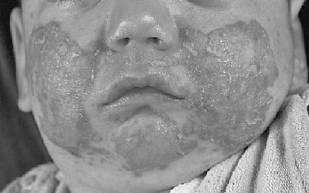
-
A
-
B
-
C
-
D
-
E
Reveal answer details
Close answer details
Correct answerB
ExplanationThe absence, or malabsorption, of zinc from the diet will result in zinc deficiency. The clinical entity is called acrodermatitis enteropathica. Symptoms may manifest during the transition from breast milk to cow's milk. The typical dermatologic manifestations of this are symmetrically distributed perianal and perioral (in a horseshoe pattern) dermatitis. The skin lesions are eczematous, dry, scaly, or psoriasiform. Children with vitamin C deficiency present with petechial hemorrhages of the skin and mucus membranes. Hypocalcemia does not include specific dermatologic changes. Tetany is a classic manifestation of hypocalcemia. Skin pallor is the most important sign of iron deficiency. Children with inadequate iodine in their diet may develop hypothyroidism.
Question 44
Single choice
A 29-year-old woman presents to the primary care clinic complaining of frequent headaches for several months. During the interview she appears tearful and withdrawn, with minimal eye contact and reluctance to answer questions. With further encouragement and support, she is able to describe intense feelings of sadness, along with significant insomnia, poor concentration, fatigue, anhedonia, and little appetite with a 20-lb weight loss.
Before she leaves the office, what is the most important question to ask her?
-
A
"Have you been drinking alcohol or using illicit drugs recently?"
-
B
"Have you been taking any over-thecounter medications?"
-
C
"Have you been treated for any medical conditions?"
-
D
"Have you ever felt like this before?"
-
E
"Have you had thoughts of hurting yourself?"
Reveal answer details
Close answer details
Correct answerE
ExplanationThis woman likely suffers from a major depressive episode. While asking about substance abuse, current medications, medical problems, and a past history of depression are very important in a complete psychiatric evaluation, assessment of suicidality is essential. The risk of suicide in patients with major depressive disorder is about 20 times higher than those without the illness. The estimated lifetime risk of suicide is approximately 15% in those individuals with major depressive disorder. The choice of a specific antidepressant may be influenced by many factors, including prior response in the patient or a family member and comorbid medical problems or substance abuse in the family (and, therefore, potentially the patient). If a patient or family member has a history of manic symptoms or bipolar disorder, consideration should be given to beginning a mood stabilizer prior to initiating antidepressant therapy, as antidepressants can cause a switch into mania in those individuals.
Question 45
Single choice
A 26-year-old G2P1 female comes to your office for her initial obstetric visit. The first day of her last menstrual period was 6 weeks ago. Other than some mild morning sickness, she is feeling fine. Her first pregnancy was 40 weeks in gestation and uncomplicated. She has no significant medical history. The result of the test that you ordered is positive. What would be appropriate management for the neonate to reduce the risk of perinatal transmission of the hepatitis B virus?
-
A
hepatitis B vaccine within 2 days of birth
-
B
hepatitis B immune globulin within 2 days of birth
-
C
hepatitis B immune globulin and hepatitisB vaccine within 12 hours of birth
-
D
deliver the baby by scheduled caesarian section
-
E
advise the mother not to breast feed
Reveal answer details
Close answer details
Correct answerC
ExplanationAt the initial prenatal visit, a complete history and physical examination is performed along with a panel of laboratory studies. Routinely, a complete blood count, blood type, and Rh group with antibody screen, rubella antibody, rapid plasma reagin (RPR), HIV, pap smear, cervical swab for gonorrhea and chlamydia, urinalysis, and urine culture are performed. Pregnancy is one of the few conditions in which treatment of asymptomatic bacteruria would be recommended. Neither a basic metabolic panel nor a TSH measurement would be indicated unless the patient had an underlying medical condition that warranted further evaluation. Screening for gestational diabetes with a glucose measurement after ingestion of 50 g of glucose is performed in many pregnancies, but not until 2428 weeks' gestation. Routine screening for vaginal or rectal colonization with group B Streptococcus is also performed, but not until 34 weeks of gestation or later. It is recommended that all pregnant women be screened for hepatitis B at their initial prenatal visit by obtaining a hepatitis B surface antigen. This helps to determine if the woman has hepatitis B that could put her baby at risk for the infection.
Hepatitis B surface antibody may be a sign of previous infection or of previous vaccination with the hepatitis B vaccine. The presence of core antibody and e antibody may be signs of previous infection.
Testing for the e antigen is not useful for initial screening purposes but may be warranted if the patient were found to have chronic hepatitis B infection.
If the mother tests positive for hepatitis B surface antigen during her pregnancy then the neonate should receive both hepatitis B immune globulin and the initial dose of the hepatitis B vaccine series. This combination has been shown to reduce risk of perinatal transmission from approximately 10% if the woman is surface antigen positive to less than 3%. There are currently no data to show that delivering a baby by caesarian section will reduce the risk of perinatal transmission of the infection. Breastfeeding has not been shown to increase the rate of transmission of infection to a nursing infant.
Question 46
Single choice
A 22-year-old female (G3P0020) presents to your office for an initial obstetric visit in her third pregnancy. She reports a sure LMP date approximately 6 weeks ago, with a history of regular cycles. Her two previous pregnancies ended in spontaneous abortions. She denies any significant medical or surgical history. She denies use of alcohol, tobacco, or illicit drugs, though she does report a history of IV drug use as a teenager. She is a full-time student. She reports that twins run in her family, but she does not have any family history of diabetes, hypertension, or congenital anomalies. On review of her prenatal labs that have already been drawn, you find that her human immunodeficiency virus (HIV) antibody test (enzyme-linked immunosorbent assay [ELISA]) is positive. Her test results are otherwise normal. Which of the following indicates how you counsel the patient?
-
A
This result is a false positive due to pregnancy, and she does not need any further testing.
-
B
She is infected with HIV and will need to begin treatment right away.
-
C
She will require an additional, confirmatory test to determine whether or not she has HIV.
-
D
She may have HIV, but she should wait until after she delivers her baby to have further testing.
-
E
Because it has been years since she participated in high-risk behaviors, she is unlikely to have HIV.
Reveal answer details
Close answer details
Correct answerC
ExplanationScreening for HIV should be offered to all pregnant women as part of routine prenatal care. Screening for HIV infection is done using an enzyme immunoassay (EIA). If the screening test is positive, it may be repeated. Once the screening test is determined to be positive, a Western blot assay or immunofluorescent antibody assay (IFA) is done as a confirmatory test. If the confirmatory test is positive, the patient is then considered to be infected with HIV. Pregnant patients should be treated for HIV by the same standards as any other adult with HIV, though some consideration is given to selection of antiretroviral medications that are safest in pregnancy. Appropriate HIV-related care should not be deferred because of pregnancy. For patients with significant HIV disease, the combination of elective scheduled cesarean and antiretroviral therapy has been shown to be more effective than antiretrovirals alone at reducing perinatal transmission of HIV. In the absence of any therapy, the risk of vertical transmission is estimated at 25%. With zidovudine therapy, the risk is decreased to approximately 58%. When zidovudine is given in combination with elective cesarean for appropriate patients, the risk is decreased to approximately 2%. In a recent meta-analysis, perinatal transmission occurred in only 1% of treated women with RNA viral loads less than 1000 copies/ mL. Given the low risk of transmission in this group, it is unclear whether cesarean delivery would provide additional benefit. After reviewing this data, the American College of Obstetricians and Gynecologists Committee on Obstetric Practice has issued a Committee Opinion concerning route of delivery, recommending consideration of scheduled cesarean delivery for HIV-1-infected pregnant women with HIV- 1 RNA levels >1000 copies/mL near the time of delivery.
Question 47
Single choice
A76 year old White female presents to her family practitioner complaining of vaginal pressure, dyspareunia, urinary incontinence, and difficulty emptying her bladder for the past 4 weeks. Seven years ago she had a prolapsed "bladder tacking" procedure. Her postvoid residual urine in the office measures 250 mL. The most notable finding on pelvic examination is seen in Figure .  What is the most likely etiology of her urinary retention?
-
A
-
B
bladder outlet obstruction
-
C
urinary tract infection (UTI)
-
D
-
E
Reveal answer details
Close answer details
Correct answerB
ExplanationWhen pelvic organs prolapse occurs beyond the level of the hymen, anatomic obstruction of urine occurs in approximately 30% of patients. Over time, urinary stasis from obstruction can lead to UTIs. Detrusor hypocontractility, not overactivity, can be another long-term sequela of chronic urinary retention, enhanced by a stretch injury to the postsynaptic parasympathetics in the bladder wall. Menopause alone is not a risk factor for retention, and a spinal cord tumor is not likely in this patient without specific neurologic complaints or findings on physical examination. Due to urinary stasis, she is at risk for a UTI. Left untreated, she could develop obstructive uropathy and/or pyelonephritis. Surgery is an option, but not without the prior consideration of nonsurgical options such as a pessary or intermittent clean, self-catheterization (if the problem were to persist). In the event of chronic retention, radiographic imaging would help to assess for upper tract obstruction (i.e., hydronephrosis). Oxybutynin is not appropriate, as it could compound urinary retention. Urodynamic studies could be helpful in the future to ascertain the exact cause of her retention (obstruction from the prolapse vs. chronic detrusor insufficiency vs. neurogenic bladder), but is not the first action to consider.
Question 48
Single choice
You are called by the labor and delivery nurse to evaluate the fetal monitoring strip of a patient. She is a 24- year-old G1 female at 40 weeks' gestation that went into spontaneous labor earlier today. She is currently on IV oxytocin (Pitocin).
You review the fetal monitoring strip shown in figure below. 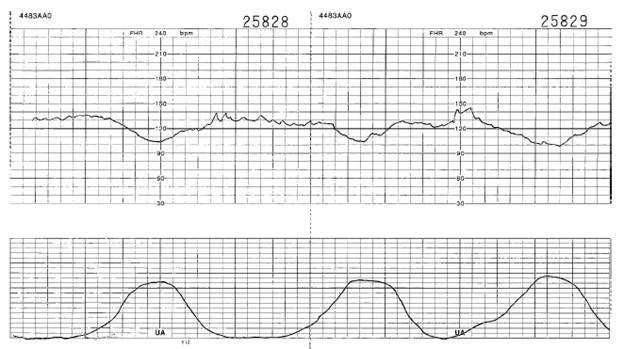 What physiologic process causes this to occur?
-
A
uteroplacental insufficiency
-
B
umbilical cord compression
-
C
compression of the fetal head
-
D
-
E
fetal acidosis caused by too frequent uterine contractions
Reveal answer details
Close answer details
Correct answerC
ExplanationThe fetal monitoring strip in these questions shows the presence of early decelerations. Early decelerations are characterized by a gradual decrease in the fetal heart rate and gradual return to the baseline in association with a contraction.
The onset and recovery of the heart rate are coincident with the onset and recovery of the contraction. These are thought to be due to vagal stimulation due to fetal head compression. They are not associated with fetal hypoxia or acidosis and no intervention, other than continued careful labor monitoring, is indicated. Variable decelerations are caused by umbilical cord compression. They are characterized by the abrupt decrease in heart rate. The onset of the deceleration frequently varies in successive contractions, and they generally last less than 2 minutes. Late decelerations are gradual decreases in heart rate that begin at or after the peak of the contraction and return to baseline after the contraction has ended. It is often the first fetal heart rate abnormality seen in uteroplacental-induced hypoxia. Any process that causes maternal hypotension, excessive uterine activity, or placental dysfunction can induce late decelerations. Fetal tachycardia is defined as a baseline fetal heart rate of >160 bpm and is considered severe if the rate is >180 bpm. The most common cause of this is maternal fever, but it can also be due to fetal compromise, arrhythmias, or certain medications.
Hyperstimulation is a nonreassuring heart rate pattern caused by the presence of frequent uterine contractions. This occurs most commonly in labors that are being augmented with oxytocin. The initial management includes reduction in the dose, or discontinuation, of the oxytocin
Question 49
Single choice
A 12-year-old boy is brought into the office by his mother, who states, "I can't deal with this anymore!" She appears exasperated, claiming that her son has been getting into more and more trouble over the past 15 months since the finalization of a particularly long and difficult divorce. He has been leaving the house at night without notifying his mother or telling her of his whereabouts. She suspects that he is responsible for the increased vandalism in the neighborhood. He has recently been caught shoplifting at a nearby store. His grades have always been poor, but he has just been suspended for missing classes and skipping school over the past year. He has often come home with evidence of having been in fights. She suspects that he may be hanging out with gang members. She is afraid of his ending up in jail and "becoming like his father."
Ahistory of which of the following premorbid diagnoses would most likely be found in this patient?
-
A
antisocial personality disorder
-
B
-
C
-
D
-
E
Reveal answer details
Close answer details
Correct answerB
ExplanationThis patient exhibits the criteria for conduct disorder. Antisocial personality disorder can only be diagnosed in a person who is over age 18. In fact, the diagnosis of antisocial personality disorder requires evidence of conduct disorder prior to age 15 (DSM IV-TR). Children with autism, schizophrenia, and mental retardation may display aggressive or disruptive behavior, but these illnesses do not necessarily predict future conduct disorder. Patients with ADHD and learning disorders are at an increased risk of developing conduct disorder as they get older. It is not uncommon for patients with conduct disorder to have a history of oppositional defiant disorder as a younger child. Indeed, the disorders are often thought of as being on a spectrum, with oppositional defiant disorder early on, followed by conduct disorder and eventually antisocial personality disorder. Having conduct disorder does not by itself predict panic disorder, schizoid personality disorder, or the development of schizophrenia. If left untreated, there is a significantly increased risk of developing a substance use disorder, which also predicts a worse prognosis
Question 50
Single choice
Which of the following is true regarding anorectal abscess and fistula?
-
A
The most common cause is a subepithelial extension of a genital infection.
-
B
Conservative management should always be considered for fistula-in-ano as many heal spontaneously.
-
C
Most acute anorectal abscesses require a course of antibiotics.
-
D
The treatment protocol is not altered for patients with valvular heart disease.
-
E
Anal fistula is classified as intersphincteric, transsphincteric, suprasphincteric, or extrasphincteric.
Reveal answer details
Close answer details
Correct answerE
ExplanationThe most common cause of anorectal fistula and abscess is infection of the anal glands, which empty into the anal canal at the level of the dentate line. Classification of anal fistula is based upon the relationship of the epithelialized tract to the anal sphincter muscle and can be intersphincteric (most common), transsphincteric, suprasphincteric, and extrasphincteric (least common). A symptomatic fistula is an indication for surgery because it rarely heals spontaneously. Despite popular teaching, there is little use for antibiotics in the primary treatment of anal abscess. As a rule, surgical drainage is required and antibiotics are only indicated if cellulitis is present. However, those patients who are immunocompromised, have valvular heart disease, or poorly controlled diabetes should always be considered for antibiotics.
Question 51
Single choice
You see a 31/2-year-old child in the emergency department who has had fever for the past week. The parents relate that their son has some swollen glands, fever, and now seems to be getting a rash on his arms. On examination, you find an uncomfortable appearing young boy whose vital signs are normal with the exception of a temperature of 104. You note t hat he has a red posterior oropharynx with dry, cracked lips. His TMs are normal. He has mild conjunctival injection bilaterally without any discharge. His chest is clear, and his heart sounds are normal. He does not have any hepatosplenomegaly. His has a lacy, confluent macular rash on his chest and upper arms, with mild peeling of the tips of his fingers. Which laboratory result would be most consistent with the diagnosis?
-
A
an elevated platelet count
-
B
a positive rapid strep test
-
C
-
D
elevated viral IgM titers
-
E
Reveal answer details
Close answer details
Correct answerA
ExplanationKawasaki disease (mucocutaneous lymph node syndrome) is a disease of unclear etiology. The salient diagnostic features include fever for greater than 5 days, cervical lymph node greater than 1 cm, nonpurulent conjunctivitis, oral changes (cracking lips or "strawberry tongue"), polymorphous rash to the trunk, and changes to the hands and feet (peeling of the fingers or toes or edema of the hands or feet). This may be confused with group Abeta-hemolytic streptococcal pharyngitis, which usually is not associated with conjunctivitis. Coxsackie viral infection is commonly seen as the "hand-footmouth" disease, with shallow ulcers on the palms, soles, and in the mouth. There is nominal fever associated, and conjunctivitis is uncommon. Parvovirus B-19 (erythema infectiosum, "fifth disease") is commonly called "slapped cheek" disease because of the exanthem of bright red cheeks. Adenopathy and conjunctivitis are not features of this infection.
Acute phase reactions are often elevated late in the course of Kawasaki disease.
The most common blood test result would be a dramatically elevated platelet count. It is usually greater than 750,000 and can be greater than 1,000,000. An ESR is also likely to be elevated, not low. Apositive rapid strep test would lead one more toward acute GAS disease. The treatment of choice for Kawasaki disease is IVIG and aspirin. IVIG infusion is usually over 12 hours and will commonly result in rapid defervescence and clinical improvement. Treatment of Kawasaki disease is important as it will prevent long-term sequelae. A common side effect of IVIG is aseptic meningitis. Nearly a quarter of untreated children will develop coronary artery dilatation. This is most common cause of acquired heart disease in children younger than 5 years of age. The coronary artery dilatation can result in aneurysm formation and myocardial infarction.
Question 52
Single choice
A 26-year-old G2P1 female comes to your office for her initial obstetric visit. The first day of her last menstrual period was 6 weeks ago. Other than some mild morning sickness, she is feeling fine. Her first pregnancy was 40 weeks in gestation and uncomplicated. She has no significant medical history. Which of the following tests is recommended for the initial obstetric visit?
-
A
-
B
blood glucose measurement 1 hour after a 50 g glucose load
-
C
-
D
vaginal culture for group B Streptococcus
-
E
basic metabolic panel (Chem-7)
Reveal answer details
Close answer details
Correct answerC
ExplanationAt the initial prenatal visit, a complete history and physical examination is performed along with a panel of laboratory studies. Routinely, a complete blood count, blood type, and Rh group with antibody screen, rubella antibody, rapid plasma reagin (RPR), HIV, pap smear, cervical swab for gonorrhea and chlamydia, urinalysis, and urine culture are performed. Pregnancy is one of the few conditions in which treatment of asymptomatic bacteruria would be recommended. Neither a basic metabolic panel nor a TSH measurement would be indicated unless the patient had an underlying medical condition that warranted further evaluation. Screening for gestational diabetes with a glucose measurement after ingestion of 50 g of glucose is performed in many pregnancies, but not until 2428 weeks' gestation. Routine screening for vaginal or rectal colonization with group B Streptococcus is also performed, but not until 34 weeks of gestation or later. It is recommended that all pregnant women be screened for hepatitis B at their initial prenatal visit by obtaining a hepatitis B surface antigen. This helps to determine if the woman has hepatitis B that could put her baby at risk for the infection.
Hepatitis B surface antibody may be a sign of previous infection or of previous vaccination with the hepatitis B vaccine. The presence of core antibody and e antibody may be signs of previous infection.
Testing for the e antigen is not useful for initial screening purposes but may be warranted if the patient were found to have chronic hepatitis B infection.
If the mother tests positive for hepatitis B surface antigen during her pregnancy then the neonate should receive both hepatitis B immune globulin and the initial dose of the hepatitis B vaccine series. This combination has been shown to reduce risk of perinatal transmission from approximately 10% if the woman is surface antigen positive to less than 3%. There are currently no data to show that delivering a baby by caesarian section will reduce the risk of perinatal transmission of the infection. Breastfeeding has not been shown to increase the rate of transmission of infection to a nursing infant.
Question 53
Single choice
A 63-year-old Native American male, with a 6-year history of DM, hypertension, and hyperlipidemia, comes to your office as a new patient for a routine examination. He has been experiencing frequent lower back pain and headaches for which he is taking ibuprofen daily for the past 5 weeks. Moreover, he is complaining of mild fatigue. In addition, he is taking aspirin, atorvastatin, verapamil, and glipizide. His physical examination shows a blood pressure of 165/80 and heart rate of 90 bpm. In general, he was not in any distress. His funduscopic examination reveals no signs of diabetic retinopathy. Cardiac examination reveals a regular rate and rhythm with an S4 gallop. His lungs are clear and abdominal examination is unremarkable without any bruit auscultated. He also has 2+ lower extremity pitting edema. Rectal examination reveals brown stool, negative for occult blood. His laboratory results are as follows: Which additional of the following would best help in the determination of the etiology of this patient's nephrotic syndrome?
-
A
fractional excretion of sodium
-
B
-
C
estimation of glomerular filtration rate
-
D
fractional excretion of urea
-
E
split 24-hour urine for protein
Reveal answer details
Close answer details
Correct answerB
ExplanationThis patient's presentation and laboratory data are consistent with nephrotic syndrome. Nephrotic syndrome is typically associated with proteinuria of greater than 3.5 g/day, hypoalbuminemia, edema, and hyperlipidemia. Abnormalities commonly seen in nephrotic syndrome include hypocalcemia (due to vitamin D deficiency), low thyroxine levels (due to loss of thyroxine-binding globulin [TBG]), and microcytic, hypochromic anemia (due to transferring loss).
Hypocomplementemia may be found in some forms of nephrotic syndrome, but this is not a typical finding. Hematuria is one of the components found in nephritic syndrome. This patient has history, physical, and laboratory findings that suggest possible multiple myeloma. For example, his history is pertinent for lower back pain and headaches. Moreover, Bence-Jones protein is not usually detected by urine dipstick but will be detected during a 24-hour urine collection. This would explain why there is relatively little urine protein detected on dipstick but over 5 g on the 24-hour urine. Lastly, multiple myeloma should be considered in an older patient with unexplained anemia. Given these findings, a serum and urine protein electrophoresis would be the best test to order next. A kidney biopsy would usually be diagnostic, but is unnecessary if the electrophoresis is positive.
Complement levels and anti-GBM titer would not be of any use at the present time. Checking glycosylated Hgb will inform you of the adequacy of glucose control, but will be of little use with regard to the workup of the nephrotic syndrome.
This patient has a low anion gap due to the presence of unmeasured cations in the blood. In this case, they arise from circulating immunoglobulins. The fractional excretion of sodium and urea can be helpful in differentiating prerenal causes from other etiologies of acute renal failure. A split 24-hour urine for protein is helpful in determining the presence of orthostatic proteinuria. Initiation of ACE inhibitors or angiotensin receptor blockers is the best option in patients with diabetic nephropathy, as these medications have been shown to slow the progression of kidney disease. The other medications listed may be used adjunctively, with an ACE inhibitor or angiotensin receptor blocker, if adequate blood pressure control could not be achieved with monotherapy. HIV-associated nephropathy is typically associated with a collapsing glomerulopathy, a variant of focal segmental glomerulosclerosis. Membranous nephropathy is associated with a number of other infections, including syphilis, hepatitis B, and hepatitis C virus. Membranoproliferative glomerulonephritis has also been associated with hepatitis C virus.
Question 54
Single choice
A 48-year-old female with a history of mild congestive heart failure (CHF) treated with furosemide presents to the emergency room (ER) for evaluation of 24 hours of epigastric pain, nausea, and vomiting after eating a large meal in a restaurant. Previously, the patient had experienced intermittent right upper quadrant pain after eating. On examination, the patient has a temperature of 98.5 and a pulse of 100. Her examinat ion is remarkable for epigastric tenderness to palpation, normal bowel sounds, and no rebound tenderness or guarding.
Laboratory studies are as follows: Leukocyte count 4800/mm3
Alanine aminotransferase (ALT) 258 U/L
Aspartate aminotransferase (AST) 287 U/L
Alkaline phosphatase, serum 350 U/L
Bilirubin (total) 2.0 mg/dL
Bilirubin (indirect) 0.4 mg/dL
Amylase 2865 U/L
Lipase 3453 U/L What would the most appropriate next test to order be?
-
A
-
B
abdominal computed tomographic (CT) scan
-
C
-
D
magnetic resonance imaging (MRI) of the abdomen
-
E
stool cultures and assessment for ova and parasites
Reveal answer details
Close answer details
Correct answerC
ExplanationThe patient has clinical and biochemical evidence of gallstone pancreatitis including epigastric pain, a history suggestive of prior biliary colic, elevated transaminases and bilirubin (suggestive of an obstructing common bile duct stone), and an elevated amylase and lipase. Gastroenteritis would not be expected to alter liver chemistries. Drug-induced pancreatitis is possible as furosemide has been shown to cause pancreatitis, but would not result in the abnormal liver chemistries.
Acute cholecystitis and cholangitis would likely be associated with an elevated leukocyte count, right upper quadrant abdominal pain, and fever. An abdominal ultrasound could assess the gallbladder for the presence of stones and signs of cholecystitis, such as gallbladder wall thickening or pericholecystic fluid. It could also look for a dilated biliary tree or an obstructing stone in the common bile duct. An abdominal x-ray could reveal a localized ileus ("sentinel loop") or calcifications suggestive of chronic pancreatitis, but would be of significantly lesser yield. A CT or MRI of the abdomen would provide images of the pancreas and liver, but are often clinically unhelpful early in the course of acute pancreatitis.
An ERCP is not indicated at this point, as only one set of liver chemistries is available. Should the bilirubin rise or fail to fall, an ERCP might be warranted to decompress the biliary tree. The patient has a common bile duct stone causing biliary obstruction. This stone likely caused the patient's acute pancreatitis as well. Papillotomy (also known as sphincterotomy) will allow endoscopic removal of the stone. The stone cannot be removed through the native papilla, as the sphincter of Oddi musculature would not allow such a large stone to pass. Thus, sphincterotomy must be performed to disrupt the sphincter musculature. Papillary balloon dilation is possible but is associated with an increased risk of pancreatitis. Abiliary stent is a viable option to provide drainage, but is inferior to sphincterotomy and stone extraction. No manipulation of the pancreatic duct is warranted. The stone should not be left in place as it could lead to recurrent pancreatitis or cholangitis.
Question 55
Single choice
A1-month-old female presents after an episode of bilious emesis. She became irritable 12 hours ago, began vomiting 6 hours ago, and is now lethargic. She had one small stool that was somewhat bloody 2 hours ago. Which of the following statements is true?
-
A
An upper GI contrast study should be obtained immediately.
-
B
The most likely explanation is pyloric stenosis.
-
C
The patient should be admitted for IV fluid resuscitation and observation. If she does not improve over the next 24 hours, a surgical consultation should be obtained.
-
D
An air contrast enema is the most appropriate next step.
-
E
A nasogastric tube should be inserted and IV antibiotics started to treat probable necrotizing enterocolitis.
Reveal answer details
Close answer details
Correct answerA
ExplanationAny infant or child that presents with bilious emesis should be evaluated immediately for malrotation with midgut volvulus. This is a surgical emergency since the volvulus can compromise the vascular supply to the intestine. Malrotation is a congenital disorder wherein the normal prenatal rotation of the midgut is incomplete and results in the cecum remaining in the epigastrium with a narrow superior mesenteric artery (SMA) pedicle. When this happens, bands form between the cecum and the abdominal wall ("Ladd's bands"). Avolvulus may result around the shortened mesentery, cutting off the vascular supply to the midgut and causing obstruction. In volvulus, patients present with acute onset of bilious emesis and later with bloody stools or hemodynamic instability. The diagnosis of malrotation can be best made with an upper GI contrast study, which will show the duodenojejunal junction displaced to the right of midline. Sometimes this can also reveal volvulus. Patients with volvulus must be taken emergently to the OR to reduce the volvulus. If intestinal ischemia is advanced, a significant portion of small bowel may have to be removed, resulting in "short gut syndrome." In this patient presenting with bilious emesis, malrotation with volvulus must be considered and addressed early. The correct answer is to get an upper GI contrast study to evaluate for malrotation and obtain a surgical consultation. Observation (choice C) may result in intestinal ischemia or death. Pyloric stenosis (choice B) presents with nonbilious emesis. Choice D refers to intussusception, which often presents with bloody stools but bilious emesis is unlikely. Necrotizing enterocolitis (choice E) can also present with bloody stools, but usually occurs in premature infants as they approach full enteral feeds.
Question 56
Single choice
A38-year-old married woman presents to her urgent care clinic complaining of "crying spells" for several weeks since the termination of her employment. She admits to feeling "down all the time." She also has difficulty falling asleep, poor energy, decreased appetite, and is "not able to enjoy anything." She fears that her condition will never improve. She has begun to feel that "it wouldn't matter if I died," but she denies any suicidal plan or intent. She drinks one to two mixed drinks per week and denies any drug use. It is decided to begin antidepressant therapy with paroxetine (Paxil) 20 mg at bedtime. If there is no significant improvement in her symptoms, but the medication is tolerated, after what length of time should a dosage increase be considered?
-
A
-
B
-
C
-
D
-
E
Reveal answer details
Close answer details
Correct answerD
ExplanationThis woman likely suffers from major depressive disorder. Treatment with a SSRI is considered to be first-line therapy. Although the neurovegetative symptoms of depression (e.g., insomnia, change in appetite, anergia, poor concentration) can sometimes improve after several days of initiating pharmacotherapy, the feelings of depression and hopelessness may take up to 46 weeks to significantly improve. As long as she is tolerating the SSRI, the urge to quickly increase the dose should be avoided so as to minimize side effects. Upon initiation of a SSRI, education and reassurance should be provided to the patient regarding the expected time until remission. Although there are characteristic side effects, most patients tolerate treatment with SSRIs. Many of these side effects, such as headaches, gastrointestinal disturbances, and vivid dreams, transpire at the start of treatment and may resolve over days to weeks. Sexual dysfunction, such as impotence or inhibited orgasm, not uncommonly occurs after several weeks to months of treatment with SSRIs and can continue with ongoing treatment.
Question 57
Single choice
Which of the following is the most appropriate treatment for a 32-year-old male with a toxic nodular goiter and compressive airway symptoms?
-
A
radioactive iodine therapy
-
B
-
C
-
D
-
E
Reveal answer details
Close answer details
Correct answerE
ExplanationToxic nodular goiter, also known as Plummer's disease, is a consequence of one or more thyroid nodules secreting inappropriately high levels of thyroid hormone independently of thyroid-stimulating hormone (TSH) control. Hyperthyroidism in patients with toxic nodular goiter is milder than in those with Graves' disease, and the condition is not accompanied by extrathyroidal manifestations such as ophthalmopathy, pretibial myxedema, vitiligo, or thyroid acropathy. Patients with toxic multinodular goiter are older at presentation than those with Graves' disease. The thyroid gland characteristically has one or more nodules on palpation. Local symptoms of compression, such as dysphagia and dyspnea, may occur. The diagnosis is suggested by a thorough history and physical examination and confirmed by documenting suppressed serum TSH level and raised serum thyroid hormone level.
Question 58
Single choice
A2-week-old infant is brought to the office for a check-up. The father relates that they have no concerns except that the baby seems to have tearing from his left eye. They also point out some swelling at the edge of his left eye. The infant is eating, sleeping, stooling, and voiding well. On examination, you find a 1/2 ?1/2 cm firm nodule inferior to the medial canthus of the left eye. What does this most likely represent?
-
A
-
B
nasolacrimal duct obstruction
-
C
-
D
-
E
Reveal answer details
Close answer details
Correct answerB
ExplanationRelative immaturity of the lacrimal drainage system can result in the accumulation of debris in the nasolacrimal duct. This will manifest as a swelling inferior to the middle canthus. Dermoid cysts in children are commonly found as a subcutaneous nodule on the lateral portion of the eyebrow. Mucoceles are usually found as fleshy papules on the inner portion of the lower lip. Frontal encephaloceles are midline in location.
Question 59
Single choice
A 64 year old woman presents with bilateral symmetric arthralgias and morning stiffness for several years. She says that she has been worked up for RA in the past. On review of her records as well as the examination you note subcutaneous nodules, positive rheumatoid factor, and radiographs of the hands that revealed joint erosions. Which of her findings has the highest positive likelihood ratio (LR) for the diagnosis of RA?
-
A
-
B
rheumatoid nodules on examination
-
C
-
D
joint erosions of the hand on xray
-
E
positive rheumatoid factor.
Reveal answer details
Close answer details
Correct answerD
ExplanationRA is primarily a clinical diagnosis. The history and physical examination are crucial to confirming the diagnosis and ruling out differential diagnosis. No one laboratory analysis can make the diagnosis, however using laboratory analysis in conjunction with a detailed history and examination can help to confirm the clinical suspicion. Some findings that may suggest RA include: morning stiffness (LR 1.9), symmetric arthralgias (LR 1.2), rheumatoid nodules (LR 3.0), positive serum rheumatoid factor (LR 8.4), and radiographic changes of hands/wrists that demonstrate erosions or hypodensity adjacent to the joints (LR 11). Rheumatoid factor is present in about 70% of patients with the diagnosis at some point in the course, however in less than 30% of patients with early RA. ANAmay be positive in 2040% of RA patients but may also be positive in many other disease states. Anti-CCP antibodies have been reported to have a sensitivity of 4070% and specificity of 95%. The presence of both RF and anti-CCP is very highly specific for the diagnosis of RA
Question 60
Single choice
A22-year-old nulliparous woman who desires future fertility is found to have a pap smear consistent with high-grade squamous intraepithelial lesion (HGSIL). The final pathology report indicates a single focus of squamous carcinoma invasive into the cervical stroma to a depth of 2.0 mm. An ECC is negative. There is no lymphvascular space invasion, and the cone margins are negative.
The most appropriate therapy for this patient is which of the following?
-
A
-
B
simple hysterectomy with pelvic lymphadenectomy
-
C
radical hysterectomy with pelvic lymphadenectomy
-
D
-
E
observation with close follow-up
Reveal answer details
Close answer details
Correct answerE
ExplanationCurrent American Society for Colposcopy and Cervical Pathology (ASCCP) guidelines for treating a pap smear consistent with HGSIL is to perform colposcopy with directed biopsies if a lesion is seen. Routine pap smear in 1 year is an unacceptable option for this patient given her increased risk for developing cervical cancer. Random biopsies have a high false negative rate if there is no visible lesion to biopsy, thus, are not helpful. The pap smear is a screening test of the cervix, not the endometrium. There is no reason to suspect that this patient has endometrial pathology, therefore, an endometrial biopsy is not warranted. HPV testing is not recommended for high-grade pap smears. All high-grade pap smears require further investigation with colposcopy regardless of HPV status. If colposcopy is unsatisfactory, meaning no lesion is identified, the full transformation zone is not visualized or the full extent of the lesion is not identified, then a diagnostic excisional procedure is warranted. A loop excisional electrocautery procedure (LEEP) would be appropriate. However, note that if your suspicion for cancer is high, the cauterized edges from a LEEP procedure can complicate the pathologic assessment of positive margins. A cold knife cervical conization can be performed in the operating room as an outpatient surgery and provides the best surgical specimen for pathologic evaluation. In this case, a TVUS, endometrial dilation, and curettage, and ECC are all inappropriate options since they do not accurately evaluate the cervix, which is the primary site of concern. This patient has, by definition, microinvasive cervical cancer. Approximately 1015% of patients in the United States with stage I cervical cancer will have a microinvasive cancer. Microinvasive cancer is defined as stage IA with invasion limited to a depth of 5 mm with lateral extent not to exceed 7 mm. Stage IA is further subdivided into stage IA1 with stromal invasion less than 3 mm and IA2 with invasion 35 mm in depth. Young patients with microinvasive squamous cell carcinoma of the cervix who desire future fertility can be treated with conization alone, provided that certain strict criteria are met. The cone specimen should be properly excised and then evaluated by an experienced pathologist. The tumor must meet the criteria for stage IA1 disease with invasion less than 3 mm and a lateral extent less than 7 mm. The cone margins must be negative, and there should be no lymphvascular space invasion.
Question 61
Single choice
A 32-year-old woman presents with complaints of irritability, heat intolerance, hyperdefecation, and frequent palpitations. She has lost 20 lb over the past six months. She has always been in good health and does not take any prescription or OTC medications. She denies any prior history of thyroid disease or exposure to head/neck irradiation, but she states that one of her relatives was diagnosed with a thyroid disorder at roughly the same age. Vital signs are as follows: BP 138/78, HR 112, RR 22, temp. 98.8. On examination, her thyroid is diffusely enlarged and smooth. Auscultation of the thyroid reveals a bruit. Her hair is fine in texture, and she has warm velvety skin. She has hyperactive deep tendon reflexes. There is a fine tremor in her outstretched hands. Which of the following sets of laboratory results would be consistent with this patient's presentation? TSH free T3 free T4
-
A
-
B
-
C
-
D
-
E
Reveal answer details
Close answer details
Correct answerC
ExplanationThis patient's presentation is consistent with Graves' disease. Infiltrative ophthalmopathy is a common finding in this condition. Approximately 2040% of patients with Graves' disease possess clinically evident eye disease. Complaints include photophobia, diplopia, reduced visual acuity, and easy tearing; and, signs of corneal or conjunctival irritation are oftentimes present. Periorbital edema, chemosis, lid retraction with restricted ocular movement, proptosis, and upward gaze
impairment may also be found. Optic nerve compression may also arise, leading to decreased visual acuity, visual field defects, impaired color vision, and papilledema. Macroglossia, hyperkeratosis, cerebellar ataxia, and pericardial effusion are all findings in hypothyroidism. (Ceci Textbook of Medicine, pp. 13961400) Free T3 levels are elevated in all patients with Graves' disease. Most patients also have elevated free T4 levels, but occasionally this level will remain within the normal reference range in a state known as T3 toxicosis. This generally occurs during the initial phases of Graves' disease or at the onset of a relapse. TSH levels are suppressed by the elevated thyroid hormone levels.
Question 62
Single choice
A 30-year-old woman with a prior history of depression is attending her postpartum followup appointment after the birth of her first child. She has no physical complaints and her examination demonstrates no significant problems. She appears anxious. When asked, she describes intrusive thoughts of wanting to harm her baby but quickly states, "I'm not like that. I would never do anything to hurt him." Which of the following is the most appropriate next step in her management?
-
A
assess further for symptoms of psychosis and support system
-
B
begin immediate treatment with an antidepressant
-
C
call child protective services in order to have the child removed
-
D
hospitalize the woman immediately for further evaluation
-
E
reassure her that these thoughts are normal
Reveal answer details
Close answer details
Correct answerA
ExplanationAlthough antidepressant treatment may be appropriate if the patient is suffering from a depressive illness, further questioning would have to be made prior to that determination. Postpartum depressive symptoms are not uncommon and they may not require treatment. If there is felt to be immediate danger to the child, calling child protective services would certainly be indicated. Having intrusive thoughts does not equate with acting on the thoughts, and thoughts similar to those in this case are not unusual given the stress of a newborn. Again, more information would need to be obtained. On the other hand, premature reassurance regarding the thoughts of harm without knowing additional facts might be dangerous if the patient is harboring a plan or intent to harm her child. Hospitalization may be necessary if the patient is suffering from postpartum psychosis or is suicidal. Only by gathering further history and symptoms, especially focusing on a support system and possible psychotic symptoms, can the clinician determine if there is significant cause for concern. Postpartum psychosis is considered a psychiatric emergency because of the risk of harm to the infant and usually requires immediate hospitalization (DSM IV-TR).
Question 63
Single choice
A 34-year-old amateur spelunker develops cough, dyspnea, and fever 2 weeks after a caving expedition to caves in Kentucky. On physical examination, the patient's temperature is 102 and respiratory rate is 24. On pulmonary examination, there are diffuse crackles bilaterally. A CXR is shown in Figure . 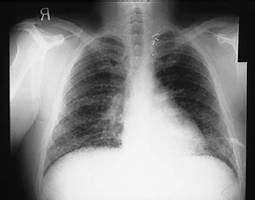 Which of the following is the most likely cause of disease in this patient?
-
A
The patient likely developed influenza from close contact with the other members of the caving expedition.
-
B
The patient likely has disseminated aspergillosis.
-
C
The patient likely has miliary tuberculosis.
-
D
The patient likely has acute pulmonary histoplasmosis.
-
E
The patient likely has Pneumocystis jiroveci pneumonia.
Reveal answer details
Close answer details
Correct answerD
ExplanationThe patient has diffuse interstitial infiltrates on CXR that correspond in time and presentation to acute inhalation histoplasmosis. This would be seen in a patient, such as an amateur spelunker, who has been in a cave with bats. It is the act of crawling through the cave that disturbs the spores of histoplasmosis that grow in the bat guano. The incubation period for influenza is 12 days. It is passed primarily by secretions from the nose spread by hands. The other members of the expedition were not sick, as they might be with influenza. Disseminated aspergillosis occurs in immunocompromised patients who have defects in both cell-mediated and humoral immunity. This patient does not have this. While the CXR could mimic military tuberculosis, the association with caving 14 days before would make tuberculosis less likely and histoplasmosis more likely. There is no history that the patient is immunocompromised with HIV and would be at risk for
P. jiroveci pneumonia. Fungal serologies would establish the diagnosis, but acute and convalescent serologies would take 3 weeks for results. These are only useful in outbreak investigations. The other choices do not fit due to the reasons above. Treatment of acute respiratory histoplasmosis is based on severe hypoxia and would require arterial blood gases to establish the need for therapy. None of the fungal infections mentioned are transmissible person to person, therefore respiratory isolation would not be necessary. Histoplasmosis is a dimorphic fungus that grows as a yeast at body temperature and a mold at room temperature. The mold produces the spores that are infectious. A similar situation occurs for Cryptococcus neoformans.
C. immitis and aspergillosis are not transmitted from person to person.
Question 64
Single choice
A 34-year-old woman with a history of type 1 diabetes mellitus presents to your office for a routine follow-up visit. She is feeling well and has no complaints. Her fasting blood sugars usually run 140 160 and her HgbA1C was recently measured at 8.2. She tells you that she would like to become pregnant but wants to know if there are any risks for her and a baby due to her diabetes. Which of the following statements about the risk to offspring of diabetic mothers is true?
-
A
Approximately 20% of children of diabetic mothers will develop type 1 diabetes.
-
B
Diabetes is associated with an increased risk of stillbirth.
-
C
Diabetes is associated with an increased risk of chromosomal anomalies.
-
D
The incidence of preterm birth is the same in both diabetics and nondiabetics.
-
E
Maternal diabetes delays the development of fetal lung maturity.
Reveal answer details
Close answer details
Correct answerB
ExplanationExplanations:
Pregestational diabetes is associated with numerous risks to both the mother and the fetus. Stillbirths are more common in pregnancies to diabetic women and stillbirths without an identifiable cause, called "unexplained" stillbirths, are a well-described phenomenon. Similarly, preterm births are more common in diabetics than nondiabetics. While congenital malformations are more common in pregnancies to diabetic women, fetal chromosomal abnormalities are not more common.
Children of women with diabetes have an approximately 13% incidence of developing type 1 diabetes. While earlier obstetrical teaching suggested that maternal diabetes delayed fetal lung maturation, more recent studies do not support this.
Gestational age is likely the most significant factor in the development of respiratory distress. While there are significant maternal risks from the interaction of diabetes and pregnancy, with the possible exception of diabetic retinopathy, the long-term course of diabetes does not appear to be affected by pregnancy. Pregnancy neither exacerbates nor modifies diabetic nephropathy and the development of diabetic peripheral neuropathy during pregnancy is uncommon. While preeclampsia is a significant risk and the perinatal mortality rate is 20 times higher in preeclamptic diabetic women compared to normotensive women, the occurrence of preeclampsia does not appear to be related to diabetic control. Diabetic ketoacidosis is a serious complication with an approximately 20% rate of fetal loss. However, it is estimated to occur in 1% of pregnancies of diabetic women. Infections occur in approximately 80% of pregnancies in insulin-dependent diabetics, with candida vaginitis, urinary tract infections, and respiratory infections being common. Preconception counseling in diabetic women who desire to become pregnant is a critical issue that often is best served by a team that includes the obstetrician, primary care physician, endocrinologist, and diabetic educators.
When possible, attempts should be made to attain optimal diabetic control. Women with good diabetic control have been shown in observational studies to have a lower rate of having infants with congenital anomalies than women with poorer diabetic control. Optimal diabetic control has been defined as glycated hemoglobin levels within or near the upper limit of the normal range. This can be obtained with multiple daily insulin injections or, in selected patients, a continuous infusion via an insulin pump. All women--diabetic or not should be counseled to take folic acid prior to conception in order to lower the rate of neural tube defects. ACE inhibitors are contraindicated during pregnancy and should, whenever possible, be discontinued prior to conception.
Question 65
Single choice
Amiddle-aged female presents with a painless enlargement of the lower aspect of the neck. With appropriate testing this is proven to be thyroid enlargement. Thyroid function tests were normal. Asurgical intervention was performed for
diagnostic purposes. Figure below 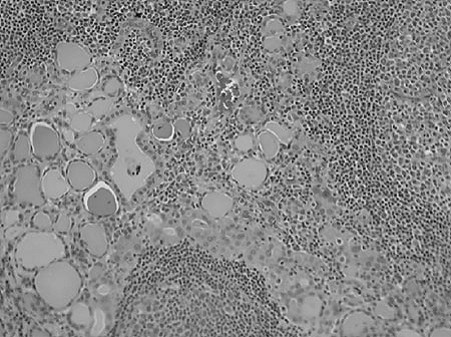 depicts a representative area of how most of thethyroid gland histologic features were seen. What are the clinical thyroid function test characteristics of the last stages of this disease?
-
A
-
B
normal thyroid function tests
-
C
some degree of hypothyroidism
-
D
invasion of the recurrent laryngeal nerve
-
E
Reveal answer details
Close answer details
Correct answerC
ExplanationHashimoto thyroiditis is a very common cause of hypothyroidism in the parts of the world where iodine levels are insufficient. The clinical picture is characterized by a gradual enlargement of the thyroid gland with autoimmune destruction.
There is a great female to male predominance, with ratio of 10 20:1. Clusters of families are seen which are associated with HLA-DR5 on the major histocompatibility complex (MHC). A few cases are also characterized by HLA-DR3. The pathogenesis is attributed to cellular and humoral immunity which produces thyroid tissue injury. The morphology of the thyroid gland is characterized by typical destruction of the thyroid parenchyma with dense lymphocytic infiltrate and many secondary germinal centers. Occasional scattered Hurthle cells are also seen. Depending on the stage of the disease, extensive areas of fibrosis may also be present. The clinical course of Hashimoto thyroiditis is usually an initial period of time in which the patient may be euthyroid followed by hypothyroidism.
Question 66
Single choice
The patient is a 26-year-old male graduate student presenting to his health maintenance organization. He is having ongoing difficulty completing his thesis. When he is working on the computer, he finds it necessary to print out and save every draft of his paper. Even though he realizes that it is unnecessary to do so, he feels compelled to read and reread all of his versions in case he made a mistake. As a result, he has been unable to move forward with his dissertation. He is consumed with doubts about his thesis, but at the same time he cannot throw away discarded sections. In fact, his apartment contains stacks of paper spread throughout his rooms. He understands that these thoughts and behaviors are "not rational," and he is greatly distressed by them and the problems they have caused. Which of the following would be the most appropriate pharmacotherapy for his condition?
-
A
-
B
-
C
-
D
-
E
Reveal answer details
Close answer details
Correct answerC
ExplanationThis patient has OCD. Benzodiazepines such as alprazolam may be helpful for the acute anxiety associated with OCD, but they are not a first-line medication to reduce the obsessions or compulsions. Although antipsychotics such as olanzapine are sometimes used in conjunction with other psychotropics in patients with severe, intractable OCD, they are not recommended as monotherapy given their significant side effects. Antidepressants that mostly affect norepinephrine, such as bupropion and desipramine, are not particularly effective in treating OCD. Serotonergic drugs, such as citalopram and the tricyclic clomipramine, have been proven to improve both obsessions and compulsions. Because of this fact, OCD is thought to involve the serotonergic system. EMDR is a treatment used specifically for posttraumatic stress disorder (PTSD). Although psychoanalysis and psychodynamic (or insight-oriented) psychotherapies may be beneficial for some individuals with OCD, there have not been enough studies to document their effectiveness. Supportive psychotherapy can be useful in helping the patients to cope with their severe anxiety and limitations, but it does not particularly address the obsessions and compulsions themselves. Behavioral therapy has consistently demonstrated success in treating OCD, and studies have shown it to be as efficacious as pharmacotherapy.
Question 67
Single choice
A21-year-old Asian female, with past medical history of exertional asthma, comes to your office complaining of mild low back pain. It started after her working out in the gym 3 days ago. The pain is 24 out of 10 in intensity, has no radiation, increases with bending or lying down for a long time, and improves with warm showers. You examine the patient, diagnose her with paravertebral muscle spasm, and give her prescriptions for cyclobenzaprine and naproxen to use as needed for pain and stiffness. You receive a call from your patient 2 hours later. She is having generalized itching, dizziness, and swelling of the tongue and lips. She is having difficulty breathing. She tells you that she took the first dose of the medication you prescribed about 30 minutes ago.
The most beneficial immediate intervention for this patient would be which of the following?
-
A
-
B
albuterol nebulizer treatment
-
C
-
D
-
E
Reveal answer details
Close answer details
Correct answerD
ExplanationThis patient is exhibiting signs and symptoms of an anaphylactic reaction, likely to one of the medications that she recently took. Angioedema is occurring (swelling of the lips and tongue). Her dyspnea may be a manifestation of laryngeal edema or of bronchospasm. She is at high risk for respiratory compromise and, therefore, of the options listed, having her activate the emergency medical system is the most appropriate. Calling 911 from your office would be another option.
Of the interventions listed, epinephrine would provide the most benefit in correcting the underlying problem. The alpha-and betaadrenergic effects result in vasoconstriction, bronchial smooth-muscle relaxation, and reduction on vascular permeability. Oxygen may be required if the patient is hypoxic, IV fluids may be necessary for persistent hypotension and albuterol may benefit the treatment of bronchospasm, but epinephrine would most immediately address the multiple systemic effects of anaphylaxis
Question 68
Single choice
A28-year-old male, well known to your clinic, presents for management of swelling, pain, and tenderness that has developed in his left ankle and right knee. It has persisted for 1 month. Your patient reports that he developed severe diarrhea after a picnic 1 month prior to the onset of his arthritis. During the interval between the diarrhea and onset of arthritis, he developed a "pink eye" that lasted for 4 days. He denies any symptoms of back pain or stiffness. You remember that he was treated with ceftriaxone and doxycycline for gonorrhea 2 years ago, which he acquired from sexual activity with multiple partners. Since that time, he has been in a monogamous relationship with his wife and has not had any genitourinary symptoms. He promises that he has been faithful to his wife and has not engaged in unprotected sexual activity outside his marriage. His physical examination is notable for a swollen left ankle, swollen right knee, and the absence of penile discharge or any skin lesions. Which of the following is the most likely diagnosis?
-
A
-
B
-
C
-
D
resistant gonococcal arthritis
-
E
Reveal answer details
Close answer details
Correct answerC
ExplanationReactive arthritis consists of a triad of nonspecific urethritis, conjunctivitis, and asymmetric arthritis, usually involving the large joints of the lower extremities. Genitourinary causes of reactive arthritis include Chlamydia or Ureaplasma. GI infections due to Salmonella, Shigella, Yersinia, Klebsiella, and Campylobacter can also cause reactive arthritis. Gout attacks are typically monoarticular and begin abruptly with the affected joint being exquisitely painful, warm, red, and swollen. These attacks often spontaneously resolve in 310 days. While the symptoms from pseudogout may mimic those of gout, they tend to be less painful and take longer to reach peak intensity. Gonococcal arthritis is seen more often in females, is associated with migratory arthralgia, tends to favor the upper limbs and knees and may be associated with cutaneous lesions (pustules). The absence of attacks and joint distribution makes gout and pseudogout less likely. The history of conjunctivitis and association with diarrhea makes the diagnosis of reactive arthritis more likely than resistant gonococcal arthritis. His clinical symptoms do not suggest ankylosing spondylitis, although if he was HLA-B27 positive he would be at increased risk of developing spondylitis. This patient has the classic symptoms and exposure risk (GI infection) to suggest reactive arthritis. For the articular symptoms, reduction of inflammation and restoration of function can be achieved with nonsteroidal antiinflammatories alone. A sufficient number of patients with reactive arthritis will not be HLA-B27 positive, thus rendering this test useless as a screening test. However, it may be useful when the clinical picture is incomplete (such as absence of antecedent infection or lack of extraarticular features). Once an antecedent infection has triggered reactive arthritis, it is unlikely that antibiotics will affect the course of the illness (except in the case of chlamydiaassociated urogenital disease where a trial of prolonged antibiotic therapy may be reasonable). Systemic corticosteroids are usually ineffective in reactive arthritis, but may be tried for resistant disease or conditions such as AIDS in which cytotoxic therapy is contraindicated. Given the absence of skin lesions, penile discharge, or urogenital symptoms, one would be hard-pressed to challenge the patient's statement that he has not engaged in unprotected sex at the risk of jeopardizing the physicianpatient relationship. Reactive arthritis may be the first manifestation of HIV infection. Therefore, HIV antibody status should be determined when the appropriate risk factors and/or clinical features are present. As mentioned previously, systemic steroids are usually ineffective for reactive arthritis and, with the possibility of joint infection, would necessitate ruling out infection by arthrocentesis of the affected joints. Joint infection cannot be ruled out based on his presentation, and joint sepsis must be excluded prior to corticosteroid injection. The clinical presentation is classic for reactive arthritis, and the absence of systemic symptoms makes the likelihood of disseminated bacterial infection low. Indomethacin, at a dose of 150200 mg/day, is the prototypic NSAID medication for treatment of reactive arthritis. Doses higher than this are associated with significant GI complications and do not improve efficacy in a patient resistant to the standard dose. In the event that the patient does not respond to 200 mg of indomethacin or alternative NSAIDs, disease-modifying antirheumatic drugs (DMARD) such as methotrexate, azathioprine, or sulfasalazine may be used, provided that HIV test results are negative, as these immunosuppressants have been reported to precipitate the onset of AIDS in HIV-positive patients.
Question 69
Single choice
The modern history of the protection of human research subjects began in the twentieth century in response to human experimentation which occurred during World War II. The Nuremberg Military Tribunal set forth initial basic standards for the conduct of research which ultimately became known as the Nuremberg Code (1947/1948). In subsequent years, these recommendations have been modified and expanded to reflect various aspects of medical ethics in biomedical and behavioral research. These international ethical guidelines include the Declaration of Helsinki (1964), the Belmont Report (1979), CIOMS (1982), and the Common Rule (1991).
The concept of beneficence in the Belmont Report emphasizes the importance of which of the following?
-
A
establishing institutional research boards (IRBs)
-
B
maximizing benefits and minimizing harms to research subjects
-
C
ensuring independent ethical review of research
-
D
ensuring scientific validity of research
-
E
including patient advocates on scientific advisory boards
Reveal answer details
Close answer details
Correct answerB
ExplanationOn September 30, 1978, the National Commission for the Protection of Human Subjects of Biomedical and Behavioral Research submitted the report "Ethical Principles and Guidelines for the Protection of Human Subjects of Research," named after the Belmont Conference Center in the Smithsonian Institution. The three ethical principles emphasized in this report include justice, beneficence, and respect for persons. Justice is the equitable distribution of research burdens and benefits. Beneficence is the mechanism to maximize benefits and minimize harm to research subjects. Respect for persons is the ethical principle which prioritizes the respect for individual autonomy and the protection of individuals with reduced autonomy. The principle of respect emphasizes the protection of subjects' privacy, maintenance of confidentiality, informed consent, and the utilization of additional safeguards for the protection of vulnerable populations. Health and Human Service (HHS) regulations delineate additional mechanisms to protect human subjects, which include (1) institutional assurances of compliance, (2) Institutional Review Board (IRB) review, and (3) informed consent. An institutional assurance of compliance is documentation that the institution will follow HHS regulations for the protection of human subjects. An IRB is a committee that has been established to protect human subjects involved in research activities. These committees must have at least five members of varying backgrounds who possess the professional competence to review research activities.
Informed consent is the voluntary choice of an individual to participate in research activities. To be truly informed consent, the individual must have a clear and accurate understanding of the purpose of the research, the risks involved, the potential benefits, the procedures to be performed and the alternative modalities of treatment available. Typically, these are in a written consent form. The legal arguments for informed consent emphasize the right of self determination. This is in contrast to the ethical basis of individual autonomy. Therefore, a mere signature by the individual participant does not fulfill the ethical requirements of the informed consent process. Any research study must have scientific validity, a fair selection of individual subjects for populations, protection of vulnerable populations, fair access to the benefits of medical research, acceptable risk-benefit ratios, appropriate informed consent, and independent review of the study. In addition, Data Safety Monitoring Boards are being utilized to further monitor the safety of research protocols and participation.
Question 70
Single choice
A 60-year-old man with a history of severe chronic obstructive pulmonary disease (COPD), which is steroid dependent, is admitted to the ICU with pulmonary infiltrates and a sepsis syndrome. His hospital course is complicated by acute renal insufficiency and respiratory failure. Therapy includes glucocorticoids and dopamine. He has no history of thyroid disease. Several weeks into his hospital course, the following laboratory studies are performed: Based on these laboratory studies, which of the following is the most appropriate next step? 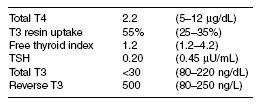
-
A
initiate levothyroxine therapy
-
B
discontinue glucocorticoid therapy
-
C
initiate methimazole therapy
-
D
order MRI of the pituitary
-
E
supportive treatment only
Reveal answer details
Close answer details
Correct answerE
ExplanationThe patient exhibits the typical features of the nonthyroidal illness syndrome. The total thyroxine level is low, but TBG is also low (based on the elevated T3 resin uptake), so that the free thyroid index is still in the normal range. The low TBG is related to the patient's nutritional deficiency. The low T3 and TSH levels are related to his illness and the use of both glucocorticoids and dopamine, which decrease TSH. The reverse T3 level is high because of the blockade of T4 to T3 conversion caused by the illness.
This finding excludes hypopituitarism as an underlying cause. There is no specific therapy for this problem other than treating the underlying illness.
Question 71
Single choice
A 17-year-old is brought by emergency medical services to the emergency room in a postictal state after a witnessed grand mal seizure. No family member is available and the patient is unable to answer questions. Afriend who is with him says that he takes some medicine for seizures, but he doesn't know the name. On examination, you note that he has prominent gingival hyperplasia.
Of the medications listed below, which one is he most likely to be taking?
-
A
-
B
-
C
-
D
-
E
Reveal answer details
Close answer details
Correct answerD
ExplanationGingival hyperplasia is a common side effect of chronic phenytoin administration. This will resolve with cessation of the medication. None of the other anticonvulsants listed will result in this problem.
Question 72
Single choice
A 60-year-old man with hypertension, hyperlipidemia, and peripheral vascular disease requires coronary artery bypass graft surgery. Which of the following vessels would be the most appropriate conduit for his coronary artery bypass graft?
-
A
-
B
internal mammary arteries
-
C
-
D
-
E
Reveal answer details
Close answer details
Correct answerB
ExplanationFinding a conduit for use in coronary artery bypass grafting can sometimes be a challenge since these patients often have diffuse atherosclerotic disease. The left internal mammary artery is most commonly used. Bilateral internal mammary arteries can be used, however this increases the chances of sternal healing problems. Saphenous vein grafts are used in patients with multivessel disease, although this may not be an option in patients with deep vein thrombosis (DVT), venous insufficiency, or arterial insufficiency to the legs (because they will not heal the harvest wound). Radial arteries, the right gastroepiploic artery, and inferior epigastric arteries have also been used.
Question 73
Single choice
An 18-year-old female presents for follow-up of a rash. She states that she has been using OTC antifungal preparations without success. She used OTC cortisone cream with mild improvement, but the lesions never disappeared. Her condition also recurred with full severity once the cortisone cream was discontinued. Her family history reveals a first degree relative with similar rash. The rash is over the elbows, trunk, and scalp . Which of the following tests is most likely to confirm your clinical suspicion?
-
A
-
B
KOH prep and microscopic analysis of scraping from rash
-
C
biopsy of the involved area
-
D
-
E
Reveal answer details
Close answer details
Correct answerC
ExplanationPsoriasis is a benign chronic, inflammatory skin disorder with a genetic basis that affects approximately 2% of the population in the United States. The condition varies in its presentation from person to person, with some having only local involvement and others having a severe generalized involvement. The incidence occurs in a bimodal distribution, with peaks persons in their 20s and 50s. Those with earlier onset generally will have a more severe disease over the course of their lifetime. Psoriasis has several variants, or subtypes, including plaque type (most common), eruptive (guttate), generalized pustular, and erythrodermic psoriasis. Some patients may be asymptomatic or may have only minor itching.
Others may have involvement of most of their body, with severe disfigurement and poor quality of life. Psoriasis may involve any skin area; however, areas such as the scalp, extensor surfaces, palms, soles, and nails should always be examined. The typical lesions are described as erythematous, well-demarcated plaques with overlying scales. Fine stippling (pitting) of the nails is highly suggestive of psoriasis. In addition to the skin findings, patients may also have arthritis.
The lesions can be reactivated with local injury or irritation of normal skin (Koebner phenomenon). The diagnosis is predominantly clinical, based on the history and examination. There are no laboratory measures that will diagnose psoriasis.
Skin biopsy, although not pathognomonic, would show features consistent with psoriasis and would help to rule out other similar appearing conditions.
Question 74
Single choice
A 14-year-old nulligravid female is brought to the ER by her parents with a 12-hour history of severe, intermittent left lower quadrant pain. She has had nausea and vomiting for the past 2 hours. On history, the patient experienced menarche at age 12 and denies past or current contact with a sexual partner. Her last normal menstrual period was 3 weeks ago. On examination, she is afebrile, pulse 100, BP 110/70, respiratory rate (RR) 20. She is visibly uncomfortable. She has no costovertebral tenderness, has diminished bowel sounds, her abdomen is nondistended, and exhibits rebound and guarding in both lower quadrants. She is unable to tolerate a pelvic examination due to pain. Laboratory values are as follows: WBC 13, HCT 39, -hCG (-), UA (-). Apelvic ultrasound shows a normal nonpregnant uterus, normal right adnexa, and an 8-cm left adnexal mass with a 3-cm solid component. Which of the following would be the next appropriate step in managing this patient?
-
A
abdominal and pelvic CT scan
-
B
social work referral for possible sexual abuse
-
C
obtain liver enzymes, amylase, and lipase
-
D
consultation for immediate surgical intervention
-
E
discharge to home with pain medications
Reveal answer details
Close answer details
Correct answerD
ExplanationThis patient is demonstrating acute peritoneal signs that require surgical intervention. Adding additional testing, either with radiology or more laboratory assessment would not alter the management at this point in time. Although some patients with chronic pelvic pain have a history of sexual or physical abuse, an assessment in the acute emergent setting does not take initial priority. Although ovarian torsion can be enigmatic in its presentation, this patient demonstrates classic signs of intermittent pelvic pain and an ovarian cyst with a solid component. The 8-cm increase in ovarian size is likely due to vascular congestion from occlusion of the blood supply. Early intervention is more likely to result in salvaging viable tissue before the onset of irreversible tissue necrosis. The absence of fever and other GI symptoms, along with a left lower quadrant mass on ultrasound goes against the possibility of appendicitis or pancreatitis. Her pregnancy test is negative which generally excludes an ectopic pregnancy.
Question 75
Single choice
A 67-year-old female was admitted to the hospital because of chronic fatigue and low back pain. An x- ray of the vertebral column showed diffuse osteoporosis and compression fractures of L1 and L2 vertebral bodies. The complete blood count (CBC) was within normal limits. The peripheral blood smear showed rouleaux formation. The immunoelectrophoresis showed a monoclonal spike of more than 3 g. A bone marrow biopsy was performed and showed an increase of more than 20% in plasma cells see Figure below 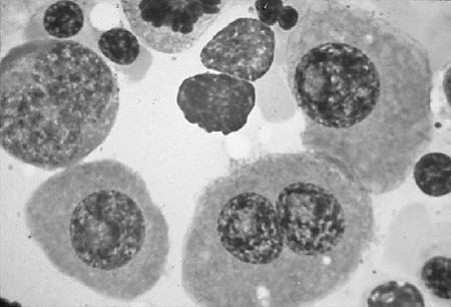 In this particular patient what would be the electrophoretical characteristic changes?
-
A
increases levels of IgG and light chains in the urine
-
B
-
C
-
D
-
E
polyclonal electrophoretic pattern
Reveal answer details
Close answer details
Correct answerA
ExplanationMultiple myeloma is a plasma cell dyscrasia that is characterized by involvement of the skeleton in multiple sites. The characteristic x-ray shows punched-out bone lesions that are very easily seen in the calvarium. Extension of the disease to lymph nodes and extranodal sites, such as skin, can be seen. The bone marrow biopsy and smears reveal an increased number of plasma cells, which usually constitute greater than 20% of all of the cells. The cells either diffusely infiltrate and replace the marrow elements or can be seen scattered throughout the hematopoietic elements. The neoplastic plasma cells have a perinuclear hof and an eccentrically placed nucleus which allows the recognition. In 99% of patients with multiple myeloma, electrophoretic analysis reveals increased levels of IgG in the blood, light chains (Bence-Jones proteins) in the urine, or both. The monoclonal IgG produces a high spike when seen in the serum or in the urine, subject to electrophoresis. In general, the quantitative analysis of the monoclonal IgG is more than 3 g. The clinicopathologic diagnosis of multiple myeloma rests on radiographic and laboratory findings. Marrow examination may reveal increased plasma cells or sheet-like aggregates that may completely replace the normal elements. The prognosis for this condition is variable, but generally poor.
Question 76
Single choice
A term infant male is born after an uncomplicated vaginal delivery. The mother's prenatal labs were negative with the exception of being GBS positive at 36 weeks' gestation. The mother received two doses of ampicillin prior to delivery and did not have a fever. The infant had APGAR scores of 9 at 1 minute and 9 at 5 minutes. The infant was brought to the newborn nursery and appears well. The most appropriate management of the infant would be which of the following?
-
A
Draw a CBC and blood culture, but do not start empiric antibiotics.
-
B
Give the baby a prophylactic dose of ampicillin.
-
C
-
D
Cultures of blood, urine, and spinal fluid and wait for culture results before starting antibiotics.
-
E
Cultures of blood, urine, and spinal fluid and begin empiric antibiotics before getting culture results.
Reveal answer details
Close answer details
Correct answerC
ExplanationThe most common bacterial infection in the newborn period is GBS. GBS is commonly cultured in the adult vaginal tract, and its vertical transmission can be interrupted with maternal antimicrobial treatment prior to delivery of the infant.
Mothers are commonly treated in labor with penicillin, ampicillin, clindamycin, or azithromycin in an attempt to interrupt transmission to the infant while passing through the birth canal. If antimicrobial prophylaxis is initiated greater than 4 hours prior to delivery, the rate of early-onset GBS disease is dramatically decreased. The current recommendation for term infants of GBS-positive women who have received antibiotics in labor (at least two doses or =4 hours prior to delivery) is observation without testing or antibiotics. (American Academy of Pediatrics, 2003, pp. 584591) Classic hemophilia is an X-linked recessive bleeding diathesis. Hemophilia is inherited on the maternal lineage from carrier (or affected) mothers.
This infant, being a male, would receive his X chromosome from his mother. He is, therefore, not at risk for having hemophilia. Further, being an X-linked trait, there cannot be a male "carrier" state.
Question 77
Single choice
While in the emergency department you see a 3-week-old infant. The mother says that the child felt warm earlier in the day and has not been eating very well. The infant has a temperature of 100.9 and has mildly decreased tone. What is the most appropriate initial management?
-
A
Give acetaminophen and reassess in a few hours.
-
B
Draw a blood culture, recommend increased fluid intake, and follow-up for re-examination in 24 hours in the primary pediatrician's office.
-
C
Admit to the hospital and perform a full "sepsis workup."
-
D
Draw a blood culture, give a shot of ceftriaxone (Rocephin) to cover for any infections and follow-up in 2448 hours.
-
E
Get a urine culture and begin trimethoprim/sulfamethoxazole (Septra).
Reveal answer details
Close answer details
Correct answerC
ExplanationA fever in the first 46 weeks of life needs to be treated very aggressively. There are no reliable clinical or laboratory findings currently available that can discriminate between a nominal viral illness and a serious bacterial infection. In the newborn period, fever may be the only indicator of bacteremia or meningitis. Any rectal temperature greater than 100.5 should trig ger a full sepsis workup. This should include cultures of the blood, urine, and spinal fluid. In this age range, empiric antimicrobials should be initiated that should cover for GBS, E. coli, and Listeria monocytogenes. A commonly used regimen is ampicillin and gentamicin. Many would also include empiric acyclovir in this age range. In infants, the routine use of antipyretics should be discouraged. A blood culture alone is not an adequate screening tool for meningitis. While a urinary tract infection (UTI) is a common cause of infection in infants, a more complete evaluation would be warranted.
Question 78
Single choice
A 28-year-old man presents with vague complaints of fatigue, nausea, and dyspnea. He has had occasional episodes of hemoptysis and some burning with urination. Laboratory studies reveal a mild anemia and an elevation of both blood urea nitrogen (BUN) and creatinine. Urinalysis reveals the presence of blood, protein, and red cell casts.
Antibodies against which of the following is the cause of this condition?
-
A
platelet surface antigens
-
B
-
C
-
D
-
E
Reveal answer details
Close answer details
Correct answerB
ExplanationGoodpasture syndrome is characterized by antibasement antibodies, with the lungs and kidneys bearing the brunt of the damage. Antibodies against platelet surface antigens, parietal cells, antigens, receptors, and colonic mucosal cells are seen in autoimmune thrombocytopenia, pernicious anemia, myasthenia gravis, and ulcerative colitis, respectively.
Question 79
Single choice
A60-year-old woman presents with an abnormal cluster of microcalcifications on a routine mammogram, and undergoes a needle-localized excisional biopsy. The pathology is shown in Figure. When counseling the patient regarding her surgical options, which of the following statements would be correct? 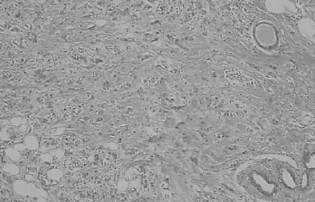
-
A
Modified radical mastectomy differs from a Halsted mastectomy in that the pectoralis major is spared in the modified radical approach.
-
B
Modified radical mastectomy differs from Halsted mastectomy in that an axillary lymphadenectomy is not performed in the modified radical approach.
-
C
The anatomic limits of the modified radical mastectomy include the sternum medially and the anterior border of the serratus anterior muscle laterally.
-
D
Injury to the thoracodorsal nerve during mastectomy results in a "winged scapula."
-
E
Lymphedema occurs mainly as a complication of the Halsted radical mastectomy and should not be seen after modified radical mastectomy.
Reveal answer details
Close answer details
Correct answerA
ExplanationThe Halsted radical mastectomy involves removal of all breast tissue, lymphadenectomy, and removal of the pectoralis major. The modified radical mastectomy preserves the pectoralis major muscle thus decreasing the morbidity of the surgery with the same survival. The modified radical mastectomy does include a lymph node dissection. The anatomic limits of the modified radical mastectomy include the sternum medially, the subclavius muscle superiorly, the inframammary fold inferiorly, and the latissimus dorsi muscle laterally. The surgeon must identify the thoracodorsal nerve and the long thoracic nerve, which innervate the latissimus dorsi muscle and the serratus anterior muscle, respectively.
Damage to the long thoracic nerve results in a "winged scapula." After a complete dissection of level I, II, and III lymph nodes, the use of radiation therapy needs to be critically evaluated because of the long-term morbidity of lymphedema.
Question 80
Single choice
A 52-year-old man presents to the ED with a complaint of rectal bleeding and hematuria. He has a medical history significant for atrial fibrillation diagnosed 10 years ago and states that he takes metoprolol as well as warfarin for this condition.
Upon examination, you find that his blood pressure is 122/78, his pulse is 84, his respiratory rate is 18, and his O2 saturation is 98% on room air. He has an irregularly irregular heart rhythm, gingival bleeding, and some bruises on his extremities. He has a positive fecal occult blood test, and laboratory studies return showing an international normalized ratio (INR) of 16.5. You order that the patient's warfarin be held. Which of the following is the most appropriate additional intervention at this time?
-
A
repeat INR measurement as an outpatient in 5 days
-
B
admit the patient to the hospital and conduct serial INR measurements
-
C
-
D
administer fresh frozen plasma
-
E
administer vitamin K1 and fresh frozen plasma
Reveal answer details
Close answer details
Correct answerE
ExplanationThis patient has a markedly supratherapeutic INR and clinical evidence of bleeding. Discontinuation or dosage reduction of warfarin is an appropriate intervention by itself in patients with an INR less than 5.0 or in patients without signs of bleeding. In patients with bleeding or with an INR greater than 5.0, however, further interventions are indicated. Vitamin K1 administration provides a more rapid reversal of the anticoagulation caused by warfarin, but it takes 68 hours to begin having an effect and up to 24 hours to achieve its maximal effect. Immediate reversal may be obtained by the administration of fresh frozen plasma intravenously in addition to vitamin K1
Question 81
Single choice
A54-year-old Asian female with no significant medical history presents with frontal headache, eye pain, nausea, and vomiting. Her abdominal examination shows mild diffuse tenderness but no rebound or guarding. Her mucous membranes are dry. Her vision is blurry in both eyes, her eyes are injected but her extraocular muscles are intact. Her pupils are mid-dilated and fixed What other finding is this patient most likely to have?
-
A
-
B
-
C
-
D
-
E
Reveal answer details
Close answer details
Correct answerA
ExplanationThe presence of headache, eye pain, nausea, and vomiting should prompt the consideration of the diagnosis of acute angle closure glaucoma. This is a rare but serious condition in which the aqueous outflow is obstructed, and the intraocular pressure abruptly rises. Susceptible eyes have a narrow anterior chamber and when the pupil becomes dilated, the peripheral iris blocks the outflow via the anterior chamber angle. Edema of the cornea occurs, resulting in cloudiness on examination. Diagnosis is made by measuring the intraocular pressure during an acute attack. Treatment includes medications to induce miosis in an effort to relieve the blockage or, if that fails, surgical intervention. In some patients, the headache or GI symptoms can overshadow the ocular symptoms, resulting in a delay in diagnosis and unnecessary workup for other conditions. In this case, the lack of findings on abdominal examination makes appendicitis or perforated bowel unlikely. DKA can present with primary GI symptoms, but would not explain the ocular symptoms. Similarly, cerebellar or other brain tumors may cause headache, nausea, and vomiting, but would not be causes of a painful, red eye.
Question 82
Single choice
A 16-year-old girl is brought into the family practice clinic for her yearly health maintenance examination. Her height is average and her weight is above average. When this is mentioned to her, she blushes and quickly states that she is trying to lose weight. When asked further about her dieting habits, she eventually admits to routinely eating large amounts of food at one sitting, such as two pizzas, a large sandwich, and a gallon of ice cream. She also confides that she frequently will self-induce vomiting in order to compensate but denies laxative use. She realizes that her behavior is unhealthy, but she feels "out of control."
Routine blood work would most likely demonstrate which of the following?
-
A
-
B
-
C
-
D
-
E
Reveal answer details
Close answer details
Correct answerD
ExplanationThis patient is suffering from bulimia nervosa, categorized by recurrent episodes of binge eating associated with compensatory behaviors including self-induced emesis, diuretic, or laxative abuse. Because of the repeated vomiting of gastric fluids, patients are prone to develop various electrolyte abnormalities, such as hypochloremic alkalosis or hypokalemia. Hypernatremia and leukopenia are not commonly seen. Anticonvulsants, such as valproic acid and carbamazepine, as well as mood stabilizers such as lithium, may be helpful for treating comorbid bipolar disorder but are not in and of themselves efficacious in the treatment of bulimia nervosa. Similarly, antipsychotics and benzodiazepines may be used in co-occurring psychotic or anxiety disorders, but do not help with binging or purging. Antidepressants, especially the SSRIs, have been shown to be successful in decreasing both the binging and purging behaviors.
Question 83
Single choice
1. A22-year-old male presents to the emergency department (ED) with complaints of right-sided chest pain and dyspnea. He has no other significant medical history. There is no history of trauma. On examination, he has a pulse of 95, BP of 110/70, and SpO2 of 95% on 2 L. A chest x-ray reveals a large right pneumothorax. Which of the following statements is true?
-
A
Since the patient is hemodynamically stable, he can be observed with oxygen supplementation, pain control, and serial chest x-rays.
-
B
The patient is likely to have a tall, thin habitus.
-
C
This condition is probably due to small lacerations in the apex of the right lung.
-
D
His risk of recurrence is 10%.
-
E
Recurrences are usually on the contralateral side since adhesions prevent recurrence on the ipsilateral side.
Reveal answer details
Close answer details
Correct answerB
ExplanationSpontaneous pneumothorax is usually found in young males. A tall, thin habitus is common. Eighty-five percent of patients are found to have pulmonary blebs on the affected side. The correct management is placement of a chest tube, pain control, oxygen supplementation, and serial chest x-rays to monitor resolution. Thoracotomy is required if the pneumothorax does not resolve with a chest tube or if there is a persistent air leak. Bleb resection and pleurodesis is usually performed at the time of operation to prevent future bleb rupture and to promote adhesion of the lung to the chest wall. Thoracotomy is also offered to patients after a recurrence to prevent future episodes. Fifty percent of patients will have a recurrence on the ipsilateral side after a spontaneous pneumothorax.
Question 84
Single choice
A 20-year-old man undergoes a colonoscopy for abdominal pain, weight loss, and diarrhea. Pathologic evaluation reveals transmural chronic inflammation with often noncaseating granulomas. What is the most likely diagnosis?
-
A
-
B
-
C
-
D
-
E
Reveal answer details
Close answer details
Correct answerD
ExplanationCrohn's disease is a chronic inflammatory disorder of unknown etiology that has the potential to involve the different portions of the gastrointestinal (GI) tract from the mouth to the anus. It is characterized by a transmural inflammation with skipped areas in which the intestinal wall is not affected. Frequently, the presence of noncaseating epithelioid granulomas is seen.
Question 85
Single choice
A40-year-old man presents with chronic diarrhea and peptic ulcer disease refractory to medical management with proton pump inhibitors. An octreotide scan is shown in Figure 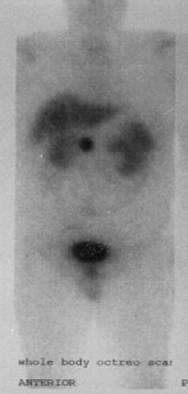 which corresponds to an area near the head of the pancreas. Which of the following factors directly results in the release of the hormone produced by this tumor?
-
A
-
B
-
C
-
D
-
E
Reveal answer details
Close answer details
Correct answerD
ExplanationThis patient has a gastrinoma, seen in Zollinger-Ellison syndrome, and should also be evaluated for possible MEN I. Gastrin is a GI hormone that is released from the antral G cells of the stomach to regulate acid secretion by the gastric parietal cells. It is released when the stomach gets the signal that is needed to initiate the digestion process, and also acts to stimulate chief cells to secrete pepsinogen and to increase gastric mucosal blood flow. Known stimulants for the release of gastrin include: vagal stimulation, calcium, alcohols in the stomach, proteins/amino acids in the stomach, antral distention, and gastric pH greater than 3. Antral pH less than 2 inhibits gastrin release, as does somatostatin. Secretin has no effect or decreases gastrin levels in healthy patients, but it increases gastrin release in patients with Zollinger-Ellison syndrome.
Glucagon has little or no effect on gastrin release.
Question 86
Single choice
The patient is a 28-year-old divorced female who presents in the emergency room complaining of insomnia. Further history reveals that she has been depressed since the divorce settlement 3 months ago. She also has anergia, poor concentration, decreased appetite with a 15-lb weight loss, anhedonia, and guilt surrounding her "failed marriage." She reluctantly admits to pervasive thoughts of killing herself, with a plan to overdose on two bottles of Tylenol as "I heard it can kill you." She has purchased the medicine and written a suicide note. She asks to leave to go home, and when discussion of admission is brought up, she becomes angry and demands to be discharged from the emergency room. What is the next most appropriate course of action?
-
A
admit her to the hospital involuntarily
-
B
admit her to the hospital voluntarily
-
C
discharge her against medical advice
-
D
discharge her with instructions to return in the morning
-
E
prescribe a selective serotonin reuptake inhibitor (SSRI) and provide outpatient follow-up
Reveal answer details
Close answer details
Correct answerA
ExplanationThis patient appears to be suffering from a major depressive episode and is exhibiting acute suicidal ideation with a definitive plan and intent to overdose on a potentially lethal substance. She clearly poses an increased risk of self-harm and requires immediate hospitalization. As she refuses a voluntary admission, involuntary admission (commitment) is warranted. Autonomy is the right of a patient to self-determination. Confidentiality is not a core ethical principle. Nonmaleficence is the duty to "first, do no harm." The concept of justice involves social, political, legal, and religious considerations. The important code of beneficence (preventing harm) is illustrated in the above case, where an immediately suicidal patient is admitted involuntarily.
Question 87
Single choice
A 29-year-old woman presents to the primary care clinic complaining of frequent headaches for several months. During the interview she appears tearful and withdrawn, with minimal eye contact and reluctance to answer questions. With further encouragement and support, she is able to describe intense feelings of sadness, along with significant insomnia, poor concentration, fatigue, anhedonia, and little appetite with a 20-lb weight loss It is decided to begin treatment for her depressive symptoms with pharmacotherapy.
Regarding the selection of the specific class of medication, a family history of what would be crucial?
-
A
-
B
-
C
-
D
-
E
Reveal answer details
Close answer details
Correct answerC
ExplanationThis woman likely suffers from a major depressive episode. While asking about substance abuse, current medications, medical problems, and a past history of depression are very important in a complete psychiatric evaluation, assessment of suicidality is essential. The risk of suicide in patients with major depressive disorder is about 20 times higher than those without the illness. The estimated lifetime risk of suicide is approximately 15% in those individuals with major depressive disorder. The choice of a specific antidepressant may be influenced by many factors, including prior response in the patient or a family member and comorbid medical problems or substance abuse in the family (and, therefore, potentially the patient). If a patient or family member has a history of manic symptoms or bipolar disorder, consideration should be given to beginning a mood stabilizer prior to initiating antidepressant therapy, as antidepressants can cause a switch into mania in those individuals.
Question 88
Single choice
You are asked to perform a high school physical examination for a 16-year-old female patient. She is on the track team. By history, she is healthy except for the fact that she has been amenorrheic for 4 months. She denies current or past sexual activity. On examination, she is 5 ft 9 in. tall and weighs 115 lbs. Her heart rate is 50 bpm. She has dry skin with lanugo. She has several sores in her mouth and obvious dental caries. She has several scratches on the backs of her hands. She is tanner stage III on breast examination. Her pelvic examination is remarkable for findings of urogenital atrophy. Her urine -hCG is negative. Which of the following would be the most likely diagnosis for this patient?
-
A
-
B
-
C
-
D
herpes simplex virus serotype I
-
E
congenital adrenal hyperplasia
Reveal answer details
Close answer details
Correct answerB
ExplanationMenstrual disorders, primarily oligo-and amenorrhea, are particularly common among women with eating disorders and are thought to be the result of hypothalamic hypoestrogenism. This patient demonstrates estrogen deficiency (decreased breast size, urogenital atrophy). Her dental caries, oral sores, and hand sores might be a result of self-induced vomiting. Hyperthyroidism would be considered in the differential diagnosis of a young woman with weight loss and menstrual irregularities. In contrast to persons with a medical condition that causes weight loss, those with an eating disorder express a disordered body image and, often, a desire to be underweight. This patient requires additional investigation to assess for the possibility of inpatient admission. Patients with a prolonged, severe eating disorder are at risk for developing dehydration, electrolyte imbalance (especially hypokalemia), cardiac dysrhythmias, and hypothermia. Hospitalization would be considered for those who are severely dehydrated, who have marked electrolyte abnormalities who are <75% of their ideal body weight, or who have a comorbid condition that would require hospitalization, such as a severe
psychiatric disorder. Although weight-bearing exercise favors bone formation, when excessive exercise and/or an eating disorder results in amenorrhea, estrogen levels fall. Subsequently, bone mineral density decreases. Persons with eating disorders are at increased risk for comorbid psychiatric conditions including depression, anxiety, obsessive-compulsive disorder, and personality disorders.
Question 89
Single choice
A 10-month-old infant has a dysplastic right external ear, some preauricular tags, and a small notch (coloboma) in the iris and lower lid. Which condition does he likely have?
-
A
-
B
neurofibromatosis, type 1 (von Recklinghausen disease)
-
C
-
D
-
E
Reveal answer details
Close answer details
Correct answerD
ExplanationThe term CHARGE is a mnemonic standing for Coloboma, Heart malformations, Atresia choanae, Retarded (growth and mental),Genital anomalies, and Ear anomalies. The colobomas are usually seen in the iris, but can be seen in the eyelids and the nasolabial folds as well. The heart anomalies of CHARGE association are usually ventricular septal defects and tetralogy of Fallot.
Question 90
Single choice
A55-year-old man with hepatic cirrhosis from alcohol abuse presents with a massive hematemesis. This is his third admission for upper GI hemorrhage in the past 2 months. He is currently receiving appropriate therapy for liver failure, including a beta-blocker and diuretics. He is lethargic and confused. His pulse is 100 and blood pressure is 85/40. His initial hematocrit is 20.
After fluid resuscitation, which of the following is the most appropriate management strategy?
-
A
The transplant team should be called immediately.
-
B
The bleeding is probably secondary to an uncontrolled duodenal ulcer related to his alcohol use.
-
C
Red blood cells should be administered immediately, but fresh frozen plasma should be withheld if possible.
-
D
Endoscopic control options include sclerotherapy and banding.
-
E
Transjugular intrahepatic portal systemic shunt (TIPS) is not an option in the immediate period.
Reveal answer details
Close answer details
Correct answerD
ExplanationIn patients with liver failure, the source of an upper GI bleed is esophageal varices in 50%, gastritis in 30%, and duodenal ulcers in only about 10%. Esophageal variceal bleeding is a potentially fatal complication of portal hypertension. The initial management should include fluid resuscitation and replacement of blood and clotting factors as needed. The second step is to control the source of bleeding. Medical management may include vasopressin or octreotide. Once the patient is stabilized, endoscopic evaluation of the bleeding is crucial. It can be both diagnostic and therapeutic. Endoscopic techniques for controlling hemorrhage can include sclerotherapy, banding, or balloon tamponade. If these methods are ineffective, or the patient has numerous recurrences, portal shunts can be considered. TIPS have increased in popularity as a method for portal decompression. This can be performed in the acute setting. Surgical shunts are also an option, but are primarily reserved for stable patients with recurrent bleeding episodes and not performed in an acutely unstable patient. Mesocaval shunts connect the SMV to the IVC in a variety of manners. Splenorenal shunts are actually the most common type of shunt. Nonselective shunts that completely divert portal blood flow from the liver can actually increase hepatic encephalopathy. Most surgeons prefer selective shunts, which preserve a component of hepatic blood flow and thus function. Synthetic graft material can be safely used to create the shunts.
Postoperative mortality is directly related to the patient's preprocedure medical condition and degree of hepatic failure.
Question 91
Single choice
A 23-year-old African-American presents with acute-onset pain in the abdomen, back, and legs. On physical examination, his pulse is 115 bpm, respiratory rate is 20, blood pressure is 100/70 mmHg, and temperature is 101. There is scleral icterus, a s ystolic ejection murmur at the right upper sternal border, bilateral rhonchi, a right upper quadrant abdominal scar from a cholecystectomy, and a diffusely tender abdomen without rebound. A neurologic examination is normal. A peripheral blood smear is shown in Figure . A CBC with differential and platelets later shows the Hgb to be 6.4, white blood count is 2100 with 85% polymorphonuclear forms, platelet count is 100, and the reticulocyte countis 0.5. Which of the following would be an appropriate next test?
-
A
serum antibody to parvovirus B19
-
B
broad-spectrum antibiotics for sepsis
-
C
consideration for splenectomy
-
D
-
E
administration of granulocyte colonystimulating factor (GnCSF)
Reveal answer details
Close answer details
Correct answerA
ExplanationThis patient has sickle cell anemia. This is evident from sickle cells forms on the peripheral blood smear in Figure 1-13. Pain medication is an important initial concern. It is often difficult to determine whether a patient in sickle cell crisis has an ongoing infection. Infections can precipitate sickle cell crisis. With respect to community-acquired pneumonia, the diagnosis is difficult. A patient with sickle cell crisis can have fever as a result of the sickle crisis. They can have an increased respiratory rate, physical examination, and CXR findings which suggest pneumonia as a result of pulmonary infarctions. A white blood count can be elevated due to marrow stimulation. In the presence of the acute chest syndrome, characterized by chest pain, hypoxia, and CXR infiltrates, antibiotics would be indicated. Without further information, it is hard to decide to empirically start broad-spectrum antibiotics for community-acquired pneumonia. Transfusions should generally be avoided in patients with sickle cell anemia who are not symptomatic due to the anemia. Since patients in sickle cell crisis have intravascular hemolysis, their reticulocyte counts are usually high and they can replace their blood quickly. Repeated small transfusions will lead to autoantibodies that will make further transfusions difficult. Arterial blood gas determination should not be the first step, given the above information. A CT scan of the abdomen is not indicated given the nonspecific nature of the patient's abdominal findings. Parvovirus B19 can cause aplastic crisis in patients with hemoglobinopathies, including sickle cell disease. A tip to this diagnosis is the decreased reticulocyte count in a patient who normally would have a high reticulocyte count. Given the information listed above, there is no indication for broad-spectrum antibiotics. Splenectomy is not a reasonable alternative at this point. Patients with sickle cell disease have autosplenectomy by the time they are adults. A bone marrow biopsy maybe indicated because of the low platelet count, but not initially. GnCSF is not indicated because the patient does not have neutropenia.
Patients with sickle cell disease typically have isosthenuria. This is due to repeated infarction of the renal papilli. This causes destruction and interference with the counter current mechanism that causes urine concentration. As a result, patients with sickle cell anemia have the inability to concentrate their urine. This results in fluid and electrolyte abnormalities. Patients in sickle cell crisis are usually fluid depleted. This and the sickled blood cells cause hyperviscosity and microinfarctions. There is no evidence that the patient has diabetes insipidus, which usually has a urine specific gravity less than 1.005. Patients with UTIs do not have isosthenuria due to RBCs and WBCs that increase the urine specific gravity. Sickle cell patients may have zinc deficiency, but this is not a cause of isosthenuria.
Question 92
Single choice
You are seeing a 48-year-old female in followup in your clinic. She originally presented for evaluation of a suspicious nonpalpable lesion in her right breast that was seen on her annual mammogram. A stereotactic core biopsy was done. She now returns to your office to review the results of the pathology report that confirms the presence of lobular carcinoma in situ (LCIS). How do you counsel her at this time?
-
A
Tamoxifen can prevent this cancer from spreading but may increase your risk of developing cancer in the other breast.
-
B
You can consider nonoperative treatment with close observation, annual mammograms, and semiannual clinical examinations.
-
C
The recommended treatment is a right breast mastectomy.
-
D
Further staging workup at this time will include a chest x-ray and bone scan.
-
E
Because you are at such high risk for future cancers, bilateral mastectomies should be performed to prevent this from happening.
Reveal answer details
Close answer details
Correct answerB
ExplanationLCIS is a benign diagnosis and alone does not have a risk of progression to an invasive cancer. However, a diagnosis of LCIS does increase the risk for development of future breast cancer at a rate of about 1% per year. It is important to remember that the risk is increased for both breasts. It has been shown that chemoprevention with tamoxifen can decrease the incidence of breast cancer by 49%. It is also sufficient to follow this population closely with annual mammograms and semiannual clinical examinations. Prophylactic bilateral mastectomies are an option and result in a 90% decrease in the risk of subsequent breast cancer. Since a diagnosis of LCIS increases the risk of cancer in both breasts, a mastectomy of the affected side is insufficient treatment
Question 93
Single choice
A husband and wife, both aged 30, come to the community health center for advice and evaluation prior to a month-long mission trip to central Africa. Both are in good health. She takes oral contraceptive pills and he is on no prescription medication. Review of their records shows that they have had all of the appropriate vaccinations for their ages, have completed a three dose hepatitis B series and had dT boosters 2 years ago. Their mission will involve building a school and health clinic in a rural area of Cameroon. What advice would be the most appropriate to provide?
-
A
Swimming in freshwater lakes would be a recommended type of exercise in the hot African climate.
-
B
The mosquito that transmits malaria is most active in the middle of the day.
-
C
The risk of motor vehicle related injuries is much lower because there are fewer cars on the road.
-
D
Due to its potential toxicity, N, N diethylm-toluamide (DEET)-containing insect repellents should be avoided.
-
E
Medication for malaria prophylaxis should be started before their trip and continued after they return home.
Reveal answer details
Close answer details
Correct answerE
ExplanationEncounters with persons traveling to other countries are common in primary care or community health settings. The advice and interventions provided are dependent on where the person is going, what he or she will be doing, and for how long he or she will be there. The most accessible and up-to-date source of this information in the United States is at the Centers for Disease Control web site, which provides detailed recommendations on vaccinations, health, and safety risks involved in overseas travel. In this series of questions, the travelers are going to the region of central Africa and, more specifically, to a rural area of Cameroon. This is an area of the world where polio remains a risk. As most Americans have not been vaccinated against polio since childhood, booster immunization against polio is recommended. The injectable polio vaccine is recommended as it does not carry with it the risk of vaccine-induced disease that the oral (live virus) vaccine does. Smallpox has been eliminated as a naturally occurring disease, although it remains of importance in bioterrorism discussions. The smallpox vaccine is not necessary for travel to any part of the world, but is used by the military or medical first responders who may be exposed in the event of a biowarfare attack. The traveling couple is up-to-date on their dT status with boosters within the past 2 years. They have completed a series of both MMR and hepatitis B, which is felt to confer lifetime immunity. Malaria prevention is an important consideration for travel to many areas of the developing world. Different regimens may be used depending on the area to which the travel will occur. All regimens, however, require the institution of prophylaxis prior to travel and the continuation of prophylaxis for up to 4 weeks after completion of travel. This is due to the life cycle of organisms that cause the disease. Prevention of malaria also involves attempts to reduce one's risk of exposure to the Ixodes mosquito which can transmit the disease. This mosquito tends to be more active early in the morning and at dusk, and less active in the middle of the day. Wearing long sleeved clothing, using mosquito nets, and insect repellent is important. DEET-containing insect repellents are recommended as the most effective products available and are safe when used appropriately. The most common cause of injury during travel is motor vehicle accidents. The risk of injury is higher in many developing countries than in the United States due to poor roads, poor vehicle maintenance, lack of seat belts, and other issues. Very cautious driving and avoidance of driving after dark may help to reduce the risk somewhat. While swimming is an ideal exercise in such hot climates as central Africa, freshwater lake swimming should be avoided due to the risk of exposure to schistosomiasis. The Schistosoma species that cause this disease are endemic in standing freshwater bodies. Swimming or bathing in salt water or chlorinated swimming pools is safer. Traveler's diarrhea and exposure to foodborne pathogens is a common cause of illness during travel to developing countries. The guideline with food is to cook it, peel it, purify it, or forget it. Fruits that can be peeled, such as oranges or bananas, are generally safe to eat. Carbonated beverages are also safe. However, ice cubes made from local water supplies are a common, and sometimes ignored, source of infection. Water purification can be accomplished by boiling or by filtering through an absolute 1 m filter and then purifying with iodine. Filtering alone does not provide adequate protection. Salads that are not made of carefully cleaned vegetables should be avoided and salad dressings may also be contaminated. Meats that are well cooked and served hot would be considered less likely to transmit an infection. Finally, brushing one's teeth with unpurified water carries a significant risk of transmission of waterborne illness and should be avoided. Purified water or bottled water should be used instead.
Question 94
Single choice
A 25-year-old nulligravid woman presents as a new patient to your gynecology practice. She has recently moved to the area. She is a healthy woman with no medical problems and is currently using oral contraceptives without problems. She informs you that she and her husband are planning to start a family within the next year. On review, you find her family history is unremarkable, but she informs you that her husband's sister has cystic fibrosis. What is the approximate prevalence of cystic fibrosis carrier state in White individuals?
-
A
-
B
-
C
-
D
-
E
Reveal answer details
Close answer details
Correct answerB
ExplanationCystic fibrosis is the most common hereditary condition in Whites with a carrier frequency of 1 in 25. The American College of Obstetricians and Gynecologists, the American College of Medical Genetics, and the National Institutes of Health have recommended that cystic fibrosis carrier screening be offered to all White couples either pregnant or considering a pregnancy, and that the availability of screening be discussed with members of other ethnic groups who have a lower frequency of cystic fibrosis carrier state. Cystic fibrosis is inherited in an autosomal recessive fashion, so for a couple in which both mother and father are carriers the risk of having an affected child is 25% or 1 in 4. In the case presented, in which the husband's sister has cystic fibrosis, his likelihood of being a carrier is 2 in 3 (since he has an affected sibling, both of his parents are obligate carriers, and since he is not affected, he is either a noncarrier [1 in 3] or a carrier [2 in 3]).
This pattern is true for all autosomal recessive disorders.
Question 95
Single choice
A 30-year-old (G2P0101) female presents to the clinic for a new obstetric visit. She has an unknown LMP. She reports that she discovered she was pregnant when she took a urine pregnancy test at home a month ago. She vaguely recalls having a period about 2 months ago, but is not sure exactly when that occurred. She reports that she is generally healthy. She had a previous delivery at 36 weeks EGA, though she reports her doctor was not really sure about her due date in that pregnancy. She reports that she had a normal spontaneous vaginal delivery in her previous pregnancy, and the child is healthy. Her postpartum course was complicated by depression, which has since resolved and not recurred. She denies history of sexually transmitted diseases or abnormal pap smears. She has no surgical history. She does not smoke, drink alcohol, or use illicit drugs. She does not have any family history of hypertension, diabetes, twins, or congenital anomalies.
She does report that her mother has a history of depression Given the patient's history of postpartum depression as well as her family history of depression, her risk of postpartum depression after this pregnancy is approximately what percentage?
-
A
-
B
-
C
-
D
-
E
Reveal answer details
Close answer details
Correct answerA
ExplanationThe pelvic ultrasound is the most reliable measurement of fetal gestational age in the absence of accurate dating by LMP. A first trimester sonogram is thought to be reliable ? days. Given the patient's history, she is likely at least 2 months pregnant. hCG level at this gestation can be variable and is not a useful method of pregnancy dating. A pelvic examination is useful to help confirm likely dating, but is not a reliable means of determining EDD. FSH and LH levels have no role in determining pregnancy dating. The risk of postpartum major depression is estimated at 820% in all postpartum patients. In those with a previous history of postpartum depression, the risk is thought to be 50100%. In patients who have had previous depression not associated with pregnancy, the risk of postpartum depression is 2030%. Maternity blues is a milder psychological reaction that can occur in the early postpartum period and is thought to occur in 70+ % of all postpartum patients. Patients with a history of bipolar disease have a igher risk of recurrence in the postpartum period, and these patients often present with postpartum psychosis symptoms.
Question 96
Single choice
A 16-year-old woman comes to see you for a yearly physical examination. Her only concern is that her periods are very irregular, and she desires oral contraceptives to regulate them. She relates that menarche was at 12 years, of age and that her periods have always been irregular. On examination, she is a markedly obese woman with a body mass index of 35 and with normal linear growth. She has some coarse facial hair down both of her checks as well as cystic acne along her hairline. On the nape of her neck she is noted to have acanthosis nigricans. She has tanner 4 breast development as well as tanner 4 pubic hair.
Her urinalysis in the office is normal. What would be the best intervention to achieve the best long-term outcome in this woman?
-
A
Begin low-dose subcutaneous insulin to prevent diabetes mellitus.
-
B
Begin daily corticosteroid therapy to suppress testosterone secretion.
-
C
Begin a regimen of lifestyle changes, including dietary and exercise alterations.
-
D
Begin levothyroxine (Synthroid) for control of weight gain.
-
E
Oophorectomy to decrease hormone levels.
Reveal answer details
Close answer details
Correct answerC
ExplanationThis clinical vignette describes an adolescent female with PCOS. PCOS is commonly seen in obese adolescent females with anovulatory menstrual cycles, hirsutism, and generalized virilization (acne). Commonly, PCOS patients will have glucose insensitivity and manifest features of type II diabetes mellitus. The diagnosis of PCOS may be difficult to ascertain. A pelvic ultrasound demonstrating "polycystic ovaries" (the string of pearls sign) may be quite helpful. Girls with PCOS will typically have elevated triglycerides, low HDL cholesterol, and a suppressed prolactin. As indicated above, PCOS girls also often have glucose insensitivity and an abnormal glucose tolerance test. The most effective therapy in PCOS involves lifestyle alterations (weight loss and exercise) and hormonal regulation of ovulation. The hypoglycemic agent metformin is now being used to assist in the management of PCOS. Occasionally, subcutaneous insulin may be effective in controlling hyperglycemia, but this will not prevent diabetes mellitus.
Question 97
Single choice
A 25-year-old woman presents to your office complaining of cold hands. She describes them turning white as she reaches for orange juice in the frozen food section of the supermarket. It seems to be getting worse lately. She has no other symptoms but does note that she and her husband are contemplating pregnancy.
Her examination today is unremarkable. Which of the following antibodies can cross the placenta and cause the syndrome of neonatal lupus?
-
A
anti-double-stranded DNA antibodies
-
B
antiscleroderma antibodies
-
C
anticardiolipin antibodies
-
D
Sjren syndrome antibodies (SSA/SSB)
-
E
Reveal answer details
Close answer details
Correct answerD
ExplanationVasospasm severe enough to reduce flow and produce cyanosis after exposure to cold is called Raynaud phenomenon. Some make a further distinction between Raynaud syndrome when the phenomenon is associated with another systemic disorder and Raynaud disease when there is no established systemic process. Similarly, Raynaud phenomenon in the absence of a systemic illness may also be referred to as primary Raynaud phenomenon, and Raynaud in the presence of another systemic illness may be termed secondary Raynaud phenomenon. In this case, there is no evidence of another systemic illness. Clinical features suggesting SLE or RA are absent. Subacute bacterial endocarditis likewise would be expected to be associated with fever, which is absent in this patient. In addition, one would expect to see areas of necrosis either in the soft tissue (Janeway spots) or under the fingernails (splinter hemorrhages) were any kind of embolic phenomenon is present. (Harrison's Principles of Internal Medicine, 15th ed., pp. 1438- 1439)
Given the patient's age, it is reasonable to explore the possibility of an associated systemic illness. If one were present, basic laboratories such as blood count, urinalysis, and chemistries are important. ANAis a reasonable screening study in this case. It does have a prognostic value increasing the likelihood of the development of a systemic process in the future. If positive, further serologic studies might then be helpful in establishing a more specific diagnosis. The arterial Doppler with cold stimulation can be a useful test in showing a marked drop in blood flow with cold exposure. Still, with such a classical description, it is hard to imagine how this test would be helpful either diagnostically or therapeutically. Antidouble-stranded DNA antibodies would establish the diagnosis of SLE. Likewise, the antiscleroderma antibodies (anti-Scl-70) would be a very important prognostic marker once the ANA is positive and certainly would occasion a rheumatic disease consultation. Patients with hypercoagulable states, including those with positive cardiolipin antibodies, can often mimic Raynaud's. Given that the patient wants to become pregnant, this would be an important study to obtain. Sjren antibodies, both SSA and SSB, are important in this case because of the contemplated pregnancy. Sjren antibodies can cross the placenta and create the syndrome of neonatal lupus (complete heart block, thrombocytopenia, and rash).
Question 98
Single choice
A 25-year-old woman presents to your office complaining of cold hands. She describes them turning white as she reaches for orange juice in the frozen food section of the supermarket. It seems to be getting worse lately. She has no other symptoms but does note that she and her husband are contemplating pregnancy. Her examination today is unremarkable.
In this patient, which of the following studies would be most likely to describe an increased risk of future systemic disease?
-
A
-
B
-
C
-
D
-
E
arterial Doppler of the upper limbs with cold stimulation
Reveal answer details
Close answer details
Correct answerC
ExplanationVasospasm severe enough to reduce flow and produce cyanosis after exposure to cold is called Raynaud phenomenon. Some make a further distinction between Raynaud syndrome when the phenomenon is associated with another systemic disorder and Raynaud disease when there is no established systemic process. Similarly, Raynaud phenomenon in the absence of a systemic illness may also be referred to as primary Raynaud phenomenon, and Raynaud in the presence of another systemic illness may be termed secondary Raynaud phenomenon. In this case, there is no evidence of another systemic illness. Clinical features suggesting SLE or RA are absent. Subacute bacterial endocarditis likewise would be expected to be associated with fever, which is absent in this patient. In addition, one would expect to see areas of necrosis either in the soft tissue (Janeway spots) or under the fingernails (splinter hemorrhages) were any kind of embolic phenomenon is present. (Harrison's Principles of Internal Medicine, 15th ed., pp. 1438- 1439)
Given the patient's age, it is reasonable to explore the possibility of an associated systemic illness. If one were present, basic laboratories such as blood count, urinalysis, and chemistries are important. ANAis a reasonable screening study in this case. It does have a prognostic value increasing the likelihood of the development of a systemic process in the future. If positive, further serologic studies might then be helpful in establishing a more specific diagnosis. The arterial Doppler with cold stimulation can be a useful test in showing a marked drop in blood flow with cold exposure. Still, with such a classical description, it is hard to imagine how this test would be helpful either diagnostically or therapeutically. Antidouble-stranded DNA antibodies would establish the diagnosis of SLE. Likewise, the antiscleroderma antibodies (anti-Scl-70) would be a very important prognostic marker once the ANA is positive and certainly would occasion a rheumatic disease consultation. Patients with hypercoagulable states, including those with positive cardiolipin antibodies, can often mimic Raynaud's. Given that the patient wants to become pregnant, this would be an important study to obtain. Sjren antibodies, both SSA and SSB, are important in this case because of the contemplated pregnancy. Sjren antibodies can cross the placenta and create the syndrome of neonatal lupus (complete heart block, thrombocytopenia, and rash).
Question 99
Single choice
A 72-year-old diabetic is transferred to your hospital for fever and altered mental status in the late summer. Symptoms started in this patient 1 week prior to admission. On physical examination, the patient was disoriented. There were no focal
neurologic findings. There was a fine rash on the patient's trunk. On oral examination, there were tongue fasciculations. A lumbar puncture was performed which showed a glucose of 71 and a protein of 94; microscopy of the cerebrospinal fluid (CSF) revealed 9 RBC and 14 WBC (21 P, 68 L, 11 H). The creatinine phosphokinase was 506. An electroencephalogram and MRI of the brain were normal. What is the best interpretation of these findings?
-
A
The patient may have cryptococcal meningitis.
-
B
The patient may have disseminated candidiasis.
-
C
The patient may have West Nile virus.
-
D
The patient may have Coccidioides immitis infection.
-
E
The patient may have rhinocerebral mucormycosis.
Reveal answer details
Close answer details
Correct answerC
ExplanationThis is a clinical presentation of West Nile virus infection. The tongue fasciculations go along with an inflammation at the base of the brain. The patient is at the right age for West Nile virus infection and he is immunocompromised due to diabetes. The diagnosis can be made by performing a West Nile virus IgM titer on the CSF. Diabetics can have cryptococcal meningitis. Lumbar puncture in this setting is usually normal with increased opening pressure, and rhabdomyolysis is not a feature of this disease. Diabetics are more at risk for candidiasis. However, the patient has no history of instrumentation, IV catheters, or other situations that would lead to disseminated candidiasis. Diabetics are at increased risk for
C. immitis infection, but we have no history of the patient living in an area endemic for this organism. Diabetics are at increased risk for rhinocerebral mucormycosis. An MRI of the head might have shown involvement of the sinus. However,
this patient's presentation is not consistent with rhinocerebral mucormycosis.
Question 100
Single choice
A67-year-old female with past medical history of rheumatoid arthritis on chronic steroid treatment and past surgical history (PSH) of complete hysterectomy secondary to fibroids presents for routine visit. Patient states that she has had multiple arthralgias worsening over the last 2 years. She had a DEXA scan done that showed a T score of -1.5. She has been taking calcium + vitamin D, and even started an exercise program at her local gym. She was started on bisphosphonates, which she has tolerated well.
Prior to discharging the patient, how soon would you counsel her to repeat the DEXA scan?
-
A
never: although she has risk for osteoporosis, she has already made all the lifestyle changes and is on pharmacotherapy
-
B
repeat in 5 years, since she only has osteopenia
-
C
-
D
-
E
Reveal answer details
Close answer details
Correct answerE
ExplanationOsteoporosis is generally defined as a T score of -2.5 SD or greater on assessment of BMD. Osteopenia is generally defined as a T score between 1 and 2.5 SD below the peak BMD for a healthy young person of the same gender.
Osteoporosis screening with an assessment of BMD should be offered to the following groups: ?All women 65 years old or older
?All adult women with a history of a fracture (or fractures) not caused by severe trauma (such as a motor vehicle accident)
?Younger postmenopausal women who have clinical risk factors for fractures ?Modifiable risk factors:
current cigarette smoking, low body weight (<127 lbs), estrogen deficiency, premature menopause, excessive thyroid hormone replacement, chronic corticosteroid therapy, low calcium intake (life-long), alcoholism, uncorrected visual impairment, inadequate physical activity, recurrent falls ?Nonmodifiable risk factors: personal or family history of fragility, family history of osteoporosis, White or Asian race, age, gender, poor health/frailty, dementia, hypogonadism in males, fracture without substantial trauma Serial assessments for BMD may be useful but one must remember the precision error among the tests. Using DEXA, a BMD must have a 35% difference to be clinically significant. Patients who are on pharmacologic treatment with bisphosphonates may only show this much change in 1 year. Therefore, static BMD or slight reduction should not be regarded as treatment failure. At present, there are no hard evidencebased guidelines for the most efficient use for BMD monitoring. However, the following guidelines are generally accepted:
?For patients with";norma"; baseline BMD (T score more than -1.0), consider a followup measurement every 35 years. Patients whose bone density is well above the minimal acceptable level may not need further bone density testing.
?For patients in an osteoporosis prevention program, perform a follow-up measurement every 12 years until bone mass stability is documented. After BMD has stabilized, perform follow-up measurements every 23 years.
?For patients on a therapeutic program, perform a follow-up measurement yearly for 2 years. If bone mass has stabilized after 2 years, perform a follow-up measurement every 2 years. Otherwise, continue with annual follow-up measurements until stability of bone mass is achieved.
|