In UiPath action central, what happens once an action is generated for a user?
-
A
A processes that was previously defined will start on a different machine.
-
B
The action will be display in the action page with the unassigned status.
-
C
The process will end successfully.
-
D
The action will be added into the Orchestrator queue of the process.
Reveal answer details
Close answer details
Correct answerB
ExplanationAccording to the UiPath documentation, an action is generated when a process reaches a point where human intervention is required. The action is then sent to the Action Center, where it can be viewed and managed by users. The action will have the status of Unassigned until it i assigned to a specific user, either manually or automatically. The process will remain in a suspended state until the action is completed by the user.
References:
Action Center - About Actions
Action Center - Managing Actions
What type of licensing should an architect check to make sure he can run the analysis within UiPath Unassisted Task Mining?
-
A
He should check if the customer has Data units allocated.
-
B
He should check if the customer has Mining units allocated.
-
C
He should check if the customer has Robot units allocated.
-
D
He should check if the customer has Al units allocated.
Reveal answer details
Close answer details
Correct answerB
ExplanationIn UiPath Unassisted Task Mining, the correct type of licensing to check for running analysis is whether the customer has Mining units allocated. Task Mining uses AI algorithms to analyze user interactions and identify automation opportunities. Mining units are a specific type of licensing metric used to quantify and allocate the resources required for the Task Mining analysis. These units are consumed based on the volume of data analyzed and the computational resources utilized during the process. Ensuring the availability of Mining units is essential for the successful execution of Task Mining projects. References:
UiPath Task Mining Guide: Introduction to Task Mining UiPath Licensing Guide: Understanding Licensing
-
A
An IDE to develop custom activities for UiPath Studio.
-
B
A system for managing digital files and content storage.
-
C
A cloud platform for creating and managing RPA solutions.
-
D
A low-node platform for building custom applications for automation.
Reveal answer details
Close answer details
Correct answerD
ExplanationUiPath Apps is a low-code application development platform that enables you to build and share enterprise-grade custom applications that deliver engaging user experiences. Using UiPath Apps, you can quickly build custom business applications that connect to data in any underlying cloud or on-premises system using the power of automation. Apps built with UiPath App Studio provide rich controls for data access and update as well as conditional logic for complex business needs. The underlying UiPath RPA platform provides advanced workflow and business logic capabilities to automate your entire end to end business process. Apps can be designed to run in multiple form factors such as a full-page console, a sidebar, or any other size for either desktop or mobile devices. References:
1: Apps - Introduction - UiPath Documentation Portal
2: Introducing UiPath Apps: A Robot-Powered Low-
Code Platform
How can a user set up a Calendar for Non-Working Days in UiPath Orchestrator?
-
A
Create a new calendar, and manually select Non-Working Days or upload a .csv file containing Non-
Working Days.
-
B
Create a new calendar, and manually select Non-Working Days.
-
C
Create a new calendar, and manually select Non-Working Days or upload a .txt file containing Non-
Working Days.
-
D
Orchestrator does not have the capability to create Calendars.
Reveal answer details
Close answer details
Correct answerA
ExplanationIn UiPath Orchestrator, calendars are used to define working and non-working days for robots. To accommodate non-working days, such as weekends or holidays, a user can create a new calendar and manually mark these days. Additionally, for ease and efficiency, a .csv file containing all non-working days can be prepared and uploaded to Orchestrator. This feature is particularly useful for planning and scheduling unattended robots, ensuring that they operate according to the organization's working calendar. References:
UiPath Orchestrator Guide: Managing Calendars
UiPath Orchestrator Guide: About Calendars
Which UiPath Studio main entry file and project settings are correct for implementing the following high-level solution diagram? 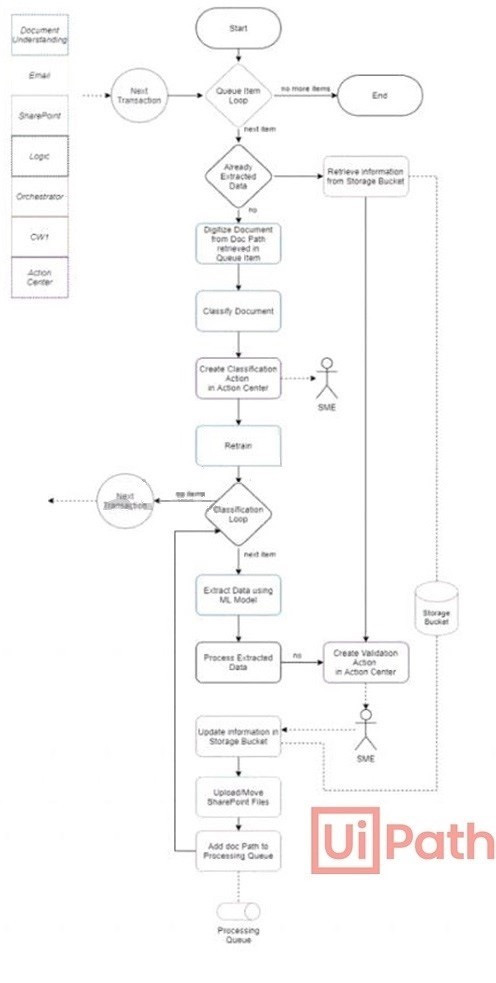 Exhibit A 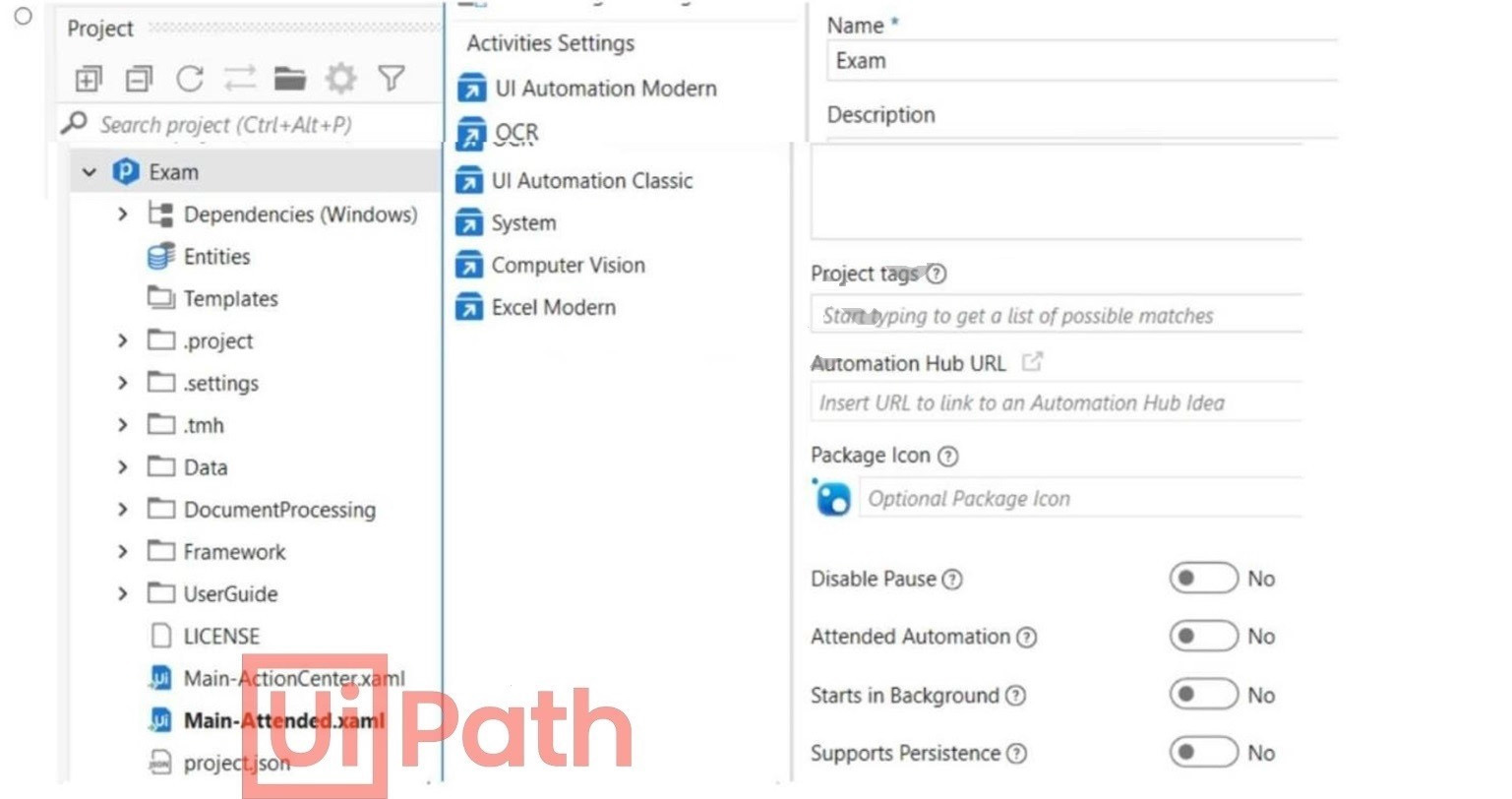 Exhibit B 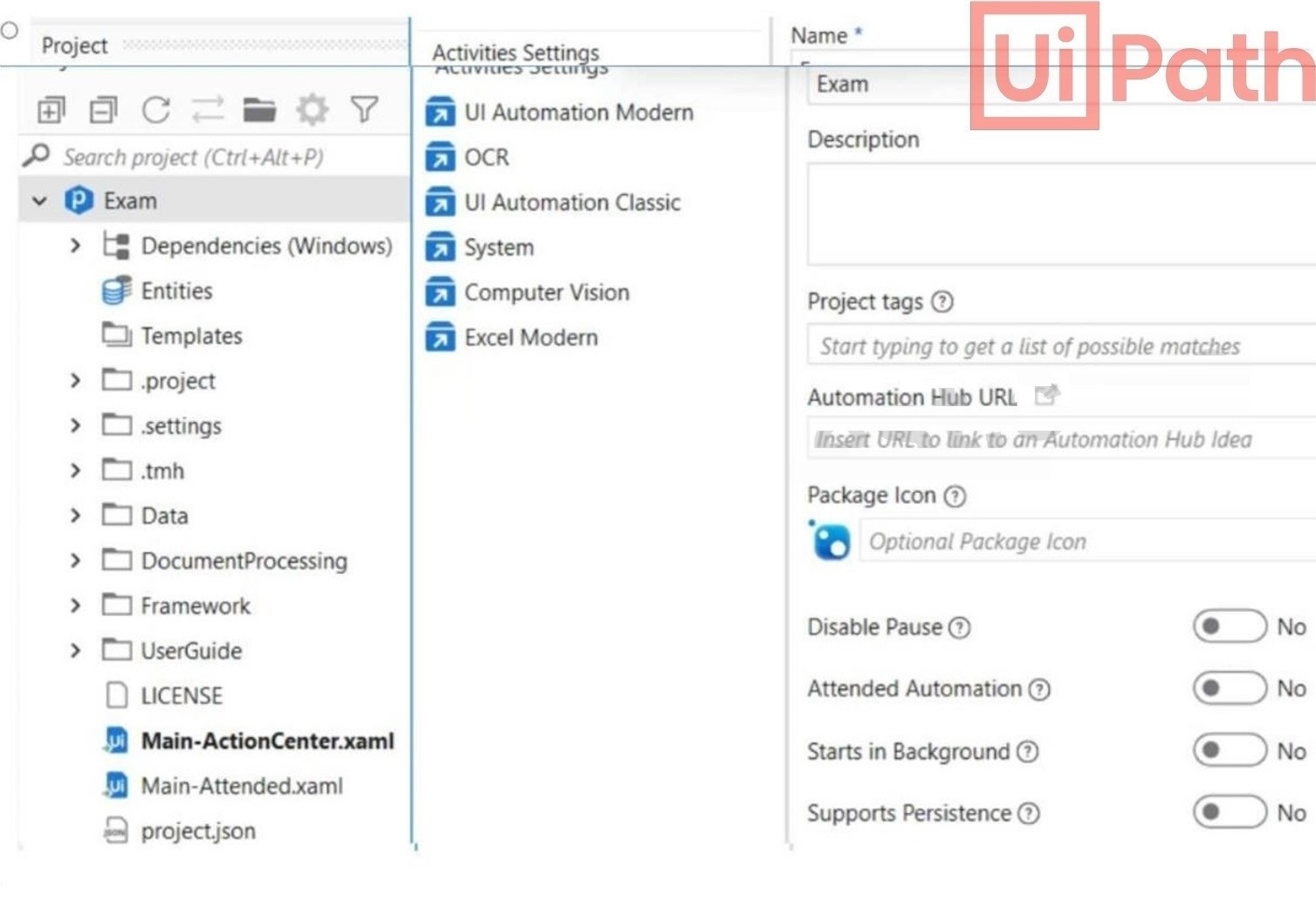 Exhibit C 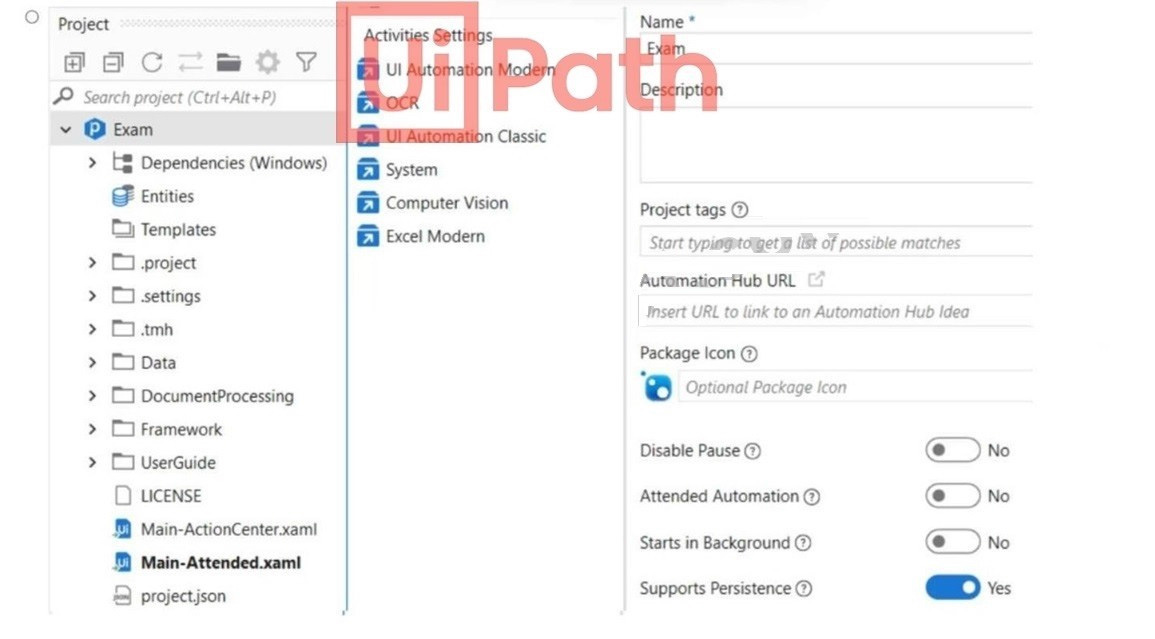 Exhibit D 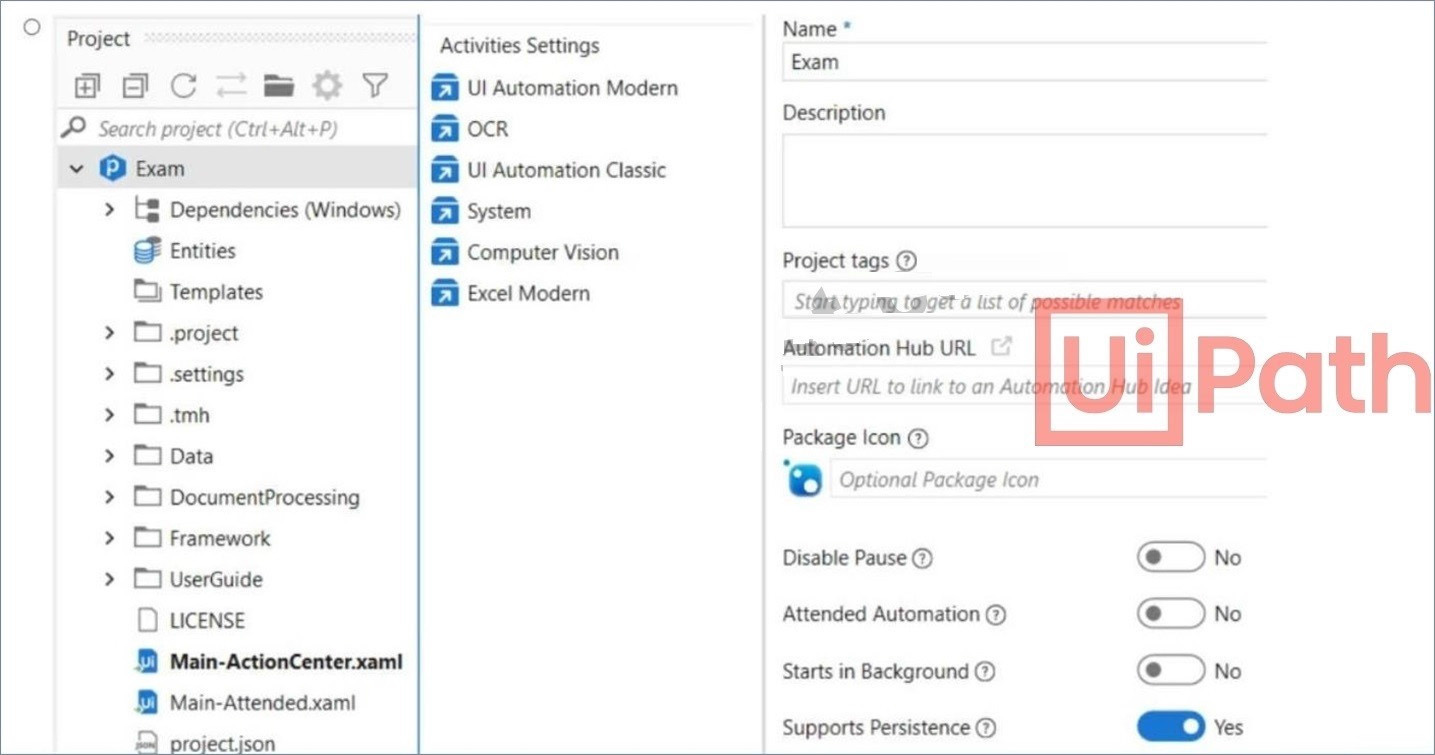
-
A
-
B
-
C
-
D
Reveal answer details
Close answer details
Question 6
Multiple choice
What are two key best practices for UiPath license estimation?
-
A
Assess the number and complexity of processes and identify required robot types (such as Attended or Unattended).
-
B
Calculate the ROI of automating a certain process and assess the volume of emails processed by the automations.
-
C
Analyze business metrics and identify the number of applications automated by the processes.
-
D
Assess concurrent robot usage during peak workload and optimize the chain of approvals in the decision-making.
Reveal answer details
Close answer details
Correct answersA, D
ExplanationFor UiPath license estimation, two key best practices include assessing the number and complexity of processes to determine the required types of robots (e.g., Attended, Unattended, Studio, StudioX) and evaluating concurrent robot usage during peak workloads. Understanding the complexity of the processes helps in choosing the right type of robots that align with the tasks' needs, ensuring efficient automation.
Concurrent usage assessment is crucial for optimizing resource allocation, especially during peak periods, to maintain high efficiency and productivity without overprovisioning resources. This strategic approach to licensing can significantly enhance the scalability and cost-effectiveness of RPA initiatives. References:
UiPath Licensing Guide: Robot Types and Licensing UiPath Best Practices: License Management
Which UiPath Task Mining integrator allows for documented tasks to be exported as automaton ideas?
-
A
Integration with UiPath Orchestrator
-
B
integration with UiPath Assistant
-
C
Integration with UiPaTh Automation Hub
-
D
Integration with UiPath Process Mining
Reveal answer details
Close answer details
Correct answerC
ExplanationUiPath Automation Hub is a centralized platform that enables users to capture, prioritize, and track automation ideas throughout their lifecycle. It also integrates with UiPath Task Mining, which is a tool that analyzes employees' desktop activities to discover repetitive and automatable tasks. By integrating Task Mining with Automation Hub, users can export the documented tasks as automation ideas and manage them in a unified pipeline. This way, users can leverage the data-driven insights from Task Mining to build a high-ROI automation portfolio. References:
Task Mining Integration with Automation Hub, Automation Hub Overview
A user is designing a solution lot a business process that uses the following Personal Identifiable Information (Pll): Employee Name and Employee Date of Birth Taking into consideration that PH should not be accessible to Database Administrators how should the details be stored in UiPath Orchestrator Queues?
-
A
Store Employee Name and Date of Birth as Transaction item Reference and set "Store in encrypted format as True
-
B
Store Employee Name and Date of Birth in Transaction item Specific Content and set "Store in encrypted format" as True
-
C
Store the Employee Name and Date of Birth in Transaction Item Specific Content
-
D
Store Employee Name and Date of Birth as Transaction item Reference so the business users can search by name
Reveal answer details
Close answer details
Correct answerB
ExplanationPersonal Identifiable Information (PII) is any data that potentially identifies a specific individual, allows for distinctions to be made between individuals, or could be used to de-anonymize anonymous data. PII should be handled with care and protected from unauthorized access or disclosure. UiPath Orchestrator Queues are a way to store and process data items for automation projects. Queues have two types of data: Reference and Specific Content. Reference is a unique identifier for the data item, while Specific Content is a collection of key-value pairs that store the actual data. To store PII in UiPath Orchestrator Queues, the best option is to use Specific Content and enable the "Store in encrypted format" option. This option encrypts the data using AES-256 encryption and prevents anyone, including database administrators, from viewing the data in plain text. Only the robots that have access to the queue can decrypt and process the data.
This ensures the security and privacy of the PII data. References:
About Queues and Transactions, Managing Queues in Studio, UiPath for Compliance, a GDPR Automation Solution
In UiPath Data Service, what does an "Entity" represent?
-
A
A process orchestration component.
-
B
A data visualization tool.
-
C
A data transformation method.
-
D
A table or data structure.
Reveal answer details
Close answer details
Correct answerD
ExplanationIn UiPath Data Service, an "Entity" represents a data model that defines the structure of data stored within the service, similar to a table in a relational database. Entities are used to model and manage business data in Data Service.
Question 10
Single choice
Consider the following estimation. What criteria from the below is not taken into account? 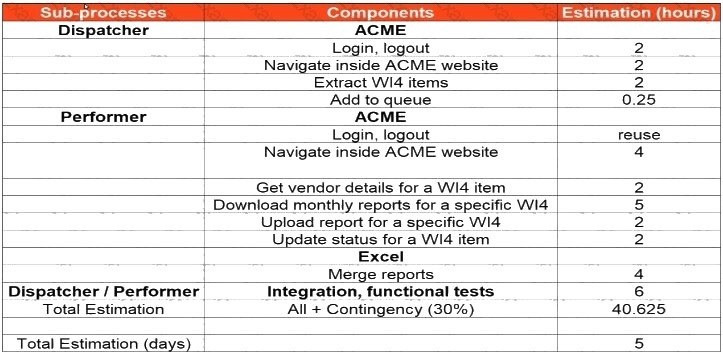
-
A
Number of clicks in the application(s).
-
B
Integration with ACME System 1 App tested successfully.
-
C
Number of sub-processes:2 (Dispatcher and performer).
-
D
Number of applications used: 2 (ACME System 1, Excel).
Reveal answer details
Close answer details
Correct answerA
ExplanationThe estimation table in the image shows the breakdown of hours required for different sub-processes and components in a UiPath automation project. The criteria that are taken into account are the number of sub-processes, the number of applications used, the integration and functional tests, and the contingency. The number of clicks in the application(s) is not a relevant criterion for the estimation, as it does not reflect the complexity or the effort of the automation. Moreover, the number of clicks may vary depending on the selectors, the UI elements, and the data inputs. References:
UiPath Automation Solution Architect Course, Module 3: Estimation and Planning Roles of a Solution Architect in Automation, RPA Setting, section: The importance of solution architecture
Question 11
Single choice
How can UiPath Communications Mining and Document Understanding be combined to optimize data extraction and analysis in an automated business process?
-
A
Communications Mining can extract insights from unstructured messages and Document Understanding can obtain hey Information from attached files
-
B
Communications Mining can access confidential messages and files and feed the data collected to Document Understanding for analysis
-
C
Communications Mining can be Inked directly to the output form Document Understanding to generate summaries of every communication
-
D
Communications Mining should be used to reanalyze data extracted by Document Understanding as if it were unstructured messages tor creating analytics
Reveal answer details
Close answer details
Correct answerA
ExplanationUiPath Communications Mining is a platform that uses AI to monitor and automate business communications across different channels, such as email, chat, calls, and tickets. It can extract insights from unstructured messages, such as the reasons for contact, the data fields, and the sentiment. UiPath Document Understanding is a framework that uses AI to process and analyze documents of various formats, such as PDF, Word, Excel, and images. It can obtain key information from attached files, such as the document type, the fields, and the values. By combining Communications Mining and Document Understanding, businesses can optimize data extraction and analysis in an automated business process.
For example, a customer service process that involves reading both messages and documents to complete a request can be automated by using Communications Mining to understand the customer's intent and data from the message, and Document Understanding to extract the relevant information from the document. This way, the process can be faster, more accurate, and more scalable. References:
Communications Mining - Overview - UiPath Documentation Portal
Document Understanding - Overview - UiPath Documentation Portal
How and where Communications Mining can be deployed
Question 12
Single choice
In the license estimation process, what might indicate the need for additional licenses during the process design stage?
-
A
Number of Data Service entities used.
-
B
High runtime, high volume, and low SLA.
-
C
Number of UiPath Studio project created
-
D
Low runtime, low volume, and medium-high SLA
Reveal answer details
Close answer details
Correct answerB
ExplanationThis answer is correct because high runtime, high volume, and low SLA indicate that the automation process is complex, frequent, and critical, which requires more resources and licenses to execute and manage. For example, more unattended robots may be needed to run the process without human intervention, more Orchestrator tenants may be needed to isolate and scale the process across different environments, and more Studio licenses may be needed to design and test the process. References:
Automation Pricing - Complete UiPath Enterprise Solution | UiPath
UiPath Pricing 2024: Its 3 RPA Pricing Models, Clearly Explained
Question 13
Single choice
What are long-running workflows?
-
A
Processes are designed to run continuously for an extended period of time.
-
B
Workflow intended to be used only by attended robots.
-
C
Master projects that supports orchestration and human intervention.
-
D
Workflow for which one can set a Stop Time
Reveal answer details
Close answer details
Correct answerC
ExplanationThis answer is correct because long-running workflows are processes that require logical fragmentation or human intervention (validations, approvals, exception handling) such as invoice processing and performance reviews. They are handled with a set of instruments in the UiPath suite: a dedicated project template in Studio called Orchestration Process, actions and resource allocation capabilities in Orchestrator. Long-running workflows use a pair of activities to introduce a condition that suspends the main job until the condition is met, and then resumes the job with the obtained data. The condition can be a job, a queue item, a form action, or an external action. References:
Orchestrator - Working With Long-running Workflows Designing long-running workflows - UiPath Documentation Portal
Question 14
Single choice
Which of the following feeds can be used to deploy a package? Select the option that members all that apply:
-
A
Tenant feed, External feed, Custom feed.
-
B
Tenant feed, External feed.
-
C
Tenant feed, Folder feed, Personal workspace feed. Custom feed.
-
D
Reveal answer details
Close answer details
Correct answerC
ExplanationAccording to the UiPath documentation and the UiPath Academy course, there are four types of feeds that can be used to deploy a package in Orchestrator: Tenant feed: This is the default feed for all tenants in Orchestrator. It is hosted on the Orchestrator server and can store both processes and libraries. It can be accessed by all users within the tenant. Folder feed: This is a feed that can be configured for a specific folder in Orchestrator. It can store only processes and can be accessed only by users within the folder. It can be useful for isolating packages for different environments or projects.
Personal workspace feed: This is a feed that can be configured for a personal workspace in Orchestrator.
It can store only processes and can be accessed only by the user who owns the workspace. It can be useful for testing and debugging packages before publishing them to other feeds.
Custom feed: This is a feed that can be configured by adding an external source, such as Azure DevOps, Artifactory, MyGet, etc. It can store both processes and libraries and can be accessed by users who have the credentials for the external source. It can be useful for integrating with third-party tools or services . References:
Automation Ops - Orchestrator Feeds - UiPath Documentation Portal
Queues and Transactions - UiPath Documentation Portal Folders - UiPath Documentation Portal Personal Workspaces - UiPath Documentation Portal External Feed For Packages - UiPath Community Forum
Question 15
Single choice
What ace the Solutions Architects responsibilities in avoiding access delays?
-
A
Create an Application Tracker document and ask the Project Manager to document the accesses needed
-
B
Request access for themselves the developers and the robots in the UAT phase
-
C
Identify and document the accesses needed for themselves, the developers and the robots
-
D
Request access for themselves the developers and the robots in the Development phase
Reveal answer details
Close answer details
Correct answerC
ExplanationOne of the responsibilities of a Solution Architect is to identify and document the accesses needed for themselves, the developers and the robots to perform the automation tasks. This includes the applications, systems, databases, APIs, credentials, permissions, roles, and security policies that are required for the automation solution. By identifying and documenting the accesses needed, the Solution Architect can avoid access delays that may impact the development, testing, and deployment of the automation solution.
The Solution Architect should also communicate and coordinate with the Project Manager, the IT team, and the business stakeholders to ensure that the access requests are approved and granted in a timely manner. References:
Roles of a Solution Architect in Automation, RPA Setting, Automation Suite - Deployment
architecture, [UiPath Automation Solution Architect Learning Plan].
Question 16
Single choice
Which package needs to be installed in order for the Taxonomy Manager wizard to appear in the top ribbon of the UiPath Studio?
-
A
UiPath.MLServices.Activities package
-
B
UiPath.Documentunderstanding.ML.Activities package
-
C
UiPath.OCR.Activities package
-
D
UiPath.IntelligentOCR.Activities package
Reveal answer details
Close answer details
Correct answerD
ExplanationThe Taxonomy Manager wizard in UiPath Studio appears when the UiPath.IntelligentOCR.Activities package is installed. This package is part of UiPath's Document Understanding framework, which allows developers to define, manage, and categorize document fields and types. The Taxonomy Manager is a crucial tool in this process, enabling the creation and editing of taxonomy for document classification and data extraction tasks. Installing this package enables the Taxonomy Manager feature in the Studio ribbon, facilitating the development of document processing workflows. References:
UiPath Document Understanding Guide: Taxonomy Manager
UiPath Marketplace: IntelligentOCR Activities
Question 17
Multiple choice
Which are the 2 types of accounts available in UiPath Automaton Cloud?
-
A
-
B
-
C
-
D
Reveal answer details
Close answer details
Correct answersB, D
ExplanationNamed user accounts are used to identify a person who can access UiPath products and services, and can be assigned roles, licenses, and groups. User Robot accounts are used to run unattended processes that do not require human interaction, and can also be assigned permissions and groups. References:
About accounts and groups
Question 18
Single choice
According to the `' process automation visibility criteria'', which tasks are most suitable for automation?
-
A
Rule-based and repetitive tasks.
-
B
Tasks involving creative problem-solving.
-
C
Tasks relying on manual user input.
-
D
Tasks requiring consultant human intervention
Reveal answer details
Close answer details
Correct answerA
ExplanationAccording to the process automation visibility criteria, the tasks that are most suitable for automation are those that are rule-based and repetitive. Rule-based tasks are those that follow a clear and consistent logic that can be programmed without human judgment. Repetitive tasks are those that are performed frequently and in large volumes, and do not vary much in their execution. These tasks are ideal for automation because they can be easily standardized, optimized, and scaled by software robots, while reducing human errors, costs, and efforts. References:
Are all processes are suitable for RPA, so how to identify the right processes for Robotic Process Automation Determining What Business Processes To Automate
How To Choose Which Processes To Automate With RPA
Question 19
Single choice
What role must approve the Pull Requests into the Main Branch?
-
A
-
B
-
C
-
D
Reveal answer details
Close answer details
Correct answerC
ExplanationIn the context of UiPath and RPA development, the Solution Architect plays a critical role in ensuring that the automation projects adhere to best practices, architectural standards, and organizational policies. One of the responsibilities of the Solution Architect is to review and approve Pull Requests into the Main Branch of the project repository. This step is crucial for maintaining code quality, ensuring that changes are aligned with the overall solution design, and preventing potential issues in production environments. The approval process by the Solution Architect helps in safeguarding the integrity and reliability of automation solutions. References:
UiPath Best Practices: Role of a Solution Architect UiPath Studio Guide: Version Control Systems
Question 20
Single choice
What are the benefits of having the UiPath Document Understanding Process templates as part of an End-
to-end Business Process (Upstream Automation > DU Process > Downstream Automation), and enabling the one-job-Per-File approach?
-
A
This approach simplifies the way a DU Process is being implemented, without any effect on the license consumption or development time.
-
B
Having the one-job-Per-File approach simplifies the End-to-End Business process tasking out the need for having a Dispatcher in place for running any DU Process. This simplifies the overall architecture and reduces the time needed to bring the implementation into production.
-
C
It prevents external issues from impacting the DU Process and unneeded license consumption due to re-execution. At the same time, it offers a better overview of the workload and robot utilization and it is easier to scale.
-
D
There is no real benefit but it offers a better separation between the existing UiPath Frameworks based on their purpose or area of expertise, it is always nice to have a dedicated tool for a specific task rather than having to reorganize a generic tool to fit your needs.
Reveal answer details
Close answer details
Correct answerC
ExplanationThis answer is correct because the one-job-per-file approach is a recommended architecture for Document Understanding processes that allows for processing each document as a separate job, regardless of the source or the trigger. This approach has several benefits, such as: It simplifies the development, debugging, and deployment of the DU Process, as it does not require any looping logic or complex exception handling. It enables the use of Orchestrator queues to store and manage the documents to be processed, which provides better visibility, tracking, and reporting of the process status and performance. It reduces the license consumption and re-execution costs, as each document is processed only once and any errors or exceptions are handled at the individual document level, without affecting the rest of the documents. It supports both attended and unattended scenarios, as well as human-in-the-loop validation via Action Center, using the same workflows and logic. It allows for easy scaling and load balancing of the process, as multiple robots can process documents in parallel from the same queue, without any conflicts or dependencies. References:
RPA Framework for Document Understanding - UiPath Community Forum
The Business Process for Document Understanding - UiPath Studio Template Explained
Question 21
Single choice
Which UiPath component allows UiPath Apps to connect to entity data sources?
-
A
-
B
-
C
-
D
Reveal answer details
Close answer details
Correct answerA
ExplanationUiPath Data Service is a persistent data storage service that brings powerful no-code data modeling and storage capabilities to your Robotic Process Automation (RPA) projects. UiPath Apps can connect and interact with entities from UiPath Data Service to create better, more complex apps. Entities are data models that define the structure and relationships of the data you want to store and use in your automation projects. You can reference an entity from Data Service in your app and bind it to various controls such as dropdown lists, tables, and custom lists. References:
About Data Service
Referencing an Entity in Your App Creating an Entity
Question 22
Single choice
What can be slated as tactual when it comes to Multi-node HA-ready production deployment?
-
A
A multi node HA ready production deployment involves one server node behind a toad balancer
-
B
A multi-node HA-ready production deployment involves a single-server node
-
C
A multi-node HA-ready production deployment involves 3 or more server nodes behind a toad balancer
-
D
A multi-node HA-ready production deployment has a knitted number of agent nodes
Reveal answer details
Close answer details
Correct answerC
ExplanationA multi-node HA-ready production deployment is the only configuration supported for production use by UiPath Automation Suite. It ensures that the cluster can handle increased workloads and demand, as well as provide resilience and availability in case of node failures or disasters. A multi-node HA-ready production deployment requires at least 3 server nodes behind a load balancer, which distributes the incoming requests among the nodes and manages the cluster state. The number of agent nodes, which run the UiPath products and shared components, is optional and depends on the actual usage and capacity. A specialized agent node with GPU support is recommended for running special tasks like Task Mining analysis and Document Understanding pipelines, which require high computational power. References:
Automation Suite - Deployment architecture - UiPath, Automation Suite - Manual: Multi-node HA-ready
production profile requirements and installation - UiPath.
Question 23
Single choice
What is U-Path Process Mining?
-
A
A solution converting IT systems data into interactive dashboards revealing value drops bottlenecks discrepancies and root causes
-
B
A solution building process diagrams tor known processes revealing differences between executions of processes by afferent users
-
C
A solution building dashboards and detailed reports based on date imported from UiPath Orchestrator logs and assets
-
D
A solution converting actions recorded from a user's workstation into a process diagram and a PDD containing the detailed sequence of steps
Reveal answer details
Close answer details
Correct answerA
ExplanationUiPath Process Mining is a technique to analyze, improve, and track processes. It uses the data already stored in systems and applications to automatically show how processes are really executed. It also uses AI-powered process modeling techniques and flexible dashboarding experience to reveal process bottlenecks and optimization opportunities. It can be used in any industry and any functional area, and it can be deployed in various options References:
Process Mining Tool - Business Process Mining | UiPath
What is Process Mining - RPA and Process Mining | UiPath
|