An Architecture where there are more than two execution domains or privilege levels is called:
-
A
-
B
-
C
-
D
Reveal answer details
Close answer details
Correct answerA
ExplanationIn computer science, hierarchical protection domains, often called protection rings, are a mechanism to protect data and functionality from faults (fault tolerance) and malicious behavior (computer security). This approach is diametrically opposite to that of capability-based security. Computer operating systems provide different levels of access to resources. A protection ring is one of two or more hierarchical levels or layers of privilege within the architecture of a computer system. This is generally hardware-enforced by some CPU architectures that provide different CPU modes at the hardware or microcode level. Rings are arranged in a hierarchy from most privileged (most trusted, usually numbered zero) to least privileged (least trusted, usually with the highest ring number). On most operating systems, Ring 0 is the level with the most privileges and interacts most directly with the physical hardware such as the CPU and memory. Special gates between rings are provided to allow an outer ring to access an inner ring's resources in a predefined manner, as opposed to allowing arbitrary usage. Correctly gating access between rings can improve security by preventing programs from one ring or privilege level from misusing resources intended for programs in another. For example, spyware running as a user program in Ring 3 should be prevented from turning on a web camera without informing the user, since hardware access should be a Ring 1 function reserved for device drivers. Programs such as web browsers running in higher numbered rings must request access to the network, a resource restricted to a lower numbered ring. Ring Architecture 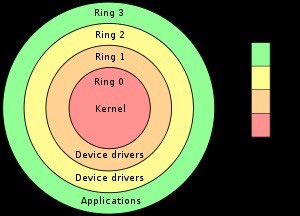 All of the other answers are incorrect because they are detractors. References:
OIG CBK Security Architecture and Models (page 311) and (https://en.wikipedia.org/wiki/Ring_%28computer_security%29)
Which of the following is the BEST way to detect software license violations?
-
A
Implementing a corporate policy on copyright infringements and software use.
-
B
Requiring that all PCs be diskless workstations.
-
C
Installing metering software on the LAN so applications can be accessed through the metered software.
-
D
Regularly scanning PCs in use to ensure that unauthorized copies of software have not been loaded on the PC.
Reveal answer details
Close answer details
Correct answerD
ExplanationThe best way to prevent and detect software license violations is to regularly scan used PCs, either from the LAN or directly, to ensure that unauthorized copies of software have not been loaded on the PC. Other options are not detective. A corporate policy is not necessarily enforced and followed by all employees. Software can be installed from other means than floppies or CD-ROMs (from a LAN or even downloaded from the Internet) and software metering only concerns applications that are registered. Source: Information Systems Audit and Control Association, Certified Information Systems Auditor 2002 review manual, Chapter 3: Technical Infrastructure and Operational Practices (page 108).
Which of the following devices enables more than one signal to be sent out simultaneously over one physical circuit?
-
A
-
B
-
C
Channel service unit/Data service unit (CSU/DSU)
-
D
Reveal answer details
Close answer details
Correct answerB
ExplanationMultiplexers are devices that enable enables more than one signal to be sent out simultaneously over one physical circuit. Source: KRUTZ, Ronald L. & VINES, Russel D., The CISSP Prep Guide: Mastering the Ten Domains of Computer Security, John Wiley & Sons, 2001, Chapter 3: Telecommunications and Network Security (page
118).
Which of the following prevents, detects, and corrects errors so that the integrity, availability, and confidentiality of transactions over networks may be maintained?
-
A
Communications security management and techniques
-
B
Information security management and techniques
-
C
Client security management and techniques
-
D
Server security management and techniques
Reveal answer details
Close answer details
Correct answerA
ExplanationCommunications security and techniques are the best area for addressing this objective. "Information security management and techniques" is incorrect. While the overall information security program would include this objective, communications security is the more specific and better answer. "Client security management and techniques" is incorrect. While client security plays a part in this overall objective, communications security is the more specific and better answer. "Server security management and techniques" is incorrect. While server security plays a part in this overall objective, communications security is the more specific and better answer. References:
CBK, p. 408
Crackers today are MOST often motivated by their desire to:
-
A
Help the community in securing their networks.
-
B
Seeing how far their skills will take them.
-
C
Getting recognition for their actions.
-
D
Gaining Money or Financial Gains.
Reveal answer details
Close answer details
Correct answerD
ExplanationA few years ago the best choice for this question would have been seeing how far their skills can take them. Today this has changed greatly, most crimes committed are financially motivated. Profit is the most widespread motive behind all cybercrimes and, indeed, most crimes-everyone wants to make money.
Hacking for money or for free services includes a smorgasbord of crimes such as embezzlement, corporate espionage and being a "hacker for hire". Scams are easier to undertake but the likelihood of success is much lower. Money-seekers come from any lifestyle but those with persuasive skills make better con artists in the same way as those who are exceptionally tech-savvy make better "hacks for hire".
"White hats" are the security specialists (as opposed to Black Hats) interested in helping the community in securing their networks. They will test systems and network with the owner authorization.
A Black Hat is someone who uses his skills for offensive purpose. They do not seek authorization before they attempt to comprise the security mechanisms in place. "Grey Hats" are people who sometimes work as a White hat and other times they will work as a "Black Hat", they have not made up their mind yet as to which side they prefer to be.
The following are incorrect answers: All the other choices could be possible reasons but the best one today is really for financial gains.
References used for this question:
http://library.thinkquest.org/04oct/00460/crimeMotives.html
and
http://www.informit.com/articles/article.aspx?p=1160835
and
http://www.aic.gov.au/documents/1/B/A/%7B1BA0F612-613A-494D-B6C5-06938FE8BB53%7Dhtcb006.pdf
A momentary power outage is a:
-
A
-
B
-
C
-
D
Reveal answer details
Close answer details
Correct answerD
ExplanationA momentary power outage is a fault.
Power Excess Spike --> Too much voltage for a short period of time. Surge --> Too much voltage for a long period of time. Power Loss Fault --> A momentary power outage. Blackout --> A long power interruption. Power Degradation Sag or Dip --> A momentary low voltage. Brownout --> A prolonged power supply that is below normal voltage. Reference(s) used for this question: HARRIS, Shon, All-In-One CISSP Certification Exam Guide, 3rd. Edition McGraw-Hill/Osborne, 2005, page 368. and https://en.wikipedia.org/wiki/Power_quality
The Diffie-Hellman algorithm is primarily used to provide which of the following?
-
A
-
B
-
C
-
D
Reveal answer details
Close answer details
Correct answerB
ExplanationDiffie and Hellman describe a means for two parties to agree upon a shared secret in such a way that the secret will be unavailable to eavesdroppers. This secret may then be converted into cryptographic keying material for other (symmetric) algorithms. A large number of minor variants of this process exist. See RFC 2631 Diffie-Hellman Key Agreement Method for more details. In 1976, Diffie and Hellman were the first to introduce the notion of public key cryptography, requiring a system allowing the exchange of secret keys over non-secure channels. The Diffie-Hellman algorithm is used for key exchange between two parties communicating with each other, it cannot be used for encrypting and decrypting messages, or digital signature. Diffie and Hellman sought to address the issue of having to exchange keys via courier and other unsecure means. Their efforts were the FIRST asymmetric key agreement algorithm. Since the Diffie-Hellman algorithm cannot be used for encrypting and decrypting it cannot provide confidentiality nor integrity. This algorithm also does not provide for digital signature functionality and thus non-repudiation is not a choice. NOTE: The DH algorithm is susceptible to man-in-the-middle attacks. KEY AGREEMENT VERSUS KEY EXCHANGE A key exchange can be done multiple way. It can be done in person, I can generate a key and then encrypt the key to get it securely to you by encrypting it with your public key. A Key Agreement protocol is done over a public medium such as the internet using a mathematical formula to come out with a common value on both sides of the communication link, without the ennemy being able to know what the common agreement is.
The following answers were incorrect: All of the other choices were not correct choices Reference(s) used for this question: Shon Harris, CISSP All In One (AIO), 6th edition . Chapter 7, Cryptography, Page 812. http://en.wikipedia.org/wiki/Diffie%E2%80%93Hellman_key_exchange
http://www.google.com/patents?vid=4200770
Which access control model is best suited in an environment where a high security level is required and where it is desired that only the administrator grants access control?
-
A
-
B
-
C
-
D
Reveal answer details
Close answer details
Correct answerB
ExplanationMAC provides high security by regulating access based on the clearance of individual users and sensitivity labels for each object. Clearance levels and sensitivity levels cannot be modified by individual users -- for example, user Joe (SECRET clearance) cannot reclassify the "Presidential Doughnut Recipe" from "SECRET" to "CONFIDENTIAL" so that his friend Jane (CONFIDENTIAL clearance) can read it. The administrator is ultimately responsible for configuring this protection in accordance with security policy and directives from the Data Owner. DAC is incorrect. In DAC, the data owner is responsible for controlling access to the object. Access control matrix is incorrect. The access control matrix is a way of thinking about the access control needed by a population of subjects to a population of objects. This access control can be applied using rules, ACL's, capability tables, etc. TACACS is incorrect. TACACS is a tool for performing user authentication. References:
CBK, p. 187, Domain 2: Access Control.
AIO3, Chapter 4, Access Control.
In Synchronous dynamic password tokens:
-
A
The token generates a new password value at fixed time intervals (this password could be based on the time of day encrypted with a secret key).
-
B
The token generates a new non-unique password value at fixed time intervals (this password could be based on the time of day encrypted with a secret key).
-
C
The unique password is not entered into a system or workstation along with an owner's PIN.
-
D
The authentication entity in a system or workstation knows an owner's secret key and PIN, and the entity verifies that the entered password is invalid and that it was entered during the invalid time window.
Reveal answer details
Close answer details
Correct answerA
ExplanationSynchronous dynamic password tokens: - The token generates a new password value at fixed time intervals (this password could be the time of day encrypted with a secret key).
- the unique password is entered into a system or workstation along with an owner's PIN. - The authentication entity in a system or workstation knows an owner's secret key and PIN, and the entity verifies that the entered password is valid and that it was entered during the valid time window. Source: KRUTZ, Ronald L. & VINES, Russel D., The CISSP Prep Guide: Mastering the Ten Domains of Computer Security, 2001, John Wiley & Sons, Page 37.
Question 10
Single choice
What can be defined as a batch process dumping backup data through communications lines to a server at an alternate location?
-
A
-
B
-
C
-
D
Reveal answer details
Close answer details
Correct answerB
ExplanationElectronic vaulting refers to the transfer of backup data to an off-site location. This is primarily a batch process of dumping backup data through communications lines to a server at an alternate location. Electronic vaulting is accomplished by backing up system data over a network. The backup location is usually at a separate geographical location known as the vault site. Vaulting can be used as a mirror or a backup mechanism using the standard incremental or differential backup cycle. Changes to the host system are sent to the vault server in real-time when the backup method is implemented as a mirror. If vaulting updates are recorded in real-time, then it will be necessary to perform regular backups at the off-site location to provide recovery services due to inadvertent or malicious alterations to user or system data. The following are incorrect answers: Remote journaling refers to the parallel processing of transactions to an alternate site (as opposed to a batch dump process). Journaling is a technique used by database management systems to provide redundancy for their transactions. When a transaction is completed, the database management system duplicates the journal entry at a remote location. The journal provides sufficient detail for the transaction to be replayed on the remote system. This provides for database recovery in the event that the database becomes corrupted or unavailable. Database shadowing uses the live processing of remote journaling, but creates even more redundancy by duplicating the database sets to multiple servers. There are also additional redundancy options available within application and database software platforms. For example, database shadowing may be used where a database management system updates records in multiple locations. This technique updates an entire copy of the database at a remote location. Data clustering refers to the classification of data into groups (clusters). Clustering may also be used, although it should not be confused with redundancy. In clustering, two or more "partners" are joined into the cluster and may all provide service at the same time. For example, in an activeactive pair, both systems may provide services at any time. In the case of a failure, the remaining partners may continue to provide service but at a decreased capacity. The following resource(s) were used for this question: Hernandez CISSP, Steven (2012-12-21). Official (ISC)2 Guide to the CISSP CBK, Third Edition ((ISC)2 Press) (Kindle Locations 20403-20407 and 20411-20414 and 20375-20377 and 20280- 20283). Auerbach Publications. Kindle Edition.
Question 11
Single choice
Which of the following is an example of an active attack?
-
A
-
B
-
C
-
D
Reveal answer details
Close answer details
Correct answerB
ExplanationScanning is definitively a very active attack. The attacker will make use of a scanner to perform the attack, the scanner will send a very large quantity of packets to the target in order to illicit responses that allows the attacker to find information about the operating system, vulnerabilities, misconfiguration and more. The packets being sent are sometimes attempting to identify if a known vulnerability exist on the remote hosts. A passive attack is usually done in the footprinting phase of an attack. While doing your passive reconnaissance you never send a single packet to the destination target. You gather information from public databases such as the DNS servers, public information through search engines, financial information from finance web sites, and technical infomation from mailing list archive or job posting for example.
An attack can be active or passive. An "active attack" attempts to alter system resources or affect their operation. A "passive attack" attempts to learn or make use of information from the system but does not affect system resources. (E.g., see: wiretapping.) The following are all incorrect answers because they are all passive attacks: Traffic Analysis - Is the process of intercepting and examining messages in order to deduce information from patterns in communication. It can be performed even when the messages are encrypted and cannot be decrypted. In general, the greater the number of messages observed, or even intercepted and stored, the more can be inferred from the traffic. Traffic analysis can be performed in the context of military intelligence or counter-intelligence, and is a concern in computer security. Eavesdropping - Eavesdropping is another security risk posed to networks. Because of the way some networks are built, anything that gets sent out is broadcast to everyone. Under normal circumstances, only the computer that the data was meant for will process that information. However, hackers can set up programs on their computers called "sniffers" that capture all data being broadcast over the network. By carefully examining the data, hackers can often reconstruct real data that was never meant for them. Some of the most damaging things that get sniffed include passwords and credit card information. In the cryptographic context, Eavesdropping and sniffing data as it passes over a network are considered passive attacks because the attacker is not affecting the protocol, algorithm, key, message, or any parts of the encryption system. Passive attacks are hard to detect, so in most cases methods are put in place to try to prevent them rather than to detect and stop them. Altering messages, modifying system files, and masquerading as another individual are acts that are considered active attacks because the attacker is actually doing something instead of sitting back and gathering data. Passive attacks are usually used to gain information prior to carrying out an active attack."
Wiretapping - Wiretapping refers to listening in on electronic communications on telephones, computers, and other devices. Many governments use it as a law enforcement tool, and it is also used in fields like corporate espionage to gain access to privileged information. Depending on where in the world one is, wiretapping may be tightly controlled with laws that are designed to protect privacy rights, or it may be a widely accepted practice with little or no protections for citizens. Several advocacy organizations have been established to help civilians understand these laws in their areas, and to fight illegal wiretapping. Reference(s) used for this question: HARRIS, Shon, All-In-One CISSP Certification Exam Guide, 6th Edition, Cryptography, Page and
http://en.wikipedia.org/wiki/Attack_%28computing%29 and http://www.wisegeek.com/what-is-wiretapping.htm
and https://pangea.stanford.edu/computing/resources/network/security/risks.php
and http://en.wikipedia.org/wiki/Traffic_analysis
Question 12
Single choice
Address Resolution Protocol (ARP) interrogates the network by sending out a?
-
A
-
B
-
C
-
D
Reveal answer details
Close answer details
Correct answerA
ExplanationARP interrogates the network by sending out a broadcast seeking a network node that has a specific IP address, and asks it to reply with its hardware address. A broadcast message is sent to everyone whether or not the message was requested. A traditional unicast is a "one-to-one" or "narrowcast" message. A multicast is a "one-to-many" message that is traditionally only sent to those machine that requested the information. Semicast is an imposter answer. Source: KRUTZ, Ronald L. & VINES, Russel D., The CISSP Prep Guide: Mastering the Ten Domains of Computer Security, 2001, John Wiley & Sons, Page 87.
Question 13
Single choice
Which of the following is true of two-factor authentication?
-
A
It uses the RSA public-key signature based on integers with large prime factors.
-
B
It requires two measurements of hand geometry.
-
C
It does not use single sign-on technology.
-
D
It relies on two independent proofs of identity.
Reveal answer details
Close answer details
Correct answerD
ExplanationThe Answer: It relies on two independent proofs of identity. Two-factor authentication refers to using two independent proofs of identity, such as something the user has (e.g. a token card) and something the user knows (a password). Two-factor authentication may be used with single sign-on. The following answers are incorrect: It requires two measurements of hand geometry. Measuring hand geometry twice does not yield two independent proofs. It uses the RSA public-key signature based on integers with large prime factors. RSA encryption uses integers with exactly two prime factors, but the term "two-factor authentication" is not used in that context. It does not use single sign-on technology. This is a detractor. The following reference(s) were/was used to create this question: Shon Harris AIO v.3 p.129 ISC2 OIG, 2007 p. 126
Question 14
Single choice
Devices that supply power when the commercial utility power system fails are called which of the following?
-
A
-
B
uninterruptible power supplies
-
C
-
D
Reveal answer details
Close answer details
Correct answerB
ExplanationFrom Shon Harris AIO Fifth Edition: Protecting power can be done in three ways: through UPSs, power line conditioners, and backup sources.
UPSs use battery packs that range in size and capacity. A UPS can be online or standby. Online UPS systems use AC line voltage to charge a bank of batteries. When in use, the UPS has an inverter that changes the DC output from the batteries into the required AC form and that regulates the voltage as it powers computer devices. Online UPS systems have the normal primary power passing through them day in and day out. They constantly provide power from their own inverters, even when the electric power is in proper use. Since the environment's electricity passes through this type of UPS all the time, the UPS device is able to quickly detect when a power failure takes place. An online UPS can provide the necessary electricity and picks up the load after a power failure much more quickly than a standby UPS. Standby UPS devices stay inactive until a power line fails. The system has sensors that detect a power failure, and the load is switched to the battery pack. The switch to the battery pack is what causes the small delay in electricity being provided. So an online UPS picks up the load much more quickly than a standby UPS, but costs more of course.
Question 15
Single choice
All hosts on an IP network have a logical ID called a(n):
-
A
-
B
-
C
-
D
Reveal answer details
Close answer details
Correct answerA
ExplanationAll hosts on a network have a logical ID that is called an IP address. An IP address is a numeric identifier that is assigned to each machine on an IP network. It designates the location of a device on a network. A MAC address is typically called a hardware address because it is "burned" into the NIC card. TCP address and Datagram address are imposter answers. Source: KRUTZ, Ronald L. & VINES, Russel D., The CISSP Prep Guide: Mastering the Ten Domains of Computer Security, 2001, John Wiley & Sons, Page 87.
Question 16
Single choice
What is defined as the hardware, firmware and software elements of a trusted computing base that implement the reference monitor concept?
-
A
-
B
-
C
-
D
Reveal answer details
Close answer details
Correct answerC
ExplanationA security kernel is defined as the hardware, firmware and software elements of a trusted computing base that implement the reference monitor concept. A reference monitor is a system component that enforces access controls on an object. A protection domain consists of the execution and memory space assigned to each process. The use of protection rings is a scheme that supports multiple protection domains. Source: KRUTZ, Ronald L. & VINES, Russel D., The CISSP Prep Guide: Mastering the Ten Domains of Computer Security, John Wiley & Sons, 2001, Chapter 5: Security Architecture and Models (page 194).
Question 17
Single choice
Which IPSec operational mode encrypts the entire data packet (including header and data) into an IPSec packet?
-
A
-
B
-
C
-
D
Reveal answer details
Close answer details
Correct answerB
ExplanationIn tunnel mode, the entire packet is encrypted and encased into an IPSec packet. In transport mode, only the datagram (payload) is encrypted, leaving the IP address visible within the IP header. Authentication mode and safe mode are not defined IPSec operational modes. Source: KRUTZ, Ronald L. & VINES, Russel D., The CISSP Prep Guide: Mastering the Ten Domains of Computer Security, John Wiley & Sons, 2001, Chapter 3: Telecommunications and Network Security (page
96).
Question 18
Single choice
Which of the following is less likely to be used today in creating a Virtual Private Network?
-
A
-
B
-
C
-
D
Reveal answer details
Close answer details
Correct answerD
ExplanationL2F (Layer 2 Forwarding) provides no authentication or encryption. It is a Protocol that supports the creation of secure virtual private dial-up networks over the Internet. At one point L2F was merged with PPTP to produce L2TP to be used on networks and not only on dial up links. IPSec is now considered the best VPN solution for IP environments. Source: HARRIS, Shon, All-In-One CISSP Certification Exam Guide, McGraw-Hill/Osborne, 2002, Chapter
8: Cryptography (page 507).
Question 19
Single choice
Which of the following is covered under Crime Insurance Policy Coverage?
-
A
Inscribed, printed and Written documents
-
B
-
C
-
D
Reveal answer details
Close answer details
Correct answerD
ExplanationSource: TIPTON, Harold F. & KRAUSE, MICKI, Information Security Management Handbook, 4th Edition, Volume 1, Property Insurance overview, Page 589.
Question 20
Single choice
Why would anomaly detection IDSs often generate a large number of false positives?
-
A
Because they can only identify correctly attacks they already know about.
-
B
Because they are application-based are more subject to attacks.
-
C
Because they can't identify abnormal behavior.
-
D
Because normal patterns of user and system behavior can vary wildly.
Reveal answer details
Close answer details
Correct answerD
ExplanationUnfortunately, anomaly detectors and the Intrusion Detection Systems (IDS) based on them often produce a large number of false alarms, as normal patterns of user and system behavior can vary wildly. Being only able to identify correctly attacks they already know about is a characteristic of misuse detection (signature-based) IDSs. Application-based IDSs are a special subset of host-based IDSs that analyze the events transpiring within a software application. They are more vulnerable to attacks than host-based IDSs. Not being able to identify abnormal behavior would not cause false positives, since they are not identified. Source: DUPUIS, Cl?ment, Access Control Systems and Methodology CISSP Open Study Guide, version
1.0, march 2002 (page 92).
Question 21
Single choice
What is defined as the manner in which the network devices are organized to facilitate communications?
-
A
-
B
-
C
LAN transmission protocols
-
D
Reveal answer details
Close answer details
Correct answerB
ExplanationA network topology defines the manner in which the network devices are organized to facilitate communications. Common LAN technologies are: bus ring star meshed LAN transmission methods refer to the way packets are sent on the network and are: unicast multicast broadcast LAN transmission protocols are the rules for communicating between computers on a LAN.
Common LAN transmission protocols are: CSMA/CD polling token-passing LAN media access methods control the use of a network (physical and data link layers). They can be: Ethernet ARCnet Token ring FDDI Source: KRUTZ, Ronald L. & VINES, Russel D., The CISSP Prep Guide: Mastering the Ten Domains of Computer Security, John Wiley & Sons, 2001, Chapter 3: Telecommunications and Network Security (page 105).
Question 22
Single choice
When an outgoing request is made on a port number greater than 1023, this type of firewall creates an ACL to allow the incoming reply on that port to pass:
-
A
-
B
-
C
-
D
Reveal answer details
Close answer details
Correct answerC
ExplanationThe dynamic packet filtering firewall is able to create ACL's on the fly to allow replies on dynamic ports (higher than 1023). Packet filtering is incorrect. The packet filtering firewall usually requires that the dynamic ports be left open as a group in order to handle this situiation. Circuit level proxy is incorrect. The circuit level proxy builds a conduit between the trusted and untrusted hosts and does not work by dynamically creating ACL's. Application level proxy is incorrect. The application level proxy "proxies" for the trusted host in its communications with the untrusted host. It does not dynamically create ACL's to control traffic.
Question 23
Single choice
Related to information security, availability is the opposite of which of the following?
-
A
-
B
-
C
-
D
Reveal answer details
Close answer details
Correct answerD
ExplanationAvailability is the opposite of "destruction." Source: KRUTZ, Ronald L. & VINES, Russel D., The CISSP Prep Guide: Mastering the Ten Domains of Computer Security, 2001, John Wiley & Sons, Page 59.
Question 24
Single choice
What is the maximum key size for the RC5 algorithm?
-
A
-
B
-
C
-
D
Reveal answer details
Close answer details
Correct answerD
ExplanationRC5 is a fast block cipher created by Ron Rivest and analyzed by RSA Data Security, Inc. It is a parameterized algorithm with a variable block size, a variable key size, and a variable number of rounds. Allowable choices for the block size are 32 bits (for experimentation and evaluation purposes only), 64 bits (for use a drop-in replacement for DES), and 128 bits. The number of rounds can range from 0 to 255, while the key can range from 0 bits to 2040 bits in size. Please note that some sources such as the latest Shon Harris book mentions that RC5 maximum key size is of 2048, not 2040 bits. I would definitively use RSA as the authoritative source which specifies a key of 2040 bits. It is an error in Shon's book. The OIG book says: RC5 was developed by Ron Rivest of RSA and is deployed in many of RSA's products. It is a very adaptable product useful for many applications, ranging from software to hardware implementations. The key for RC5 can vary from 0 to 2040 bits, the number of rounds it executes can be adjusted from 0 to 255, and the length of the input words can also be chosen from 16-, 32-, and 64-bit lengths. The following answers were incorrect choices: All of the other answers were wrong. Reference(s) used for this question: Schneiter, Andrew (2013-04-15). Official (ISC)2 Guide to the CISSP CBK, Third Edition : Cryptography (Kindle Locations 1098-1101). . Kindle Edition. Harris, Shon (2012-10-25). CISSP All-in-One Exam Guide, 6th Edition (Kindle Locations 16744-16747). McGraw-Hill. Kindle Edition. http://www.rsa.com/rsalabs/node.asp?id=2251,
What are RC5 and RC6, RSA The Security Division of
EMC. From Rivest himself, see
http://people.csail.mit.edu/rivest/Rivest-rc5rev.pdf Also see the draft IETF IPSEC standard which clearly mention that it is in fact 2040 bits as a MAXIMUM key size: http://www.tools.ietf.org/html/draft-ietf-ipsec-esp-rc5-cbc-00
http://en.wikipedia.org/wiki/RC5,
Mention a maximum key size of 2040 as well.
Question 25
Single choice
Telnet and rlogin use which protocol?
-
A
-
B
-
C
-
D
Reveal answer details
Close answer details
Correct answerC
ExplanationTCP allows for reliabilty in connections which would be required for terminal emulation. The following answers are incorrect: UDP. Is incorrect because with User Datagram Protocol (UDP) you don't have a reliable transmission, datagrams could arrive out of sequence. SNMP. Is incorrect because it is a network management protocol, Simple Network Management Protocol (SNMP). IGP. Is incorrect because Interior Gateway Protocol (IGP) is used interally on a network.
Question 26
Single choice
Which of the following steps should be one of the first step performed in a Business Impact Analysis (BIA)?
-
A
Identify all CRITICAL business units within the organization.
-
B
Evaluate the impact of disruptive events.
-
C
Estimate the Recovery Time Objectives (RTO).
-
D
Identify and Prioritize Critical Organization Functions
Reveal answer details
Close answer details
Correct answerD
ExplanationProject Initiation and Management This is the first step in building the Business Continuity program is project initiation and management.
During this phase, the following activities will occur: Obtain senior management support to go forward with the project Define a project scope, the objectives to be achieved, and the planning assumptions Estimate the project resources needed to be successful, both human resources and financial resources Define a timeline and major deliverables of the project In this phase, the program will be managed like a project, and a project manager should be assigned to the BC and DR domain. The next step in the planning process is to have the planning team perform a BIA. The BIA will help the company decide what needs to be recovered, and how quickly. Mission functions are typically designated with terms such as critical, essential, supporting and nonessential to help determine the appropriate prioritization. One of the first steps of a BIA is to Identify and Prioritize Critical Organization Functions. All organizational functions and the technology that supports them need to be classified based on their recovery priority.
Recovery time frames for organization operations are driven by the consequences of not performing the function. The consequences may be the result of organization lost during the down period; contractual
commitments not met resulting in fines or lawsuits, lost goodwill with customers. All other answers are incorrect. Reference(s) used for this question: Hernandez CISSP, Steven (2012-12-21). Official (ISC)2 Guide to the CISSP CBK, Third Edition ((ISC)2 Press) (Kindle Locations 21073-21075). Auerbach Publications. Kindle Edition. Hernandez CISSP, Steven (2012-12-21). Official (ISC)2 Guide to the CISSP CBK, Third Edition ((ISC)2 Press) (Kindle Locations 20697-20710). Auerbach Publications. Kindle Edition.
Question 27
Single choice
Which access control type has a central authority that determine to what objects the subjects have access to and it is based on role or on the organizational security policy?
-
A
-
B
Discretionary Access Control
-
C
Non-Discretionary Access Control
-
D
Rule-based Access control
Reveal answer details
Close answer details
Correct answerC
ExplanationNon Discretionary Access Control include Role Based Access Control (RBAC) and Rule Based Access Control (RBAC or RuBAC). RABC being a subset of NDAC, it was easy to eliminate RBAC as it was covered under NDAC already. Some people think that RBAC is synonymous with NDAC but RuBAC would also fall into this category. Discretionary Access control is for environment with very low level of security. There is no control on the dissemination of the information. A user who has access to a file can copy the file or further share it with other users. Rule Based Access Control is when you have ONE set of rules applied uniformly to all users. A good example would be a firewall at the edge of your network. A single rule based is applied against any packets received from the internet. Mandatory Access Control is a very rigid type of access control. The subject must dominate the object and the subject must have a Need To Know to access the information. Objects have labels that indicate the sensitivity (classification) and there is also categories to enforce the Need To Know (NTK).
Source: KRUTZ, Ronald L. & VINES, Russel D., The CISSP Prep Guide: Mastering the Ten Domains of Computer Security, 2001, John Wiley & Sons, Page 33.
Question 28
Single choice
What IDS approach relies on a database of known attacks?
-
A
Signature-based intrusion detection
-
B
Statistical anomaly-based intrusion detection
-
C
Behavior-based intrusion detection
-
D
Network-based intrusion detection
Reveal answer details
Close answer details
Correct answerA
ExplanationA weakness of the signature-based (or knowledge-based) intrusion detection approach is that only attack signatures that are stored in a database are detected. Network-based intrusion detection can either be signature-based or statistical anomaly-based (also called behavior-based). Source: KRUTZ, Ronald L. & VINES, Russel D., The CISSP Prep Guide: Mastering the Ten Domains of Computer Security, John Wiley & Sons, 2001, Chapter 2: Access control systems (page 49).
Question 29
Single choice
What is the primary difference between FTP and TFTP?
-
A
-
B
-
C
-
D
TFTP is used to transfer configuration files to and from network equipment.
Reveal answer details
Close answer details
Correct answerB
ExplanationTFTP (Trivial File Transfer Protocol) is sometimes used to transfer configuration files from equipments such as routers but the primary difference between FTP and TFTP is that TFTP does not require authentication. Speed and ability to automate are not important. Both of these protocols (FTP and TFTP) can be used for transferring files across the Internet. The differences between the two protocols are explained below: FTP is a complete, session-oriented, general purpose file transfer protocol. TFTP is used as a bare-bones special purpose file transfer protocol.
FTP can be used interactively. TFTP allows only unidirectional transfer of files. FTP depends on TCP, is connection oriented, and provides reliable control. TFTP depends on UDP, requires less overhead, and
provides virtually no control.
FTP provides user authentication. TFTP does not.
FTP uses well-known TCP port numbers: 20 for data and 21 for connection dialog. TFTP uses UDP port number 69 for its file transfer activity.
The Windows NT FTP server service does not support TFTP because TFTP does not support authentication.
Windows 95 and TCP/IP-32 for Windows for Workgroups do not include a TFTP client program.
Ref:
http://support.microsoft.com/kb/102737
Question 30
Single choice
Under the Business Exemption Rule to the hearsay evidence, which of the following exceptions would have no bearing on the inadmissibility of audit logs and audit trails in a court of law?
-
A
Records are collected during the regular conduct of business.
-
B
Records are collected by senior or executive management.
-
C
Records are collected at or near the time of occurrence of the act being investigated to generate automated reports.
-
D
You can prove no one could have changed the records/data/logs that were collected.
Reveal answer details
Close answer details
Correct answerB
ExplanationHearsay evidence is not normally admissible in court unless it has firsthand evidence that can be used to prove the evidence's accuracy, trustworthiness, and reliability like a business person who generated the computer logs and collected them. It is important that this person generates and collects logs as a normal part of his business and not just this one time for court. It has to be a documented process that is carried out daily. The value of evidence depends upon the genuineness and competence of the source; therefore, since record collection is not an activity likely to be performed by senior or executive management, records collected by senior or executive management are not likely to be admissible in court. Hearsay evidence is usually not admissible in court unless it meets the Business Records Exemption rule to the Hearsay evidence. In certain instances computer records fall outside of the hearsay rule (e.g., business records exemption)  Information relates to regular business activities - Automatically computer generated data No human intervention Prove system was operating correctly Prove no one changed the data If you have a documented business process and you make use of intrusion detection tools, log analysis tools, and you produce daily reports of activities, then the computer generated data might be admissible in court and would not be considered Hearsay Evidence. Reference(s) used for this question: HARRIS, Shon, All-In-One CISSP Certification Exam Guide, McGraw-Hill/Osborne, 2002, chapter 10: Law, Investigation, and Ethics (page 676).
Question 31
Single choice
Where parties do not have a shared secret and large quantities of sensitive information must be passed, the most efficient means of transferring information is to use Hybrid Encryption Methods. What does this mean?
-
A
Use of public key encryption to secure a secret key, and message encryption using the secret key.
-
B
Use of the recipient's public key for encryption and decryption based on the recipient's private key.
-
C
Use of software encryption assisted by a hardware encryption accelerator.
-
D
Use of elliptic curve encryption.
Reveal answer details
Close answer details
Correct answerA
ExplanationA Public Key is also known as an asymmetric algorithm and the use of a secret key would be a symmetric algorithm. The following answers are incorrect: Use of the recipient's public key for encryption and decryption based on the recipient's private key. Is incorrect this would be known as an asymmetric algorithm. Use of software encryption assisted by a hardware encryption accelerator. This is incorrect, it is a distractor. Use of Elliptic Curve Encryption. Is incorrect this would use an asymmetric algorithm.
Question 32
Single choice
Which of the following is a not a preventative control?
-
A
Deny programmer access to production data.
-
B
Require change requests to include information about dates, descriptions, cost analysis and anticipated effects.
-
C
Run a source comparison program between control and current source periodically.
-
D
Establish procedures for emergency changes.
Reveal answer details
Close answer details
Correct answerC
ExplanationRunning the source comparison program between control and current source periodically allows detection, not prevention, of unauthorized changes in the production environment. Other options are preventive controls. Source: Information Systems Audit and Control Association, Certified Information Systems Auditor 2002 review manual, chapter 6: Business Application System Development, Acquisition, Implementation and Maintenance (page 309).
Question 33
Single choice
Who first described the DoD multilevel military security policy in abstract, formal terms?
-
A
David Bell and Leonard LaPadula
-
B
Rivest, Shamir and Adleman
-
C
Whitfield Diffie and Martin Hellman
-
D
David Clark and David Wilson
Reveal answer details
Close answer details
Correct answerA
ExplanationIt was David Bell and Leonard LaPadula who, in 1973, first described the DoD multilevel military security policy in abstract, formal terms. The Bell-LaPadula is a Mandatory Access Control (MAC) model concerned with confidentiality. Rivest, Shamir and Adleman (RSA) developed the RSA encryption algorithm. Whitfield Diffie and Martin Hellman published the Diffie-Hellman key agreement algorithm in 1976. David Clark and David Wilson developed the Clark-Wilson integrity model, more appropriate for security in commercial activities. Source: RUSSEL, Deborah & GANGEMI, G.T. Sr., Computer Security Basics, O'Reilly, July 1992 (pages
78,109).
Question 34
Single choice
What is a decrease in amplitude as a signal propagates along a transmission medium best known as?
-
A
-
B
-
C
-
D
Reveal answer details
Close answer details
Correct answerD
ExplanationAttenuation is the loss of signal strength as it travels. The longer a cable, the more at tenuation occurs, which causes the signal carrying the data to deteriorate. This is why standards include suggested cable-run lengths. If a networking cable is too long, attenuation may occur. Basically, the data are in the form of electrons, and these electrons have to "swim" through a copper wire. However, this is more like swimming upstream, because there is a lot of resistance on the electrons working in this media. After a certain distance, the electrons start to slow down and their encoding format loses form. If the form gets too degraded, the receiving system cannot interpret them any longer. If a network administrator needs to run a cable longer than its recommended segment length, she needs to insert a repeater or some type of device that will amplify the signal and ensure it gets to its destination in the right encoding format. Attenuation can also be caused by cable breaks and malfunctions. This is why cables should be tested. If a cable is suspected of attenuation problems, cable testers can inject signals into the cable and read the results at the end of the cable. The following answers are incorrect: Crosstalk - Crosstalk is one example of noise where unwanted electrical coupling between adjacent lines causes the signal in one wire to be picked up by the signal in an adjacent wire. Noise - Noise is also a signal degradation but it refers to a large amount of electrical fluctuation that can interfere with the interpretation of the signal by the receiver. Delay distortion - Delay distortion can result in a misinterpretation of a signal that results from transmitting a digital signal with varying frequency components. The various components arrive at the receiver with varying delays. Following reference(s) were/was used to create this question: CISA review manual 2014 Page number 265 Official ISC2 guide to CISSP CBK 3rd Edition Page number 229 & CISSP All-In-One Exam guide 6th
Edition Page Number 561
Question 35
Single choice
Which of the following is NOT a symmetric key algorithm?
-
A
-
B
Digital Signature Standard (DSS)
-
C
-
D
Reveal answer details
Close answer details
Correct answerB
ExplanationDigital Signature Standard (DSS) specifies a Digital Signature Algorithm (DSA) appropriate for applications requiring a digital signature, providing the capability to generate signatures (with the use of a private key) and verify them (with the use of the corresponding public key). Source: HARRIS, Shon, All-In-One CISSP Certification Exam Guide, McGraw-Hill/Osborne, 2002, chapter
8: Cryptography (page 550). References:
DSS: (http://www.itl.nist.gov/fipspubs/fip186.htm.)
Question 36
Single choice
The session layer provides a logical persistent connection between peer hosts. Which of the following is one of the modes used in the session layer to establish this connection?
-
A
-
B
-
C
-
D
Reveal answer details
Close answer details
Correct answerA
ExplanationLayer 5 of the OSI model is the Session Layer. This layer provides a logical persistent connection between peer hosts. A session is analogous to a conversation that is necessary for applications to exchange information. The session layer is responsible for establishing, managing, and closing end-to-end connections, called sessions, between applications located at different network endpoints. Dialogue control management provided by the session layer includes full-duplex, half-duplex, and simplex communications. Session layer management also helps to ensure that multiple streams of data stay synchronized with each other, as in the case of multimedia applications like video conferencing, and assists with the prevention of application related data errors. The session layer is responsible for creating, maintaining, and tearing down the session. Three modes are offered: (Full) Duplex: Both hosts can exchange information simultaneously, independent of each other. Half Duplex: Hosts can exchange information, but only one host at a time. Simplex: Only one host can send information to its peer. Information travels in one direction only. Another aspect of performance that is worthy of some attention is the mode of operation of the network or connection. Obviously, whenever we connect together device A and device B, there must be some way for A to send to B and B to send to A. Many people don't realize, however, that networking technologies can differ in terms of how these two directions of communication are handled. Depending on how the network is set up, and the characteristics of the technologies used, performance may be improved through the selection of performance-enhancing modes. Basic Communication Modes of Operation Let's begin with a look at the three basic modes of operation that can exist for any network connection, communications channel, or interface.
Simplex Operation In simplex operation, a network cable or communications channel can only send information in one direction; it's a "one-way street". This may seem counter-intuitive: what's the point of communications that
only travel in one direction? In fact, there are at least two different places where simplex operation is encountered in modern networking. The first is when two distinct channels are used for communication: one transmits from A to B and the other from B to A. This is surprisingly common, even though not always obvious. For example, most if not all fiber optic communication is simplex, using one strand to send data in each direction. But this may not be obvious if the pair of fiber strands are combined into one cable. Simplex operation is also used in special types of technologies, especially ones that are asymmetric. For example, one type of satellite Internet access sends data over the satellite only for downloads, while a regular dial-up modem is used for upload to the service provider. In this case, both the satellite link and the dial-up connection are operating in a simplex mode. Half-Duplex Operation Technologies that employ half-duplex operation are capable of sending information in both directions between two nodes, but only one direction or the other can be utilized at a time. This is a fairly common mode of operation when there is only a single network medium (cable, radio frequency and so forth) between devices. While this term is often used to describe the behavior of a pair of devices, it can more generally refer to any number of connected devices that take turns transmitting. For example, in conventional Ethernet networks, any device can transmit, but only one may do so at a time. For this reason, regular (unswitched)
Ethernet networks are often said to be "half-duplex", even though it may seem strange to describe a LAN that way. Full-Duplex Operation
In full-duplex operation, a connection between two devices is capable of sending data in both directions simultaneously. Full-duplex channels can be constructed either as a pair of simplex links (as described above) or using one channel designed to permit bidirectional simultaneous transmissions. A full-duplex link can only connect two devices, so many such links are required if multiple devices are to be connected together. Note that the term "full-duplex" is somewhat redundant; "duplex" would suffice, but everyone still says "full- duplex" (likely, to differentiate this mode from half-duplex). For a listing of protocols associated with Layer 5 of the OSI model, see below: ADSP - AppleTalk Data Stream Protocol ASP - AppleTalk Session Protocol H.245 - Call Control Protocol for Multimedia Communication ISO-SP OSI session-layer protocol (X.225, ISO 8327) iSNS - Internet Storage Name Service The following are incorrect answers: Synchronous and Asynchronous are not session layer modes. Half simplex does not exist. By definition, simplex means that information travels one way only, so half-simplex is a oxymoron. Reference(s) used for this question: Hernandez CISSP, Steven (2012-12-21). Official (ISC)2 Guide to the CISSP CBK, Third Edition ((ISC)2 Press) (Kindle Locations 5603-5636). Auerbach Publications. Kindle Edition. and http://www.tcpipguide.com/free/t_SimplexFullDuplexandHalfDuplexOperation.htm
and http://www.wisegeek.com/what-is-a-session-layer.htm
Question 37
Single choice
Organizations should consider which of the following first before allowing external access to their LANs via the Internet?
-
A
plan for implementing workstation locking mechanisms.
-
B
plan for protecting the modem pool.
-
C
plan for providing the user with his account usage information.
-
D
plan for considering proper authentication options.
Reveal answer details
Close answer details
Correct answerD
ExplanationBefore a LAN is connected to the Internet, you need to determine what the access controls mechanisms are to be used, this would include how you are going to authenticate individuals that may access your network externally through access control. The following answers are incorrect: plan for implementing workstation locking mechanisms. This is incorrect because locking the workstations have no impact on the LAN or Internet access. plan for protecting the modem pool. This is incorrect because protecting the modem pool has no impact on the LAN or Internet access, it just protects the modem. plan for providing the user with his account usage information. This is incorrect because the question asks what should be done first. While important your primary concern should be focused on security.
Question 38
Single choice
Technical controls such as encryption and access control can be built into the operating system, be software applications, or can be supplemental hardware/software units.
Such controls, also known as logical controls, represent which pairing?
-
A
Preventive/Administrative Pairing
-
B
Preventive/Technical Pairing
-
C
Preventive/Physical Pairing
-
D
Detective/Technical Pairing
Reveal answer details
Close answer details
Correct answerB
ExplanationPreventive/Technical controls are also known as logical controls and can be built into the operating system, be software applications, or can be supplemental hardware/software units. Source: KRUTZ, Ronald L. & VINES, Russel D., The CISSP Prep Guide: Mastering the Ten Domains of Computer Security, 2001, John Wiley & Sons, Page 34.
Question 39
Single choice
Which of the following is immune to the effects of electromagnetic interference (EMI) and therefore has a much longer effective usable length?
-
A
-
B
-
C
-
D
Reveal answer details
Close answer details
Correct answerA
ExplanationFiber Optic cable is immune to the effects of electromagnetic interference (EMI) and therefore has a much longer effective usable length (up to two kilometers in some cases). Source: KRUTZ, Ronald L. & VINES, Russel D., The CISSP Prep Guide: Mastering the Ten Domains of Computer Security, 2001, John Wiley & Sons, Page 72.
Question 40
Single choice
The International Standards Organization / Open Systems Interconnection (ISO/OSI) Layers does NOT have which of the following characteristics?
-
A
Standard model for network communications
-
B
Used to gain information from network devices such as count of packets received and routing tables
-
C
Enables dissimilar networks to communicate
-
D
Defines 7 protocol layers (a.k.a. protocol stack)
Reveal answer details
Close answer details
Correct answerB
ExplanationThe International Standards Organization / Open Systems Interconnection (ISO/OSI) Layers and Characteristics Standard model for network communications enables dissimilar networks to communicate, Defines 7 protocol layers (a.k.a. protocol stack) Each layer on one workstation communicates with its respective layer on another workstation using protocols (i.e. agreed-upon communication formats)
"Mapping" each protocol to the model is useful for comparing protocols. Mnemonics: Please Do Not Throw Sausage Pizza Away (bottom to top layer) All People Seem To Need Data Processing (top to bottom layer). Source: STEINER, Kurt, Telecommunications and Network Security, Version 1, May 2002, CISSP Open Study Group (Domain Leader: skottikus), Page 12.
Question 41
Single choice
Which of the following offers security to wireless communications?
-
A
-
B
-
C
-
D
Reveal answer details
Close answer details
Correct answerB
ExplanationWireless Transport Layer Security (WTLS) is a communication protocol that allows wireless devices to send and receive encrypted information over the Internet. S-WAP is not defined. WSP (Wireless Session Protocol) and WDP (Wireless Datagram Protocol) are part of Wireless Access Protocol (WAP). Source: KRUTZ, Ronald L. & VINES, Russel D., The CISSP Prep Guide: Mastering the Ten Domains of Computer Security, John Wiley & Sons, 2001, Chapter 4: Cryptography (page 173).
Question 42
Single choice
What algorithm has been selected as the AES algorithm, replacing the DES algorithm?
-
A
-
B
-
C
-
D
Reveal answer details
Close answer details
Correct answerC
ExplanationOn October 2, 2000, NIST announced the selection of the Rijndael Block Cipher, developed by the Belgian cryptographers Dr. Joan Daemen and Dr. Vincent Rijmen, as the proposed AES algorithm. Twofish and RC6 were also candidates. Blowfish is also a symmetric algorithm but wasn't a finalist for a replacement for DES. Source: KRUTZ, Ronald L. & VINES, Russel D., The CISSP Prep Guide: Mastering the Ten Domains of Computer Security, John Wiley & Sons, 2001, Chapter 4: Cryptography (page 152).
Question 43
Single choice
Which of the following computer design approaches is based on the fact that in earlier technologies, the instruction fetch was the longest part of the cycle?
-
A
-
B
Reduced Instruction Set Computers (RISC)
-
C
Complex Instruction Set Computers (CISC)
-
D
Reveal answer details
Close answer details
Correct answerC
ExplanationComplex Instruction Set Computer (CISC) uses instructions that perform many operations per instruction.
It was based on the fact that in earlier technologies, the instruction fetch was the longest part of the cycle.
Therefore, by packing more operations into an instruction, the number of fetches could be reduced.
Pipelining involves overlapping the steps of different instructions to increase the performance in a computer. Reduced Instruction Set Computers (RISC) involve simpler instructions that require fewer clock cycles to execute. Scalar processors are processors that execute one instruction at a time. Source: KRUTZ, Ronald L. & VINES, Russel D., The CISSP Prep Guide: Mastering the Ten Domains of Computer Security, John Wiley & Sons, 2001, Chapter 5: Security Architectures and Models (page 188).
Question 44
Single choice
What is a common problem when using vibration detection devices for perimeter control?
-
A
They are vulnerable to non-adversarial disturbances.
-
B
They can be defeated by electronic means.
-
C
Signal amplitude is affected by weather conditions.
-
D
They must be buried below the frost line.
Reveal answer details
Close answer details
Correct answerA
ExplanationVibration sensors are similar and are also implemented to detect forced entry. Financial institutions may choose to implement these types of sensors on exterior walls, where bank robbers may attempt to drive a vehicle through. They are also commonly used around the ceiling and flooring of vaults to detect someone trying to make an unauthorized bank withdrawal. Such sensors are proned to false positive. If there is a large truck with heavy equipment driving by it may trigger the sensor. The same with a storm with thunder and lighting, it may trigger the alarm even thou there are no adversarial threat or disturbance. The following are incorrect answers: All of the other choices are incorrect.
Reference used for this question: Harris, Shon (2012-10-18). CISSP All-in-One Exam Guide, 6th Edition (pp. 495-496). McGraw-Hill . Kindle Edition.
Question 45
Single choice
Which of the following standards is concerned with message handling?
-
A
-
B
-
C
-
D
Reveal answer details
Close answer details
Correct answerA
ExplanationX.400 is used in e-mail as a message handling protocol. X.500 is used in directory services. X.509 is used in digital certificates and X.800 is used a network security standard. References:
http://www.alvestrand.no/x400/.
Question 46
Single choice
Which of the following statements pertaining to disaster recovery planning is incorrect?
-
A
Every organization must have a disaster recovery plan
-
B
A disaster recovery plan contains actions to be taken before, during and after a disruptive event.
-
C
The major goal of disaster recovery planning is to provide an organized way to make decisions if a disruptive event occurs.
-
D
A disaster recovery plan should cover return from alternate facilities to primary facilities.
Reveal answer details
Close answer details
Correct answerA
ExplanationIt is possible that an organization may not need a disaster recovery plan. An organization may not have any critical processing areas or system and they would be able to withstand lengthy interruptions. Remember that DRP is related to systems needed to support your most critical business functions. The DRP plan covers actions to be taken when a disaster occur but DRP PLANNING which is the keywork in the question would also include steps that happen before you use the plan such as development of the plan, training, drills, logistics, and a lot more. To be effective, the plan would certainly cover before, during, and after the disaster actions. It may take you a couple years to develop a plan for a medium size company, there is a lot that has to happen before the plan would be actually used in a real disaster scenario. Plan for the worst and hope for the best. All other statements are true. NOTE FROM CLEMENT: Below is a great article on who legally needs a plan which is very much in line with this question. Does EVERY company needs a plan? The legal answer is NO. Some companies, industries, will be required according to laws or regulations to have a plan. A blank statement saying: All companies MUST have a plan would not be accurate. The article below is specific to the USA but similar laws will exist in many other countries. Some companies such as utilities, power, etc... might also need plan if they have been defined as Critical Infrastructure by the government. The legal side of IT is always very complex and varies in different countries. Always talk to your lawyer to ensure you follow the law of the land :-) Read the details below: So Who, Legally, MUST Plan? With the caveats above, let's cover a few of the common laws where there is a duty to have a disaster recovery plan. I will try to include the basis for that requirement, where there is an implied mandate to do so, and what the difference is between the two Banks and Financial Institutions MUST Have a Plan The Federal Financial Institutions Examination Council (Council) was established on March 10, 1979, pursuant to Title X of the Financial Institutions Regulatory and Interest Rate Control Act of 1978 (FIRA), Public Law 95-630. In 1989, Title XI of the Financial Institutions Reform, Recovery and Enforcement Act of 1989 (FIRREA) established the Examination Council (the Council). The Council is a formal interagency body empowered to prescribe uniform principles, standards, and report forms for the federal examination of financial institutions by the Board of Governors of the Federal Reserve System (FRB), the Federal Deposit Insurance Corporation (FDIC), the National Credit Union Administration (NCUA), the Office of the Comptroller of the Currency (OCC), and the Office of Thrift Supervision (OTS); and to make recommendations to promote uniformity in the supervision of financial institutions. In other words, every bank, savings and loan, credit union, and other financial institution is governed by the principles adopted by the Council. In March of 2003, the Council released its Business Continuity Planning handbook designed to provide guidance and examination procedures for examiners in evaluating financial institution and service provider risk-management processes.
Stockbrokers MUST Have a Plan The National Association of Securities Dealers (NASD) has adopted rules that require all its members to have business continuity plans. The NASD oversees the activities of more than 5,100 brokerage firms, approximately 130,800 branch offices and more than 658,770 registered securities representatives. As of June 14, 2004, the rules apply to all NASD member firms. The requirements, which are specified in Rule 3510, begin with the following: 3510. Business Continuity Plans. (a) Each member must create and maintain a written business continuity plan identifying procedures relating to an emergency or significant business disruption. Such procedures must be reasonably designed to enable the member to meet its existing obligations to customers. In addition, such procedures must address the member's existing relationships with other broker-dealers and counter-parties. The business continuity plan must be made available promptly upon request to NASD staff. NOTE: The rules apply to every company that deals in securities, such as brokers, dealers, and their representatives, it does NOT apply to the listed companies themselves. Electric Utilities WILL Need a Plan The disaster recovery function relating to the electric utility grid is presently undergoing a change. Prior to 2005, the Federal Energy Regulatory Commission (FERC) could only coordinate volunteer efforts between utilities. This has changed with the adoption of Title XII of the Energy Policy Act of 2005 (16 U.S.C. 824o).
That new law authorizes the FERC to create an Electric Reliability Organization (ERO). The ERO will have the capability to adopt and enforce reliability standards for "all users, owners, and operators of the bulk power system" in the United States. At this time, FERC is in the process of finalizing the rules for the creation of the ERO. Once the ERO is created, it will begin the process of establishing reliability standards. It is very safe to assume that the ERO will adopt standards for service restoration and disaster recovery, particularly after such widespread disasters as Hurricane Katrina. Telecommunications Utilities SHOULD Have Plans, but MIGHT NOT Telecommunications utilities are governed on the federal level by the Federal Communications Commission (FCC) for interstate services and by state Public Utility Commissions (PUCs) for services within the state. The FCC has created the Network Reliability and Interoperability Council (NRIC). The role of the NRIC is to develop recommendations for the FCC and the telecommunications industry to "insure [sic] optimal reliability, security, interoperability and interconnectivity of, and accessibility to, public communications networks and the internet." The NRIC members are senior representatives of providers and users of telecommunications services and products, including telecommunications carriers, the satellite, cable television, wireless and computer industries, trade associations, labor and consumer representatives, manufacturers, research organizations, and government-related organizations. There is no explicit provision that we could find that says telecommunications carriers must have a Disaster Recovery Plan. As I have stated frequently in this series of articles on disaster recovery, however, telecommunications facilities are tempting targets for terrorism. I have not changed my mind in that regard and urge caution. You might also want to consider what the liability of a telephone company is if it does have a disaster that causes loss to your organization. In three words: It's not much. The following is the statement used in most telephone company tariffs with regard to its liability: The Telephone Company's liability, if any, for its gross negligence or willful misconduct is not limited by this tariff. With respect to any other claim or suit, by a customer or any others, for damages arising out of mistakes, omissions, interruptions, delays or errors, or defects in transmission occurring in the course of furnishing services hereunder, the Telephone Company's liability, if any, shall not exceed an amount equivalent to the proportionate charge to the customer for the period of service during which such mistake, omission, interruption, delay, error or defect in transmission or service occurs and continues. (Source, General Exchange Tariff for major carrier)
All Health Care Providers WILL Need a Disaster Recovery Plan HIPAA is an acronym for the Health Insurance Portability and Accountability Act of 1996, Public Law 104- 191, which amended the Internal Revenue Service Code of 1986. Also known as the Kennedy-Kassebaum
Act, the Act includes a section, Title II, entitled Administrative Simplification, requiring "Improved efficiency in healthcare delivery by standardizing electronic data interchange, and protection of confidentiality and security of health data through setting and enforcing standards." The legislation called upon the Department of Health and Human Services (HHS) to publish new rules that will ensure security standards protecting the confidentiality and integrity of "individually identifiable health information," past, present, or future. The final Security Rule was published by HHS on February 20, 2003 and provides for a uniform level of protection of all health information that is housed or transmitted electronically and that pertains to an individual. The Security Rule requires covered entities to ensure the confidentiality, integrity, and availability of all electronic protected health information (ePHI) that the covered entity creates, receives, maintains, or transmits. It also requires entities to protect against any reasonably anticipated threats or hazards to the security or integrity of ePHI, protect against any reasonably anticipated uses or disclosures of such information that are not permitted or required by the Privacy Rule, and ensure compliance by their workforce. Required safeguards include application of appropriate policies and procedures, safeguarding physical access to ePHI, and ensuring that technical security measures are in place to protect networks, computers and other electronic devices. Companies with More than 10 Employees The United States Department of Labor has adopted numerous rules and regulations in regard to workplace safety as part of the Occupational Safety and Health Act. For example, 29 USC 654 specifically requires: (a) Each employer: (1) shall furnish to each of his employees employment and a place of employment which are free from recognized hazards that are causing or are likely to cause death or serious physical harm to his
employees; (2) shall comply with occupational safety and health standards promulgated under this Act. (b) Each employee shall comply with occupational safety and health standards and all rules, regulations, and orders issued pursuant to this Act which are applicable to his own actions and conduct. Other Considerations or Expensive Research QUESTION NO: s for Lawyers (Sorry, Eddie!) The Foreign Corrupt Practices Act of 1977 Internal Revenue Service (IRS) Law for Protecting Taxpayer Information Food and Drug Administration (FDA) Mandated Requirements Homeland Security and Terrorist Prevention Pandemic (Bird Flu) Prevention ISO 9000 Certification Requirements for Radio and TV Broadcasters Contract Obligations to Customers Document Protection and Retention Laws Personal Identity Theft...and MORE!
Suffice it to say you will need to check with your legal department for specific requirements in your business and industry! I would like to thank my good friend, Eddie M. Pope, for his insightful contributions to this article, our upcoming book, and my ever-growing pool of lawyer jokes. If you want more information on the legal aspects of recovery planning, Eddie can be contacted at my company or via email at mailto:[email protected]. (Eddie cannot, of course, give you legal advice, but he can point you in the right direction.) I hope this article helps you better understand the complex realities of the legal reasons why we plan and wish you the best of luck See original article at:
http://www.informit.com/articles/article.aspx?p=777896 See another interesting article on the subject at:
http://www.informit.com/articles/article.aspx?p=677910&seqNum=1 References used for this question: KRUTZ, Ronald L. & VINES, Russel D., The CISSP Prep Guide: Mastering the Ten Domains of Computer Security, John Wiley & Sons, 2001, Chapter 8: Business Continuity Planning and Disaster Recovery Planning (page 281).
Question 47
Single choice
Which of the following BEST explains why computerized information systems frequently fail to meet the needs of users?
-
A
Inadequate quality assurance (QA) tools.
-
B
Constantly changing user needs.
-
C
Inadequate user participation in defining the system's requirements.
-
D
Inadequate project management.
Reveal answer details
Close answer details
Correct answerC
ExplanationInadequate user participation in defining the system's requirements. Most projects fail to meet the needs of the users because there was inadequate input in the initial steps of the project from the user community and what their needs really are. The other answers, while potentially valid, are incorrect because they do not represent the most common problem assosciated with information systems failing to meet the needs of users. References:
All in One pg 834
Only users can define what their needs are and, therefore, what the system should accomplish. Lack of adequate user involvement, especially in the systems requirements phase, will usually result in a system that doesn't fully or adequately address the needs of the user.
Source: Information Systems Audit and Control Association, Certified Information Systems Auditor 2002 review manual, chapter 6: Business Application System Development, Acquisition, Implementation and Maintenance (page 296).
Question 48
Single choice
Which of the following type of traffic can easily be filtered with a stateful packet filter by enforcing the context or state of the request?
-
A
-
B
-
C
-
D
Reveal answer details
Close answer details
Correct answerB
ExplanationThe question is explict in asking *easily*. With TCP connection establishment there is a distinct state or sequence that can be expected. Consult the references for further details. ICMP, IP and UDP don't have any concept of a session; i.e. each packet or datagram is handled individually, with no reference to the contents of the previous one. With no sessions, these protocols usually cannot be filtered on the state of the session. Some newer firewalls, however, simulate the concept of state for these protocols, and filter out unexpected packets based upon normal usage. Although these are commonly treated like normal stateful filters, they are more complex to program, and hence more prone to errors. A stateful packet filter or stateful inspection inspects each packet and only allows known connection states through. So, if a SYN/ACK packet was recieved and there was not a prior SYN packet sent it would filter that packet and not let it in. The correct sequence of steps are known and if the sequence or state is incorrect then it is dropped. The incorrect answers are: ICMP. ICMP is basically stateless so you could not easily filter them based on the state or sequence. UDP. UDP has no real state so you could only partially filter them based on the state or sequence. The question was explicit in asking easily. While it is possible, UDP is not the best answer. IP. IP would refer to the Internet Protocol and as such is stateless so you would not be able to filter it out easily. The following reference(s) were used for this question: http://www.nwo.net/ipf/ipf-howto.pdf
Question 49
Single choice
Which of the following Operation Security controls is intended to prevent unauthorized intruders from internally or externally accessing the system, and to lower the amount and impact of unintentional errors that are entering the system?
-
A
-
B
-
C
-
D
Reveal answer details
Close answer details
Correct answerB
ExplanationIn the Operations Security domain, Preventative Controls are designed to prevent unauthorized intruders from internally or externally accessing the system, and to lower the amount and impact of unintentional errors that are entering the system. Source: KRUTZ, Ronald L. & VINES, Russel D., The CISSP Prep Guide: Mastering the Ten Domains of Computer Security, 2001, John Wiley & Sons, Page 217.
Question 50
Single choice
What is one disadvantage of content-dependent protection of information?
-
A
It increases processing overhead.
-
B
It requires additional password entry.
-
C
It exposes the system to data locking.
-
D
It limits the user's individual address space.
Reveal answer details
Close answer details
Correct answerA
ExplanationSource: TIPTON, Hal, (ISC)2, Introduction to the CISSP Exam presentation.
Question 51
Single choice
Which of the following is NOT true about IPSec Tunnel mode?
-
A
Fundamentally an IP tunnel with encryption and authentication
-
B
Works at the Transport layer of the OSI model
-
C
Have two sets of IP headers
-
D
Established for gateway service
Reveal answer details
Close answer details
Correct answerB
ExplanationIPSec can be run in either tunnel mode or transport mode. Each of these modes has its own particular uses and care should be taken to ensure that the correct one is selected for the solution: Tunnel mode is most commonly used between gateways, or at an end-station to a gateway, the gateway acting as a proxy for the hosts behind it.
Transport mode is used between end-stations or between an end-station and a gateway, if the gateway is being treated as a host--for example, an encrypted Telnet session from a workstation to a router, in which the router is the actual destination. As Figure 1 shows, basically transport mode should be used for end-to-end sessions and tunnel mode should be used for everything else. (Refer to the figure for the following discussion.) Figure 1 Tunnel and transport modes in IPSec.
Figure 1 displays some examples of when to use tunnel versus transport mode: Tunnel mode is most commonly used to encrypt traffic between secure IPSec gateways, such as between the Cisco router and PIX Firewall (as shown in example A in Figure 1). The IPSec gateways proxy IPSec for the devices behind them, such as Alice's PC and the HR servers in Figure 1. In example A, Alice connects to the HR servers securely through the IPSec tunnel set up between the gateways.
Tunnel mode is also used to connect an end-station running IPSec software, such as the Cisco Secure VPN Client, to an IPSec gateway, as shown in example B. In example C, tunnel mode is used to set up an IPSec tunnel between the Cisco router and a server running IPSec software. Note that Cisco IOS software and the PIX Firewall sets tunnel mode as the default IPSec mode.
Transport mode is used between end-stations supporting IPSec, or between an end-station and a gateway, if the gateway is being treated as a host. In example D, transport mode is used to set up an encrypted Telnet session from Alice's PC running Cisco Secure VPN Client software to terminate at the PIX Firewall, enabling Alice to remotely configure the PIX Firewall securely.
AH Tunnel Versus Transport Mode
Figure 2 shows the differences that the IPSec mode makes to AH. In transport mode, AH services protect the external IP header along with the data payload. AH services protect all the fields in the header that don't change in transport. The header goes after the IP header and before the ESP header, if present, and other higher-layer protocols. In tunnel mode, the entire original header is authenticated, a new IP header is built, and the new IP header is protected in the same way as the IP header in transport mode.
Figure 2 AH tunnel versus transport mode.
AH is incompatible with Network Address Translation (NAT) because NAT changes the source IP address, which breaks the AH header and causes the packets to be rejected by the IPSec peer. ESP Tunnel Versus Transport Mode
Figure 3 shows the differences that the IPSec mode makes to ESP. In transport mode, the IP payload is encrypted and the original headers are left intact. The ESP header is inserted after the IP header and before the upper-layer protocol header. The upper-layer protocols are encrypted and authenticated along with the ESP header. ESP doesn't authenticate the IP header itself.
NOTE
Higher-layer information is not available because it's part of the encrypted payload. When ESP is used in tunnel mode, the original IP header is well protected because the entire original IP datagram is encrypted.
With an ESP authentication mechanism, the original IP datagram and the ESP header are included;
however, the new IP header is not included in the authentication.
When both authentication and encryption are selected, encryption is performed first, before authentication.
One reason for this order of processing is that it facilitates rapid detection and rejection of replayed or bogus packets by the receiving node. Prior to decrypting the packet, the receiver can detect the problem and potentially reduce the impact of denial-of-service attacks.
Figure 3 ESP tunnel versus transport mode.
ESP can also provide packet authentication with an optional field for authentication. Cisco IOS software and the PIX Firewall refer to this service as ESP hashed message authentication code (HMAC).
Authentication is calculated after the encryption is done. The current IPSec standard specifies SHA-1 and MD5 as the mandatory HMAC algorithms. The main difference between the authentication provided by ESP and AH is the extent of the coverage. Specifically, ESP doesn't protect any IP header fields unless those fields are encapsulated by ESP (tunnel mode). Figure 4 illustrates the fields protected by ESP HMAC.
Figure 4 ESP encryption with a keyed HMAC.
IPSec Transforms
An IPSec transform specifies a single IPSec security protocol (either AH or ESP) with its corresponding security algorithms and mode. Example transforms include the following: The AH protocol with the HMAC with MD5 authentication algorithm in tunnel mode is used for authentication.
The ESP protocol with the triple DES (3DES) encryption algorithm in transport mode is used for confidentiality of data.
The ESP protocol with the 56-bit DES encryption algorithm and the HMAC with SHA-1 authentication algorithm in tunnel mode is used for authentication and confidentiality.
Transform Sets
A transform set is a combination of individual IPSec transforms designed to enact a specific security policy for traffic. During the ISAKMP IPSec security association negotiation that occurs in IKE phase 2 quick mode, the peers agree to use a particular transform set for protecting a particular data flow. Transform sets combine the following IPSec factors: Mechanism for payload authentication--AH transform Mechanism for payload encryption--ESP transform IPSec mode (transport versus tunnel)
Transform sets equal a combination of an AH transform, plus an ESP transform, plus the IPSec mode (either tunnel or transport mode).
This brings us to the end of the second part of this five-part series of articles covering IPSec. Be sure to catch the next installment.
Cisco Press at: http://www.ciscopress.com/articles/printerfriendly.asp?p=25477 and Source: TIPTON, Harold F. & KRAUSE, MICKI, Information Security Management Handbook, 4th Edition, Volume 2, 2001, CRC Press, NY, Pages 166-167.
Question 52
Single choice
Controls like guards and general steps to maintain building security, securing of server rooms or laptops, the protection of cables, and usage of magnetic switches on doors and windows are some of the examples of:
-
A
-
B
-
C
-
D
Reveal answer details
Close answer details
Correct answerD
ExplanationControls like guards and general steps to maintain building security, securing of server rooms or laptops, the protection of cables, and usage of magnetic switches on doors and windows are all examples of Physical Security. Reference(s) used for this question: KRUTZ, Ronald L. & VINES, Russel D., The CISSP Prep Guide: Mastering the Ten Domains of Computer Security, 2001, John Wiley & Sons, Page 33.
Question 53
Single choice
Which of the following can best be defined as a key distribution protocol that uses hybrid encryption to convey session keys.
This protocol establishes a long-term key once, and then requires no prior communication in order to establish or exchange keys on a session-by-session basis?
-
A
Internet Security Association and Key Management Protocol (ISAKMP)
-
B
Simple Key-management for Internet Protocols (SKIP)
-
C
Diffie-Hellman Key Distribution Protocol
-
D
Reveal answer details
Close answer details
Correct answerB
ExplanationRFC 2828 (Internet Security Glossary) defines Simple Key Management for Internet Protocols (SKIP) as: A key distribution protocol that uses hybrid encryption to convey session keys that are used to encrypt data in IP packets. SKIP is an hybrid Key distribution protocol similar to SSL, except that it establishes a long-term key once, and then requires no prior communication in order to establish or exchange keys on a session-by-session basis. Therefore, no connection setup overhead exists and new keys values are not continually generated.
SKIP uses the knowledge of its own secret key or private component and the destination's public component to calculate a unique key that can only be used between them. IKE stand for Internet Key Exchange, it makes use of ISAKMP and OAKLEY internally. Internet Key Exchange (IKE or IKEv2) is the protocol used to set up a security association (SA) in the IPsec protocol suite. IKE builds upon the Oakley protocol and ISAKMP. IKE uses X.509 certificates for authentication and a DiffieHellman key exchange to set up a shared session secret from which cryptographic keys are derived. The following are incorrect answers: ISAKMP is an Internet IPsec protocol to negotiate, establish, modify, and delete security associations, and to exchange key generation and authentication data, independent of the details of any specific key generation technique, key establishment protocol, encryption algorithm, or authentication mechanism. IKE is an Internet, IPsec, key-establishment protocol (partly based on OAKLEY) that is intended for putting in place authenticated keying material for use with ISAKMP and for other security associations, such as in
AH and ESP. IPsec Key exchange (IKE) is only a detracto. Reference(s) used for this question: SHIREY, Robert W., RFC2828: Internet Security Glossary, may 2000. and http://en.wikipedia.org/wiki/Simple_Key-Management_for_Internet_Protocol
and http://en.wikipedia.org/wiki/Simple_Key-Management_for_Internet_Protocol
Question 54
Single choice
Which of the following was designed as a more fault-tolerant topology than Ethernet, and very resilient when properly implemented?
-
A
-
B
-
C
-
D
Reveal answer details
Close answer details
Correct answerC
ExplanationToken Ring was designed to be a more fault-tolerant topology than Ethernet, and can be a very resilient topology when properly implemented. Source: KRUTZ, Ronald L. & VINES, Russel D., The CISSP Prep Guide: Mastering the Ten Domains of Computer Security, 2001, John Wiley & Sons, Page 72.
Question 55
Single choice
What is the difference between Advisory and Regulatory security policies?
-
A
there is no difference between them
-
B
regulatory policies are high level policy, while advisory policies are very detailed
-
C
Advisory policies are not mandated. Regulatory policies must be implemented.
-
D
Advisory policies are mandated while Regulatory policies are not
Reveal answer details
Close answer details
Correct answerC
ExplanationAdvisory policies are security polices that are not mandated to be followed but are strongly suggested, perhaps with serious consequences defined for failure to follow them (such as termination, a job action warning, and so forth). A company with such policies wants most employees to consider these policies mandatory. Most policies fall under this broad category. Advisory policies can have many exclusions or application levels. Thus, these policies can control some employees more than others, according to their roles and responsibilities within that organization. For example, a policy that requires a certain procedure for transaction processing might allow for an alternative procedure under certain, specified conditions. Regulatory Regulatory policies are security policies that an organization must implement due to compliance, regulation, or other legal requirements. These companies might be financial institutions, public utilities, or some other type of organization that operates in the public interest. These policies are usually very detailed and are specific to the industry in which the organization operates. Regulatory polices commonly have two main purposes: 1. To ensure that an organization is following the standard procedures or base practices of operation in its specific industry 2. To give an organization the confidence that it is following the standard and accepted industry policy Informative Informative policies are policies that exist simply to inform the reader. There are no implied or specified requirements, and the audience for this information could be certain internal (within the organization) or external parties. This does not mean that the policies are authorized for public consumption but that they are general enough to be distributed to external parties (vendors accessing an extranet, for example) without a loss of confidentiality.
References:
KRUTZ, Ronald L. & VINES, Russel D., The CISSP Prep Guide: Mastering the Ten Domains of Computer Security, John Wiley & Sons, 2001, Page 12, Chapter 1: Security Management Practices.
also see:
The CISSP Prep Guide:Mastering the Ten Domains of Computer Security by Ronald
L. Krutz, Russell Dean Vines, Edward
M. Stroz also see: http://i-data-recovery.com/information-security/information-security-policies-standards-
guidelines-and-procedures
Question 56
Single choice
Which OSI/ISO layers are TCP and UDP implemented at?
-
A
-
B
-
C
-
D
Reveal answer details
Close answer details
Correct answerD
ExplanationTCP and UDP are implemented at the transport layer (layer 4). Source: KRUTZ, Ronald L. & VINES, Russel D., The CISSP Prep Guide: Mastering the Ten Domains of Computer Security, John Wiley & Sons, 2001, Chapter 3: Telecommunications and Network Security (page
82).
Question 57
Single choice
The general philosophy for DMZ's is that:
-
A
any system on the DMZ can be compromized because it's accessible from the Internet.
-
B
any system on the DMZ cannot be compromized because it's not accessible from the Internet.
-
C
some systems on the DMZ can be compromized because they are accessible from the Internet.
-
D
any system on the DMZ cannot be compromized because it's by definition 100 percent safe and not accessible from the Internet.
Reveal answer details
Close answer details
Correct answerA
ExplanationBecause the DMZ systems are accessible from the Internet, they are more at risk for attacka nd compromise and must be hardened appropriately. "Any system on the DMZ cannot be compromised because it's not accessible from the Internet" is incorrect. The reason a system is placed in the DMZ is so it can be accessible from the Internet. "Some systems on the DMZ can be compromised because they are accessible from the Internet" is incorrect. All systems in the DMZ face an increased risk of attack and compromise because they are accessible from the Internet. "Any system on the DMZ cannot be compromised because it's by definition 100 percent safe and not accessible from the Internet" is incorrect. Again, a system is placed in the DMZ because it must be accessible from the Internet. References:
CBK, p. 434
AIO3, p. 483
Question 58
Single choice
In Mandatory Access Control, sensitivity labels attached to object contain what information?
-
A
The item's classification
-
B
The item's classification and category set
-
C
-
D
Reveal answer details
Close answer details
Correct answerB
ExplanationA Sensitivity label must contain at least one classification and one category set. Category set and Compartment set are synonyms, they mean the same thing. The sensitivity label must contain at least one Classification and at least one Category. It is common in some environments for a single item to belong to multiple categories. The list of all the categories to which an item belongs is called a compartment set or category set. The following answers are incorrect: the item's classification. Is incorrect because you need a category set as well. the item's category. Is incorrect because category set and classification would be both be required.
The item's need to know. Is incorrect because there is no such thing. The need to know is indicated by the catergories the object belongs to. This is NOT the best answer. Reference(s) used for this question:
OIG CBK, Access Control (pages 186 - 188) AIO, 3rd Edition, Access Control (pages 162 - 163)
AIO, 4th Edittion, Access Control, pp 212-214. Wikipedia -
http://en.wikipedia.org/wiki/Mandatory_Access_Control
Question 59
Single choice
What prevents a process from accessing another process' data?
-
A
-
B
-
C
-
D
Reveal answer details
Close answer details
Correct answerB
ExplanationProcess isolation is where each process has its own distinct address space for its application code and data. In this way, it is possible to prevent each process from accessing another process' data. This prevents data leakage, or modification to the data while it is in memory. Memory segmentation is a virtual memory management mechanism. The reference monitor is an abstract machine that mediates all accesses to objects by subjects. Data hiding, also known as information hiding, is a mechanism that makes information available at one processing level is not available at another level. Source: HARE, Chris, Security Architecture and Models, Area 6 CISSP Open Study Guide, January 2002.
Question 60
Single choice
Which of the following is NOT a transaction redundancy implementation?
-
A
-
B
-
C
-
D
Reveal answer details
Close answer details
Correct answerA
ExplanationThree concepts are used to create a level of fault tolerance and redundancy in transaction processing. They are Electronic vaulting, remote journaling and database shadowing provide redundancy at the transaction level.
Electronic vaulting is accomplished by backing up system data over a network. The backup location is usually at a separate geographical location known as the vault site. Vaulting can be used as a mirror or a backup mechanism using the standard incremental or differential backup cycle. Changes to the host system are sent to the vault server in real-time when the backup method is implemented as a mirror. If vaulting updates are recorded in real-time, then it will be necessary to perform regular backups at the off-site location to provide recovery services due to inadvertent or malicious alterations to user or system data. Journaling or Remote Journaling is another technique used by database management systems to provide redundancy for their transactions. When a transaction is completed, the database management system duplicates the journal entry at a remote location. The journal provides sufficient detail for the transaction to be replayed on the remote system. This provides for database recovery in the event that the database becomes corrupted or unavailable. There are also additional redundancy options available within application and database software platforms.
For example, database shadowing may be used where a database management system updates records in multiple locations. This technique updates an entire copy of the database at a remote location. Reference used for this question: Hernandez CISSP, Steven (2012-12-21). Official (ISC)2 Guide to the CISSP CBK, Third Edition ((ISC)2 Press) (Kindle Locations 20403-20407). Auerbach Publications. Kindle Edition. and Hernandez CISSP, Steven (2012-12-21). Official (ISC)2 Guide to the CISSP CBK, Third Edition ((ISC)2 Press) (Kindle Locations 20375-20377). Auerbach Publications. Kindle Edition.
Question 61
Single choice
The controls that usually require a human to evaluate the input from sensors or cameras to determine if a real threat exists are associated with:
-
A
-
B
-
C
-
D
Reveal answer details
Close answer details
Correct answerC
ExplanationDetective/physical controls usually require a human to evaluate the input from sensors or cameras to determine if a real threat exists. Source: KRUTZ, Ronald L. & VINES, Russel D., The CISSP Prep Guide: Mastering the Ten Domains of Computer Security, 2001, John Wiley & Sons, Page 36.
Question 62
Single choice
Which of the following items is NOT a benefit of cold sites?
-
A
No resource contention with other organisation
-
B
-
C
A secondary location is available to reconstruct the environment
-
D
Reveal answer details
Close answer details
Correct answerB
ExplanationA cold site is a permanent location that provide you with your own space that you can move into in case of a disaster or catastrophe. It is one of the cheapest solution available as a rental place but it is also the one that would take the most time to recover. A cold site usually takes one to two weeks for recoverey. Although major disruptions with long-term effects may be rare, they should be accounted for in the contingency plan. The plan should include a trategy to recover and perform system operations at an alternate facility for an extended period. In general, three types of alternate sites are available: Dedicated site owned or operated by the organization. Also called redundant or alternate sites; Reciprocal agreement or memorandum of agreement with an internal or external entity; and Commercially leased facility. Regardless of the type of alternate site chosen, the facility must be able to support system operations as defined in the contingency plan. The three alternate site types commonly categorized in terms of their operational readiness are cold sites, warm sites, or hot sites. Other variations or combinations of these can be found, but generally all variations retain similar core features found in one of these three site types. Progressing from basic to advanced, the sites are described below: Cold Sites are typically facilities with adequate space and infrastructure (electric power, telecommunications connections, and environmental controls) to support information system recovery activities. Warm Sites are partially equipped office spaces that contain some or all of the system hardware, software, telecommunications, and power sources. Hot Sites are facilities appropriately sized to support system requirements and configured with the necessary system hardware, supporting infrastructure, and support personnel. As discussed above, these three alternate site types are the most common. There are also variations, and hybrid mixtures of features from any one of the three. Each organization should evaluate its core requirements in order to establish the most effective solution. Two examples of variations to the site types are: Mobile Sites are self-contained, transportable shells custom-fitted with specific telecommunications and system equipment necessary to meet system requirements. Mirrored Sites are fully redundant facilities with automated real-time information mirroring. Mirrored sites are identical to the primary site in all technical respects. There are obvious cost and ready-time differences among the options. In these examples, the mirrored site is the most expensive choice, but it ensures virtually 100 percent availability. Cold sites are the least expensive to maintain, although they may require substantial time to acquire and install necessary equipment. Partially equipped sites, such as warm sites, fall in the middle of the spectrum. In many cases, mobile sites may be delivered to the desired location within 24 hours, but the time necessary for equipment installation and setup can increase this response time. The selection of fixed-site locations should account for the time and mode of transportation necessary to move personnel and/or equipment there. In addition, the fixed site should be in a geographic area that is unlikely to be negatively affected by the same hazard as the organization's primary site.
The following reference(s) were used for this question: http://csrc.nist.gov/publications/nistpubs/800-34-rev1/sp800-34-rev1_errata-Nov11-2010.pdf
Question 63
Single choice
Which of the following BEST describes a function relying on a shared secret key that is used along with a hashing algorithm to verify the integrity of the communication content as well as the sender?
-
A
Message Authentication Code - MAC
-
B
PAM - Pluggable Authentication Module
-
C
NAM - Negative Acknowledgement Message
-
D
Digital Signature Certificate
Reveal answer details
Close answer details
Correct answerA
ExplanationThe purpose of a message authentication code - MAC is to verify both the source and message integrity without the need for additional processes. A MAC algorithm, sometimes called a keyed (cryptographic) hash function (however, cryptographic hash function is only one of the possible ways to generate MACs), accepts as input a secret key and an arbitrary-length message to be authenticated, and outputs a MAC (sometimes known as a tag). The MAC value protects both a message's data integrity as well as its authenticity, by allowing verifiers (who also possess the secret key) to detect any changes to the message content.
MACs differ from digital signatures as MAC values are both generated and verified using the same secret key. This implies that the sender and receiver of a message must agree on the same key before initiating communications, as is the case with symmetric encryption. For the same reason, MACs do not provide the property of non-repudiation offered by signatures specifically in the case of a network-wide shared secret key: any user who can verify a MAC is also capable of generating MACs for other messages. In contrast, a digital signature is generated using the private key of a key pair, which is asymmetric encryption. Since this private key is only accessible to its holder, a digital signature proves that a document was signed by none other than that holder. Thus, digital signatures do offer non-repudiation. The following answers are incorrect: PAM - Pluggable Authentication Module: This isn't the right answer. There is no known message authentication function called a PAM. However, a pluggable authentication module (PAM) is a mechanism to integrate multiple low-level authentication schemes and commonly used within the Linux Operating System. NAM - Negative Acknowledgement Message: This isn't the right answer. There is no known message authentication function called a NAM. The proper term for a negative acknowledgement is NAK, it is a signal used in digital communications to ensure that data is received with a minimum of errors. Digital Signature Certificate: This isn't right. As it is explained and contrasted in the explanations provided above. The following reference(s) was used to create this question: The CCCure Computer Based Tutorial for Security+, you can subscribe at http://www.cccure.tv and
http://en.wikipedia.org/wiki/Message_authentication_code
Question 64
Single choice
What is the primary role of smartcards in a PKI?
-
A
Transparent renewal of user keys
-
B
Easy distribution of the certificates between the users
-
C
Fast hardware encryption of the raw data
-
D
Tamper resistant, mobile storage and application of private keys of the users
Reveal answer details
Close answer details
Correct answerD
ExplanationReferences:
HARRIS, Shon, All-In-One CISSP Certification Exam Guide, 2001, McGraw-Hill/Osborne, page 139; SNYDER, J., What is a SMART CARD?. Wikipedia has a nice definition at: (http://en.wikipedia.org/wiki/Tamper_resistance)
Security Tamper-resistant microprocessors are used to store and process private or sensitive information, such as private keys or electronic money credit. To prevent an attacker from retrieving or modifying the information, the chips are designed so that the information is not accessible through external means and can be accessed only by the embedded software, which should contain the appropriate security measures. Examples of tamper-resistant chips include all secure cryptoprocessors, such as the IBM 4758 and chips used in smartcards, as well as the Clipper chip. It has been argued that it is very difficult to make simple electronic devices secure against tampering, because numerous attacks are possible, including: physical attack of various forms (microprobing, drills, files, solvents, etc.) freezing the device applying out-of-spec voltages or power surges applying unusual clock signals inducing software errors using radiation measuring the precise time and power requirements of certain operations (see power analysis) Tamper-resistant chips may be designed to zeroise their sensitive data (especially cryptographic keys) if they detect penetration of their security encapsulation or out-of-specification environmental parameters. A chip may even be rated for "cold zeroisation", the ability to zeroise itself even after its power supply has been crippled. Nevertheless, the fact that an attacker may have the device in his possession for as long as he likes, and perhaps obtain numerous other samples for testing and practice, means that it is practically impossible to totally eliminate tampering by a sufficiently motivated opponent. Because of this, one of the most important elements in protecting a system is overall system design. In particular, tamper-resistant systems should "fail gracefully" by ensuring that compromise of one device does not compromise the entire system. In this manner, the attacker can be practically restricted to attacks that cost less than the expected return from compromising a single device (plus, perhaps, a little more for kudos). Since the most sophisticated attacks have been estimated to cost several hundred thousand dollars to carry out, carefully designed systems may be invulnerable in practice.
Question 65
Single choice
Which of the following is not a disadvantage of symmetric cryptography when compared with Asymmetric Ciphers?
-
A
Provides Limited security services
-
B
Has no built in Key distribution
-
C
-
D
Large number of keys are needed
Reveal answer details
Close answer details
Correct answerC
ExplanationSymmetric cryptography ciphers are generally fast and hard to break. So speed is one of the key advantage of Symmetric ciphers and NOT a disadvantage. Symmetric Ciphers uses simple encryption steps such as XOR, substitution, permutation, shifting columns, shifting rows, etc... Such steps does not required a large amount of processing power compare to the complex mathematical problem used within Asymmetric Ciphers. Some of the weaknesses of Symmetric Ciphers are: The lack of automated key distribution. Usually an Asymmetric cipher would be use to protect the symmetric key if it needs to be communicated to another entity securely over a public network. In the good old day this was done manually where it was distributed using the Floppy Net sometimes called the Sneaker Net (you run to someone's office to give them the key). As far as the total number of keys are required to communicate securely between a large group of users, it does not scale very well. 10 users would require 45 keys for them to communicate securely with each other. If you have 1000 users then you would need almost half a million key to communicate secure. On Asymmetric ciphers there is only 2000 keys required for 1000 users. The formula to calculate the total number of keys required for a group of users who wishes to communicate securely with each others using Symmetric encryption is Total Number of Users (N) * Total Number of users minus one Divided by 2 or N (N-1)/2 Symmetric Ciphers are limited when it comes to security services, they cannot provide all of the security services provided by Asymmetric ciphers. Symmetric ciphers provides mostly confidentiality but can also provide integrity and authentication if a Message Authentication Code (MAC) is used and could also provide user authentication if Kerberos is used for example. Symmetric Ciphers cannot provide Digital Signature and Non-Repudiation. Reference used for theis question: WALLHOFF, John, CBK#5 Cryptography (CISSP Study Guide), April 2002 (page 2).
Question 66
Single choice
To be admissible in court, computer evidence must be which of the following?
-
A
-
B
-
C
-
D
Reveal answer details
Close answer details
Correct answerA
ExplanationBefore any evidence can be admissible in court, the evidence has to be relevant, material to the issue, and it must be presented in compliance with the rules of evidence. This holds true for computer evidence as well. While there are no absolute means to ensure that evidence will be allowed and helpful in a court of law, information security professionals should understand the basic rules of evidence. Evidence should be relevant, authentic, accurate, complete, and convincing. Evidence gathering should emphasize these criteria.
As stated in CISSP for Dummies: Because computer-generated evidence can sometimes be easily manipulated, altered , or tampered with, and because it's not easily and commonly understood, this type of evidence is usually considered suspect in a court of law. In order to be admissible, evidence must be Relevant: It must tend to prove or disprove facts that are relevant and material to the case. Reliable: It must be reasonably proven that what is presented as evidence is what was originally collected and that the evidence itself is reliable. This is accomplished, in part, through proper evidence handling and the chain of custody. (We discuss this in the upcoming section "Chain of custody and the evidence life cycle.") Legally permissible: It must be obtained through legal means. Evidence that's not legally permissible may include evidence obtained through the following means: Illegal search and seizure: Law enforcement personnel must obtain a prior court order; however, non-law enforcement personnel, such as a supervisor or system administrator, may be able to conduct an authorized search under some circumstances. Illegal wiretaps or phone taps: Anyone conducting wiretaps or phone taps must obtain a prior court order. Entrapment or enticement: Entrapment encourages someone to commit a crime that the individual may have had no intention of committing. Conversely, enticement lures someone toward certain evidence (a honey pot, if you will) after that individual has already committed a crime. Enticement is not necessarily illegal but does raise certain ethical arguments and may not be admissible in court. Coercion: Coerced testimony or confessions are not legally permissible. Unauthorized or improper monitoring: Active monitoring must be properly authorized and conducted in a standard manner; users
must be notified that they may be subject to monitoring. The following answers are incorrect: decrypted. Is incorrect because evidence has to be relevant, material to the issue, and it must be presented in compliance with the rules of evidence. edited. Is incorrect because evidence has to be relevant, material to the issue, and it must be presented in compliance with the rules of evidence. Edited evidence violates the rules of evidence. incriminating. Is incorrect because evidence has to be relevant, material to the issue, and it must be presented in compliance with the rules of evidence. Reference(s) used for this question: CISSP STudy Guide (Conrad, Misenar, Feldman) Elsevier. 2012. Page 423 and Mc Graw Hill, Shon Harris CISSP All In One (AIO), 6th Edition , Pages 1051-1056 and CISSP for Dummies , Peter Gregory
Question 67
Single choice
What is the key size of the International Data Encryption Algorithm (IDEA)?
-
A
-
B
-
C
-
D
Reveal answer details
Close answer details
Correct answerB
ExplanationThe International Data Encryption Algorithm (IDEA) is a block cipher that operates on 64 bit blocks of data with a 128-bit key. The data blocks are divided into 16 smaller blocks and each has eight rounds of mathematical functions performed on it. It is used in the PGP encryption software. Source: WALLHOFF, John, CBK#5 Cryptography (CISSP Study Guide), April 2002 (page 3).
Question 68
Single choice
Which of the following is NOT a characteristic or shortcoming of packet filtering gateways?
-
A
The source and destination addresses, protocols, and ports contained in the IP packet header are the only information that is available to the router in making a decision whether or not to permit traffic access to an internal network.
-
B
They don't protect against IP or DNS address spoofing.
-
C
They do not support strong user authentication.
-
D
They are appropriate for medium-risk environment.
Reveal answer details
Close answer details
Correct answerD
ExplanationPacket filtering firewalls use routers with packet filtering rules to grant or deny access based on source address, destination address, and port.
They offer minimum security but at a very low cost, and can be an appropriate choice for a lowrisk environment.
Source: TIPTON, Harold F. & KRAUSE, Micki, Information Security Management Handbook, 4th edition (volume 1), 2000, CRC Press, Chapter 3, Secured Connections to External Networks (page 60).
Question 69
Single choice
In the statement below, fill in the blank: Law enforcement agencies must get a warrant to search and seize an individual's property, as stated in the
_____ Amendment.
-
A
-
B
-
C
-
D
Reveal answer details
Close answer details
Correct answerD
ExplanationThe Fourth Amendment does not apply to a seizure or an arrest by private citizens. Search and seizure activities can get tricky depending on what is being searched for and where. For example, American citizens are protected by the Fourth Amendment against unlawful search and seizure, so law enforcement agencies must have probable cause and request a search warrant from a judge or court before conducting such a search. The actual search can only take place in the areas outlined by the warrant. The Fourth Amendment does not apply to actions by private citizens unless they are acting as police agents. So, for example, if Kristy's boss warned all employees that the management could remove files from their computers at any time, and her boss was not a police officer or acting as a police agent, she could not successfully claim that her Fourth Amendment rights were violated. Kristy's boss may have violated some specific privacy laws, but he
did not violate Kristy's Fourth Amendment rights. In some circumstances, a law enforcement agent may seize evidence that is not included in the warrant, such as if the suspect tries to destroy the evidence. In other words, if there is an impending possibility that evidence might be destroyed, law enforcement may quickly seize the evidence to prevent its destruction.
This is referred to as exigent circumstances, and a judge will later decide whether the seizure was proper and legal before allowing the evidence to be admitted. For example, if a police officer had a search warrant that allowed him to search a suspect's living room but no other rooms, and then he saw the suspect dumping cocaine down the toilet, the police officer could seize the cocaine even though it was in a room not covered under his search warrant. After evidence is gathered, the chain of custody needs to be enacted and enforced to make sure the evidence's integrity is not compromised. All other choices were only detractors. Reference(s) used for this question: Harris, Shon (2012-10-25). CISSP All-in-One Exam Guide, 6th Edition (p. 1057). McGraw-Hill.
Kindle Edition.
Question 70
Single choice
Which of the following biometric devices offers the LOWEST CER?
-
A
-
B
-
C
-
D
Reveal answer details
Close answer details
Correct answerC
ExplanationFrom most effective (lowest CER) to least effective (highest CER) are: Iris scan, fingerprint, voice verification, keystroke dynamics. References:
Shon Harris Aio v3 , Chapter-4 : Access Control , Page : 131 Also see: (http://www.sans.org/reading_room/whitepapers/authentication/biometric-selection-body-parts-online_139)
Question 71
Single choice
Secure Shell (SSH-2) supports authentication, compression, confidentiality, and integrity, SSH is commonly used as a secure alternative to all of the following protocols below except:
-
A
-
B
-
C
-
D
Reveal answer details
Close answer details
Correct answerD
ExplanationHTTPS is used for secure web transactions and is not commonly replaced by SSH. Users often want to log on to a remote computer. Unfortunately, most early implementations to meet that need were designed for a trusted network. Protocols/programs, such as TELNET, RSH, and rlogin, transmit unencrypted over the network, which allows traffic to be easily intercepted. Secure shell (SSH) was designed as an alternative to the above insecure protocols and allows users to securely access resources on remote computers over an encrypted tunnel. SSH's services include remote log-on, file transfer, and command execution. It also supports port forwarding, which redirects other protocols through an encrypted SSH tunnel. Many users protect less secure traffic of protocols, such as X Windows and VNC (virtual network computing), by forwarding them through a SSH tunnel. The SSH tunnel protects the integrity of communication, preventing session hijacking and other man-in-the-middle attacks. Another advantage of SSH over its predecessors is that it supports strong authentication. There are several alternatives for SSH clients to authenticate to a SSH server, including passwords and digital certificates.
Keep in mind that authenticating with a password is still a significant improvement over the other protocols because the password is transmitted encrypted. The following were wrong answers: telnet is an incorrect choice. SSH is commonly used as an more secure alternative to telnet. In fact Telnet should not longer be used today. rlogin is and incorrect choice. SSH is commonly used as a more secure alternative to rlogin. RSH is an incorrect choice. SSH is commonly used as a more secure alternative to RSH. Reference(s) used for this question: Hernandez CISSP, Steven (2012-12-21). Official (ISC)2 Guide to the CISSP CBK, Third Edition ((ISC)2 Press) (Kindle Locations 7077-7088). Auerbach Publications. Kindle Edition.
Question 72
Single choice
The typical computer fraudsters are usually persons with which of the following characteristics?
-
A
They have had previous contact with law enforcement
-
B
They conspire with others
-
C
They hold a position of trust
-
D
They deviate from the accepted norms of society
Reveal answer details
Close answer details
Correct answerC
ExplanationThese people, as employees, are trusted to perform their duties honestly and not take advantage of the trust placed in them. The following answers are incorrect: They have had previous contact with law enforcement. Is incorrect because most often it is a person that holds a position of trust and this answer implies they have a criminal background. This type of individual is typically not in a position of trust within an organization. They conspire with others. Is incorrect because they typically work alone, often as a form of retribution over a percieved injustice done to them. They deviate from the accepted norms of society. Is incorrect because while the nature of fraudsters deviate from the norm, the fraudsters often hold a position of trust within the organization.
Question 73
Single choice
Which of the following can be defined as an Internet protocol by which a client workstation can dynamically access a mailbox on a server host to manipulate and retrieve mail messages that the server has received and is holding for the client?
-
A
-
B
-
C
-
D
Reveal answer details
Close answer details
Correct answerA
ExplanationRFC 2828 (Internet Security Glossary) defines the Internet Message Access Protocol, version 4 (IMAP4) as an Internet protocol by which a client workstation can dynamically access a mailbox on a server host to manipulate and retrieve mail messages that the server has received and is holding for the client.
IMAP4 has mechanisms for optionally authenticating a client to a server and providing other security services.
MIME is the MultiPurpose Internet Mail Extension. MIME extends the format of Internet mail to allow non-US-ASCII textual messages, non-textual messages, multipart message bodies, and non-US-ASCII information in message headers.
Simple Mail Transfer Protocol (SMTP) is a TCP-based, application-layer, Internet Standard protocol for moving electronic mail messages from one computer to another. Privacy Enhanced Mail (PEM) is an Internet protocol to provide data confidentiality, data integrity, and data origin authentication for electronic mail. Source: SHIREY, Robert W., RFC2828: Internet Security Glossary, may 2000.
Question 74
Single choice
Which of the following questions are least likely to help in assessing controls covering audit trails?
-
A
Does the audit trail provide a trace of user actions?
-
B
Are incidents monitored and tracked until resolved?
-
C
Is access to online logs strictly controlled?
-
D
Is there separation of duties between security personnel who administer the access control function and those who administer the audit trail?
Reveal answer details
Close answer details
Correct answerB
ExplanationAudit trails maintain a record of system activity by system or application processes and by user activity. In conjunction with appropriate tools and procedures, audit trails can provide individual accountability, a means to reconstruct events, detect intrusions, and identify problems. Audit trail controls are considered technical controls. Monitoring and tracking of incidents is more an operational control related to incident response capability. Reference(s) used for this question: SWANSON, Marianne, NIST Special Publication 800-26, Security Self-Assessment Guide for Information Technology Systems, November 2001 (Pages A-50 to A-51). NOTE: NIST SP 800-26 has been superceded By: FIPS 200, SP 800-53, SP 800-53A You can find the new replacement at:
http://csrc.nist.gov/publications/PubsSPs.html However, if you really wish to see the old standard, it is listed as an archived document at: http://csrc.nist.gov/publications/PubsSPArch.html
Question 75
Single choice
Access Control techniques do not include which of the following?
-
A
Rule-Based Access Controls
-
B
Role-Based Access Control
-
C
-
D
Random Number Based Access Control
Reveal answer details
Close answer details
Correct answerD
ExplanationAccess Control Techniques Discretionary Access Control Mandatory Access Control Lattice Based Access Control Rule-Based Access Control Role-Based Access Control
Source: DUPUIS, Clement, Access Control Systems and Methodology, Version 1, May 2002, CISSP Open Study Group Study Guide for Domain 1, Page 13.
Question 76
Single choice
Notifying the appropriate parties to take action in order to determine the extent of the severity of an incident and to remediate the incident's effects is part of:
-
A
-
B
-
C
-
D
Reveal answer details
Close answer details
Correct answerD
ExplanationThese are core functions of the incident response process. "Incident Evaluation" is incorrect. Evaluation of the extent and cause of the incident is a component of the incident response process. "Incident Recognition" is incorrect. Recognition that an incident has occurred is the precursor to the initiation of the incident response process. "Incident Protection" is incorrect. This is an almost-right-sounding nonsense answer to distract the unwary. References CBK, pp. 698 - 703
Question 77
Single choice
Which of the following was developed by the National Computer Security Center (NCSC) for the US Department of Defense ?
-
A
-
B
-
C
-
D
Reveal answer details
Close answer details
Correct answerA
ExplanationThe Answer: TCSEC; The TCSEC, frequently referred to as the Orange Book, is the centerpiece of the
DoD Rainbow Series publications. Initially issued by the National Computer Security Center (NCSC) an arm of the National Security Agency in 1983 and then updated in 1985, TCSEC was replaced with the development of the Common Criteria international standard originally published in 2005. References:
KRUTZ, Ronald L. & VINES, Russel D., The CISSP Prep Guide: Mastering the Ten Domains of Computer Security, pages 197-199. Wikepedia (http://en.wikipedia.org/wiki/TCSEC)
Question 78
Single choice
What does "residual risk" mean?
-
A
The security risk that remains after controls have been implemented
-
B
Weakness of an assets which can be exploited by a threat
-
C
Risk that remains after risk assessment has has been performed
-
D
A security risk intrinsic to an asset being audited, where no mitigation has taken place.
Reveal answer details
Close answer details
Correct answerA
ExplanationResidual risk is "The security risk that remains after controls have been implemented" ISO/IEC TR 13335-1
Guidelines for the Management of IT Security (GMITS), Part 1: Concepts and Models for IT Security, 1996.
"Weakness of an assets which can be exploited by a threat" is vulnerability. "The result of unwanted incident" is impact. Risk that remains after risk analysis has been performed is a distracter. Risk can never be eliminated nor avoided, but it can be mitigated, transferred or accpeted. Even after applying a countermeasure like for example putiing up an Antivirus. But still it is not 100% that systems will be protected by antivirus.
Question 79
Single choice
Frame relay uses a public switched network to provide:
-
A
Local Area Network (LAN) connectivity.
-
B
Metropolitan Area Network (MAN) connectivity.
-
C
Wide Area Network (WAN) connectivity.
-
D
World Area Network (WAN) connectivity.
Reveal answer details
Close answer details
Correct answerC
ExplanationFrame relay uses a public switched network to provide Wide Area Network (WAN) connectivity. Source: KRUTZ, Ronald L. & VINES, Russel D., The CISSP Prep Guide: Mastering the Ten Domains of Computer Security, 2001, John Wiley & Sons, Page 73.
Question 80
Single choice
Which of the following is NOT a valid reason to use external penetration service firms rather than corporate resources?
-
A
They are more cost-effective
-
B
They offer a lack of corporate bias
-
C
They use highly talented ex-hackers
-
D
They ensure a more complete reporting
Reveal answer details
Close answer details
Correct answerC
ExplanationTwo points are important to consider when it comes to ethical hacking: integrity and independence. By not using an ethical hacking firm that hires or subcontracts to ex-hackers of others who have criminal records, an entire subset of risks can be avoided by an organization. Also, it is not cost-effective for a single firm to fund the effort of the ongoing research and development, systems development, and maintenance that is needed to operate state-of-the-art proprietary and open source testing tools and techniques. External penetration firms are more effective than internal penetration testers because they are not influenced by any previous system security decisions, knowledge of the current system environment, or future system security plans. Moreover, an employee performing penetration testing might be reluctant to fully report security gaps. Source: KRUTZ, Ronald L. & VINES, Russel D., The CISSP Prep Guide: Mastering the Ten Domains of Computer Security, John Wiley & Sons, 2001, Appendix F: The Case for Ethical Hacking (page 517).
Question 81
Single choice
Which of the following is NOT a technical control?
-
A
Password and resource management
-
B
Identification and authentication methods
-
C
Monitoring for physical intrusion
-
D
Intrusion Detection Systems
Reveal answer details
Close answer details
Correct answerC
ExplanationIt is considered to be a 'Physical Control' There are three broad categories of access control: administrative, technical, and physical. Each category has different access control mechanisms that can be carried out manually or automatically. All of these access control mechanisms should work in concert with each other to protect an infrastructure and its data. Each category of access control has several components that fall within it, a partial list is shown here. Not all controls fall into a single category, many of the controls will be in two or more categories. Below you have an example with backups where it is in all three categories: Administrative Controls Policy and procedures - A backup policy would be in place Personnel controls Supervisory structure Security-awareness training Testing Physical Controls Network segregation Perimeter security Computer controls Work area separation
Data backups (actual storage of the media, i:e Offsite Storage Facility) Cabling Technical Controls System access Network architecture Network access Encryption and protocols Control zone Auditing Backup (Actual software doing the backups) The following answers are incorrect : Password and resource management is considered to be a logical or technical control. Identification and authentication methods is considered to be a logical or technical control. Intrusion Detection Systems is considered to be a logical or technical control. References:
Shon Harris , AIO v3 , Chapter - 4 : Access Control , Page : 180 - 185
Question 82
Single choice
What is the primary role of cross certification?
-
A
Creating trust between different PKIs
-
B
Build an overall PKI hierarchy
-
C
set up direct trust to a second root CA
-
D
Prevent the nullification of user certificates by CA certificate revocation
Reveal answer details
Close answer details
Correct answerA
ExplanationMore and more organizations are setting up their own internal PKIs. When these independent PKIs need to interconnect to allow for secure communication to take place (either between departments or different companies), there must be a way for the two root CAs to trust each other. These two CAs do not have a CA above them they can both trust, so they must carry out cross certification. A cross certification is the process undertaken by CAs to establish a trust relationship in which they rely upon each other's digital certificates and public keys as if they had issued them themselves. When this is set up, a CA for one company can validate digital certificates from the other company and vice versa. Reference(s) used for this question: For more information and illustration on Cross certification:
http://www.microsoft.com/technet/prodtechnol/windowsserver2003/technologies/security/ws03q
swp.mspx
http://www.entrust.com/resources/pdf/cross_certification.pdf
also see: Shon Harris, CISSP All in one book, 4th Edition, Page 727 and RFC 2459: Internet X.509 Public Key Infrastructure Certificate and CRL Profile; FORD, Warwick & BAUM, Michael S., Secure Electronic Commerce: Building the Infrastructure for Digital Signatures and Encryption
(2nd Edition), 2000, Prentice Hall PTR, Page 254.
Question 83
Single choice
Organizations should consider which of the following first before allowing external access to their LANs via the Internet?
-
A
plan for implementing workstation locking mechanisms.
-
B
plan for protecting the modem pool.
-
C
plan for providing the user with his account usage information.
-
D
plan for considering proper authentication options.
Reveal answer details
Close answer details
Correct answerD
ExplanationBefore a LAN is connected to the Internet, you need to determine what the access controls mechanisms are to be used, this would include how you are going to authenticate individuals that may access your network externally through access control.
The following answers are incorrect: plan for implementing workstation locking mechanisms. This is incorrect because locking the workstations have no impact on the LAN or Internet access. plan for protecting the modem pool. This is incorrect because protecting the modem pool has no impact on the LAN or Internet access, it just protects the modem. plan for providing the user with his account usage information. This is incorrect because the question asks what should be done first. While important your primary concern should be focused on security.
Question 84
Single choice
Which of the following recovery plan test results would be most useful to management?
-
A
elapsed time to perform various activities.
-
B
list of successful and unsuccessful activities.
-
C
amount of work completed.
-
D
description of each activity.
Reveal answer details
Close answer details
Correct answerB
ExplanationAfter a test has been performed the most useful test results for manangement would be knowing what worked and what didn't so that they could correct the mistakes where needed. The following answers are incorrect: elapsed time to perform various activities. This is incorrect because it is not the best answer, these results are not as useful as list of successful and unsuccessful activities would be to managment. amount of work completed. This is incorrect because it is not the best answer, these results are not as useful as list of successful and unsuccessful activities would be to managment. description of each activity. This is incorrect because it is not the best answer, these results are not as useful as list of successful and unsuccessful activities would be to managment.
Question 85
Single choice
Which one of the following represents an ALE calculation?
-
A
single loss expectancy x annualized rate of occurrence.
-
B
gross loss expectancy x loss frequency.
-
C
actual replacement cost - proceeds of salvage.
-
D
asset value x loss expectancy.
Reveal answer details
Close answer details
Correct answerA
ExplanationSingle Loss Expectancy (SLE) is the dollar amount that would be lost if there was a loss of an asset.
Annualized Rate of Occurrence (ARO) is an estimated possibility of a threat to an asset taking place in one year (for example if there is a change of a flood occuring once in 10 years the ARO would be .1, and if there was a chance of a flood occuring once in 100 years then the ARO would be .01). The following answers are incorrect: gross loss expectancy x loss frequency. Is incorrect because this is a distractor. actual replacement cost - proceeds of salvage. Is incorrect because this is a distractor. asset value x loss expectancy. Is incorrect because this is a distractor.
Question 86
Single choice
What is called the percentage at which the False Rejection Rate equals the False Acceptance Rate?
-
A
False Rejection Rate (FRR) or Type I Error
-
B
False Acceptance Rate (FAR) or Type II Error
-
C
Crossover Error Rate (CER)
-
D
Failure to enroll rate (FTE or FER)
Reveal answer details
Close answer details
Correct answerC
ExplanationThe percentage at which the False Rejection Rate equals the False Acceptance Rate is called the Crossover Error Rate (CER). Another name for the CER is the Equal Error Rate (EER), any of the two terms could be used. Equal error rate or crossover error rate (EER or CER) It is the rate at which both accept and reject errors are equal. The EER is a quick way to compare the accuracy of devices with different ROC curves. In general, the device with the lowest EER is most accurate. The other choices were all wrong answers: The following are used as performance metrics for biometric systems: false accept rate or false match rate (FAR or FMR): the probability that the system incorrectly matches the input pattern to a non-matching template in the database. It measures the percent of invalid inputs which are incorrectly accepted. This is when an impostor would be accepted by the system. False reject rate or false non-match rate (FRR or FNMR): the probability that the system fails to detect a match between the input pattern and a matching template in the database. It measures the percent of valid inputs which are incorrectly rejected. This is when a valid company employee would be rejected by the system. Failure to enroll rate (FTE or FER): the rate at which attempts to create a template from an input is unsuccessful. This is most commonly caused by low quality inputs. Reference(s) used for this question: KRUTZ, Ronald L. & VINES, Russel D., The CISSP Prep Guide: Mastering the Ten Domains of Computer Security, 2001, John Wiley & Sons, Page 38. and https://en.wikipedia.org/wiki/Biometrics
Question 87
Single choice
What is the PRIMARY goal of incident handling?
-
A
Successfully retrieve all evidence that can be used to prosecute
-
B
Improve the company's ability to be prepared for threats and disasters
-
C
Improve the company's disaster recovery plan
-
D
Contain and repair any damage caused by an event.
Reveal answer details
Close answer details
Correct answerD
ExplanationThis is the PRIMARY goal of an incident handling process. The other answers are incorrect because : Successfully retrieve all evidence that can be used to prosecute is more often used in identifying weaknesses than in prosecuting. Improve the company's ability to be prepared for threats and disasters is more appropriate for a disaster recovery plan. Improve the company's disaster recovery plan is also more appropriate for disaster recovery plan. References:
Shon Harris AIO v3 , Chapter - 10 : Law, Investigation, and Ethics , Page : 727-728
Question 88
Single choice
Valuable paper insurance coverage does not cover damage to which of the following?
-
A
Inscribed, printed and Written documents
-
B
-
C
-
D
Reveal answer details
Close answer details
Correct answerD
ExplanationAll businesses are driven by records. Even in today's electronic society businesses generate mountains of critical documents everyday. Invoices, client lists, calendars, contracts, files, medical records, and innumerable other records are generated every day. Stop and ask yourself what happens if your business lost those documents today. Valuable papers business insurance coverage provides coverage to your business in case of a loss of vital records. Over the years policy language has evolved to include a number of different types of records.
Generally, the policy will cover "written, printed, or otherwise inscribed documents and records, including books, maps, films, drawings, abstracts, deeds, mortgages, and manuscripts." But, read the policy coverage carefully. The policy language typically "does not mean "money" or "securities," converted data,programs or instructions used in your data processing operations, including the materials on which the data is recorded." The coverage is often included as a part of property insurance or as part of a small business owner policy. For example, a small business owner policy includes in many cases valuable papers coverage up to $25,000. It is important to realize what the coverage actually entails and, even more critical, to analyze your business to determine what it would cost to replace records. The coverage pays for the loss of vital papers and the cost to replace the records up to the limit of the insurance and after application of any deductible. For example, the insurer will pay to have waterlogged papers dried and reproduced (remember, fires are put out by water and the fire department does not stop to remove your book keeping records). The insurer may cover temporary storage or the cost of moving records to avoid a loss. For some businesses, losing customer lists, some business records, and contracts, can mean the expense and trouble of having to recreate those documents, but is relatively easy and a low level risk and loss. Larger businesses and especially professionals (lawyers, accountants, doctors) are in an entirely separate category and the cost of replacement of documents is much higher. Consider, in analyzing your business and potential risk, what it would actually cost to reproduce your critical business records. Would you need to hire temporary personnel? How many hours of productivity would go into replacing the records? Would you need to obtain originals? Would original work need to be recreated (for example, home inspectors, surveyors, cartographers)? Often when a business owner considers the actual cost related to the reproduction of records, the owner quickly realizes that their business insurance policy limits for valuable papers coverage is woefully inadequate. Insurers (and your insurance professional)will often suggest higher coverages for valuable papers. The extra premium is often worth the cost and should be considered. Finally, most policies will require records to be protected. You need to review your declarations pages and speak with your insurer to determine what is required. Some insurers may offer discounted coverage if there is a document retention and back up plan in place and followed. There are professional organizations that can assist your business in designing a records management policy to lower the risk (and your premiums). For example, ARMA International has been around since 1955 and its members consist of some of the top document retention and storage companies. Reference(s) used for this question: http://businessinsure.about.com/od/propertyinsurance/f/vpcov.htm
Question 89
Single choice
Which of the following is the core of fiber optic cables made of?
-
A
-
B
-
C
-
D
Reveal answer details
Close answer details
Correct answerB
ExplanationFiber optic cables have an outer insulating jacket made of Teflon or PVC, Kevlar fiber, which helps to strengthen the cable and prevent breakage, plastic coatings, used to cushion the fiber center. The center (core) of the cable is made of glass or plastic fibers. Source: ANDRESS, Mandy, Exam Cram CISSP, Coriolis, 2001, Chapter 3: Telecommunications and Network Security (page 31).
Question 90
Single choice
Which of the following offers security to wireless communications?
-
A
-
B
-
C
-
D
Reveal answer details
Close answer details
Correct answerB
ExplanationWireless Transport Layer Security (WTLS) is a communication protocol that allows wireless devices to send and receive encrypted information over the Internet. S-WAP is not defined. WSP (Wireless Session Protocol) and WDP (Wireless Datagram Protocol) are part of Wireless Access Protocol (WAP). Source: KRUTZ, Ronald L. & VINES, Russel D., The CISSP Prep Guide: Mastering the Ten Domains of Computer Security, John Wiley & Sons, 2001, Chapter 4: Cryptography (page 173).
Question 91
Single choice
Ensuring least privilege does not require:
-
A
Identifying what the user's job is.
-
B
Ensuring that the user alone does not have sufficient rights to subvert an important process.
-
C
Determining the minimum set of privileges required for a user to perform their duties.
-
D
Restricting the user to required privileges and nothing more.
Reveal answer details
Close answer details
Correct answerB
ExplanationEnsuring that the user alone does not have sufficient rights to subvert an important process is a concern of the separation of duties principle and it does not concern the least privilege principle. Source: DUPUIS, Clément, Access Control Systems and Methodology CISSP Open Study Guide, version
1.0, march 2002 (page 33).
Question 92
Single choice
Physically securing backup tapes from unauthorized access is obviously a security concern and is considered a function of the:
-
A
Operations Security Domain.
-
B
Operations Security Domain Analysis.
-
C
Telecommunications and Network Security Domain.
-
D
Business Continuity Planning and Disater Recovery Planning.
Reveal answer details
Close answer details
Correct answerA
ExplanationPhysically securing the tapes from unauthorized access is obviously a security concern and is considered a function of the Operations Security Domain. Source: KRUTZ, Ronald L. & VINES, Russel D., The CISSP Prep Guide: Mastering the Ten Domains of Computer Security, 2001, John Wiley & Sons, Page 71.
Question 93
Single choice
Which of the following biometric devices has the lowest user acceptance level?
-
A
-
B
-
C
-
D
Reveal answer details
Close answer details
Correct answerA
ExplanationAccording to the cited reference, of the given options, the Retina scan has the lowest user acceptance level as it is needed for the user to get his eye close to a device and it is not user friendly and very intrusive. However, retina scan is the most precise with about one error per 10 millions usage. Look at the 2 tables below. If necessary right click on the image and save it on your desktop for a larger view or visit the web site directly at
https://sites.google.com/site/biometricsecuritysolutions/crossover-accuracy
. Biometric Comparison Chart 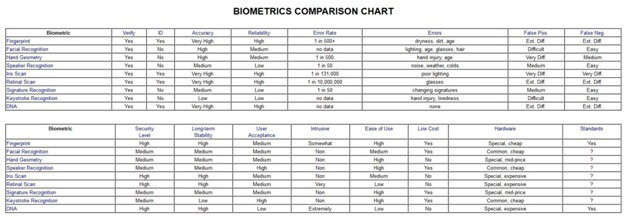 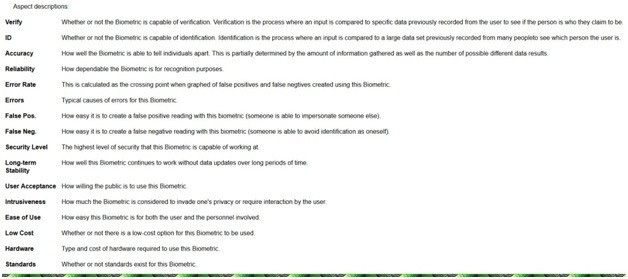 Biometric Aspect Descriptions Reference(s) used for this question: RHODES, Keith A., Chief Technologist, United States General Accounting Office, National Preparedness, Technologies to Secure Federal Buildings, April 2002 (page 10). and https://sites.google.com/site/biometricsecuritysolutions/crossover-accuracy
Question 94
Single choice
In discretionary access environments, which of the following entities is authorized to grant information access to other people?
-
A
-
B
-
C
-
D
Reveal answer details
Close answer details
Correct answerD
ExplanationIn Discretionary Access Control (DAC) environments, the user who creates a file is also considered the owner and has full control over the file including the ability to set permissions for that file. The following answers are incorrect: manager. Is incorrect because in Discretionary Access Control (DAC) environments it is the owner/user that is authorized to grant information access to other people. group leader. Is incorrect because in Discretionary Access Control (DAC) environments it is the owner/ user that is authorized to grant information access to other people. security manager. Is incorrect because in Discretionary Access Control (DAC) environments it is the owner/user that is authorized to grant information access to other people. IMPORTANT NOTE:
The term Data Owner is also used within Classifications as well. Under the subject of classification the Data Owner is a person from management who has been entrusted with a data set that belongs to the company. For example it could be the Chief Financial Officer (CFO) who is entrusted with all of the financial data for a company. As such the CFO would determine the classification of the financial data and who can access as well. The Data Owner would then tell the Data Custodian (a technical person) what the classification and need to know is on the specific set of data.
The term Data Owner under DAC simply means whoever created the file and as the creator of the file the owner has full access and can grant access to other subjects based on their identity.
Question 95
Single choice
In the CIA triad, what does the letter A stand for?
-
A
-
B
-
C
-
D
Reveal answer details
Close answer details
Correct answerC
ExplanationThe CIA triad stands for Confidentiality, Integrity and Availability.
Question 96
Single choice
Which of the following best allows risk management results to be used knowledgeably?
-
A
-
B
-
C
-
D
Reveal answer details
Close answer details
Correct answerC
ExplanationRisk management consists of two primary and one underlying activity; risk assessment and risk mitigation are the primary activities and uncertainty analysis is the underlying one. After having performed risk assessment and mitigation, an uncertainty analysis should be performed. Risk management must often rely on speculation, best guesses, incomplete data, and many unproven assumptions. A documented uncertainty analysis allows the risk management results to be used knowledgeably. A vulnerability analysis, likelihood assessment and threat identification are all parts of the collection and analysis of data part of the risk assessment, one of the primary activities of risk management. Source: SWANSON, Marianne & GUTTMAN, Barbara, National Institute of Standards and Technology (NIST), NIST Special Publication 800-14, Generally Accepted Principles and Practices for Securing Information Technology Systems, September 1996 (pages 19-21).
Question 97
Single choice
A server cluster looks like a:
-
A
single server from the user's point of view
-
B
dual server from the user's point of view
-
C
triple server from the user's point of view
-
D
quardle server from the user's point of view
Reveal answer details
Close answer details
Correct answerA
ExplanationThe cluster looks like a single server from the user's point of view. Source: KRUTZ, Ronald L. & VINES, Russel D., The CISSP Prep Guide: Mastering the Ten Domains of Computer Security, 2001, John Wiley & Sons, Page 67.
Question 98
Single choice
Which of the following is NOT an advantage that TACACS+ has over TACACS?
-
A
-
B
Use of two-factor password authentication
-
C
User has the ability to change his password
-
D
Ability for security tokens to be resynchronized
Reveal answer details
Close answer details
Correct answerA
ExplanationAlthough TACACS+ provides better audit trails, event logging is a service that is provided with TACACS. Source: KRUTZ, Ronald L. & VINES, Russel D., The CISSP Prep Guide: Mastering the Ten Domains of Computer Security, John Wiley & Sons, 2001, Chapter 3: Telecommunications and Network Security (page
121).
Question 99
Single choice
Hierarchical Storage Management (HSM) is commonly employed in:
-
A
very large data retrieval systems
-
B
very small data retrieval systems
-
C
shorter data retrieval systems
-
D
most data retrieval systems
Reveal answer details
Close answer details
Correct answerA
ExplanationHierarchical Storage Management (HSM) is commonly employed in very large data retrieval systems. Source: KRUTZ, Ronald L. & VINES, Russel D., The CISSP Prep Guide: Mastering the Ten Domains of Computer Security, 2001, John Wiley & Sons, Page 71.
Question 100
Single choice
What is called the act of a user professing an identity to a system, usually in the form of a log-on ID?
-
A
-
B
-
C
-
D
Reveal answer details
Close answer details
Correct answerB
ExplanationIdentification is the act of a user professing an identity to a system, usually in the form of a log-on ID to the system.
Identification is nothing more than claiming you are somebody. You identify yourself when you speak to someone on the phone that you don't know, and they ask you who they're speaking to. When you say, "I'm
Jason.", you've just identified yourself. In the information security world, this is analogous to entering a username. It's not analogous to entering a password. Entering a password is a method for verifying that you are who you identified yourself as. NOTE: The word "professing" used above means: "to say that you are, do, or feel something when other people doubt what you say". This is exactly what happen when you provide your identifier (identification), you claim to be someone but the system cannot take your word for it, you must further Authenticate to the system to prove who you claim to be. The following are incorrect answers: Authentication: is how one proves that they are who they say they are. When you claim to be Jane Smith by logging into a computer system as "jsmith", it's most likely going to ask you for a password. You've claimed to be that person by entering the name into the username field (that's the identification part), but now you have to prove that you are really that person. Many systems use a password for this, which is based on "something you know", i.e. a secret between you and the system. Another form of authentication is presenting something you have, such as a driver's license, an RSA token, or a smart card. You can also authenticate via something you are. This is the foundation for biometrics. When you do this, you first identify yourself and then submit a thumb print, a retina scan, or another form of bio-based authentication.
Once you've successfully authenticated, you have now done two things: you've claimed to be someone, and you've proven that you are that person. The only thing that's left is for the system to determine what you're allowed to do. Authorization: is what takes place after a person has been both identified and authenticated; it's the step determines what a person can then do on the system. An example in people terms would be someone knocking on your door at night. You say, "Who is it?", and wait for a response. They say, "It's John." in order to identify themselves. You ask them to back up into the light so you can see them through the peephole. They do so, and you authenticate them based on what they look like (biometric). At that point you decide they can come inside the house. If they had said they were someone you didn't want in your house (identification), and you then verified that it was that person (authentication), the authorization phase would not include access to the inside of the house. Confidentiality: Is one part of the CIA triad. It prevents sensitive information from reaching the wrong people, while making sure that the right people can in fact get it. A good example is a credit card number while shopping online, the merchant needs it to clear the transaction but you do not want your informaiton exposed over the network, you would use a secure link such as SSL, TLS, or some tunneling tool to protect the information from prying eyes between point A and point B. Data encryption is a common method of ensuring confidentiality. The other parts of the CIA triad are listed below: Integrity involves maintaining the consistency, accuracy, and trustworthiness of data over its entire life cycle. Data must not be changed in transit, and steps must be taken to ensure that data cannot be altered by unauthorized people (for example, in a breach of confidentiality). In addition, some means must be in place to detect any changes in data that might occur as a result of non-human-caused events such as an electromagnetic pulse (EMP) or server crash. If an unexpected change occurs, a backup copy must be available to restore the affected data to its correct state.
Availability is best ensured by rigorously maintaining all hardware, performing hardware repairs immediately when needed, providing a certain measure of redundancy and failover, providing adequate communications bandwidth and preventing the occurrence of bottlenecks, implementing emergency backup power systems, keeping current with all necessary system upgrades, and guarding against malicious actions such as denial-of-service (DoS) attacks. Reference used for this question: http://whatis.techtarget.com/definition/Confidentiality-integrity-and-availability-CIA
http://www.danielmiessler.com/blog/security-identification-authentication-and-authorization http://www.merriam-webster.com/dictionary/profess KRUTZ, Ronald L. & VINES, Russel D., The CISSP Prep Guide: Mastering the Ten Domains of Computer Security, 2001, John Wiley & Sons, Page 36.
|