A user is displaying the CPU utilization, and Network in and Network out CloudWatch metrics data of a single instance on the same graph. The graph uses one Y-axis for CPU utilization and Network in and another Y-axis for Network out. Since Network in is too high, the CPU utilization data is not visible clearly on graph to the user. How can the data be viewed better on the same graph?
-
A
It is not possible to show multiple metrics with the different units on the same graph
-
B
Add a third Y-axis with the console to show all the data in proportion
-
C
Change the axis of Network by using the Switch command from the graph
-
D
Change the units of CPU utilization so it can be shown in proportion with Network
Reveal answer details
Close answer details
Correct answerC
ExplanationExplanation:
Amazon CloudWatch provides the functionality to graph the metric data generated either by the AWS services or the custom metric to make it easier for the user to analyze. It is possible to show the multiple metrics with different units on the same graph. If the graph is not plotted properly due to a difference in the unit data over two metrics, the user can change the Y-axis of one of the graph by selecting that graph and clicking on the Switch option.
A company runs an Amazon RDS MySQL DB instance. Corporate policy requires that a daily backup of the database must be copied to a separate security account. What is the MOST cost-effective way to meet this requirement?
-
A
Copy an automated RDS snapshot to the security account using the copy-db-snapshot command
with the AWS CLI.
-
B
Create an RDS MySQL Read Replica for the critical database in the security account, then enable automatic backups for the Read Replica.
-
C
Create an RDS snapshot with the AWS CLI create-db-snapshot command, share it with the security account, then create a copy of the shared snapshot in the security account.
-
D
Use AWS DMS to replicate data from the critical database to another RDS MySQL instance in the security account, then use an automated backup for the RDS instance.
Reveal answer details
Close answer details
A security audit revealed that the security groups in a VPC have ports 22 and 3389 open to all, introducing a possible threat that instances can be stopped or configurations can be modified. A sysops administrator needs to automate remediation. What should the sysops administrator do to meet these requirements?
-
A
Create an IAM managed policy to deny access to ports 22 and 3389 on any security groups in a VPC.
-
B
Define an AWS Config rule and remediation action with AWS Systems Manager automation documents.
-
C
Enable AWS Trusted Advisor to remediate public port access.
-
D
Use AWS Systems Manager configuration compliance to remediate public port access.
Reveal answer details
Close answer details
Correct answerB
ExplanationReferences:
https://asecure.cloud/a/ar_ssm_ec2_approved_ami_id/
Question 4
Multiple choice
In AWS, which security aspects are the customer's responsibility? (Choose four.)
-
A
Controlling physical access to compute resources
-
B
Patch management on the EC2 instance s operating system
-
C
Encryption of EBS (Elastic Block Storage) volumes
-
D
Life-cycle management of IAM credentials
-
E
Decommissioning storage devices
-
F
Security Group and ACL (Access Control List) settings
Reveal answer details
Close answer details
Correct answersB, C, D, F
A SysOps Administrator maintains several Amazon EC2 instances that do not have access to the public internet. To patch operating systems, the instances require outbound internet connectivity. For security reasons, the instances should not be reachable from the public Internet. The Administrator deploys a NAT instance, updates the security groups, and configures the appropriate routes within the route table. However, the instances are still unable to reach the Internet. What should be done to resolve the issue?
-
A
Assign Elastic IP addresses to the instances and create a route from the private subnets to the internet gateway
-
B
Delete the NAT instance and replace it with AWS WAF
-
C
Disable source/destination checks on the NAT instance
-
D
Start/stop the NAT instance so it is launched on a different host
Reveal answer details
Close answer details
Correct answerA
ExplanationReferences:
https://docs.aws.amazon.com/vpc/latest/userguide/VPC_Scenario2.html
A company's finance department wants to receive a monthly report showing AWS resource usage by department. Which solution should be used to meet the requirements?
-
A
Configure AWS Cost and Usage reports for each department. Run the reports monthly.
-
B
Schedule a monthly report for each department using AWS Budgets.
-
C
Run a monthly AWS CloudTrail report of resource usage by tag using department codes.
-
D
Tag all resources with department codes. Generate a monthly cost allocation report.
Reveal answer details
Close answer details
Correct answerA
ExplanationReferences:
https://docs.aws.amazon.com/cur/latest/userguide/monthly-report.html
A company with dozens of AWS accounts wants to ensure that governance rules are being applied across all accounts. The CIO has recommended that AWS Config rules be deployed using an AWS CloudFormation template. How should these requirements be met?
-
A
Create a CloudFormation stack set, then select the CloudFormation template and use it to configure the AWS accounts
-
B
Write a script that iterates over the company's AWS accounts and executes the CloudFormation template in each account
-
C
Use AWS Organizations to execute the CloudFormation template in all accounts
-
D
Create a CloudFormation stack in the master account of AWS Organizations and execute the CloudFormation template to create AWS Config rules in all accounts
Reveal answer details
Close answer details
A company is using an AWS KMS customer master key (CMK) with imported key material. The company references the CMK by its alias in the Java application to encrypt data. The CMK must be rotated every 6 months. What is the process to rotate the key?
-
A
Enable automatic key rotation for the CMK, and specify a period of 6 months.
-
B
Create a new CMK with new imported material, and update the key alias to point to the new CMK.
-
C
Delete the current key material, and import new material into the existing CMK.
-
D
Import a copy of the existing key material into a new CMK as a backup, and set the rotation schedule for 6 months.
Reveal answer details
Close answer details
Correct answerA
ExplanationExplanation:
Cryptographic best practices discourage extensive reuse of encryption keys. To create new cryptographic material for your AWS Key Management Service (AWS KMS) customer master keys (CMKs), you can create new CMKs, and then change your applications or aliases to use the new CMKs. Or, you can enable automatic key rotation for an existing CMK. When you enable automatic key rotation for a customer managed CMK, AWS KMS generates new cryptographic material for the CMK every year. AWS KMS also saves the CMK's older cryptographic material in perpetuity so it can be used to decrypt data that it encrypted. AWS KMS does not delete any rotated key material until you delete the CMK.
References:
https://docs.aws.amazon.com/kms/latest/developerguide/rotate-keys.html
You have private video content in S3 that you want to serve to subscribed users on the Internet. User IDs, credentials, and subscriptions are stored in an Amazon RDS database. Which configuration will allow you to securely serve private content to your users?
-
A
Generate pre-signed URLs for each user as they request access to protected S3 content
-
B
Create an IAM user for each subscribed user and assign the GetObject permission to each IAM user
-
C
Create an S3 bucket policy that limits access to your private content to only your subscribed users' credentials
-
D
Create a CloudFront Origin Identity user for your subscribed users and assign the GetObject permission to this user
Reveal answer details
Close answer details
Correct answerA
ExplanationExplanation:
"You can optionally secure the content in your Amazon S3 bucket so users can access it through CloudFront but cannot access it directly by using Amazon S3 URLs. This prevents anyone from bypassing CloudFront and using the Amazon S3 URL to get content that you want to restrict access to. This step isn't required to use signed URLs, but we recommend it." References:
http://docs.aws.amazon.com/AmazonCloudFront/latest/DeveloperGuide/PrivateContent.html
Question 10
Single choice
A company has received a notification in its AWS Personal Health Dashboard that one of its Amazon EBS-backed Amazon EC2 instances is on hardware that is scheduled for maintenance. The instance runs a critical production workload that must be available during normal business hours. Which steps will ensure that the instance maintenance does not produce an outage?
-
A
Configure an Amazon Lambda function to automatically start the instance if it is stopped.
-
B
Create an Amazon Machine Image (AMI) of the instance and use the AMI to launch a new instance once the existing instance is retired.
-
C
Enable termination protection on the EC2 instance.
-
D
Stop and start the EC2 instance during a maintenance window outside of normal business hours.
Reveal answer details
Close answer details
Question 11
Single choice
A company relies on a fleet of Amazon EC2 instances to support an application. One of the EC2 instances was scheduled for hardware maintenance by AWS. An operations team did not remove the EC2 instance from the fleet in advance of the scheduled maintenance, and an unplanned outage resulted. A SysOps administrator must configure notifications to let the operations team know about scheduled maintenance in the future. Which action should the SysOps administrator take to meet this requirement?
-
A
Create an AWS Lambda function K> look up user data settings of the EC2 instance and publish a
notification to an Amazon Simple Notification Service {Amazon SNS) topic.
-
B
Create AWS Config rules to monitor the fleet of EC2 instances and publish a notification to an Amazon Simple Notification Service {Amazon SNS) topic.
-
C
Configure an Amazon EventBridge (Amazon CloudWatch Events) rule to publish AWS Personal Health Dashboard events to an Amazon Simple Notification Service (Amazon SNS) topic.
-
D
Configure an Amazon EventBridge (Amazon CloudWatch Events) rule to publish AWS Service Health Dashboard events lo an Amazon Simple Notification Service (Amazon SNS) topic.
Reveal answer details
Close answer details
Question 12
Single choice
You have identified network throughput as a bottleneck on your m1.small EC2 instance when uploading data Into Amazon S3 In the same region. How do you remedy this situation?
-
A
-
B
Change to a larger Instance
-
C
Use DirectConnect between EC2 and S3
-
D
Use EBS PIOPS on the local volume
Reveal answer details
Close answer details
Correct answerB
ExplanationExplanation:
https://media.amazonwebservices.com/AWS_Amazon_EMR_Best_Practices.pdf
Question 13
Single choice
A company is deploying a legacy web application on Amazon EC2 instances behind an ELB Application Load Balancer. The application worked well in the test environment. However, in production, users report that they are prompted to log in to the system several times an hour. Which troubleshooting step should be taken to help resolve the problem reported by users?
-
A
Confirm that the Application Load Balancer is in a multi-AZ configuration.
-
B
Enable health checks on the Application Load Balancer.
-
C
Ensure that port 80 is configured on the security group.
-
D
Enable sticky sessions on the Application Load Balancer.
Reveal answer details
Close answer details
Correct answerD
ExplanationReferences:
https://docs.aws.amazon.com/elasticbeanstalk/latest/dg/environments-cfg-alb.html
Question 14
Multiple choice
A SysOps Administrator has received a request to enable access logging for a Network Load Balancer and is setting up an Amazon S3 bucket to store the logs. What are the MINIMUM requirements for the S3 bucket? (Choose two.)
-
A
The bucket must be in the same Region as the Network Load Balancer.
-
B
The bucket must have a bucket policy that grants Elastic Load Balancing permissions to write the access logs to the bucket.
-
C
The bucket must have encryption enabled.
-
D
The bucket must have lifecycle policies set.
-
E
The bucket must have public access disabled.
Reveal answer details
Close answer details
Correct answersA, B
ExplanationReferences:
https://docs.aws.amazon.com/elasticloadbalancing/latest/network/load-balancer-access-
logs.html (bucket requirements)
Question 15
Single choice
Pricing is ____ consumed for EC2 instances.
-
A
-
B
per instance-minute or instance-hour
-
C
per instance-second or per instance-hour
-
D
Reveal answer details
Close answer details
Correct answerC
ExplanationExplanation:
In AWS, you pay only for what you use.
EC2 pricing is per instance-second consumed, or per instance-hour consumed depending on the in-stance type and operating system for the AMI. For example, spot instances, reserved instances and on-demand instances are billed per-second, while Dedicated instances are billed per hour.
Linux instances can be billed per second, but Microsoft Windows instances are billed per hour.
References:
https://aws.amazon.com/blogs/aws/new-per-second-billing-for-ec2-instances-and-ebs-volumes/
Question 16
Single choice
A user has created a web application with Auto Scaling. The user is regularly monitoring the application and he observed that the traffic is highest on Thursday and Friday between 8 AM to 6 PM. What is the best solution to handle scaling in this case?
-
A
Add a new instance manually by 8 AM Thursday and terminate the same by 6 PM Friday
-
B
Schedule Auto Scaling to scale up by 8 AM Thursday and scale down after 6 PM on Friday
-
C
Schedule a policy which may scale up every day at 8 AM and scales down by 6 PM
-
D
Configure a batch process to add an instance by 8 AM and remove it by Friday 6 PM
Reveal answer details
Close answer details
Correct answerB
ExplanationExplanation:
Auto Scaling based on a schedule allows the user to scale the application in response to predictable load changes. In this case the load increases by Thursday and decreases by Friday. Thus, the user can setup the scaling activity based on the predictable traffic patterns of the web application using Auto Scaling scale by Schedule.
Question 17
Single choice
A streaming services company has a three-tier web application hosted on Amazon EC2 instances in an Auto Scaling group behind an Application Load Balancer (ALB). When the Auto Scaling group scales in, a deregistration delay occurs and the delay is sometimes longer than the time required to terminate the EC2 instance. A SysOps administrator must ensure that the latest logs are delivered to an external system before the EC2 instance is terminated. Which solution will solve this problem?
-
A
Add a lifecycle hook to the Auto Scaling group to put the EC2 instance in a wait state until the log files have been delivered.
-
B
Configure a fixed response for the ALB to use custom error messages to respond to incoming requests with HTTP error response codes.
-
C
Create an Amazon CloudWatch alarm based on the RequestCountPerTarget metric for the Auto Scaling group. Modify the cooldown period to wait until the EC2 instance is terminated.
-
D
Update the launch configuration to enable scale-in protection for the Auto Scaling group and detach the EC2 instance protected for termination.
Reveal answer details
Close answer details
Question 18
Single choice
A user has set the Alarm for the CPU utilization > 50%. Due to an internal process, the current CPU utilization will be 80% for 6 hours. How can the user ensure that the CloudWatch alarm does not perform any action?
-
A
The user can disable the alarm using the DisableAlarmActions API.
-
B
The user can set CloudWatch in a sleep state using the CLI mon-sleep-alarm-action.
-
C
The user can pause the alarm from the console.
-
D
The user cannot stop the alarm from performing an action unless the alarm is deleted.
Reveal answer details
Close answer details
Correct answerA
ExplanationExplanation:
The user can disable or enable the CloudWatch alarm using the DisableAlarmActions and Ena-bleAlarmActions APIs or the mon-disable-alarm-actions and mon-enable-alarm-actions commands.
References:
http://docs.aws.amazon.com/AmazonCloudWatch/latest/DeveloperGuide/AlarmThatSendsEmail.html
Question 19
Multiple choice
A user needs to put sensitive data in an Amazon S3 bucket that can be accessed through an S3 VPC endpoint only. The user must ensure that resources in the VPC can only access the single S3 bucket. Which combination of actions will meet the requirements? (Choose two.)
-
A
Configure the bucket policy to only allow access through the S3 Private Endpoint.
-
B
Modify the VPC endpoint policy on the bucket to only allow the VPC to access it.
-
C
Modify the VPC peering configuration to only allow access to the S3 private Endpoint.
-
D
Configure the VPC endpoint policy to only allow the VPC to access the specific S3 bucket.
-
E
Configure the IAM policy attached to the S3 bucket to only allow access from the specific VPC.
Reveal answer details
Close answer details
Correct answersB, D
ExplanationReferences:
https://docs.aws.amazon.com/AmazonS3/latest/dev/example-bucket-policies-vpc-endpoint.html
Question 20
Single choice
A company must share monthly report files that are uploaded to Amazon S3 with a third party. The third-party user list is dynamic, is distributed, and changes frequently. The least amount of access must be granted to the third party. Administrative overhead must be low for the internal teams who manage the process. How can this be accomplished while providing the LEAST amount of access to the third party?
-
A
Allow only specified IP addresses to access the S3 buckets which will host files that need to be provided to the third party.
-
B
Create an IAM role with the appropriate access to the S3 bucket, and grant login permissions to the console for the third party to access the S3 bucket.
-
C
Create a pre-signed URL that can be distributed by email to the third party, allowing it to download specific S3 filed.
-
D
Have the third party sign up for an AWS account, and grant it cross-account access to the appropriate
S3 bucket in the source account.
Reveal answer details
Close answer details
Question 21
Single choice
An image processing system runs asynchronously on AWS Lambda. A SysOps administrator is configuring a Lambda function to notify developers when an image falls to process after three attempts.
The SysOps administrator has created an Amazon Simple Notification Service (Amazon SNS) topic to notify the developers. Which additional action should the SysOps administrator take to meet this requirement?
-
A
Configure an Amazon CloudWatch alarm for errors from the Lambda function, which notifies the Amazon SNS topic.
-
B
Implement a dead-letter queue targeting the Amazon SNS topic.
-
C
Modify the Lambda function code to publish failed orders to the Amazon SNS topic before exiting.
-
D
Subscribe to Lambda function error notifications from the AWS Personal Health Dashboard.
Reveal answer details
Close answer details
Correct answerA
ExplanationReferences:
https://docs.aws.amazon.com/AmazonCloudFront/latest/DeveloperGuide/receiving-notifications.html
Question 22
Single choice
What was the recommended use case for S3 Reduced Redundancy storage before its deprecation was planned?
-
A
It was used to reduce storage costs by providing 500 times the durability of a typical disk drive at lower levels of redundancy.
-
B
It was used to reduce storage costs for noncritical data at lower levels of redundancy.
-
C
It was used to reduce storage costs by allowing you to destroy any copy of your files outside a specific jurisdiction.
-
D
It was used to reduce storage costs for reproducible data at high levels of redundancy in a single facility.
Reveal answer details
Close answer details
Correct answerB
ExplanationReduced Redundancy Storage (RRS) was introduced in order to reduce storage costs. When first developed, you could use reduced redundancy storage for noncritical, reproducible data at lower levels of redundancy than Amazon S3 provides with standard storage. Now Standard is a more af-fordable from a cost perspective, because Amazon is deprecating RRS and has changed the pricing structure.
References:
http://docs.aws.amazon.com/AmazonS3/latest/dev/UsingRRS.html
Question 23
Single choice
A user has launched 5 instances in EC2-CLASSIC and attached 5 elastic IPs to the five different instances in the US East region. The user is creating a VPC in the same region. The user wants to assign an elastic IP to the VPC instance. How can the user achieve this?
-
A
The user has to request AWS to increase the number of elastic IPs associated with the account
-
B
AWS allows 10 EC2 Classic IPs per region; so it will allow to allocate new Elastic IPs to the same
region
-
C
The AWS will not allow to create a new elastic IP in VPC; it will throw an error
-
D
The user can allocate a new IP address in VPC as it has a different limit than EC2
Reveal answer details
Close answer details
Correct answerD
ExplanationSection: (none)
A Virtual Private Cloud (VPC) is a virtual network dedicated to the user's AWS account. A user can create a subnet with VPC and launch instances inside that subnet. A user can have 5 IP addresses per region with EC2 Classic. The user can have 5 separate IPs with VPC in the same region as it has a separate limit than EC2 Classic.
Question 24
Single choice
A user is having data generated randomly based on a certain event. The user wants to upload that data to CloudWatch. It may happen that event may not have data generated for some period due to randomness. Which of the below mentioned options is a recommended option for this case?
-
A
For the period when there is no data, the user should not send the data at all
-
B
For the period when there is no data the user should send a blank value
-
C
For the period when there is no data the user should send the value as 0
-
D
The user must upload the data to CloudWatch as having no data for some period will cause an error at CloudWatch monitoring
Reveal answer details
Close answer details
Correct answerC
ExplanationExplanation:
AWS CloudWatch supports the custom metrics. The user can always capture the custom data and upload the data to CloudWatch using CLI or APIs. When the user data is more random and not generated at regular intervals, there can be a period which has no associated data. The user can either publish the zero (0. Value for that period or not publish the data at all. It is recommended that the user should publish zero instead of no value to monitor the health of the application. This is helpful in an alarm as well as in the generation of the sample data count.
Question 25
Multiple choice
Which of the following steps are required to configure SAML 2.0 for federated access to AWS? (Choose two.)
-
A
Create IAM users for each identity provider (IdP) user to allow access to the AWS environment.
-
B
Define assertions that map the company's identity provider (IdP) users to IAM roles.
-
C
Create IAM roles with a trust policy that lists the SAML provider as the principal.
-
D
Create IAM users, place them in a group named SAML, and grant them necessary IAM permissions.
-
E
Grant identity provider (IdP) users the necessary IAM permissions to be able to log in to the AWS environment.
Reveal answer details
Close answer details
Question 26
Single choice
A user has created a VPC with public and private subnets. The VPC has CIDR 20.0.0.0/16. The private subnet uses CIDR 20.0.1.0/24 and the public subnet uses CIDR 20.0.0.0/24. The user is planning to host a web server in the public subnet (port 80. and a DB server in the private subnet (port 3306). The user is configuring a security group of the NAT instance. Which of the below mentioned entries is not required for the NAT security group?
-
A
For Inbound allow Source: 20.0.1.0/24 on port 80
-
B
For Outbound allow Destination: 0.0.0.0/0 on port 80
-
C
For Inbound allow Source: 20.0.0.0/24 on port 80
-
D
For Outbound allow Destination: 0.0.0.0/0 on port 443
Reveal answer details
Close answer details
Correct answerC
ExplanationExplanation:
A user can create a subnet with VPC and launch instances inside that subnet. If the user has created a public private subnet to host the web server and DB server respectively, the user should configure that the instances in the private subnet can connect to the internet using the NAT instances. The user should first configure that NAT can receive traffic on ports 80 and 443 from the private subnet. Thus, allow ports 80 and 443 in Inbound for the private subnet 20.0.1.0/24. Now to route this traffic to the internet configure ports 80 and 443 in Outbound with destination 0.0.0.0/0. The NAT should not have an entry for the public subnet CIDR.
Question 27
Single choice
Does Amazon RDS support SSL encryption for SQL Server DB Instances?
-
A
Yes, for all supported SQL Server editions
-
B
-
C
Yes, but only when the instances are in a single region
-
D
No, encryption using SSL is supported only in the GovCloud.
Reveal answer details
Close answer details
Correct answerA
ExplanationExplanation:
Amazon RDS supports SSL encryption for SQL Server DB Instances. Using SSL, you can encrypt connections between your applications and your SQL Server DB Instances. This is available for all the versions of Microsoft SQL Server.
References:
http://docs.aws.amazon.com/AmazonRDS/latest/UserGuide/Concepts.DBEngine.SQLServer.html
Question 28
Single choice
You are attempting to connect to an instance in Amazon VPC without success. You have already verified that the VPC has an Internet Gateway (IGW) the instance has an associated Elastic IP (EIP) and correct security group rules are in place. Which VPC component should you evaluate next?
-
A
The configuration of a NAT instance
-
B
The configuration of the Routing Table
-
C
The configuration of the internet Gateway (IGW)
-
D
The configuration of SRC/DST checking
Reveal answer details
Close answer details
Correct answerB
ExplanationExplanation:
http://docs.aws.amazon.com/ElasticLoadBalancing/latest/DeveloperGuide/UserScenariosForVPC.html
Question 29
Single choice
A user has created a VPC with public and private subnets using the VPC wizard. Which of the below mentioned statements is not true in this scenario?
-
A
The VPC will create a routing instance and attach it with a public subnet
-
B
The VPC will create two subnets
-
C
The VPC will create one internet gateway and attach it to VPC
-
D
The VPC will launch one NAT instance with an elastic IP
Reveal answer details
Close answer details
Correct answerA
ExplanationExplanation:
A user can create a subnet with VPC and launch instances inside that subnet. If the user has created a public private subnet, the instances in the public subnet can receive inbound traffic directly from the internet, whereas the instances in the private subnet cannot. If these subnets are created with Wizard, AWS will create a NAT instance with an elastic IP. Wizard will also create two subnets with route tables. It will also create an internet gateway and attach it to the VPC.
Question 30
Multiple choice
According to the shared responsibility model, for which of the following Amazon EC2 activities is AWS responsible? (Choose two.)
-
A
Patching the guest operating system
-
B
Monitoring memory utilization
-
C
-
D
-
E
Maintaining network infrastructure
Reveal answer details
Close answer details
Correct answersD, E
ExplanationReferences:
https://aws.amazon.com/compliance/shared-responsibility-model/
Question 31
Single choice
_________ is a fast, reliable, scalable, fully managed message queuing service.
-
A
-
B
-
C
-
D
Reveal answer details
Close answer details
Correct answerC
ExplanationExplanation:
Amazon Simple Queue Service (SQS) is a fast, reliable, scalable, fully managed message queuing service. SQS makes it simple and cost-effective to decouple the components of a cloud application.
Decoupling the components of an application -you have a queue of work items and want to track the successful completion of each item independently. Amazon SQS tracks the ACK/FAIL results, so the application does not have to maintain a persistent checkpoint or cursor. After a configured visibility timeout, Amazon SQS deletes acknowledged messages and redelivers failed messages.
Configuring individual message delay -you have a job queue and you need to schedule individual jobs with a delay. With standard queues, you can configure individual messages to have a delay of up to 15 minutes.
Dynamically increasing concurrency or throughput at read time -you have a work queue and want to add more consumers until the backlog is cleared. Amazon SQS requires no pre-provisioning.
Scaling transparently -your buffer requests and the load changes as a result of occasional load spikes or the natural growth of your business. Because Amazon SQS can process each buffered request independently, Amazon SQS can scale transparently to handle the load without any provisioning instructions from you. References:
http://aws.amazon.com/sqs/
Question 32
Single choice
An existing, deployed solution uses Amazon EC2 instances with Amazon EBS General Purpose SSD volumes, am Amazon RDS PostgreSQL database, an Amazon EFS file system, and static objects stored in an Amazon S3 bucket. The Security team now mandates that at-rest encryption be turned on immediately for all aspects of the application, without creating new resources and without any downtime. To satisfy the requirements, which one of these services can the SysOps Administrator enable at-rest encryption on?
-
A
EBS General Purpose SSD volumes
-
B
-
C
-
D
S3 objects within a bucket
Reveal answer details
Close answer details
Question 33
Single choice
Which of the following is an incorrect statement about Amazon CloudWatch?
-
A
You can use CloudWatch to collect and track metrics, which are the variables you want to measure for your resources and applications.
-
B
You can set CloudWatch alarms to send notifications or automatically make changes to the resources you are monitoring, based on rules that you define.
-
C
You can control and monitor all Security Groups and their related rules.
-
D
You gain system-wide visibility into resource utilization, application performance, and operation-al health.
Reveal answer details
Close answer details
Correct answerC
ExplanationExplanation:
Amazon CloudWatch monitors your Amazon Web Services (AWS) resources and the applications you run on AWS in real-time.
You can use CloudWatch to collect and track metrics, which are the variables you want to measure for your resources and applications. CloudWatch alarms send notifications or automatically make changes to the resources you are monitoring based on rules that you define. For example, you can monitor the CPU usage and disk reads and writes of your Amazon Elastic Compute Cloud (Ama-zon EC2) instances and then use this data to determine whether you should launch additional in-stances to handle increased load.
You can also use this data to stop under-used instances to save money. In addition to monitoring the built-in metrics that come with AWS, you can monitor your own custom metrics. With CloudWatch, you gain system-wide visibility into resource utilization, application performance, and operational health.
References:
http://docs.aws.amazon.com/AmazonCloudWatch/latest/DeveloperGuide/WhatIsCloudWatch.html
Question 34
Single choice
An application running on Amazon EC2 instances needs to write files to an Amazon S3 bucket. What is the MOST secure way to grant the application access to the S3 bucket?
-
A
Create an IAM user with the necessary privileges. Generate an access key and embed the key in the code running on the EC2 instances.
-
B
Install secure FTP (SFTP) software on the EC2 instances. Use an AWS Lambda function to copy the files from the EC2 instances to Amazon S3 using SFTP.
-
C
Create an IAM role with the necessary privileges. Associate the role with the EC2 instances at launch.
-
D
Use rsync and cron to set up the transfer of files from the EC2 instances to the S3 bucket. Enable AWS Shield to protect the data.
Reveal answer details
Close answer details
Question 35
Single choice
A user has configured two security groups which allow traffic as given below:
1: SecGrp1:
Inbound on port 80 for 0.0.0.0/0
Inbound on port 22 for 0.0.0.0/0 2: SecGrp2:
Inbound on port 22 for 10.10.10.1/32 If both the security groups are associated with the same instance, which of the below mentioned statements is true?
-
A
It is not possible to have more than one security group assigned to a single instance
-
B
It allows inbound traffic for everyone on both ports 22 and 80
-
C
It is not possible to create the security group with conflicting rules. AWS will reject the request
-
D
It allows inbound traffic on port 22 for IP 10.10.10.1 and for everyone else on port 80
Reveal answer details
Close answer details
Correct answerB
ExplanationExplanation:
A user can attach more than one security group to a single EC2 instance. In this case, the rules from each security group are effectively aggregated to create one set of rules. AWS uses this set of rules to determine whether to allow access or not. Thus, here the rule for port 22 with IP 10.10.10.1/32 will merge with IP 0.0.0.0/0 and open ports 22 and 80 for all.
References:
http://docs.aws.amazon.com/AWSEC2/latest/UserGuide/using-network-security.html
Question 36
Single choice
A user has created an ELB with Auto Scaling. Which of the below mentioned offerings from ELB helps the user to stop sending new requests traffic from the load balancer to the EC2 instance when the instance is being deregistered while continuing in-flight requests?
-
A
-
B
-
C
-
D
ELB auto registration Off
Reveal answer details
Close answer details
Correct answerC
ExplanationExplanation:
The Elastic Load Balancer connection draining feature causes the load balancer to stop sending new requests to the back-end instances when the instances are deregistering or become unhealthy, while ensuring that inflight requests continue to be served.
Question 37
Single choice
In AWS Identity and Access Management (IAM), you can make use of the ______ APIs to grant users temporary access to your resources.
-
A
AWS Security Transport Service (STS)
-
B
AWS Security Tree Service (STS)
-
C
AWS Security Task Service (STS)
-
D
AWS Security Token Service (STS)
Reveal answer details
Close answer details
Correct answerD
ExplanationExplanation:
AWS Security Token Service enables the creation of temporary credentials that can be used along with IAM in order to grant access to trusted entities and users to your AWS resources for a prede-fined amount of time.
References:
http://docs.aws.amazon.com/IAM/latest/UserGuide/id_credentials_temp.html
Question 38
Single choice
A user is trying to pre-warm a blank EBS volume attached to a Linux instance. Which of the below mentioned steps should be performed by the user?
-
A
There is no need to pre-warm an EBS volume
-
B
Contact AWS support to pre-warm
-
C
Unmount the volume before pre-warming
-
D
Reveal answer details
Close answer details
Correct answerC
ExplanationExplanation:
When the user creates a new EBS volume or restores a volume from the snapshot, the back-end storage blocks are immediately allocated to the user EBS. However, the first time when the user is trying to access a block of the storage, it is recommended to either be wiped from the new volumes or instantiated from the snapshot (for restored volumes. before the user can access the block. This preliminary action takes time and can cause a 5 to 50 percent loss of IOPS for the volume when the block is accessed for the first time. To avoid this, it is required to pre warm the volume. Pre-warming an EBS volume on a Linux instance requires that the user should unmount the blank device first and then write all the blocks on the device using a command, such as "dd".
Question 39
Single choice
A group in IAM can contain many users.
Can a user belong to multiple groups?
-
A
Yes, a user can be a member of up to 150 groups.
-
B
Yes, a user can be a member of up to 50 groups.
-
C
Yes, a user can be a member of up to 100 groups.
-
D
Yes, a user can be a member of up to 10 groups.
Reveal answer details
Close answer details
Correct answerD
ExplanationExplanation:
In Amazon IAM, a user can belong to up to 10 different groups.
References:
http://docs.aws.amazon.com/IAM/latest/UserGuide/LimitationsOnEntities.html
Question 40
Single choice
Does AWS offer any web-based graphic user interface to access and manage EC2 instances?
-
A
Yes, the AWS Application Clusters.
-
B
No, you can only use the available software development kits.
-
C
Yes, the AWS Management Console.
-
D
No, you can only use the command line interface.
Reveal answer details
Close answer details
Correct answerC
ExplanationExplanation:
You can access and manage Amazon Web Services through a simple and intuitive web-based user interface known as the AWS Management Console.
References:
http://aws.amazon.com/console/
Question 41
Single choice
A SysOps Administrator implemented the following bucket policy to allow only the corporate IP address range of 54.240.143.0/24 to access objects in an Amazon S3 bucket. 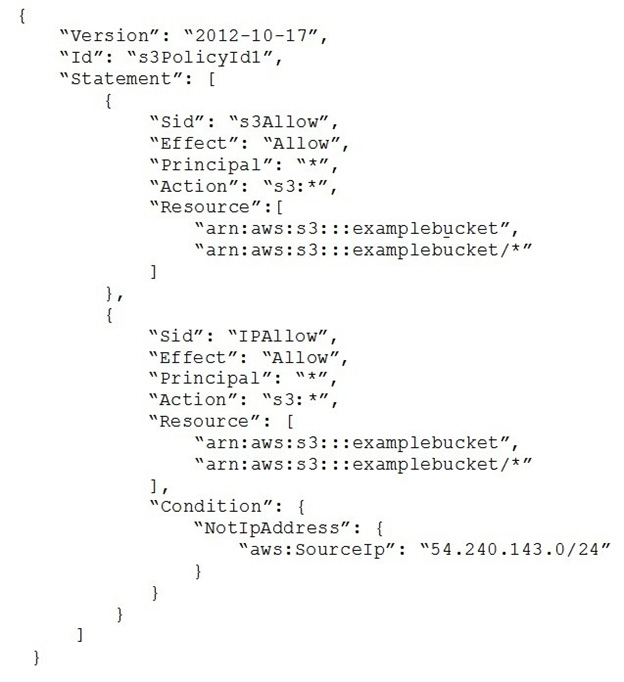 Some employees are reporting that they are able to access the S3 bucket from IP addresses outside the
corporate IP address range. How can the Administrator address this issue?
-
A
Modify the Condition operator to include both NotIpAddress and IpAddress to prevent unauthorized access to the S3 bucket.
-
B
Modify the Condition element from the IAM policy to aws:StringEquals instead of aws:SourceIp.
-
C
Modify the IAM policy instead of the bucket policy to restrict users from accessing the bucket based on
their source IP addresses.
-
D
Change Effect from Allow to Deny in the second statement of the policy to deny requests not from the source IP range.
Reveal answer details
Close answer details
Correct answerD
ExplanationReferences:
https://aws.amazon.com/premiumsupport/knowledge-center/block-s3-traffic-vpc-ip/
Question 42
Single choice
Where is an object stored in Amazon S3?
-
A
-
B
-
C
-
D
Reveal answer details
Close answer details
Correct answerA
ExplanationExplanation:
Every object in Amazon S3 is stored in a bucket. Before you can store data in Amazon S3, you must create a bucket.
References:
http://docs.aws.amazon.com/AmazonS3/latest/gsg/CreatingABucket.html
Question 43
Single choice
A company hosts a multi-tier ecommerce web application on AWS, and has recently been alerted to suspicious application traffic The architecture consists of Amazon EC2 instances deployed across multiple Availability Zones behind an Application Load Balancer (ALB) After examining the server logs, a sysops administrator determines that the suspicious traffic is an attempted SQL injection attack. What should the sysops administrator do to prevent similar attacks?
-
A
Install Amazon Inspector on the EC2 instances and configure a rules package Use the findings reports to identify and block SQL injection attacks.
-
B
Modify the security group of the ALB Use the IP addresses from the logs to block the IP addresses where SQL injection originated.
-
C
Create an AWS WAF web ACL in front of the ALB. Add an SQL injection rule to the web ACL Associate the web ACL to the ALB
-
D
Enable Amazon GuardDuty in the AWS Region Use Amazon CloudWatch Events to trigger an AWS Lambda function response every time an SQL injection finding is discovered
Reveal answer details
Close answer details
Question 44
Single choice
An application is being developed that will be served across a fleet of Amazon EC2 instances, which
require a consistent view of persistent data. Items stored vary in size from 1KB to 300MB; the items are
read frequently, created occasionally, and often require partial changes without conflict. The data store is not expected to grow beyond 2TB, and items will be expired according to age and content type. Which AWS service solution meets these requirements?
-
A
Amazon S3 buckets with lifecycle policies to delete old objects.
-
B
Amazon RDS PostgreSQL and a job that deletes rows based on age and file type columns.
-
C
Amazon EFS and a scheduled process to delete files based on age and extension.
-
D
An EC2 instance store synced on boot from a central Amazon EBS-backed instance.
Reveal answer details
Close answer details
Correct answerD
ExplanationReferences:
https://docs.aws.amazon.com/AWSEC2/latest/UserGuide/ComponentsAMIs.html
Question 45
Single choice
A root account owner has created an S3 bucket testmycloud. The account owner wants to allow everyone to upload the objects as well as enforce that the person who uploaded the object should manage the permission of those objects. Which is the easiest way to achieve this?
-
A
The root account owner should create a bucket policy which allows the IAM users to upload the object
-
B
The root account owner should create the bucket policy which allows the other account owners to set the object policy of that bucket
-
C
The root account should use ACL with the bucket to allow everyone to upload the object
-
D
The root account should create the IAM users and provide them the permission to upload content to the bucket
Reveal answer details
Close answer details
Correct answerC
ExplanationExplanation: Each AWS S3 bucket and object has an ACL (Access Control List. associated with it. An ACL is a list of grants identifying the grantee and the permission granted. The user can use ACLs to grant basic read/ write permissions to other AWS accounts. ACLs use an Amazon S3-specific XML schema. The user cannot grant permissions to other users in his account. ACLs are suitable for specific scenarios. For example, if a bucket owner allows other AWS accounts to upload objects, permissions to these objects can only be managed using the object ACL by the AWS account that owns the object.
Question 46
Single choice
An organization is generating digital policy files which are required by the admins for verification. Once the files are verified they may not be required in the future unless there is some compliance issue.
If the organization wants to save them in a cost effective way, which is the best possible solution?
-
A
-
B
-
C
-
D
Reveal answer details
Close answer details
Correct answerD
ExplanationExplanation:
Amazon S3 stores objects according to their storage class. There are three major storage classes: Standard, Reduced Redundancy and Glacier. Standard is for AWS S3 and provides very high durability.
However, the costs are a little higher. Reduced redundancy is for less critical files. Glacier is for archival and the files which are accessed infrequently. It is an extremely low-cost storage service that provides secure and durable storage for data archiving and backup.
Question 47
Single choice
A Content Processing team has notified a SysOps Administrator that their content is sometimes taking a long time to process, whereas other times it processes quickly. The Content Processing submits messages to an Amazon Simple Queue Service (Amazon SQS) queue, which details the files that need to be processed. An Amazon EC2 instance polls the queue to determine which file to process next. How could the Administrator maintain a fast but cost-effective processing time?
-
A
Attach an Auto Scaling policy to the Amazon SQS queue to increase the number of EC2 instances based on the depth of the SQS queue
-
B
Create an Auto Scaling policy to increase the number of EC2 instances polling the queue and a CloudWatch alarm to scale based on MaxVisibility Timeout
-
C
Attach an Auto Scaling policy to the SQS queue to scale instances based on the depth of the dead-letter queue
-
D
Create an Auto Scaling policy to increase the number of EC2 instances polling the queue and a CloudWatch alarm to scale based on ApproximateNumberOfMessagesVisible
Reveal answer details
Close answer details
Question 48
Single choice
AWS IAM permissions can be assigned in two ways:
-
A
as role-based or as resource-based.
-
B
as identity-based or as resource-based.
-
C
as security group-based or as key-based.
-
D
as user-based or as key-based.
Reveal answer details
Close answer details
Correct answerB
ExplanationExplanation:
Permissions can be assigned in two ways: as identity-based or as resource-based. Identity-based, or IAM permissions, are attached to an IAM user, group, or role and let you specify what that user, group, or role can do. For example, you can assign permissions to the IAM user named Bob, stating that he has permission to use the Amazon Elastic Compute Cloud (Amazon EC2) RunInstances ac-tion and that he has permission to get items from an Amazon DynamoDB table named MyCompa-ny. The user Bob might also be granted access to manage his own IAM security credentials. Identi-ty-based permissions can be managed or inline.
Resource-based permissions are attached to a resource. You can specify resource-based permissions for Amazon S3 buckets, Amazon Glacier vaults, Amazon SNS topics, Amazon SQS queues, and AWS Key Management Service encryption keys. Resource-based permissions let you specify who has access to the resource and what actions they can perform on it. Resource-based policies are in-line only, not managed.
References:
http://docs.aws.amazon.com/IAM/latest/UserGuide/access_permissions.html
Question 49
Single choice
After a particularly high AWS bill, an organization wants to review the use of AWS services. What AWS service will allow the SysOps Administrator to quickly view this information to share it, and will also forecast expenses for the current billing period?
-
A
-
B
-
C
AWS Cost and Usage Report
-
D
Reveal answer details
Close answer details
Correct answerD
ExplanationReferences:
https://docs.aws.amazon.com/awsaccountbilling/latest/aboutv2/ce-forecast.html
Question 50
Single choice
A SysOps Administrator is notified that an Amazon EC2 instance has stopped responding. The AWS Management Console indicates that the system checks are failing. What should the SysOps Administrator do first to resolve this issue?
-
A
Reboot the EC2 instance so it can be launched on a new host.
-
B
Stop and then start the EC2 instance so that it can be launched on a new host.
-
C
Terminate the EC2 instance and relaunch it.
-
D
View the AWS CloudTrail log to investigate what changed on the EC2 instance.
Reveal answer details
Close answer details
Correct answerB
ExplanationReferences:
https://docs.aws.amazon.com/AWSEC2/latest/UserGuide/TroubleshootingInstances.html
Question 51
Single choice
An organization has configured Auto Scaling with ELB. There is a memory issue in the application which is causing CPU utilization to go above 90%. The higher CPU usage triggers an event for Auto Scaling as per the scaling policy.
If the user wants to find the root cause inside the application without triggering a scaling activity, how can he achieve this?
-
A
Stop the scaling process until research is completed
-
B
It is not possible to find the root cause from that instance without triggering scaling
-
C
Delete Auto Scaling until research is completed
-
D
Suspend the scaling process until research is completed
Reveal answer details
Close answer details
Correct answerD
ExplanationExplanation:
Auto Scaling allows the user to suspend and then resume one or more of the Auto Scaling processes in the Auto Scaling group. This is very useful when the user wants to investigate a configuration problem or some other issue, such as a memory leak with the web application and then make changes to the application, without triggering the Auto Scaling process.
Question 52
Single choice
A SysOps Administrator is required to monitor free space on Amazon EBS volumes attached to Microsoft Windows-based Amazon EC2 instances within a company's account. The Administrator must be alerted to potential issues. What should the Administrator do to receive email alerts before low storage space affects EC2 instance performance?
-
A
Use built-in Amazon CloudWatch metrics, and configure CloudWatch alarms and an Amazon SNS topic for email notifications
-
B
Use AWS CloudTrail logs and configure the trail to send notifications to an Amazon SNS topic
-
C
Use the Amazon CloudWatch agent to send disk space metrics, then set up CloudWatch alarms using an Amazon SNS topic
-
D
Use AWS Trusted Advisor and enable email notification alerts for EC2 disk space
Reveal answer details
Close answer details
Question 53
Single choice
An ecommerce site is using Amazon ElastiCache with Memcached to store session state for a web application and to cache frequently used data. For the last month, users have been complaining about performance. The metric data for the Amazon EC2 instances and the Amazon RDS instance appear normal, but the eviction count metrics are high. What should be done to address this issue and improve performance?
-
A
Scale the cluster by adding additional nodes
-
B
Scale the cluster by adding read replicas
-
C
Scale the cluster by increasing CPU capacity
-
D
Scale the web layer by adding additional EC2 instances
Reveal answer details
Close answer details
Question 54
Single choice
Spot instances are ideally designed for which purpose below?
-
A
Running database instances that can scale up and down based on a specific workload.
-
B
Running long duration and highly transactional applications.
-
C
For building distributed fault tolerant databases under a tight deadline.
-
D
Taking advantage of excess EC2 capacity at prices below standard on-demand rates, for short duration jobs.
Reveal answer details
Close answer details
Correct answerD
ExplanationExplanation:
There are four general categories of time-flexible and interruption-tolerant tasks that work well with Spot Instances: Delayable tasks, Optional tasks, Tasks that can be sped up by adding additional-computing power and at the end, Tasks that require a large number of compute instances that you can't access any other way.
References:
http://aws.amazon.com/ec2/spot-instances/
Question 55
Single choice
A company is running an application on Amazon EC2 instances. The company needs to stop all development instances during non-business hours to reduce costs. The instances must be started again at trie beginning of each business day. Which solution meets these requirements with the LEAST administrative overhead?
-
A
Add the instances to an EC2 Auto Scaling group. Configure the scaling policy to scale in when the instances are at low CPU utilization levels.
-
B
Create a cron script on each EC2 instance that shuts down the instance at the end of each day.
-
C
Create an Amazon EventBridge (Amazon CloudWatch Events) rule that triggers an Amazon Simple Notification Service (Amazon SNS) topic to let a SysOps administrator know to start or stop the EC2 instances.
-
D
Create Amazon EventBridge (Amazon CloudWatch Events) scheduled rules that trigger an AWS Lambda function to start or stop the EC2 instances.
Reveal answer details
Close answer details
Question 56
Single choice
A user is using a small MySQL RDS DB. The user is experiencing high latency due to the Multi AZ feature. Which of the below mentioned options may not help the user in this situation?
-
A
Schedule the automated back up in non-working hours
-
B
Use a large or higher size instance
-
C
-
D
Take a snapshot from standby Replica
Reveal answer details
Close answer details
Correct answerD
ExplanationExplanation:
An RDS DB instance which has enabled Multi AZ deployments may experience increased write and commit latency compared to a Single AZ deployment, due to synchronous data replication. The user may also face changes in latency if deployment fails over to the standby replica. For production workloads, AWS recommends the user to use provisioned IOPS and DB instance classes (m1.large and larger. as they are optimized for provisioned IOPS to give a fast, and consistent performance. With Multi AZ feature, the user can not have option to take snapshot from replica.
Question 57
Single choice
A user has configured an Auto Scaling group with ELB. The user has enabled detailed CloudWatch monitoring on Auto Scaling. Which of the below mentioned statements will help the user understand the functionality better?
-
A
It is not possible to setup detailed monitoring for Auto Scaling
-
B
In this case, Auto Scaling will send data every minute and will charge the user extra
-
C
Detailed monitoring will send data every minute without additional charges
-
D
Auto Scaling sends data every minute only and does not charge the user
Reveal answer details
Close answer details
Correct answerB
ExplanationExplanation:
CloudWatch is used to monitor AWS as well as the custom services. It provides either basic or detailed monitoring for the supported AWS products. In basic monitoring, a service sends data points to CloudWatch every five minutes, while in detailed monitoring a service sends data points to CloudWatch every minute. Auto Scaling includes 7 metrics and 1 dimension, and sends data to CloudWatch every 5 minutes by default. The user can enable detailed monitoring for Auto Scaling, which sends data to CloudWatch every minute. However, this will have some extra-costs.
Question 58
Multiple choice
A company uses many Amazon Elastic Block Store (Amazon EBS) volumes. The company wants to use Amazon Data Lifecycle Manager (Amazon DLM) to manage the lifecycle of EBS snapshots that have tags of "Production" and "Compliance". Which combination of the following are needed to turn on this feature? (Choose two.)
-
A
A minimum storage requirement of 5 GB
-
B
One IAM role for Amazon DLM and another IAM role for the users
-
C
Encryption of the EBS volumes
-
D
A minimum baseline performance of 3 IOPS/GB
-
E
Tagging of the EBS volumes
Reveal answer details
Close answer details
Question 59
Single choice
You need to determine what encryption operations were taken with which key in AWS KMS to ei-ther encrypt or decrypt data in the AWS CodeCommit repository. Which of the following actions will best help you accomplish this?
-
A
Searching for the AWS CodeCommit repository ID in AWS CloudTrail logs
-
B
Searching for the encryption key ID in AWS CloudTrail logs
-
C
Searching for the AWS CodeCommit repository ID in AWS CloudWatch
-
D
Searching for the encryption key ID in AWS CloudWatch
Reveal answer details
Close answer details
Correct answerA
ExplanationExplanation:
The encryption context is additional authenticated information AWS KMS uses to check for data integrity.
When specified for the encryption operation, it must also be specified in the decryption operation or decryption will fail. AWS CodeCommit uses the AWS CodeCommit repository ID for the encryption context.
You can find the repository ID by using the get-repository command or by viewing repository details in the AWS CodeCommit console. Search for the AWS CodeCommit repository ID in AWS CloudTrail logs to understand which encryption operations were taken on which key in AWS KMS to encrypt or decrypt data in the AWS CodeCommit repository.
References:
http://docs.aws.amazon.com/codecommit/latest/userguide/encryption.html
Question 60
Single choice
A company is concerned about a security vulnerability impacting its Linux operating system. What should the SysOps Administrator do to alleviate this concern?
-
A
Patch the vulnerability with Amazon Inspector.
-
B
Provide an AWS Trusted Advisor report showing which Amazon EC2 instances have been patched.
-
C
Redeploy the Amazon EC2 instances using AWS CloudFormation.
-
D
Patch the Linux operating system using AWS Systems Manager.
Reveal answer details
Close answer details
Correct answerD
ExplanationReferences:
https://docs.aws.amazon.com/systems-manager/latest/userguide/systems-manager-patch.html
Question 61
Single choice
A SysOps Administrator attempting to delete an Amazon S3 bucket ran the following command: aws s3
rb s3://my bucket The command failed and bucket still exists. The administrator validated that no files existed in the bucket by running aws s3 1s s3://mybucket and getting an empty response. Why is the Administrator unable to delete the bucket, and what must be done to accomplish this task?
-
A
The bucket has MFA Delete enabled, and the Administrator must turn it off.
-
B
The bucket has versioning enabled, and the Administrator must permanently delete the objects' delete markers.
-
C
The bucket is storing files in Amazon Glacier, and the Administrator must wait 3-5 hours for the files to delete.
-
D
The bucket has server-side encryption enabled, and the Administrator must run the aws s3 rb
s3://my bucket -- sse command.
Reveal answer details
Close answer details
Question 62
Single choice
A user is sending a custom metric to CloudWatch.
If the call to the CloudWatch APIs has different dimensions, but the same metric name, how will CloudWatch treat all the requests?
-
A
It will treat each unique combination of dimensions as a separate metric.
-
B
It will group all the calls into a single call.
-
C
It will overwrite the previous dimension data with the new dimension data.
-
D
It will reject the request as there cannot be a separate dimension for a single metric.
Reveal answer details
Close answer details
Correct answerA
ExplanationExplanation:
A dimension is a key-value pair used to uniquely identify a metric. CloudWatch treats each unique combination of dimensions as a separate metric. Thus, if the user is making 4 calls with the same metric name but a separate dimension, it will create 4 separate metrics.
References:
http://docs.aws.amazon.com/AmazonCloudWatch/latest/DeveloperGuide/cloudwatch_concepts.html
Question 63
Multiple choice
A SysOps Administrator must remove public IP addresses from all Amazon EC2 Instances to prevent exposure to the internet. However, many corporate applications running on those EC2 instances need to access Amazon S3 buckets. The administrator is tasked with allowing the EC2 instances to continue to access the S3 buckets. Which solutions can be used? (Select Two).
-
A
Deploy a NAT Gateway and configure the route tables according in the VPC where the EC2 instances are running.
-
B
Modify the network ACLs with the private IP addresses in the routes to connect to Amazon S3.
-
C
Modify the security groups on the EC2 instances with private IP addresses in the routes to connect to Amazon S3.
-
D
Set up AWS Direct connect and configure a virtual interface between the EC2 instances and the S3 buckets.
-
E
Set up VPC endpoint in the VPC where the EC2 instances are running and configure the routes tables accordingly.
Reveal answer details
Close answer details
Question 64
Single choice
A user has created an ELB with three instances. How many security groups will ELB create by default?
-
A
-
B
-
C
-
D
Reveal answer details
Close answer details
Correct answerC
ExplanationExplanation:
Elastic Load Balancing provides a special Amazon EC2 source security group that the user can use to ensure that back-end EC2 instances receive traffic only from Elastic Load Balancing. This feature needs two security groups: the source security group and a security group that defines the ingress rules for the back-end instances. To ensure that traffic only flows between the load balancer and the back-end instances, the user can add or modify a rule to the back-end security group which can limit the ingress traffic. Thus, it can come only from the source security group provided by Elastic Load Balancing.
Question 65
Single choice
A company needs to deploy a web application on two Amazon EC2 instances behind an Application Load Balancer (ALB). Two EC2 instances will also be deployed to host the database. The infrastructure needs to be designed across Availability Zones (AZs) for high availability and must limit public access to the instances as much as possible. How should this be achieved within a VPC?
-
A
Use two AZs and create a public subnet in each AZ for the Application Load Balancer, a private subnet in each AZ for the web servers, and a private subnet in each AZ for the database servers.
-
B
Use two AZs and create a public subnet in each AZ for the Application Load Balancer, a public subnet in each AZ for the web servers, and a public subnet in each AZ for the database servers.
-
C
Use two AZs and create one public subnet for the Application Load Balancer, a private subnet in each AZ for the web servers, and a public subnet in each AZ for the database servers.
-
D
Use two AZs and create one public subnet for the Application Load Balancer, a public subnet in each AZ for the web servers, and a private subnet in each AZ for the database servers.
Reveal answer details
Close answer details
Question 66
Single choice
An AWS root account owner is trying to create a policy to access RDS. Which of the below mentioned statements is true with respect to the above information?
-
A
Create a policy which allows the users to access RDS and apply it to the RDS instances
-
B
The user cannot access the RDS database if he is not assigned the correct IAM policy
-
C
The root account owner should create a policy for the IAM user and give him access to the RDS services
-
D
The policy should be created for the user and provide access for RDS
Reveal answer details
Close answer details
Correct answerC
ExplanationExplanation:
AWS Identity and Access Management is a web service which allows organizations to manage users and user permissions for various AWS services. If the account owner wants to create a policy for RDS, the owner has to create an IAM user and define the policy which entitles the IAM user with various RDS services such as Launch Instance, Manage security group, Manage parameter group etc.
Question 67
Single choice
A fleet of servers must send local logs to Amazon CloudWatch. How should the servers be configured to meet this requirement?
-
A
Configure AWS Config to forward events to CloudWatch.
-
B
Configure a Simple Network Management Protocol (SNMP) agent to forward events to CloudWatch.
-
C
Install and configure the unified CloudWatch agent.
-
D
Install and configure the Amazon Inspector agent.
Reveal answer details
Close answer details
Question 68
Single choice
Application developers are reporting Access Denied errors when trying to list the contents of an Amazon
S3 bucket by using the IAM user "arn:aws:iam::111111111111:user/application". The following
S3 bucket policy is in use: 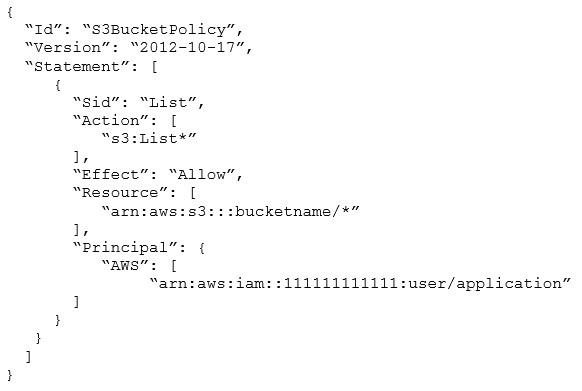 How should a SysOps Administrator modify the S3 bucket policy to fix the issue?
-
A
Change the "Effect" from "Allow" to "Deny"
-
B
Change the "Action" from "s3:List*" to "s3:ListBucket"
-
C
Change the "Resource" from "arn:aws:s3:::bucketname/*" to "arn:aws:s3:::bucketname"
-
D
Change the "Principal" from "arn:aws:iam::111111111111:user/application" to "arn:aws:iam::111111111111:role/application"
Reveal answer details
Close answer details
Question 69
Single choice
A SysOps administrator manages an AWS CloudFormation template that provisions Amazon EC2 instances, an Elastic Load Balancer, and Amazon RDS instances. As part of an ongoing transformation project, CloudFormation stacks are being created and deleted continuously. The administrator needs to ensure that the RDS instances continue running after a stack has been deleted. Which action should be taken to meet these requirements?
-
A
Edit the template to remove the RDS resources and update the stack.
-
B
Enable termination protection on the stack.
-
C
Set the DeletionPolicy attribute for RDS resources to Retain in the template.
-
D
Set the deletion-protection parameter on RDS resources.
Reveal answer details
Close answer details
Correct answerC
ExplanationReferences:
https://docs.aws.amazon.com/AWSCloudFormation/latest/UserGuide/aws-attribute-deletionpolicy.html
Question 70
Multiple choice
A company developed and now runs a memory-intensive application on multiple Amazon EC2 Linux instances. The memory utilization metrics of the EC2 Linux instances must be monitored every minute. How should the SysOps Administrator publish the memory metrics? (Choose two.)
-
A
Enable detailed monitoring on the instance within Amazon CloudWatch
-
B
Publish the memory metrics to Amazon CloudWatch Events
-
C
Publish the memory metrics using the Amazon CloudWatch agent
-
D
Publish the memory metrics using Amazon CloudWatch Logs
-
E
Set metrics_collection_interval to 60 seconds
Reveal answer details
Close answer details
Correct answersA, B
ExplanationReferences:
https://docs.aws.amazon.com/AWSEC2/latest/UserGuide/
automating_with_cloudwatch_events.html
Question 71
Single choice
A SysOps Administrator needs to confirm that security best practices are being followed with the AWS account root user. How should the Administrator ensure that this is done?
-
A
Change the root user password by using the AWS CLI routinely.
-
B
Periodically use the AWS CLI to rotate access keys and secret keys for the root user.
-
C
Use AWS Trusted Advisor security checks to review the configuration of the root user.
-
D
Periodically distribute the AWS compliance document from AWS Artifact that governs the root user configuration.
Reveal answer details
Close answer details
Correct answerB
ExplanationReferences:
https://docs.aws.amazon.com/IAM/latest/UserGuide/id_root-user.html
Question 72
Single choice
Which of the following programming languages is not supported by Amazon's Elastic Beanstalk?
-
A
-
B
-
C
-
D
Reveal answer details
Close answer details
Correct answerD
ExplanationExplanation:
AWS Elastic Beanstalk web server environment tiers support applications developed in Java, PHP, .NET, Node.js, Python, and Ruby as well as different container types for each language.
Worker environments are supported for all platforms except .NET.
References:
http://docs.aws.amazon.com/elasticbeanstalk/latest/dg/concepts.platforms.html
Question 73
Single choice
A user has stored data on an encrypted EBS volume. The user wants to share the data with his friend's AWS account. How can user achieve this?
-
A
Create an AMI from the volume and share the AMI
-
B
Copy the data to an unencrypted volume and then share
-
C
Take a snapshot and share the snapshot with a friend
-
D
If both the accounts are using the same encryption key then the user can share the volume directly
Reveal answer details
Close answer details
Correct answerB
ExplanationExplanation:
AWS EBS supports encryption of the volume. It also supports creating volumes from existing snapshots provided the snapshots are created from encrypted volumes. If the user is having data on an encrypted volume and is trying to share it with others, he has to copy the data from the encrypted volume to a new unencrypted volume. Only then can the user share it as an encrypted volume data. Otherwise the snapshot cannot be shared.
Question 74
Multiple choice
A web-based application is running in AWS. The application is using a MySQL Amazon RDS database instance for persistence. The application stores transactional data and is read-heavy. The RDS instance gets busy during the peak usage, which shows the overall application response times. The SysOps Administrator is asked to improve the read queries performance using a scalable solution. Which options will meet these requirements? (Choose two.)
-
A
Scale up the RDS instance to a larger instance size
-
B
Enable the RDS database Multi-AZ option
-
C
Create a read replica of the RDS instance
-
D
Use Amazon DynamoDB instead of RDS
-
E
Use Amazon ElastiCache to cache read queries
Reveal answer details
Close answer details
Question 75
Single choice
Users are struggling to connect to a single public-facing development web server using its public IP address on a unique port number of 8181. The security group is correctly configured to allow access on that port, and the network ACLs are using the default configuration. Which log type will confirm whether users are trying to connect to the correct port?
-
A
-
B
Elastic Load Balancer access logs
-
C
-
D
Reveal answer details
Close answer details
Question 76
Single choice
A web application runs on Amazon EC2 instances with public IPs assigned behind an Application Load Balancer. The instances run in an Auto Scaling group across multiple Availability Zones. The application stores data in an Amazon RDS Multi-AZ DB instance. The Application Load Balancer, EC2 instances, and RDS DB instance all run in separate sets of subnets. The EC2 instances can communicate with the DB instance, but cannot connect with external services. What is the MOST likely solution?
-
A
Assign a public IP address to the database server and restart the database engine.
-
B
Create and attach an Internet gateway to the VPC. Create a route table for the EC2 instance's subnets that sends Internet traffic to the gateway.
-
C
Create and attach a virtual private gateway to the VPC. Create a route table for the EC2 instances' subnets that sends Internet traffic to the gateway.
-
D
Create a VPC peering connection to a VPC that has an Internet gateway attached. Create a route table for the EC2 instances' subnets that sends Internet traffic to the peered VPC.
Reveal answer details
Close answer details
Question 77
Single choice
An organization, which has the AWS account ID as 999988887777, has created 50 IAM users. All the users are added to the same group cloudacademy. If the organization has enabled that each IAM user can login with the AWS console, which AWS login URL will the IAM users use?
-
A
https://999988887777.signin.aws.amazon.com/console/
-
B
https://signin.aws.amazon.com/cloudacademy/
-
C
https://cloudacademy.signin.aws.amazon.com/999988887777/console/
-
D
https://999988887777.aws.amazon.com/cloudacademy/
Reveal answer details
Close answer details
Correct answerC
ExplanationAWS Identity and Access Management is a web service which allows organizations to manage users and user permissions for various AWS services. Once the organization has created the IAM users, they will have a separate AWS console URL to login to the AWS console. The console login URL for the IAM user will be https://AWS_Account_ID.signin.aws.amazon.com/console/. It uses only the AWS account ID and does not depend on the group or user ID.
Question 78
Multiple choice
A web application's performance has been degrading. Historically, the application has had highly-variable workloads, but lately, there has been a steady growth in traffic as the result of a new product launch. After reviewing several Amazon CloudWatch metrics, it is discovered that over the last two weeks the balance of CPU credits has dropped to zero several times. Which solutions will improve performance? (Choose two.)
-
A
Begin using the T2 instance type
-
B
Purchase more CPU credits for the existing instance
-
C
Increase the size of the current instance type
-
D
Configure a CloudWatch alarm on the CPU credits metric
Reveal answer details
Close answer details
Question 79
Single choice
A company runs a web application that users access using the domain name www.example.com. The company manages the domain name using Amazon Route 53. The company created an Amazon CloudFront distribution in front of the application and would like www.example.com to access the application through CloudFront. What is the MOST cost-effective way to achieve this?
-
A
Create a CNAME record in Amazon Route 53 that points to the CloudFront distribution URL.
-
B
Create an ALIAS record in Amazon Route 53 that points to the CloudFront distribution URL.
-
C
Create an A record in Amazon Route 53 that points to the public IP address of the web application.
-
D
Create a PTR record in Amazon Route 53 that points to the public IP address of the web application.
Reveal answer details
Close answer details
Correct answerB
ExplanationReferences:
https://docs.aws.amazon.com/Route53/latest/DeveloperGuide/routing-to-cloudfront-distribution.html
Question 80
Single choice
An organization is using cost allocation tags to find the cost distribution of different departments and projects. One of the instances has two separate tags with the key/ value as "InstanceName/HR", "CostCenter/HR". What will AWS do in this case?
-
A
InstanceName is a reserved tag for AWS. Thus, AWS will not allow this tag
-
B
AWS will not allow the tags as the value is the same for different keys
-
C
AWS will allow tags but will not show correctly in the cost allocation report due to the same value of the two separate keys
-
D
AWS will allow both the tags and show properly in the cost distribution report
Reveal answer details
Close answer details
Correct answerD
ExplanationExplanation:
AWS provides cost allocation tags to categorize and track the AWS costs. When the user applies tags to his AWS resources, AWS generates a cost allocation report as a comma-separated value (CSV file. with the usage and costs aggregated by those tags. Each tag will have a key-value and can be applied to services, such as EC2, S3, RDS, EMR, etc. It is required that the key should be different for each tag. The value can be the same for different keys. In this case since the value is different, AWS will properly show the distribution report with the correct values.
Question 81
Multiple choice
When preparing for a compliance assessment of your system built inside of AWS.
what are three best-practices for you to prepare for an audit? (Choose three.)
-
A
Gather evidence of your IT operational controls
-
B
Request and obtain applicable third-party audited AWS compliance reports and certifications
-
C
Request and obtain a compliance and security tour of an AWS data center for a pre-assessment security review
-
D
Request and obtain approval from AWS to perform relevant network scans and in-depth penetration tests of your system's Instances and endpoints
-
E
Schedule meetings with AWS's third-party auditors to provide evidence of AWS compliance that maps to your control objectives
Reveal answer details
Close answer details
Question 82
Multiple choice
A new application is being tested for deployment on an Amazon EC2 instance that requires greater IOPS than currently provided by the single 4TB General Purpose SSD (gp2) volume. Which actions should be taken to provide additional Amazon EBS IOPS for the application? (Choose two.)
-
A
Increase the size of the General Purpose (gp2) volume
-
B
Use RAID 0 to distribute I/O across multiple volumes
-
C
Migrate to a Provisioned IOPS SSD (io1) volume
-
D
Enable MAX I/O performance mode on the General Purpose (gp2) volume
-
E
Use RAID 1 to distribute I/O across multiple volumes
Reveal answer details
Close answer details
Question 83
Single choice
An organization with a large IT department has decided to migrate to AWS. With different job functions in the IT department, it is not desirable to give all users access to all AWS resources. Currently the organization handles access via LDAP group membership. What is the BEST method to allow access using current LDAP credentials?
-
A
Create an AWS Directly Service Simple AD. Replicate the on-premises LDAP directory to Simple AD.
-
B
Create a Lambda function to read LDAP groups and automate the creation of IAM users.
-
C
Use AWS CloudFormation to create IAM roles. Deploy Direct Connect to allow access to the on-premises LDAP server.
-
D
Federate the LDAP directory with IAM using SAML. Create different IAM roles to correspond to different LDAP groups to limit permissions.
Reveal answer details
Close answer details
Correct answerD
ExplanationReferences:
https://docs.aws.amazon.com/IAM/latest/UserGuide/id_roles_common-scenarios_federated-users.html
Question 84
Single choice
A company's security policy states that connecting to Amazon EC2 instances is not permitted through SSH and RDP. If access is required, authorized staff can connect to instances by using AWS Systems Manager Session Manager. Users report that they are unable to connect to one specific Amazon EC2 instance that is running Ubuntu and has AWS Systems Manager Agent (SSM Agent) pre-installed. These users are able to use Session Manager to connect to other instances in the same subnet, and they are in an IAM group that has Session Manager permission for all instances. What should a SysOps administrator do to resolve this issue?
-
A
Add an inbound rule for port 22 in the security group associated with the Ubuntu instance.
-
B
Assign the AmazonSSMManagedInstanceCore managed policy to the EC2 instance profile for the Ubuntu instance.
-
C
Configure the SSM Agent to log in with a user name of "ubuntu".
-
D
Generate a new key pair, configure Session Manager to use this new key pair, and provide the private key to the users.
Reveal answer details
Close answer details
Question 85
Single choice
Which component of an Ethernet frame is used to notify a host that traffic is coming?
-
A
-
B
-
C
-
D
Reveal answer details
Close answer details
Question 86
Single choice
A SysOps Administrator must devise a strategy for enforcing tagging of all EC2 instances and Amazon Elastic Block Store (Amazon EBS) volumes. What action can the Administrator take to implement this for real-time enforcement?
-
A
Use the AWS Tag Editor to manually search for untagged resources and then tag them properly in the editor.
-
B
Set up AWS Service Catalog with the TagOptions Library rule that enforces a tagging taxonomy proactively when instances and volumes are launched.
-
C
In a PowerShell or shell script, check for untagged items by using the resource tagging GetResources API action, and then manually tag the reported items.
-
D
Launch items by using the AWS API. Use the TagResources API action to apply the required tags when the instances and volumes are launched.
Reveal answer details
Close answer details
Question 87
Single choice
A company is about to launch a new product and is expecting a large increase in application traffic. The application is running on Amazon EC3 is an Auto scaling group and using an Amazon RDS multi-AZ instance. The static content is stored in Amazon S3. During the load test, the time to access the application increased significantly. A SysOps administrator wants to increase the scalability of the application without compromising the durability of the architecture. How can this goal be achieved?
-
A
Move the static content from Amazon EFS and serve that the content through the EC2 instances.
-
B
Move the databases from Amazon RDS to Amazon ElastiCache for Memcached.
-
C
Use Amazon Cloudfront to cache the static content.
-
D
Use Amazon Route S3 with geolocation routing.
Reveal answer details
Close answer details
Question 88
Single choice
A user has launched an EBS backed instance. The user started the instance at 9 AM in the morning.
Between 9 AM to 10 AM, the user is testing some script. Thus, he stopped the instance twice and restarted it. In the same hour the user rebooted the instance once.
For how many instance hours will AWS charge the user?
-
A
-
B
-
C
-
D
Reveal answer details
Close answer details
Correct answerA
ExplanationExplanation:
A user can stop/start or reboot an EC2 instance using the AWS console, the Amazon EC2 CLI or the Amazon EC2 API. Rebooting an instance is equivalent to rebooting an operating system. When the instance is rebooted AWS will not charge the user for the extra hours. In case the user stops the instance, AWS does not charge the running cost but charges only the EBS storage cost. If the user starts and stops the instance multiple times in a single hour, AWS will charge the user for every start and stop. In this case, since the instance was rebooted twice, it will cost the user for 3 instance hours.
Question 89
Single choice
A sysops administrator manages an AWS CloudFormation templates that provisions Amazon EC2 instances, an Elastic Load Balancer, and Amazon RDS instances. As part of an ongoing transformation project CloudFormation stacks are being created and deleted continuously. The administrator needs to ensure that the RDS instances continue running after a stack has been deleted. Which action should be taken to meet these requirements?
-
A
Edit the template to remove the RDS resources and update the stack.
-
B
Enable termination protection on the stack.
-
C
Set the deletionPolicy attributes for RDS resources to retain in the template.
-
D
Set the deletion-protection parameter on RDS resources.
Reveal answer details
Close answer details
Question 90
Single choice
A company is running critical applications on Amazon EC2 instances. The company needs to ensure its resources are automatically recovered if they become impaired due to an underlying hardware failure. Which service can be used to monitor and recover the EC2 instances?
-
A
Amazon EC2 Systems Manager
-
B
-
C
-
D
Reveal answer details
Close answer details
Correct answerD
ExplanationReferences:
https://docs.aws.amazon.com/AWSEC2/latest/UserGuide/ec2-instance-recover.html
Question 91
Single choice
A user creates an Auto Scaling group from the Amazon AWS Console and assigned a tag with a key of "environment" and a value of "Prod".
Can the user assign tags to instances launched in the Auto Scaling group, to organize and manage them?
-
A
Yes, this is possible only if the tags are configured at the launch configuration with a maximum length of 300 characters.
-
B
-
C
Yes, this is possible only if the tags are in the same AZ and the tag names are uppercase.
-
D
Reveal answer details
Close answer details
Correct answerB
ExplanationExplanation:
You can organize and manage your Auto Scaling groups by assigning your own metadata to each group in the form of tags. You specify a key and a value for each tag. A key can be a general cate-gory, such as "project", "owner", or "environment", with specific associated values.
By default, the instance will have a tag with the key as "aws:autoscaling:groupName" and the value as the name of the group.
References:
http://docs.aws.amazon.com/AutoScaling/latest/DeveloperGuide/ASTagging.html
Question 92
Single choice
A SysOps Administrator is managing an AWS account where Developers are authorized to launch Amazon EC2 instances to test new code. To limit costs, the Administrator must ensure that the EC2 instances in the account are terminated 24 hours after launch. How should the Administrator meet these requirements?
-
A
Create an Amazon CloudWatch alarm based on the CPUUtilization metric. When the metric is 0% for 24 hours, trigger an action to terminate the EC2 instance when the alarm is triggered.
-
B
Create an AWS Lambda function to check all EC2 instances and terminate instances running more than 24 hours. Trigger the function with an Amazon CloudWatch Events event every 15 minutes.
-
C
Add an action to AWS Trusted Advisor to turn off EC2 instances based on the Low Utilization Amazon EC2 Instances check, terminating instances identified by Trusted Advisor as running for more than 24 hours.
-
D
Install the unified Amazon CloudWatch agent on every EC2 instance. Configure the agent to terminate instances after they have been running for 24 hours.
Reveal answer details
Close answer details
Question 93
Single choice
A user has setup a web application on EC2. The user is generating a log of the application performance at every second. There are multiple entries for each second.
If the user wants to send that data to CloudWatch every minute, what should he do?
-
A
The user should send only the data of the 60th second as CloudWatch will map the receive data timezone with the sent data timezone
-
B
It is not possible to send the custom metric to CloudWatch every minute
-
C
Give CloudWatch the Min, Max, Sum, and SampleCount of a number of every minute
-
D
Calculate the average of one minute and send the data to CloudWatch
Reveal answer details
Close answer details
Correct answerC
ExplanationExplanation:
Amazon CloudWatch aggregates statistics according to the period length that the user has specified while getting data from CloudWatch. The user can publish as many data points as he wants with the same or similar time stamps. CloudWatch aggregates them by the period length when the user calls get statistics about those data points. CloudWatch records the average (sum of all items divided by the number of items. of the values received for every 1-minute period, as well as the number of samples, maximum value, and minimum value for the same time period. CloudWatch will aggregate all the data which have time stamps within a one-minute period.
Question 94
Single choice
A user is sending the data to CloudWatch using the CloudWatch API. The user is sending data 90 minutes in the future. What will CloudWatch do in this case?
-
A
CloudWatch will accept the data
-
B
It is not possible to send data of the future
-
C
It is not possible to send the data manually to CloudWatch
-
D
The user cannot send data for more than 60 minutes in the future
Reveal answer details
Close answer details
Correct answerA
ExplanationExplanation:
With Amazon CloudWatch, each metric data point must be marked with a time stamp. The user can send the data using CLI but the time has to be in the UTC format. If the user does not provide the time, CloudWatch will take the data received time in the UTC timezone. The time stamp sent by the user can be up to two weeks in the past and up to two hours into the future.
Question 95
Single choice
An organization has created a Queue named "modularqueue" with SQS. The organization is not performing any operations such as SendMessage, ReceiveMessage, DeleteMessage, GetQueueAttributes, SetQueueAttributes, AddPermission, and RemovePermission on the queue. What can happen in this scenario?
-
A
AWS SQS sends notification after 15 days for inactivity on queue
-
B
AWS SQS can delete queue after 30 days without notification
-
C
AWS SQS marks queue inactive after 30 days
-
D
AWS SQS notifies the user after 2 weeks and deletes the queue after 3 weeks.
Reveal answer details
Close answer details
Correct answerB
ExplanationExplanation:
Amazon SQS can delete a queue without notification if one of the following actions hasn't been performed on it for 30 consecutive days: SendMessage, ReceiveMessage, DeleteMessage, GetQueueAttributes, SetQueueAttributes, AddPermission, and RemovePermission.
Question 96
Single choice
A sysops administrator is managing an application on AWS that uses Amazon EC2 instances and Amazon Aurora MySQL. The EC2 instances and Aurora instances are in two different subnets. The application servers running in EC2 cannot connect to the Aurora database. The EC2 subnet is 192.168.87.0/24 and has a security group named sg-123456 with the following configuration. 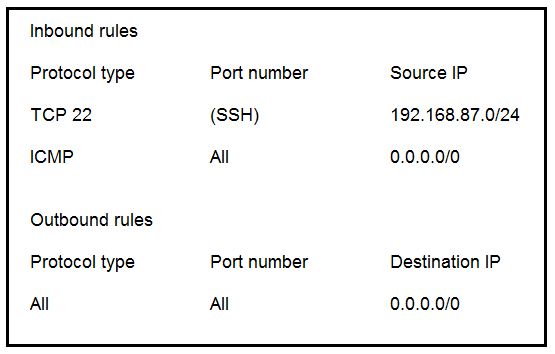 The Aurora subnet is 192.168.88.0/24 and has a security group named sg-abcdef with the following configuration. 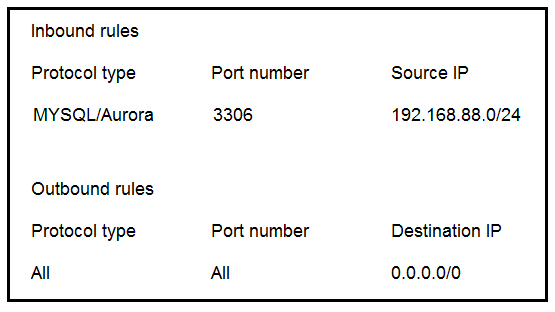 Which action should the sysops administrator take to allow the EC2 instances to connect to the Aurora database?
-
A
In the inbound rules table of the Aurora security group, add an inbound TCP rule with the MySQL port and sg-123456 as the traffic source.
-
B
In the inbound rules table of the EC2 security group, add an inbound TCP rule with the MySQL port
and 192.168.88.0/24 as the traffic source.
-
C
In the outbound rules table of the Aurora security group, add an outbound TCP rule with the MySQL
port and 192.168.87.0/24 as the destination.
-
D
In the outbound rules table of the EC2 security group, add an outbound TCP rule with the MySQL port and sg-abcdef as the destination.
Reveal answer details
Close answer details
Question 97
Single choice
A SysOps Administrator is troubleshooting Amazon EC2 connectivity issues to the internet. The EC2 instance is in a private subnet. Below is the route table that is applied to the subnet of the EC2 instance. Destination - 10.2.0.0/16
Target - local
Status - Active
Propagated - No Destination - 0.0.0.0/0
Target - nat-xxxxxxx
Status - Blackhole
Propagated - No What has caused the connectivity issue?
-
A
The NAT gateway no longer exists.
-
B
There is no route to the internet gateway.
-
C
The routes are no longer propagating.
-
D
There is no route rule with a destination for the internet.
Reveal answer details
Close answer details
Question 98
Single choice
A user is planning to use AWS Cloudformation. Which of the below mentioned functionalities does not help him to correctly understand Cloudfromation?
-
A
Cloudformation follows the DevOps model for the creation of Dev & Test
-
B
AWS Cloudfromation does not charge the user for its service but only charges for the AWS resources created with it
-
C
Cloudformation works with a wide variety of AWS services, such as EC2, EBS, VPC, IAM, S3, RDS,
ELB, etc.
-
D
CloudFormation provides a set of application bootstrapping scripts which enables the user to install Software
Reveal answer details
Close answer details
Correct answerA
ExplanationExplanation:
AWS Cloudformation is an application management tool which provides application modelling, deployment, configuration, management and related activities. It supports a wide variety of AWS services, such as EC2, EBS, AS, ELB, RDS, VPC, etc. It also provides application bootstrapping scripts which enable the user to install software packages or create folders. It is free of the cost and only charges the user for the services created with it. The only challenge is that it does not follow any model, such as DevOps; instead customers can define templates and use them to provision and manage the AWS resources in an orderly way.
Question 99
Single choice
An organization has hired an external firm to audit unauthorized changes on the company's AWS environment, the external auditor needs appropriate access. How can this be accomplished?
-
A
Create an IAM user and assign them a new policy with GetResources access on AWS Artifact
-
B
Create an IAM user and add them to the existing "Administrator" IAM group
-
C
Create an IAM user and assign them a new IAM policy with read access to the AWS CloudTrail logs in Amazon S3
-
D
Create an IAM user and assign them a new policy with ListFindings access on Amazon Inspector
Reveal answer details
Close answer details
Question 100
Single choice
____________ is a fast, flexible, fully managed pub/sub messaging service.
-
A
-
B
-
C
-
D
Reveal answer details
Close answer details
Correct answerD
ExplanationExplanation:
Amazon Simple Notification Service (Amazon SNS) is a fast, flexible, fully managed push messag-ing service. Amazon SNS makes it simple and cost-effective to push to mobile devices such as iPh-one, iPad, Android, Kindle Fire, and internet connected smart devices, as well as pushing to other distributed services.
References:
http://aws.amazon.com/sns/?nc1=h_l2_as
|