Preview real exam questions, verified answers and available explanations before choosing a study plan.
Question 1
Hotspot
HOTSPOT
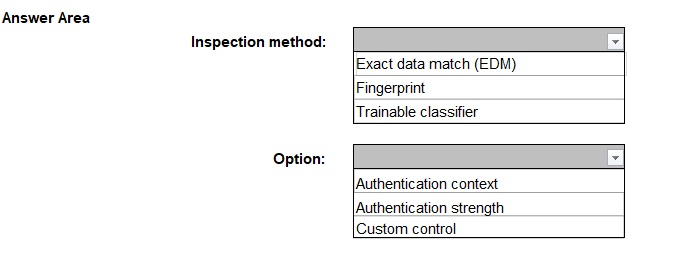
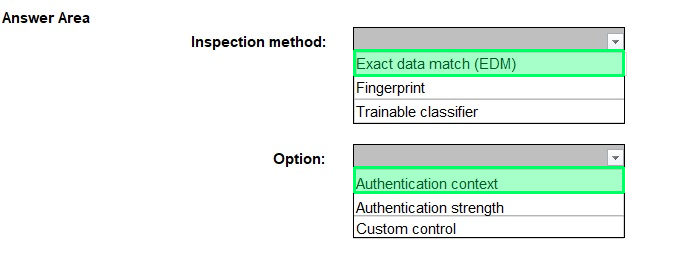
You have a Microsoft 365 subscription that contains a Microsoft SharePoint Online site named Site1. Site1 stores documents that are based on a predefined form and include confidential employee information.
You monitor access to Site1 by using a Microsoft Defender for Cloud Apps session policy.
You need to ensure that step-up authentication is triggered when a user downloads documents that are based on the predefined form. The solution must minimize administrative effort.
Which Microsoft Data Classification Service inspection method should you use, and which Conditional Access option should you add to the session policy? To answer, select the appropriate options in the answer area.
NOTE: Each correct selection is worth one point.
Reveal answer detailsClose answer details
Question 2
Hotspot
HOTSPOT
Your company has a Microsoft 365 E5 subscription, an Azure subscription, on-premises applications, and Active Directory Domain Services (AD DS).
You need to recommend an identity security strategy that meets the following requirements:
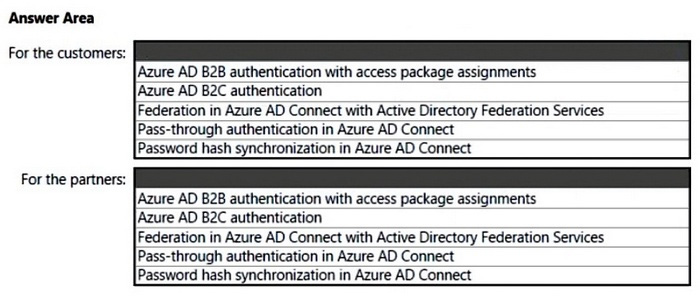
1. Ensures that customers can use their Facebook credentials to authenticate to an Azure App Service website 2. Ensures that partner companies can access Microsoft SharePoint Online sites for the project to which they are assigned
The solution must minimize the need to deploy additional infrastructure components.
What should you include in the recommendation? To answer, select the appropriate options in the answer area.
NOTE: Each correct selection is worth one point.
Reveal answer detailsClose answer details
Explanation
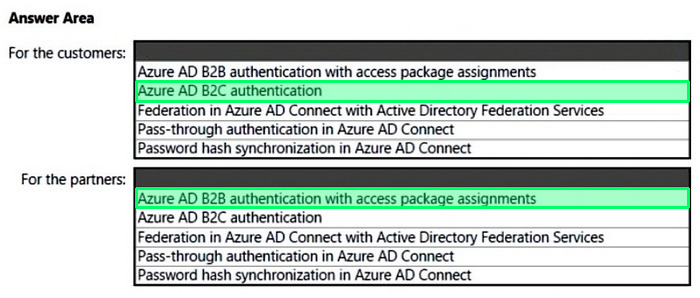
Box 1: Azure AD B2C authentication Ensures that customers can use their Facebook credentials to authenticate to an Azure App Service website.
You can set up sign-up and sign-in with a Facebook account using Azure Active Directory B2C.
Box 2: Azure AD B2B authentication with access package assignments Govern access for external users in Azure AD entitlement management Azure AD entitlement management uses Azure AD business-to-business (B2B) to share access so you can collaborate with people outside your organization. With Azure AD B2B, external users authenticate to their home directory, but have a representation in your directory. The representation in your directory enables the user to be assigned access to your resources.
Incorrect: Not: Password hash synchronization in Azure AD connect The partners are not integrated with AD DS.
Your company has a Microsoft 365 subscription and uses Microsoft Defender for Identity.
You are informed about incidents that relate to compromised identities.
You need to recommend a solution to expose several accounts for attackers to exploit. When the attackers attempt to exploit the accounts, an alert must be triggered.
Which Defender for Identity feature should you include in the recommendation?
A
sensitivity labels
B
custom user tags
C
standalone sensors
D
honeytoken entity tags
Reveal answer detailsClose answer details
Correct answerD
Explanation
Honeytoken entities are used as traps for malicious actors. Any authentication associated with these honeytoken entities triggers an alert.
Incorrect: Not B: custom user tags After you apply system tags or custom tags to users, you can use those tags as filters in alerts, reports, and investigation.
You have an on-premises app named App1. Remote users access App1 by using VPN connections.
You have a third-party software as a service (SaaS) app named App2.
You need to deploy Global Secure Access to manage access to App1 and App2.
What should you use for each app?
A
Microsoft Entra Private Access for App1 and Microsoft Entra Internet Access for App2
B
Microsoft Entra Private Access for App1 and App2
C
Microsoft Entra Internet Access for App1 and App2
D
Microsoft Entra Private Access for App2 and Microsoft Entra Internet Access for App1
Reveal answer detailsClose answer details
Correct answerA
Question 5
Single choice
You have on-premises Windows 11 devices with the Global Secure Access client deployed.
Your Microsoft 365 subscription includes Microsoft SharePoint Online and Exchange Online.
You deploy Microsoft Entra Internet Access from your on-premises network to Microsoft 365. This deployment has the Microsoft 365 profile enabled, with the following configuration:
1. Default traffic policies for Microsoft 365 services 2. A linked Conditional Access policy that performs compliant network checks with continuous access evaluation (CAE) applied to all users 3. An assignment to all devices 4. An assignment to a remote network associated with the on-premises network
Which Microsoft 365 resources are protected using continuous access evaluation (CAE)?
A
SharePoint Online only
B
Exchange Online only
C
both SharePoint Online and Exchange Online
Reveal answer detailsClose answer details
Correct answerA
Explanation
Compliant network check enforcement Compliant network enforcement reduces the risk of token theft/replay attacks. Compliant network enforcement happens at the authentication plane (generally available) and at the data plane (preview). Authentication plane enforcement is performed by Microsoft Entra ID at the time of user authentication. If an adversary has stolen a session token and attempts to replay it from a device that is not connected to your organization's compliant network (for example, requesting an access token with a stolen refresh token), Entra ID will immediately deny the request and further access will be blocked. Data plane enforcement works with services that support Continuous Access Evaluation (CAE) - currently, *only SharePoint Online*. With apps that support CAE, stolen access tokens that are replayed outside your tenant's compliant network will be rejected by the application in near-real time. Without CAE, a stolen access token will last up to its full lifetime (default 60-90 minutes).
Your company has an Azure subscription that uses Azure Storage.
The company plans to share specific blobs with vendors.
You need to recommend a solution to provide the vendors with secure access to specific blobs without exposing the blobs publicly. The access must be time-limited.
What should you include in the recommendation?
A
Configure private link connections.
B
Configure encryption by using customer-managed keys (CMKs).
C
Share the connection string of the access key.
D
Create shared access signatures (SAS).
Reveal answer detailsClose answer details
Correct answerD
Explanation
A shared access signature (SAS) provides secure delegated access to resources in your storage account. With a SAS, you have granular control over how a client can access your data. For example:
What resources the client may access.
What permissions they have to those resources.
How long the SAS is valid.
Types of shared access signatures Azure Storage supports three types of shared access signatures:
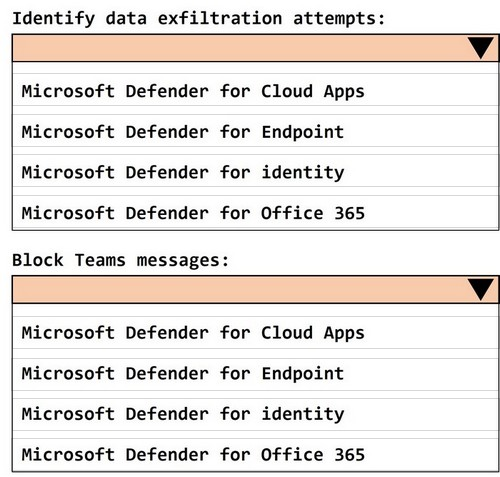
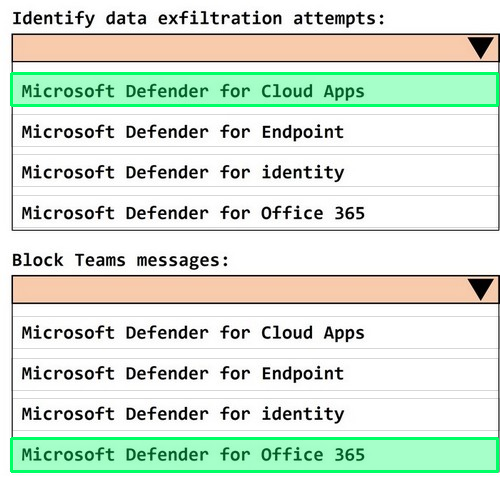
You need to recommend a Microsoft 365 Defender solution to enhance security for the tenant. The solution must meet the following requirements:
1. Identify users that are downloading an unusually high number of files from Microsoft SharePoint Online sites and are possibly involved in a data exfiltration attempt. 2. Block Microsoft Teams messages that contain potentially malicious content by using zero-hour auto
purge (ZAP).
What should you recommend for each requirement? To answer, select the appropriate options in the answer area. NOTE: Each correct selection is worth one point.
Reveal answer detailsClose answer details
Question 8
Hotspot
HOTSPOT
Your company has offices in New York City and Los Angeles.
The New York City office contains an on-premises app named Appl.
You have an Azure subscription. The subscription is linked to a Microsoft Entra tenant that is hosted in North America.
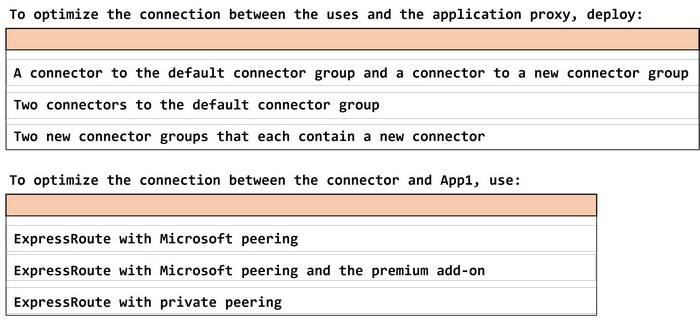
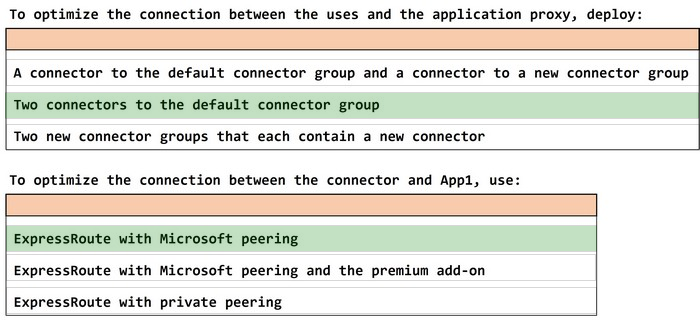
You plan to manage access to App1 for the users in the Los Angeles office by using Microsoft Entra Private Access. You will deploy Private Access by performing the following actions:
1. Provision an ExpressRoute circuit from the New York City office to the closest peering location. 2. Create an Azure virtual network named VNet1 in the East US Azure region. 3. Deploy a Microsoft Entra application proxy connector to VNet1.
You need to optimize the network for the planned deployment. The solution must meet the following requirements:
1. Maximize redundancy for connectivity to App1. 2. Minimize network latency when accessing App1 3. Minimize complexity. 4. Minimize costs.
What should you include in the solution? To answer, select the appropriate options in the answer area.
NOTE: Each correct selection is worth one point.
Reveal answer detailsClose answer details
Question 9
Single choice
You have the following on-premises servers that run Windows Server:
1. Two domain controllers in an Active Directory Domain Services (AD DS) domain 2. Two application servers named Server1 and Server2 that run ASP.NET web apps 3. A VPN server named Served that authenticates by using RADIUS and AD DS 4. End users use a VPN to access the web apps over the internet.
You need to redesign a user access solution to increase the security of the connections to the web apps.
The solution must minimize the attack surface and follow the Zero Trust principles of the Microsoft Cybersecurity Reference Architectures (MCRA).
What should you include in the recommendation?
A
Publish the web apps by using Azure AD Application Proxy.
B
Configure the VPN to use Azure AD authentication.
C
Configure connectors and rules in Microsoft Defender for Cloud Apps.
D
Configure web protection in Microsoft Defender for Endpoint.
Reveal answer detailsClose answer details
Correct answerA
Question 10
Hotspot
HOTSPOT
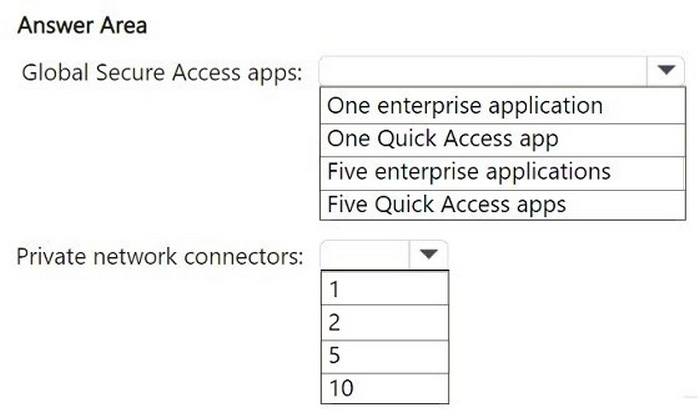
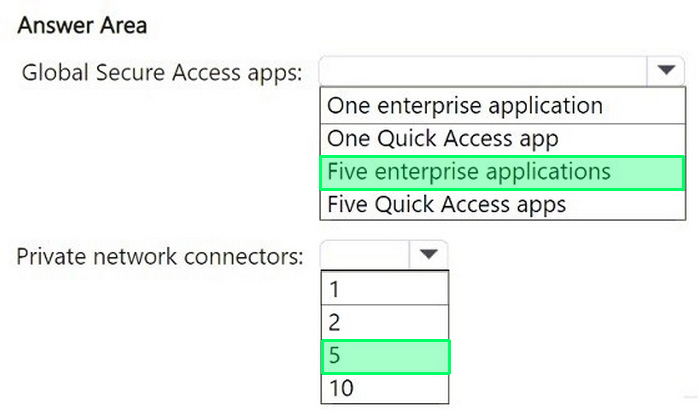
Your on-premises network contains an Active Directory Domain Services (AD DS) domain with a group named Group1 and five servers running Windows Server. Each server hosts a standalone app used by the members of Group1.
You have a Microsoft Entra tenant that syncs with the domain and plan to manage access to the apps by deploying Global Secure Access. A Conditional Access policy will be used to enforce security controls for all connections to the apps.
You need to recommend a Global Secure Access app and Microsoft Entra private network connector configuration for the planned deployment. The solution must minimize administrative effort and ensure high availability.
What is the minimum number of Global Secure Access apps and private network connectors you should recommend?
To answer, select the appropriate options in the answer area.
Each correct selection is worth one point.
Reveal answer detailsClose answer details
Question 11
Multiple choice
You have an Azure subscription that contains virtual machines.
Port 3389 and port 22 are disabled for outside access.
You need to design a solution to provide administrators with secure remote access to the virtual machines. The solution must meet the following requirements:
1. Prevent the need to enable ports 3389 and 22 from the internet. 2. Only provide permission to connect the virtual machines when required. 3. Ensure that administrators use the Azure portal to connect to the virtual machines.
Which two actions should you include in the solution? Each correct answer presents part of the solution.
NOTE: Each correct selection is worth one point.
A
Configure Azure VPN Gateway.
B
Enable Just Enough Administration (JEA).
C
Configure Azure Bastion.
D
Enable just-in-time (JIT) VM access.
E
Enable Azure AD Privileged Identity Management (PIM) roles as virtual machine contributors.
Reveal answer detailsClose answer details
Correct answersC, D
Explanation
C: Bastion provides secure remote access. It uses RDP/SSH session is over TLS on port 443.
Note: Azure Bastion is a service you deploy that lets you connect to a virtual machine using your browser and the Azure portal. The Azure Bastion service is a fully platform-managed PaaS service that you provision inside your virtual network. It provides secure and seamless RDP/SSH connectivity to your virtual machines directly from the Azure portal over TLS. When you connect via Azure Bastion, your virtual machines don't need a public IP address, agent, or special client software.
D: Lock down inbound traffic to your Azure Virtual Machines with Microsoft Defender for Cloud's just-in-time (JIT) virtual machine (VM) access feature. This reduces exposure to attacks while providing easy access when you need to connect to a VM.
Meets the requirement: Only provide permission to connect the virtual machines when required
Incorrect: Not B: Does not address: Only provide permission to connect the virtual machines when required Just Enough Administration (JEA) is a security technology that enables delegated administration for anything managed by PowerShell. With JEA, you can:
Reduce the number of administrators on your machines using virtual accounts or group-managed service accounts to perform privileged actions on behalf of regular users. Limit what users can do by specifying which cmdlets, functions, and external commands they can run. Better understand what your users are doing with transcripts and logs that show you exactly which commands a user executed during their session.
Not E: Does not help with the remote access.
Note: Classic Virtual Machine Contributor: Lets you manage classic virtual machines, but not access to them, and not the virtual network or storage account they're connected to.
You are designing a solution to protect confidential data in Microsoft SharePoint Online sites that contain more than one million documents.
You need to recommend a solution to prevent Personally Identifiable Information (Pll) from being shared.
Which two components should you include in the recommendation? Each correct answer presents part of the solution.
NOTE: Each correct selection is worth one point.
A
data loss prevention (DLP) policies
B
retention label policies
C
eDiscovery cases
D
sensitivity label policies
Reveal answer detailsClose answer details
Correct answersA, D
Explanation
A: Data loss prevention in Office 365. Data loss prevention (DLP) helps you protect sensitive information and prevent its inadvertent disclosure. Examples of sensitive information that you might want to prevent from leaking outside your organization include financial data or personally identifiable information (PII) such as credit card numbers, social security numbers, or health records. With a data loss prevention (DLP) policy, you can identify, monitor, and automatically protect sensitive information across Office 365.
D: Sensitivity labels Sensitivity labels from Microsoft Purview Information Protection let you classify and protect your organization's data without hindering the productivity of users and their ability to collaborate.
Plan for integration into a broader information protection scheme. On top of coexistence with OME, sensitivity labels can be used along-side capabilities like Microsoft Purview Data Loss Prevention (DLP) and Microsoft Defender for Cloud Apps.
Incorrect: Not B: Retention labels help you retain what you need and delete what you don't at the item level (document or email). They are also used to declare an item as a record as part of a records management solution for your Microsoft 365 data.
Not C: eDiscovery cases in eDiscovery (Standard) and eDiscovery (Premium) let you associate specific searches and exports with a specific investigation. You can also assign members to a case to control who can access the case and view the contents of the case. Place content locations on legal hold.
Note: This question is part of a series of questions that present the same scenario. Each question in the series contains a unique solution that might meet the stated goals. Some question sets might have more than one correct solution, while others might not have a correct solution.
After you answer a question in this section, you will NOT be able to return to it. As a result, these questions will not appear in the review screen.
Your on-premises network contains an e-commerce web app that was developed in Angular and Node,js. The web app uses a MongoDB database. You plan to migrate the web app to Azure. The solution architecture team proposes the following architecture as an Azure landing zone.
You need to provide recommendations to secure the connection between the web app and the database. The solution must follow the Zero Trust model.
Solution: You recommend implementing Azure Application Gateway with Azure Web Application Firewall (WAF).
Does this meet the goal?
A
Yes
B
No
Reveal answer detailsClose answer details
Correct answerB
Explanation
Instead use solution: You recommend creating private endpoints for the web app and the database layer.
Note: How to Use Azure Private Endpoints to Restrict Public Access to WebApps. As an Azure administrator or architect, you are sometimes asked the question: "How can we safely deploy internal business applications to Azure App Services?"
These applications characteristically are:
Not accessible from the public internet. Accessible from within the on-premises corporate network Accessible via an authorized VPN client from outside the corporate network. For such scenarios, we can use Azure Private Links, which enables private and secure access to Azure PaaS services over Azure Private Endpoints, along with the Site-to-Site VPN, Point-to-Site VPN, or the Express Route. Azure Private Endpoint is a read-only network interface service associated with the Azure PAAS Services. It allows you to bring deployed sites into your virtual network, limiting access to them at the network level.
It uses one of the private IP addresses from your Azure VNet and associates it with the Azure App Services. These services are called Private Link resources. They can be Azure Storage, Azure Cosmos DB, SQL, App Services Web App, your own / partner owned services, Azure Backups, Event Grids, Azure Service Bus, or Azure Automations.
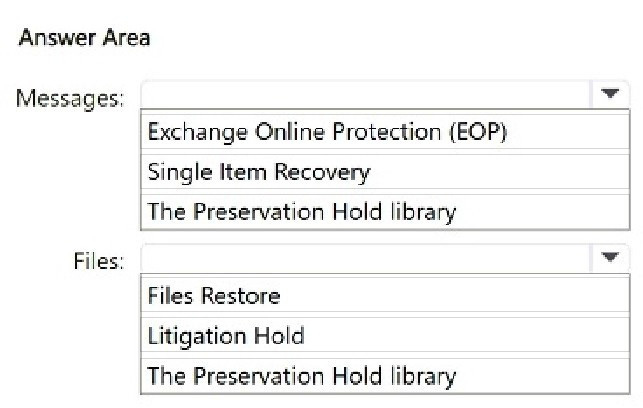
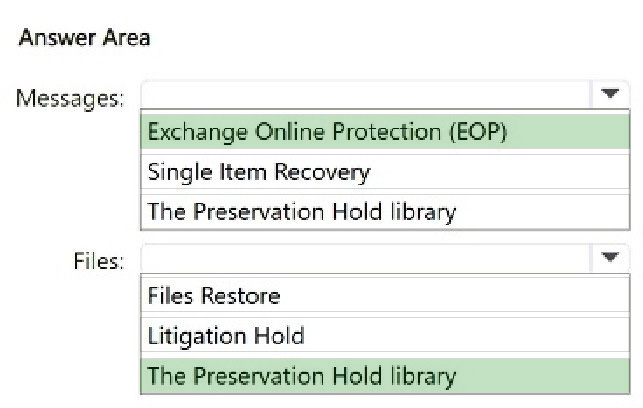
You need to mitigate ransomware attacks against messages posted to Microsoft Teams channels and files stored in Teams channels.
What should you include in the solution for each type of content? To answer, select the appropriate options in the answer area.
NOTE: Each correct selection is worth one point.
Reveal answer detailsClose answer details
Question 15
Single choice
Your company has an on-premises network, an Azure subscription, and a Microsoft 365 E5 subscription.
The company uses the following devices:
1. Computers that run either Windows 10 or Windows 11 2. Tablets and phones that run either Android or iOS
You need to recommend a solution to classify and encrypt sensitive Microsoft Office 365 data regardless of where the data is stored.
What should you include in the recommendation?
A
eDiscovery
B
Microsoft Information Protection
C
Compliance Manager
D
retention policies
Reveal answer detailsClose answer details
Correct answerB
Explanation
Protect your sensitive data with Microsoft Purview. Implement capabilities from Microsoft Purview Information Protection (formerly Microsoft Information Protection) to help you discover, classify, and protect sensitive information wherever it lives or travels.
Note: You can use Microsoft Information Protection: Microsoft Purview for Auditing and Analytics in Outlook for iOS, Android, and Mac (DoD).
Incorrect: Not A: Electronic discovery, or eDiscovery, is the process of identifying and delivering electronic information that can be used as evidence in legal cases. You can use eDiscovery tools in Microsoft Purview to search for content in Exchange Online, OneDrive for Business, SharePoint Online, Microsoft Teams, Microsoft 365 Groups, and Yammer teams. You can search mailboxes and sites in the same eDiscovery search, and then export the search results. You can use Microsoft Purview eDiscovery (Standard) cases to identify, hold, and export content found in mailboxes and sites. If your organization has an Office 365 E5 or Microsoft 365 E5 subscription (or related E5 add-on subscriptions), you can further manage custodians and analyze content by using the feature-rich Microsoft Purview eDiscovery (Premium) solution in Microsoft 365.
Not C: What does compliance Manager do? Compliance managers ensure that a business, its employees and its projects comply with all relevant regulations and specifications. This could include health and safety, environmental, legal or quality standards, as well as any ethical policies the company may have.
Not D: A retention policy (also called a 'schedule') is a key part of the lifecycle of a record. It describes how long a business needs to keep a piece of information (record), where it's stored and how to dispose of the record when its time.
You have a Microsoft 365 subscription and an Azure subscription. Microsoft 365 Defender and Microsoft Defender for Cloud are enabled.
The Azure subscription contains 50 virtual machines. Each virtual machine runs different applications on Windows Server 2019.
You need to recommend a solution to ensure that only authorized applications can run on the virtual machines. If an unauthorized application attempts to run or be installed, the application must be blocked automatically until an administrator authorizes the application.
Which security control should you recommend?
A
app discovery anomaly detection policies in Microsoft Defender for Cloud Apps
B
Azure AD Conditional Access App Control policies
C
adaptive application controls in Defender for Cloud
D
app protection policies in Microsoft Endpoint Manager
Reveal answer detailsClose answer details
Correct answerC
Explanation
Use adaptive application controls to reduce your machines' attack surfaces
Adaptive application controls are an intelligent and automated solution for defining allowlists of known-safe applications for your machines.
When you've enabled and configured adaptive application controls, you'll get security alerts if any application runs other than the ones you've defined as safe.
Incorrect: Not A: A Cloud Discovery anomaly detection policy enables you to set up and configure continuous monitoring of unusual increases in cloud application usage. Increases in downloaded data, uploaded data, transactions, and users are considered for each cloud application. Each increase is compared to the normal usage pattern of the application as learned from past usage. The most extreme increases trigger security alerts.
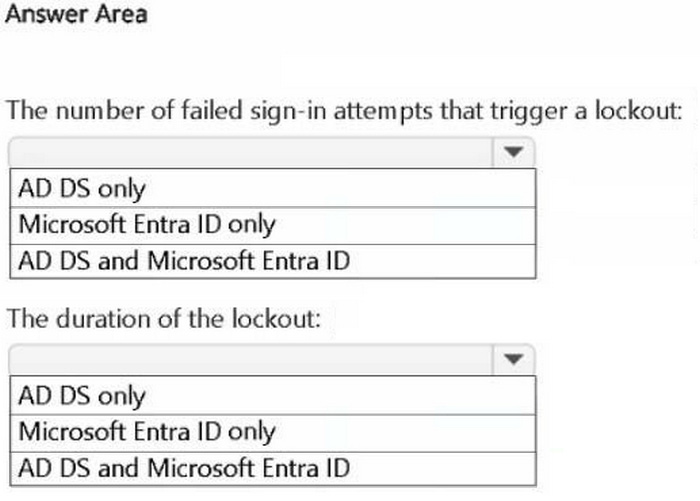
Your network contains an Active Directory Domain Services (AD DS) domain named Domain1.
You have a Microsoft Entra tenant.
Domain1 syncs with the tenant using Microsoft Entra Connect.
You need to evaluate Microsoft Entra smart lockout by testing the following account lockout considerations:
1. The number of failed sign-in attempts that trigger a lockout 2. The duration of the lockout
What should you use to test each consideration?
To answer, select the appropriate options in the answer area.
Each correct selection is worth one point.
Reveal answer detailsClose answer details
Explanation
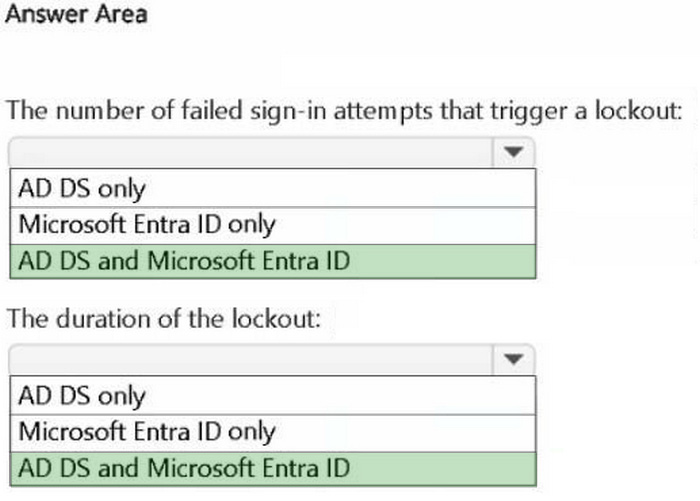
Box 1: AD DS and Microsoft Entra ID The number of failed sign-in attempts that trigger a lockout.
Smart lockout can be integrated with hybrid deployments that use password hash sync or pass-through authentication to protect on-premises Active Directory Domain Services (AD DS) accounts from being locked out by attackers. By setting smart lockout policies in Microsoft Entra ID appropriately, attacks can be filtered out before they reach on-premises AD DS. When using pass-through authentication, the following considerations apply:
* The Microsoft Entra lockout threshold must be less than the AD DS account lockout threshold. Set the values so that the AD DS account lockout threshold is at least two or three times greater than the Microsoft Entra lockout threshold.
* The Microsoft Entra lockout duration must be longer than the AD DS account lockout duration. The Microsoft Entra duration is set in seconds, while the AD DS duration is set in minutes.
Tip This configuration ensures Microsoft Entra smart lockout stops your on-premises AD DS accounts from being locked out by brute force attacks, like password spray attacks on your Microsoft Entra accounts.
Box 2: AD DS and Microsoft Entra ID The duration of the lockout.
You have an Azure subscription that has Microsoft Defender for Cloud enabled.
You need to enforce ISO 27001:2013 standards for new resources deployed to the subscription. The solution must ensure that noncompliant resources are automatically detected.
What should you use?
A
Azure Policy
B
Azure Blueprints
C
the regulatory compliance dashboard in Defender for Cloud
D
Azure role-based access control (Azure RBAC)
Reveal answer detailsClose answer details
Correct answerA
Explanation
Control mapping of the ISO 27001 Shared Services blueprint sample The following mappings are to the ISO 27001:2013 controls. Use the navigation on the right to jump directly to a specific control mapping. Many of the mapped controls are implemented with an Azure Policy initiative.
Open Policy in the Azure portal and select the Definitions page. Then, find and select the [Preview] Audit ISO 27001:2013 controls and deploy specific VM Extensions to support audit requirements built-in policy initiative.
Note: Security Center can now auto provision the Azure Policy's Guest Configuration extension (in preview) Azure Policy can audit settings inside a machine, both for machines running in Azure and Arc connected machines. The validation is performed by the Guest Configuration extension and client.
With this update, you can now set Security Center to automatically provision this extension to all supported machines.
Enforcing a secure configuration, based on a specific recommendation, is offered in two modes:
Using the Deny effect of Azure Policy, you can stop unhealthy resources from being created Using the Enforce option, you can take advantage of Azure Policy's DeployIfNotExist effect and automatically remediate non-compliant resources upon creation
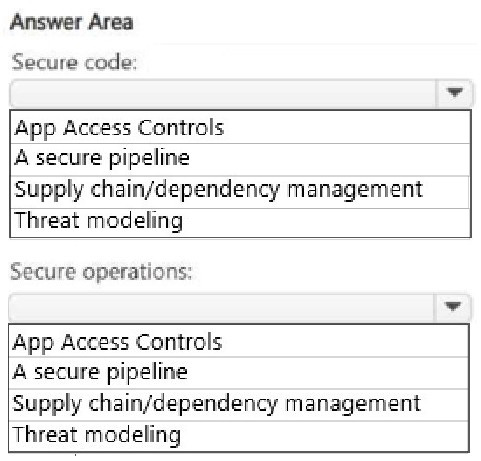
You have an Azure DevOps organization that is used to manage the development and deployment of internal apps to multiple Azure subscriptions.
You are developing a DevSecOps strategy.
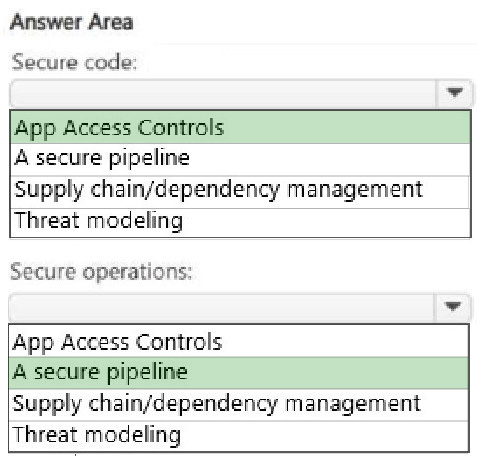
You need to apply DevSecOps controls for the secure code stage and the secure operations stage.
The solution must be based on Microsoft Cloud Adoption Framework for Azure principles.
What should you apply for each stage? To answer, select the appropriate options in the answer area.
NOTE: Each correct selection is worth one point.
Reveal answer detailsClose answer details
Question 20
Hotspot
HOTSPOT
You have an Azure subscription.
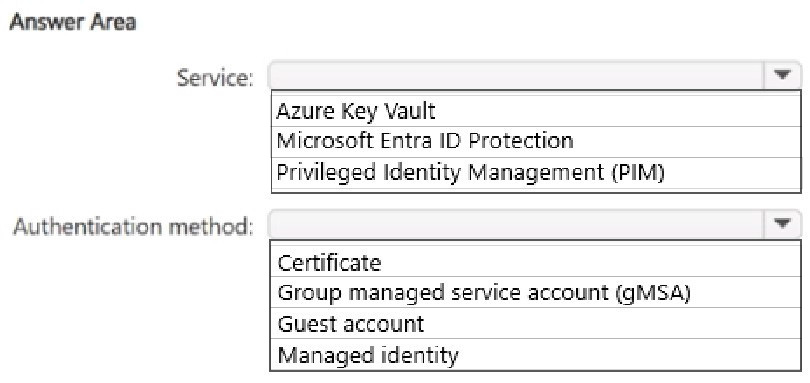
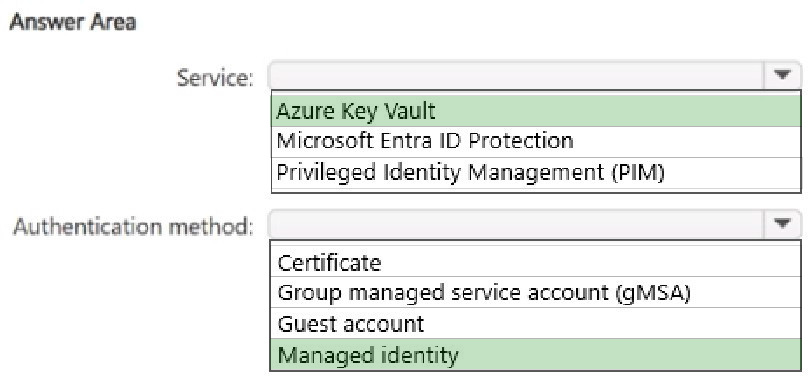
You plan to deploy an Azure App Service app named App1 that will access an external web service by using a username and password.
You need to recommend a password storage solution for App1 that meets the following requirements:
1. Ensures that the password is stored securely. 2. Ensures that App1 can authenticate to the service that will store the password.
Which service should you use to store the password, and which authentication method should App1 use to access the service? To answer, select the appropriate options in the answer area.
NOTE: Each correct selection is worth one point.
Reveal answer detailsClose answer details
Question 21
Drag & drop
DRAG DROP
You have a Microsoft 365 subscription.
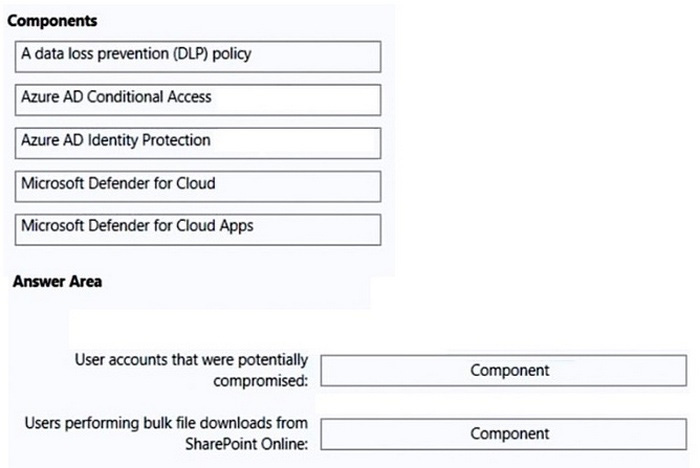
You need to recommend a security solution to monitor the following activities:
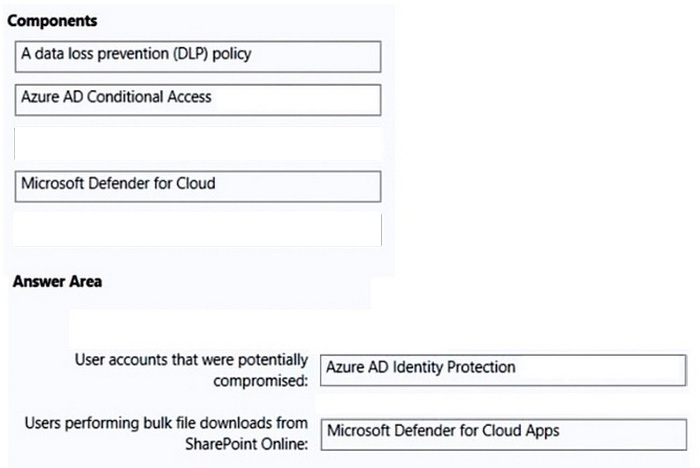
1. User accounts that were potentially compromised 2. Users performing bulk file downloads from Microsoft SharePoint Online
What should you include in the recommendation for each activity? To answer, drag the appropriate components to the correct activities. Each component may be used once, more than once, or not at all. You may need to drag the split bar between panes or scroll to view content.
NOTE: Each correct selection is worth one point.
Reveal answer detailsClose answer details
Explanation
Box 1: Azure Active Directory (Azure AD) Identity Protection Risk detections in Azure AD Identity Protection include any identified suspicious actions related to user accounts in the directory. Risk detections (both user and sign-in linked) contribute to the overall user risk score that is found in the Risky Users report.
Identity Protection provides organizations access to powerful resources to see and respond quickly to these suspicious actions.
Note: Premium sign-in risk detections include: * Token Issuer Anomaly - This risk detection indicates the SAML token issuer for the associated SAML token is potentially compromised. The claims included in the token are unusual or match known attacker patterns.
* Suspicious inbox manipulation rules - This detection is discovered by Microsoft Defender for Cloud Apps. This detection profiles your environment and triggers alerts when suspicious rules that delete or move messages or folders are set on a user's inbox. This detection may indicate that the user's account is compromised, that messages are being intentionally hidden, and that the mailbox is being used to distribute spam or malware in your organization.
* Etc.
Incorrect: Not: Microsoft 365 Defender for Cloud Part of your incident investigation can include user accounts. You can see the details of user accounts identified in the alerts of an incident in the Microsoft 365 Defender portal from Incidents & alerts > incident > Users.
Box 2: Microsoft 365 Defender for App Defender for Cloud apps detect mass download (data exfiltration) policy Detect when a certain user accesses or downloads a massive number of files in a short period of time.
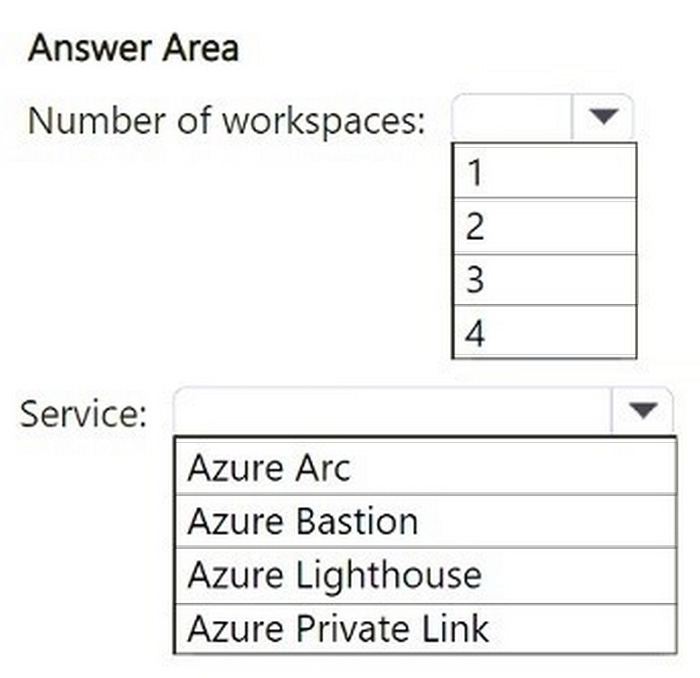
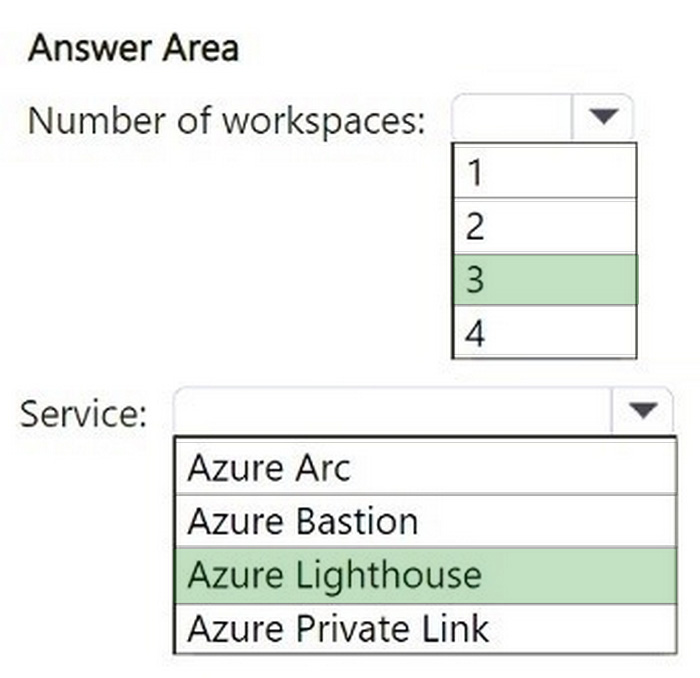
You have four Azure subscriptions: Sub1, Sub2, Sub3, and Sub4. Each subscription is linked to a unique Microsoft Entra tenant and a Microsoft 365 subscription. Sub1 contains a user named User1.
You plan to implement Microsoft Sentinel and need to ensure that User1 can monitor Microsoft Entra ID events and Microsoft 365 events for Sub2, Sub3, and Sub4 using Microsoft Sentinel. The solution must minimize administrative effort.
What is the minimum number of Microsoft Sentinel workspaces you should create, and which Azure service should you use?
To answer, select the appropriate options in the answer area.
Reveal answer detailsClose answer details
Explanation
Box 1: 3 Number of workspace
One for Sub2, one for Sub3, and one for Sub4.
Note: Extend Microsoft Sentinel across workspaces and tenants When you onboard Microsoft Sentinel, your first step is to select your Log Analytics workspace. While you can get the full benefit of the Microsoft Sentinel experience with a single workspace, in some cases, you might want to extend your workspace to query and analyze your data across workspaces and tenants.
Box 2: Azure Lighthouse Service
Manage workspaces across tenants using Azure Lighthouse
As mentioned above, in many scenarios, the different Log Analytics workspaces enabled for Microsoft Sentinels can be located in different Microsoft Entra tenants. You can use Azure Lighthouse to extend all cross-workspace activities across tenant boundaries, allowing users in your managing tenant to work on workspaces across all tenants. 66 Once Azure Lighthouse is onboarded, use the directory + subscription selector on the Azure portal to select all the subscriptions containing workspaces you want to manage, in order to ensure that they'll all be available in the different workspace selectors in the portal.
When using Azure Lighthouse, it's recommended to create a group for each Microsoft Sentinel role and delegate permissions from each tenant to those groups.
You have a Microsoft 365 subscription that contains 1,000 users. Each user is assigned a Microsoft 365 E5 license.
The subscription uses sensitivity labels to classify corporate documents. All the users have Windows 11 devices that are onboarded to Microsoft Defender for Endpoint and are configured to sync files to Microsoft OneDrive.
You need to prevent the users from uploading the documents from OneDrive to external websites.
What should you include in the solution?
A
Microsoft Purview Information Protection
B
Microsoft Purview data loss prevention (DLP)
C
web content filtering in Defender for Endpoint
D
an endpoint security policy
Reveal answer detailsClose answer details
Correct answerB
Question 24
Single choice
You have a Microsoft 365 tenant named contoso.com.
You need to ensure that users can authenticate only to contoso.com, while meeting the following requirements:
1. Prevent users from authenticating to other Microsoft 365 tenants. 2. Minimize administrative effort.
What should you use?
A
Microsoft Entra Private Access
B
Microsoft Defender for Endpoint
C
Microsoft Entra Internet Access
D
Microsoft Defender for Cloud Apps
Reveal answer detailsClose answer details
Correct answerA
Explanation
Microsoft Entra Private Access unlocks the ability to specify the fully qualified domain names (FQDNs) and IP addresses that you consider private or internal, so you can manage how your organization accesses them. With Private Access, you can modernize how your organization's users access private apps and resources. Remote workers don't need to use a VPN to access these resources if they have the Global Secure Access Client installed. The client quietly and seamlessly connects them to the resources they need.
Private Access provides two ways to configure the private resources that you want to tunnel through the service. You can configure Quick Access, which is the primary group of FQDNs and IP addresses that you want to secure. You can also configure a Global Secure Access app for per-app access, which allows you to specify a subset of private resources that you want to secure. The Global Secure Access app provides a granular approach to securing your private resources. The features of Microsoft Entra Private Access provide a quick and easy way to replace your VPN to allow secure access to your internal resources with an easy-one time configuration, using the secure capabilities of Conditional Access. Incorrect: Not C: Microsoft Entra Internet Access provides an identity-centric Secure Web Gateway (SWG) solution for Software as a Service (SaaS) applications and other Internet traffic. It protects users, devices, and data from the Internet's wide threat landscape with best-in-class security controls and visibility through Traffic Logs. Web content filtering The key introductory feature for Microsoft Entra Internet Access for all apps is Web content filtering. This feature provides granular access control for web categories and Fully Qualified Domain Names (FQDNs). By explicitly blocking known inappropriate, malicious, or unsafe sites, you protect your users and their devices from any Internet connection whether they're remote or within the corporate network. Web content filtering is implemented using filtering policies, which are grouped into security profiles, which can be linked to Conditional Access policies.
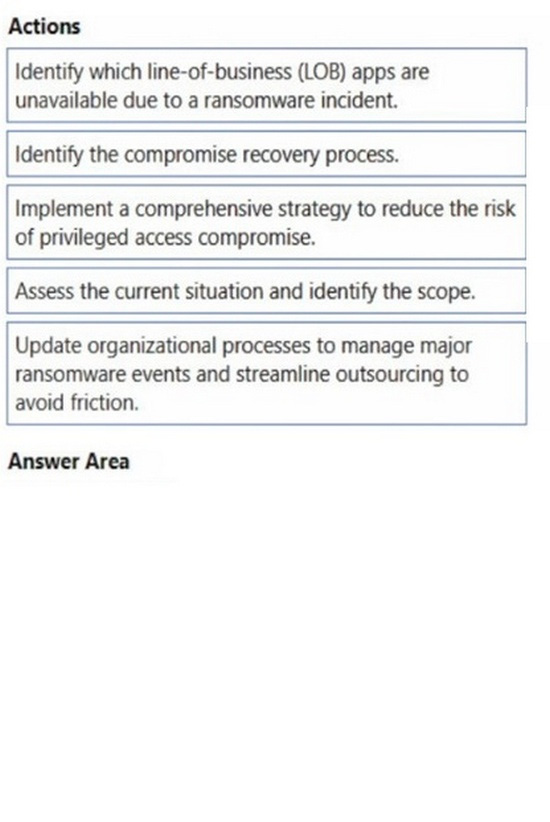
Your company wants to optimize ransomware incident investigations.
You need to recommend a plan to investigate ransomware incidents based on the Microsoft Detection and Response Team (DART) approach.
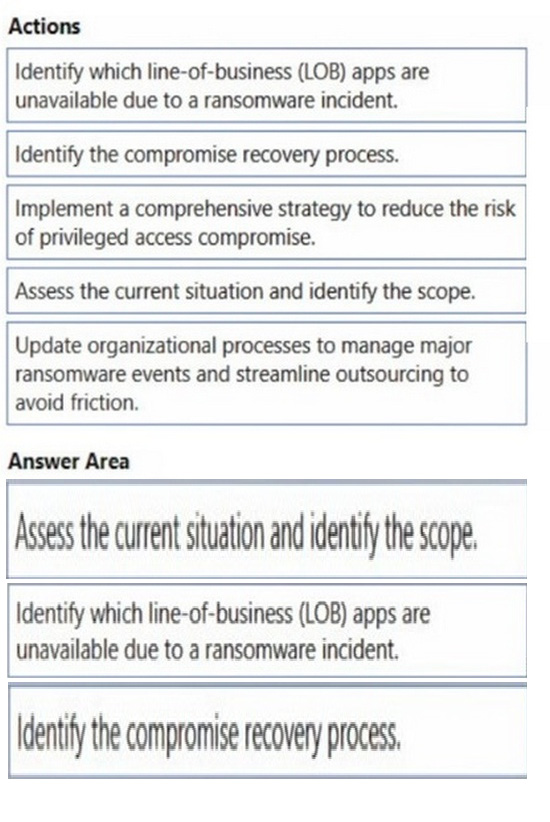
Which three actions should you recommend performing in sequence in the plan? To answer, move the appropriate actions from the list of actions to the answer area and arrange them in the correct order.
Reveal answer detailsClose answer details
Explanation
Step 1: Assess the current situation and identify the scope. The DART approach to conducting ransomware incident investigations You should make every effort to determine how the adversary gained access to your assets so that vulnerabilities can be remediated. Otherwise, it is highly likely that the same type of attack will take place again in the future. In some cases, the threat actor takes steps to cover their tracks and destroy evidence, so it is possible that the entire chain of events may not be evident.
The following are three key steps in DART ransomware investigations:
1. Assess the current situation Understand the scope
What initially made you aware of a ransomware attack? What time/date did you first learn of the incident? What logs are available and is there any indication that the actor is currently accessing systems?
Step 2: Identify which line-of-business (LOB) apps are unavailable due to a ransomware incident.
2. Identify the affected line-of-business (LOB) apps Get systems back online
Does the application require an identity? Are backups of the application, configuration, and data available? Are the content and integrity of backups regularly verified using a restore exercise?
Step 3: Identify the compromise recovery process.
3. Determine the compromise recovery (CR) process Remove attacker control from the environment
Your company plans to evaluate the security of its Azure environment based on the principles of the Microsoft Cloud Adoption Framework for Azure.
You need to recommend a cloud-based service to evaluate whether the Azure resources comply with the National Institute of Standards and Technology (NIST) Cybersecurity Framework (CSF).
What should you recommend?
A
Compliance Manager in Microsoft Purview
B
Microsoft Defender for Cloud
C
Microsoft Sentinel
D
Microsoft Defender for Cloud Apps
Reveal answer detailsClose answer details
Correct answerB
Question 27
Single choice
Note: This question is part of a series of questions that present the same scenario. Each question in the series contains a unique solution that might meet the stated goals. Some question sets might have more than one correct solution, while others might not have a correct solution.
After you answer a question in this section, you will NOT be able to return to it. As a result, these questions will not appear in the review screen.
You have an Azure subscription that has Microsoft Defender for Cloud enabled.
You are evaluating the Azure Security Benchmark V3 report.
In the Secure management ports controls, you discover that you have 0 out of a potential 8 points.
You need to recommend configurations to increase the score of the Secure management ports controls.
Solution: You recommend enabling just-in-time (JIT) VM access on all virtual machines.
Does this meet the goal?
A
Yes
B
No
Reveal answer detailsClose answer details
Correct answerA
Explanation
Secure management ports - Brute force attacks often target management ports. Use these recommendations to reduce your exposure with tools like just-in-time VM access and network security groups.
Recommendations: - Internet-facing virtual machines should be protected with network security groups - Management ports of virtual machines should be protected with just-in-time network access control - Management ports should be closed on your virtual machines
You are designing a new Azure environment based on the security best practices of the Microsoft Cloud Adoption Framework for Azure. The environment will contain one subscription for shared infrastructure components and three separate subscriptions for applications.
You need to recommend a deployment solution that includes network security groups (NSGs), Azure Firewall, Azure Key Vault, and Azure Bastion. The solution must minimize deployment effort and follow security best practices of the Microsoft Cloud Adoption Framework for Azure.
What should you include in the recommendation?
A
the Azure landing zone accelerator
B
the Azure Well-Architected Framework
C
Azure Security Benchmark v3
D
Azure Advisor
Reveal answer detailsClose answer details
Correct answerA
Explanation
About Azure Bastion host and jumpboxes The most simple solution is to host a jumpbox on the virtual network of the data management landing zone or data landing zone to connect to the data services through private endpoints.
Azure Bastion provides a few other core security benefits, including: * The service integrates with native security appliances for an Azure virtual network, such as Azure Firewall.
Note: * Platform landing zones: Subscriptions deployed to provide centralized services, often operated by a central team, or a number of central teams split by function (e.g. networking, identity), which will be used by various workloads and applications. Platform landing zones represent key services that often benefit from being consolidated for efficiency and ease of operations. Examples include networking, identity, and management services.
* The Azure App Service landing zone accelerator is an open-source collection of architectural guidance and reference implementation to accelerate deployment of Azure App Service at scale. It can provide a specific architectural approach and reference implementation via infrastructure as code templates to prepare your landing zones. The landing zones adhere to the architecture and best practices of the Cloud Adoption Framework.
Incorrect:
Not B: The Azure Well-Architected Framework is a set of guiding tenets that can be used to improve the quality of a workload. The framework consists of five pillars of architectural excellence:
Not C: The Azure Security Benchmark (ASB) provides prescriptive best practices and recommendations to help improve the security of workloads, data, and services on Azure. This benchmark is part of a set of holistic security guidance that also includes:
* Cloud Adoption Framework: Guidance on security, including strategy, roles and responsibilities, Azure Top 10 Security Best Practices, and reference implementation.
* Azure Well-Architected Framework: Guidance on securing your workloads on Azure.
* Microsoft Security Best Practices: Recommendations with examples on Azure. Microsoft Cybersecurity Reference Architectures (MCRA): Visual diagrams and guidance for security components and relationships
* The Azure Security Benchmark focuses on cloud-centric control areas. These controls are consistent with well-known security benchmarks, such as those described by the Center for Internet Security (CIS)
Controls, National Institute of Standards and Technology (NIST), and Payment Card Industry Data Security Standard (PCI-DSS).
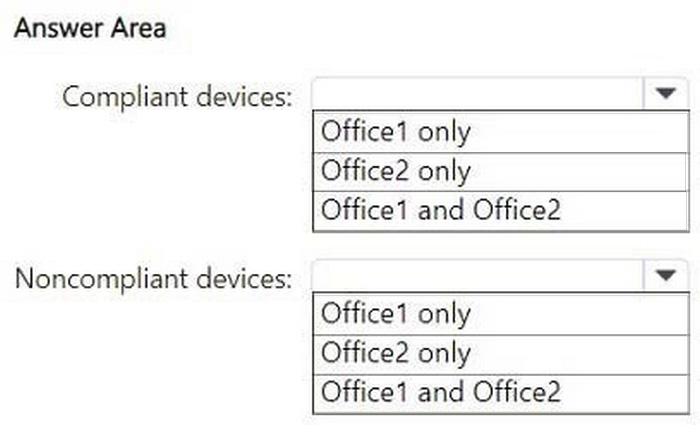
Your company has two offices: Office1 and Office2, containing 1,000 on-premises Windows 11 devices that are Microsoft Entra joined.
You have a Microsoft 365 subscription and use Microsoft Intune. You plan to deploy Microsoft Entra Internet Access from the offices to Microsoft 365.
You have enabled the Microsoft 365 profile and configured the following:
A traffic policy for all Microsoft 365 traffic
A linked Conditional Access policy with the following configurations:
1. Applies to all users 2. Performs compliant network checks 3. Allows Microsoft 365 traffic from compliant devices 4. An assignment to all devices 5. An assignment to the remote network associated with Office1
You deploy the Global Secure Access client to all devices in Office2 and establish connections.
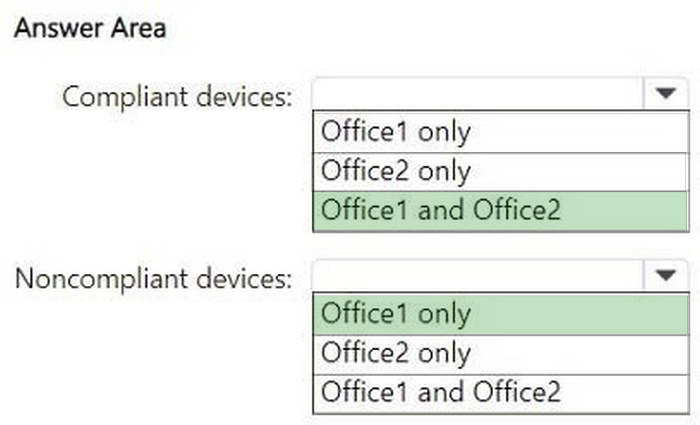
Which users can access Microsoft 365 services from compliant devices, and which users are blocked from accessing Microsoft 365 services when using noncompliant devices?
To answer, select the appropriate options in the answer area.Each correct selection is worth one point.
Reveal answer detailsClose answer details
Explanation
Box 1: Office1 and Office2 Compliant devices
* Office1 Global Secure Access Enable compliant network check with Conditional Access Organizations who use Conditional Access along with the Global Secure Access, can prevent malicious access to Microsoft apps, third-party SaaS apps, and private line-of-business (LoB) apps using multiple conditions to provide defense-in-depth. These conditions might include device compliance, location, and more to provide protection against user identity or token theft. Global Secure Access introduces the concept of a compliant network within Microsoft Entra ID Conditional Access. This compliant network check ensures users connect from a verified network connectivity model for their specific tenant and are compliant with security policies enforced by administrators.
The Global Secure Access Client installed on devices or users behind configured remote networks allows administrators to secure resources behind a compliant network with advanced Conditional Access controls. This compliant network feature makes it easier for administrators to manage access policies, without having to maintain a list of egress IP addresses. This removes the requirement to hairpin traffic through organization's VPN.
* Office2 The Global Secure Access client allows organizations control over network traffic at the end-user computing device, giving organizations the ability to route specific traffic profiles through Microsoft Entra Internet Access and Microsoft Entra Private Access. Routing traffic in this method allows for more controls like continuous access evaluation (CAE), device compliance, or multifactor authentication to be required for resource access.
Your on-premises network contains an Active Directory Domain Services (AD DS) domain and a hybrid deployment between a Microsoft Exchange Server 2019 organization and an Exchange Online tenant. The
AD DS domain contains a group named Group1. Group1 is a member of the Organization Management role group for the Exchange deployment.
You have a Microsoft 365 E5 subscription that uses Microsoft Defender.
You have an Azure subscription that uses Microsoft Sentinel.
You need to recommend a solution to ensure that Group1 is marked as a sensitive group and that any changes made to Group1 raises an alert in Microsoft Sentinel. The solution must minimize administrative effort.
What should you include in the recommendation?
A
Microsoft Entra ID Protection
B
Microsoft Defender for Identity
C
Microsoft Defender for Office 365
D
Microsoft Entra Privileged Identity Management (PIM)
Reveal answer detailsClose answer details
Correct answerB
Question 31
Hotspot
HOTSPOT
You have a Microsoft Entra tenant. The tenant contains a security group named Group1. Group1 contains the members of your company's IT support team.
You have an Azure subscription. The subscription contains 800 Windows devices that are Microsoft Entra joined and 200 Windows devices that are Microsoft Entra registered.
You have 200 standalone macOS devices.
You deploy 10 Windows devices that are Microsoft Entra joined and have the Microsoft Entra ExtensionAttribute1 value set to SecureWorkstation.
You need to recommend a Conditional Access solution that meets the following requirements:
Only allows access to Microsoft Entra resources from devices that run Windows 10 or Windows 11
Restricts Windows Azure Service Management API access to the following users:
1. The members of Group1. 2. Users that authenticate by using multifactor authentication (MFA) 3. Users that connect from a device that has the SecureWorkstation ExtensionAttribute1.
The solution must minimize the number of required policies and maximize security.
What should include in the recommendation? To answer, select the appropriate options in the answer area.
NOTE: Each correct selection is worth one point.
Reveal answer detailsClose answer details
Question 32
Multiple choice
Your company has a main office and a branch office.
1. The main office houses 20 on-premises servers running Windows Server, which host applications published via Microsoft Entra application proxy. 2. The main office also has 500 on-premises computers running Windows 11. In contrast, the branch office has 100 on-premises Windows 11 computers. 3. All computers in the main office are enrolled in Microsoft Intune, while the branch office computers are not. 4. Your company holds a Microsoft 365 E5 subscription and has a Microsoft Entra tenant. 5. A third-party Software as a Service (SaaS) application is registered within the Microsoft Entra tenant. 6. You plan to implement Global Secure Access and are considering the use of compliant network checks and Conditional Access policies.
You need to determine which two scenarios are supported by compliant network check.
Which two scenarios are supported by compliant network check?
A
connections to the third-party SaaS app
B
connections from the branch office computers
C
Continuous Access Evaluation for Microsoft Exchange Online
D
connections to the on-premises apps
Reveal answer detailsClose answer details
Correct answersA, C
Explanation
Global Secure Access, Enable compliant network check with Conditional Access A: Organizations who use Conditional Access along with the Global Secure Access, can prevent malicious access to Microsoft apps, third-party SaaS apps, and private line-of-business (LoB) apps using multiple conditions to provide defense-in-depth. These conditions might include device compliance, location, and more to provide protection against user identity or token theft. Global Secure Access introduces the concept of a compliant network within Microsoft Entra ID Conditional Access. This compliant network check ensures users connect from a verified network connectivity model for their specific tenant and are compliant with security policies enforced by administrators. C: Compliant network check data plane enforcement (preview) with Continuous Access Evaluation is supported for SharePoint Online and Exchange Online. Compliant network check is currently not supported for Private Access applications.
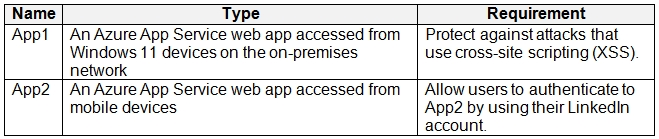
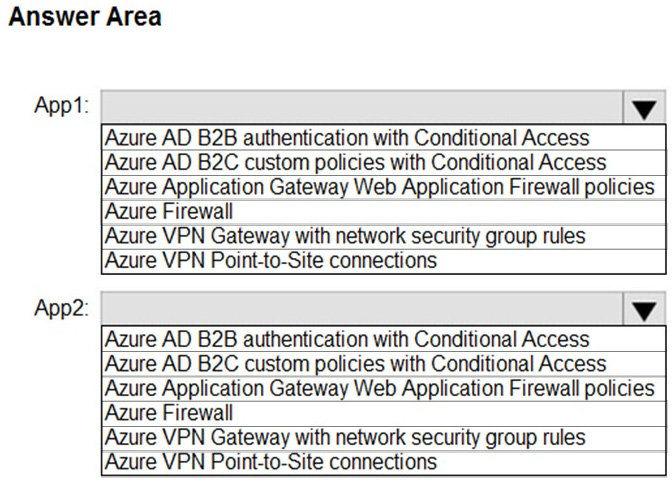
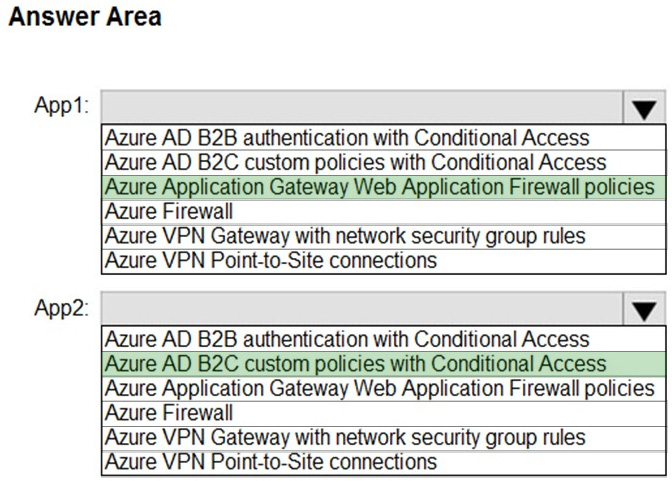
You plan to deploy the Azure applications shown in the following table.
What should you use to meet the requirement of each app? To answer, select the appropriate options in the answer area.
NOTE: Each correct selection is worth one point.
Reveal answer detailsClose answer details
Explanation
Box 1: Azure Application Gateway Web Application Firewall policies Azure Application Gateway is a web traffic load balancer that enables you to manage traffic to your web applications.
Azure Web Application Firewall is a cloud-native service that protects web apps from common web-hacking techniques such as SQL injection and security vulnerabilities such as cross-site scripting.
Box 2: Azure Active Directory B2C with Conditional Access You can set up sign-up and sign-in with a LinkedIn account using Azure Active Directory B2C.
You can enhance the security of Azure Active Directory B2C (Azure AD B2C) with Azure AD Identity Protection and Conditional Access.
Incorrect:
* Azure VPN Gateway with network security group rules NSGs cannot protect against XSS.
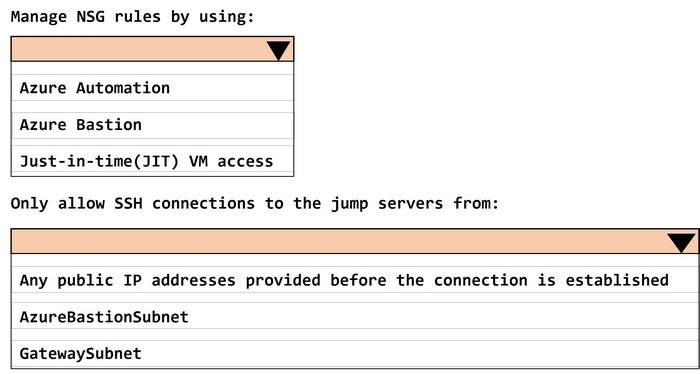
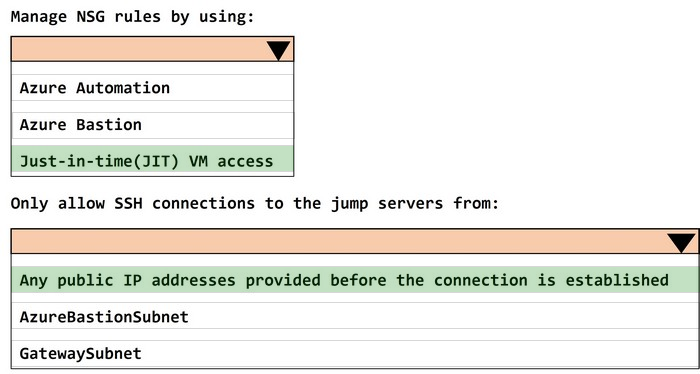
You plan to deploy a dynamically scaling, Linux-based Azure Virtual Machine Scale Set that will host jump servers. The jump servers will be used by support staff who connect f personal and kiosk devices via the internet. The subnet of the jump servers will be associated to a network security group (NSG)
You need to design an access solution for the Azure Virtual Machine Scale Set. The solution must meet the following requirements:
1. Ensure that each time the support staff connects to a jump server; they must request access to the server. 2. Ensure that only authorized support staff can initiate SSH connections to the jump servers. 3. Maximize protection against brute-force attacks from internal networks and the internet. 4. Ensure that users can only connect to the jump servers from the internet. 5. Minimize administrative effort
What should you include in the solution? To answer, select the appropriate options in the answer area.
NOTE: Each correct selection is worth one point.
Reveal answer detailsClose answer details
Question 35
Single choice
You have an Azure subscription that has Microsoft Defender for Cloud enabled.
Suspicious authentication activity alerts have been appearing in the Workload protections dashboard.
You need to recommend a solution to evaluate and remediate the alerts by using a workflow automation feature of Microsoft Defender for Cloud.
What should you include in the recommendation?
A
Azure Monitor webhooks
B
Azure Event Hubs
C
Azure Functions apps
D
Azure Logic Apps
Reveal answer detailsClose answer details
Correct answerD
Explanation
The workflow automation feature of Microsoft Defender for Cloud feature can trigger Logic Apps on security alerts, recommendations, and changes to regulatory compliance.
Note: Azure Logic Apps is a cloud-based platform for creating and running automated workflows that integrate your apps, data, services, and systems. With this platform, you can quickly develop highly scalable integration solutions for your enterprise and business-to-business (B2B) scenarios.
Incorrect: Not C: Using Azure Functions apps would require more effort.
You have a Microsoft 365 subscription and an Azure subscription. Microsoft 365 Defender and Microsoft Defender for Cloud are enabled.
The Azure subscription contains 50 virtual machines. Each virtual machine runs different applications on Windows Server 2019.
You need to recommend a solution to ensure that only authorized applications can run on the virtual machines. If an unauthorized application attempts to run or be installed, the application must be blocked automatically until an administrator authorizes the application.
Which security control should you recommend?
A
adaptive application controls in Defender for Cloud
B
app protection policies in Microsoft Endpoint Manager
C
app discovery anomaly detection policies in Microsoft Defender for Cloud Apps
D
Azure Security Benchmark compliance controls in Defender for Cloud
Reveal answer detailsClose answer details
Correct answerA
Explanation
Adaptive application controls are an intelligent and automated solution for defining allowlists of known-safe applications for your machines.
Often, organizations have collections of machines that routinely run the same processes. Microsoft Defender for Cloud uses machine learning to analyze the applications running on your machines and create a list of the known-safe software. Allowlists are based on your specific Azure workloads, and you can further customize the recommendations using the instructions below.
When you've enabled and configured adaptive application controls, you'll get security alerts if any application runs other than the ones you've defined as safe.
Incorrect: Not B: App protection policies (APP) are rules that ensure an organization's data remains safe or contained in a managed app. A policy can be a rule that is enforced when the user attempts to access or move "corporate" data, or a set of actions that are prohibited or monitored when the user is inside the app. A managed app is an app that has app protection policies applied to it, and can be managed by Intune.
Not C: Cloud Discovery anomaly detection policy reference. A Cloud Discovery anomaly detection policy enables you to set up and configure continuous monitoring of unusual increases in cloud application usage. Increases in downloaded data, uploaded data, transactions, and users are considered for each cloud application.
Not D: The Azure Security Benchmark (ASB) provides prescriptive best practices and recommendations to help improve the security of workloads, data, and services on Azure. This benchmark is part of a set of holistic security guidance.
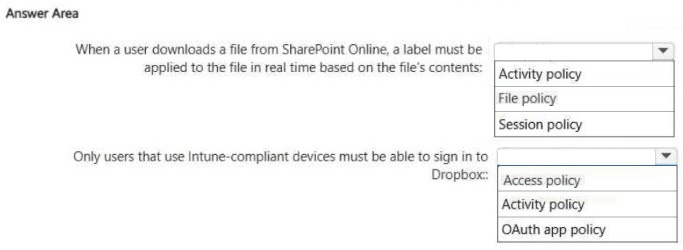
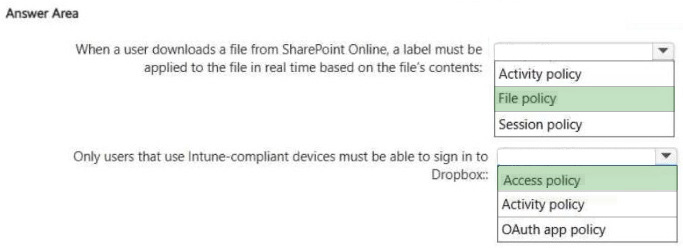
You have a Microsoft 365 E5 subscription. The subscription contains 1,000 devices that run Windows 11 Pro and are enrolled in Microsoft Intune. You need to recommend a Microsoft Defender for Cloud Apps solution that meets the following requirements:
When a user downloads a file from Microsoft SharePoint Online, a label must be applied to the file in real time based on the file's contents.
Only users that use Intune-compliant devices must be able to sign in to Dropbox.
Which type of policy should you recommend for each requirement? To answer, select the appropriate options in the answer area.
NOTE: Each correct selection is worth one point.
Reveal answer detailsClose answer details
Question 38
Hotspot
HOTSPOT
You have a Microsoft 365 E5 subscription.
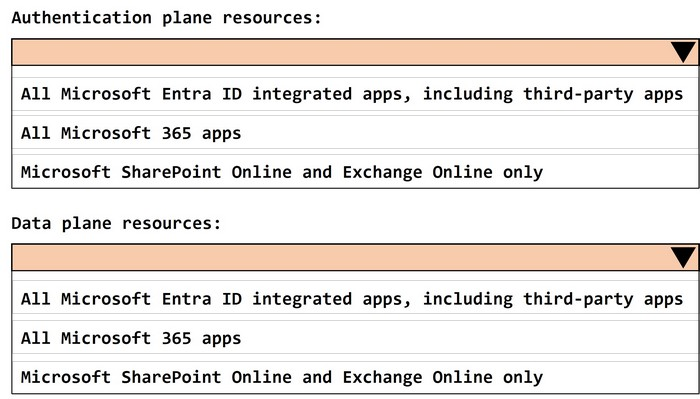
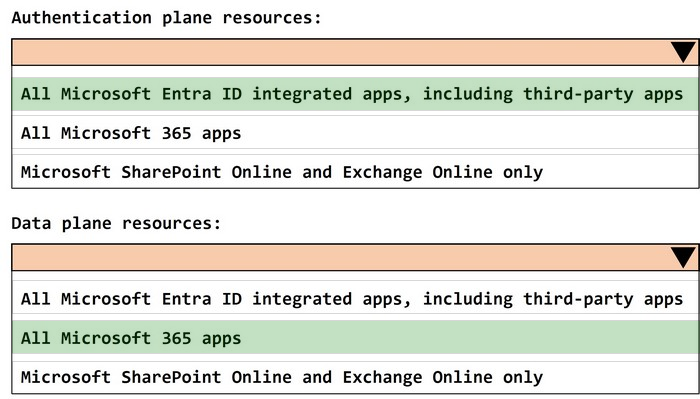
You plan to deploy Global Secure Access universal tenant restrictions v2.
Which authentication plane resources and which data plane resources will be protected? To answer, select the appropriate options in the answer area.
NOTE: Each correct selection is worth one point.
Reveal answer detailsClose answer details
Question 39
Hotspot
HOTSPOT
You have an Azure subscription and an on-premises datacenter. The datacenter contains 100 servers that run Windows Server. All the servers are backed up to a Recovery Services vault by using Azure Backup and the Microsoft Azure Recovery Services (MARS) agent.
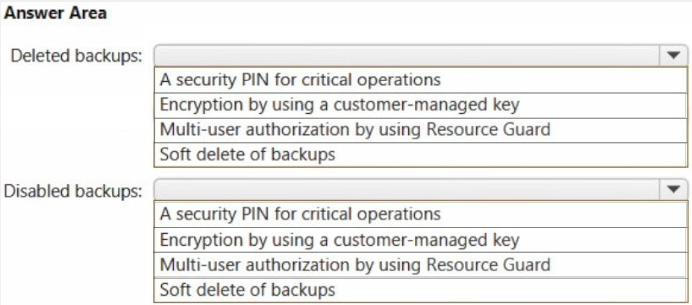
You need to design a recovery solution for ransomware attacks that encrypt the on-premises servers. The solution must follow Microsoft Security Best Practices and protect against the following risks:
1. A compromised administrator account used to delete the backups from Azure Backup before encrypting the servers 2. A compromised administrator account used to disable the backups on the MARS agent before encrypting the servers
What should you use for each risk? To answer, select the appropriate options in the answer area.
NOTE: Each correct selection is worth one point.
Reveal answer detailsClose answer details
Explanation
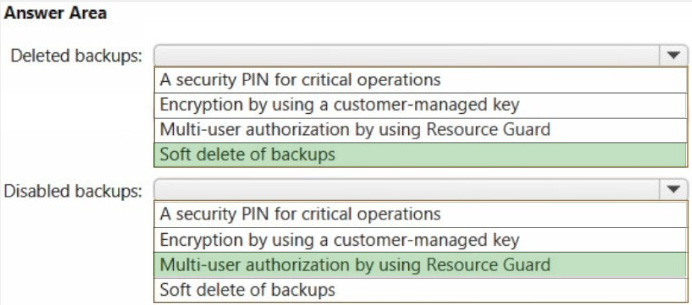
Box 1: Soft delete of backups How to block intentional or unintentional deletion of backup data? Enable Soft delete is enabled to protect backups from accidental or malicious deletes.
Soft delete is a useful feature that helps you deal with data loss. Soft delete retains backup data for 14 days, allowing the recovery of that backup item before it's permanently lost.
Box 2: Multi-user authorization by using Resource Guard Ensure Multi-user authorization (MUA) is enabled for an additional layer of protection.
MUA for Azure Backup uses a new resource called Resource Guard to ensure critical operations, such as disabling soft delete, stopping and deleting backups, or reducing retention of backup policies, are performed only with applicable authorization.
Litware, Inc. is a financial services company that has main offices in New York and San Francisco. Litware has 30 branch offices and remote employees across the United States. The remote employees connect to the main offices by using a VPN.
Litware has grown significantly during the last two years due to mergers and acquisitions. The acquisitions include several companies based in France.
Existing Environment
Litware has an Azure AD tenant that syncs with an Active Directory Domain Services (AD DS) forest named litware.com and is linked to 20 Azure subscriptions. Azure AD Connect is used to implement pass-through authentication. Password hash synchronization is disabled, and password writeback is enabled. All Litware users have Microsoft 365 E5 licenses.
The environment also includes several AD DS forests, Azure AD tenants, and hundreds of Azure subscriptions that belong to the subsidiaries of Litware.
Requirements. Planned Changes
Litware plans to implement the following changes:
1. Create a management group hierarchy for each Azure AD tenant. 2. Design a landing zone strategy to refactor the existing Azure environment of Litware and deploy all future Azure workloads. 3. Implement Azure AD Application Proxy to provide secure access to internal applications that are currently accessed by using the VPN.
Requirements. Business Requirements
Litware identifies the following business requirements:
1. Minimize any additional on-premises infrastructure.
2. Minimize the operational costs associated with administrative overhead.
Requirements. Hybrid Requirements
Litware identifies the following hybrid cloud requirements:
Enable the management of on-premises resources from Azure, including the following: - Use Azure Policy for enforcement and compliance evaluation. - Provide change tracking and asset inventory. - Implement patch management. Provide centralized, cross-tenant subscription management without the overhead of maintaining guest accounts.
Requirements. Microsoft Sentinel Requirements
Litware plans to leverage the security information and event management (SIEM) and security orchestration automated response (SOAR) capabilities of Microsoft Sentinel. The company wants to centralize Security Operations Center (SOC) by using Microsoft Sentinel.
Requirements. Identity Requirements
Litware identifies the following identity requirements:
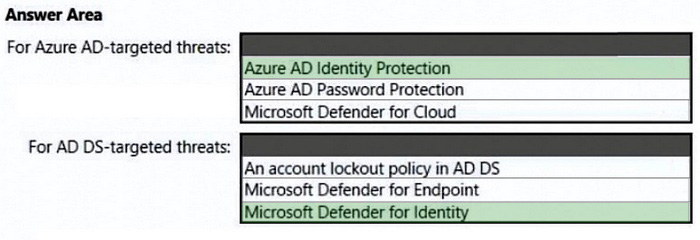
1. Detect brute force attacks that directly target AD DS user accounts. 2. Implement leaked credential detection in the Azure AD tenant of Litware. 3. Prevent AD DS user accounts from being locked out by brute force attacks that target Azure AD user accounts. 4. Implement delegated management of users and groups in the Azure AD tenant of Litware, including support for: - The management of group properties, membership, and licensing - The management of user properties, passwords, and licensing - The delegation of user management based on business units
Requirements. Regulatory Compliance Requirements
Litware identifies the following regulatory compliance requirements:
1. Ensure data residency compliance when collecting logs, telemetry, and data owned by each United States-and France-based subsidiary. 2. Leverage built-in Azure Policy definitions to evaluate regulatory compliance across the entire managed environment. 3. Use the principle of least privilege.
Requirements. Azure Landing Zone Requirements
Litware identifies the following landing zone requirements:
1. Route all internet-bound traffic from landing zones through Azure Firewall in a dedicated Azure subscription. 2. Provide a secure score scoped to the landing zone. 3. Ensure that the Azure virtual machines in each landing zone communicate with Azure App Service web apps in the same zone over the Microsoft backbone network, rather than over public endpoints. 4. Minimize the possibility of data exfiltration. 5. Maximize network bandwidth.
The landing zone architecture will include the dedicated subscription, which will serve as the hub for internet and hybrid connectivity. Each landing zone will have the following characteristics:
1. Be created in a dedicated subscription. 2. Use a DNS namespace of litware.com.
Requirements. Application Security Requirements
Litware identifies the following application security requirements:
1. Identify internal applications that will support single sign-on (SSO) by using Azure AD Application Proxy. 2. Monitor and control access to Microsoft SharePoint Online and Exchange Online data in real time.
Question 40
Testlet 2Hotspot
HOTSPOT
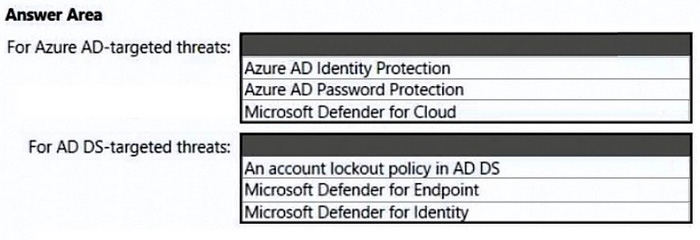
You need to recommend a strategy for securing the litware.com forest. The solution must meet the identity requirements.
What should you include in the recommendation?
To answer, select the appropriate options in the answer area. NOTE; Each correct selection is worth one point.
Reveal answer detailsClose answer details
Explanation
1. Azure AD Identity Protection Brute Force Detection: https://docs.microsoft.com/en-us/azure/active-directory/identityprotection/overview-identity-protection
2. Defender for Identity MDI can detect brute force attacks: ref: https://docs.microsoft.com/en-us/defender-foridentity/
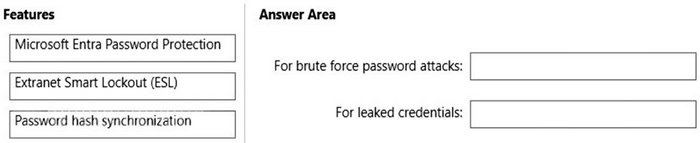
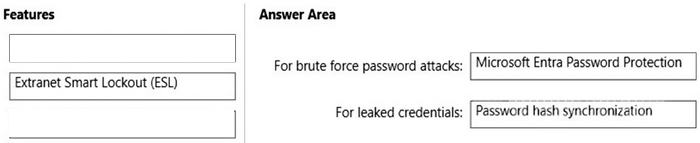
You have a hybrid Azure AD tenant that has pass-through authentication enabled.
You are designing an identity security strategy.
You need to minimize the impact of brute force password attacks and leaked credentials of hybrid identities.
What should you include in the design?
To answer, drag the appropriate features to the correct requirements. Each feature may be used once, more than once, or not at all. You may need to drag the split bar between panes or scroll to view content.
NOTE: Each correct selection is worth one point.
Reveal answer detailsClose answer details
Question 42
Hotspot
HOTSPOT
You are designing the security architecture for a cloud-only environment.
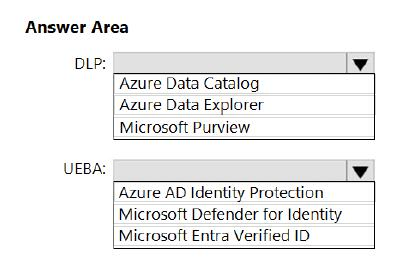
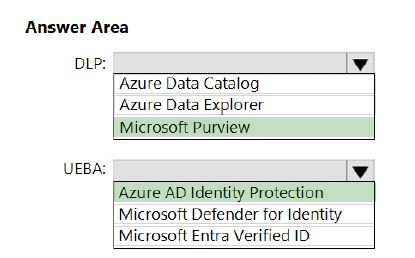
You are reviewing the integration point between Microsoft 365 Defender and other Microsoft cloud services based on Microsoft Cybersecurity Reference Architectures (MCRA).
You need to recommend which Microsoft cloud services integrate directly with Microsoft 365 Defender and meet the following requirements:
1. Enforce data loss prevention (DLP) policies that can be managed directly from the Microsoft 365 Defender portal. 2. Detect and respond to security threats based on User and Entity Behavior Analytics (UEBA) with unified alerting.
What should you include in the recommendation for each requirement? To answer, select the appropriate options in the answer area.
NOTE: Each correct selection is worth one point.
Reveal answer detailsClose answer details
Question 43
Hotspot
HOTSPOT
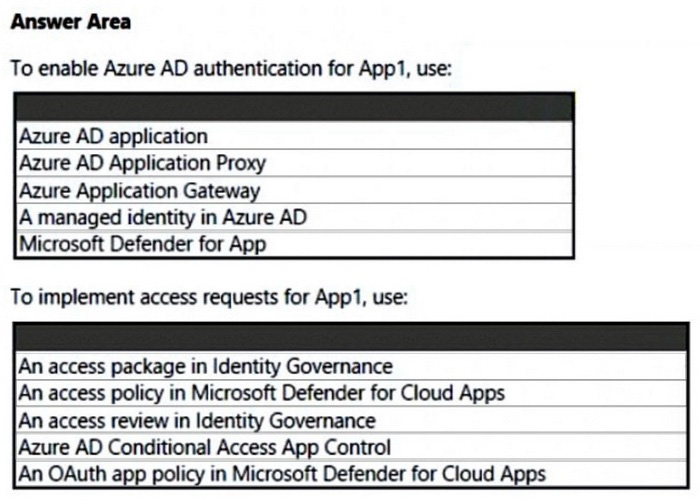
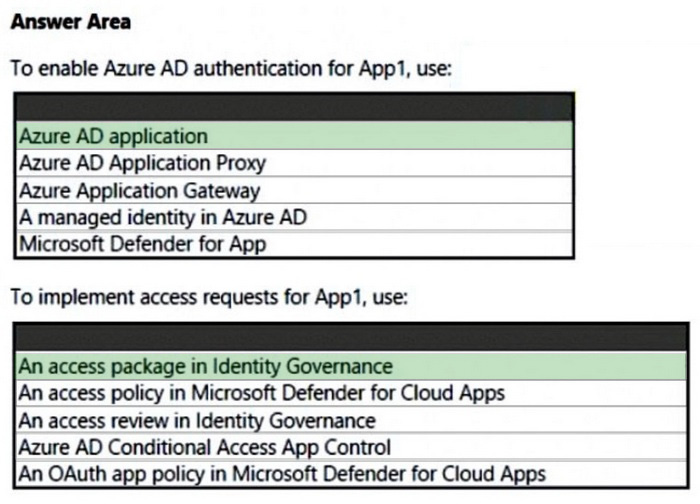
You are creating the security recommendations for an Azure App Service web app named App1.
App1 has the following specifications:
1. Users will request access to App1 through the My Apps portal. A human resources manager will approve the requests. 2. Users will authenticate by using Azure Active Directory (Azure AD) user accounts.
You need to recommend an access security architecture for App1.
What should you include in the recommendation? To answer, select the appropriate options in the answer area. NOTE: Each correct selection is worth one point.
Reveal answer detailsClose answer details
Question 44
Single choice
You are evaluating an Azure environment for compliance.
You need to design an Azure Policy implementation that can be used to evaluate compliance without changing any resources.
Which effect should you use in Azure Policy?
A
Deny
B
Modify
C
Append
D
Disabled
Reveal answer detailsClose answer details
Correct answerD
Explanation
This effect is useful for testing situations or for when the policy definition has parameterized the effect. This flexibility makes it possible to disable a single assignment instead of disabling all of that policy's assignments.
An alternative to the Disabled effect is enforcementMode, which is set on the policy assignment. When enforcementMode is Disabled, resources are still evaluated.
Incorrect: Not A: Deny is used to prevent a resource request that doesn't match defined standards through a policy definition and fails the request. Not B: Modify evaluates before the request gets processed by a Resource Provider during the creation or updating of a resource. The Modify operations are applied to the request content when the if condition of the policy rule is met. Each Modify operation can specify a condition that determines when it's applied. Operations with conditions that are evaluated to false are skipped. Not C: Append is used to add additional fields to the requested resource during creation or update.
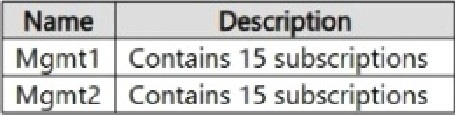
You have a Microsoft Entra tenant named contoso.com. You have 30 Azure subscriptions that are linked to contoso.com.
The tenant contains the management groups shown in the following table.
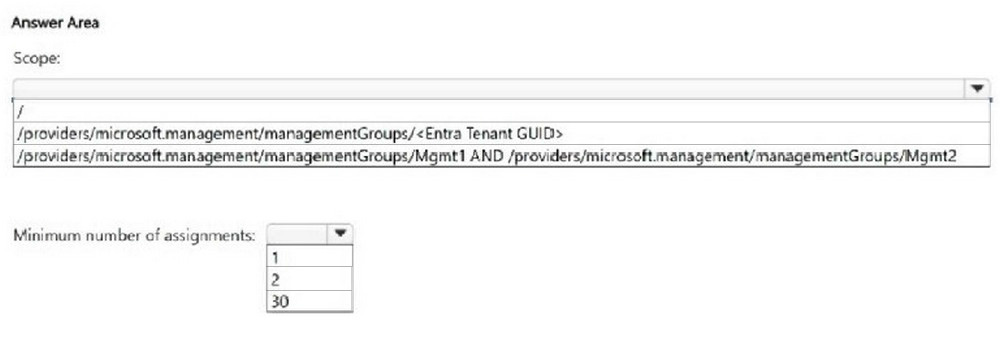
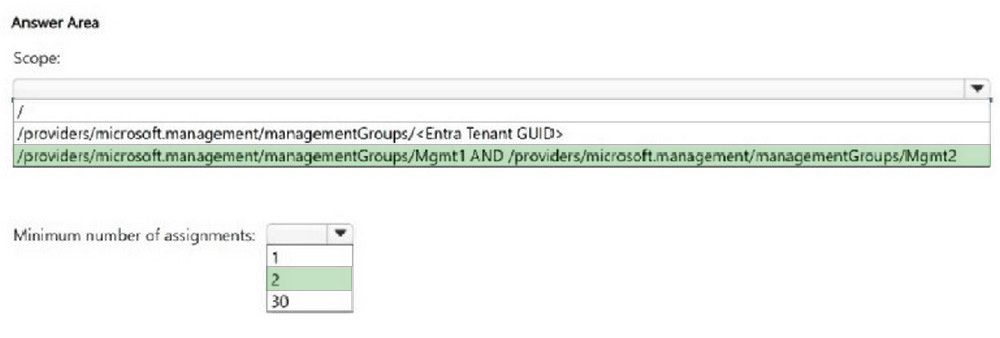
You need to design a governance solution to manage access to all the Azure Storage accounts across the subscriptions. The solution must meet the following requirements:
1. Use custom role-based access control (RBAC) to provide granular access to control plane and data plane operations. 2. Minimize administrative effort.
At which scope should you assign the roles, and what is the minimum number of assignments per role? To answer, select the appropriate options in the answer area.
NOTE: Each correct selection is worth one point.
Reveal answer detailsClose answer details
Question 46
Multiple choice
You are designing a ransomware mitigation strategy.
You perform a ransomware risk assessment and identify business-critical assets.
You need to recommend a solution to mitigate ransomware threats. The solution must follow Microsoft security best practices.
Which two actions should you include in the recommendation? Each correct answer presents a complete solution.
NOTE: Each correct answer is worth one point.
A
Enable firewall logging for auditing, without restricting inbound or outbound traffic.
B
Use extended patching cycles to reduce the risk of update-related service disruptions.
C
Implement immutable, offline backups that have restricted access and test restore procedures regularly.
D
Deploy Privileged Identity Management (PIM) that uses just-in-time (JIT) access and approval workflows.
Reveal answer detailsClose answer details
Correct answersC, D
Question 47
Single choice
You have a Microsoft 365 subscription that uses Microsoft Defender XDR and Microsoft Purview.
On a Microsoft SharePoint Online site, you have a file named File1 that has a sensitivity label applied.
You need to recommend a solution that will reevaluate Conditional Access policies when a user downloads Filel from the SharePoint site.
What should you include in the recommendation?
A
Microsoft Defender for Cloud Apps
B
Microsoft Defender for Cloud
C
Microsoft Defender for Office 365
D
Microsoft Entra application proxy
Reveal answer detailsClose answer details
Correct answerA
Question 48
Hotspot
HOTSPOT
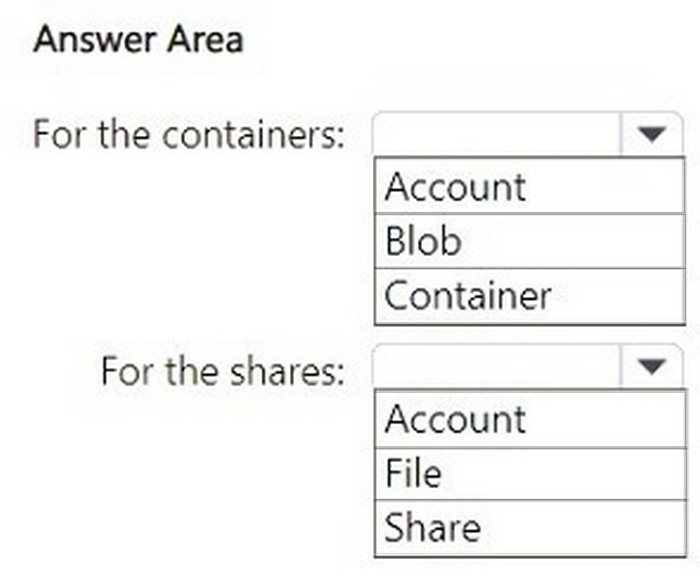
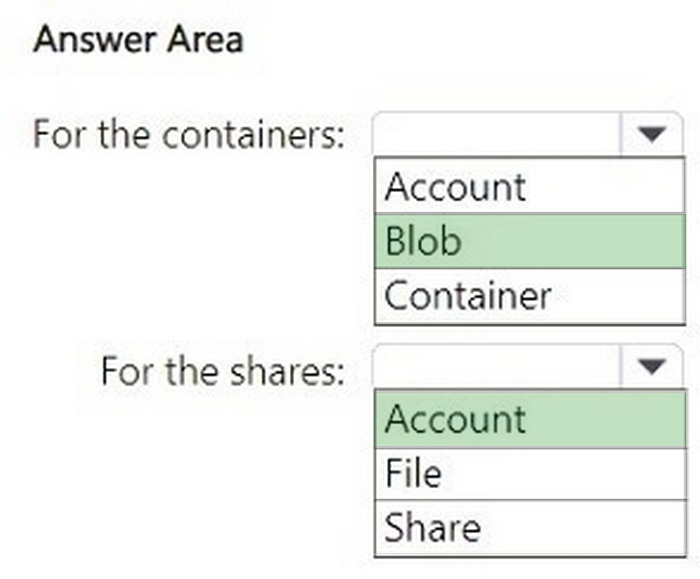
You have an Azure subscription that contains multiple storage accounts, which include Azure Files shares and Azure Blob Storage containers. The accounts have encryption scopes and infrastructure encryption enabled.
You need to implement customer-managed key-based encryption for the shares and containers. The solution must ensure that the encryption keys are applied at the most granular level.
At which level should you apply the encryption keys?
To answer, select the appropriate options in the answer area.
Each correct selection is worth one point.
Reveal answer detailsClose answer details
Explanation
Box 1: Blob For containers
Azure Storage Blobs, Create and manage encryption scopes. Encryption scopes enable you to manage encryption with a key that is scoped to a container or an individual blob. You can use encryption scopes to create secure boundaries between data that resides in the same storage account but belongs to different customers.
You have on-premises servers and virtual machines that run Windows Server, Red Hat Enterprise Linux (RHEL) 7, or RHEL 8.
You have an Azure subscription that contains virtual machines running Windows Server Datacenter: Azure Edition.
You need to recommend a solution to manage operating system updates for the on-premises servers and the virtual machines. The solution must meet the following requirements:
1. Enable hotpatching for the Azure virtual machines. 2. Enable on-demand inventory and deployment of updates. 3. Enable the deployment of Extended Security Update (ESU) patches to the on-premises servers.
What should you include in the recommendation?
To answer, select the options in the answer area.Each correct answer is worth one point.
Reveal answer detailsClose answer details
Explanation
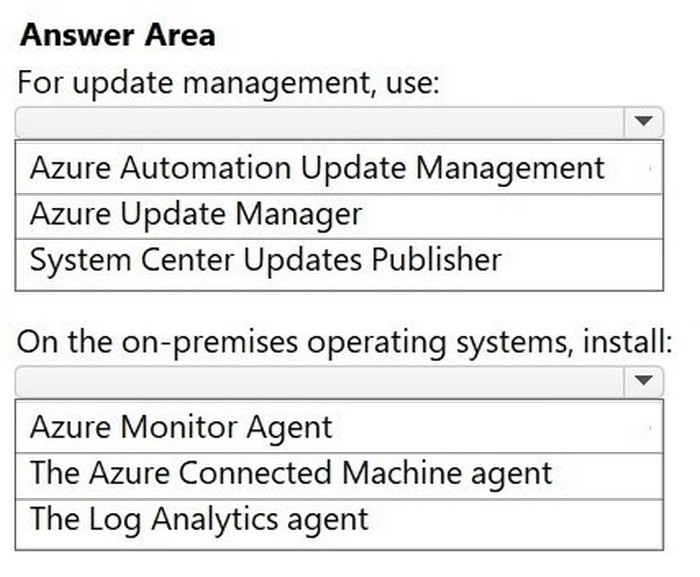
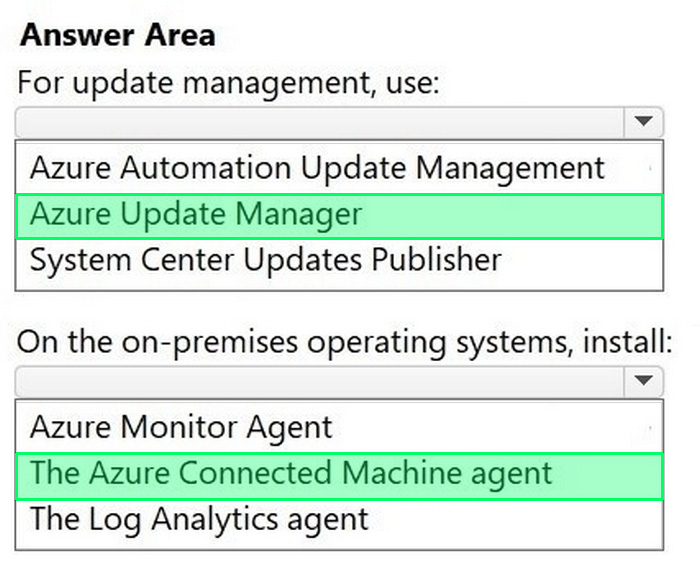
Box 1: Azure Update Manager For update management, use:
Support matrix for Azure Update Manager
Operating system updates Update Manager supports operating system updates for both Windows and Linux.
Extended Security Updates (ESU) for Windows Server Using Azure Update Manager, you can deploy Extended Security Updates for your Azure Arc-enabled Windows Server 2012 / R2 machines.
Incorrect: * Azure Automation Update Management Azure Automation Update Management will retire on 31 August 2024.
* System Center Updates Publisher System Center Updates Publisher (Updates Publisher) is a stand-alone tool that enables independent software vendors or line-of-business application developers to manage custom updates. This custom updates management includes updates that have dependencies, like drivers and update bundles.
Using Updates Publisher, you can:
Import updates from external catalogs (non-Microsoft update catalogs). Modify update definitions including applicability, and deployment metadata. Export updates to external catalogs. Publish updates to an update server.
Box 2: The Azure Connected Machine agent On the on-premises operating systems, install:
The Update Manager extension is installed and managed by using:
Azure VM Windows agent or the Azure VM Linux agent for Azure VMs. Azure Arc-enabled servers agent (also known as the Azure Connected Machine agent) for non-Azure Linux and Windows machines or physical servers. The Azure Connected Machine agent enables you to manage your Windows and Linux machines hosted outside of Azure on your corporate network or other cloud providers.
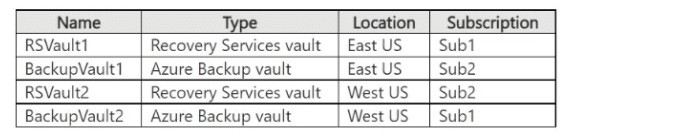
You have two Azure subscriptions named Sub1 and Sub2 that contain the vaults shown in the following table.
You need to design a multi-user authorization (MUA) solution for security operations on the vaults. The solution must meet the following requirements:
RSVault1 and RSVault2 must require MUA for disabling soft delete, removing MUA protection, and disabling immutability. BackupVault1 and BackupVault2 must require MUA for disabling soft delete and removing MUA protection.
What is the minimum number of Resource Guard resources required?
A
1
B
2
C
3
D
4
Reveal answer detailsClose answer details
Correct answerC
Question 51
Multiple choice
You have an on-premises network and a Microsoft 365 subscription.
You are designing a Zero Trust security strategy.
Which two security controls should you include as part of the Zero Trust solution? Each correct answer presents part of the solution.
NOTE: Each correct answer is worth one point.
A
Always allow connections from the on-premises network.
B
Disable passwordless sign-in for sensitive accounts.
C
Block sign-in attempts from unknown locations.
D
Block sign-in attempts from noncompliant devices.
Reveal answer detailsClose answer details
Correct answersC, D
Question 52
Single choice
You manage multiple Azure subscriptions, each containing several resource groups.
You need to identify the privileged role assignments in each subscription and assess any associated security risks.
The solution should minimize administrative effort.
What tool or service should you use?
A
access reviews in Privileged Identity Management (PIM)
B
access reviews in Microsoft Entra ID Identity Governance
C
Microsoft Defender External Attack Surface Management (Defender EASM) discovery
D
the Analytics dashboard in Microsoft Entra Permissions Management
Reveal answer detailsClose answer details
Correct answerA
Explanation
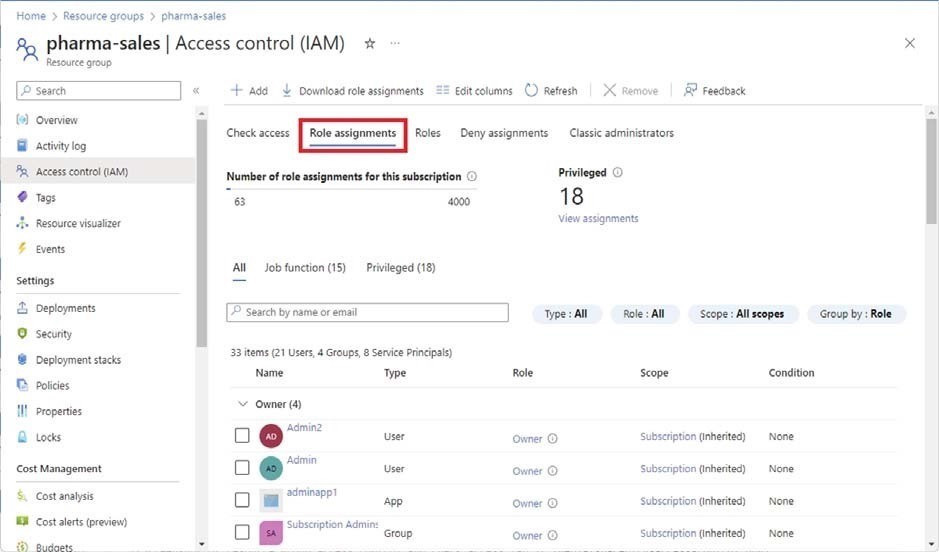
Azure role assignment integration with Privileged Identity Management is currently in PREVIEW. Follow these steps: 1. In the Azure portal, click All services and then select the scope. For example, you can select Management groups, Subscriptions, Resource groups, or a resource. 2. Click the specific resource. 3. Click Access control (IAM). 4. Click the Role assignments tab to view the role assignments at this scope. If you have a Microsoft Entra ID Free or Microsoft Entra ID P1 license, your Role assignments tab is similar to the following screenshot.
You are designing a ransomware response plan that follows Microsoft Security Best Practices.
You need to recommend a solution to limit the scope of damage of ransomware attacks without being locked out.
What should you include in the recommendation?
A
device compliance policies
B
Privileged Access Workstations (PAWs)
C
Customer Lockbox for Microsoft Azure
D
emergency access accounts
Reveal answer detailsClose answer details
Correct answerB
Explanation
The use of privileged access workstations (PAWs) helps protect privileged users from internet attacks and threat vectors by providing a dedicated machine for sensitive tacks and separating these sensitive tasks and accounts from the daily use workstations.
Customers with good least-privileged access policies such as using Privileged Access Workstations (PAW) devices were able to protect key resources even in the face of initial network access by the attackers.
Incorrect: * Customer Lockbox Customer Lockbox ensures that no one at Microsoft can access customer content to perform a service operation without the customer's explicit approval. Customer Lockbox brings the customer into the approval workflow for requests to access their content. Occasionally, Microsoft engineers are involved during the support process to troubleshoot and fix customer-reported issues. In most cases, issues are fixed through extensive telemetry and debugging tools that Microsoft has in place for its services. However, there may be cases that require a Microsoft engineer to access customer content to determine the root cause and fix the issue. Customer Lockbox requires the engineer to request access from the customer as a final step in the approval workflow. This gives organizations the option to approve or deny these requests, which gives them direct control over whether a Microsoft engineer can access the organizations' end-user data.
* emergency access accounts It is important that you prevent being accidentally locked out of your Azure Active Directory (Azure AD) organization because you can't sign in or activate another user's account as an administrator. You can mitigate the impact of accidental lack of administrative access by creating two or more emergency access accounts in your organization.
Why use an emergency access account An organization might need to use an emergency access account in the following situations:
The user accounts are federated, and federation is currently unavailable because of a cell-network break or an identity-provider outage. For example, if the identity provider host in your environment has gone down, users might be unable to sign in when Azure AD redirects to their identity provider. The administrators are registered through Azure AD Multi-Factor Authentication, and all their individual devices are unavailable or the service is unavailable. Users might be unable to complete Multi-Factor Authentication to activate a role. For example, a cell network outage is preventing them from answering phone calls or receiving text messages, the only two authentication mechanisms that they registered for their device. The person with the most recent Global Administrator access has left the organization. Azure AD prevents the last Global Administrator account from being deleted, but it does not prevent the account from being deleted or disabled on-premises. Either situation might make the organization unable to recover the account. Unforeseen circumstances such as a natural disaster emergency, during which a mobile phone or other networks might be unavailable.
You have a Microsoft 365 subscription that contains a Microsoft SharePoint Online site named Site1. Site1 stores documents that are based on a predefined form and include confidential employee information.
You monitor access to Site1 by using a Microsoft Defender for Cloud Apps session policy.
You need to ensure that step-up authentication is triggered when a user downloads documents that are based on the predefined form. The solution must minimize administrative effort.
Which Microsoft Data Classification Service inspection method should you use, and which Conditional Access option should you add to the session policy? To answer, select the appropriate options in the answer area.
NOTE: Each correct selection is worth one point.
Correct Answer:
QUESTION 2
HOTSPOT
Your company has a Microsoft 365 E5 subscription, an Azure subscription, on-premises applications, and Active Directory Domain Services (AD DS).
You need to recommend an identity security strategy that meets the following requirements:
1. Ensures that customers can use their Facebook credentials to authenticate to an Azure App Service website 2. Ensures that partner companies can access Microsoft SharePoint Online sites for the project to which they are assigned
The solution must minimize the need to deploy additional infrastructure components.
What should you include in the recommendation? To answer, select the appropriate options in the answer area.
NOTE: Each correct selection is worth one point.
Correct Answer:
Explanation
Explanation/Reference:
Box 1: Azure AD B2C authentication Ensures that customers can use their Facebook credentials to authenticate to an Azure App Service website.
You can set up sign-up and sign-in with a Facebook account using Azure Active Directory B2C.
Box 2: Azure AD B2B authentication with access package assignments Govern access for external users in Azure AD entitlement management Azure AD entitlement management uses Azure AD business-to-business (B2B) to share access so you can collaborate with people outside your organization. With Azure AD B2B, external users authenticate to their home directory, but have a representation in your directory. The representation in your directory enables the user to be assigned access to your resources.
Incorrect: Not: Password hash synchronization in Azure AD connect The partners are not integrated with AD DS.
Your company has a Microsoft 365 subscription and uses Microsoft Defender for Identity.
You are informed about incidents that relate to compromised identities.
You need to recommend a solution to expose several accounts for attackers to exploit. When the attackers attempt to exploit the accounts, an alert must be triggered.
Which Defender for Identity feature should you include in the recommendation?
A.
sensitivity labels
B.
custom user tags
C.
standalone sensors
D.
honeytoken entity tags
Correct Answer: D
Explanation
Explanation/Reference:
Honeytoken entities are used as traps for malicious actors. Any authentication associated with these honeytoken entities triggers an alert.
Incorrect: Not B: custom user tags After you apply system tags or custom tags to users, you can use those tags as filters in alerts, reports, and investigation.
You have an on-premises app named App1. Remote users access App1 by using VPN connections.
You have a third-party software as a service (SaaS) app named App2.
You need to deploy Global Secure Access to manage access to App1 and App2.
What should you use for each app?
A.
Microsoft Entra Private Access for App1 and Microsoft Entra Internet Access for App2
B.
Microsoft Entra Private Access for App1 and App2
C.
Microsoft Entra Internet Access for App1 and App2
D.
Microsoft Entra Private Access for App2 and Microsoft Entra Internet Access for App1
Correct Answer: A
QUESTION 5
You have on-premises Windows 11 devices with the Global Secure Access client deployed.
Your Microsoft 365 subscription includes Microsoft SharePoint Online and Exchange Online.
You deploy Microsoft Entra Internet Access from your on-premises network to Microsoft 365. This deployment has the Microsoft 365 profile enabled, with the following configuration:
1. Default traffic policies for Microsoft 365 services 2. A linked Conditional Access policy that performs compliant network checks with continuous access evaluation (CAE) applied to all users 3. An assignment to all devices 4. An assignment to a remote network associated with the on-premises network
Which Microsoft 365 resources are protected using continuous access evaluation (CAE)?
A.
SharePoint Online only
B.
Exchange Online only
C.
both SharePoint Online and Exchange Online
Correct Answer: A
Explanation
Explanation/Reference:
Compliant network check enforcement Compliant network enforcement reduces the risk of token theft/replay attacks. Compliant network enforcement happens at the authentication plane (generally available) and at the data plane (preview). Authentication plane enforcement is performed by Microsoft Entra ID at the time of user authentication. If an adversary has stolen a session token and attempts to replay it from a device that is not connected to your organization's compliant network (for example, requesting an access token with a stolen refresh token), Entra ID will immediately deny the request and further access will be blocked. Data plane enforcement works with services that support Continuous Access Evaluation (CAE) - currently, *only SharePoint Online*. With apps that support CAE, stolen access tokens that are replayed outside your tenant's compliant network will be rejected by the application in near-real time. Without CAE, a stolen access token will last up to its full lifetime (default 60-90 minutes).
Your company has an Azure subscription that uses Azure Storage.
The company plans to share specific blobs with vendors.
You need to recommend a solution to provide the vendors with secure access to specific blobs without exposing the blobs publicly. The access must be time-limited.
What should you include in the recommendation?
A.
Configure private link connections.
B.
Configure encryption by using customer-managed keys (CMKs).
C.
Share the connection string of the access key.
D.
Create shared access signatures (SAS).
Correct Answer: D
Explanation
Explanation/Reference:
A shared access signature (SAS) provides secure delegated access to resources in your storage account. With a SAS, you have granular control over how a client can access your data. For example:
What resources the client may access.
What permissions they have to those resources.
How long the SAS is valid.
Types of shared access signatures Azure Storage supports three types of shared access signatures:
You need to recommend a Microsoft 365 Defender solution to enhance security for the tenant. The solution must meet the following requirements:
1. Identify users that are downloading an unusually high number of files from Microsoft SharePoint Online sites and are possibly involved in a data exfiltration attempt. 2. Block Microsoft Teams messages that contain potentially malicious content by using zero-hour auto
purge (ZAP).
What should you recommend for each requirement? To answer, select the appropriate options in the answer area. NOTE: Each correct selection is worth one point.
Correct Answer:
QUESTION 8
HOTSPOT
Your company has offices in New York City and Los Angeles.
The New York City office contains an on-premises app named Appl.
You have an Azure subscription. The subscription is linked to a Microsoft Entra tenant that is hosted in North America.
You plan to manage access to App1 for the users in the Los Angeles office by using Microsoft Entra Private Access. You will deploy Private Access by performing the following actions:
1. Provision an ExpressRoute circuit from the New York City office to the closest peering location. 2. Create an Azure virtual network named VNet1 in the East US Azure region. 3. Deploy a Microsoft Entra application proxy connector to VNet1.
You need to optimize the network for the planned deployment. The solution must meet the following requirements:
1. Maximize redundancy for connectivity to App1. 2. Minimize network latency when accessing App1 3. Minimize complexity. 4. Minimize costs.
What should you include in the solution? To answer, select the appropriate options in the answer area.
NOTE: Each correct selection is worth one point.
Correct Answer:
QUESTION 9
You have the following on-premises servers that run Windows Server:
1. Two domain controllers in an Active Directory Domain Services (AD DS) domain 2. Two application servers named Server1 and Server2 that run ASP.NET web apps 3. A VPN server named Served that authenticates by using RADIUS and AD DS 4. End users use a VPN to access the web apps over the internet.
You need to redesign a user access solution to increase the security of the connections to the web apps.
The solution must minimize the attack surface and follow the Zero Trust principles of the Microsoft Cybersecurity Reference Architectures (MCRA).
What should you include in the recommendation?
A.
Publish the web apps by using Azure AD Application Proxy.
B.
Configure the VPN to use Azure AD authentication.
C.
Configure connectors and rules in Microsoft Defender for Cloud Apps.
D.
Configure web protection in Microsoft Defender for Endpoint.
Correct Answer: A
QUESTION 10
HOTSPOT
Your on-premises network contains an Active Directory Domain Services (AD DS) domain with a group named Group1 and five servers running Windows Server. Each server hosts a standalone app used by the members of Group1.
You have a Microsoft Entra tenant that syncs with the domain and plan to manage access to the apps by deploying Global Secure Access. A Conditional Access policy will be used to enforce security controls for all connections to the apps.
You need to recommend a Global Secure Access app and Microsoft Entra private network connector configuration for the planned deployment. The solution must minimize administrative effort and ensure high availability.
What is the minimum number of Global Secure Access apps and private network connectors you should recommend?
To answer, select the appropriate options in the answer area.
Each correct selection is worth one point.
Correct Answer:
QUESTION 11
You have an Azure subscription that contains virtual machines.
Port 3389 and port 22 are disabled for outside access.
You need to design a solution to provide administrators with secure remote access to the virtual machines. The solution must meet the following requirements:
1. Prevent the need to enable ports 3389 and 22 from the internet. 2. Only provide permission to connect the virtual machines when required. 3. Ensure that administrators use the Azure portal to connect to the virtual machines.
Which two actions should you include in the solution? Each correct answer presents part of the solution.
NOTE: Each correct selection is worth one point.
A.
Configure Azure VPN Gateway.
B.
Enable Just Enough Administration (JEA).
C.
Configure Azure Bastion.
D.
Enable just-in-time (JIT) VM access.
E.
Enable Azure AD Privileged Identity Management (PIM) roles as virtual machine contributors.
Correct Answer: CD
Explanation
Explanation/Reference:
C: Bastion provides secure remote access. It uses RDP/SSH session is over TLS on port 443.
Note: Azure Bastion is a service you deploy that lets you connect to a virtual machine using your browser and the Azure portal. The Azure Bastion service is a fully platform-managed PaaS service that you provision inside your virtual network. It provides secure and seamless RDP/SSH connectivity to your virtual machines directly from the Azure portal over TLS. When you connect via Azure Bastion, your virtual machines don't need a public IP address, agent, or special client software.
D: Lock down inbound traffic to your Azure Virtual Machines with Microsoft Defender for Cloud's just-in-time (JIT) virtual machine (VM) access feature. This reduces exposure to attacks while providing easy access when you need to connect to a VM.
Meets the requirement: Only provide permission to connect the virtual machines when required
Incorrect: Not B: Does not address: Only provide permission to connect the virtual machines when required Just Enough Administration (JEA) is a security technology that enables delegated administration for anything managed by PowerShell. With JEA, you can:
Reduce the number of administrators on your machines using virtual accounts or group-managed service accounts to perform privileged actions on behalf of regular users. Limit what users can do by specifying which cmdlets, functions, and external commands they can run. Better understand what your users are doing with transcripts and logs that show you exactly which commands a user executed during their session.
Not E: Does not help with the remote access.
Note: Classic Virtual Machine Contributor: Lets you manage classic virtual machines, but not access to them, and not the virtual network or storage account they're connected to.
You are designing a solution to protect confidential data in Microsoft SharePoint Online sites that contain more than one million documents.
You need to recommend a solution to prevent Personally Identifiable Information (Pll) from being shared.
Which two components should you include in the recommendation? Each correct answer presents part of the solution.
NOTE: Each correct selection is worth one point.
A.
data loss prevention (DLP) policies
B.
retention label policies
C.
eDiscovery cases
D.
sensitivity label policies
Correct Answer: AD
Explanation
Explanation/Reference:
A: Data loss prevention in Office 365. Data loss prevention (DLP) helps you protect sensitive information and prevent its inadvertent disclosure. Examples of sensitive information that you might want to prevent from leaking outside your organization include financial data or personally identifiable information (PII) such as credit card numbers, social security numbers, or health records. With a data loss prevention (DLP) policy, you can identify, monitor, and automatically protect sensitive information across Office 365.
D: Sensitivity labels Sensitivity labels from Microsoft Purview Information Protection let you classify and protect your organization's data without hindering the productivity of users and their ability to collaborate.
Plan for integration into a broader information protection scheme. On top of coexistence with OME, sensitivity labels can be used along-side capabilities like Microsoft Purview Data Loss Prevention (DLP) and Microsoft Defender for Cloud Apps.
Incorrect: Not B: Retention labels help you retain what you need and delete what you don't at the item level (document or email). They are also used to declare an item as a record as part of a records management solution for your Microsoft 365 data.
Not C: eDiscovery cases in eDiscovery (Standard) and eDiscovery (Premium) let you associate specific searches and exports with a specific investigation. You can also assign members to a case to control who can access the case and view the contents of the case. Place content locations on legal hold.
Note: This question is part of a series of questions that present the same scenario. Each question in the series contains a unique solution that might meet the stated goals. Some question sets might have more than one correct solution, while others might not have a correct solution.
After you answer a question in this section, you will NOT be able to return to it. As a result, these questions will not appear in the review screen.
Your on-premises network contains an e-commerce web app that was developed in Angular and Node,js. The web app uses a MongoDB database. You plan to migrate the web app to Azure. The solution architecture team proposes the following architecture as an Azure landing zone.
You need to provide recommendations to secure the connection between the web app and the database. The solution must follow the Zero Trust model.
Solution: You recommend implementing Azure Application Gateway with Azure Web Application Firewall (WAF).
Does this meet the goal?
A.
Yes
B.
No
Correct Answer: B
Explanation
Explanation/Reference:
Instead use solution: You recommend creating private endpoints for the web app and the database layer.
Note: How to Use Azure Private Endpoints to Restrict Public Access to WebApps. As an Azure administrator or architect, you are sometimes asked the question: "How can we safely deploy internal business applications to Azure App Services?"
These applications characteristically are:
Not accessible from the public internet. Accessible from within the on-premises corporate network Accessible via an authorized VPN client from outside the corporate network. For such scenarios, we can use Azure Private Links, which enables private and secure access to Azure PaaS services over Azure Private Endpoints, along with the Site-to-Site VPN, Point-to-Site VPN, or the Express Route. Azure Private Endpoint is a read-only network interface service associated with the Azure PAAS Services. It allows you to bring deployed sites into your virtual network, limiting access to them at the network level.
It uses one of the private IP addresses from your Azure VNet and associates it with the Azure App Services. These services are called Private Link resources. They can be Azure Storage, Azure Cosmos DB, SQL, App Services Web App, your own / partner owned services, Azure Backups, Event Grids, Azure Service Bus, or Azure Automations.
You need to mitigate ransomware attacks against messages posted to Microsoft Teams channels and files stored in Teams channels.
What should you include in the solution for each type of content? To answer, select the appropriate options in the answer area.
NOTE: Each correct selection is worth one point.
Correct Answer:
QUESTION 15
Your company has an on-premises network, an Azure subscription, and a Microsoft 365 E5 subscription.
The company uses the following devices:
1. Computers that run either Windows 10 or Windows 11 2. Tablets and phones that run either Android or iOS
You need to recommend a solution to classify and encrypt sensitive Microsoft Office 365 data regardless of where the data is stored.
What should you include in the recommendation?
A.
eDiscovery
B.
Microsoft Information Protection
C.
Compliance Manager
D.
retention policies
Correct Answer: B
Explanation
Explanation/Reference:
Protect your sensitive data with Microsoft Purview. Implement capabilities from Microsoft Purview Information Protection (formerly Microsoft Information Protection) to help you discover, classify, and protect sensitive information wherever it lives or travels.
Note: You can use Microsoft Information Protection: Microsoft Purview for Auditing and Analytics in Outlook for iOS, Android, and Mac (DoD).
Incorrect: Not A: Electronic discovery, or eDiscovery, is the process of identifying and delivering electronic information that can be used as evidence in legal cases. You can use eDiscovery tools in Microsoft Purview to search for content in Exchange Online, OneDrive for Business, SharePoint Online, Microsoft Teams, Microsoft 365 Groups, and Yammer teams. You can search mailboxes and sites in the same eDiscovery search, and then export the search results. You can use Microsoft Purview eDiscovery (Standard) cases to identify, hold, and export content found in mailboxes and sites. If your organization has an Office 365 E5 or Microsoft 365 E5 subscription (or related E5 add-on subscriptions), you can further manage custodians and analyze content by using the feature-rich Microsoft Purview eDiscovery (Premium) solution in Microsoft 365.
Not C: What does compliance Manager do? Compliance managers ensure that a business, its employees and its projects comply with all relevant regulations and specifications. This could include health and safety, environmental, legal or quality standards, as well as any ethical policies the company may have.
Not D: A retention policy (also called a 'schedule') is a key part of the lifecycle of a record. It describes how long a business needs to keep a piece of information (record), where it's stored and how to dispose of the record when its time.
You have a Microsoft 365 subscription and an Azure subscription. Microsoft 365 Defender and Microsoft Defender for Cloud are enabled.
The Azure subscription contains 50 virtual machines. Each virtual machine runs different applications on Windows Server 2019.
You need to recommend a solution to ensure that only authorized applications can run on the virtual machines. If an unauthorized application attempts to run or be installed, the application must be blocked automatically until an administrator authorizes the application.
Which security control should you recommend?
A.
app discovery anomaly detection policies in Microsoft Defender for Cloud Apps
B.
Azure AD Conditional Access App Control policies
C.
adaptive application controls in Defender for Cloud
D.
app protection policies in Microsoft Endpoint Manager
Correct Answer: C
Explanation
Explanation/Reference:
Use adaptive application controls to reduce your machines' attack surfaces
Adaptive application controls are an intelligent and automated solution for defining allowlists of known-safe applications for your machines.
When you've enabled and configured adaptive application controls, you'll get security alerts if any application runs other than the ones you've defined as safe.
Incorrect: Not A: A Cloud Discovery anomaly detection policy enables you to set up and configure continuous monitoring of unusual increases in cloud application usage. Increases in downloaded data, uploaded data, transactions, and users are considered for each cloud application. Each increase is compared to the normal usage pattern of the application as learned from past usage. The most extreme increases trigger security alerts.
Your network contains an Active Directory Domain Services (AD DS) domain named Domain1.
You have a Microsoft Entra tenant.
Domain1 syncs with the tenant using Microsoft Entra Connect.
You need to evaluate Microsoft Entra smart lockout by testing the following account lockout considerations:
1. The number of failed sign-in attempts that trigger a lockout 2. The duration of the lockout
What should you use to test each consideration?
To answer, select the appropriate options in the answer area.
Each correct selection is worth one point.
Correct Answer:
Explanation
Explanation/Reference:
Box 1: AD DS and Microsoft Entra ID The number of failed sign-in attempts that trigger a lockout.
Smart lockout can be integrated with hybrid deployments that use password hash sync or pass-through authentication to protect on-premises Active Directory Domain Services (AD DS) accounts from being locked out by attackers. By setting smart lockout policies in Microsoft Entra ID appropriately, attacks can be filtered out before they reach on-premises AD DS. When using pass-through authentication, the following considerations apply:
* The Microsoft Entra lockout threshold must be less than the AD DS account lockout threshold. Set the values so that the AD DS account lockout threshold is at least two or three times greater than the Microsoft Entra lockout threshold.
* The Microsoft Entra lockout duration must be longer than the AD DS account lockout duration. The Microsoft Entra duration is set in seconds, while the AD DS duration is set in minutes.
Tip This configuration ensures Microsoft Entra smart lockout stops your on-premises AD DS accounts from being locked out by brute force attacks, like password spray attacks on your Microsoft Entra accounts.
Box 2: AD DS and Microsoft Entra ID The duration of the lockout.
You have an Azure subscription that has Microsoft Defender for Cloud enabled.
You need to enforce ISO 27001:2013 standards for new resources deployed to the subscription. The solution must ensure that noncompliant resources are automatically detected.
What should you use?
A.
Azure Policy
B.
Azure Blueprints
C.
the regulatory compliance dashboard in Defender for Cloud
D.
Azure role-based access control (Azure RBAC)
Correct Answer: A
Explanation
Explanation/Reference:
Control mapping of the ISO 27001 Shared Services blueprint sample The following mappings are to the ISO 27001:2013 controls. Use the navigation on the right to jump directly to a specific control mapping. Many of the mapped controls are implemented with an Azure Policy initiative.
Open Policy in the Azure portal and select the Definitions page. Then, find and select the [Preview] Audit ISO 27001:2013 controls and deploy specific VM Extensions to support audit requirements built-in policy initiative.
Note: Security Center can now auto provision the Azure Policy's Guest Configuration extension (in preview) Azure Policy can audit settings inside a machine, both for machines running in Azure and Arc connected machines. The validation is performed by the Guest Configuration extension and client.
With this update, you can now set Security Center to automatically provision this extension to all supported machines.
Enforcing a secure configuration, based on a specific recommendation, is offered in two modes:
Using the Deny effect of Azure Policy, you can stop unhealthy resources from being created Using the Enforce option, you can take advantage of Azure Policy's DeployIfNotExist effect and automatically remediate non-compliant resources upon creation
You have an Azure DevOps organization that is used to manage the development and deployment of internal apps to multiple Azure subscriptions.
You are developing a DevSecOps strategy.
You need to apply DevSecOps controls for the secure code stage and the secure operations stage.
The solution must be based on Microsoft Cloud Adoption Framework for Azure principles.
What should you apply for each stage? To answer, select the appropriate options in the answer area.
NOTE: Each correct selection is worth one point.
Correct Answer:
QUESTION 20
HOTSPOT
You have an Azure subscription.
You plan to deploy an Azure App Service app named App1 that will access an external web service by using a username and password.
You need to recommend a password storage solution for App1 that meets the following requirements:
1. Ensures that the password is stored securely. 2. Ensures that App1 can authenticate to the service that will store the password.
Which service should you use to store the password, and which authentication method should App1 use to access the service? To answer, select the appropriate options in the answer area.
NOTE: Each correct selection is worth one point.
Correct Answer:
QUESTION 21
DRAG DROP
You have a Microsoft 365 subscription.
You need to recommend a security solution to monitor the following activities:
1. User accounts that were potentially compromised 2. Users performing bulk file downloads from Microsoft SharePoint Online
What should you include in the recommendation for each activity? To answer, drag the appropriate components to the correct activities. Each component may be used once, more than once, or not at all. You may need to drag the split bar between panes or scroll to view content.
NOTE: Each correct selection is worth one point.
Correct Answer:
Explanation
Explanation/Reference:
Box 1: Azure Active Directory (Azure AD) Identity Protection Risk detections in Azure AD Identity Protection include any identified suspicious actions related to user accounts in the directory. Risk detections (both user and sign-in linked) contribute to the overall user risk score that is found in the Risky Users report.
Identity Protection provides organizations access to powerful resources to see and respond quickly to these suspicious actions.
Note: Premium sign-in risk detections include: * Token Issuer Anomaly - This risk detection indicates the SAML token issuer for the associated SAML token is potentially compromised. The claims included in the token are unusual or match known attacker patterns.
* Suspicious inbox manipulation rules - This detection is discovered by Microsoft Defender for Cloud Apps. This detection profiles your environment and triggers alerts when suspicious rules that delete or move messages or folders are set on a user's inbox. This detection may indicate that the user's account is compromised, that messages are being intentionally hidden, and that the mailbox is being used to distribute spam or malware in your organization.
* Etc.
Incorrect: Not: Microsoft 365 Defender for Cloud Part of your incident investigation can include user accounts. You can see the details of user accounts identified in the alerts of an incident in the Microsoft 365 Defender portal from Incidents & alerts > incident > Users.
Box 2: Microsoft 365 Defender for App Defender for Cloud apps detect mass download (data exfiltration) policy Detect when a certain user accesses or downloads a massive number of files in a short period of time.
You have four Azure subscriptions: Sub1, Sub2, Sub3, and Sub4. Each subscription is linked to a unique Microsoft Entra tenant and a Microsoft 365 subscription. Sub1 contains a user named User1.
You plan to implement Microsoft Sentinel and need to ensure that User1 can monitor Microsoft Entra ID events and Microsoft 365 events for Sub2, Sub3, and Sub4 using Microsoft Sentinel. The solution must minimize administrative effort.
What is the minimum number of Microsoft Sentinel workspaces you should create, and which Azure service should you use?
To answer, select the appropriate options in the answer area.
Correct Answer:
Explanation
Explanation/Reference:
Box 1: 3 Number of workspace
One for Sub2, one for Sub3, and one for Sub4.
Note: Extend Microsoft Sentinel across workspaces and tenants When you onboard Microsoft Sentinel, your first step is to select your Log Analytics workspace. While you can get the full benefit of the Microsoft Sentinel experience with a single workspace, in some cases, you might want to extend your workspace to query and analyze your data across workspaces and tenants.
Box 2: Azure Lighthouse Service
Manage workspaces across tenants using Azure Lighthouse
As mentioned above, in many scenarios, the different Log Analytics workspaces enabled for Microsoft Sentinels can be located in different Microsoft Entra tenants. You can use Azure Lighthouse to extend all cross-workspace activities across tenant boundaries, allowing users in your managing tenant to work on workspaces across all tenants. 66 Once Azure Lighthouse is onboarded, use the directory + subscription selector on the Azure portal to select all the subscriptions containing workspaces you want to manage, in order to ensure that they'll all be available in the different workspace selectors in the portal.
When using Azure Lighthouse, it's recommended to create a group for each Microsoft Sentinel role and delegate permissions from each tenant to those groups.
You have a Microsoft 365 subscription that contains 1,000 users. Each user is assigned a Microsoft 365 E5 license.
The subscription uses sensitivity labels to classify corporate documents. All the users have Windows 11 devices that are onboarded to Microsoft Defender for Endpoint and are configured to sync files to Microsoft OneDrive.
You need to prevent the users from uploading the documents from OneDrive to external websites.
What should you include in the solution?
A.
Microsoft Purview Information Protection
B.
Microsoft Purview data loss prevention (DLP)
C.
web content filtering in Defender for Endpoint
D.
an endpoint security policy
Correct Answer: B
QUESTION 24
You have a Microsoft 365 tenant named contoso.com.
You need to ensure that users can authenticate only to contoso.com, while meeting the following requirements:
1. Prevent users from authenticating to other Microsoft 365 tenants. 2. Minimize administrative effort.
What should you use?
A.
Microsoft Entra Private Access
B.
Microsoft Defender for Endpoint
C.
Microsoft Entra Internet Access
D.
Microsoft Defender for Cloud Apps
Correct Answer: A
Explanation
Explanation/Reference:
Microsoft Entra Private Access unlocks the ability to specify the fully qualified domain names (FQDNs) and IP addresses that you consider private or internal, so you can manage how your organization accesses them. With Private Access, you can modernize how your organization's users access private apps and resources. Remote workers don't need to use a VPN to access these resources if they have the Global Secure Access Client installed. The client quietly and seamlessly connects them to the resources they need.
Private Access provides two ways to configure the private resources that you want to tunnel through the service. You can configure Quick Access, which is the primary group of FQDNs and IP addresses that you want to secure. You can also configure a Global Secure Access app for per-app access, which allows you to specify a subset of private resources that you want to secure. The Global Secure Access app provides a granular approach to securing your private resources. The features of Microsoft Entra Private Access provide a quick and easy way to replace your VPN to allow secure access to your internal resources with an easy-one time configuration, using the secure capabilities of Conditional Access. Incorrect: Not C: Microsoft Entra Internet Access provides an identity-centric Secure Web Gateway (SWG) solution for Software as a Service (SaaS) applications and other Internet traffic. It protects users, devices, and data from the Internet's wide threat landscape with best-in-class security controls and visibility through Traffic Logs. Web content filtering The key introductory feature for Microsoft Entra Internet Access for all apps is Web content filtering. This feature provides granular access control for web categories and Fully Qualified Domain Names (FQDNs). By explicitly blocking known inappropriate, malicious, or unsafe sites, you protect your users and their devices from any Internet connection whether they're remote or within the corporate network. Web content filtering is implemented using filtering policies, which are grouped into security profiles, which can be linked to Conditional Access policies.
Your company wants to optimize ransomware incident investigations.
You need to recommend a plan to investigate ransomware incidents based on the Microsoft Detection and Response Team (DART) approach.
Which three actions should you recommend performing in sequence in the plan? To answer, move the appropriate actions from the list of actions to the answer area and arrange them in the correct order.
Correct Answer:
Explanation
Explanation/Reference:
Step 1: Assess the current situation and identify the scope. The DART approach to conducting ransomware incident investigations You should make every effort to determine how the adversary gained access to your assets so that vulnerabilities can be remediated. Otherwise, it is highly likely that the same type of attack will take place again in the future. In some cases, the threat actor takes steps to cover their tracks and destroy evidence, so it is possible that the entire chain of events may not be evident.
The following are three key steps in DART ransomware investigations:
1. Assess the current situation Understand the scope
What initially made you aware of a ransomware attack? What time/date did you first learn of the incident? What logs are available and is there any indication that the actor is currently accessing systems?
Step 2: Identify which line-of-business (LOB) apps are unavailable due to a ransomware incident.
2. Identify the affected line-of-business (LOB) apps Get systems back online
Does the application require an identity? Are backups of the application, configuration, and data available? Are the content and integrity of backups regularly verified using a restore exercise?
Step 3: Identify the compromise recovery process.
3. Determine the compromise recovery (CR) process Remove attacker control from the environment
Your company plans to evaluate the security of its Azure environment based on the principles of the Microsoft Cloud Adoption Framework for Azure.
You need to recommend a cloud-based service to evaluate whether the Azure resources comply with the National Institute of Standards and Technology (NIST) Cybersecurity Framework (CSF).
What should you recommend?
A.
Compliance Manager in Microsoft Purview
B.
Microsoft Defender for Cloud
C.
Microsoft Sentinel
D.
Microsoft Defender for Cloud Apps
Correct Answer: B
QUESTION 27
Note: This question is part of a series of questions that present the same scenario. Each question in the series contains a unique solution that might meet the stated goals. Some question sets might have more than one correct solution, while others might not have a correct solution.
After you answer a question in this section, you will NOT be able to return to it. As a result, these questions will not appear in the review screen.
You have an Azure subscription that has Microsoft Defender for Cloud enabled.
You are evaluating the Azure Security Benchmark V3 report.
In the Secure management ports controls, you discover that you have 0 out of a potential 8 points.
You need to recommend configurations to increase the score of the Secure management ports controls.
Solution: You recommend enabling just-in-time (JIT) VM access on all virtual machines.
Does this meet the goal?
A.
Yes
B.
No
Correct Answer: A
Explanation
Explanation/Reference:
Secure management ports - Brute force attacks often target management ports. Use these recommendations to reduce your exposure with tools like just-in-time VM access and network security groups.
Recommendations: - Internet-facing virtual machines should be protected with network security groups - Management ports of virtual machines should be protected with just-in-time network access control - Management ports should be closed on your virtual machines
You are designing a new Azure environment based on the security best practices of the Microsoft Cloud Adoption Framework for Azure. The environment will contain one subscription for shared infrastructure components and three separate subscriptions for applications.
You need to recommend a deployment solution that includes network security groups (NSGs), Azure Firewall, Azure Key Vault, and Azure Bastion. The solution must minimize deployment effort and follow security best practices of the Microsoft Cloud Adoption Framework for Azure.
What should you include in the recommendation?
A.
the Azure landing zone accelerator
B.
the Azure Well-Architected Framework
C.
Azure Security Benchmark v3
D.
Azure Advisor
Correct Answer: A
Explanation
Explanation/Reference:
About Azure Bastion host and jumpboxes The most simple solution is to host a jumpbox on the virtual network of the data management landing zone or data landing zone to connect to the data services through private endpoints.
Azure Bastion provides a few other core security benefits, including: * The service integrates with native security appliances for an Azure virtual network, such as Azure Firewall.
Note: * Platform landing zones: Subscriptions deployed to provide centralized services, often operated by a central team, or a number of central teams split by function (e.g. networking, identity), which will be used by various workloads and applications. Platform landing zones represent key services that often benefit from being consolidated for efficiency and ease of operations. Examples include networking, identity, and management services.
* The Azure App Service landing zone accelerator is an open-source collection of architectural guidance and reference implementation to accelerate deployment of Azure App Service at scale. It can provide a specific architectural approach and reference implementation via infrastructure as code templates to prepare your landing zones. The landing zones adhere to the architecture and best practices of the Cloud Adoption Framework.
Incorrect:
Not B: The Azure Well-Architected Framework is a set of guiding tenets that can be used to improve the quality of a workload. The framework consists of five pillars of architectural excellence:
Not C: The Azure Security Benchmark (ASB) provides prescriptive best practices and recommendations to help improve the security of workloads, data, and services on Azure. This benchmark is part of a set of holistic security guidance that also includes:
* Cloud Adoption Framework: Guidance on security, including strategy, roles and responsibilities, Azure Top 10 Security Best Practices, and reference implementation.
* Azure Well-Architected Framework: Guidance on securing your workloads on Azure.
* Microsoft Security Best Practices: Recommendations with examples on Azure. Microsoft Cybersecurity Reference Architectures (MCRA): Visual diagrams and guidance for security components and relationships
* The Azure Security Benchmark focuses on cloud-centric control areas. These controls are consistent with well-known security benchmarks, such as those described by the Center for Internet Security (CIS)
Controls, National Institute of Standards and Technology (NIST), and Payment Card Industry Data Security Standard (PCI-DSS).
Your company has two offices: Office1 and Office2, containing 1,000 on-premises Windows 11 devices that are Microsoft Entra joined.
You have a Microsoft 365 subscription and use Microsoft Intune. You plan to deploy Microsoft Entra Internet Access from the offices to Microsoft 365.
You have enabled the Microsoft 365 profile and configured the following:
A traffic policy for all Microsoft 365 traffic
A linked Conditional Access policy with the following configurations:
1. Applies to all users 2. Performs compliant network checks 3. Allows Microsoft 365 traffic from compliant devices 4. An assignment to all devices 5. An assignment to the remote network associated with Office1
You deploy the Global Secure Access client to all devices in Office2 and establish connections.
Which users can access Microsoft 365 services from compliant devices, and which users are blocked from accessing Microsoft 365 services when using noncompliant devices?
To answer, select the appropriate options in the answer area.Each correct selection is worth one point.
Correct Answer:
Explanation
Explanation/Reference:
Box 1: Office1 and Office2 Compliant devices
* Office1 Global Secure Access Enable compliant network check with Conditional Access Organizations who use Conditional Access along with the Global Secure Access, can prevent malicious access to Microsoft apps, third-party SaaS apps, and private line-of-business (LoB) apps using multiple conditions to provide defense-in-depth. These conditions might include device compliance, location, and more to provide protection against user identity or token theft. Global Secure Access introduces the concept of a compliant network within Microsoft Entra ID Conditional Access. This compliant network check ensures users connect from a verified network connectivity model for their specific tenant and are compliant with security policies enforced by administrators.
The Global Secure Access Client installed on devices or users behind configured remote networks allows administrators to secure resources behind a compliant network with advanced Conditional Access controls. This compliant network feature makes it easier for administrators to manage access policies, without having to maintain a list of egress IP addresses. This removes the requirement to hairpin traffic through organization's VPN.
* Office2 The Global Secure Access client allows organizations control over network traffic at the end-user computing device, giving organizations the ability to route specific traffic profiles through Microsoft Entra Internet Access and Microsoft Entra Private Access. Routing traffic in this method allows for more controls like continuous access evaluation (CAE), device compliance, or multifactor authentication to be required for resource access.
Your on-premises network contains an Active Directory Domain Services (AD DS) domain and a hybrid deployment between a Microsoft Exchange Server 2019 organization and an Exchange Online tenant. The
AD DS domain contains a group named Group1. Group1 is a member of the Organization Management role group for the Exchange deployment.
You have a Microsoft 365 E5 subscription that uses Microsoft Defender.
You have an Azure subscription that uses Microsoft Sentinel.
You need to recommend a solution to ensure that Group1 is marked as a sensitive group and that any changes made to Group1 raises an alert in Microsoft Sentinel. The solution must minimize administrative effort.
What should you include in the recommendation?
A.
Microsoft Entra ID Protection
B.
Microsoft Defender for Identity
C.
Microsoft Defender for Office 365
D.
Microsoft Entra Privileged Identity Management (PIM)
Correct Answer: B
QUESTION 31
HOTSPOT
You have a Microsoft Entra tenant. The tenant contains a security group named Group1. Group1 contains the members of your company's IT support team.
You have an Azure subscription. The subscription contains 800 Windows devices that are Microsoft Entra joined and 200 Windows devices that are Microsoft Entra registered.
You have 200 standalone macOS devices.
You deploy 10 Windows devices that are Microsoft Entra joined and have the Microsoft Entra ExtensionAttribute1 value set to SecureWorkstation.
You need to recommend a Conditional Access solution that meets the following requirements:
Only allows access to Microsoft Entra resources from devices that run Windows 10 or Windows 11
Restricts Windows Azure Service Management API access to the following users:
1. The members of Group1. 2. Users that authenticate by using multifactor authentication (MFA) 3. Users that connect from a device that has the SecureWorkstation ExtensionAttribute1.
The solution must minimize the number of required policies and maximize security.
What should include in the recommendation? To answer, select the appropriate options in the answer area.
NOTE: Each correct selection is worth one point.
Correct Answer:
QUESTION 32
Your company has a main office and a branch office.
1. The main office houses 20 on-premises servers running Windows Server, which host applications published via Microsoft Entra application proxy. 2. The main office also has 500 on-premises computers running Windows 11. In contrast, the branch office has 100 on-premises Windows 11 computers. 3. All computers in the main office are enrolled in Microsoft Intune, while the branch office computers are not. 4. Your company holds a Microsoft 365 E5 subscription and has a Microsoft Entra tenant. 5. A third-party Software as a Service (SaaS) application is registered within the Microsoft Entra tenant. 6. You plan to implement Global Secure Access and are considering the use of compliant network checks and Conditional Access policies.
You need to determine which two scenarios are supported by compliant network check.
Which two scenarios are supported by compliant network check?
A.
connections to the third-party SaaS app
B.
connections from the branch office computers
C.
Continuous Access Evaluation for Microsoft Exchange Online
D.
connections to the on-premises apps
Correct Answer: AC
Explanation
Explanation/Reference:
Global Secure Access, Enable compliant network check with Conditional Access A: Organizations who use Conditional Access along with the Global Secure Access, can prevent malicious access to Microsoft apps, third-party SaaS apps, and private line-of-business (LoB) apps using multiple conditions to provide defense-in-depth. These conditions might include device compliance, location, and more to provide protection against user identity or token theft. Global Secure Access introduces the concept of a compliant network within Microsoft Entra ID Conditional Access. This compliant network check ensures users connect from a verified network connectivity model for their specific tenant and are compliant with security policies enforced by administrators. C: Compliant network check data plane enforcement (preview) with Continuous Access Evaluation is supported for SharePoint Online and Exchange Online. Compliant network check is currently not supported for Private Access applications.
You plan to deploy the Azure applications shown in the following table.
What should you use to meet the requirement of each app? To answer, select the appropriate options in the answer area.
NOTE: Each correct selection is worth one point.
Correct Answer:
Explanation
Explanation/Reference:
Box 1: Azure Application Gateway Web Application Firewall policies Azure Application Gateway is a web traffic load balancer that enables you to manage traffic to your web applications.
Azure Web Application Firewall is a cloud-native service that protects web apps from common web-hacking techniques such as SQL injection and security vulnerabilities such as cross-site scripting.
Box 2: Azure Active Directory B2C with Conditional Access You can set up sign-up and sign-in with a LinkedIn account using Azure Active Directory B2C.
You can enhance the security of Azure Active Directory B2C (Azure AD B2C) with Azure AD Identity Protection and Conditional Access.
Incorrect:
* Azure VPN Gateway with network security group rules NSGs cannot protect against XSS.
You plan to deploy a dynamically scaling, Linux-based Azure Virtual Machine Scale Set that will host jump servers. The jump servers will be used by support staff who connect f personal and kiosk devices via the internet. The subnet of the jump servers will be associated to a network security group (NSG)
You need to design an access solution for the Azure Virtual Machine Scale Set. The solution must meet the following requirements:
1. Ensure that each time the support staff connects to a jump server; they must request access to the server. 2. Ensure that only authorized support staff can initiate SSH connections to the jump servers. 3. Maximize protection against brute-force attacks from internal networks and the internet. 4. Ensure that users can only connect to the jump servers from the internet. 5. Minimize administrative effort
What should you include in the solution? To answer, select the appropriate options in the answer area.
NOTE: Each correct selection is worth one point.
Correct Answer:
QUESTION 35
You have an Azure subscription that has Microsoft Defender for Cloud enabled.
Suspicious authentication activity alerts have been appearing in the Workload protections dashboard.
You need to recommend a solution to evaluate and remediate the alerts by using a workflow automation feature of Microsoft Defender for Cloud.
What should you include in the recommendation?
A.
Azure Monitor webhooks
B.
Azure Event Hubs
C.
Azure Functions apps
D.
Azure Logic Apps
Correct Answer: D
Explanation
Explanation/Reference:
The workflow automation feature of Microsoft Defender for Cloud feature can trigger Logic Apps on security alerts, recommendations, and changes to regulatory compliance.
Note: Azure Logic Apps is a cloud-based platform for creating and running automated workflows that integrate your apps, data, services, and systems. With this platform, you can quickly develop highly scalable integration solutions for your enterprise and business-to-business (B2B) scenarios.
Incorrect: Not C: Using Azure Functions apps would require more effort.
You have a Microsoft 365 subscription and an Azure subscription. Microsoft 365 Defender and Microsoft Defender for Cloud are enabled.
The Azure subscription contains 50 virtual machines. Each virtual machine runs different applications on Windows Server 2019.
You need to recommend a solution to ensure that only authorized applications can run on the virtual machines. If an unauthorized application attempts to run or be installed, the application must be blocked automatically until an administrator authorizes the application.
Which security control should you recommend?
A.
adaptive application controls in Defender for Cloud
B.
app protection policies in Microsoft Endpoint Manager
C.
app discovery anomaly detection policies in Microsoft Defender for Cloud Apps
D.
Azure Security Benchmark compliance controls in Defender for Cloud
Correct Answer: A
Explanation
Explanation/Reference:
Adaptive application controls are an intelligent and automated solution for defining allowlists of known-safe applications for your machines.
Often, organizations have collections of machines that routinely run the same processes. Microsoft Defender for Cloud uses machine learning to analyze the applications running on your machines and create a list of the known-safe software. Allowlists are based on your specific Azure workloads, and you can further customize the recommendations using the instructions below.
When you've enabled and configured adaptive application controls, you'll get security alerts if any application runs other than the ones you've defined as safe.
Incorrect: Not B: App protection policies (APP) are rules that ensure an organization's data remains safe or contained in a managed app. A policy can be a rule that is enforced when the user attempts to access or move "corporate" data, or a set of actions that are prohibited or monitored when the user is inside the app. A managed app is an app that has app protection policies applied to it, and can be managed by Intune.
Not C: Cloud Discovery anomaly detection policy reference. A Cloud Discovery anomaly detection policy enables you to set up and configure continuous monitoring of unusual increases in cloud application usage. Increases in downloaded data, uploaded data, transactions, and users are considered for each cloud application.
Not D: The Azure Security Benchmark (ASB) provides prescriptive best practices and recommendations to help improve the security of workloads, data, and services on Azure. This benchmark is part of a set of holistic security guidance.
You have a Microsoft 365 E5 subscription. The subscription contains 1,000 devices that run Windows 11 Pro and are enrolled in Microsoft Intune. You need to recommend a Microsoft Defender for Cloud Apps solution that meets the following requirements:
When a user downloads a file from Microsoft SharePoint Online, a label must be applied to the file in real time based on the file's contents.
Only users that use Intune-compliant devices must be able to sign in to Dropbox.
Which type of policy should you recommend for each requirement? To answer, select the appropriate options in the answer area.
NOTE: Each correct selection is worth one point.
Correct Answer:
QUESTION 38
HOTSPOT
You have a Microsoft 365 E5 subscription.
You plan to deploy Global Secure Access universal tenant restrictions v2.
Which authentication plane resources and which data plane resources will be protected? To answer, select the appropriate options in the answer area.
NOTE: Each correct selection is worth one point.
Correct Answer:
QUESTION 39
HOTSPOT
You have an Azure subscription and an on-premises datacenter. The datacenter contains 100 servers that run Windows Server. All the servers are backed up to a Recovery Services vault by using Azure Backup and the Microsoft Azure Recovery Services (MARS) agent.
You need to design a recovery solution for ransomware attacks that encrypt the on-premises servers. The solution must follow Microsoft Security Best Practices and protect against the following risks:
1. A compromised administrator account used to delete the backups from Azure Backup before encrypting the servers 2. A compromised administrator account used to disable the backups on the MARS agent before encrypting the servers
What should you use for each risk? To answer, select the appropriate options in the answer area.
NOTE: Each correct selection is worth one point.
Correct Answer:
Explanation
Explanation/Reference:
Box 1: Soft delete of backups How to block intentional or unintentional deletion of backup data? Enable Soft delete is enabled to protect backups from accidental or malicious deletes.
Soft delete is a useful feature that helps you deal with data loss. Soft delete retains backup data for 14 days, allowing the recovery of that backup item before it's permanently lost.
Box 2: Multi-user authorization by using Resource Guard Ensure Multi-user authorization (MUA) is enabled for an additional layer of protection.
MUA for Azure Backup uses a new resource called Resource Guard to ensure critical operations, such as disabling soft delete, stopping and deleting backups, or reducing retention of backup policies, are performed only with applicable authorization.
Litware, Inc. is a financial services company that has main offices in New York and San Francisco. Litware has 30 branch offices and remote employees across the United States. The remote employees connect to the main offices by using a VPN.
Litware has grown significantly during the last two years due to mergers and acquisitions. The acquisitions include several companies based in France.
Existing Environment
Litware has an Azure AD tenant that syncs with an Active Directory Domain Services (AD DS) forest named litware.com and is linked to 20 Azure subscriptions. Azure AD Connect is used to implement pass-through authentication. Password hash synchronization is disabled, and password writeback is enabled. All Litware users have Microsoft 365 E5 licenses.
The environment also includes several AD DS forests, Azure AD tenants, and hundreds of Azure subscriptions that belong to the subsidiaries of Litware.
Requirements. Planned Changes
Litware plans to implement the following changes:
1. Create a management group hierarchy for each Azure AD tenant. 2. Design a landing zone strategy to refactor the existing Azure environment of Litware and deploy all future Azure workloads. 3. Implement Azure AD Application Proxy to provide secure access to internal applications that are currently accessed by using the VPN.
Requirements. Business Requirements
Litware identifies the following business requirements:
1. Minimize any additional on-premises infrastructure.
2. Minimize the operational costs associated with administrative overhead.
Requirements. Hybrid Requirements
Litware identifies the following hybrid cloud requirements:
Enable the management of on-premises resources from Azure, including the following: - Use Azure Policy for enforcement and compliance evaluation. - Provide change tracking and asset inventory. - Implement patch management. Provide centralized, cross-tenant subscription management without the overhead of maintaining guest accounts.
Requirements. Microsoft Sentinel Requirements
Litware plans to leverage the security information and event management (SIEM) and security orchestration automated response (SOAR) capabilities of Microsoft Sentinel. The company wants to centralize Security Operations Center (SOC) by using Microsoft Sentinel.
Requirements. Identity Requirements
Litware identifies the following identity requirements:
1. Detect brute force attacks that directly target AD DS user accounts. 2. Implement leaked credential detection in the Azure AD tenant of Litware. 3. Prevent AD DS user accounts from being locked out by brute force attacks that target Azure AD user accounts. 4. Implement delegated management of users and groups in the Azure AD tenant of Litware, including support for: - The management of group properties, membership, and licensing - The management of user properties, passwords, and licensing - The delegation of user management based on business units
Requirements. Regulatory Compliance Requirements
Litware identifies the following regulatory compliance requirements:
1. Ensure data residency compliance when collecting logs, telemetry, and data owned by each United States-and France-based subsidiary. 2. Leverage built-in Azure Policy definitions to evaluate regulatory compliance across the entire managed environment. 3. Use the principle of least privilege.
Requirements. Azure Landing Zone Requirements
Litware identifies the following landing zone requirements:
1. Route all internet-bound traffic from landing zones through Azure Firewall in a dedicated Azure subscription. 2. Provide a secure score scoped to the landing zone. 3. Ensure that the Azure virtual machines in each landing zone communicate with Azure App Service web apps in the same zone over the Microsoft backbone network, rather than over public endpoints. 4. Minimize the possibility of data exfiltration. 5. Maximize network bandwidth.
The landing zone architecture will include the dedicated subscription, which will serve as the hub for internet and hybrid connectivity. Each landing zone will have the following characteristics:
1. Be created in a dedicated subscription. 2. Use a DNS namespace of litware.com.
Requirements. Application Security Requirements
Litware identifies the following application security requirements:
1. Identify internal applications that will support single sign-on (SSO) by using Azure AD Application Proxy. 2. Monitor and control access to Microsoft SharePoint Online and Exchange Online data in real time.
QUESTION 40
HOTSPOT
You need to recommend a strategy for securing the litware.com forest. The solution must meet the identity requirements.
What should you include in the recommendation?
To answer, select the appropriate options in the answer area. NOTE; Each correct selection is worth one point.
Correct Answer:
Explanation
Explanation/Reference:
1. Azure AD Identity Protection Brute Force Detection: https://docs.microsoft.com/en-us/azure/active-directory/identityprotection/overview-identity-protection
2. Defender for Identity MDI can detect brute force attacks: ref: https://docs.microsoft.com/en-us/defender-foridentity/
You have a hybrid Azure AD tenant that has pass-through authentication enabled.
You are designing an identity security strategy.
You need to minimize the impact of brute force password attacks and leaked credentials of hybrid identities.
What should you include in the design?
To answer, drag the appropriate features to the correct requirements. Each feature may be used once, more than once, or not at all. You may need to drag the split bar between panes or scroll to view content.
NOTE: Each correct selection is worth one point.
Correct Answer:
QUESTION 42
HOTSPOT
You are designing the security architecture for a cloud-only environment.
You are reviewing the integration point between Microsoft 365 Defender and other Microsoft cloud services based on Microsoft Cybersecurity Reference Architectures (MCRA).
You need to recommend which Microsoft cloud services integrate directly with Microsoft 365 Defender and meet the following requirements:
1. Enforce data loss prevention (DLP) policies that can be managed directly from the Microsoft 365 Defender portal. 2. Detect and respond to security threats based on User and Entity Behavior Analytics (UEBA) with unified alerting.
What should you include in the recommendation for each requirement? To answer, select the appropriate options in the answer area.
NOTE: Each correct selection is worth one point.
Correct Answer:
QUESTION 43
HOTSPOT
You are creating the security recommendations for an Azure App Service web app named App1.
App1 has the following specifications:
1. Users will request access to App1 through the My Apps portal. A human resources manager will approve the requests. 2. Users will authenticate by using Azure Active Directory (Azure AD) user accounts.
You need to recommend an access security architecture for App1.
What should you include in the recommendation? To answer, select the appropriate options in the answer area. NOTE: Each correct selection is worth one point.
Correct Answer:
QUESTION 44
You are evaluating an Azure environment for compliance.
You need to design an Azure Policy implementation that can be used to evaluate compliance without changing any resources.
Which effect should you use in Azure Policy?
A.
Deny
B.
Modify
C.
Append
D.
Disabled
Correct Answer: D
Explanation
Explanation/Reference:
This effect is useful for testing situations or for when the policy definition has parameterized the effect. This flexibility makes it possible to disable a single assignment instead of disabling all of that policy's assignments.
An alternative to the Disabled effect is enforcementMode, which is set on the policy assignment. When enforcementMode is Disabled, resources are still evaluated.
Incorrect: Not A: Deny is used to prevent a resource request that doesn't match defined standards through a policy definition and fails the request. Not B: Modify evaluates before the request gets processed by a Resource Provider during the creation or updating of a resource. The Modify operations are applied to the request content when the if condition of the policy rule is met. Each Modify operation can specify a condition that determines when it's applied. Operations with conditions that are evaluated to false are skipped. Not C: Append is used to add additional fields to the requested resource during creation or update.
You have a Microsoft Entra tenant named contoso.com. You have 30 Azure subscriptions that are linked to contoso.com.
The tenant contains the management groups shown in the following table.
You need to design a governance solution to manage access to all the Azure Storage accounts across the subscriptions. The solution must meet the following requirements:
1. Use custom role-based access control (RBAC) to provide granular access to control plane and data plane operations. 2. Minimize administrative effort.
At which scope should you assign the roles, and what is the minimum number of assignments per role? To answer, select the appropriate options in the answer area.
NOTE: Each correct selection is worth one point.
Correct Answer:
QUESTION 46
You are designing a ransomware mitigation strategy.
You perform a ransomware risk assessment and identify business-critical assets.
You need to recommend a solution to mitigate ransomware threats. The solution must follow Microsoft security best practices.
Which two actions should you include in the recommendation? Each correct answer presents a complete solution.
NOTE: Each correct answer is worth one point.
A.
Enable firewall logging for auditing, without restricting inbound or outbound traffic.
B.
Use extended patching cycles to reduce the risk of update-related service disruptions.
C.
Implement immutable, offline backups that have restricted access and test restore procedures regularly.
D.
Deploy Privileged Identity Management (PIM) that uses just-in-time (JIT) access and approval workflows.
Correct Answer: CD
QUESTION 47
You have a Microsoft 365 subscription that uses Microsoft Defender XDR and Microsoft Purview.
On a Microsoft SharePoint Online site, you have a file named File1 that has a sensitivity label applied.
You need to recommend a solution that will reevaluate Conditional Access policies when a user downloads Filel from the SharePoint site.
What should you include in the recommendation?
A.
Microsoft Defender for Cloud Apps
B.
Microsoft Defender for Cloud
C.
Microsoft Defender for Office 365
D.
Microsoft Entra application proxy
Correct Answer: A
QUESTION 48
HOTSPOT
You have an Azure subscription that contains multiple storage accounts, which include Azure Files shares and Azure Blob Storage containers. The accounts have encryption scopes and infrastructure encryption enabled.
You need to implement customer-managed key-based encryption for the shares and containers. The solution must ensure that the encryption keys are applied at the most granular level.
At which level should you apply the encryption keys?
To answer, select the appropriate options in the answer area.
Each correct selection is worth one point.
Correct Answer:
Explanation
Explanation/Reference:
Box 1: Blob For containers
Azure Storage Blobs, Create and manage encryption scopes. Encryption scopes enable you to manage encryption with a key that is scoped to a container or an individual blob. You can use encryption scopes to create secure boundaries between data that resides in the same storage account but belongs to different customers.
You have on-premises servers and virtual machines that run Windows Server, Red Hat Enterprise Linux (RHEL) 7, or RHEL 8.
You have an Azure subscription that contains virtual machines running Windows Server Datacenter: Azure Edition.
You need to recommend a solution to manage operating system updates for the on-premises servers and the virtual machines. The solution must meet the following requirements:
1. Enable hotpatching for the Azure virtual machines. 2. Enable on-demand inventory and deployment of updates. 3. Enable the deployment of Extended Security Update (ESU) patches to the on-premises servers.
What should you include in the recommendation?
To answer, select the options in the answer area.Each correct answer is worth one point.
Correct Answer:
Explanation
Explanation/Reference:
Box 1: Azure Update Manager For update management, use:
Support matrix for Azure Update Manager
Operating system updates Update Manager supports operating system updates for both Windows and Linux.
Extended Security Updates (ESU) for Windows Server Using Azure Update Manager, you can deploy Extended Security Updates for your Azure Arc-enabled Windows Server 2012 / R2 machines.
Incorrect: * Azure Automation Update Management Azure Automation Update Management will retire on 31 August 2024.
* System Center Updates Publisher System Center Updates Publisher (Updates Publisher) is a stand-alone tool that enables independent software vendors or line-of-business application developers to manage custom updates. This custom updates management includes updates that have dependencies, like drivers and update bundles.
Using Updates Publisher, you can:
Import updates from external catalogs (non-Microsoft update catalogs). Modify update definitions including applicability, and deployment metadata. Export updates to external catalogs. Publish updates to an update server.
Box 2: The Azure Connected Machine agent On the on-premises operating systems, install:
The Update Manager extension is installed and managed by using:
Azure VM Windows agent or the Azure VM Linux agent for Azure VMs. Azure Arc-enabled servers agent (also known as the Azure Connected Machine agent) for non-Azure Linux and Windows machines or physical servers. The Azure Connected Machine agent enables you to manage your Windows and Linux machines hosted outside of Azure on your corporate network or other cloud providers.
You have two Azure subscriptions named Sub1 and Sub2 that contain the vaults shown in the following table.
You need to design a multi-user authorization (MUA) solution for security operations on the vaults. The solution must meet the following requirements:
RSVault1 and RSVault2 must require MUA for disabling soft delete, removing MUA protection, and disabling immutability. BackupVault1 and BackupVault2 must require MUA for disabling soft delete and removing MUA protection.
What is the minimum number of Resource Guard resources required?
A.
1
B.
2
C.
3
D.
4
Correct Answer: C
QUESTION 51
You have an on-premises network and a Microsoft 365 subscription.
You are designing a Zero Trust security strategy.
Which two security controls should you include as part of the Zero Trust solution? Each correct answer presents part of the solution.
NOTE: Each correct answer is worth one point.
A.
Always allow connections from the on-premises network.
B.
Disable passwordless sign-in for sensitive accounts.
C.
Block sign-in attempts from unknown locations.
D.
Block sign-in attempts from noncompliant devices.
Correct Answer: CD
QUESTION 52
You manage multiple Azure subscriptions, each containing several resource groups.
You need to identify the privileged role assignments in each subscription and assess any associated security risks.
The solution should minimize administrative effort.
What tool or service should you use?
A.
access reviews in Privileged Identity Management (PIM)
B.
access reviews in Microsoft Entra ID Identity Governance
C.
Microsoft Defender External Attack Surface Management (Defender EASM) discovery
D.
the Analytics dashboard in Microsoft Entra Permissions Management
Correct Answer: A
Explanation
Explanation/Reference:
Azure role assignment integration with Privileged Identity Management is currently in PREVIEW. Follow these steps: 1. In the Azure portal, click All services and then select the scope. For example, you can select Management groups, Subscriptions, Resource groups, or a resource. 2. Click the specific resource. 3. Click Access control (IAM). 4. Click the Role assignments tab to view the role assignments at this scope. If you have a Microsoft Entra ID Free or Microsoft Entra ID P1 license, your Role assignments tab is similar to the following screenshot.
You are designing a ransomware response plan that follows Microsoft Security Best Practices.
You need to recommend a solution to limit the scope of damage of ransomware attacks without being locked out.
What should you include in the recommendation?
A.
device compliance policies
B.
Privileged Access Workstations (PAWs)
C.
Customer Lockbox for Microsoft Azure
D.
emergency access accounts
Correct Answer: B
Explanation
Explanation/Reference:
The use of privileged access workstations (PAWs) helps protect privileged users from internet attacks and threat vectors by providing a dedicated machine for sensitive tacks and separating these sensitive tasks and accounts from the daily use workstations.
Customers with good least-privileged access policies such as using Privileged Access Workstations (PAW) devices were able to protect key resources even in the face of initial network access by the attackers.
Incorrect: * Customer Lockbox Customer Lockbox ensures that no one at Microsoft can access customer content to perform a service operation without the customer's explicit approval. Customer Lockbox brings the customer into the approval workflow for requests to access their content. Occasionally, Microsoft engineers are involved during the support process to troubleshoot and fix customer-reported issues. In most cases, issues are fixed through extensive telemetry and debugging tools that Microsoft has in place for its services. However, there may be cases that require a Microsoft engineer to access customer content to determine the root cause and fix the issue. Customer Lockbox requires the engineer to request access from the customer as a final step in the approval workflow. This gives organizations the option to approve or deny these requests, which gives them direct control over whether a Microsoft engineer can access the organizations' end-user data.
* emergency access accounts It is important that you prevent being accidentally locked out of your Azure Active Directory (Azure AD) organization because you can't sign in or activate another user's account as an administrator. You can mitigate the impact of accidental lack of administrative access by creating two or more emergency access accounts in your organization.
Why use an emergency access account An organization might need to use an emergency access account in the following situations:
The user accounts are federated, and federation is currently unavailable because of a cell-network break or an identity-provider outage. For example, if the identity provider host in your environment has gone down, users might be unable to sign in when Azure AD redirects to their identity provider. The administrators are registered through Azure AD Multi-Factor Authentication, and all their individual devices are unavailable or the service is unavailable. Users might be unable to complete Multi-Factor Authentication to activate a role. For example, a cell network outage is preventing them from answering phone calls or receiving text messages, the only two authentication mechanisms that they registered for their device. The person with the most recent Global Administrator access has left the organization. Azure AD prevents the last Global Administrator account from being deleted, but it does not prevent the account from being deleted or disabled on-premises. Either situation might make the organization unable to recover the account. Unforeseen circumstances such as a natural disaster emergency, during which a mobile phone or other networks might be unavailable.