What frequency band is NOT specified for use by IEEE 802.11 radios?
-
A
-
B
2.4000 2.4835 GHz ISM band
-
C
4.94 4.99 GHz public safety band
-
D
-
E
5.470 5.725 GHz UNII band
-
F
Reveal answer details
Close answer details
As a consultant, you've been hired by XYZ Company to provide recommendations about client device selection, operation, and interoperability. What information should be considered to help them choose the right WLAN client devices?
-
A
802.11n OFDM is more susceptible to high-power, narrowband interference than 802.11a OFDM.
-
B
In order to earn Wi-Fi Alliance certification, 802.11n clients stations are required to support both 2.4 and 5 GHz frequencies
-
C
802.11a/g devices may support WMM, but all 802.11n devices are required to support WMM.
-
D
An 802.11g/n AP that is configured to support only OFDM data rates will allow HR/DSSS devices to associate.
-
E
When HR/DSSS devices are present, HT MCS rates are disabled for the entire BSS.
Reveal answer details
Close answer details
Question 3
Multiple choice
In WLAN security, which authentication methods always create Layer 2 dynamic encryption keys? (Choose two)
-
A
-
B
-
C
-
D
-
E
-
F
Reveal answer details
Close answer details
Question 4
Multiple choice
What 802.11n technologies require MIMO support on both the transmitter and receiver? (Choose 2)
-
A
-
B
-
C
-
D
-
E
-
F
Reveal answer details
Close answer details
In an infrastructure Basic Service Set (BSS), how does the passive scanning process occur?
-
A
Access points broadcast Beacons on all channels of each radio within the regulatory domain. Nearby client stations record information found in the Beacons for use in the association process.
-
B
Client stations broadcast Probe Request frames on all supported channels in the regulatory domain.
Nearby access points respond with Probe Response frames. Client stations record information in the Probe Response frames for use in the association process.
-
C
Client stations broadcast Probe Request frames on the single channel for which they are programmed.
Nearby access points respond on that channel with Probe Response frames. Clientstations record information found in the Probe Response frames for use in the association process.
-
D
Access points broadcast Beacons on a single channel for which it is programmed. Nearby client stations listen for Beacon frames and record information found in the Beacons for use in the association process.
Reveal answer details
Close answer details
During the discovery and connectivity process, client and AP stations exchange information about their supported data rates.
After the association, how do client and AP stations select the supported data rate that will be used to send an 802.11 data frame?
-
A
During the association, the client and AP agree to use the same transmit rate, but either station can request a change at any time after the association.
-
B
The client and AP each choose the optimal data rate to use independently of one another, based on their own experience of the RF link.
-
C
The client and AP may use different transmit rates, but the AP determines the data rate that will be used by each client station in the BSS.
-
D
The client and AP may use different transmit rates, but the client determines the data rate that it will use and the data rate that the AP will use when communicating to the client.
-
E
The client and AP may use a different transmit rates, but the transmit rate is determined by the peer station, based on the peer's experience of the RF link.
Reveal answer details
Close answer details
Given:
XYZ Company is planning to install a new 802.11 WLAN, but wants to upgrade its wired infrastructure first to provide the best user experience possible. XYZ has hired you to perform the RF site survey. During the interview with the network manager, you are told that the new Ethernet edge switches will support VoIP phones and 802.11 access points, both using 802.3af PoE. After hearing this information, what immediate concerns do you note?
-
A
VoIP phones and 802.11 access points should not be powered by the same edge switch due to distortion.
-
B
The edge Ethernet switches will need to support 802.3at PoE in order to support both access points and VoIP phones.
-
C
If the switches are in optimal locations for VoIP phones, they are likely to be suboptimal locations for
802.11 APs.
-
D
The power budget in the edge switches must be carefully planned and monitored based on the number of supported PoE devices.
Reveal answer details
Close answer details
Question 8
Multiple choice
What causes of hidden nodes within a BSS would likely lead to an increase in collisions and retries? (Choose two)
-
A
Data frames too large for the physical environment
-
B
Client stations broadcasting with too much power
-
C
Access points broadcasting with too little power
-
D
Client stations too close in proximity to each other
-
E
Obstacles between client stations causing attenuation
-
F
Large 802.11 cells with physically distributed stations
Reveal answer details
Close answer details
Question 9
Multiple choice
What features were introduced in the IEEE 802.11h amendment in order to uphold regulatory requirements for 5 GHz operation? (Choose two)
-
A
Automated Radio Measurement (ARM)
-
B
Distributed Coordination Function (DCF)
-
C
Frequency Shift Keying (FSK)
-
D
Transmit Power Control (TPC)
-
E
Radio Resource Management (RRM)
-
F
Dynamic Frequency Selection (DFS)
Reveal answer details
Close answer details
Question 10
Single choice
What statement is true concerning the use of Orthogonal Frequency Division Multiplexing (OFDM) in IEEE 802.11 WLANs?
-
A
802.11a and 11n use six (6) "pilot" subcarriers as a reference for the receiver to detect frequency and phase shifts of the signal.
-
B
802.11a/g/n OFDM includes several combinations of modulation and coding to achieve data rates from
1-600 Mbps.
-
C
With 802.11a OFDM, 16-QAM provides either 48 or 54 Mbps data rates, depending upon coding rates.
-
D
802.11n HT-OFDM utilizes 256-QAM, which increases the data rate from 54 Mbps (with 64-QAM) up to
65 Mbps.
-
E
In 802.11a OFDM, forty-eight (48) subcarriers are used as parallel symbol transmission paths to carry data.
Reveal answer details
Close answer details
Question 11
Multiple choice
The IEEE 802.11a/n physical layer technologies utilize the 5 GHz frequency band. What is true of the two lower bands (UNII-1 and UNII-2) in this frequency spectrum? (Choose two)
-
A
The frequency range of these bands is 5000 MHz - 5200 MHz
-
B
Each of these two bands contain five 20 MHz channels.
-
C
Regulatory domains worldwide require DFS and TPC in these bands.
-
D
These bands have a total combined bandwidth of 200 MHz.
-
E
20 MHz in each of these bands is reserved as a guard band.
Reveal answer details
Close answer details
Question 12
Single choice
Given:
You have been sent as a consultant to a customer site that is experiencing problems with some 2.4 GHz clients on their 802.11a/g network. After collecting information from the company about the problem, your initial troubleshooting step is to find a client device experiencing performance problems and observe its 802.11 frame exchanges in a protocol analyzer. The retransmission rate for that client is 65% instead of the company's baseline, which is 9%. Based on this information, what troubleshooting step should follow to isolate the problem?
-
A
Check the frame decodes in the protocol analyzer and look for an excessive number of deauthentication frames.
-
B
Evaluate the client's operating frequency band with a spectrum analyzer, looking for a high noise floor or interference sources.
-
C
Utilize a laptop-based site survey and planning tool to create a predictive model of the optimal AP placement in the customer's facility.
-
D
With a protocol analyzer, identify the client's roaming threshold settings and reassociation behavior.
-
E
Install Wi-Fi endpoint security and reporting software on the client device to monitor and log the retransmission behavior.
Reveal answer details
Close answer details
Question 13
Multiple choice
Which features are incorporated in the 802.11-2007 specification and are recommend for robust WLAN client security? (Choose 2)
-
A
-
B
-
C
-
D
-
E
-
F
Reveal answer details
Close answer details
Question 14
Single choice
Which unit of measurement is a relative unit that is used to quantify power level changes?
-
A
-
B
-
C
-
D
-
E
Reveal answer details
Close answer details
Question 15
Multiple choice
What statements accurately describe the RF cables and connectors that are used in an 802.11 WLAN system? (Choose three)
-
A
RF cables have upper and lower frequency range specifications.
-
B
75 and 125 ohms are the typical impedances of 802.11 WLAN connectors.
-
C
Two RF connectors of the same type (e.g. SMA), manufactured by different companies, may vary in specifications.
-
D
Every RF connector causes insertion loss.
-
E
Large diameter RF cables cause greater loss than small diameter cables.
-
F
Coaxial RF cables can be used to carry Power-over-Ethernet (PoE) to an outdoor bridge mounted on a mast.
Reveal answer details
Close answer details
Question 16
Single choice
Given: You are on-site to perform a post-deployment site survey. When verifying a multiple channel VoWiFi deployment using a VoWiFi handset, which aspect is most important?
-
A
Performing protocol analysis with a single wireless adapter that is scanning all channels in use
-
B
Testing a constant conversation or handset tone while roaming from area to area, or performing an active survey
-
C
Configuring DSCP-to-802.11e QoS maps on the handset for each access category.
-
D
Verifying the orientation/polarity of all omni-directional antennas in use by the VoWiFi clients.
Reveal answer details
Close answer details
Question 17
Multiple choice
Which IEEE 802.11 physical layer (PHY) specifications include support for and compatibility of both OFDM and HR/DSSS? (Choose 2)
-
A
-
B
-
C
-
D
-
E
-
F
Reveal answer details
Close answer details
Question 18
Multiple choice
What factors will have the most significant affect on the amount of wireless bandwidth available to each station within a BSS? (Choose two)
-
A
The number of client stations associated to the BSS
-
B
The power management settings in the access point's beacons
-
C
The presence of co-located (10m away) access points on non-overlapping channels
-
D
The data rates at which nearby client stations are transmitting and receiving data
-
E
The layer 3 protocol used by each station to transmit data over the wireless link
Reveal answer details
Close answer details
Question 19
Single choice
Using the exhibit as a reference, 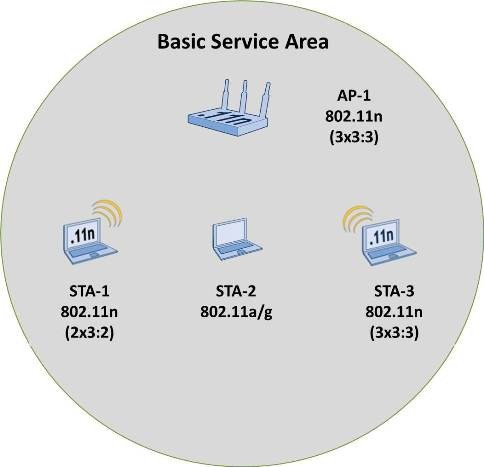 what is the maximum number of spatial streams that could be used for a downlink HT-OFDM transmission from AP-1 to STA-3?
-
A
One spatial stream, because the BSS must maintain backwards compatibility with STA-2, which supports only 802.11g (ERP) without MIMO or multiple spatial streams.
-
B
Two spatial streams, because the number of spatial streams for an HT-OFDM transmission is limited to the capabilities of the least capable HT station in the BSS.
-
C
Two spatial streams, because the third transmit chain in the HT AP must be used simultaneously for protection mechanisms with the 802.11g (ERP) station.
-
D
Three spatial streams, because HT-OFDM transmissions will be preceded with protection mechanisms using a basic data rate for STA-2 and possibly STA-1.
Reveal answer details
Close answer details
|