You are running a cluster on Kubernetes Engine (GKE) to serve a web application. Users are reporting that a specific part of the application is not responding anymore. You notice that all pods of your deployment keep restarting after 2 seconds. The application writes logs to standard output. You want to inspect the logs to find the cause of the issue. Which approach can you take?
-
A
Review the Stackdriver logs for each Compute Engine instance that is serving as a node in the cluster.
-
B
Review the Stackdriver logs for the specific Kubernetes Engine container that is serving the unresponsive part of the application.
-
C
Connect to the cluster using gcloud credentials and connect to a container in one of the pods to read the logs.
-
D
Review the Serial Port logs for each Compute Engine instance that is serving as a node in the cluster.
Reveal answer details
Close answer details
Case study
Case Study 8
Company overview Helicopter Racing League (HRL) is a global sports league for competitive helicopter racing.
Each year HRL holds the world championship and several regional league competitions where teams compete to earn a spot in the world championship. HRL offers a paid service to stream the races all over the world with live telemetry and predictions throughout each race. Solution concept
HRL wants to migrate their existing service to a new platform to expand their use of managed AI and ML services to facilitate race predictions. Additionally, as new fans engage with the sport, particularly in emerging regions, they want to move the serving of their content, both real-time and recorded, closer to their users. Existing technical environment
HRL is a public cloud-first company; the core of their mission-critical applications runs on their current
public cloud provider. Video recording and editing is performed at the race tracks, and the content is encoded and transcoded, where needed, in the cloud. Enterprisegrade connectivity and local compute is provided by truck-mounted mobile data centers.
Their race prediction services are hosted exclusively on their existing public cloud provider.
Their existing technical environment is as follows: 1. Existing content is stored in an object storage service on their existing public cloud provider.
2. Video encoding and transcoding is performed on VMs created for each job.
3. Race predictions are performed using TensorFlow running on VMs in the current public cloud provider. Business requirements
HRL's owners want to expand their predictive capabilities and reduce latency for their viewers in emerging markets.
Their requirements are:
1. Support ability to expose the predictive models to partners.
2. Increase predictive capabilities during and before races:
Race results
Mechanical failures
Crowd sentiment
3. Increase telemetry and create additional insights.
4. Measure fan engagement with new predictions.
5. Enhance global availability and quality of the broadcasts.
6. Increase the number of concurrent viewers.
7. Minimize operational complexity.
8. Ensure compliance with regulations.
9. Create a merchandising revenue stream. Technical requirements
1. Maintain or increase prediction throughput and accuracy.
2. Reduce viewer latency.
3. Increase transcoding performance.
4. Create real-time analytics of viewer consumption patterns and engagement.
5. Create a data mart to enable processing of large volumes of race data. Executive statement
Our CEO, S. Hawke, wants to bring high-adrenaline racing to fans all around the world. We listen to our fans, and they want enhanced video streams that include predictions of events within the race (e.g., overtaking). Our current platform allows us to predict race outcomes but lacks the facility to support real-time predictions during races and the capacity to process season-long results.
Testlet 8
Single choice
For this question, refer to the Helicopter Racing League (HRL) case study. Recently HRL started a new regional racing league in Cape Town, South Africa. In an effort to give customers in Cape Town a better user experience, HRL has partnered with the Content Delivery Network provider, Fastly. HRL needs to allow traffic coming from all of the Fastly IP address ranges into their Virtual Private Cloud network (VPC network). You are a member of the HRL security team and you need to configure the update that will allow only the Fastly IP address ranges through the External HTTP(S) load balancer. Which command should you use?
-
A
gcloud compute security-policies rules update 1000 \
--security-policy from-fastly \
--src-ip-ranges * \
--action "allow"
-
B
gcloud compute firewall rules update sourceiplist-fastly \
--priority 100 \
--allow tcp:443
-
C
gcloud compute firewall rules update hir-policy \
--priority 100 \
--target-tags=sourceiplist-fastly \
--allow tcp:443
-
D
gcloud compute security-policies rules update 1000 \
--security-policy hir-policy \
--expression "evaluatePreconfiguredExpr(`sourceiplist-fastly')" \
--action "allow"
Reveal answer details
Close answer details
Correct answerD
ExplanationReferences:
https://cloud.google.com/load-balancing/docs/https
Case study
Case Study 10
Company overview Mountkirk Games makes online, session-based, multiplayer games for mobile platforms. They have recently started expanding to other platforms after successfully migrating their on-premises environments to Google Cloud. Their most recent endeavor is to create a retro-style first-person shooter (FPS) game that allows hundreds of simultaneous players to join a geo-specific digital arena from multiple platforms and locations. A realtime digital banner will display a global leaderboard of all the top players across every active arena. Solution concept
Mountkirk Games is building a new multiplayer game that they expect to be very popular. They plan to deploy the game's backend on Google Kubernetes Engine so they can scale rapidly and use Google's global load balancer to route players to the closest regional game arenas. In order to keep the global leader board in sync, they plan to use a multi-region Spanner cluster. Existing technical environment
The existing environment was recently migrated to Google Cloud, and five games came across using liftand-shift virtual machine migrations, with a few minor exceptions. Each new game exists in an isolated Google Cloud project nested below a folder that maintains most of the permissions and network policies. Legacy games with low traffic have been consolidated into a single project. There are also separate environments for development and testing. Business requirements 1. Support multiple gaming platforms.
2. Support multiple regions.
3. Support rapid iteration of game features.
4. Minimize latency.
5. Optimize for dynamic scaling.
6. Use managed services and pooled resources.
7. Minimize costs. Technical requirements 1. Dynamically scale based on game activity.
2. Publish scoring data on a near real-time global leaderboard.
3. Store game activity logs in structured files for future analysis.
4. Use GPU processing to render graphics server-side for multi-platform support.
5. Support eventual migration of legacy games to this new platform. Executive statement
Our last game was the first time we used Google Cloud, and it was a tremendous success. We were able to analyze player behavior and game telemetry in ways that we never could before. This success allowed us to bet on a full migration to the cloud and to start building all-new games using cloud-native design principles. Our new game is our most ambitious to date and will open up doors for us to support more gaming platforms beyond mobile. Latency is our top priority, although cost management is the next most important challenge. As with our first cloud-based game, we have grown to expect the cloud to enable advanced analytics capabilities so we can rapidly iterate on our deployments of bug fixes and new functionality.
Testlet 10
Single choice
Mountkirk Games wants you to secure the connectivity from the new gaming application platform to Google Cloud. You want to streamline the process and follow Google-recommended practices. What should you do?
-
A
Configure Workload Identity and service accounts to be used by the application platform.
-
B
Use Kubernetes Secrets, which are obfuscated by default. Configure these Secrets to be used by the application platform.
-
C
Configure Kubernetes Secrets to store the secret, enable Application-Layer Secrets Encryption, and use Cloud Key Management Service (Cloud KMS) to manage the encryption keys. Configure these Secrets to be used by the application platform.
-
D
Configure HashiCorp Vault on Compute Engine, and use customer managed encryption keys and Cloud Key Management Service (Cloud KMS) to manage the encryption keys. Configure these Secrets to be used by the application platform.
Reveal answer details
Close answer details
You need to develop procedures to test a disaster plan for a mission-critical application. You want to use Google-recommended practices and native capabilities within GCP. What should you do?
-
A
Use Deployment Manager to automate service provisioning. Use Activity Logs to monitor and debug your tests.
-
B
Use Deployment Manager to automate provisioning. Use Stackdriver to monitor and debug your tests.
-
C
Use gcloud scripts to automate service provisioning. Use Activity Logs monitor and debug your tests.
-
D
Use automated scripts to automate service provisioning. Use Activity Logs monitor and debug your tests.
Reveal answer details
Close answer details
Correct answerB
Explanationhttps://cloud.google.com/solutions/dr-scenarios-planning-guide
You set up an autoscaling instance group to serve web traffic for an upcoming launch. After configuring the instance group as a backend service to an HTTP(S) load balancer, you notice that virtual machine (VM) instances are being terminated and re-launched every minute. The instances do not have a public IP address. You have verified the appropriate web response is coming from each instance using the curl command. You want to ensure the backend is configured correctly. What should you do?
-
A
Ensure that a firewall rule exists to allow source traffic on HTTP/HTTPS to reach the load balancer.
-
B
Assign a public IP to each instance and configure a firewall rule to allow the load balancer to reach the instance public IP.
-
C
Ensure that a firewall rule exists to allow load balancer health checks to reach the instances in the instance group.
-
D
Create a tag on each instance with the name of the load balancer. Configure a firewall rule with the name of the load balancer as the source and the instance tag as the destination.
Reveal answer details
Close answer details
Correct answerC
Explanationhttps://cloud.google.com/vpc/docs/using-firewalls The best practice when configuration a health check is to check health and serve traffic on the same port.
However, it is possible to perform health checks on one port, but serve traffic on another. If you do use two different ports, ensure that firewall rules and services running on instances are configured appropriately. If you run health checks and serve traffic on the same port, but decide to switch ports at some point, be sure to update both the backend service and the health check. Backend services that do not have a valid global forwarding rule referencing it will not be health checked and will have no health status. References:
https://cloud.google.com/compute/docs/load-balancing/http/backend-service
Your company provides a recommendation engine for retail customers. You are providing retail customers with an API where they can submit a user ID and the API returns a list of recommendations for that user.
You are responsible for the API lifecycle and want to ensure stability for your customers in case the API
makes backward-incompatible changes. You want to follow Google-recommended practices. What should you do?
-
A
Create a distribution list of all customers to inform them of an upcoming backward-incompatible change at least one month before replacing the old API with the new API.
-
B
Create an automated process to generate API documentation, and update the public API documentation as part of the CI/CD process when deploying an update to the API.
-
C
Use a versioning strategy for the APIs that increases the version number on every backward-incompatible change.
-
D
Use a versioning strategy for the APIs that adds the suffix "DEPRECATED" to the current API version number on every backward-incompatible change. Use the current version number for the new API.
Reveal answer details
Close answer details
Correct answerC
Explanationhttps://cloud.google.com/apis/design/versioning
All Google API interfaces must provide a major version number, which is encoded at the end of the protobuf package, and included as the first part of the URI path for REST APIs. If an API introduces a breaking change, such as removing or renaming a field, it must increment its API version number to ensure that existing user code does not suddenly break.
An application development team believes their current logging tool will not meet their needs for their new cloud-based product. They want a bettor tool to capture errors and help them analyze their historical log data. You want to help them find a solution that meets their needs. What should you do?
-
A
Direct them to download and install the Google StackDriver logging agent.
-
B
Send them a list of online resources about logging best practices.
-
C
Help them define their requirements and assess viable logging tools.
-
D
Help them upgrade their current tool to take advantage of any new features.
Reveal answer details
Close answer details
Correct answerC
ExplanationHelp them define their requirements and assess viable logging tools. They know the requirements and the existing tools' problems. While it's true StackDriver Logging and Error Reporting possibly meet all their requirements, there might be other tools also meet their need. They need you to provide expertise to make assessment for new tools, specifically, logging tools that can "capture errors and help them analyze their historical log data". References:
https://cloud.google.com/logging/docs/agent/installation
Your company has a Google Cloud project that uses BigQuery for data warehousing. There are some tables that contain personally identifiable information (PII). Only the compliance team may access the PII.
The other information in the tables must be available to the data science team. You want to minimize cost and the time it takes to assign appropriate access to the tables. What should you do?
-
A
1. From the dataset where you have the source data, create views of tables that you want to share, excluding Pll
2. Assign an appropriate project-level IAM role to the members of the data science team
3. Assign access controls to the dataset that contains the view
-
B
1. From the dataset where you have the source data, create materialized views of tables that you want to share excluding Pll
2. Assign an appropriate project-level IAM role to the members of the data science team 3..Assign access controls to the dataset that contains the view.
-
C
1. Create a dataset for the data science team
2. Create views of tables that you want to share excluding Pll
3. Assign an appropriate project-level IAM role to the members of the data science team
4. Assign access controls to the dataset that contains the view
5. Authorize the view to access the source dataset
-
D
1. Create a dataset for the data science team.
2. Create materialized views of tables that you want to share, excluding Pll
3. Assign an appropriate project-level IAM role to the members of the data science team
4. Assign access controls to the dataset that contains the view
5. Authorize the view to access the source dataset
Reveal answer details
Close answer details
Correct answerC
ExplanationThis option can help minimize cost and time by using views and authorized datasets. Views are virtual tables defined by a SQL query that can exclude PII columns from the source tables. Views do not incur storage costs and do not duplicate data. Authorized datasets are datasets that have access to another dataset's data without granting direct access to individual users or groups. By creating a dataset for the data science team and creating views of tables that exclude PII, you can share only the relevant information with the team. By assigning an appropriate project-level IAM role to the members of the data science team, you can grant them access to the BigQuery service and resources. By assigning access controls to the dataset that contains the view, you can grant them access to query the views. By authorizing the view to access the source dataset, you can enable the view to read data from the source tables without exposing PII. The other options are not optimal for this scenario, because they either use materialized views instead of views, which incur storage costs and duplicate data (B, D), or do not create a separate dataset for the data science team, which makes it harder to manage access controls (A).
References:
https://cloud.google.com/bigquery/docs/views
https://cloud.google.com/bigquery/docs/authorized-datasets
Case study
Case Study 5
Company Overview TerramEarth manufactures heavy equipment for the mining and agricultural industries. About 80% of their business is from mining and 20% from agriculture. They currently have over 500 dealers and service centers in 100 countries. Their mission is to build products that make their customers more productive. Solution Concept There are 20 million TerramEarth vehicles in operation that collect 120 fields of data per second. Data is stored locally on the vehicle and can be accessed for analysis when a vehicle is serviced. The data is downloaded via a maintenance port. This same port can be used to adjust operational parameters, allowing the vehicles to be upgraded in the field with new computing modules. Approximately 200,000 vehicles are connected to a cellular network, allowing TerramEarth to collect data directly. At a rate of 120 fields of data per second with 22 hours of operation per day, TerramEarth collects a total of about 9 TB/day from these connected vehicles. Existing Technical Environment TerramEarth's existing architecture is composed of Linux and Windows-based systems that reside in a single U.S. west coast based data center. These systems gzip CSV files from the field and upload via FTP, and place the data in their data warehouse. Because this process takes time, aggregated reports are based on data that is 3 weeks old. With this data, TerramEarth has been able to preemptively stock replacement parts and reduce unplanned downtime of their vehicles by 60%. However, because the data is stale, some customers are without their vehicles for up to 4 weeks while they wait for replacement parts. Business Requirements Decrease unplanned vehicle downtime to less than 1 week.
Support the dealer network with more data on how their customers use their equipment to better position new products and services Have the ability to partner with different companies - especially with seed and fertilizer suppliers in the fast-growing agricultural business - to create compelling joint offerings for their customers. Technical Requirements
Expand beyond a single datacenter to decrease latency to the American Midwest and east coast.
Create a backup strategy.
Increase security of data transfer from equipment to the datacenter.
Improve data in the data warehouse.
Use customer and equipment data to anticipate customer needs. Application 1: Data ingest
A custom Python application reads uploaded datafiles from a single server, writes to the data warehouse.
Compute:
Windows Server 2008 R2
- 16 CPUs
- 128 GB of RAM
- 10 TB local HDD storage Application 2: Reporting
An off the shelf application that business analysts use to run a daily report to see what equipment needs repair. Only 2 analysts of a team of 10 (5 west coast, 5 east coast) can connect to the reporting application at a time.
Compute:
Off the shelf application. License tied to number of physical CPUs
- Windows Server 2008 R2 - 16 CPUs
- 32 GB of RAM
- 500 GB HDD
Data warehouse:
A single PostgreSQL server
- RedHat Linux
- 64 CPUs
- 128 GB of RAM
- 4x 6TB HDD in RAID 0 Executive Statement Our competitive advantage has always been in the manufacturing process, with our ability to build better vehicles for lower cost than our competitors. However, new products with different approaches are constantly being developed, and I'm concerned that we lack the skills to undergo the next wave of transformations in our industry. My goals are to build our skills while addressing immediate market needs through incremental innovations.
Testlet 5
Single choice
For this question, refer to the TerramEarth case study. TerramEarth has decided to store data files in Cloud Storage. You need to configure Cloud Storage lifecycle rule to store 1 year of data and minimize file storage cost. Which two actions should you take?
-
A
Create a Cloud Storage lifecycle rule with Age: "30", Storage Class: "Standard", and Action: "Set to Coldline", and create a second GCS life-cycle rule with Age: "365", Storage Class: "Coldline", and Action: "Delete".
-
B
Create a Cloud Storage lifecycle rule with Age: "30", Storage Class: "Coldline", and Action: "Set to Nearline", and create a second GCS life-cycle rule with Age: "91", Storage Class: "Coldline", and Action: "Set to Nearline".
-
C
Create a Cloud Storage lifecycle rule with Age: "90", Storage Class: "Standard", and Action: "Set to Nearline", and create a second GCS life-cycle rule with Age: "91", Storage Class: "Nearline", and Action: "Set to Coldline".
-
D
Create a Cloud Storage lifecycle rule with Age: "30", Storage Class: "Standard", and Action: "Set to Coldline", and create a second GCS life-cycle rule with Age: "365", Storage Class: "Nearline", and Action: "Delete".
Reveal answer details
Close answer details
Question 10
Single choice
You are planning to migrate your on-premises compute and SAP workloads to Google Cloud. You want to follow Google-recommended practices to quickly create a cost estimate for running these workloads in Google Cloud. What should you do?
-
A
Leverage Cloud Asset Inventory to gather data and generate a cost estimate.
-
B
Use the Google Cloud pricing calculator, and input the estimated resource to generate a cost estimate.
-
C
Engage with a Google Cloud partner to perform a comprehensive assessment and provide a customized cost estimate.
-
D
Gather data about your current environment, and leverage Google Cloud Migration Center to generate a cost estimate.
Reveal answer details
Close answer details
Correct answerD
ExplanationGoogle Cloud Migration Center is the recommended tool for quickly estimating migration costs. It allows you to collect on-premises infrastructure data, analyze workload characteristics, and generate automated cost estimates for running those workloads (including SAP) on Google Cloud. This approach provides accurate, data-driven insights aligned with Google best practices.
Question 11
Single choice
You are analyzing and defining business processes to support your startup's trial usage of GCP, and you don't yet know what consumer demand for your product will be. Your manager requires you to minimize GCP service costs and adhere to Google best practices. What should you do?
-
A
Utilize free tier and sustained use discounts. Provision a staff position for service cost management.
-
B
Utilize free tier and sustained use discounts. Provide training to the team about service cost management.
-
C
Utilize free tier and committed use discounts. Provision a staff position for service cost management.
-
D
Utilize free tier and committed use discounts. Provide training to the team about service cost management.
Reveal answer details
Close answer details
Correct answerB
Explanationhttps://cloud.google.com/compute/docs/instances/signing-up-committed-use-discounts
Question 12
Single choice
You want your Google Kubernetes Engine cluster to automatically add or remove nodes based on CPU load. What should you do?
-
A
Configure a HorizontalPodAutoscaler with a target CPU usage. Enable the Cluster Autoscaler from the
GCP Console.
-
B
Configure a HorizontalPodAutoscaler with a target CPU usage. Enable autoscaling on the managed instance group for the cluster using the gcloud command.
-
C
Create a deployment and set the maxUnavailable and maxSurge properties. Enable the Cluster Autoscaler using the gcloud command.
-
D
Create a deployment and set the maxUnavailable and maxSurge properties. Enable autoscaling on the cluster managed instance group from the GCP Console.
Reveal answer details
Close answer details
Case study
Case Study 4
Company Overview TerramEarth manufactures heavy equipment for the mining and agricultural industries: about 80% of their business is from mining and 20% from agriculture. They currently have over 500 dealers and service centers in 100 countries. Their mission is to build products that make their customers more productive. Company background TerramEarth was formed in 1946, when several small, family owned companies combined to retool after World War II. The company cares about their employees and customers and considers them to be extended members of their family. TerramEarth is proud of their ability to innovate on their core products and find new markets as their customers' needs change. For the past 20 years, trends in the industry have been largely toward increasing productivity by using larger vehicles with a human operator. Solution Concept There are 20 million TerramEarth vehicles in operation that collect 120 fields of data per second. Data is stored locally on the vehicle and can be accessed for analysis when a vehicle is serviced. The data is downloaded via a maintenance port. This same port can be used to adjust operational parameters, allowing the vehicles to be upgraded in the field with new computing modules. Approximately 200,000 vehicles are connected to a cellular network, allowing TerramEarth to collect data directly. At a rate of 120 fields of data per second with 22 hours of operation per day, Terram Earth collects a total of about 9 TB/day from these connected vehicles. Existing Technical Environment 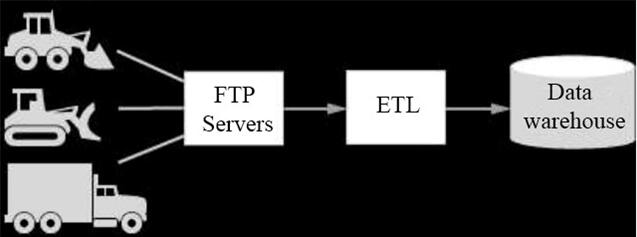 TerramEarth's existing architecture is composed of Linux-based systems that reside in a data center.
These systems gzip CSV files from the field and upload via FTP, transform and aggregate them, and place the data in their data warehouse. Because this process takes time, aggregated reports are based on data that is 3 weeks old. With this data, TerramEarth has been able to preemptively stock replacement parts and reduce unplanned downtime of their vehicles by 60%. However, because the data is stale, some customers are without their vehicles for up to 4 weeks while they wait for replacement parts. Business Requirements 1. Decrease unplanned vehicle downtime to less than 1 week, without increasing the cost of carrying surplus inventory
2. Support the dealer network with more data on how their customers use their equipment to better position new products and services
3. Have the ability to partner with different companies - especially with seed and fertilizer suppliers in the fast-growing agricultural business - to create compelling joint offerings for their customers. CEO Statement We have been successful in capitalizing on the trend toward larger vehicles to increase the productivity of our customers. Technological change is occurring rapidly, and TerramEarth has taken advantage of connected devices technology to provide our customers with better services, such as our intelligent farming equipment. With this technology, we have been able to increase farmers' yields by 25%, by using past trends to adjust how our vehicles operate. These advances have led to the rapid growth of our agricultural product line, which we expect will generate 50% of our revenues by 2020. CTO Statement Our competitive advantage has always been in the manufacturing process, with our ability to build better vehicles for lower cost than our competitors. However, new products with different approaches are constantly being developed, and I'm concerned that we lack the skills to undergo the next wave of transformations in our industry. Unfortunately, our CEO doesn't take technology obsolescence seriously and he considers the many new companies in our industry to be niche players. My goals are to build our skills while addressing immediate market needs through incremental innovations.
Testlet 4
Single choice
Your development team has created a structured API to retrieve vehicle data. They want to allow third parties to develop tools for dealerships that use this vehicle event data. You want to support delegated authorization against this data. What should you do?
-
A
Build or leverage an OAuth-compatible access control system
-
B
Build SAML 2.0 SSO compatibility into your authentication system
-
C
Restrict data access based on the source IP address of the partner systems
-
D
Create secondary credentials for each dealer that can be given to the trusted third party
Reveal answer details
Close answer details
Correct answerA
ExplanationDelegate application authorization with OAuth2 Cloud Platform APIs support OAuth 2.0, and scopes provide granular authorization over the methods that are supported. Cloud Platform supports both service-account and user-account OAuth, also called three-legged OAuth. References:
https://cloud.google.com/docs/enterprise/best-practices-for-enterprise-organizations#delegate_application_authorization_with_oauth2
https://cloud.google.com/appengine/docs/flexible/go/authorizing-apps
Question 14
Single choice
Your team is running applications on a Google Kubernetes Engine (GKE) cluster with a private endpoint.
You've set up a Cloud Deploy pipeline, but deployments to the GKE cluster are failing. You need to resolve the issue. What should you do?
-
A
Use VPC Service Controls with Cloud Build Update the Cloud pipeline to use Cloud Build as its execution environment.
-
B
Create a Cloud Build private pool in the default VPC. Use Cloud Build to deploy the applications to the
GKE cluster.
-
C
Create a Cloud Build private pool that is peered with the same VPC network as your GKE cluster.Update the Cloud Deploy pipeline to use this private pool as its execution environment.
-
D
Create a custom target in Cloud Deploy Update the deploy pipeline to use the custom target for the application deployment.
Reveal answer details
Close answer details
Correct answerC
ExplanationA GKE cluster with a private endpoint is only reachable from networks that have private connectivity to the control plane (same VPC or peered). By default, Cloud Deploy uses a public Cloud Build pool, which cannot reach the private endpoint. Creating a Cloud Build private pool that is peered with the same VPC as the GKE cluster, and configuring Cloud Deploy to use this pool as its execution environment, gives the deploy job private network access to the cluster and resolves the deployment failures.
Question 15
Single choice
You are using a single Cloud SQL instance to serve your application from a specific zone. You want to introduce high availability. What should you do?
-
A
Create a read replica instance in a different region
-
B
Create a failover replica instance in a different region
-
C
Create a read replica instance in the same region, but in a different zone
-
D
Create a failover replica instance in the same region, but in a different zone
Reveal answer details
Close answer details
Correct answerD
Explanationhttps://cloud.google.com/sql/docs/mysql/high-availability#HA-configuration
Question 16
Single choice
Your company has just recently activated Cloud Identity to manage users. The Google Cloud Organization has been configured as well. The security team needs to secure projects that will be part of the Organization. They want to prohibit IAM users outside the domain from gaining permissions from now on. What should they do?
-
A
Configure an organization policy to restrict identities by domain
-
B
Configure an organization policy to block creation of service accounts
-
C
Configure Cloud Scheduler to trigger a Cloud Function every hour that removes all users that don't belong to the Cloud identity domain from all projects.
-
D
Create a technical user (e.g., [email protected]), and give it the project owner role at root organization level.
Reveal answer details
Close answer details
Correct answerA
Explanationhttps://cloud.google.com/resource-manager/docs/organization-policy/restricting-domains
Case study
Case Study 5
Company Overview TerramEarth manufactures heavy equipment for the mining and agricultural industries. About 80% of their business is from mining and 20% from agriculture. They currently have over 500 dealers and service centers in 100 countries. Their mission is to build products that make their customers more productive. Solution Concept There are 20 million TerramEarth vehicles in operation that collect 120 fields of data per second. Data is stored locally on the vehicle and can be accessed for analysis when a vehicle is serviced. The data is downloaded via a maintenance port. This same port can be used to adjust operational parameters, allowing the vehicles to be upgraded in the field with new computing modules. Approximately 200,000 vehicles are connected to a cellular network, allowing TerramEarth to collect data directly. At a rate of 120 fields of data per second with 22 hours of operation per day, TerramEarth collects a total of about 9 TB/day from these connected vehicles. Existing Technical Environment TerramEarth's existing architecture is composed of Linux and Windows-based systems that reside in a single U.S. west coast based data center. These systems gzip CSV files from the field and upload via FTP, and place the data in their data warehouse. Because this process takes time, aggregated reports are based on data that is 3 weeks old. With this data, TerramEarth has been able to preemptively stock replacement parts and reduce unplanned downtime of their vehicles by 60%. However, because the data is stale, some customers are without their vehicles for up to 4 weeks while they wait for replacement parts. Business Requirements Decrease unplanned vehicle downtime to less than 1 week.
Support the dealer network with more data on how their customers use their equipment to better position new products and services Have the ability to partner with different companies - especially with seed and fertilizer suppliers in the fast-growing agricultural business - to create compelling joint offerings for their customers. Technical Requirements
Expand beyond a single datacenter to decrease latency to the American Midwest and east coast.
Create a backup strategy.
Increase security of data transfer from equipment to the datacenter.
Improve data in the data warehouse.
Use customer and equipment data to anticipate customer needs. Application 1: Data ingest
A custom Python application reads uploaded datafiles from a single server, writes to the data warehouse.
Compute:
Windows Server 2008 R2
- 16 CPUs
- 128 GB of RAM
- 10 TB local HDD storage Application 2: Reporting
An off the shelf application that business analysts use to run a daily report to see what equipment needs repair. Only 2 analysts of a team of 10 (5 west coast, 5 east coast) can connect to the reporting application at a time.
Compute:
Off the shelf application. License tied to number of physical CPUs
- Windows Server 2008 R2 - 16 CPUs
- 32 GB of RAM
- 500 GB HDD
Data warehouse:
A single PostgreSQL server
- RedHat Linux
- 64 CPUs
- 128 GB of RAM
- 4x 6TB HDD in RAID 0 Executive Statement Our competitive advantage has always been in the manufacturing process, with our ability to build better vehicles for lower cost than our competitors. However, new products with different approaches are constantly being developed, and I'm concerned that we lack the skills to undergo the next wave of transformations in our industry. My goals are to build our skills while addressing immediate market needs through incremental innovations.
Testlet 5
Single choice
For this question, refer to the TerramEarth case study. You need to implement a reliable, scalable GCP solution for the data warehouse for your company, TerramEarth. Considering the TerramEarth business and technical requirements, what should you do?
-
A
Replace the existing data warehouse with BigQuery. Use table partitioning.
-
B
Replace the existing data warehouse with a Compute Engine instance with 96 CPUs.
-
C
Replace the existing data warehouse with BigQuery. Use federated data sources.
-
D
Replace the existing data warehouse with a Compute Engine instance with 96 CPUs. Add an additional Compute Engine pre-emptible instance with 32 CPUs.
Reveal answer details
Close answer details
Question 18
Multiple choice
Your company just finished a rapid lift and shift to Google Compute Engine for your compute needs. You have another 9 months to design and deploy a more cloud-native solution. Specifically, you want a system that is no-ops and auto-scaling. Which two compute products should you choose? (Choose two.)
-
A
Compute Engine with containers
-
B
Google Kubernetes Engine with containers
-
C
Google App Engine Standard Environment
-
D
Compute Engine with custom instance types
-
E
Compute Engine with managed instance groups
Reveal answer details
Close answer details
Correct answersB, C
ExplanationB: With Container Engine, Google will automatically deploy your cluster for you, update, patch, secure the nodes.
Kubernetes Engine's cluster autoscaler automatically resizes clusters based on the demands of the workloads you want to run.
C: Solutions like Datastore, BigQuery, AppEngine, etc are truly NoOps. App Engine by default scales the number of instances running up and down to match the load, thus providing consistent performance for your app at all times while minimizing idle instances and thus reducing cost.
Note: At a high level, NoOps means that there is no infrastructure to build out and manage during usage of the platform. Typically, the compromise you make with NoOps is that you lose control of the underlying infrastructure. References:
https://www.quora.com/How-well-does-Google-Container-Engine-support-Google-Cloud-Platform%E2%80%99s-NoOps-claim
Question 19
Single choice
You have deployed an application on Anthos clusters (formerly Anthos GKE). According to the SRE practices at your company you need to be alerted if the request latency is above a certain threshold for a specified amount of time. What should you do?
-
A
Enable the Cloud Trace API on your project, and use Cloud Monitoring Alerts to send an alert based on the Cloud Trace metrics.
-
B
Configure Anthos Config Management on your cluster, and create a yaml file that defines the SLO and alerting policy you want to deploy in your cluster.
-
C
Use Cloud Profiler to follow up the request latency. Create a custom metric in Cloud Monitoring based on the results of Cloud Profiler, and create an Alerting policy in case this metric exceeds the threshold.
-
D
Install Anthos Service Mesh on your cluster. Use the Google Cloud Console to define a Service Level Objective (SLO), and create an alerting policy based on this SLO.
Reveal answer details
Close answer details
Correct answerD
Explanationhttps://cloud.google.com/service-mesh/docs/overview
https://cloud.google.com/service-mesh/docs/observability/slo-overview
Question 20
Single choice
Your product team is building a critical, customer-facing application on Google Cloud. The development team wants to use Spanner for their database to take advantage of its horizontal scalability and low operational overhead.
However, the FinOps team is concerned about the direct monthly cost of Spanner and proposed using a self-managed PostgreSQL database on Compute Engine VMs instead. You need to resolve this conflict and ensure the project moves forward with an architecturally sound database choice that balances technical requirements with financial constraints. What should you do?
-
A
Provide the development team with a reference architecture for deploying a highly available PostgreSQL cluster on a regional managed instance group (MIG).
-
B
Suggest using Cloud SQL for PostgreSQL as a compromise to get a managed service at a lower cost than Spanner.
-
C
Develop a total cost of ownership (TCO) analysis that includes operational overhead, and present it in a workshop to facilitate a decision.
-
D
Cite the reliability and performance optimization pillars of the Google Cloud Well-Architected Framework to formally justify the use of Spanner.
Reveal answer details
Close answer details
Correct answerC
ExplanationThis is a stakeholder and trade-off decision, not just a pure tech choice. The Google-recommended approach is to perform a total cost of ownership (TCO) analysis that includes not only direct service costs, but also operational overhead, maintenance, reliability engineering, and scaling complexity of a self-managed PostgreSQL on Compute Engine vs. managed options like Spanner. Presenting this TCO in a workshop with development and FinOps enables a data-driven, shared decision that balances technical requirements (scalability, reliability) with financial constraints, ensuring an architecturally sound and agreed-upon database choice.
Case study
Case Study 5
Company Overview TerramEarth manufactures heavy equipment for the mining and agricultural industries. About 80% of their business is from mining and 20% from agriculture. They currently have over 500 dealers and service centers in 100 countries. Their mission is to build products that make their customers more productive. Solution Concept There are 20 million TerramEarth vehicles in operation that collect 120 fields of data per second. Data is stored locally on the vehicle and can be accessed for analysis when a vehicle is serviced. The data is downloaded via a maintenance port. This same port can be used to adjust operational parameters, allowing the vehicles to be upgraded in the field with new computing modules. Approximately 200,000 vehicles are connected to a cellular network, allowing TerramEarth to collect data directly. At a rate of 120 fields of data per second with 22 hours of operation per day, TerramEarth collects a total of about 9 TB/day from these connected vehicles. Existing Technical Environment TerramEarth's existing architecture is composed of Linux and Windows-based systems that reside in a single U.S. west coast based data center. These systems gzip CSV files from the field and upload via FTP, and place the data in their data warehouse. Because this process takes time, aggregated reports are based on data that is 3 weeks old. With this data, TerramEarth has been able to preemptively stock replacement parts and reduce unplanned downtime of their vehicles by 60%. However, because the data is stale, some customers are without their vehicles for up to 4 weeks while they wait for replacement parts. Business Requirements Decrease unplanned vehicle downtime to less than 1 week.
Support the dealer network with more data on how their customers use their equipment to better position new products and services Have the ability to partner with different companies - especially with seed and fertilizer suppliers in the fast-growing agricultural business - to create compelling joint offerings for their customers. Technical Requirements
Expand beyond a single datacenter to decrease latency to the American Midwest and east coast.
Create a backup strategy.
Increase security of data transfer from equipment to the datacenter.
Improve data in the data warehouse.
Use customer and equipment data to anticipate customer needs. Application 1: Data ingest
A custom Python application reads uploaded datafiles from a single server, writes to the data warehouse.
Compute:
Windows Server 2008 R2
- 16 CPUs
- 128 GB of RAM
- 10 TB local HDD storage Application 2: Reporting
An off the shelf application that business analysts use to run a daily report to see what equipment needs repair. Only 2 analysts of a team of 10 (5 west coast, 5 east coast) can connect to the reporting application at a time.
Compute:
Off the shelf application. License tied to number of physical CPUs
- Windows Server 2008 R2 - 16 CPUs
- 32 GB of RAM
- 500 GB HDD
Data warehouse:
A single PostgreSQL server
- RedHat Linux
- 64 CPUs
- 128 GB of RAM
- 4x 6TB HDD in RAID 0 Executive Statement Our competitive advantage has always been in the manufacturing process, with our ability to build better vehicles for lower cost than our competitors. However, new products with different approaches are constantly being developed, and I'm concerned that we lack the skills to undergo the next wave of transformations in our industry. My goals are to build our skills while addressing immediate market needs through incremental innovations.
Testlet 5
Single choice
For this question, refer to the TerramEarth case study.
Considering the technical requirements, how should you reduce the unplanned vehicle downtime in GCP?
-
A
Use BigQuery as the data warehouse. Connect all vehicles to the network and stream data into BigQuery using Cloud Pub/Sub and Cloud Dataflow. Use Google Data Studio for analysis and reporting.
-
B
Use BigQuery as the data warehouse. Connect all vehicles to the network and upload gzip files to a Multi-Regional Cloud Storage bucket using gcloud. Use Google Data Studio for analysis and reporting.
-
C
Use Cloud Dataproc Hive as the data warehouse. Upload gzip files to a MultiRegional Cloud Storage bucket. Upload this data into BigQuery using gcloud. Use Google data Studio for analysis and reporting.
-
D
Use Cloud Dataproc Hive as the data warehouse. Directly stream data into prtitioned Hive tables. Use
Pig scripts to analyze data.
Reveal answer details
Close answer details
Case study
Case Study 10
Company overview Mountkirk Games makes online, session-based, multiplayer games for mobile platforms. They have recently started expanding to other platforms after successfully migrating their on-premises environments to Google Cloud. Their most recent endeavor is to create a retro-style first-person shooter (FPS) game that allows hundreds of simultaneous players to join a geo-specific digital arena from multiple platforms and locations. A realtime digital banner will display a global leaderboard of all the top players across every active arena. Solution concept
Mountkirk Games is building a new multiplayer game that they expect to be very popular. They plan to deploy the game's backend on Google Kubernetes Engine so they can scale rapidly and use Google's global load balancer to route players to the closest regional game arenas. In order to keep the global leader board in sync, they plan to use a multi-region Spanner cluster. Existing technical environment
The existing environment was recently migrated to Google Cloud, and five games came across using liftand-shift virtual machine migrations, with a few minor exceptions. Each new game exists in an isolated Google Cloud project nested below a folder that maintains most of the permissions and network policies. Legacy games with low traffic have been consolidated into a single project. There are also separate environments for development and testing. Business requirements 1. Support multiple gaming platforms.
2. Support multiple regions.
3. Support rapid iteration of game features.
4. Minimize latency.
5. Optimize for dynamic scaling.
6. Use managed services and pooled resources.
7. Minimize costs. Technical requirements 1. Dynamically scale based on game activity.
2. Publish scoring data on a near real-time global leaderboard.
3. Store game activity logs in structured files for future analysis.
4. Use GPU processing to render graphics server-side for multi-platform support.
5. Support eventual migration of legacy games to this new platform. Executive statement
Our last game was the first time we used Google Cloud, and it was a tremendous success. We were able to analyze player behavior and game telemetry in ways that we never could before. This success allowed us to bet on a full migration to the cloud and to start building all-new games using cloud-native design principles. Our new game is our most ambitious to date and will open up doors for us to support more gaming platforms beyond mobile. Latency is our top priority, although cost management is the next most important challenge. As with our first cloud-based game, we have grown to expect the cloud to enable advanced analytics capabilities so we can rapidly iterate on our deployments of bug fixes and new functionality.
Testlet 10
Single choice
Your development teams release new versions of games running on Google Kubernetes Engine (GKE) daily. You want to create service level indicators (SLIs) to evaluate the quality of the new versions from the user's perspective. What should you do?
-
A
Create CPU Utilization and Request Latency as service level indicators.
-
B
Create GKE CPU Utilization and Memory Utilization as service level indicators.
-
C
Create Request Latency and Error Rate as service level indicators.
-
D
Create Server Uptime and Error Rate as service level indicators.
Reveal answer details
Close answer details
Question 23
Single choice
Your company has a Google Cloud project that uses BigQuery for data warehousing. The VPN tunnel between the on-premises environment and Google Cloud is configured with Cloud VPN. Your security team wants to avoid data exfiltration by malicious insiders, compromised code, and accidental oversharing. What should you do?
-
A
Configure VPC Service Controls and configure Private Google Access for on-premises hosts.
-
B
Create a service account, grant the BigQuery JobUser role and Storage Object Viewer role to the service account, and remove all other Identity and Access Management (IAM) access from the project.
-
C
Configure Private Google Access.
-
D
Configure Private Service Connect.
Reveal answer details
Close answer details
Question 24
Single choice
Your company has an application running on Compute Engine mat allows users to play their favorite music. There are a fixed number of instances Files are stored in Cloud Storage and data is streamed directly to users. Users are reporting that they sometimes need to attempt to play popular songs multiple times before they are successful. You need to improve the performance of the application. What should you do?
-
A
1. Copy popular songs into CloudSQL as a blob
2. Update application code to retrieve data from CloudSQL when Cloud Storage is overloaded
-
B
1. Create a managed instance group with Compute Engine instances
2. Create a global load balancer and configure it with two backends
* Managed instance group
* Cloud Storage bucket
3. Enable Cloud CDN on the bucket backend
-
C
1. Mount the Cloud Storage bucket using gcsfuse on all backend Compute Engine instances
2. Serve muse files directly from the backend Compute Engine instance
-
D
1. Create a Cloud Filestore NFS volume and attach it to the backend Compute Engine instances
2. Download popular songs in Cloud Filestore
3. Serve music Wes directly from the backend Compute Engine instance
Reveal answer details
Close answer details
Case study
Case Study 4
Company Overview TerramEarth manufactures heavy equipment for the mining and agricultural industries: about 80% of their business is from mining and 20% from agriculture. They currently have over 500 dealers and service centers in 100 countries. Their mission is to build products that make their customers more productive. Company background TerramEarth was formed in 1946, when several small, family owned companies combined to retool after World War II. The company cares about their employees and customers and considers them to be extended members of their family. TerramEarth is proud of their ability to innovate on their core products and find new markets as their customers' needs change. For the past 20 years, trends in the industry have been largely toward increasing productivity by using larger vehicles with a human operator. Solution Concept There are 20 million TerramEarth vehicles in operation that collect 120 fields of data per second. Data is stored locally on the vehicle and can be accessed for analysis when a vehicle is serviced. The data is downloaded via a maintenance port. This same port can be used to adjust operational parameters, allowing the vehicles to be upgraded in the field with new computing modules. Approximately 200,000 vehicles are connected to a cellular network, allowing TerramEarth to collect data directly. At a rate of 120 fields of data per second with 22 hours of operation per day, Terram Earth collects a total of about 9 TB/day from these connected vehicles. Existing Technical Environment TerramEarth's existing architecture is composed of Linux-based systems that reside in a data center.
These systems gzip CSV files from the field and upload via FTP, transform and aggregate them, and place the data in their data warehouse. Because this process takes time, aggregated reports are based on data that is 3 weeks old. With this data, TerramEarth has been able to preemptively stock replacement parts and reduce unplanned downtime of their vehicles by 60%. However, because the data is stale, some customers are without their vehicles for up to 4 weeks while they wait for replacement parts. Business Requirements 1. Decrease unplanned vehicle downtime to less than 1 week, without increasing the cost of carrying surplus inventory
2. Support the dealer network with more data on how their customers use their equipment to better position new products and services
3. Have the ability to partner with different companies - especially with seed and fertilizer suppliers in the fast-growing agricultural business - to create compelling joint offerings for their customers. CEO Statement We have been successful in capitalizing on the trend toward larger vehicles to increase the productivity of our customers. Technological change is occurring rapidly, and TerramEarth has taken advantage of connected devices technology to provide our customers with better services, such as our intelligent farming equipment. With this technology, we have been able to increase farmers' yields by 25%, by using past trends to adjust how our vehicles operate. These advances have led to the rapid growth of our agricultural product line, which we expect will generate 50% of our revenues by 2020. CTO Statement Our competitive advantage has always been in the manufacturing process, with our ability to build better vehicles for lower cost than our competitors. However, new products with different approaches are constantly being developed, and I'm concerned that we lack the skills to undergo the next wave of transformations in our industry. Unfortunately, our CEO doesn't take technology obsolescence seriously and he considers the many new companies in our industry to be niche players. My goals are to build our skills while addressing immediate market needs through incremental innovations. Your agricultural division is experimenting with fully autonomous vehicles. You want your architecture to
promote strong security during vehicle operation. Which two architectures should you consider? (Choose two.)
-
A
Treat every micro service call between modules on the vehicle as untrusted.
-
B
Require IPv6 for connectivity to ensure a secure address space.
-
C
Use a trusted platform module (TPM) and verify firmware and binaries on boot.
-
D
Use a functional programming language to isolate code execution cycles.
-
E
Use multiple connectivity subsystems for redundancy.
-
F
Enclose the vehicle's drive electronics in a Faraday cage to isolate chips.
Reveal answer details
Close answer details
Case study
Case Study 2
Company Overview Mountkirk Games makes online, session-based, multiplayer games for the most popular mobile platforms. Company Background Mountkirk Games builds all of their games with some server-side integration, and has historically used cloud providers to lease physical servers. A few of their games were more popular than expected, and they had problems scaling their application servers, MySQL databases, and analytics tools.
Mountkirk's current model is to write game statistics to files and send them through an ETL tool that loads them into a centralized MySQL database for reporting. Solution Concept Mountkirk Gamesis building a new game, which they expect to be very popular. They plan to deploy the game's backend on Google Compute Engine so they can capture streaming metrics, run intensive analytics, and take advantage of its autoscaling server environment and integrate with a managed NoSQL database. Technical Requirements Requirements for Game Backend Platform
1. Dynamically scale up or down based on game activity
2. Connect to a managed NoSQL database service
3. Run customize Linux distro Requirements for Game Analytics Platform
1. Dynamically scale up or down based on game activity
2. Process incoming data on the fly directly from the game servers
3. Process data that arrives late because of slow mobile networks
4. Allow SQL queries to access at least 10 TB of historical data
5. Process files that are regularly uploaded by users' mobile devices
6. Use only fully managed services CEO Statement Our last successful game did not scale well with our previous cloud provider, resulting in lower user adoption and affecting the game's reputation. Our investors want more key performance indicators (KPIs) to evaluate the speed and stability of the game, as well as other metrics that provide deeper insight into usage patterns so we can adapt the game to target users. CTO Statement Our current technology stack cannot provide the scale we need, so we want to replace MySQL and move to an environment that provides autoscaling, low latency load balancing, and frees us up from managing physical servers. CFO Statement We are not capturing enough user demographic data, usage metrics, and other KPIs. As a result, we do not engage the right users, we are not confident that our marketing is targeting the right users, and we are not selling enough premium Blast-Ups inside the games, which dramatically impacts our revenue.
Testlet 2
Single choice
Mountkirk Games wants to set up a continuous delivery pipeline. Their architecture includes many small services that they want to be able to update and roll back quickly.
Mountkirk Games has the following requirements: 1. Services are deployed redundantly across multiple regions in the US and Europe
2. Only frontend services are exposed on the public internet
3. They can provide a single frontend IP for their fleet of services
4. Deployment artifacts are immutable Which set of products should they use?
-
A
Google Cloud Storage, Google Cloud Dataflow, Google Compute Engine
-
B
Google Cloud Storage, Google App Engine, Google Network Load Balancer
-
C
Google Kubernetes Registry, Google Container Engine, Google HTTP(S) Load Balancer
-
D
Google Cloud Functions, Google Cloud Pub/Sub, Google Cloud Deployment Manager
Reveal answer details
Close answer details
Correct answerC
ExplanationA is not correct because Mountkirk Games wants to set up a continuous delivery pipeline, not a data processing pipeline. Cloud Dataflow is a fully managed service for creating data processing pipelines. B is not correct because a Cloud Load Balancer distributes traffic to Compute Engine instances. App Engine and Cloud Load Balancer are parts of different solutions. C is correct because: Google Kubernetes Engine is ideal for deploying small services that can be updated and rolled back quickly. It is a best practice to manage services using immutable containers. -Cloud Load Balancing supports globally distributed services across multiple regions. It provides a single global IP address that can be used in DNS records. Using URL Maps, the requests can be routed to only the services that Mountkirk wants to expose. -Container Registry is a single place for a team to manage Docker images for the services. D is not correct because you cannot reserve a single frontend IP for cloud functions. When deployed, an HTTP-triggered cloud function creates an endpoint with an automatically assigned IP.
Case study
Case Study 9
Company overview EHR Healthcare is a leading provider of electronic health record software to the medical industry. EHR Healthcare provides their software as a service to multi-national medical offices, hospitals, and insurance providers. Solution concept Due to rapid changes in the healthcare and insurance industry, EHR Healthcare's business has been growing exponentially year over year. They need to be able to scale their environment, adapt their disaster recovery plan, and roll out new continuous deployment capabilities to update their software at a fast pace.
Google Cloud has been chosen to replace their current colocation facilities. Existing technical environment EHR's software is currently hosted in multiple colocation facilities. The lease on one of the data centers is about to expire. Customer-facing applications are web-based, and many have recently been containerized to run on a group of Kubernetes clusters. Data is stored in a mixture of relational and NoSQL databases (MySQL, MS SQL Server, Redis, and MongoDB). EHR is hosting several legacy file-and API-based integrations with insurance providers on-premises.
These systems are scheduled to be replaced over the next several years. There is no plan to upgrade or move these systems at the current time. Users are managed via Microsoft Active Directory. Monitoring is currently being done via various open source tools. Alerts are sent via email and are often ignored. Business requirements 1. On-board new insurance providers as quickly as possible.
2. Provide a minimum 99.9% availability for all customer-facing systems.
3. Provide centralized visibility and proactive action on system performance and usage.
4. Increase ability to provide insights into healthcare trends.
5. Reduce latency to all customers.
6. Maintain regulatory compliance.
7. Decrease infrastructure administration costs.
8. Make predictions and generate reports on industry trends based on provider data. Technical requirements 1. Maintain legacy interfaces to insurance providers with connectivity to both on-premises systems and cloud providers.
2. Provide a consistent way to manage customer-facing applications that are container-based.
3. Provide a secure and high-performance connection between on-premises systems and Google Cloud.
4. Provide consistent logging, log retention, monitoring, and alerting capabilities.
5. Maintain and manage multiple container-based environments.
6. Dynamically scale and provision new environments.
7. Create interfaces to ingest and process data from new providers. Executive statement Our on-premises strategy has worked for years but has required a major investment of time and money in training our team on distinctly different systems, managing similar but separate environments, and responding to outages. Many of these outages have been a result of misconfigured systems, inadequate capacity to manage spikes in traffic, and inconsistent monitoring practices. We want to use Google Cloud to leverage a scalable, resilient platform that can span multiple environments seamlessly and provide a consistent and stable user experience that positions us for future growth.
Testlet 9
Single choice
You need to upgrade the EHR connection to comply with their requirements. The new connection design must support business-critical needs and meet the same network and security policy requirements. What should you do?
-
A
Add a new Dedicated Interconnect connection.
-
B
Upgrade the bandwidth on the Dedicated Interconnect connection to 100 G.
-
C
Add three new Cloud VPN connections.
-
D
Add a new Carrier Peering connection.
Reveal answer details
Close answer details
Correct answerA
ExplanationThe case does not call out the throughput being an issue. However, to achieve 99.99%, you need to have 4 connections as per Google recommendations. However, in the options only A has the option to add an additional Interconnect connection.
https://cloud.google.com/network-connectivity/docs/interconnect/concepts/dedicatedoverview#availability
Case study
Case Study 10
Company overview Mountkirk Games makes online, session-based, multiplayer games for mobile platforms. They have recently started expanding to other platforms after successfully migrating their on-premises environments to Google Cloud. Their most recent endeavor is to create a retro-style first-person shooter (FPS) game that allows hundreds of simultaneous players to join a geo-specific digital arena from multiple platforms and locations. A realtime digital banner will display a global leaderboard of all the top players across every active arena. Solution concept
Mountkirk Games is building a new multiplayer game that they expect to be very popular. They plan to deploy the game's backend on Google Kubernetes Engine so they can scale rapidly and use Google's global load balancer to route players to the closest regional game arenas. In order to keep the global leader board in sync, they plan to use a multi-region Spanner cluster. Existing technical environment
The existing environment was recently migrated to Google Cloud, and five games came across using liftand-shift virtual machine migrations, with a few minor exceptions. Each new game exists in an isolated Google Cloud project nested below a folder that maintains most of the permissions and network policies. Legacy games with low traffic have been consolidated into a single project. There are also separate environments for development and testing. Business requirements 1. Support multiple gaming platforms.
2. Support multiple regions.
3. Support rapid iteration of game features.
4. Minimize latency.
5. Optimize for dynamic scaling.
6. Use managed services and pooled resources.
7. Minimize costs. Technical requirements 1. Dynamically scale based on game activity.
2. Publish scoring data on a near real-time global leaderboard.
3. Store game activity logs in structured files for future analysis.
4. Use GPU processing to render graphics server-side for multi-platform support.
5. Support eventual migration of legacy games to this new platform. Executive statement
Our last game was the first time we used Google Cloud, and it was a tremendous success. We were able to analyze player behavior and game telemetry in ways that we never could before. This success allowed us to bet on a full migration to the cloud and to start building all-new games using cloud-native design principles. Our new game is our most ambitious to date and will open up doors for us to support more gaming platforms beyond mobile. Latency is our top priority, although cost management is the next most important challenge. As with our first cloud-based game, we have grown to expect the cloud to enable advanced analytics capabilities so we can rapidly iterate on our deployments of bug fixes and new functionality.
Testlet 10
Single choice
You are implementing Firestore for Mountkirk Games. Mountkirk Games wants to give a new game programmatic access to a legacy game's Firestore database. Access should be as restricted as possible. What should you do?
-
A
Create a service account (SA) in the legacy game's Google Cloud project, add a second SA in the new game's IAM page, and then give the Organization Admin role to both SAs.
-
B
Create a service account (SA) in the legacy game's Google Cloud project, give the SA the Organization Admin role, and then give it the Firebase Admin role in both projects.
-
C
Create a service account (SA) in the legacy game's Google Cloud project, add this SA in the new game's IAM page, and then give it the Firebase Admin role in both projects.
-
D
Create a service account (SA) in the legacy game's Google Cloud project, give it the Firebase Admin role, and then migrate the new game to the legacy game's project.
Reveal answer details
Close answer details
Question 29
Single choice
Your company has decided to make a major revision of their API in order to create better experiences for their developers. They need to keep the old version of the API available and deployable, while allowing new customers and testers to try out the new API. They want to keep the same SSL and DNS records in place to serve both APIs. What should they do?
-
A
Configure a new load balancer for the new version of the API.
-
B
Reconfigure old clients to use a new endpoint for the new API.
-
C
Have the old API forward traffic to the new API based on the path.
-
D
Use separate backend pools for each API path behind the load balancer.
Reveal answer details
Close answer details
Correct answerD
Explanationhttps://cloud.google.com/endpoints/docs/openapi/lifecycle-management
Question 30
Single choice
Your company has just recently activated Cloud Identity to manage users. The Google Cloud Organization has been configured as wed. The security learn needs to secure protects that will be part of the Organization. They want to prohibit IAM users outside the domain from gaining permissions from now on. What should they do?
-
A
Configure an organization policy to restrict identities by domain.
-
B
Configure an organization policy to block creation of service accounts.
-
C
Configure Cloud Scheduler to trigger a Cloud Function every hour that removes all users that don't belong to the Cloud identity domain from all projects.
-
D
Create a technical user (e.g., [email protected]), and give it the project owner role at root organization level. Write a bash script that: Lists all the IAM rules of all projects within the organization.
Deletes all users that do not belong to the company domain. Create a Compute Engine instance in a project within the Organization and configure gcloud to be executed with technical user credentials.
Configure a cron job that executes the bash script every hour.
Reveal answer details
Close answer details
Correct answerA
Explanationhttps://cloud.google.com/resource-manager/docs/organization-policy/restricting-domains
Question 31
Single choice
You want to enable your running Google Kubernetes Engine cluster to scale as demand for your application changes. What should you do?
-
A
Add additional nodes to your Kubernetes Engine cluster using the following command:gcloud container
clusters resizeCLUSTER_Name -size 10
-
B
Add a tag to the instances in the cluster with the following command:gcloud compute instances add-
tagsINSTANCE--tags enable-autoscaling max-nodes-10
-
C
Update the existing Kubernetes Engine cluster with the following command:gcloud alpha container
clustersupdate mycluster--enable-autoscaling--min-nodes=1--max-nodes=10
-
D
Create a new Kubernetes Engine cluster with the following command:gcloud alpha container clusterscreate mycluster--enable-autoscaling--min-nodes=1--max-nodes=10and redeploy your application
Reveal answer details
Close answer details
Correct answerC
Explanationhttps://cloud.google.com/kubernetes-engine/docs/concepts/cluster-autoscaler
To enable autoscaling for an existing node pool, run the following command:
gcloud container clusters update [CLUSTER_NAME]--enable-autoscaling \--min-nodes 1--max-nodes 10-- zone [COMPUTE_ZONE]--node-pool default-pool
Question 32
Single choice
You need to deploy a stateful workload on Google Cloud. The workload can scale horizontally, but each instance needs to read and write to the same POSIX filesystem. At high load, the stateful workload needs to support up to 100 MB/s of writes. What should you do?
-
A
Use a persistent disk for each instance.
-
B
Use a regional persistent disk for each instance.
-
C
Create a Cloud Filestore instance and mount it in each instance.
-
D
Create a Cloud Storage bucket and mount it in each instance using gcsfuse.
Reveal answer details
Close answer details
Correct answerC
Explanationhttps://cloud.google.com/storage/docs/gcs-fuse#notes
Cloud Filestore: Cloud Filestore is a scalable and highly available shared file service fully managed by Google. Cloud Filestore provides persistent storage ideal for shared workloads. It is best suited for enterprise applications requiring persistent, durable, shared storage which is accessed by NFS or requires a POSIX compliant file system. References:
https://cloud.google.com/storage/docs/gcs-fuse
Question 33
Single choice
Your company is building a new architecture to support its data-centric business focus. You are responsible for setting up the network. Your company's mobile and web-facing applications will be deployed on-premises, and all data analysis will be conducted in GCP. The plan is to process and load 7 years of archived .csv files totaling 900 TB of data and then continue loading 10 TB of data daily. You currently have an existing 100-MB internet connection. What actions will meet your company's needs?
-
A
Compress and upload both achieved files and files uploaded daily using the qsutil -m option.
-
B
Lease a Transfer Appliance, upload archived files to it, and send it, and send it to Google to transfer archived data to Cloud Storage. Establish a connection with Google using a Dedicated Interconnect or Direct Peering connection and use it to upload files daily.
-
C
Lease a Transfer Appliance, upload archived files to it, and send it, and send it to Google to transfer archived data to Cloud Storage. Establish one Cloud VPN Tunnel to VPC networks over the public internet, and compares and upload files daily using the gsutil -m option.
-
D
Lease a Transfer Appliance, upload archived files to it, and send it to Google to transfer archived data to Cloud Storage. Establish a Cloud VPN Tunnel to VPC networks over the public internet, and compress and upload files daily.
Reveal answer details
Close answer details
Correct answerB
Explanationhttps://cloud.google.com/solutions/transferring-big-data-sets-to-gcp#close
Question 34
Single choice
Your company has a Google Cloud project that uses BigQuery for data warehousing. They have a VPN tunnel between the on-premises environment and Google Cloud that is configured with Cloud VPN. The security team wants to avoid data exfiltration by malicious insiders, compromised code, and accidental oversharing. What should they do?
-
A
Configure Private Google Access for on-premises only.
-
B
Perform the following tasks:
1) Create a service account.
2) Give the BigQuery JobUser role and Storage Reader role to the service account.
3) Remove all other IAM access from the project.
-
C
Configure VPC Service Controls and configure Private Google Access.
-
D
Configure Private Google Access.
Reveal answer details
Close answer details
Correct answerC
Explanationhttps://cloud.google.com/vpc-service-controls/docs/overview
Question 35
Single choice
You are moving an application that uses MySQL from on-premises to Google Cloud. The application will run on Compute Engine and will use Cloud SQL. You want to cut over to the Compute Engine deployment of the application with minimal downtime and no data loss to your customers. You want to migrate the application with minimal modification. You also need to determine the cutover strategy. What should you do?
-
A
1. Set up Cloud VPN to provide private network connectivity between the Compute Engine application and the on-premises MySQL server.
2. Stop the on-premises application.
3. Create a mysqldump of the on-premises MySQL server.
4. Upload the dump to a Cloud Storage bucket.
5. Import the dump into Cloud SQL.
6. Modify the source code of the application to write queries to both databases and read from its local database.
7. Start the Compute Engine application.
8. Stop the on-premises application.
-
B
1. Set up Cloud SQL proxy and MySQL proxy.
2. Create a mysqldump of the on-premises MySQL server. 3. Upload the dump to a Cloud Storage bucket.
4. Import the dump into Cloud SQL.
5. Stop the on-premises application.
6. Start the Compute Engine application.
-
C
1. Set up Cloud VPN to provide private network connectivity between the Compute Engine application and the on-premises MySQL server.
2. Stop the on-premises application.
3. Start the Compute Engine application, configured to read and write to the on-premises MySQL server.
4. Create the replication configuration in Cloud SQL.
5. Configure the source database server to accept connections from the Cloud SQL replica.
6. Finalize the Cloud SQL replica configuration.
7. When replication has been completed, stop the Compute Engine application.
8. Promote the Cloud SQL replica to a standalone instance.
9. Restart the Compute Engine application, configured to read and write to the Cloud SQL standalone instance.
-
D
1. Stop the on-premises application.
2. Create a mysqldump of the on-premises MySQL server.
3. Upload the dump to a Cloud Storage bucket.
4. Import the dump into Cloud SQL.
5. Start the application on Compute Engine.
Reveal answer details
Close answer details
Correct answerC
ExplanationExternal replica promotion migration In the migration strategy of external replica promotion, you create an external database replica and synchronize the existing data to that replica. This can happen with minimal downtime to the existing database. When you have a replica database, the two databases have different roles that are referred to in this document as primary and replica. After the data is synchronized, you promote the replica to be the primary in order to move the management layer with minimal impact to database uptime. In Cloud SQL, an easy way to accomplish the external replica promotion is to use the automated migration workflow. This process automates many of the steps that are needed for this type of migration. https://cloud.google.com/architecture/migrating-mysql-to-cloudsql-concept The best option for migrating your MySQL database is to use an external replica promotion. In this strategy, you create a replica database and set your existing database as the primary. You wait until the two databases are in sync, and you then promote your MySQL replica database to be the primary. This process minimizes database downtime related to the database migration. https://cloud.google.com/architecture/migrating-mysql-to-cloudsql-concept#external_replica_promotion_migration
Case study
Case Study 6
Company Overview Dress4win is a web-based company that helps their users organize and manage their personal wardrobe using a website and mobile application. The company also cultivates an active social network that connects their users with designers and retailers. They monetize their services through advertising, e- commerce, referrals, and a premium app model. Company Background
Dress4win's application has grown from a few servers in the founder's garage to several hundred servers and appliances in a collocated data center. However, the capacity of their infrastructure is now insufficient for the application's rapid growth. Because of this growth and the company's desire to innovate faster, Dress4win is committing to a full migration to a public cloud. Solution Concept
For the first phase of their migration to the cloud, Dress4win is considering moving their development and test environments. They are also considering building a disaster recovery site, because their current infrastructure is at a single location. They are not sure which components of their architecture they can migrate as is and which components they need to change before migrating them. Existing Technical Environment
The Dress4win application is served out of a single data center location.
Databases:
- MySQL - user data, inventory, static data
- Redis - metadata, social graph, caching
Application servers:
- Tomcat - Java micro-services
- Nginx - static content
- Apache Beam - Batch processing
Storage appliances:
- iSCSI for VM hosts
- Fiber channel SAN - MySQL databases
- NAS - image storage, logs, backups
Apache Hadoop/Spark servers:
- Data analysis
- Real-time trending calculations
MQ servers:
- Messaging
- Social notifications
- Events
Miscellaneous servers:
- Jenkins, monitoring, bastion hosts, security scanners Business Requirements
Build a reliable and reproducible environment with scaled parity of production.
Improve security by defining and adhering to a set of security and Identity and Access Management (IAM) best practices for cloud.
Improve business agility and speed of innovation through rapid provisioning of new resources.
Analyze and optimize architecture for performance in the cloud.
Migrate fully to the cloud if all other requirements are met. Technical Requirements
Evaluate and choose an automation framework for provisioning resources in cloud.
Support failover of the production environment to cloud during an emergency.
Identify production services that can migrate to cloud to save capacity.
Use managed services whenever possible.
Encrypt data on the wire and at rest.
Support multiple VPN connections between the production data center and cloud environment. CEO Statement
Our investors are concerned about our ability to scale and contain costs with our current infrastructure.
They are also concerned that a new competitor could use a public cloud platform to offset their up-front investment and freeing them to focus on developing better features. CTO Statement
We have invested heavily in the current infrastructure, but much of the equipment is approaching the end of its useful life. We are consistently waiting weeks for new gear to be racked before we can start new
projects. Our traffic patterns are highest in the mornings and weekend evenings; during other times, 80%
of our capacity is sitting idle. CFO Statement
Our capital expenditure is now exceeding our quarterly projections. Migrating to the cloud will likely cause an initial increase in spending, but we expect to fully transition before our next hardware refresh cycle. Our total cost of ownership (TCO) analysis over the next 5 years puts a cloud strategy between 30 to 50% lower than our current model.
Testlet 6
Single choice
For this question, refer to the Dress4Win case study. Dress4Win has configured a new uptime check with Google Stackdriver for several of their legacy services. The Stackdriver dashboard is not reporting the services as healthy. What should they do?
-
A
Install the Stackdriver agent on all of the legacy web servers.
-
B
In the Cloud Platform Console download the list of the uptime servers' IP addresses and create an inbound firewall rule
-
C
Configure their load balancer to pass through the User-Agent HTTP header when the value matches GoogleStackdriverMonitoring-UptimeChecks (https://cloud.google.com/monitoring)
-
D
Configure their legacy web servers to allow requests that contain user-Agent HTTP header when the
value matches GoogleStackdriverMonitoring-UptimeChecks (https://cloud.google.com/monitoring)
Reveal answer details
Close answer details
Question 37
Single choice
Your customer runs a web service used by e-commerce sites to offer product recommendations to users.
The company has begun experimenting with a machine learning model on Google Cloud Platform to improve the quality of results. What should the customer do to improve their model's results over time?
-
A
Export Cloud Machine Learning Engine performance metrics from Stackdriver to BigQuery, to be used to analyze the efficiency of the model.
-
B
Build a roadmap to move the machine learning model training from Cloud GPUs to Cloud TPUs, which offer better results.
-
C
Monitor Compute Engine announcements for availability of newer CPU architectures, and deploy the model to them as soon as they are available for additional performance.
-
D
Save a history of recommendations and results of the recommendations in BigQuery, to be used as training data.
Reveal answer details
Close answer details
Correct answerD
Explanationhttps://cloud.google.com/solutions/building-a-serverless-ml-model
Question 38
Single choice
Your company is planning to perform a lift and shift migration of their Linux RHEL 6.5+ virtual machines.
The virtual machines are running in an on-premises VMware environment. You want to migrate them to Compute Engine following Google-recommended practices. What should you do?
-
A
1. Define a migration plan based on the list of the applications and their dependencies.
2. Migrate all virtual machines into Compute Engine individually with Migrate for Compute Engine.
-
B
1. Perform an assessment of virtual machines running in the current VMware environment.
2. Create images of all disks. Import disks on Compute Engine.
3. Create standard virtual machines where the boot disks are the ones you have imported.
-
C
1. Perform an assessment of virtual machines running in the current VMware environment.
2. Define a migration plan, prepare a Migrate for Compute Engine migration RunBook, and execute the migration.
-
D
1. Perform an assessment of virtual machines running in the current VMware environment.
2. Install a third-party agent on all selected virtual machines.
3. Migrate all virtual machines into Compute Engine.
Reveal answer details
Close answer details
Correct answerC
ExplanationThe framework illustrated in the preceding diagram has four phases: Assess. In this phase, you assess your source environment, assess the workloads that you want to migrate to Google Cloud, and assess which VMs support each workload.
Plan. In this phase, you create the basic infrastructure for Migrate for Compute Engine, such as provisioning the resource hierarchy and setting up network access.
Deploy. In this phase, you migrate the VMs from the source environment to Compute Engine.
Optimize. In this phase, you begin to take advantage of the cloud technologies and capabilities. References:
https://cloud.google.com/architecture/migrating-vms-migrate-for-compute-engine-getting-started
Case study
Case Study 4
Company Overview TerramEarth manufactures heavy equipment for the mining and agricultural industries: about 80% of their business is from mining and 20% from agriculture. They currently have over 500 dealers and service centers in 100 countries. Their mission is to build products that make their customers more productive. Company background TerramEarth was formed in 1946, when several small, family owned companies combined to retool after World War II. The company cares about their employees and customers and considers them to be extended members of their family. TerramEarth is proud of their ability to innovate on their core products and find new markets as their customers' needs change. For the past 20 years, trends in the industry have been largely toward increasing productivity by using larger vehicles with a human operator. Solution Concept There are 20 million TerramEarth vehicles in operation that collect 120 fields of data per second. Data is stored locally on the vehicle and can be accessed for analysis when a vehicle is serviced. The data is downloaded via a maintenance port. This same port can be used to adjust operational parameters, allowing the vehicles to be upgraded in the field with new computing modules. Approximately 200,000 vehicles are connected to a cellular network, allowing TerramEarth to collect data directly. At a rate of 120 fields of data per second with 22 hours of operation per day, Terram Earth collects a total of about 9 TB/day from these connected vehicles. Existing Technical Environment TerramEarth's existing architecture is composed of Linux-based systems that reside in a data center.
These systems gzip CSV files from the field and upload via FTP, transform and aggregate them, and place the data in their data warehouse. Because this process takes time, aggregated reports are based on data that is 3 weeks old. With this data, TerramEarth has been able to preemptively stock replacement parts and reduce unplanned downtime of their vehicles by 60%. However, because the data is stale, some customers are without their vehicles for up to 4 weeks while they wait for replacement parts. Business Requirements 1. Decrease unplanned vehicle downtime to less than 1 week, without increasing the cost of carrying surplus inventory
2. Support the dealer network with more data on how their customers use their equipment to better position new products and services
3. Have the ability to partner with different companies - especially with seed and fertilizer suppliers in the fast-growing agricultural business - to create compelling joint offerings for their customers. CEO Statement We have been successful in capitalizing on the trend toward larger vehicles to increase the productivity of our customers. Technological change is occurring rapidly, and TerramEarth has taken advantage of connected devices technology to provide our customers with better services, such as our intelligent farming equipment. With this technology, we have been able to increase farmers' yields by 25%, by using past trends to adjust how our vehicles operate. These advances have led to the rapid growth of our agricultural product line, which we expect will generate 50% of our revenues by 2020. CTO Statement Our competitive advantage has always been in the manufacturing process, with our ability to build better vehicles for lower cost than our competitors. However, new products with different approaches are constantly being developed, and I'm concerned that we lack the skills to undergo the next wave of transformations in our industry. Unfortunately, our CEO doesn't take technology obsolescence seriously and he considers the many new companies in our industry to be niche players. My goals are to build our skills while addressing immediate market needs through incremental innovations.
Testlet 4
Single choice
Which of TerramEarth's legacy enterprise processes will experience significant change as a result of increased Google Cloud Platform adoption?
-
A
Opex/capex allocation, LAN changes, capacity planning
-
B
Capacity planning, TCO calculations, opex/capex allocation
-
C
Capacity planning, utilization measurement, data center expansion
-
D
Data Center expansion, TCO calculations, utilization measurement
Reveal answer details
Close answer details
Correct answerB
ExplanationCapacity planning, TCO calculations, opex/capex allocation From the case study, it can conclude that Management (CXO) all concern rapid provision of resources (infrastructure) for growing as well as cost management, such as Cost optimization in Infrastructure, trade up front capital expenditures (Capex) for ongoing operating expenditures (Opex), and Total cost of ownership (TCO)
Question 40
Single choice
Your company acquired a healthcare startup and must retain its customers' medical information for up to 4 more years, depending on when it was created. Your corporate policy is to securely retain this data, and then delete it as soon as regulations allow. Which approach should you take?
-
A
Store the data in Google Drive and manually delete records as they expire.
-
B
Anonymize the data using the Cloud Data Loss Prevention API and store it indefinitely.
-
C
Store the data using the Cloud Storage and use lifecycle management to delete files when they expire.
-
D
Store the data in Cloud Storage and run a nightly batch script that deletes all expired data.
Reveal answer details
Close answer details
Correct answerC
Explanationhttps://cloud.google.com/storage/docs/lifecycle
Case study
Case Study 4
Company Overview TerramEarth manufactures heavy equipment for the mining and agricultural industries: about 80% of their business is from mining and 20% from agriculture. They currently have over 500 dealers and service centers in 100 countries. Their mission is to build products that make their customers more productive. Company background TerramEarth was formed in 1946, when several small, family owned companies combined to retool after World War II. The company cares about their employees and customers and considers them to be extended members of their family. TerramEarth is proud of their ability to innovate on their core products and find new markets as their customers' needs change. For the past 20 years, trends in the industry have been largely toward increasing productivity by using larger vehicles with a human operator. Solution Concept There are 20 million TerramEarth vehicles in operation that collect 120 fields of data per second. Data is stored locally on the vehicle and can be accessed for analysis when a vehicle is serviced. The data is downloaded via a maintenance port. This same port can be used to adjust operational parameters, allowing the vehicles to be upgraded in the field with new computing modules. Approximately 200,000 vehicles are connected to a cellular network, allowing TerramEarth to collect data directly. At a rate of 120 fields of data per second with 22 hours of operation per day, Terram Earth collects a total of about 9 TB/day from these connected vehicles. Existing Technical Environment TerramEarth's existing architecture is composed of Linux-based systems that reside in a data center.
These systems gzip CSV files from the field and upload via FTP, transform and aggregate them, and place the data in their data warehouse. Because this process takes time, aggregated reports are based on data that is 3 weeks old. With this data, TerramEarth has been able to preemptively stock replacement parts and reduce unplanned downtime of their vehicles by 60%. However, because the data is stale, some customers are without their vehicles for up to 4 weeks while they wait for replacement parts. Business Requirements 1. Decrease unplanned vehicle downtime to less than 1 week, without increasing the cost of carrying surplus inventory
2. Support the dealer network with more data on how their customers use their equipment to better position new products and services
3. Have the ability to partner with different companies - especially with seed and fertilizer suppliers in the fast-growing agricultural business - to create compelling joint offerings for their customers. CEO Statement We have been successful in capitalizing on the trend toward larger vehicles to increase the productivity of our customers. Technological change is occurring rapidly, and TerramEarth has taken advantage of connected devices technology to provide our customers with better services, such as our intelligent farming equipment. With this technology, we have been able to increase farmers' yields by 25%, by using past trends to adjust how our vehicles operate. These advances have led to the rapid growth of our agricultural product line, which we expect will generate 50% of our revenues by 2020. CTO Statement Our competitive advantage has always been in the manufacturing process, with our ability to build better vehicles for lower cost than our competitors. However, new products with different approaches are constantly being developed, and I'm concerned that we lack the skills to undergo the next wave of transformations in our industry. Unfortunately, our CEO doesn't take technology obsolescence seriously and he considers the many new companies in our industry to be niche players. My goals are to build our skills while addressing immediate market needs through incremental innovations.
Testlet 4
Single choice
To speed up data retrieval, more vehicles will be upgraded to cellular connections and be able to transmit data to the ETL process. The current FTP process is error-prone and restarts the data transfer from the start of the file when connections fail, which happens often. You want to improve the reliability of the solution and minimize data transfer time on the cellular connections. What should you do?
-
A
Use one Google Container Engine cluster of FTP servers. Save the data to a Multi-Regional bucket.
Run the ETL process using data in the bucket
-
B
Use multiple Google Container Engine clusters running FTP servers located in different regions. Save the data to Multi-Regional buckets in US, EU, and Asia. Run the ETL process using the data in the bucket
-
C
Directly transfer the files to different Google Cloud Multi-Regional Storage bucket locations in US, EU, and Asia using Google APIs over HTTP(S). Run the ETL process using the data in the bucket
-
D
Directly transfer the files to a different Google Cloud Regional Storage bucket location in US, EU, and Asia using Google APIs over HTTP(S). Run the ETL process to retrieve the data from each Regional bucket
Reveal answer details
Close answer details
Correct answerD
ExplanationFrom scenario: They currently have over 500 dealers and service centers in 100 countries. Multi-Regional Storage is appropriate for storing data that is frequently accessed ("hot" objects), such as serving website content, interactive workloads, or data supporting mobile and gaming applications. Multi-
Regional Storage data has the most availability compared to other storage classes. Multi-Regional Storage is geo-redundant, which means Cloud Storage stores your data redundantly in at least two geographic places separated by at least 100 miles within the multi-regional location of the bucket.
Geo-redundancy occurs asynchronously, but Multi-Regional Storage data is redundant within at least one geographic place as soon as you upload it. Like all Cloud Storage data, it is also immediately accessible worldwide. References:
https://cloud.google.com/storage/docs/storage-classes#multi-regional
Case study
Case Study 7
##Csae Company Overview Dress4win is a web-based company that helps their users organize and manage their personal wardrobe using a website and mobile application. The company also cultivates an active social network that connects their users with designers and retailers. They monetize their services through advertising, e- commerce, referrals, and a freemium app model. The application has grown from a few servers in the founder's garage to several hundred servers and appliances in a collocated data center. However, the capacity of their infrastructure is now insufficient for the application's rapid growth. Because of this growth and the company's desire to innovate faster. Dress4Win is committing to a full migration to a public cloud. Solution Concept
For the first phase of their migration to the cloud, Dress4win is moving their development and test environments. They are also building a disaster recovery site, because their current infrastructure is at a single location. They are not sure which components of their architecture they can migrate as is and which components they need to change before migrating them. Existing Technical Environment The Dress4win application is served out of a single data center location. All servers run Ubuntu LTS v16.04. Databases: MySQL. 1 server for user data, inventory, static data:
- MySQL 5.8
- 8 core CPUs
- 128 GB of RAM
- 2x 5 TB HDD (RAID 1) Redis 3 server cluster for metadata, social graph, caching. Each server is: - Redis 3.2
- 4 core CPUs
- 32GB of RAM Compute: 40 Web Application servers providing micro-services based APIs and static content.
- Tomcat - Java
- Nginx
- 4 core CPUs
- 32 GB of RAM 20 Apache Hadoop/Spark servers:
- Data analysis
- Real-time trending calculations
- 8 core CPUS
- 128 GB of RAM
- 4x 5 TB HDD (RAID 1) 3 RabbitMQ servers for messaging, social notifications, and events:
- 8 core CPUs
- 32GB of RAM Miscellaneous servers:
- Jenkins, monitoring, bastion hosts, security scanners
- 8 core CPUs
- 32GB of RAM Storage appliances: iSCSI for VM hosts Fiber channel SAN - MySQL databases
- 1 PB total storage; 400 TB available
NAS - image storage, logs, backups
- 100 TB total storage; 35 TB available Business Requirements
Build a reliable and reproducible environment with scaled parity of production.
Improve security by defining and adhering to a set of security and Identity and Access Management (IAM) best practices for cloud.
Improve business agility and speed of innovation through rapid provisioning of new resources.
Analyze and optimize architecture for performance in the cloud. Technical Requirements
Easily create non-production environment in the cloud.
Implement an automation framework for provisioning resources in cloud.
Implement a continuous deployment process for deploying applications to the on-premises datacenter or cloud.
Support failover of the production environment to cloud during an emergency.
Encrypt data on the wire and at rest.
Support multiple private connections between the production data center and cloud environment. Executive Statement
Our investors are concerned about our ability to scale and contain costs with our current infrastructure.
They are also concerned that a competitor could use a public cloud platform to offset their up-front investment and free them to focus on developing better features. Our traffic patterns are highest in the
mornings and weekend evenings; during other times, 80% of our capacity is sitting idle.
Our capital expenditure is now exceeding our quarterly projections. Migrating to the cloud will likely cause an initial increase in spending, but we expect to fully transition before our next hardware refresh cycle. Our total cost of ownership (TCO) analysis over the next 5 years for a public cloud strategy achieves a cost reduction between 30% and 50% over our current model.
Testlet 7
Single choice
For this question, refer to the Dress4Win case study. Considering the given business requirements, how would you automate the deployment of web and transactional data layers?
-
A
Deploy Nginx and Tomcat using Cloud Deployment Manager to Compute Engine. Deploy a Cloud SQL server to replace MySQL. Deploy Jenkins using Cloud Deployment Manager.
-
B
Deploy Nginx and Tomcat using Cloud Launcher. Deploy a MySQL server using Cloud Launcher.
Deploy Jenkins to Compute Engine using Cloud Deployment Manager scripts.
-
C
Migrate Nginx and Tomcat to App Engine. Deploy a Cloud Datastore server to replace the MySQL server in a high-availability configuration. Deploy Jenkins to Compute Engine using Cloud Launcher.
-
D
Migrate Nginx and Tomcat to App Engine. Deploy a MySQL server using Cloud Launcher. Deploy Jenkins to Compute Engine using Cloud Launcher.
Reveal answer details
Close answer details
Case study
Case Study 4
Company Overview TerramEarth manufactures heavy equipment for the mining and agricultural industries: about 80% of their business is from mining and 20% from agriculture. They currently have over 500 dealers and service centers in 100 countries. Their mission is to build products that make their customers more productive. Company background TerramEarth was formed in 1946, when several small, family owned companies combined to retool after World War II. The company cares about their employees and customers and considers them to be extended members of their family. TerramEarth is proud of their ability to innovate on their core products and find new markets as their customers' needs change. For the past 20 years, trends in the industry have been largely toward increasing productivity by using larger vehicles with a human operator. Solution Concept There are 20 million TerramEarth vehicles in operation that collect 120 fields of data per second. Data is stored locally on the vehicle and can be accessed for analysis when a vehicle is serviced. The data is downloaded via a maintenance port. This same port can be used to adjust operational parameters, allowing the vehicles to be upgraded in the field with new computing modules. Approximately 200,000 vehicles are connected to a cellular network, allowing TerramEarth to collect data directly. At a rate of 120 fields of data per second with 22 hours of operation per day, Terram Earth collects a total of about 9 TB/day from these connected vehicles. Existing Technical Environment TerramEarth's existing architecture is composed of Linux-based systems that reside in a data center.
These systems gzip CSV files from the field and upload via FTP, transform and aggregate them, and place the data in their data warehouse. Because this process takes time, aggregated reports are based on data that is 3 weeks old. With this data, TerramEarth has been able to preemptively stock replacement parts and reduce unplanned downtime of their vehicles by 60%. However, because the data is stale, some customers are without their vehicles for up to 4 weeks while they wait for replacement parts. Business Requirements 1. Decrease unplanned vehicle downtime to less than 1 week, without increasing the cost of carrying surplus inventory
2. Support the dealer network with more data on how their customers use their equipment to better position new products and services
3. Have the ability to partner with different companies - especially with seed and fertilizer suppliers in the fast-growing agricultural business - to create compelling joint offerings for their customers. CEO Statement We have been successful in capitalizing on the trend toward larger vehicles to increase the productivity of our customers. Technological change is occurring rapidly, and TerramEarth has taken advantage of connected devices technology to provide our customers with better services, such as our intelligent farming equipment. With this technology, we have been able to increase farmers' yields by 25%, by using past trends to adjust how our vehicles operate. These advances have led to the rapid growth of our agricultural product line, which we expect will generate 50% of our revenues by 2020. CTO Statement Our competitive advantage has always been in the manufacturing process, with our ability to build better vehicles for lower cost than our competitors. However, new products with different approaches are constantly being developed, and I'm concerned that we lack the skills to undergo the next wave of transformations in our industry. Unfortunately, our CEO doesn't take technology obsolescence seriously and he considers the many new companies in our industry to be niche players. My goals are to build our skills while addressing immediate market needs through incremental innovations.
Testlet 4
Single choice
TerramEarth plans to connect all 20 million vehicles in the field to the cloud. This increases the volume to 20 million 600 byte records a second for 40 TB an hour. How should you design the data ingestion?
-
A
Vehicles write data directly to GCS
-
B
Vehicles write data directly to Google Cloud Pub/Sub
-
C
Vehicles stream data directly to Google BigQuery
-
D
Vehicles continue to write data using the existing system (FTP)
Reveal answer details
Close answer details
Correct answerB
ExplanationStreamed data is available for real-time analysis within a few seconds of the first streaming insertion into a table. Instead of using a job to load data into BigQuery, you can choose to stream your data into BigQuery one record at a time by using the tabledata().insertAll() method. This approach enables querying data without the delay of running a load job. References:
https://cloud.google.com/bigquery/streaming-data-into-bigquery
Question 44
Multiple choice
A lead engineer wrote a custom tool that deploys virtual machines in the legacy data center. He wants to migrate the custom tool to the new cloud environment. You want to advocate for the adoption of Google Cloud Deployment Manager. What are two business risks of migrating to Cloud Deployment Manager? (Choose two.)
-
A
Cloud Deployment Manager uses Python.
-
B
Cloud Deployment Manager APIs could be deprecated in the future.
-
C
Cloud Deployment Manager is unfamiliar to the company's engineers.
-
D
Cloud Deployment Manager requires a Google APIs service account to run.
-
E
Cloud Deployment Manager can be used to permanently delete cloud resources.
-
F
Cloud Deployment Manager only supports automation of Google Cloud resources.
Reveal answer details
Close answer details
Correct answersC, F
Explanationhttps://cloud.google.com/deployment-manager/docs/deployments/deleting-deployments
Question 45
Single choice
Your company is using BigQuery as its enterprise data warehouse. Data is distributed over several Google Cloud projects. All queries on BigQuery need to be billed on a single project. You want to make sure that no query costs are incurred on the projects that contain the data. Users should be able to query the datasets, but not edit them. How should you configure users' access roles?
-
A
Add all users to a group. Grant the group the role of BigQuery user on the billing project and BigQuery dataViewer on the projects that contain the data.
-
B
Add all users to a group. Grant the group the roles of BigQuery dataViewer on the billing project and BigQuery user on the projects that contain the data.
-
C
Add all users to a group. Grant the group the roles of BigQuery jobUser on the billing project and BigQuery dataViewer on the projects that contain the data.
-
D
Add all users to a group. Grant the group the roles of BigQuery dataViewer on the billing project and BigQuery jobUser on the projects that contain the data.
Reveal answer details
Close answer details
Correct answerC
Explanationhttps://cloud.google.com/bigquery/docs/access-control
Case study
Case Study 9
Company overview EHR Healthcare is a leading provider of electronic health record software to the medical industry. EHR Healthcare provides their software as a service to multi-national medical offices, hospitals, and insurance providers. Solution concept Due to rapid changes in the healthcare and insurance industry, EHR Healthcare's business has been growing exponentially year over year. They need to be able to scale their environment, adapt their disaster recovery plan, and roll out new continuous deployment capabilities to update their software at a fast pace.
Google Cloud has been chosen to replace their current colocation facilities. Existing technical environment EHR's software is currently hosted in multiple colocation facilities. The lease on one of the data centers is about to expire. Customer-facing applications are web-based, and many have recently been containerized to run on a group of Kubernetes clusters. Data is stored in a mixture of relational and NoSQL databases (MySQL, MS SQL Server, Redis, and MongoDB). EHR is hosting several legacy file-and API-based integrations with insurance providers on-premises.
These systems are scheduled to be replaced over the next several years. There is no plan to upgrade or move these systems at the current time. Users are managed via Microsoft Active Directory. Monitoring is currently being done via various open source tools. Alerts are sent via email and are often ignored. Business requirements 1. On-board new insurance providers as quickly as possible.
2. Provide a minimum 99.9% availability for all customer-facing systems.
3. Provide centralized visibility and proactive action on system performance and usage.
4. Increase ability to provide insights into healthcare trends.
5. Reduce latency to all customers.
6. Maintain regulatory compliance.
7. Decrease infrastructure administration costs.
8. Make predictions and generate reports on industry trends based on provider data. Technical requirements 1. Maintain legacy interfaces to insurance providers with connectivity to both on-premises systems and cloud providers.
2. Provide a consistent way to manage customer-facing applications that are container-based.
3. Provide a secure and high-performance connection between on-premises systems and Google Cloud.
4. Provide consistent logging, log retention, monitoring, and alerting capabilities.
5. Maintain and manage multiple container-based environments.
6. Dynamically scale and provision new environments.
7. Create interfaces to ingest and process data from new providers. Executive statement Our on-premises strategy has worked for years but has required a major investment of time and money in training our team on distinctly different systems, managing similar but separate environments, and responding to outages. Many of these outages have been a result of misconfigured systems, inadequate capacity to manage spikes in traffic, and inconsistent monitoring practices. We want to use Google Cloud to leverage a scalable, resilient platform that can span multiple environments seamlessly and provide a consistent and stable user experience that positions us for future growth.
Testlet 9
Single choice
For this question, refer to the EHR Healthcare case study. You need to define the technical architecture for hybrid connectivity between EHR's on-premises systems and Google Cloud. You want to follow Google's recommended practices for production-level applications. Considering the EHR Healthcare business and technical requirements, what should you do?
-
A
Configure two Partner Interconnect connections in one metro (City), and make sure the Interconnect connections are placed in different metro zones.
-
B
Configure two VPN connections from on-premises to Google Cloud, and make sure the VPN devices on-premises are in separate racks.
-
C
Configure Direct Peering between EHR Healthcare and Google Cloud, and make sure you are peering at least two Google locations.
-
D
Configure two Dedicated Interconnect connections in one metro (City) and two connections in another metro, and make sure the Interconnect connections are placed in different metro zones.
Reveal answer details
Close answer details
Correct answerD
Explanationbased on the requirement of secure and high-performance connection between on-premises systems to Google Cloud
https://cloud.google.com/network-connectivity/docs/interconnect/tutorials/partner-creating-9999-availability
Question 47
Single choice
You have developed a non-critical update to your application that is running in a managed instance group, and have created a new instance template with the update that you want to release. To prevent any possible impact to the application, you don't want to update any running instances. You want any new instances that are created by the managed instance group to contain the new update. What should you do?
-
A
Start a new rolling restart operation.
-
B
Start a new rolling replace operation.
-
C
Start a new rolling update. Select the Proactive update mode.
-
D
Start a new rolling update. Select the Opportunistic update mode.
Reveal answer details
Close answer details
Correct answerD
ExplanationIn certain scenarios, an opportunistic update is useful because you don't want to cause instability to the system if it can be avoided. For example, if you have a non-critical update that can be applied as necessary without any urgency and you have a MIG that is actively being autoscaled, perform an opportunistic update so that Compute Engine does not actively tear down your existing instances to apply the update. When resizing down, the autoscaler preferentially terminates instances with the old template as well as instances that are not yet in a RUNNING state.
Case study
Case Study 4
Company Overview TerramEarth manufactures heavy equipment for the mining and agricultural industries: about 80% of their business is from mining and 20% from agriculture. They currently have over 500 dealers and service centers in 100 countries. Their mission is to build products that make their customers more productive. Company background TerramEarth was formed in 1946, when several small, family owned companies combined to retool after World War II. The company cares about their employees and customers and considers them to be extended members of their family. TerramEarth is proud of their ability to innovate on their core products and find new markets as their customers' needs change. For the past 20 years, trends in the industry have been largely toward increasing productivity by using larger vehicles with a human operator. Solution Concept There are 20 million TerramEarth vehicles in operation that collect 120 fields of data per second. Data is stored locally on the vehicle and can be accessed for analysis when a vehicle is serviced. The data is downloaded via a maintenance port. This same port can be used to adjust operational parameters, allowing the vehicles to be upgraded in the field with new computing modules. Approximately 200,000 vehicles are connected to a cellular network, allowing TerramEarth to collect data directly. At a rate of 120 fields of data per second with 22 hours of operation per day, Terram Earth collects a total of about 9 TB/day from these connected vehicles. Existing Technical Environment TerramEarth's existing architecture is composed of Linux-based systems that reside in a data center.
These systems gzip CSV files from the field and upload via FTP, transform and aggregate them, and place the data in their data warehouse. Because this process takes time, aggregated reports are based on data that is 3 weeks old. With this data, TerramEarth has been able to preemptively stock replacement parts and reduce unplanned downtime of their vehicles by 60%. However, because the data is stale, some customers are without their vehicles for up to 4 weeks while they wait for replacement parts. Business Requirements 1. Decrease unplanned vehicle downtime to less than 1 week, without increasing the cost of carrying surplus inventory
2. Support the dealer network with more data on how their customers use their equipment to better position new products and services
3. Have the ability to partner with different companies - especially with seed and fertilizer suppliers in the fast-growing agricultural business - to create compelling joint offerings for their customers. CEO Statement We have been successful in capitalizing on the trend toward larger vehicles to increase the productivity of our customers. Technological change is occurring rapidly, and TerramEarth has taken advantage of connected devices technology to provide our customers with better services, such as our intelligent farming equipment. With this technology, we have been able to increase farmers' yields by 25%, by using past trends to adjust how our vehicles operate. These advances have led to the rapid growth of our agricultural product line, which we expect will generate 50% of our revenues by 2020. CTO Statement Our competitive advantage has always been in the manufacturing process, with our ability to build better vehicles for lower cost than our competitors. However, new products with different approaches are constantly being developed, and I'm concerned that we lack the skills to undergo the next wave of transformations in our industry. Unfortunately, our CEO doesn't take technology obsolescence seriously and he considers the many new companies in our industry to be niche players. My goals are to build our skills while addressing immediate market needs through incremental innovations.
Testlet 4
Single choice
You analyzed TerramEarth's business requirement to reduce downtime, and found that they can achieve a majority of time saving by reducing customer's wait time for parts. You decided to focus on reduction of the
3 weeks aggregate reporting time. Which modifications to the company's processes should you recommend?
-
A
Migrate from CSV to binary format, migrate from FTP to SFTP transport, and develop machine learning analysis of metrics
-
B
Migrate from FTP to streaming transport, migrate from CSV to binary format, and develop machine learning analysis of metrics
-
C
Increase fleet cellular connectivity to 80%, migrate from FTP to streaming transport, and develop machine learning analysis of metrics
-
D
Migrate from FTP to SFTP transport, develop machine learning analysis of metrics, and increase dealer local inventory by a fixed factor
Reveal answer details
Close answer details
Correct answerC
ExplanationThe Avro binary format is the preferred format for loading compressed data. Avro data is faster to load because the data can be read in parallel, even when the data blocks are compressed. Cloud Storage supports streaming transfers with the gsutil tool or boto library, based on HTTP chunked transfer encoding. Streaming data lets you stream data to and from your Cloud Storage account as soon as it becomes available without requiring that the data be first saved to a separate file. Streaming transfers are useful if you have a process that generates data and you do not want to buffer it locally before uploading it, or if you want to send the result from a computational pipeline directly into Cloud Storage. References:
https://cloud.google.com/storage/docs/streaming
https://cloud.google.com/bigquery/docs/loading-data
|