Laura is the project manager for her organization and management has requested her to create a report on her project's performance.
Laura needs to analyze her current project performance and then compare it against what, in order to create a performance report?
-
A
Cost variances and Cost Performance Index
-
B
-
C
Performance measurement baseline
-
D
Schedule variances, planned value, and the Schedule Performance Index
Reveal answer details
Close answer details
Correct answerC
ExplanationExplanation: The performance measurement baseline, which can be comprised of cost, scope, and schedule, is the foundation for creating a performance report.
Answer option B is incorrect. The scope baseline will only reflect the performance of the scope, whereas performance reports typically need scope, time, and cost as its foundation. Answer
option A is incorrect.
Cost variances and the cost performance index are cost values that must be considered along with the scope performance and schedule performance. Answer option D is incorrect. Only reporting performance on the schedule is not enough for a performance report. Laura should also report on scope and cost at a minimum.
Question 2
Fill in the blank
Fill in the blank with an appropriate phrase.
The __________ includes a description of any collateral services required, such as performance reporting or post-project operational support for the procured item.
Reveal answer details
Close answer details
Accepted answerAnswer: procurement SOW
ExplanationExplanation: The procurement SOW consists of a description of some collateral services required, such as performance reporting or post-project operational support for the procured item. The procurement SOW is revised and refined as required when it moves through the procurement process until incorporated into a signed contract award.
You work as a Project Manager for Tech Perfect Inc. Several projects are running under your supervision.
Martha, a team leader of a project, informs you about the performance indexes of her project. The schedule performance index (SPI) of her project is 0.835. What does this figure indicate?
-
A
The schedule performance is right on target.
-
B
The schedule performance is better than expected.
-
C
The cost performance is better than expected.
-
D
The schedule performance is below expectation.
Reveal answer details
Close answer details
Correct answerD
ExplanationExplanation: According to the question, the SPI of Martha's project is 0.835. This figure is less than 1. Hence, it shows that the schedule performance is below expectation. What is SPI? Schedule performance index (SPI) is the measure of schedule efficiency on a project. It is used in trend analysis to predict future performance.
SPI is the ratio of earned value to planned value. The SPI is calculated based on the following formula: SPI
= Earned Value (EV) / Planned Value (PV) If the SPI value is greater than 1, it indicates better than expected performance, whereas if the value is less than 1, it shows poor performance. The SPI value of 1 indicates that the project is right on target. Answer options B and A are incorrect. An SPI value of 1 or above indicates that the schedule performance is either right on target or better than expected. Answer option C is incorrect. SPI has nothing to do with cost performance.
Holly is the project manager of the NDS project and she is 85 percent complete with her project though she should be 95 percent complete. Her project has a BAC of $9,850,400 and she has spent $8,011,221 to date. What is Holly's schedule performance index for this project?
-
A
-
B
-
C
-
D
Reveal answer details
Close answer details
Correct answerC
ExplanationExplanation: The schedule performance index is found by dividing the earned value by the planned value. For Holly's project, it would be as follows:
SPI = EV/PV
= (0.85*9,850,400)/(0.95*9,850,400)
=8,372,840/9,357,880
=0.89
Schedule performance index (SPI) is the measure of schedule efficiency on a project. It is used in trend analysis to predict future performance. SPI is the ratio of earned value to planned value. The SPI is calculated based on the following formula:
SPI = Earned Value (EV) / Planned Value (PV)
If the SPI value is greater than 1, it indicates better than expected performance, whereas if the value is less than 1, it shows poor performance. The SPI value of 1 indicates that the project is right on target.
Answer option D is incorrect. Ten percent is not a valid calculation for this question. Answer
option B is incorrect. 0.98 is the cost performance index. Answer option A is incorrect. 1.07 is the to-complete performance index based on the BAC.
Tom works as the project manager for BlueWell Inc. He is working with his project to ensure timely and appropriate generation, retrieval, distribution, collection, storage, and ultimate disposition of project information. What is the process in which Tom is working?
-
A
Work performance measurement
-
B
Stakeholder expectation management
-
C
Project communication management
-
D
Reveal answer details
Close answer details
Correct answerC
ExplanationExplanation: Tom is working with the project communication management process, as it is required to ensure the timely disposition of project information. Project Communications Management is one of the nine Knowledge Areas. It employs the processes required to ensure timely and appropriate generation, collection, distribution, storage, retrieval, and ultimate disposition of project information. The following processes are part of Project Communications Management: Identify Stakeholders
Plan Communications
Distribute information
Manage Stakeholder Expectations  Report Performance
The Project Communications Management processes provide the critical links among people and information that are necessary for successful communications. These processes interact with each other and with the processes in the other Knowledge Areas as well. Answer option B is incorrect. Managing stakeholder expectation is the process of working and communicating with the stakeholders to meet their requirements. Answer
option A is incorrect. Work performance measurement uses the information to create project activity metrics to evaluate actual progress compared to planned progress. Answer option D is incorrect. Stakeholder analysis is the process of gathering and analyzing quantitative and qualitative information to determine the interest of the stakeholders. You are the project manager for your organization. Management has asked you to document the holidays, weekends, and other corporate working hours, which will supersede the project timings for your schedule. Which calendar will communicate to the project stakeholders, when the project work will take place within the organization? 
Examine the figure given below. 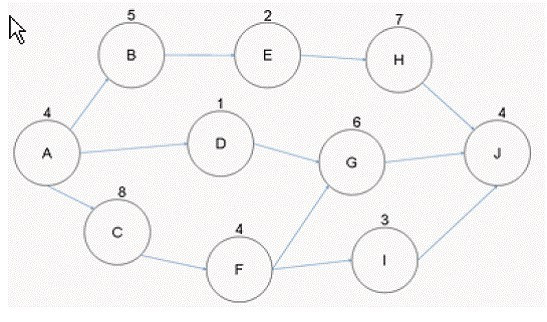 In this project network diagram, what is the total float for Activity I?
-
A
-
B
-
C
-
D
Reveal answer details
Close answer details
Correct answerA
ExplanationExplanation: The float for Activity I is three days. The early start for Activity I is Day 17 and the late start for Activity I is Day 20. Therefore, the difference of the early start and the late start reveals the float as three days. It is possible, and acceptable, to use the difference of the early finish and the late finish to find the float, as the value will be the same amount.
Answer options B, D, and C are incorrect. These are not the valid calculation for the total float.
You are the project manager of the JKM Project for your organization. Your project is supposed to be 60 percent complete but you are only 45 percent complete. The project has an assigned budget of $765,000 but you have already spent $365,000 to reach this point in the project due to some errors and rework.
Management is pressing you on when you'll complete the project and how much the project will likely cost based on the current performance. You need to tell management what the project's current cost performance index (CPI) is. What value should you report to management based on your project's performance?
-
A
-
B
-
C
-
D
Reveal answer details
Close answer details
Correct answerB
ExplanationExplanation: Management wants to know the cost performance index (CPI). You can find the CPI by first finding the earned value (EV) and then dividing it by the actual costs (AC) spent to date on the project. You find EV by multiplying percent complete by the project's budget; in this instance that's $344,250. The actual costs are
reported as $365,000. The formula for the CPI on this project is $344,250 / $365,000 for a value of .94.
What is CPI? Cost performance index (CPI) is used to calculate performance efficiencies. It is used in trend analysis to predict future performance. CPI is the ratio of earned value to actual cost. The CPI is calculated based on the following formula: CPI = Earned Value (EV) / Actual Cost (AC) If the CPI value is greater than 1, it indicates better than expected performance, whereas if the value is less than 1, it shows poor performance. The CPI value of 1 indicates that the project is right on target. What is BCWP (or EV)?
Budgeted cost of work performed (BCWP) or Earned Value (EV) is the value of completed work. It is the budgeted amount for the work actually completed on the schedule activity during a given time period.
Answer options C, A, and D are incorrect. These do not reflect an accurate value for the project's cost performance index. The project is performing moderately well on cost as the closer the CPI is to 1 the better the project's performance.
What is the term assigned to graphic in the figure given below? 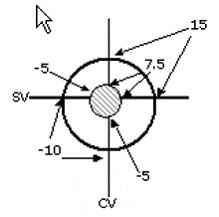
-
A
Communications bull's eye
-
B
-
C
Earned value management goals
-
D
Reveal answer details
Close answer details
Correct answerA
ExplanationExplanation:
The graphic shown in the figure is a communications bull's eye. The project manager must keep the project within the boundaries defined by the bull's eye or he will need to generate a performance report.
This is an example of management by exception because the project manager only communicates with management when there is an exception, or variance, within the project. Answer options C, B, and D are incorrect. These are not valid terms for the communications bull's eye.
You are the project manager of the NHQ project. This project is currently running about 15 percent behind schedule and the management has asked you to rectify the problem. You have elected to crash the project. What does this term mean?
-
A
Reject all proposed change requests for the project.
-
B
Add resources to the project work.
-
C
Add cost to the project budget.
-
D
Cut non-value added activities to the project.
Reveal answer details
Close answer details
Correct answerB
ExplanationExplanation: Crashing means that the project manager will add resources to the project to complete effort-driven activities in the project. This schedule compression technique adds costs to the project. What is crashing?
Crashing is a schedule compression technique to obtain the greatest amount of compression for the least incremental cost. Crashing works for activities where additional resources will shorten the duration. Approving overtime, bringing in additional resources, paying to expedite delivery to activities on the critical path are examples of crashing.
Answer option C is incorrect. Crashing does generally add costs to the project because of the labor added, but this is not the best choice for the question. Answer options D and A are incorrect. These are not the valid definitions of crashing.
Question 10
Fill in the blank
Fill in the blank with an appropriate phrase. The_____allows the project team to look at the performance of the project to date, and use that data to make more accurate projections about the future.
Reveal answer details
Close answer details
Accepted answerAnswer: Schedule model
ExplanationExplanation: The main function of the schedule model is to provide a useful 'road map' that can be used by the project manager and the project team to assist them in completing the project fruitfully. A well-developed schedule model is an active tool used to predict at what time the project work that remains to be completed can reasonably be completed. The schedule model allows the project team to look at the performance of the project to date, and use that data to make more accurate projections about the future.
Question 11
Single choice
You're a project manager and you've completed your project schedule. The schedule will take 18 months to complete the project work. Throughout the schedule there are instances that the project work will require the project team members to work more than fifty hours per week.
If you must adhere to a maximum of 45 hours of project work per team member, per week, what will likely happen to your project schedule as it stands right now?
-
A
Nothing, the 45 hours limit is a guideline.
-
B
The project will take longer to complete.
-
C
The project will take less time to complete.
-
D
The project will require more resources.
Reveal answer details
Close answer details
Correct answerB
ExplanationExplanation: If a resource leveling heuristic, such as 45 hours maximum per time period, is enforced on the project, then the project schedule will take longer to complete. What is resource leveling heuristics? Resource leveling heuristics is a prioritization method that allocates inadequate resources to critical path activities first. It is a schedule network analysis technique useful to a schedule that has already been analyzed by the critical path method. It is used when shared or critical essential resources are only available at certain times, in limited quantities, or to keep resource usage at a constant level. It is a technique that resolves resource conflicts by delaying tasks within their slack allowances. Resource leveling is the process in which project teams come across problems when developing their project schedules. If a company has multiple projects running simultaneously that require the same resources, then problems can arise. It can often cause the critical path method to change. Answer option A is incorrect. The 45-hour limit is a restriction on the project. Answer
option C is incorrect. The project will not take less time to complete because the project team members won't be able to complete as much work in the same amount of time.
Answer option D is incorrect. The project may require more resources if the project manager and management want the project to finish by a particular date. In this question, however, the focus is on what will happen to the project schedule, not the project staffing.
Question 12
Single choice
Which one of the following estimate types is a form of expert judgment?
-
A
-
B
-
C
-
D
Reveal answer details
Close answer details
Correct answerB
ExplanationExplanation: An analogous estimate is a form of expert judgment because it relies on historical information. The historical information, assuming that it is accurate, serves as the conduit to the expert that created the historical information.
Answer option C is incorrect. A bottom-up estimate creates an activity duration estimate for each work
package in the WBS.
Answer option A is incorrect. Parametric estimating uses a parameter, such as 10 hours per fixture installation, as a base to predict the duration of the project. Answer
option D is incorrect. A definitive estimate, also known as a bottom-up estimate, accounts for the cost of each work package.
Question 13
Single choice
You work as a project manager for BlueWell Inc. Some of the activities in your project are not being completed on time. You review these activities with your project team discovered that the time estimates for the project are much more aggressive than what they are actually experiencing in the completion of the activities. You decide on to create a new schedule for the project. What project management process are you working with when you create a new target schedule?
-
A
Estimate activity durations
-
B
Estimate activity resources
-
C
-
D
Reveal answer details
Close answer details
Correct answerC
ExplanationExplanation: In severe cases, new schedule duration estimates with new forecasted start and finish dates are needed.
In these instances, it is an example of using the control schedule process. Control schedule process is a method of monitoring the status of the project to update project progress and deal with the changes to the schedule baseline. It is concerned with: Determining the current status of the project Influencing the factors that create schedule changes Determining that the project schedule has changed Managing the actual changes as they occur Control schedule is a component of the Perform Integration Change Control process.
Answer option B is incorrect. The activity resources would only address the addition or replacement of resources needed to complete the project work.
Answer option A is incorrect. This is a tempting choice, but according to the PMBOK, new schedules are part of the control schedule process.
Answer option D is incorrect. Develop schedule is not the best choice for this question. It is a process of analyzing activity sequences, durations, resource requirements, and schedule constraints to create the project schedule.
Question 14
Single choice
You are the project manager for your company. You are currently working with your project team to begin sequencing the activity list. You will need organizational process assets and four other documents as inputs to this process. Which of the following is NOT one of the four documents you will need for activity sequencing?
-
A
-
B
-
C
Project schedule network diagrams
-
D
Reveal answer details
Close answer details
Correct answerC
ExplanationExplanation: The project schedule network diagram is an output of the sequence activity process, not an input. This process uses five inputs: the activity list, the activity attributes, milestone list, the project scope statement, and the organizational process assets. The project schedule network diagram is an output of the sequence activity process. It represents a schematic display of the project's schedule activities and the logical relationship among them. This diagram can be produced manually or by using the project management software. It consists of complete project details, or one or more summary activities. Answer options D, B and A are incorrect. These are inputs to the process.
Question 15
Fill in the blank
Fill in the blank with the appropriate word. ____ management sets the boundaries for the project and is the foundation on which the other project elements are built.
Reveal answer details
Close answer details
Accepted answerAnswer: Scope
ExplanationExplanation: Project scope is the effort that must be required to gather a client's plan, goals for space, purpose, properties, impact, and stage of eminence. Scope management sets the boundaries for the project and is the foundation on which the other project elements are built. Scope management helps to organize the work responsibilities and their requirements for successful completion. Managing the project scope is primarily concerned with defining and controlling what is and what is not included in the project.
Question 16
Single choice
You work as a scheduler for your organization. You are developing a schedule and its constraints for the SAP project. There are nine inputs to develop a project schedule. Which of the following is NOT an input to the schedule development process?
-
A
-
B
-
C
-
D
Reveal answer details
Close answer details
Correct answerA
ExplanationExplanation: The WBS is not an input, directly, to the develop schedule process. Technically, you will need the scope baseline, which does include the WBS. The inputs in developing a schedule process are of nine types, which are as follows: Activity list
Activity attributes
Project schedule network diagrams
Activity resource requirements
Resource calendars
Activity duration estimates
Project scope statement
Enterprise environmental factors
Organization process assets 
Question 17
Single choice
Sam works as a project manager for BlueWell Inc. Which of the following processes will he use for selecting a scheduling method, scheduling tool, incorporating project specific data within that scheduling tool to develop a project specific schedule model, and generating project schedule?
-
A
Constructability Analysis process
-
B
Schedule Maintenance process
-
C
Schedule Development process
-
D
Perform Integrated Change Control process
Reveal answer details
Close answer details
Correct answerC
ExplanationExplanation: The schedule development process is used for selecting a scheduling method, scheduling tool, incorporating project specific data within that scheduling tool to develop a project specific schedule model, and generating project schedule. Schedule development is the process of analyzing activity sequences, durations, resource requirements, and schedule constraints to create the project schedule. Inserting the activities, durations, and resources into the scheduling tool generates a schedule with planned dates for completing the project activities. The goal of the schedule development is to form the processes such that the stakeholders can use it in the creation of the project. Schedule development consists of two main sections: ArticlesItemsReportsHelp 1. Input and Data: The starting point for any schedule is the input of information developed during the planning process.
Define schedule scope
Breakdown structure relationships
Schedule specification
Feedback from stakeholders
Cost estimate model 2. Creating Schedule: This process provides basic knowledge in an outline structure for a study of the means, methods, and tools necessary for the project schedule development process.
Types of schedules
Activities
Durations
Relationships
Constraints and calendars Cost and resource loading Schedule quality analysis and compliance review Schedule basis documentation Answer option B is incorrect. Schedules maintenance is a method to account progress and to forecast trends, progress, and completion. Schedules are used to manage successful execution of projects. A schedule models the plan using resources and execution strategy to gather the project objectives. Periodic updates are undertaken to determine the actual progress achieved. Information obtained in the updating process, along with trend analysis and forecast of future progress, is reported to stakeholders. These progress updates include schedule maintenance to account for nominal changes to the execution plan.
Depending upon the nature of change, the schedule and assumptions upon which the schedule was based significantly change. The schedule must be re-examined and updated, as necessary, to develop a new baseline for measuring further progress. Schedule maintenance consists of the following elements: Baseline Schedule Tracking Schedule Progress Cost and Resource Management Schedule Change Management Acceleration Schedule Maintenance Feedback Answer option D is incorrect. Perform Integrated Change Control is the process of reviewing all change requests, approving changes, and controlling changes to the deliverables and organizational process assets in a project. Perform Integrated Change Control has to do with influencing the things that cause change, determining that the change is required or has happened, and managing the change. Answer
option A is incorrect. Constructability analysis is a process that starts in the initial planning phases and persists all over the entire planning cycle and into the implementation phase of the project. Constructability analysis during the planning process examines the methods and cost of installed equipment and materials, technology, site conditions, resources, and related infrastructure. The benefit of constructability analysis is to reduce both the time and cost of a project. Constructability analysis is repeatedly performed throughout the life-cycle of a project in order to optimize cost, plan, and schedule while mitigating risk. It is a very important process that needs to be performed early in planning to allow alternatives to be considered and integrated into the design.
Question 18
Single choice
You are the project manager of a project that has a budget of $675,000 and you have completed 40 percent of the project work. Your project is supposed to be 60 percent complete but you are actually only 40 percent complete. Due to some errors, however, you have actually spent $335,000 of the budget.
Management wants to know what the project's cost performance index (CPI) is. What value do you report?
-
A
-
B
-
C
-
D
Reveal answer details
Close answer details
Correct answerC
ExplanationExplanation: Cost performance index (CPI) is used to calculate performance efficiencies. It is used in trend analysis to predict future performance. CPI is the ratio of earned value to actual cost. The CPI is calculated based on the following formula: CPI = Earned Value (EV) / Actual Cost (AC) If the CPI value is greater than 1, it indicates better than expected performance, whereas if the value is less than 1, it shows poor performance. The CPI value of 1 indicates that the project is right on target. In this instances it is $270,000 divided by $335,000 for a CPI of .81. Answer option B is incorrect. .67 is actually the schedule performance index. Answer
option D is incorrect. -$65,000 is the cost variance for the project. Answer option A is incorrect. -$135,000 is the schedule variance of the project.
Question 19
Single choice
Della works as a project manager for BlueWell Inc. She has asked her assistant Beth to provide activity duration estimate for an activity. Beth provides Della the following estimate chart: 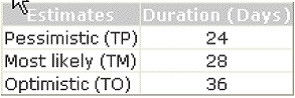 What will be the activity duration according to the PERT three-point analysis?
-
A
-
B
-
C
-
D
Reveal answer details
Close answer details
Correct answerC
ExplanationExplanation: A three-point estimate records the optimistic, most likely, and the pessimistic duration and then records an average for the predicted duration. Three-point estimate is a way to enhance the accuracy of activity duration estimates. This concept is originated with the Program Evaluation and Review Technique (PERT).
PERT charts the following three estimates: Most likely (TM): The duration of activity based on realistic factors such as resources assigned, interruptions, etc. Optimistic (TO): The activity duration based on the best-case scenario Pessimistic (TP): The activity duration based on the worst-case scenario.
The expected (TE) activity duration is a weighted average of these three estimates: TE = (TO + 4TM + TP) / 6
Duration estimates based on the above equations (sometimes simple average of the three estimates is also used) provide more accuracy.
Here it is,
TE = ( 24 + 28*4 + 36) / 6
= 272/6
= 29 (approx)
Answer options B, D, and A are incorrect. These are not the valid answers for this question.
Question 20
Single choice
Which of the following scheduling techniques identifies the successor activities and the predecessor activities to assist the project manager in sequencing the project work?
-
A
Precedence Diagramming Method
-
B
Schedule network template
-
C
-
D
Reveal answer details
Close answer details
Correct answerA
ExplanationExplanation: The Precedence Diagramming Method uses both predecessors and successors as nodes in the project network diagram. The PDM approach is the most common network diagram approach used. Answer option C is incorrect. Dependency determination identifies the order of the project work. Answer
option B is incorrect. The schedule network template is a tool that uses a previous project network diagram as a base for the current project network diagram. Answer option D is incorrect. Activity on the node places activities on circles within a network diagram. It is an example of the precedence diagramming method.
Question 21
Single choice
You are the project manager of the NHQ Project. You are coaching Alice, a new project manager, on the relationships in a project network diagram. Which relationship type between activities are the most common?
-
A
-
B
-
C
-
D
Reveal answer details
Close answer details
Correct answerB
ExplanationExplanation: The finish-to-start relationship type is the most common in a project network diagram. It means that the predecessor activity must finish before its successor activity can start. For example, the carpet must be installed before the painting activity can begin. What is precedence diagramming method (PDM) in sequence activities? Precedence diagramming method (PDM) is used in critical path methodology for building a project schedule network diagram that uses boxes or rectangles, referred to as nodes, to represent activities, and join each other with arrows that show the logical relationship that exists between them. This technique is also known as Activity-On-Node (AON).It includes four types of dependencies or logical relationships: Finish-to-start(FS): The initiation of the successor activity depends upon the completion of the predecessor activity. Finish-to-finish(FF): The completion of the successor activity depends upon the completion of the predecessor activity. Start-to-start(SS): The initiation of the successor activity depends upon the initiation of the predecessor activity. Start-to-finish(SF): The completion of the successor activity depends upon the initiation of the predecessor activity.
Question 22
Single choice
You have a project to install 45,900 emergency exit signs throughout a university campus. You have a crew of 45 project team members to install the signs and they are making good progress on the installation but it looks like they'll miss the promised end date. Your project requires all of the signs to be installed one week before classes are scheduled to begin. You elect to crash the project in an effort to shorten the installation duration activity. What does it mean to crash the project?
-
A
Increase the working hours.
-
B
Level the project schedule.
-
C
-
D
Reduce the project scope.
Reveal answer details
Close answer details
Correct answerC
ExplanationExplanation: Crashing adds more workers to the project team. Crashing allows the project to complete faster because there are more people helping with the project work.
Answer option D is incorrect. Reducing the project scope is called descoping or project scope changes.
Answer option A is incorrect. Crashing does not consider the working hours. Answer
option B is incorrect.
Resource leveling actually increases the project duration.
Question 23
Single choice
Wendy is the project manager for the NHQ project. She is working with her project to begin creating the project duration estimate. Her organization is in weak matrix and several of the project team members are scheduled to complete work on other projects. What input will most likely be of the biggest assistance as Wendy and the project team begin creating the duration estimate for this project?
-
A
-
B
-
C
Project communications management plan
-
D
Reveal answer details
Close answer details
Correct answerD
ExplanationExplanation: The resource calendar is needed because it will help Wendy and the project team to determine when the project team resources will be available. The availability of the project resources can affect the overall duration of the project. A resource calendar is used to make sure that work resources (people and equipment) are scheduled only when they are available for work. They affect a specific resource or category of resources. By default, the working time settings in the resource calendar are the same as in the project calendar. However, a user can customize the resource calendar to show individual schedule information, such as vacations, leaves of absence, or equipment maintenance time. Answer option B is incorrect. The project scope statement is an input to the estimate activity duration estimate, but it is not the best choice for this question. Answer
option C is incorrect. The project communications management plan is not an input to the estimate activity duration process.
Answer option A is incorrect. The project charter is not an input to the estimate activity duration process.
Question 24
Single choice
Mark is the project manager of the GHQ Project. He is happily reporting that his project has a schedule performance index of 2.12. Management, however, does not think this is good news. What is the most likely reason why management does not like an SPI of 2.12?
-
A
It is not good news because a larger number means the schedule duration estimates were likely to be wrong to begin with.
-
B
They likely do not understand the SPI formula.
-
C
It is not good news, as the number should be closer to 100 than 0.
-
D
It is good news, but Mark may have large cost variances to achieve this value.
Reveal answer details
Close answer details
Correct answerA
ExplanationExplanation: Cost and schedule performance indexes should be as close to 1 as possible. A larger value, such as 2.12, means that the schedule duration estimates were likely bloated or incorrect to begin with. Answer option B is incorrect. This is not the best choice for this question. Answer
option C is incorrect. The number should not be close to 100; it should be close to 1. Answer option D is incorrect. While Mark may have crashed
the schedule and driven up costs to achieve the SPI value, a more likely reason is that the time estimates were bloated.
Question 25
Single choice
Donna is the project manager of the QSD Project and she believes Risk Event D in the following figure is likely to happen. 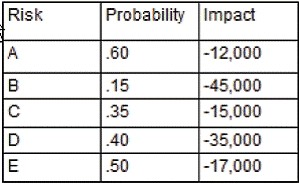 If this event does happen, how much will Donna have left in the risk contingency reserve if none of the other risk events have happened?
-
A
-
B
-
C
-
D
Reveal answer details
Close answer details
Correct answerC
ExplanationExplanation: To answer this question, you'll first need to calculate the contingency reserve. Contingency reserves are estimated costs to be used at the discretion of the project manager to deal with anticipated, but not certain, events. These events are "known unknowns" and are part of the project scope and cost baselines. The contingency reserve is calculated by multiplying the probability and the impact for the risk event value for each risk event. The sum of the risk events equals the contingency reserve for the project. The sum of the risk events equals the contingency reserve for the project. In this question, the value is $41,700. If Risk D happens, it'll cost the project $35,000. The difference of $35,000 and $41,700 is $6,700.
Answer option A is incorrect. This is the impact of Risk Event D.
Answer option D is incorrect. $14,000 is the risk event value of Risk Event D.
Answer option B is incorrect. $41,700 is the amount of the contingency reserve.
Question 26
Single choice
You are the project manager for the GRT Project in your organization. You have created your time duration estimates based on historical information, but the estimates are not holding true in your current project. Unfortunately, many activities are late. You have decided to create a PERT estimate with your project team for each of their activities. What is the formula used for PERT?
-
A
-
B
-
C
-
D
Reveal answer details
Close answer details
Correct answerC
ExplanationExplanation: PERT uses the formula of (O+4M+P)/6 to predict the duration of the project activities and the overall project schedule. Three-point estimate is a way to enhance the accuracy of activity duration estimates.
This concept is originated with the Program Evaluation and Review Technique (PERT). PERT charts the following three estimates: Most likely (TM): The duration of activity based on realistic factors such as resources assigned, interruptions, etc. Optimistic (TO): The activity duration based on the best-case scenario Pessimistic (TP): The activity duration based on the worst-case scenario.
The expected (TE) activity duration is a weighted average of these three estimates: TE = (TO + 4TM + TP) / 6 Duration estimates based on the above equations (sometimes simple average of the three estimates is also used) provide more accuracy.
Answer option A is incorrect. This is not a valid formula. Answer
option D is incorrect. This almost describes the three-point estimate, but does not answer the question about PERT.
Answer option B is incorrect. This is the formula for the three-point estimate. Note the PERT, while similar, uses 4M and divides the result by six factors.
Question 27
Single choice
You are the project manager of the GHY Project. This project is scheduled to last for one year and has a BAC of $4,500,000. You are currently 45 percent complete with this project, though you are supposed to be at your second milestone which accounts for half of the project completion. There have been some errors in the project which has caused you to spend $2,073,654. What is this project's schedule performance index?
-
A
-
B
-
C
-
D
Reveal answer details
Close answer details
Correct answerC
ExplanationExplanation: The schedule performance index shows how well the project is performing on its schedule goals. The SPI can be found by dividing the earned value by the planned value. In this instance, it is $2,025,000 divided by $2,250,000 for .90. The closer to 1, the better the performance. Schedule performance index (SPI) is the measure of schedule efficiency on a project. It is used in trend analysis to predict future performance.
SPI is the ratio of earned value to planned value. The SPI is calculated based on the following formula: SPI
= Earned Value (EV) / Planned Value (PV) If the SPI value is greater than 1, it indicates better than expected performance, whereas if the value is less than 1, it shows poor performance. The SPI value of 1 indicates that the project is right on target. Answer option B is incorrect. 0.98 is the cost performance index. Answer
option A is incorrect. 1.02 is the to-complete performance index. Answer option D is incorrect. -$108,120 is the variance at completion based on current performance.
Question 28
Single choice
What schedule analysis simulation tool allows you, the project manager, to review possible combinations of events such as optimistic, most likely and pessimistic outcomes for your project?
-
A
-
B
-
C
-
D
Reveal answer details
Close answer details
Correct answerB
ExplanationExplanation: The Monte Carlo simulation tool allows a project manager to explore "what-if" analysis for the project schedule and possible combinations of events in the project. Monte Carlo simulation is a process for iteratively evaluating a deterministic form using sets of random numbers as inputs. This method is repeatedly used when the model is complex, nonlinear, or involves more than just a couple of vague parameters. Monte Carlo simulation is named after the city in Monaco, where the major attractions are casinos that have games of chance. Gambling games, such as roulette, dice, and slot machines, exhibit random behavior. This technique works particularly well when the process is one where the underlying probabilities are known but the results are more difficult to determine. It is a process that generates hundreds or thousands of probable performance outcomes based on probability distribution for cost and schedule on individual tasks. The outcomes are then used to generate a probability distribution for the project as a whole.
Answer option D is incorrect. GERT is the Graphical Evaluation Review Technique and is a visual mapping of the project work including branches and loop backs within the project. Answer
option A is incorrect.
PERT is the Program Evaluation and Review Technique and is used for project scheduling and time estimating.
Answer option C is incorrect. PMIS is a project management information system, such as Microsoft Project, and often includes what-if analysis tools, but it's not the best answer for this question.
Question 29
Single choice
Amy is working on a project which is forty percent complete though it was scheduled to be fifty percent complete as of today. Management has asked Amy to report on the schedule variance for her project.
If Amy's project has a BAC of $750,000 and she has spent $485,000 to date, what is the schedule variance value?
-
A
-
B
-
C
-
D
Reveal answer details
Close answer details
Correct answerA
ExplanationExplanation: The schedule variance is found by subtracting the planned value from the earned value. The earned value is the percentage of the project completeness multiplied by the BAC. Planned value is the percetage of where the project should be at this time multiplied by the BAC. Schedule variance (SV) is a measure of schedule performance on a project. The variance notifies that the schedule is ahead or behind what was planned for this period in time. The schedule variance is calculated based on the following formula:
SV = Earned Value (EV) - Planned Value (PV)
If the resulting schedule is negative, it indicates that the project is behind schedule. A value greater than 0 shows that the project is ahead of the planned schedule. A value of 0 indicates that the project is right on target. In this example,
EV = 40% of BAC
= 300,000, and
PV = 50% of BAC
= 375,000
SV = 300,000 - 375,000
= -75,000
Answer options C, B, and D are incorrect. These are not the correct values for the schedule variance.
Question 30
Single choice
All of the following statements about the critical path are false except for which one?
-
A
The critical path cannot be crashed.
-
B
The critical path is the shortest path in the project network diagram.
-
C
The critical path is always one path with the longest duration.
-
D
The critical path shows the project's earliest date for completion.
Reveal answer details
Close answer details
Correct answerD
ExplanationExplanation: The only statement that is true is that the critical path shows the project's earliest date for completion. A critical path is the sequence of project activities, which add up to the longest overall duration. This determines the shortest time possible to complete the project. Any delay of an activity on the critical path directly impacts the planned project completion date (i.e. there is no float on the critical path). A project can have several, parallel, near critical paths. An additional parallel path through the network with the total durations shorter than the critical path is called a sub-critical or non-critical path. These results allow managers to prioritize activities for the effective management of project completion, and to shorten the planned critical path of a project by pruning critical path activities, by "fast tracking" (i.e., performing more activities in parallel), and/or by "crashing the critical path" (i.e., shortening the durations of critical path activities by adding resources). Answer option C is incorrect. There can be more than one critical path, as two paths in the project network diagram can both take the same amount of time and be longer than any other paths in the project.
Answer option A is incorrect. The critical path can be, and often is, crashed with extra resources in an attempt to recover the project schedule.
Answer option B is incorrect. The critical path is the longest path to project completion.
Question 31
Single choice
You are the project manager of the NHA Project. This project is expected to last one year with quarterly milestones throughout the year. Your project is supposed to be at the third milestone today but you're likely only 60 percent complete. Your project has a BAC of $745,000 and you've spent $440,000 of the budget-to-date. What is your schedule performance index for this project?
-
A
-
B
-
C
-
D
Reveal answer details
Close answer details
Correct answerD
ExplanationExplanation: The schedule performance index can be found by dividing the earned value by the planned value. In this project, it's $447,000 divided by the $558,750 for a value of 0.80. Schedule performance index (SPI) is the measure of schedule efficiency on a project. It is used in trend analysis to predict future performance.
SPI is the ratio of earned value to planned value. The SPI is calculated based on the following formula:
SPI = Earned Value (EV) / Planned Value (PV)
If the SPI value is greater than 1, it indicates better than expected performance, whereas if the value is less than 1, it shows poor performance. The SPI value of 1 indicates that the project is right on target.
Answer option A is incorrect. "80" is not the same value as ".80". Answer
option B is incorrect. 1.02 is the cost performance index. Answer option C is incorrect. 102 is not a valid calculation for this question.
Question 32
Single choice
Gary is the project manager of the NHF project, which is a part of a program in his organization.
According to the PMBOK, how will Gary provide feedback to programs and portfolios?
-
A
-
B
-
C
-
D
Status reports and change requests
Reveal answer details
Close answer details
Correct answerD
ExplanationExplanation: According to the PMBOK, the project manager provides the feedback to programs and portfolios by means of status reports and change requests that may impact other projects, programs, or portfolios. The needs of the projects, including the resource needs, are rolled up and communicated back to the portfolio level, which in turn sets the direction for organizational planning. What is a status report? A status report is a narrative description about a subject that is relevant to an organization. Typically, a user submits a status report that was created for him by a manager. He can also create and submit his own unrequested status report at any time. It is a collaborative feature specific to PW A. Status report in PWA is a convenient way to exchange textual information with the team members about the status of a project or items in addition to task progress, which a user updates on the Tasks page. What are change requests? Change requests are requests to expand or reduce the project scope, modify policies, processes, plans, or procedures, modify costs or budgets or revise schedules. These requests for a change can be direct or indirect, externally or internally initiated, and legally or contractually imposed or optional. A Project Manager needs to ensure that only formally documented requested changes are processed and only approved change requests are implemented. Answer option C is incorrect. While regular communication is needed, this is not the best answer for the question.
Answer option A is incorrect. Status meetings are a part of project communications, but do not answer the question as completely as status reports and change requests. Answer
option B is incorrect. Push communications is one type of communicating mode where the project manager pushes the information to recipients. This is not the best choice for the question because there are other modes communicating as well.
Question 33
Single choice
You are the project manager of the NHQ Project. You have created the project network diagram as shown in the figure: 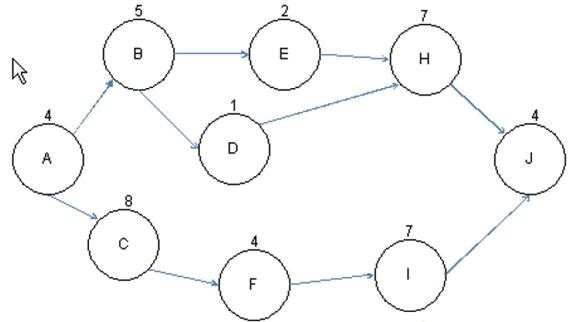 Based on the project network diagram, how much float is available for Activity H if Activity B is delayed by four days and Activity D is delayed by two days?
-
A
-
B
-
C
-
D
Reveal answer details
Close answer details
Correct answerD
ExplanationExplanation: The path of ABDHJ will take 21 days to complete and cannot exceed 27 days or else the project will be late. If Activity B takes four additional days and Activity D takes two additional days, this adds (4+2= 6) six days to the path, bringing the path's duration to exactly (21+6 = 27) twenty seven days. There is no
available float left for Activity E or H. Float or total float (TF) is the total amount of time that a schedule activity may be delayed from its early start date without delaying the project finish date, or violating a schedule constraint. It is calculated by using the critical path method technique and determining the difference between the early finish dates and late finish dates. Answer options A, C, and B are incorrect.
There is no float available because the path's duration has increased to 27 days.
Question 34
Multiple choice
John is a scheduler in ABC Company. He has to plan an activity for the schedule models. Which of the following activities will he use to make the schedule models? . Each correct answer represents a complete solution. Choose all that apply.
-
A
-
B
-
C
-
D
Reveal answer details
Close answer details
Correct answersA, C, D
ExplanationExplanation: An activity is an individual component of work that is logically linked to other activities to outline the schedule. Its key characteristics include an overall duration based upon the resources applied to it (manpower, material, and equipment), a start and completion date that is tied to a work calendar, and an association with other activities (predecessor and successors). Following are the various types of activities in schedule creation: Tasks: A task is an activity that needs to be accomplished within a defined period of time. Milestones: A milestone is the end of a stage that marks the completion of a work package or phase, typically marked by a high level event such as completion, endorsement or signing of a deliverable, document or a high level review meeting. Flags: Flags shall occur at appropriate intervals of approximately each month. The flags shall be located on the critical path and be incorporated into the baseline, all targets, and the current schedule. Hammocks: Hammocks are a summary pseudo "activity" representing a group of related activities that collectively cover some portion of a project.
Answer option B is incorrect. The Critical Path scheduling, or Critical Path Analysis, is a mathematically based algorithm for scheduling a set of project activities.
Question 35
Single choice
Amy works as a project manager for BlueWell Inc. She is working on the SDI project, which has a BAC of $2,816,000. She is currently 20 percent complete with this project, though she should be 25 percent complete with the project work. The project has consumed $495,000 of the project budget to date.
Management has asked her the project's Estimate To Complete (ETC) based on the current project performance. What is the ETC for this project?
-
A
-
B
-
C
-
D
Reveal answer details
Close answer details
Correct answerB
ExplanationExplanation: The estimate to complete is about knowing how much more money the project will need to complete its objectives. The estimate to complete (ETC) is the expected cost needed to complete all the remaining work for a scheduled activity, a group of activities, or the project. ETC helps project managers predict what the final cost of the project will be upon completion. The formula for the ETC is EAC-AC. The EAC is BAC/ CPI. Here it is,
CPI = EV/AC
= (0.20*2,816,000)/495,000
= 563200/495,000
= 1.1378
EAC = BAC/ CPI
= 2,816,000/1.1378
= 2,474,952 (Approx)
ETC = EAC - AC
= 2,474,952 - 495,000
= 1,979,952
Answer options C and A are incorrect. These are not the valid answers for this question. Answer option D is incorrect. This is the estimate at completion based on the current project performance.
Question 36
Single choice
Paula works as a project manager for her organization. She is working with the project team to define the activity attributes. Which of the following is NOT a valid activity attribute?
-
A
-
B
-
C
-
D
Reveal answer details
Close answer details
Correct answerC
ExplanationExplanation: Risk events are not associated with the activity attributes, but are recorded in the project risk register. Risk events are the distinct and particular occurrence that negatively affects a decision or a plan. Activity attributes are an output of the Define Activity process. These attributes refer to the multiple components that frame up an activity. The components for each activity during the early stages of the project are the Activity ID, WBS ID, and Activity name. At the later stages, the activity attributes include Activity codes, Predecessor activity, activity description, logical relationship, successor activity, leads and lags, imposed dates, and constraints and assumptions. Activity attributes are used for schedule development and for ordering, selecting, and sorting the planned schedule activities in a number of ways within reports.
Question 37
Single choice
Harry works as a project manager for BlueWell Inc. He is determining the budget of the project. According to the PMBOK, there are seven inputs to this process. Which one of the following is NOT an input to the determine budget process?
-
A
-
B
-
C
-
D
Reveal answer details
Close answer details
Correct answerB
ExplanationExplanation:
Reserve analysis is not an input to the determine budget process. It is a technique used for determining the budget. The inputs to the determine budget process are as follows: Activity cost estimates Basis of estimates Scope baseline Project schedule Resource calendars Contracts Organizational process assets
Question 38
Single choice
You have been hired as a contract project manager for Tech Perfect Inc. The project has already been started. Sufficient details of the project have already been structured. You are working with your team for cost estimation of the project. Which of the following estimating techniques will you use for the highest degree of accuracy?
-
A
-
B
-
C
-
D
Reveal answer details
Close answer details
Correct answerD
ExplanationExplanation:
According to the question, you have to use the estimating technique that has a higher degree of accuracy.
The most accurate estimating technique is bottom-up estimating. What is bottom-up estimating? Bottom-up is a cost estimating technique that involves estimating the cost of individual work packages or schedule activities with the lowest level of detail. The detailed cost is rolled up (or summarized) to higher levels for total project estimates. This summarized data is very useful for reporting and tracking purposes. Bottom-up estimating provides a higher degree of accuracy, provided the estimates at the work package level are accurate.
Answer options C, A, and B are incorrect. Parametric modeling and analogous estimating techniques use top-down estimation model. These are less accurate than the bottom-up estimation. What is analogous estimating? Analogous is an estimating technique that uses the values of parameter, such as scope, cost, budget, and duration or measures of scale such as size, weight, and complexity from a previous, similar activity as the basis for estimation of the same parameter for a future activity. It is a top-down estimating technique and is a form of expert judgment. It provides a lower degree of accuracy than other estimating techniques. This technique is primarily used when there is a limited amount of detailed information about the project or program. What is parametric modeling? Parametric modeling is an estimating technique that uses parameters, or project characteristics, to forecast project costs. It involves a top-down approach and is similar but more accurate than analogous estimating. It uses historical data and other variables to calculate an estimate for activity parameters, such as scope, cost, budget, and duration.
Question 39
Single choice
Kenny is the project manager for the NHQ organization. She is creating the project duration estimates.
She has stressed to her project team that they will need to create accurate and reliable project duration estimates without padding their estimates for errors or risks. Kenny is also relying on historical information to help her predict the duration of the project work. Jennifer, one of the project team members, wants to know how Kenny will account for the certain-to-happen errors and delays in the project schedule. What approach should Kenny use in the project?
-
A
Rewards and recognition for completing the project work without delays
-
B
-
C
-
D
Reveal answer details
Close answer details
Correct answerD
ExplanationExplanation:
Management reserve is an allotment of time added to the end of the project schedule. When delays happen within the project, the delays are subtracted from the management reserve. Answer option C is incorrect. Kenny is not using a three-point estimate in this instance. Answer
option A is incorrect. Rewards and recognitions are a good incentive for accurate work, but errors and delays may still happen and the rewards would not necessarily prevent delays in the project. Answer option B is incorrect. Kenny may be using some type of analogous estimating to predict activity duration, but the best answer is the reliance on the management reserve.
Question 40
Single choice
You are the project manager of the NNN Project. Stakeholders in the two-year project have requested to send status reports to them via email every week. You have agreed and are sending the reports on each Thursday. After six months of the project, the stakeholders are pleased with the project progress and they would like you to reduce the status reports to every two weeks. What process will examine the change to this project process and implement it in the project?
-
A
Project change control process
-
B
Perform integrated change control process
-
C
-
D
Communications management
Reveal answer details
Close answer details
Correct answerB
ExplanationExplanation: Although this appears to be a simple change the project manager must still follow the rules of the project's change control system. Perform Integrated Change Control is the process of reviewing all change requests, approving changes, and controlling changes to the deliverables and organizational process assets in a project. Perform Integrated Change Control has to do with influencing the things that cause change, determining that the change is required or has happened, and managing the change. Answer option D is incorrect. Communications management is the execution of the communications management plan.
Answer option A is incorrect. The project change control process not valid as it's the parent of the integrated change control process, which is more accurate for this question. Answer
option C is incorrect. Configuration management is the documentation and control of the product's features and functions.
Question 41
Single choice
What is the formula to find the schedule performance index?
-
A
-
B
-
C
-
D
Reveal answer details
Close answer details
Correct answerC
ExplanationExplanation: The schedule performance index shows how well the project is performing on schedule. It is found by dividing the earned value by the planned value. Schedule variance (SV) is a measure of schedule performance on a project. The variance notifies that the schedule is ahead or behind what was planned for this period in time. The schedule variance is calculated based on the following formula: SV = Earned Value (EV) - Planned Value (PV) If the resulting schedule is negative, it indicates that the project is behind schedule. A value greater than 0 shows that the project is ahead of the planned schedule. A value of 0 indicates that the project is right on target. Answer option D is incorrect. EV-AC is the project's cost variance. Answer
option B is incorrect. EV/AC is the project's cost performance index. Answer option A is incorrect. EV-PV is the project's schedule variance.
Question 42
Single choice
You are the project manager for the GHB Organization. Management has asked that you review your recent SPI to determine why there was a schedule variance. They'd also like you to explain what approach you'll do to counteract the SPI going forward in the project. You complete the variance analysis and report to management that you'll be fast tracking a portion of your project work. What will be the management's concern with, when it comes to fast tracking the project?
-
A
Added costs for the additional project labor
-
B
-
C
Continued variances in the SPI
-
D
Slippage in the project quality
Reveal answer details
Close answer details
Correct answerB
ExplanationExplanation: When the project manager elects to use fast tracking the project manager is allowing phases of the project to overlap. When phases overlap there is added risk to the project. Fast tracking is a technique for compressing project schedule. In fast tracking, phases are overlapped that would normally be done in sequence. It is shortening the project schedule without reducing the project scope. Answer option C is incorrect. Management's greatest concern is about the added risks of fast tracking and not about the SPI.
Answer option A is incorrect. Costs are added when the project manager elects to crash a project. Answer
option D is incorrect. Quality may suffer, but the most prominent concern is the added risks to the project work.
Question 43
Single choice
You are the project manager for the GHY Project. This project has stakeholders, both internal and external, that need to receive performance reports from you on a regular basis. You have decided that in addition to emailing the weekly performance report, you will also keep the performance reports available on your secured project management Website.
The Website is an example of what type of communication reporting?
-
A
-
B
-
C
-
D
Reveal answer details
Close answer details
Correct answerA
ExplanationExplanation: A Website is an example of a pull communication. This means the information is available, but the reader must go to the source and retrieve the information. Pull communication is defined by what the reader wants and what interests he has in retrieving the information. In other words, the information is available, but the reader must go to the source and retrieve the information. This type of communication is used by advertising agencies to draw clients into retail establishments to receive messages. Customers decide on when and how they will act on the messages in the pull model of communications. Some virtual examples of pull communication are: Blogs Wikipedia Websites Answer option D is incorrect. This does not describe the communication model or how information is distributed.
Answer option C is incorrect. Passive communication is a not a project management term to describe communications.
Answer option B is incorrect. Push communication describes the process of delivering the communication to the recipients, such as through email.
Question 44
Single choice
John is the project manager for his organization. He has created a status dashboard for his stakeholders. What is a status dashboard?
-
A
It is a report that details the current status of risks and issues.
-
B
It is a software application that allows stakeholders to view the project manager's performance.
-
C
It is a web-based tool to inspect the project deliverables for performance.
-
D
It is a report that reflects the overall performance of scope, schedule, quality, cost, or other project performance metrics.
Reveal answer details
Close answer details
Correct answerD
ExplanationExplanation: Of all the choices, the best explanation is that a dashboard is a report for quick review of the project's performance metrics. While there are some software solutions, they still focus on the key performance criteria of the project.
Answer option C is incorrect. This answer defines the definition of quality control, not the dashboard's review of project performance.
Answer option B is incorrect. Dashboards focus on the performance of the project's key performance factors, not the project manager.
Answer option A is incorrect. A status report could include the details of the project's risks and issues, but usually not the dashboard.
Question 45
Single choice
In which of the following group decision making techniques does the largest block in a group decide the group decision even if a bulk is not achieved?
-
A
-
B
-
C
-
D
Reveal answer details
Close answer details
Correct answerD
ExplanationExplanation: The various techniques of group decision making are as follows: Unanimity: In this technique, everyone agrees on a single course of action. Majority: In this technique, more than 50% of the members of the group support the decisions. Plurality: In this technique, the largest block in a group decides even if a bulk is not achieved. Dictatorship: In this technique, one individual makes the decision for the group.
Question 46
Single choice
Nancy is the project manager of the JJJ Project. This project has recently been approved by the project customer as complete so Nancy must now finalize the administrative closure. Nancy needs to create the final project report to report the successes and failures in the project.
Who should Nancy deliver this final project report to if she is participating in a projectized structure?
-
A
-
B
-
C
Whomever the communications management plan directs her to
-
D
Reveal answer details
Close answer details
Correct answerC
ExplanationExplanation: The communications management plan will define who will receive what information. Answer option B is incorrect. The project sponsor may be a recipient but the project communications management plan is the best selection.
Answer option A is incorrect. Functional management is not the best choice in a projectized structure.
Answer option D is incorrect. The project customer may receive a copy of the report, but the project communications management plan should direct the communications.
Question 47
Single choice
Which of the following components of the change control system includes the documentation, tracking systems, and defined approval levels necessary for authorizing and controlling changes?
-
A
-
B
Configuration Management System
-
C
Project Management Information System
-
D
Integrated Change Control
Reveal answer details
Close answer details
Correct answerB
ExplanationExplanation: The change management system comprises several components that guide the change request through the process. When a change request is made, it will affect the project scope. The Configuration Management System evaluates the change request, and documents the features and functions of the change on the project scope. What is Configuration Management System? Configuration Management System is a subsystem of the overall project management system. It is a collection of formal documented procedures used to identify and document the functional and physical characteristics of a product, result, service, or component of the project. It also controls any changes to such characteristics, and records and reports each change and its implementation status. It includes the documentation, tracking systems, and defined approval levels necessary for authorizing and controlling changes. Audits are performed as part of configuration management to determine if the requirements have been met.
Answer option D is incorrect. Integrated Change Control, part of the change control system, does not document changes to the features and functions of the project scope. It evaluates the change's impact on eight knowledge areas: scope, time, cost, quality, human resources, communication, risk, and procurement. What is Perform Integrated Change Control? Perform Integrated Change Control is the process of reviewing all change requests, approving changes, and controlling changes to the deliverables and organizational process assets in a project. Perform Integrated Change Control has to do with influencing the things that cause change, determining that the change is required or has happened, and managing the change.
Answer option A is incorrect. Verify scope is a process of formalizing acceptance of the completed project deliverables. It is an inspection-driven process the stakeholders will complete to inspect the project scope deliverables. It is typically performed at the end of the phase and at the end of the project. Answer
option C is incorrect. The Project Management Information System (PMIS) is an information system consisting of the tools and techniques used to gather, integrate, and disseminate the outputs of project management processes. It is used to support all aspects of the project from initiating through closing, and can include both manual and automated systems. It is the parent of the change control process. It is a system that includes all of the change control processes for scope, time, cost, and procurement. Configuration management is part of the PMIS.
Question 48
Single choice
Holly is the project manager for her organization. Her current project is running late and her project customer has asked Holly to find a method to apply corrective actions to the project schedule. Holly is exploring the concept of crashing the project. Which of the following statements is true about crashing the activities in Holly's project?
-
A
The activities to be crashed must have additional quality control metrics associated with them.
-
B
The activities to be crashed cannot be of fixed duration.
-
C
The activities to be crashed cannot have risks associated with them greater than 0.80.
-
D
The activities cannot be on the critical path in order to be crashed.
Reveal answer details
Close answer details
Correct answerB
ExplanationExplanation: Crashing adds effort to the project activities. Activities that are of fixed duration, for example software testing, would not finish faster with added resources. Crashing is a schedule compression technique to obtain the greatest amount of compression for the least incremental cost. Crashing works for activities where additional resources will shorten the duration. Approving overtime, bringing in additional resources, paying to expedite delivery to activities on the critical path are examples of crashing. Answer option D is incorrect. Activities on the critical path can be crashed. Answer
option C is incorrect. Activities with risks can be crashed. Answer option A is incorrect. Additional quality control metrics are not necessary just because Holly elects to crash her project.
Question 49
Single choice
Once the project's WBS has been created what process may happen next?
-
A
Estimate activity resources
-
B
-
C
Estimate activity durations
-
D
Reveal answer details
Close answer details
Correct answerB
ExplanationExplanation: The define activities process is the process that may begin once the project's WBS has been completed and approved. It is possible, in some projects, to complete the WBS and the activity list at the same time.
Answer option D is incorrect. Sequencing the activities cannot happen until the activity list has been created.
Answer option A is incorrect. Estimating activity resources is dependent on the activity list, so this choice is not valid.
Answer option C is incorrect. Estimate activity durations are dependent on the activity list, so this choice is not valid.
|