Question 1
Multiple choice
Which three items are generated and displayed in the compliance score of an application? (Choose three.)
-
A
Rules with warnings in the application
-
B
Pega Platform core rules used in the application
-
C
Rules with unjustified warnings in the application
-
D
Unweighted compliance score
-
E
Percentage of compliant rules in the application
Reveal answer details
Close answer details
Correct answersA, C, E
ExplanationThe compliance score of an application is generated based on several factors, including the number of rules with warnings, the number of rules with unjustified warnings, and the percentage of compliant rules in the application. This score helps to identify potential issues with rule compliance and areas that may need attention.
References:
Pega Platform Help - Compliance score.
Question 2
Multiple choice
Which two statements describe the role of the cache manifest in a mobile app? (Choose two.)
-
A
Allows downloading of rules for offline use with a mobile app.
-
B
Provides access to static resources such as HTML files, image files, or JS files.
-
C
Enables users to continue interacting with mobile apps while offline.
-
D
Supports debugging efforts by providing a run-time view of the rules accessed by the app.
Reveal answer details
Close answer details
Correct answersA, B
ExplanationThe cache manifest in a mobile app facilitates the use of the app while offline by allowing the download of rules and static resources. This ensures that users can access the app's functionality and interface elements even when they do not have an internet connection.
References:
Pega Mobile Client Developer Guide.
In the hierarchy of a single organization, which statement about the relationship between organizational elements is true?
-
A
A work queue belongs to a single operator record.
-
B
A unit can belong to multiple organizations.
-
C
An operator record can belong to multiple units.
-
D
A work group can have more than one manager.
Reveal answer details
Close answer details
Correct answerD
ExplanationIn the organizational hierarchy of Pega Platform, a work group can indeed have more than one manager, allowing for shared management responsibilities and coverage.
References:
Pega Platform Help -
Organization and Work Groups.
Question 4
Multiple choice
Which two statements are valid about configuring Pega Web Mashup? (Choose Two)
-
A
Only create one DIV element in the hosting web page for each Pega gadget.
-
B
Add a list of trusted domains in your applications in which you want to use the mashup.
-
C
Use the Integration wizard to generate mashup code for use in other systems.
-
D
Keep the original names of default actions in the mashup code to prevent security risks.
Reveal answer details
Close answer details
Correct answersA, B
ExplanationWhen configuring Pega Web Mashup, it's essential to create one DIV element in the hosting web page for each Pega gadget (A), ensuring that each gadget is properly isolated and rendered within its designated area on the web page. Additionally, adding a list of trusted domains in your application settings (B) is crucial for security, as it specifies which domains are authorized to host the mashup, preventing unauthorized use or embedding of the Pega functionalities in untrusted environments.
References:
Pega Community documentation on Pega Web Mashup configuration and security best practices.
Question 5
Multiple choice
In a hiring case type, only HR Managers should have read access to a candidate's reference letter attachment. Once the privilege is created in the system, which two configurations, when performed together, allow you to fulfill this requirement? (Choose Two)
-
A
Specify the HR Managers work group when creating the Attachment category.
-
B
Apply the appropriate privilege to the Attachment category.
-
C
Define an Access of Role to Object record on the Access group for HR Managers.
-
D
Configure an access control policy condition on the Attachment category.
Reveal answer details
Close answer details
You are integrating two Pega Web Mashups into a client's mortgage loan financing page. What do you configure to successfully embed both mashups?
-
A
Load both mashups simultaneously.
-
B
Define identical URLs for each mashup.
-
C
Identify unique names for each mashup.
-
D
Run the mashups on the same thread.
Reveal answer details
Close answer details
Correct answerC
ExplanationWhen integrating multiple Pega Web Mashups into a single page, it is necessary to identify unique names for each mashup to ensure that they are embedded and function independently without conflict on the client's page.
References:
Pega Platform Help - Pega Web Mashup.
Question 7
Multiple choice
Identify two options for passing data between a Pega application and a webpage containing a web mashup. (Choose Two)
-
A
Call the function pega.web.api.doAction()
-
B
Call a Pega API function from the host server
-
C
Use REST methods to call Pega microservices
-
D
Use the attribute data-pega-event-onpagedata
Reveal answer details
Close answer details
Correct answersA, D
ExplanationA: Calling the function pega.web.api.doAction() allows for specific actions to be performed in the Pega application from the web mashup, such as refreshing a section or submitting an assignment.
D: Using the attribute data-pega-event-onpagedata allows for passing data from the web mashup to the Pega application when specific events occur on the page.
References:
Pega official documentation on Pega Web Mashup methods and attributes.
Question 8
Multiple choice
Which two statements about keyed data pages are true? (Choose Two)
-
A
A keyed data page is required for all data pages.
-
B
A keyed data page can use a report definition.
-
C
A keyed data page can return multiple embedded pages.
-
D
A keyed data page can have multiple keys.
Reveal answer details
Close answer details
Correct answersB, D
ExplanationKeyed data pages can return multiple embedded pages if the data structure includes lists or other page structures. They can also have multiple keys, which allows them to return data based on a combination of key values.
References:
Pega Platform Help - Data Pages.
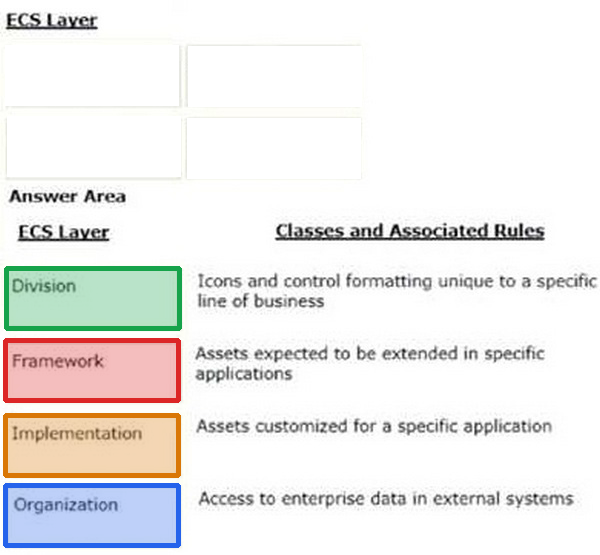
DRAG DROP Organize the classes and associated rules in the appropriate Enterprise Class Structure (ECS) layer. 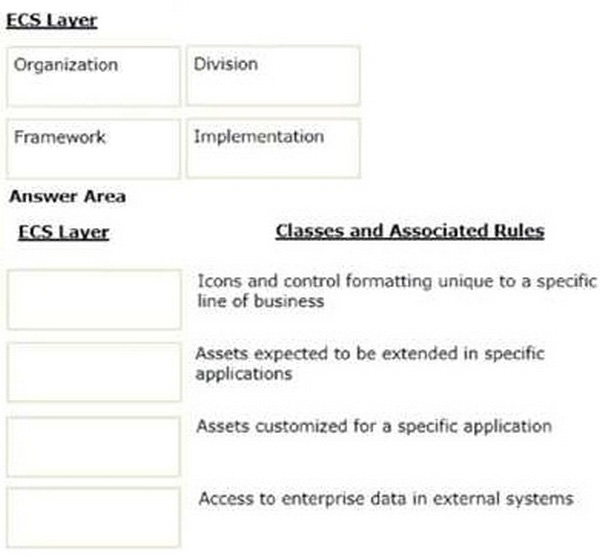
Reveal answer details
Close answer details
Question 10
Multiple choice
What are the two most common ways to expose your application to an external system? (Choose Two)
-
A
Create a connector linked to a data page.
-
B
-
C
Configure a signed certificate.
-
D
Create a web service with the Service wizard.
Reveal answer details
Close answer details
Correct answersB, D
ExplanationThe two most common ways to expose your application to an external system are to leverage the Pega API (B) and to create a web service with the Service wizard (D). The Pega API provides a set of out-of-the-box RESTful endpoints for performing operations within the Pega Platform. The Service wizard simplifies the creation of SOAP or REST services, enabling external systems to interact with Pega applications.
References:
Pega Community documentation on Pega API and Service wizard.
Question 11
Multiple choice
A developer has identified resource-intensive queue processors as the source of performance issues that application users are experiencing. Which two actions do you perform to resolve the performance issues? (Choose Two)
-
A
Associate the queue processors with the appropriate node types.
-
B
Select the Include in background processing option on the application rule.
-
C
Configure the queue processors to run multiple times a day.
-
D
Configure the application nodes with node types.
Reveal answer details
Close answer details
Correct answersA, D
ExplanationTo resolve performance issues caused by resource-intensive queue processors, it's essential to ensure that these processors are associated with appropriate node types (A) and that application nodes are configured with node types (D). Associating queue processors with specific node types allows for the distribution of workload across the application infrastructure, optimizing resource utilization and improving performance. Configuring application nodes with node types ensures that tasks are executed on the most suitable nodes, further enhancing system efficiency and scalability.
References:
Pega Community documentation on queue processors and node types.
Question 12
Single choice
Which statement about operator records is true?
-
A
Adding an operator record in Dev Studio creates an access group in App Studio.
-
B
An operator record must have a default work group.
-
C
Operator records must have an authorized manager.
-
D
Operator records in Dev Studio are known as personas in App Studio.
Reveal answer details
Close answer details
Question 13
Multiple choice
Teams X and Y work on different enhancements in the same ruleset. The release date for each enhancement is uncertain. Which two options, when performed together, allow each team to keep its work separate? (Choose Two)
-
A
Create a new ruleset version for one of the teams.
-
B
Create a branch ruleset for each team.
-
C
Apply privileges to the rules each team configures.
-
D
Create access groups for each of the teams.
Reveal answer details
Close answer details
Correct answersA, B
ExplanationWhen two teams work on different enhancements within the same ruleset and wish to keep their work separate, the best practice is to create a new ruleset version for one of the teams and to use branch rulesets for each team. This allows for parallel development without interference, and the teams can merge their work back into the main ruleset when they're ready.
References:
Pega best practices for parallel development.
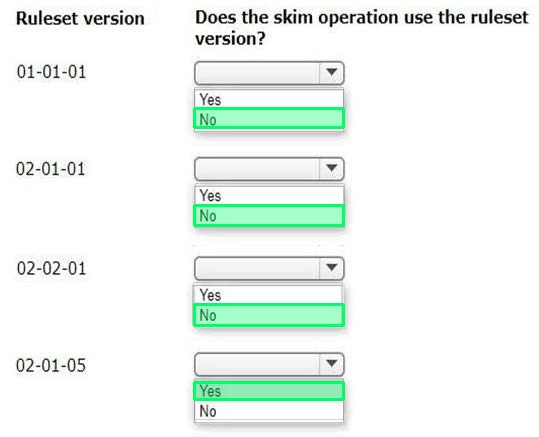
HOTSPOT You perform a major skim on the ruleset ABC:02-02 to ABC:03-01. In the Answer area, select the ruleset versions that the skim operation uses. 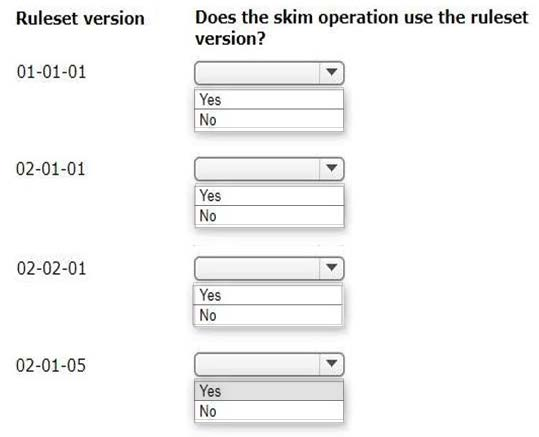
Reveal answer details
Close answer details
Question 15
Multiple choice
Which three options do you consider when deciding to use post-processing actions on a flow action? (Choose Three)
-
A
The effect if the flow action is reloaded
-
B
The sequence in which the system runs different actions
-
C
The timing of the commit for the flow action
-
D
The security setting for the flow action
-
E
The potential reuse of the flow action
Reveal answer details
Close answer details
Correct answersA, B, C
ExplanationWhen considering post-processing actions on a flow action, it's crucial to understand their implications on the user experience and system behavior. The effect if the flow action is reloaded (A) is important because post-processing actions might not execute again, leading to inconsistent data or user experience. The sequence in which the system runs different actions (B) is critical to ensure that data transformations and business logic are applied in the correct order, maintaining data integrity and consistency. The timing of the commit for the flow action (C) influences transaction management, ensuring that all changes are saved correctly and that the system maintains data consistency, especially in multi-user environments.
References:
Pega Community documentation on flow actions and post-processing.
Question 16
Single choice
You should consider using a field value when the list of allowed values is
-
A
-
B
-
C
specific to one case type
-
D
shared across all case types
Reveal answer details
Close answer details
Correct answerA
ExplanationYou should consider using a field value when the list of allowed values is mostly static. Field values are best used for properties with values that do not change often and need to be reused throughout the application.
References:
Pega official documentation on field values.
Question 17
Single choice
When deploying mashup code in a webpage, which option is necessary to ensure that Pega Platform accepts incoming requests?
-
A
Ensure the host is configured to support HTTPS.
-
B
Establish a private tunnel from the host to Pega Platform.
-
C
Enable authentication policies on Pega Platform.
-
D
Add the host URL in the Pega application.
Reveal answer details
Close answer details
Correct answerD
ExplanationWhen deploying mashup code in a webpage, it is necessary to add the host URL in the Pega application to ensure that Pega Platform accepts incoming requests. This is part of configuring the trusted origins within the application's settings.
References:
Pega official documentation on Pega Web Mashup deployment and configuration.
Question 18
Single choice
What is the difference between using the Call and Branch methods in an activity step to invoke other activities?
-
A
Call provides more robust debugging capability than Branch, while Branch provides better run-time performance.
-
B
Branch overrides the security restrictions of the called activity allowing you to easily test code; it will not
run in production.
-
C
Branch creates a new thread to allow asynchronous processing, while Call runs in the thread from it was invoked.
-
D
Call returns to the originating activity, while Branch skips the remainder of the originating activity.
Reveal answer details
Close answer details
Correct answerD
ExplanationThe difference between using the Call and Branch methods in an activity step to invoke other activities is that Call will return to the originating activity once the called activity completes, while Branch will not return to the originating activity and will skip the remainder of it after the called activity completes.
References:
Pega official documentation on activity methods.
Question 19
Multiple choice
What two actions must you perform to create a class join in a report definition? (Choose Two)
-
A
Select the type of match for key values.
-
B
Add an association rule to match key values.
-
C
Create a prefix for the joined class.
-
D
Add a parameter for each property in the class you want to join.
Reveal answer details
Close answer details
Correct answersA, C
ExplanationTo create a class join in a report definition, you must select the type of match for key values (A) and create a prefix for the joined class (C). Selecting the type of match, such as Inner Join or Left Outer Join, determines how records from the primary class and the joined class are combined based on matching key values. Creating a prefix for the joined class helps in distinguishing properties from the joined class from those of the primary class, preventing naming conflicts and clarifying the report definition. These actions are fundamental steps in setting up class joins in report definitions to retrieve and display data from
multiple related classes.
References:
Pega Community documentation on report definition and class joins.
Question 20
Single choice
A requirement states that the Manager role cannot open a purchase request during the Audit stage. How do you configure the case stage to satisfy this requirement?
-
A
Apply an Access Deny record.
-
B
Apply an Access When record.
-
C
-
D
Apply a Privilege record.
Reveal answer details
Close answer details
Correct answerB
ExplanationTo ensure that the Manager role cannot open a purchase request during the Audit stage, applying an Access When record (B) is the most suitable approach. An Access When record allows for the definition of conditional logic that determines whether a specific action, such as opening a case, is permitted based on the user's role and the current context of the case, such as its stage. By configuring this rule to evaluate to false for users with the Manager role during the Audit stage, you can effectively restrict their access to purchase requests in this stage, aligning with the requirement.
References:
Pega Community documentation on Access When rules and stage-based access control.
Question 21
Single choice
The ruleset list for an application consists of the following rulesets, ordered from highest to lowest: SelfService:01-01
TGB-HR:01-01
TGB:01-01 A rule with an Apply to: class of TGB-HR-SelfService-Work-TimeOff references a rule named ConfirmationRequest. The four instances of ConfirmationRequest in the rules cache are shown in the following table. 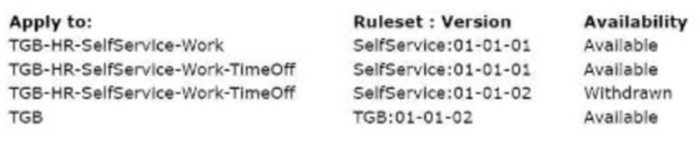 Which is chosen during rule resolution?
-
A
TGB-HR-SelfService-Work-TimeOff .ConfirmationRequest (SelfService:01-01-01)
-
B
TGB .ConfirmationRequest (TGB:01-01-02)
-
C
TGB-HR-SelfService-Work .ConfirmationRequest (SelfService:01-01-01)
-
D
TGB-HR-5elfService-Work-TimeOff .ConfirmationRequest (SelfService:01-01-02)
Reveal answer details
Close answer details
Correct answerC
ExplanationRule resolution in Pega follows the "Rule Resolution" algorithm, which will look for the rule that best matches the class hierarchy and the ruleset list. In this scenario, the rule that matches the Apply to: class of TGB-HR-SelfService-Work-TimeOff and is in the highest listed ruleset that is available (SelfService) will be selected.
References:
Pega SSA course materials on rule resolution.
Question 22
Multiple choice
What are three valid ways to exchange data through a Pega Web Mashup? (Choose Three)
-
A
Use an action object configured as a script to perform additional actions on a web mashup gadget.
-
B
Use the Javascript function doAction() to set or read data values through the hosting web page.
-
C
Use an SQL call to exchange data between the mashup and hosting web page.
-
D
Use a queue processor to pass updated attributes to the gadget on the hosting web page.
-
E
Use the data-pega-event-onpagedata attribute to configure the default value for the gadget.
Reveal answer details
Close answer details
Correct answersA, B, E
ExplanationIn a Pega Web Mashup, valid ways to exchange data include using an action object configured as a script to perform additional actions on a web mashup gadget (A), utilizing the Javascript function doAction() to set or read data values through the hosting web page (B), and using the data-pega-event-onpagedata attribute to configure default values for the gadget (E). These methods facilitate dynamic interaction between the mashup and the hosting web page, allowing for seamless data exchange and integration of Pega functionalities into external web applications.
References:
Pega Community documentation on Pega
Web Mashup and integration techniques.
|