A library application used by staff creates a book request case when a member wishes to borrow one or more books. As part of the case process, the application shows the staff a read only list of outstanding past-due books to remind the member to return late books, select the Data page definition for this use case.
-
A
-
B
-
C
-
D
-
E
-
F
Reveal answer details
Close answer details
Correct answerD
ExplanationFor the use case where a library application displays a read-only list of outstanding past-due books to staff during the book request case process, the appropriate Data Page configuration needs to ensure the data is accessible and specific to each user session without the possibility of modification. D . List, Readonly, Requestor: This configuration is optimal for the described scenario. A 'List' type is suitable because it involves displaying multiple records (outstanding books). 'Readonly' ensures that the data cannot be altered during the process, maintaining the integrity of the information displayed. The 'Requestor' scope is chosen because the information needs to be specific to the user session, providing a personalized reminder for the staff member to notify the member about their past-due books.
Options involving 'Page' (B, C, E) are not suitable as they are designed for single records rather than lists.
'Editable' (B, E) permissions are unnecessary and potentially problematic for this use case since the data should not be modified.
'Node' scope (F) would not provide the user-specific session data needed for this functionality.
Pega's official documentation on Data Pages provides guidance on configuring data pages, including choosing the appropriate type, scope, and edit mode based on the use case requirements.
A human resources application contains reports that are used to review hiring practices. The product manager has asked you to test the recent hire training report. How do you run a unit test on the report?
-
A
Create a copy of the rule and use the run rule window
-
B
Initialize the rule with test data using the run rule window
-
C
Identify a data test page to unit test the rule
-
D
Run the report definition using the contents of a database table
Reveal answer details
Close answer details
Correct answerD
ExplanationTo test a report, specifically the recent hire training report within a human resources application, the most direct and effective method is to run the report definition against actual data. This approach allows for the evaluation of the report's functionality, ensuring it meets the requirements and accurately reflects the data.
D . Run the report definition using the contents of a database table: This option involves executing the report definition to generate the report using data stored in a database table. It allows for the assessment of how well the report handles real data, including the correctness of the information displayed, the performance of the report, and whether it meets the product manager's requirements for reviewing hiring practices. Creating a copy of the rule (A) and initializing the rule with test data using the run rule window (B) can be part of the development or debugging process but might not fully test the report under realistic conditions. Identifying a data test page to unit test the rule (C) is more applicable to testing rule logic rather than report output.
Pega's documentation on report testing emphasizes the importance of evaluating report definitions with real or representative data to ensure accuracy and performance before deployment.
In a purchase request case type, you have the following requirement: Purchase requests should automatically go to a manager of an employee.
To meet this requirement, you design a case with a_________
-
A
step that routes to the manager
-
B
change stage step to allow the employee to route to the manager
-
C
stage to route requests to the manager
-
D
process that routes to the manager
Reveal answer details
Close answer details
Correct answerA
ExplanationFor a purchase request case type where requests should automatically go to a manager of an employee, the most straightforward configuration is to design a step within the case lifecycle that specifically routes the case to the manager. This routing logic ensures that once an employee submits a purchase request, it is automatically forwarded to their manager for approval, streamlining the workflow and enforcing organizational approval hierarchies.
Question 4
Multiple choice
Which requirement can be implemented through circumstancing?
-
A
An application establishes a goal of four hours to adjust claims for platinum customers. For other customers, the application establishes a goal of one business day.
-
B
An application sets the default shipping option for orders that exceed USD100 to two-day delivery.
Otherwise, the default option is five-day delivery.
-
C
An application audits insurance claims that an insurance adjuster values at USD10000 or greater.
Otherwise, the claim is approved.
-
D
An application routes upgrade requests for US customers to one work queue, and requests for European customers to a different work queue.
Reveal answer details
Close answer details
Correct answersA, D
ExplanationCircumstancing in Pega allows for variations in process handling based on specific conditions or contexts: A . An application establishes a goal of four hours to adjust claims for platinum customers. For other customers, the application establishes a goal of one business day. This requirement is ideal for circumstancing because it involves applying different service levels based on a specific customer attribute (customer type). Circumstancing enables the creation of a specialized rule that automatically adjusts processing times based on the customer type identified.
A music studio allows clients to upload audio recordings, and if they choose, they can upload before they begin consultation. The studio wants to pause case processing after the Client Intake stage and give clients 72 hours to upload recordings before beginning the Client Consultation process. Which configuration meets this requirement?
-
A
Configure a case wide optional action to allow uploads. Add a Wait shape with a Timer Wait type set to
72 hours.
-
B
Configure a service level on the stage that contains the Client Consultation process with a deadline of
72 hours.
-
C
Configure a child case to upload recordings. Add a Wait shape with a case dependency until the child case is resolved.
-
D
Configure a validate rule on the Client Intake stage and set the elapsed time to 72 hours.
Reveal answer details
Close answer details
Correct answerA
ExplanationTo pause case processing after the Client Intake stage and provide a timeframe for clients to upload recordings: A . Configure a case-wide optional action to allow uploads. Add a Wait shape with a Timer Wait type set to 72 hours. This configuration meets the requirement by allowing an optional action for clients to upload their recordings and then using a Wait shape to pause the case. The Timer Wait type ensures that the case will not proceed to the Client Consultation stage until 72 hours have passed, giving clients ample time for uploads.
Question 6
Multiple choice
An online sales application supports both laptop and mobile devices. You are configuring the application skin and you notice the responsive layout in the mobile device is not displaying views as stakeholders require. Which two options allow you to resolve this situation without negatively impacting the laptop users? (Choose two.)
-
A
Use the same application skin in all portals.
-
B
Update the process to give mobile users a separate portal.
-
C
Do not use a skin for the mobile application version.
-
D
Adjust the responsive behavior in the skin for optimal viewing in the mobile portal.
Reveal answer details
Close answer details
Correct answersA, D
ExplanationWhen configuring an application skin to ensure responsive layouts are displaying correctly across different devices, such as laptops and mobile devices, without impacting the user experience negatively for laptop users, careful adjustments to the skin and its responsive settings are required. A . Use the same application skin in all portals: Utilizing a single application skin across all portals ensures consistency in branding and design. The same skin can be configured to adapt responsively to various screen sizes, ensuring a seamless user experience across devices. D . Adjust the responsive behavior in the skin for optimal viewing in the mobile portal: The skins responsive behavior settings allow for adjustments specific to how UI elements are rendered on different screen sizes. By fine-tuning these settings, the application can ensure that views are displayed as required on mobile devices without affecting the layout on larger screens, like laptops. Updating the process to give mobile users a separate portal (B) could be an approach but might introduce complexity and maintenance overhead, as well as potentially fragment the user experience. Not using a skin for the mobile application version (C) is not advisable as it disregards the benefits of a unified and controlled UI design across devices.
Pega's documentation on skin configuration and responsive UI design principles highlights how to manage and adjust application skins to accommodate various display requirements, ensuring a consistent and effective user experience across device types.
A survey is sent to a customer via email. How do you configure a solution to ensure the email includes the case ID for the survey?
-
A
Create a required field for the case ID that must be entered by a user during the case process prior to sending the survey.
-
B
Call a data transform to copy the case ID from pyWorkPage to the email.
-
C
Create a process using the Send Email step allowing representatives to quickly add the case ID to the email.
-
D
Use the Insert Property feature of a Send Email step to add the case ID when composing the message dialog.
Reveal answer details
Close answer details
Correct answerD
ExplanationTo ensure that a survey email sent to a customer includes the case ID for the survey, incorporating dynamic content into the email is necessary. The most direct and efficient way to achieve this is by utilizing Pega's built-in functionality for email composition.
D . Use the Insert Property feature of a Send Email step: This approach allows for the dynamic insertion of the case ID directly into the email content at the time of composing the email. The Insert Property feature is designed to reference and pull in property values (such as the case ID) from the case context, ensuring that the email content is accurately personalized for each recipient. This method ensures that the email template remains flexible and reusable, while still providing specific information like the case ID.
Creating a required field for the case ID (A) unnecessarily complicates the process for users. Calling a data transform (B) can copy data between pages within the application but does not directly address the insertion of case ID into an email. Creating a process using the Send Email step (C) provides a mechanism for sending emails but, without utilizing the Insert Property feature, does not automatically include the case ID in the email content. Pega's email integration documentation details how to use the Insert Property feature within email steps, highlighting its utility in personalizing emails with case-specific information, such as case IDs.
You are building a new booking application in pega platform with a case type that displays a customer's various accounts and allows them to make banking transactions. The transaction data object allows customers to dispute a transaction. The system provides a drop-down list of reasons for the dispute, which are collected along with the transaction ID.
According to pega best practices, which option do you use to source the transaction data object?
-
A
External system of record
-
B
-
C
Pega platform system of record
-
D
Reveal answer details
Close answer details
Correct answerB
ExplanationFor sourcing a transaction data object in a booking application, particularly when listing reasons for a transaction dispute: B . A data page. This option is typically recommended for sourcing data objects in Pega applications because data pages allow for efficient data management and can be configured to pull data from various sources, including external systems or internal databases. This ensures that data remains dynamic, up-to-date, and is efficiently managed within the application framework.
Question 9
Multiple choice
An online retailer allows customers to select a courier service for deliveries. The list of available courier services is drawn from a data type sourced in the Pega database. The Fulfillment department wants to allow local warehouse managers to add courier services to mitigate increases in delivery times and remove courier services that fail to meet delivery metrics. Which two options are required to allow local warehouse managers to update courier service records in production? (Choose two.)
-
A
Create an access group for local warehouse managers.
-
B
Delegate the records for the courier service data type.
-
C
Define an approval process for adding and removing courier services.
-
D
Enable rule checkout for the local warehouse managers
Reveal answer details
Close answer details
Correct answersB, C
ExplanationTo enable local warehouse managers to dynamically update the list of courier services based on performance and delivery metrics directly in the production environment, specific functionalities need to be leveraged within Pega. B . Delegate the records for the courier service data type: Delegation is a powerful feature in Pega that allows certain data types or rules to be managed by business users directly in production. By delegating the courier service data type, local warehouse managers can add or remove courier services as needed without requiring changes to the application code or direct database access. C. Define an approval process for adding and removing courier services: Implementing an approval process ensures that changes to courier services undergo review before becoming effective. This step maintains data integrity and service quality by ensuring only justified updates are made to the list of courier services.
Creating an access group for local warehouse managers (A) is a necessary step for defining user permissions but on its own does not specifically enable the updating of courier service records. Enabling rule checkout (D) is more related to the development environment and rule versioning, not directly applicable to the business user's management of data records in production. Pegas official documentation on data delegation and workflow configuration provides insights into enabling business users to manage specific types of data directly and securely, including the setup of approval processes for such changes.
Question 10
Single choice
Which statement about channel interfaces is true?
-
A
Creating a channel interface creates a default work queue in Agg Studio.
-
B
All users see the same channel interface.
-
C
A persona requires a unique channel interface.
-
D
Channel interfaces are user interfaces that meet business requirements.
Reveal answer details
Close answer details
Correct answerD
ExplanationA statement about channel interfaces: D . Channel interfaces are user interfaces that meet business requirements. Channel interfaces in Pega are tailored to fit the specific needs of a business process or user group, ensuring that the user interface supports the business goals and provides an effective means of interaction for the endusers.
Question 11
Single choice
Customers can log their own product support requests using an online portal. Once logged in, the portal displays the list of products purchased by the customer. The customer can initiate one or more support requests for each product. What is the appropriate scope for a data page that sources the list of products purchased by the customer?
-
A
-
B
-
C
-
D
Reveal answer details
Close answer details
Correct answerC
ExplanationThe appropriate scope for a data page that lists products purchased by a customer viewed in an online portal is "Requestor". This scope ensures that the data page is unique to each user session and is accessible across multiple requests within that session. The "Requestor" scope is suitable because it persists for the duration of the user's interaction with the application, across multiple threads or cases, making it ideal for situations where a user might be working on multiple support requests during a single login session.
Question 12
Multiple choice
In which three situations can you use a data transform? (Choose Three)
-
A
To set the destination location as the arrival location
-
B
To create a new property after case creation
-
C
To set the default arrival date to five days in the future
-
D
To copy the first and last name properties into a single property value
-
E
To perform an action that allows the user to update a reservation
Reveal answer details
Close answer details
Correct answersA, C, D
ExplanationData transforms in Pega can be used effectively in the following scenarios:
A. Setting a destination
location to match an arrival location as part of data normalization.
C. Automatically calculating and setting a future date based on a specific business logic, such as setting an arrival date five days ahead.
D.
Merging multiple pieces of data, such as first and last names, into a single property to facilitate easier data management or reporting.
Question 13
Multiple choice
In a Human Resources (HR) application, a business architect has developed a new process for the Onboarding case type. You want to test the process and the fields to verify the Ul elements collect expected results.
-
A
Add explicit assertions on the Ul elements
-
B
Create a unit test for the Onboarding case type
-
C
Create a scenario test for the Onboarding case type
-
D
Add validations on the Ul elements
Reveal answer details
Close answer details
Correct answersA, C
ExplanationCreating a scenario test for the Onboarding case type is the most effective way to test the process and verify that UI elements collect the expected results. Scenario testing allows you to simulate realworld user interactions within the HR application, ensuring that the process flows correctly and that all UI components function as intended. This type of test covers a broader range of application functionalities compared to unit tests, which are more granular, and it is more comprehensive than adding assertions or validations to individual UI elements.
Question 14
Single choice
You are configuring an accident claim case for an automobile insurance company with two child cases as illustrated. How do you suspend the Accident Claim case processing until the Vehicle Damage and Body Injury cases are resolved?
-
A
Add a wait shape to the parent case pausing the parent case until the child cases resolve.
-
B
Add a service level agreement to resolve the child cases within 90 days.
-
C
Add a 30-day wait to the parent case to allow time for the child cases to resolve.
-
D
Add an approval shape to each of the child cases to resolve the cases.
Reveal answer details
Close answer details
Correct answerA
ExplanationTo ensure that the processing of an Accident Claim case is paused until the resolution of both Vehicle Damage and Body Injury child cases: A . Add a wait shape to the parent case pausing the parent case until the child cases resolve. The wait shape is used in Pega to halt the process flow until specified conditions are met, in this case, the resolution of both child cases. This ensures that the parent case does not proceed until all necessary assessments and repairs documented in the child cases are completed, providing a coherent and controlled case management process.
Question 15
Multiple choice
Users create Insurance Coverage Request Cases to authorize insurance payments. Users enter information that includes the name of the patient, the date of the procedure and the type of the procedure.
After entering the information, the user submits the request for a review of the patient's insurance policy.
Because multiple users enter requests, the duplicate requests can occur. A request is considered a duplicate if the patient name, procedure type, and procedure date match an existing request. You have been given two requirements: Ensure that users can identify duplicate requests.
If a case is duplicated, it is not written to the database. Otherwise, write the case to the database. Which two options configure the application so that users can identify duplicate requests? (Choose two)
-
A
Add a duplicate search step to the case life cycle design.
-
B
Configure a duplicate search decision table and add it to a Decision shape
-
C
Configure weighted conditions.
-
D
Configure a validation rule to validate matching cases.
Reveal answer details
Close answer details
Correct answersA, B
ExplanationTo prevent duplicate insurance coverage request cases from being entered into the database, the following configurations would be appropriate: A . Add a duplicate search step to the case life cycle design. This step is integrated into the case life cycle to automatically check for duplicates at a specific point in the case processing, typically before the data is submitted for further processing or saved to the database.
B . Configure a duplicate search decision table and add it to a Decision shape. This approach uses a decision table to define the criteria for what constitutes a duplicate (e.g., matching patient name, procedure type, and date). The decision shape then uses this table to determine if the current case is a duplicate, preventing it from proceeding if it is.
Question 16
Single choice
A flow action calls a pre-processing data transform to initiate values. There are several flow actions available for the assignment. You want to make sure that the values are only initiated once for each flow action. How do you implement a solution?
-
A
Do nothing. The pre-processing data transform is only called once for each assignment.
-
B
Make sure that the flow action does not have the highest likelihood since it will always be invoked.
-
C
Configure the data transform as post-processing instead of pre-processing.
-
D
Add logic to the pre-processing data transform to test if values were already initiated.
Reveal answer details
Close answer details
Correct answerD
ExplanationIn situations where a flow action calls a pre-processing data transform to initiate values and there are several flow actions available for the assignment, ensuring that values are only initiated once for each flow action requires a strategic approach: D . Add logic to the pre-processing data transform to test if values were already initiated: This solution involves incorporating a check within the data transform itself to determine whether the initiation of values has already occurred. If the check
Question 17
Single choice
How do you identify if a result in a decision rule cannot be returned?
-
A
Test for missing conditions
-
B
-
C
Test the rule using a unit test
-
D
Reveal answer details
Close answer details
Correct answerB
ExplanationWhen using decision rules in Pega, ensuring that no potential result is unaddressed is crucial for maintaining the rule's effectiveness. Testing for completeness involves verifying that all possible inputs and conditions have been accounted for in the decision rule. This type of testing ensures that every feasible scenario has a corresponding outcome defined, thereby preventing the decision rule from failing to return a result due to missing conditions.
Question 18
Single choice
A manager requests a report that contains the following columns: Create Date, Case ID, Create Operator, and World Status. You must sort the cases so the case with the most recent create date appears at the top of the list and descends in order. How do you design the report definition to support this requirement?
-
A
Select Lowest to Highest sort type for Create Date.
-
B
Add a filter condition where Create Date is greater than the current date.
-
C
Select Highest to Lowest sort type for Create Date.
-
D
Make the Create Date the first column in the report.
Reveal answer details
Close answer details
Correct answerC
ExplanationTo design a report definition that sorts cases so that the case with the most recent create date appears at the top of the list and descends in order, the sorting of the Create Date column must be configured appropriately. C . Select Highest to Lowest sort type for Create Date: This sorting option ensures that the report organizes the cases starting with the most recent (highest) create date first, descending to the earliest (lowest) create date. This configuration aligns directly with the manager's requirement to have the most recently created cases at the top of the report, facilitating quick access to the latest cases. Selecting Lowest to Highest sort type for Create Date (A) would result in the opposite of the requested order, placing the oldest cases at the top. Adding a filter condition where Create Date is greater than the current date (B) wouldn't be practical, as create dates cannot be in the future. Making the Create Date the first column in the report (D) might aid in readability but on its own does not ensure the correct sorting order. Pega's official documentation on report definitions explains how to configure sorting options to organize report data effectively, emphasizing the importance of sorting for enhancing report usability and meeting specific user requirements.
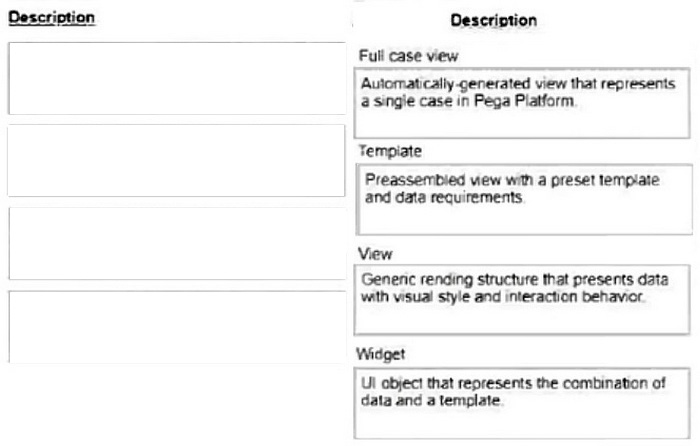
DRAG DROP Consider an application built on the Constellation architecture. Select each description on the left and drag it to the appropriate UX concept on the right. 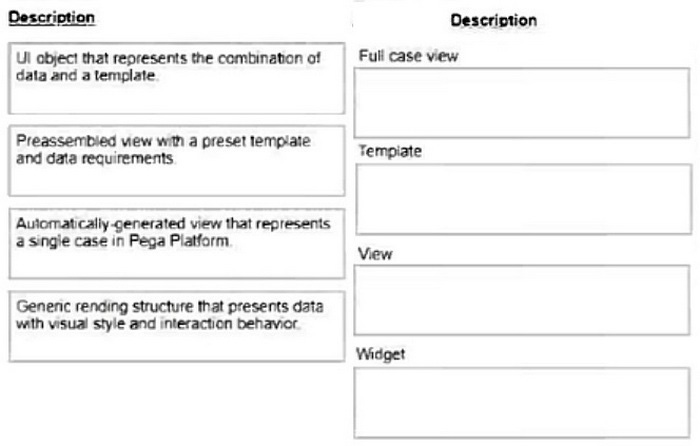
Reveal answer details
Close answer details
Question 20
Single choice
A process routes loan requests to a specific loan officer based on the type of loan. - If the loan is a mortgage, it is routed to Adam Ross. If the loan is for an automobile, it is routed to Julia Samuels. - If the loan is an equity line, the case is routed to Don Smith. How do you configure a router to ensure that case advances to the correct loan officer?
-
A
Route the case to a worklist using a skilled router.
-
B
Route the case to a work queue using a When condition.
-
C
Route the case to a work queue using a skilled router.
-
D
Route the case to a worklist using a When condition.
Reveal answer details
Close answer details
Correct answerD
ExplanationFor routing loan requests to specific loan officers based on the type of loan, the configuration needs to precisely match the type of loan to the designated officer. D . Route the case to a worklist using a When condition: This approach utilizes Pega's conditional logic capabilities to evaluate the type of loan and route the case accordingly. A "When" condition can be configured for each loan type to determine the appropriate loan officer's worklist (Adam Ross for mortgages, Julia Samuels for automobile loans, and Don Smith for equity lines). This ensures that each loan request advances directly to the correct officer's attention based on the specified criteria. Routing the case to a worklist or work queue using a skilled router (A and C) could be used in scenarios where assignment is based on skill levels or capabilities rather than specific conditional logic. Routing the case to a work queue using a When condition (B) is close but less direct than using worklists for individual officers, as work queues are typically used for groups or teams rather than individuals. Pega's documentation on case routing provides insights into different routing options, including the use of conditional logic ("When" conditions) to direct work to specific users or teams based on case attributes.
Question 21
Single choice
In an application that sells office supplies, the Payment view displays order items and collects payment information. In the Payment section rule, the order items are grouped in a dynamic layout. You find out later that the Order Summary view must also display the order items. How do you configure the Ul so that the order items display is shared between the Payment view and Order Summary view?
-
A
Convert the Payment section layout that contains order items to a section, and embed this section in the Order Summary section.
-
B
Build the Order Summary section with a layout inside to group the order items, similar to the Payment section.
-
C
Embed the Payment section in the Order Summary section.
-
D
Reuse the Payment section in the Order Summary view and use a disable when condition to disable payment information on the Payment section rule.
Reveal answer details
Close answer details
Correct answerA
ExplanationTo achieve reuse and consistency between the Payment view and the Order Summary view in an application that sells office supplies, converting the layout that groups the order items into a reusable section is an effective solution. This reusable section can then be embedded in both the Payment and Order Summary views. This approach ensures that any updates to the order items are automatically reflected in both views, maintaining a single source of truth and reducing maintenance overhead.
Question 22
Single choice
A company requires that patients receive status updates during processing of medical tests. Patients are not users of the application.
You create the work party for the patient as an instance of which class?
-
A
-
B
-
C
-
D
Reveal answer details
Close answer details
Correct answerA
ExplanationIn Pega applications, work parties represent entities associated with a case. When configuring status updates for patients who are not users of the application, it is essential to use a class that accurately represents external individuals. A . Data-Party-Person: This class is designed to represent individual people as parties in a case. Using this class to create a work party for a patient allows the application to store relevant personal information and contact details necessary for sending status updates about medical test processing. Since patients are the recipients of the information and not operators or organizational entities within the system, this class is the most appropriate choice. The other options, such as Data-Party-Operator (used for application users), Data-Party-Org (used for organizations), and Data-
Party-Com (used for commercial entities), do not fit the context of individual patients receiving updates.
Pega Academy's courses on case management detail the use of work parties in cases, explaining the purpose of various Data-Party classes and how they are applied in real-world scenarios to manage communications and interactions.
Question 23
Single choice
A data page holds product information. The data page's Reload if older Than field is set to 15 minutes. The data page is created at 06:12.At 06:20 the user requests product information. At 06:42 the user requests product information. When is the data page reloaded?
-
A
-
B
-
C
-
D
Reveal answer details
Close answer details
Correct answerD
ExplanationFor a data page set with a "Reload if Older Than" threshold of 15 minutes, it is essential to understand how this setting dictates the data page's reload timing in response to user requests for product information. D . 06:42: The data page is reloaded at 06:42 because this is the point at which the next user request for product information occurs outside the 15-minute validity window from the data page's last load at 06:12.
The 06:20 request does not trigger a reload since it falls within the 15-minute window. By 06:42, the data page has surpassed the "Reload if Older Than" threshold relative to its initial load time, necessitating a reload to ensure the currency and accuracy of the product
Question 24
Multiple choice
Which three use cases demonstrate the Pega dynamic Ul behavior? (Choose Three)
-
A
Display a message upon form submission that a date field must be in the future.
-
B
Unmask a password field when users click an icon.
-
C
Automatically calculate order total when users change quantities.
-
D
Display partner information fields when a screen loads for married applicants.
-
E
Display a shipping address section when users select the Different than billing address check box.
Reveal answer details
Close answer details
Correct answersA, C, E
ExplanationDynamic UI behavior in Pega is exemplified by interactions that adjust in real-time to user input or conditions: A . Display a message upon form submission that a date field must be in the future. This is a validation feature that dynamically checks the validity of date inputs against the condition set (future date) at the time of form submission. C . Automatically calculate order total when users change quantities. Dynamic UI behavior includes recalculating values in real-time as users adjust input parameters, like quantity in this case, enhancing the interactive experience. E. Display a shipping address section when users select the 'Different than billing address' checkbox. This functionality shows additional UI components based on user selections, which is a key feature of dynamic UIs, allowing for a responsive and adaptive user interface.
Question 25
Multiple choice
Depending upon the purchase request amount, approvals cascade from the users to a loan officer, then to a director and finally to a vice president. The loan officer is the user's manager. The director is the loan officer's manager. The vice president is the director's manager.Which two approaches can you use to configure the cascading approval? (Choose two)
-
A
Approval based on Authority Matrix, with a Decision Tree rule to determine the approver(s)
-
B
Approval based on Authority Matrix, with a Decision Table rule to determine the approver(s)
-
C
Approval based on Reporting structure, using the workbasket manager to determine the approver(s)
-
D
Approval based on Reporting structure and when conditions, using each operator's reporting to manager to determine the approver(s)
Reveal answer details
Close answer details
Correct answersB, D
ExplanationTo configure cascading approvals in a scenario where approvals move up through an organizational hierarchy (user to loan officer to director to vice president), two effective methods include using an Authority Matrix in conjunction with a Decision Table and leveraging the reporting structure with conditional logic. A Decision Table allows for the definition of approval rules in a structured, tabular format, which is ideal for setting different approval thresholds based on the purchase amount. Using the reporting structure with "when" conditions allows the system to dynamically determine the next approver based on the employees direct reporting line, ensuring that each approval level is adhered to according to organizational hierarchy.
Question 26
Single choice
How do you enable field-level auditing for properties?
-
A
Add an auditing optional action to the case workflow.
-
B
Enable the auditing feature on the property rule forms.
-
C
Enable field-level auditing for the case type.
-
D
Add a field validation to the case workflow.
Reveal answer details
Close answer details
Correct answerB
ExplanationIn Pega, enabling field-level auditing for properties is typically done through the property rule form. By enabling the auditing feature on specific property rule forms, changes to those properties are automatically tracked and recorded by the system. This setup is essential for compliance, transparency, and historical data analysis purposes, allowing organizations to monitor and audit changes to critical data fields systematically.
Question 27
Single choice
You are defining a user view for a loan application. If the loan applicant indicates there is an existing open account, the Date account opened must be before the current date. Select the approach that meets the validation requirements.
-
A
Use a pick list control to verify the Date account opened is in the past.
-
B
Use a validate rule to verify the Date account opened is in the past.
-
C
Use a when rule to verify the Date account opened is in the past.
-
D
Use a calendar control to verify the Date account opened is in the past.
Reveal answer details
Close answer details
Correct answerB
ExplanationTo ensure the validation that the 'Date account opened' is indeed in the past for a loan application: B . Use a validate rule to verify the Date account opened is in the past. Validate rules in Pega are used to enforce data integrity and accuracy, making them suitable for verifying that a date entered is before the current date. This method ensures that data meets the business requirement directly and effectively.
Question 28
Single choice
A user view includes a list of four urgency options selectable by radio buttons. How do you configure the selection list?
-
A
Configure a field group with selectable urgency options.
-
B
Configure a drop down field with selectable urgency options.
-
C
Configure a picklist with radio buttons for the urgency options.
-
D
Configure a Boolean field with selectable urgency options.
Reveal answer details
Close answer details
Correct answerC
ExplanationFor a user view that includes a list of four urgency options selectable by radio buttons, the goal is to present a single choice among predefined options in a user-friendly manner. C . Configure a picklist with radio buttons for the urgency options: This approach directly meets the requirement by allowing users to select one urgency level from the provided options using radio buttons. A picklist configured with radio buttons effectively presents discrete choices in a clear format, ensuring that only one urgency option can be selected at any time, which aligns with the functionality described. Configuring a field group (A) is generally used for grouping related fields but does not inherently provide the singular selection mechanism of radio buttons.
Question 29
Multiple choice
Which two rules do you localize by using the localization wizard? (Choose Two)
-
A
-
B
-
C
-
D
Reveal answer details
Close answer details
Correct answersB, C
ExplanationThe Localization Wizard in Pega is designed to facilitate the localization of various rule types that involve user-facing text: B . Paragraph. Paragraph rules, which contain blocks of text used in user interfaces, are often localized to cater to different languages, making them accessible and understandable to users in various regions. C .
Correspondence Fragment. Correspondence fragments are parts of larger correspondence templates and typically contain text that needs to be presented in the user's language, making them crucial candidates for localization using the wizard.
Question 30
Single choice
You are configuring routing for a customer warranty service request. All warranty service requests are routed to the warranty resolution group except for warranty service requests for beta and release product that requires review by the vice president of service. How do you configure assignment routing to review warranty service requests?
-
A
Route the assignment to the vice president of service who routes assignments to the warranty resolution group as needed.
-
B
Route the assignment to the warranty resolution group who sends an email notification to the vice president of service for the beta-release product.
-
C
Route the assignment to the skilled group for the beta release when the request is for the beta release.
Otherwise, route the assignment to the warranty resolution group.
-
D
Route the assignment to the vice president of service when the request is for the beta release.
Otherwise, route the assignment to the warranty resolution group.
Reveal answer details
Close answer details
Correct answerD
ExplanationFor routing customer warranty service requests, particularly when different routing rules apply based on product status: D . Route the assignment to the vice president of service when the request is for the beta release.
Otherwise, route the assignment to the warranty resolution group. This routing strategy is efficient for handling cases where special attention is required by higher management (e.g., the vice president of service) for beta and release products, ensuring that such cases are escalated appropriately while other standard warranty requests continue to be processed by the usual resolution group. This setup optimizes the handling process by directing cases based on their specificity and importance.
Question 31
Multiple choice
An online shopping application allows customers to select the item quantity of different goods and add items to the shopping cart. In the shopping cart, the application displays the price for each item type, indicates the quantity of each item type, calculate the total item prices, and calculate the total cost for all items in the shopping cart. The application pulls the price of each item type from a data page that references an external inventory management system.
Select two unit tests useful in developing the shopping cart page. (Choose Two)
-
A
Verify the data page has the correct item prices.
-
B
Verify the data transform copies the correct value from the data page to the shopping cart page.
-
C
Verify the price fields are displayed in the correct format.
-
D
Verify the order total cost property is accurately calculated
Reveal answer details
Close answer details
Correct answersA, D
ExplanationFor an online shopping application, ensuring accurate item pricing and total cost calculations in the shopping cart is crucial for functionality and user trust. Unit testing focused on verifying these aspects is essential during development. A . Verify the data page has the correct item prices: This test ensures that the prices pulled from the external inventory management system into the application via the data page are accurate. Correct item pricing is foundational to calculating the total cost for items in the shopping cart. D . Verify the order total cost property is accurately calculated: This test checks whether the application correctly calculates the total cost of all items in the shopping cart, considering both the individual item prices and their quantities. Accurate total cost calculation is crucial for the final order summary and checkout process. Verifying the data transform copies the correct value (B) is important for data integrity but is a more granular detail compared to the overarching need to ensure accurate pricing and total calculations. Verifying the price fields are displayed in the correct format (C) is also significant but focuses more on UI presentation than on the underlying functional correctness of pricing and total cost calculations.
Unit testing best practices in application development emphasize the importance of verifying core functionalities, such as accurate data retrieval and calculations, to ensure the application operates correctly and provides a reliable user experience, as outlined in Pega's development documentation.
Question 32
Multiple choice
Which two conditions do you test with a unit test? (Choose Two)
-
A
A data page populates without any errors.
-
B
A property value is set correctly by a data transform.
-
C
An application displays user views for 20 users within three seconds.
-
D
An application is successfully migrated to a test system.
Reveal answer details
Close answer details
Correct answersA, B
ExplanationUnit testing in Pega involves verifying specific conditions within the application to ensure they function as intended: A . A data page populates without any errors. This test confirms that the data page is configured correctly and can retrieve and display data without issues, which is crucial for ensuring the reliability of data-dependent features in the application.
B . A property value is set correctly by a data transform. Testing this condition ensures that data transforms, which are used to manipulate data within the application, are correctly modifying and setting values as expected, which is fundamental for maintaining data integrity and application logic.
Question 33
Single choice
Which statement about responsive breakpoints is true?
-
A
Responsive breakpoints trigger selected behaviors to optimize data presentation.
-
B
Responsive breakpoint behavior changes based on the device brand.
-
C
Responsive behavior allows users to see all relevant information with scroll bars.
-
D
You configure custom responsive breakpoint display widths in Ag Studio.
Reveal answer details
Close answer details
Correct answerA
ExplanationResponsive breakpoints in UI design: A . Responsive breakpoints trigger selected behaviors to optimize data presentation. Breakpoints are specific widths at which a sites layout will adjust to provide the best user experience. They help to ensure that no matter the size of the screen, from a mobile phone to a desktop monitor, the application presents data in an organized and readable manner.
Question 34
Multiple choice
Based on security factors, which two options are considered strong passwords? (Choose Two)
-
A
lLik3Chocolate&sawDustIcecre@m
-
B
d8073&gxn*,.ki;vnhdf($h&m
-
C
-
D
Reveal answer details
Close answer details
Correct answersA, B
ExplanationStrong passwords are crucial for enhancing security. They are typically characterized by a combination of uppercase and lowercase letters, numbers, and special characters, making them difficult to guess or crack.
A . lLik3Chocolate&sawDustIcecre@m: This password incorporates uppercase and lowercase letters, numbers, and special characters, and is sufficiently complex and lengthy, making it a strong password. B .
d8073&gxn,.ki;vnhdf($h&m*: Similarly, this password includes a mix of characters, numbers, and special symbols, contributing to its strength due to its complexity and unpredictability. Option C, "bluedoor", lacks the mix of character types and is relatively simple, making it a weak password. Option D, "Pe6@5yst3m$", though incorporating a mix of character types, is closer to a common pattern related to the word
"password", which might not be as strong as options A and B, which are more complex and less predictable.
Cybersecurity best practices emphasize the importance of strong passwords that combine various character types and avoid common words or patterns, enhancing account security against unauthorized access or brute-force attacks.
Question 35
Single choice
Which piece of application content do you localize by using a Field Value rule?
-
A
Labels and drop-down values on a section rule
-
B
Logos or other images on a harness rule
-
C
User instructions in a paragraph rule
-
D
User-editable text in a correspondence rule
Reveal answer details
Close answer details
Correct answerA
ExplanationField Value rules in Pega are used primarily for localizing user interface elements: A . Labels and drop-down values on a section rule. Localizing these elements ensures that applications can adapt to different languages and regional settings, enhancing user accessibility and usability across diverse geographical locations.
Question 36
Single choice
You are designing a form for an online bookstore to show new arrivals. Which layout do you use to display the book cover pictures, as shown in the image?
-
A
-
B
-
C
-
D
Reveal answer details
Close answer details
Correct answerC
ExplanationFor displaying book cover pictures in a grid or list format on an online bookstore form: C . Repeating dynamic layout. This layout type is ideal for displaying collections of items such as book covers, as it can dynamically repeat content based on the data source. It allows for an organized, responsive, and visually appealing presentation of new arrivals, each represented by their respective cover image.
Question 37
Single choice
You need to test whether a user interface is suitable for users with visual disabilities, such as Deuteranopia (red-green confusion). How do you perform this task?
-
A
Use the Accessibility Inspector.
-
B
Use a screen reader extension.
-
C
-
D
Reveal answer details
Close answer details
Correct answerA
ExplanationTo test the suitability of a user interface for users with visual disabilities like Deuteranopia: A . Use the Accessibility Inspector. The Accessibility Inspector in Pega is a tool designed to evaluate UIs for compliance with accessibility standards, including color contrast and visibility, which are crucial for users with color vision deficiencies. This tool provides an effective means to ensure that the application is accessible to users with such visual disabilities.
Question 38
Single choice
An internet provider has a quiz that gives customers a recommended internet speed based on their typical internet use. The questions differ based on the selections that the customer makes, for example, whether they are seeking a recommendation for a residence or a business.
Once the customer completes the quiz, how do you determine the recommended internet speed?
-
A
Configure a decision table
-
B
Configure a view with the quiz questions
-
C
Configure a decision tree
-
D
Configure a process with multiple decision shapes
Reveal answer details
Close answer details
Correct answerA
ExplanationFor an internet provider's quiz designed to recommend internet speeds based on varying customer usage profiles, including differentiating between residential and business needs, employing a decision mechanism that efficiently handles multiple input factors is key.
A . Configure a decision table: Decision tables are ideal for scenarios where the output (recommended internet speed) depends on multiple conditions (quiz answers about internet use). They offer a clear, concise way to map various combinations of inputs to their corresponding outputs, making it easy to update and manage as new conditions or outcomes are introduced. This configuration supports dynamic and nuanced decision-making based on customer responses. Configuring a view with quiz questions (B) is necessary for collecting inputs but does not determine the outcome. A decision tree (C) could also be used but might become complex with multiple branching conditions. A process with multiple decision shapes (D) could handle the logic but may be less efficient and harder to maintain than a decision table.
Pega's decision management tools, including decision tables, provide a structured approach to making rule-based decisions based on multiple input conditions, as outlined in Pega's official documentation on decision rules.
Question 39
Single choice
A stakeholder prefers to group a set of existing actions into a multistep form. Which work item do you create in Agile workbench to address this change request?
-
A
-
B
-
C
-
D
Reveal answer details
Close answer details
Correct answerD
ExplanationGrouping a set of existing actions into a multistep form as per a stakeholder's request involves adding new functionality or modifying the existing functionality of an application. This type of change request is best captured as a User Story in Agile Workbench.
D. User Story: User stories are a way to document specific requirements or changes in an agile
development environment. They focus on the value or outcome of the change from the perspective of the end-user or stakeholder. In this case, creating a user story allows for the clear articulation of the stakeholder's preference for a multistep form, including the rationale and the expected benefit, facilitating prioritization and implementation during the development cycle. Bugs (A) are used to report issues or errors in the existing application functionalities. Feedback (B) can capture general comments or suggestions but lacks the structured approach of a user story for implementing new features or changes.
Status (C) is not a work item but an attribute used to track the progress of items like bugs, feedback, or user stories.
Agile methodologies and Pega's Agile Workbench documentation emphasize the use of user stories to effectively manage new features and changes, ensuring that development efforts are aligned with user needs and stakeholder expectations.
|