Based on the image below, which source IP address will be seen in the data filtering logs of the Cloud NGFW for AWS with the default rulestack settings? 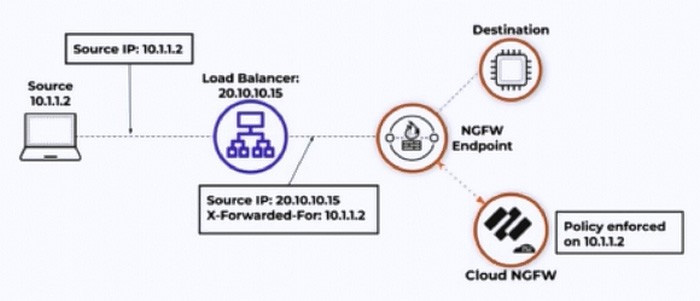
-
A
-
B
-
C
-
D
Reveal answer details
Close answer details
Correct answerC
ExplanationBased on the image and default rulestack settings of theCloud NGFW for AWS, the source IP address seen in the data filtering logs will be20.10.10.15, which is the IP address of the load balancer. Default Rulestack Behavior: By default, the rulestack settings do not inspect or preserve the original client IP (e.g., 10.1.1.2) in the "X-Forwarded-For" header. Instead, the load balancer's IP (20.10.10.15) is recorded as the source IP. Logging Mechanism: Unless explicitly configured to parse the "X-Forwarded-For" header, the firewall's logs will reflect the IP address of the device directly sending the traffic to the NGFW (the load balancer in this case). References:
Cloud NGFW for AWS Documentation Data Filtering Logs and Source IP Behavior
A security engineer is configuring GlobalProtect for a workforce that alternates between working from home and in the office. Which configuration helps ensure that users in the office do not unnecessarily establish a GlobalProtect tunnel while remote users remain protected?
-
A
Use internal gateways only and require users to always connect to VPN
-
B
Enable external host detection and configure internal host detection to match the corporate network
-
C
Disable internal gateways and force all traffic through an external gateway
-
D
Configure split tunneling to send only SaaS traffic into the tunnel
Reveal answer details
Close answer details
Correct answerB
ExplanationGlobalProtect useshost detectionto determine whether the user is on the internal network or remote.
External and internal host detection (B)
The agent checksfor a preconfigured internal hostor IP pattern that exists only on the corporate LAN.
If the internal host is reachable,the agent assumes the user is on-premisesand doesnot form the VPN tunnel.
If unreachable, the agentinitiates the tunnelto an external gateway for remote protection. A. Use internal gateways only and require users to always connect to VPN
This forces VPN usage even on-site, causingunnecessary overhead and complexity.
C. Disable internal gateways and force all traffic through an external gateway
This design ignoresoffice vs. remote contextand may break internal routing patterns.
D. Configure split tunneling to send only SaaS traffic into the tunnel
Split tunneling optimizesbandwidth, but doesnot decide when the tunnel should be built. Firewall Deployment - GlobalProtect intelligently chooses internal or external gateways based on host detection.
Security Policies - Different posture and access control can be applied to internal vs. remote users.
Zero Trust Architectures - Ensures secure remote access while avoiding redundant on-premises tunnels.
Which feature is available in both Panorama and Strata Cloud Manager (SCM)?
-
A
-
B
-
C
-
D
Reveal answer details
Close answer details
Correct answerC
ExplanationBoth Panorama and Strata Cloud Manager (SCM) offer the Policy Optimizer feature, which assists administrators in refining and enhancing security policies. Policy Optimizer identifies overly permissive or unused security rules and provides recommendations to convert them into more specific, application-based rules, thereby strengthening the organization's security posture. In Panorama, Policy Optimizer analyzes traffic logs to detect security rules that are too broad or unused. It then suggests modifications to these rules, enabling administrators to implement more precise policies that align with actual network traffic patterns.
Similarly, Strata Cloud Manager incorporates Policy Optimizer to help organizations clean up and streamline their security policies. It offers insights into rule usage and provides actionable recommendations to replace broad rules with more specific ones, ensuring that security policies are both effective and efficient.
A company allows access to its approved Google Workspace tenant but wants to prevent users from signing in to personal or other unauthorized Google Workspace environments. Which configuration meets this requirement?
-
A
-
B
-
C
-
D
Reveal answer details
Close answer details
Correct answerA
ExplanationTenant restrictions are used to allow access to approved SaaS tenants while blocking access to unsanctioned ones. In this case, they provide control over which Google Workspace tenant users may access, helping prevent data movement to personal or unauthorized environments. This is the appropriate control for differentiating between sanctioned and unsanctioned tenants of the same SaaS service. Option
B is incorrect because Dynamic Address Groups organize IP-based objects and do not control SaaS tenant access.
Option C is incorrect because URL controls do not provide tenant-level enforcement for approved versus unapproved Google Workspace environments.
Option D is incorrect because DoS Protection addresses availability attacks, not SaaS tenant restriction.
Question 5
Multiple choice
An administrator wants Advanced Threat Prevention to inspect encrypted outbound web traffic so inline deep-learning analysis can evaluate the session content. Which two steps are required? (Choose two.)
-
A
Enable SSL Forward Proxy for the outbound traffic
-
B
Configure SSL Inbound Inspection for internal web servers
-
C
Attach Advanced Threat Prevention profiles to Security policies matching the decrypted traffic
-
D
Disable URL Filtering so the threat engine can work independently
Reveal answer details
Close answer details
Correct answersA, C
ExplanationSSL Forward Proxy is required to decrypt outbound encrypted traffic so the firewall can inspect the session content before re-encrypting it. After decryption is available, the relevant Security policy must have the Advanced Threat Prevention profile attached so the traffic can be inspected by the inline threat-prevention engines. Both steps are necessary for encrypted outbound web traffic to be analyzed effectively.
Option B is incorrect because SSL Inbound Inspection is used for traffic destined to internal servers, not general outbound browsing sessions.
Option D is incorrect because URL Filtering complements threat inspection and does not need to be disabled for Advanced Threat Prevention to function.
Which firewall attribute can an engineer use to simplify rule creation and automatically adapt to changes in server roles or security posture based on log events?
-
A
-
B
-
C
-
D
Reveal answer details
Close answer details
Correct answerA
ExplanationADynamic Address Group (DAG)is a firewall feature thatautomatically updates firewall rules based on changing attributes of devices, servers, or endpoints. This allows engineers tosimplify rule creationand ensure policies remainup-to-date without manual intervention.
Automatically Adapts to Changes DAGs uselog events, tags, and attributesto dynamically update firewall rules. If aserver role changes(e.g., a web server becomes an application server), it isautomatically placed in the correct security rulewithout requiring manual updates.
Simplifies Rule Creation Instead of manually definingstatic IP addresses, engineers uselogical groupingsbased on metadata, such asVM tags, cloud attributes, or user roles.
Ensurespolicies remain accurateeven whenIP addresses or security postures change. (B) Dynamic User Groups - Controls policies based onuser identity, notserver roles or log-based attributes. (C) Predefined IP Addresses-Static and does not adaptto infrastructure changes. (D) Address Objects - Manually defined and does not dynamically adjust based on log events or security posture.
Firewall Deployment - DAGs help dynamically assign security policies based on real-time data. Security Policies - Automatically applies correct rules based on changing attributes.
Threat Prevention & WildFire - Ensures that compromised systems are automatically placed under restrictive security policies. Panorama - DAGs are managed centrally, ensuringuniform policy enforcementacross multiple firewalls.
Zero Trust Architectures-Dynamic adaptation ensures least-privilege access enforcementas environments change. Why Dynamic Address Groups?Other Answer Choices AnalysisReferences and Justification:Thus,Dynamic Address Groups (A) is the correct answer, as it simplifies rule creation and ensures automatic adaptation to changes in server roles or security posture.
A security administrator is adding a new sanctioned cloud application to SaaS Data Security.
After authentication, how does the tool gain API access for monitoring?
-
A
It transmits the configured SAML user profile to the cloud application for security event attribution.
-
B
It establishes an encrypted key pair with the cloud application to safely transmit user data.
-
C
It generates a certificate and sends it to the cloud application for TLS decryption and inspection.
-
D
It receives a token from the cloud application for establishing and maintaining a secure connection.
Reveal answer details
Close answer details
Correct answerD
ExplanationWhen adding a new sanctioned cloud application toSaaS Data Security, the tool establishes API access by receiving anOAuth tokenor a similar type of token from the cloud application. API Integration: The token allows the SaaS Data Security solution to authenticate itself with the cloud application, enabling secure monitoring and management of user activity, data flow, and security events. Token Usage: The token maintains the connection between the SaaS application and the security tool, ensuring seamless communication while enforcing access policies and monitoring for anomalies. Security: This method ensures that API access is secure and prevents unauthorized access to the cloud application. References:
Palo Alto Networks SaaS Security API Documentation OAuth Authentication and API Access
All branch sites in an organization have NGFWs running in production, and the organization wants to centralize its logs with Strata Logging Service. Which type of certificate is required to ensure connectivity from the NGFWs to Strata Logging Service?
-
A
-
B
-
C
-
D
Reveal answer details
Close answer details
Correct answerC
ExplanationTocentralize logsfromNGFWs to the Strata Logging Service, aRoot Certificate Authority (Root CA) certificateis required to ensuresecure connectivitybetween firewalls and Palo Alto Networks' cloud-basedStrata Logging Service.
Authenticates Firewall Connections - EnsuresNGFWs trust the Strata Logging Service.
Enables Encrypted Communication - Protectslog integrity and confidentiality.
Prevents Man-in-the-Middle Attacks - Ensuressecure TLS encryptionfor log transmission.
A. Device#
Incorrect, becauseDevice Certificates are used for firewall management authentication, notlog transmission to Strata Logging Service.
B. Server#
Incorrect, becauseServer Certificates authenticate service endpoints, butfirewalls need to trust a Root CA for secure logging connections.
D. Intermediate CA#
Incorrect, becauseIntermediate CA certificates are used for validating certificate chains, butfirewalls must trust the Root CA for establishing secure connections. Firewall Deployment - Ensuressecure log transmission to centralized services. Security Policies - Preventslog tampering and unauthorized access.
VPN Configurations - EnsuresVPN logs are securely sent to the Strata Logging Service. Threat Prevention
- Ensuresfirewall logs are analyzed for security threats. WildFire Integration - Logsmalware-related events to the cloud for analysis.
Zero Trust Architectures - Ensuressecure logging of all network events. Why a Root Certificate is Required?Why Other Options Are Incorrect?References to Firewall Deployment and Security Features:Thus, the correct answer is:#C. Root
Question 9
Multiple choice
Which two configurations are required when creating deployment profiles to migrate a perpetual VM-Series firewall to a flexible VM? (Choose two.)
-
A
Choose "Fixed vCPU Models" for configuration type.
-
B
Allocate the same number of vCPUs as the perpetual VM.
-
C
Deploy virtual Panorama for management.
-
D
Allow only the same security services as the perpetual VM.
Reveal answer details
Close answer details
Correct answersA, C
ExplanationMigrating a perpetual VM-Series firewall license to a flexible VM-Series license involves specific configurations to ensure a seamless transition. The process requires careful planning and execution to align with Palo Alto Networks' licensing models and deployment strategies.
A. Choose "Fixed vCPU Models" for configuration type.When creating a deployment profile for the
migration, selecting the appropriate configuration type is crucial. Palo Alto Networks offers two configuration types: Fixed vCPU Models and Flexible vCPU Models.
Fixed vCPU Models:
This configuration aligns with traditional VM-Series models (e.g., VM-300, VM-500) and is suitable for environments where the firewall's resource allocation remains consistent. Choosing this option ensures that the migrated firewall retains a familiar resource profile, simplifying the transition from a perpetual license.
Flexible vCPU Models:
This configuration allows for dynamic allocation of vCPUs, providing scalability based on varying workload demands. While offering flexibility, it requires careful planning to match resource allocation with licensing entitlements.
For a straightforward migration that maintains existing resource allocations, selecting "Fixed vCPU Models" is recommended. This choice ensures compatibility with the perpetual VM's configuration and simplifies the licensing transition. C. Deploy virtual Panorama for management.Effective management of VM-Series firewalls, especially during a migration, necessitates acentralized management platform. Panorama, Palo Alto Networks' centralized management solution, provides comprehensive tools for configuration, monitoring, and licensing management.
Centralized Management:
Panorama offers a single interface to manage multiple firewalls, streamlining policy updates and configuration changes.
Licensing Management:
During the migration to a flexible VM-Series license, Panorama facilitates the application of new licenses and ensures compliance across all managed devices.
Visibility and Reporting:
With Panorama, administrators gain enhanced visibility into traffic patterns and security events, which is crucial during transitional periods. Deploying a virtual Panorama instance ensures that the migration process is managed efficiently, reducing the risk of configuration errors and ensuring that all firewalls operate under the correct licensing model.
Incorrect Options:
B. Allocate the same number of vCPUs as the perpetual VM.
While maintaining the same number of vCPUs might seem logical, the flexible licensing model allows for dynamic allocation based on current needs. Strictly matching the perpetual VM's vCPU count may not leverage the benefits of the flexible model.
D. Allow only the same security services as the perpetual VM.
The flexible licensing model provides an opportunity to reassess and potentially enhance the security services in use. Restricting to the same services may limit the advantages offered by the new licensing structure. References:
Palo Alto Networks Documentation on Migrating to a Flexible VM-Series License: docs.paloaltonetworks.com Palo Alto Networks Knowledge Base Article on License Migration: knowledgebase.paloaltonetworks.com Palo Alto Networks Professional Services Flex Licensing Migration Lab: github.com
By selecting the appropriate configuration type and utilizing Panorama for centralized management, organizations can ensure a smooth and efficient migration from a perpetual VM-Series firewall license to a
flexible VM-Series license.
Question 10
Single choice
A network security engineer wants to forward Strata Logging Service data to tools used by the Security Operations Center (SOC) for further investigation.
In which best practice step of Palo Alto Networks Zero Trust does this fit?
-
A
-
B
-
C
Map and Verify Transactions
-
D
Reveal answer details
Close answer details
Correct answerB
ExplanationForwardingStrata Logging Service datatoSecurity Operations Center (SOC) toolsaligns with the"Report and Maintenance"phase ofPalo Alto Networks Zero Trust best practices.
Continuous Monitoring - Security teamsanalyze logs and alerts from Strata Logging Serviceto detect threats.
Incident Response - SOC teams uselog data for forensic investigationsand attack mitigation. Threat Intelligence Correlation - Strata logsintegrate with SIEM/SOAR platformsforautomated threat detection.
Compliance & Auditing - Logssupport regulatory compliance effortsby maintainingdetailed activity records.
A. Implementation#
Incorrect, becauseImplementation focuses on configuring and deploying security controls, notongoing log analysis.
C. Map and Verify Transactions#
Incorrect, becausethis step involves identifying and mapping network transactions, rather thanreporting on security events.
D. Standards and Designs#
Incorrect, becausethis step involves setting security baselines, butdoes not include log monitoring and reporting. Why Report and Maintenance?Why Other Options Are Incorrect?
Question 11
Single choice
A hospital system allows mobile medical imaging trailers to connect directly to the internal network of its various campuses. The network security team is concerned about this direct connection and wants to begin implementing a Zero Trust approach in the flat network. Which solution provides cost-effective network segmentation and security enforcement in this scenario?
-
A
Deploy edge firewalls at each campus entry point to monitor and control various traffic types through direct connection with the trailers.
-
B
Manually inspect large images like holograms and MRIs, but permit smaller images to pass freely through the campus core firewalls.
-
C
Configure separate zones to isolate the imaging trailer's traffic and apply enforcement using the
existing campus core firewalls.
-
D
Configure access control lists on the campus core switches to control and inspect traffic based on image size, type, and frequency.
Reveal answer details
Close answer details
Correct answerC
ExplanationIn aZero Trust Architecture (ZTA), network segmentation is critical toprevent unauthorized lateral movementwithin a flat network. Since the hospital system allowsmobile medical imaging trailersto connect directly to its internal network, this poses asignificant security risk, as these trailers may introducemalware, vulnerabilities, or unauthorized accessto sensitive medical data. The mostcost-effectiveandpracticalsolution in this scenario is: Creating separate security zonesfor the imaging trailers.
Applying access control and inspection policiesvia the hospital'sexisting core firewallsinstead of deploying new hardware. Implementing strict policy enforcementto ensure that only authorized communication occurs between the trailers and the hospital's network. Network Segmentation for Zero Trust By placing the medical imaging trailers in theirown firewall-enforced zone, they areisolated from the main hospital network. Thisreduces attack surfaceand prevents an infected trailer from spreading malware to critical hospital systems. Granular security policies ensureonly necessary communicationsoccur between zones.
Cost-Effective Approach
Usesexisting core firewallsinstead of deploying costly additional edge firewalls at every campus.
Reduces complexityby leveraging the current security infrastructure.
Visibility & Security Enforcement The firewall enforces security policies, such asallowing only medical imaging protocolswhile blocking unauthorized traffic. Integration withThreat Prevention and WildFireensures that malicious files or traffic anomalies are detected.
Logging and monitoring via Panoramahelps the security team track and respond to threats effectively. (A) Deploy edge firewalls at each campus entry point This is an expensive approach, requiring multiple hardware firewalls at every hospital location. While effective, it isnot the most cost-efficientsolution when existingcore firewallscan enforce the necessary segmentation and policies. (B) Manually inspect large images like holograms and MRIs Thisdoes not align with Zero Trust principles.
Manual inspection is impractical, as it slows down medical workflows.
Threats do not depend on image size; malware can be embedded in small and large files alike. (D) Configure access control lists (ACLs) on core switches ACLs are limited in security enforcement, as they operate atLayer 3/4and do not providedeep inspection (e.g., malware scanning, user authentication, or Zero Trust enforcement).
Firewalls offerapplication-layer visibility, which ACLs on switches cannot provide.
Switches do not log and analyze threatslike firewalls do.
Firewall Deployment - Firewall-enforced network segmentation is akey practice in Zero Trust.
Security Policies-Granular policiesensure medical imaging traffic is controlled and monitored.
VPN Configurations-If remote trailers are involved, secure VPN access can be enforced within the zones.
Threat Prevention & WildFire - Firewalls can scan imaging files (e.g., DICOM images) for malware.
Panorama - Centralized visibility into all traffic between hospital zones and trailers.
Zero Trust Architectures-This solutionfollows Zero Trust principlesby segmenting untrusted devices and
enforcing least privilege access.
Why Separate Zones with Enforcement is the Best Solution?
Other Answer Choices AnalysisReferences and Justification:Thus,Configuring separate zones (C) is the correct answer, as it providescost-effective segmentation, Zero Trust enforcement, and security
visibilityusing existing firewall infrastructure.
Question 12
Multiple choice
An organization wants to adopt a Zero Trust approach for users accessing private applications hosted in
multiple public cloud environments. Which two design principles must be prioritized when using Prisma Access and ZTNA connectors? (Choose two.)
-
A
Allow any traffic from trusted networks and only inspect untrusted networks
-
B
Enforce identity-based access and least privilege for every user and application
-
C
Rely on static IP address ranges to define trust boundaries
-
D
Continuously verify device posture and user behavior before granting access
Reveal answer details
Close answer details
Correct answersB, D
ExplanationZero Trust with Prisma Access and ZTNA connectors focuses onidentity and contextinstead of IP-based trust.
Identity-based access and least privilege (B) ZTNA policy decisions are driven byuser identity, group membership, and application context.
Access is scoped only toapproved private applicationsrather than the entire network segment.
Continuous verification of device posture and behavior (D)
Prisma Access can usedevice posture (HIP), user risk, and behavior analyticsbefore granting or maintaining access.
Access is not "one-time granted"; it iscontinuously validatedthroughout the session. A. Allow any traffic from trusted networks and only inspect untrusted networks
This contradicts Zero Trust;trusted networks do not existas an inherent concept in Zero Trust designs.
C. Rely on static IP address ranges to define trust boundaries
IP addresses arepoor indicators of identity, especially in cloud and mobile scenarios; Zero Trust moves away from IP-based trust. Firewall Deployment - Prisma Access and ZTNA connectors expose applications, not networks.
Security Policies - Policies are built onuser, app, and device contextinstead of subnets.
Zero Trust Architectures - Enforceleast privilegeandcontinuous verificationfor all private app access.
Question 13
Single choice
Which action in the Customer Support Portal is required to generate authorization codes for Software NGFWs?
-
A
Download authorization codes from the public cloud marketplace.
-
B
Create a deployment profile.
-
C
Use the Enterprise Support Agreement (ESA) authorization code.
-
D
Register the device with the cloud service provider.
Reveal answer details
Close answer details
Correct answerB
ExplanationTo generate authorization codes for Software Next-Generation Firewalls (NGFWs), it is necessary to create a deployment profile within the Palo Alto Networks Customer Support Portal (CSP). This process involves defining the specifics of your deployment, such as the desired firewall model, associated subscriptions, and other relevant configurations.
Once the deployment profile is established, the CSP generates an authorization code corresponding to the specified configuration. This code is then used during the firewall's activation process to license the software and enable the associated subscriptions.
It's important to note that authorization codes are not typically obtained directly from public cloud marketplaces or through Enterprise Support Agreement (ESA) codes. Additionally, while registering the device with the cloud service provider is a necessary step, it does not, by itself, generate the required authorization codes.
Question 14
Single choice
An administrator wants to prevent users from submitting corporate credentials in a phishing attack. Which Security profile should be applied?
-
A
-
B
-
C
-
D
Reveal answer details
Close answer details
Question 15
Single choice
Which security profile will provide the best protection against ICMP floods, based on individual combinations of a packet`s source and destination IP address?
-
A
-
B
-
C
-
D
Reveal answer details
Close answer details
|