A firewall team wants to allow an internal custom application on TCP/8888 without allowing any other unknown traffic on that port. The application can be reliably identified by a custom signature. Which approach is the most secure?
-
A
Allow unknown-tcp on TCP/8888
-
B
Create a custom App-ID and allow that application on the required service
-
C
Use a broad any-any rule for TCP/8888
-
D
Disable App-ID for TCP/8888 traffic
Reveal answer details
Close answer details
Correct answerB
ExplanationComprehensive and Detailed 150 to 250 words of Explanation From Palo Alto Networks Network Security Analyst Knowledge: The most secure approach is to create a custom App-ID for the internal application and then allow that specific application on the required service. This preserves Layer 7 visibility and control while restricting the rule to the known business application. It prevents unrelated or potentially malicious unknown traffic from being allowed simply because it happens to use the same port. Option A is incorrect because allowing unknown-tcp opens the port to traffic the firewall cannot positively identify, creating a significant visibility and enforcement gap.
Option C is incorrect because a broad any-any rule on the port removes application-specific control and weakens the security posture.
Option D is incorrect because disabling App-ID reduces the firewall to less granular enforcement and defeats one of its core security advantages. For a Network Security Analyst, creating a custom App-ID is the preferred solution when dealing with proprietary business applications. It enables accurate reporting, cleaner rule design, and stronger control over what is actually traversing the firewall. This approach supports the positive enforcement model by allowing only what is recognized and approved, instead of broadly permitting unidentified traffic.
An analyst wants to allow users to visit "Social Networking" sites but prevent them from posting comments or uploading files. Which combination of Security Profile and Action is required?
-
A
URL Filtering Profile set to "Alert" for the category.
-
B
URL Filtering Profile using a "URL Filtering Override."
-
C
URL Filtering Profile set to "Continue" for the category.
-
D
URL Filtering Profile set to "Override" for HTTP Header Insertion.
Reveal answer details
Close answer details
Correct answerC
ExplanationComprehensive and Detailed 150 to 250 words of Explanation From Palo Alto Networks Network Security Analyst Knowledge: The "Continue" action in a URL Filtering profile is a unique "user-education" and control feature. When a user visits a site in a category set to "Continue," the firewall blocks the initial request and presents a "Response Page" that warns the user about the company's acceptable use policy. The user must click a "Continue" button to acknowledge the warning and proceed to the site. For many social networking sites, this "Continue" action forces the browser to re-authenticate the session, which can effectively break the interactive features (like "Post" or "Upload") while still allowing the user to "read" the content. While more granular control is usually handled by App-ID (blocking facebook-posting), the Continue action is a core objective for analysts who want to implement "Soft Policy" enforcement and increase user awareness of security risks without completely cutting off access to a web category.
Based on the image below, what is a risk associated with this configuration? 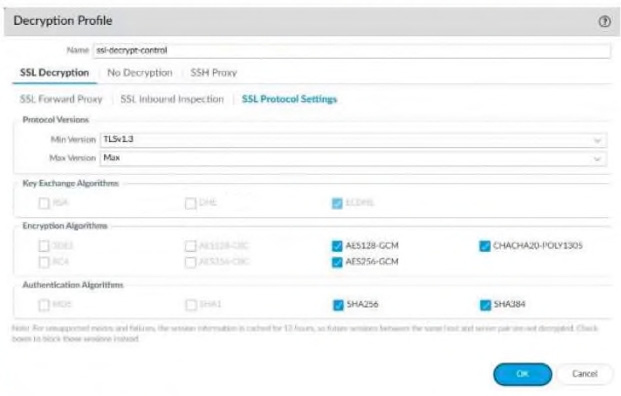
-
A
Min Version setting of TLSv1.3 can cause compatibility issues with legacy applications or clients.
-
B
Authentication algorithm selections can significantly increase resource consumption and cause performance degradation.
-
C
Encryption algorithms 3DES and RC4 being disabled decreases security posture.
-
D
Max Version setting of "Max" enables the use of Perfect Forward Secrecy (PFS) and cannot be decrypted.
Reveal answer details
Close answer details
Correct answerA
ExplanationComprehensive and Detailed 150 to 250 words of Explanation From Palo Alto Networks Network Security Analyst Knowledge: In the provided image, the Decryption Profile is configured with a Min Version of TLSv1.3. While this represents a high security posture, it introduces a significant operational risk: compatibility issues with legacy applications or clients.
Many older operating systems, web browsers, and legacy internal applications do not support TLS 1.3. If a client or server attempts to negotiate a connection using an older, unsupported protocol version (such as TLS 1.2 or 1.1), the firewall will drop the connection because it falls below the configured minimum threshold. A Network Security Analyst must balance the need for modern encryption with the functional requirements of the network.
Option C is incorrect because disabling weak algorithms like 3DES and RC4 actually improves the security posture.
Option D is incorrect because the firewall is fully capable of decrypting traffic using Perfect Forward Secrecy (PFS) if the appropriate certificates are installed.
Option B is a general concern for all decryption but is not a specific risk of the versioning shown. Therefore, the most immediate risk of setting the minimum version to TLS 1.3 is the potential disruption of services for any user or system still relying on the widely-used TLS 1.2 protocol or older.
A user reports that a specific business application is dropping connection every few minutes. The analyst wants to see if the firewall's session table is reaching its limit for that specific user. Which tool should the analyst use?
-
A
ACC (Application Command Center)
-
B
-
C
-
D
Reveal answer details
Close answer details
Correct answerB
ExplanationComprehensive and Detailed 150 to 250 words of Explanation From Palo Alto Networks Network Security Analyst Knowledge: The Session Browser (found under the Monitor tab) provides a real-time view of every active session currently being processed by the firewall's data plane. Unlike the Traffic Log, which shows completed or denied sessions, the Session Browser allows an analyst to inspect "live" traffic. By filtering the Session Browser by the user's source IP, the analyst can see exactly how many sessions are open, the state of those sessions (e.g., active, discard, or closing), and the time-to-live (TTL) for each session. If an application is frequently dropping, the analyst can check if the session is timing out prematurely or if the host is reaching a session limit set by a DoS Protection profile. This granular, real-time visibility is essential for troubleshooting complex application performance issues that do not necessarily appear as a "deny" in the standard log files.
An organization wants to decrypt outbound traffic to ensure no malware is hidden in HTTPS sessions. Which type of decryption policy must be configured on the firewall to act as a "Man-in-the-Middle"?
-
A
-
B
-
C
-
D
Reveal answer details
Close answer details
Correct answerC
ExplanationComprehensive and Detailed 150 to 250 words of Explanation From Palo Alto Networks Network Security Analyst Knowledge: To inspect outbound traffic from internal users to external websites, the firewall must use SSL Forward Proxy. In this mode, the firewall acts as a transparent proxy. When a user attempts to connect to a secure site (like a cloud storage provider), the firewall intercepts the request, establishes its own secure connection to the destination, and then creates a separate secure connection back to the user. This allows the firewall to decrypt the traffic, inspect it for threats (using Content-ID), and then re-encrypt it before sending it to the destination. This is distinct from SSL Inbound Inspection (Option A), which is used to protect internal servers from external users by using the server's own private key. For a Network Security Analyst, implementing Forward Proxy is a critical objective to eliminate the "blind spot" created by encrypted traffic, which now accounts for the majority of all web communication.
What is the function of a "Service" object in a Palo Alto Networks firewall configuration?
-
A
To define the Layer 7 App-ID signatures.
-
B
To define the Layer 4 protocol (TCP/UDP) and port numbers.
-
C
To specify the URL categories to be blocked.
-
D
To set the QoS priority for specific traffic.
Reveal answer details
Close answer details
Correct answerB
ExplanationComprehensive and Detailed 150 to 250 words of Explanation From Palo Alto Networks Network Security Analyst Knowledge: While Palo Alto Networks firewalls are famous for Layer 7 App-ID inspection, they still require Service objects to define the Layer 4 (Transport Layer) parameters of a connection. A Service object defines whether the traffic is TCP or UDP and specifies the Destination Port. A core objective for an analyst is managing these objects to maintain security. For instance, when creating a Security rule, an analyst can set the Service to application-default, which tells the firewall to only allow the application on its standard ports. However, if an internal application uses a non-standard port, the analyst must create a custom Service object for that specific port. This ensures that the firewall's state engine knows which ports to open for the session. Service objects can also be grouped into Service Groups to simplify policy management, allowing an analyst to update a single group object rather than editing multiple individual security rules.
In Panorama, which feature allows an analyst to group multiple Template Stacks together to push a common set of network configurations to a large number of firewalls simultaneously?
-
A
-
B
-
C
-
D
Reveal answer details
Close answer details
Correct answerB
ExplanationComprehensive and Detailed 150 to 250 words of Explanation From Palo Alto Networks Network Security Analyst Knowledge: In a large-scale deployment managed by Panorama, consistency across network configurations (like DNS, NTP, and SNMP settings) is achieved using Templates and Template Stacks. To manage common settings across many devices that may otherwise have unique requirements (like different local IP
addresses), analysts use Variables.
Variables allow the analyst to define a standard configuration in a template but leave specific values as placeholders (e.g., $Local_Gateway). When the configuration is pushed to the firewalls, Panorama inserts the specific value assigned to each individual device. This ensures that the analyst can manage hundreds of firewalls using a single, unified template stack while still accommodating the local network differences required for each site to function. This reduces the administrative burden of maintaining dozens of near-identical templates and minimizes the risk of manual configuration errors during site deployments.
A financial institution must comply with a regulation that prohibits the decryption of any traffic destined for "Banking" or "Healthcare" websites. How should the analyst implement this requirement while still decrypting other web traffic?
-
A
Set the default Decryption Profile to "No-Decrypt."
-
B
Create a Decryption Policy with the action "No Decrypt" and select the relevant URL categories.
-
C
Add the banking URLs to the "External Dynamic List."
-
D
Use a NAT policy to bypass the SSL engine for those categories.
Reveal answer details
Close answer details
Correct answerB
ExplanationComprehensive and Detailed 150 to 250 words of Explanation From Palo Alto Networks Network Security Analyst Knowledge: Compliance and privacy are major objectives for a Network Security Analyst. Palo Alto Networks firewalls use Decryption Policies to determine which traffic should be inspected and which should be bypassed. By creating a specific policy rule with the action set to "No Decrypt," the analyst can use URL Categories (such as financial-services and health-and-medicine) as the matching criteria. When an internal user visits a banking site, the firewall identifies the category and allows the encrypted session to pass through untouched, maintaining the user's privacy and meeting regulatory requirements. This rule must be placed higher in the policy list than the general "Decrypt Everything" rule to ensure it takes precedence. This granular control allows the organization to eliminate security "blind spots" for most web traffic while respecting the sensitive nature of specific personal data.
In a Zero Trust environment, why is it recommended to use "User-ID" instead of just IP addresses in Security policy rules?
-
A
To allow the firewall to perform hardware-level decryption.
-
B
IP addresses are dynamic and do not provide persistent identity in modern networks.
-
C
User-ID is required to enable the "application-default" service setting.
-
D
Using User-ID reduces the CPU load on the Management Plane.
Reveal answer details
Close answer details
Correct answerB
ExplanationComprehensive and Detailed 150 to 250 words of Explanation From Palo Alto Networks Network Security Analyst Knowledge: The transition from IP-based rules to identity-based rules is a cornerstone of the Network Security Analyst role. In modern environments-especially those with Wi-Fi, DHCP, and remote workers-an IP address is a temporary identifier that can change multiple times a day. Relying solely on IPs makes it difficult to maintain accurate security audits and granular control.
By implementing User-ID, the analyst maps IP addresses to specific users and groups retrieved from an identity provider like Active Directory or Okta. This allows the analyst to write rules like "Allow HR-Group to access HR-SaaS-App," which remains effective regardless of which IP address the HR employee is currently using. This provides persistent visibility and control, ensuring that security policies follow the user rather than the device. This is a critical objective for achieving a Zero Trust architecture, where identity is verified at every step of the communication process.
Question 10
Single choice
A company wants to ensure that all internal users are prevented from uploading sensitive documents to a
specific personal cloud storage site. Which Security profile is specifically designed to inspect the content of file transfers for specific data patterns?
-
A
-
B
Vulnerability Protection Profile
-
C
-
D
WildFire Analysis Profile
Reveal answer details
Close answer details
Correct answerC
ExplanationComprehensive and Detailed 150 to 250 words of Explanation From Palo Alto Networks Network Security Analyst Knowledge: While a File Blocking Profile (Option A) can block files based on their type (e.g., preventing any.docx upload), it does not look at the information within the file. The Data Filtering Profile is the tool designed for Data Loss Prevention (DLP).
An analyst uses Data Filtering to scan file uploads and downloads for specific sensitive patterns, such as credit card numbers, Social Security numbers, or custom regex patterns (like internal project IDs). By attaching this profile to a security rule that allows access to the cloud storage application, the firewall can permit the use of the app while specifically blocking any session that contains unauthorized data. This provides a granular layer of security that protects intellectual property and ensures regulatory compliance without completely disabling the business applications users need to perform their jobs.
Question 11
Single choice
An analyst wants to ensure that any traffic from the "Guest-Zone" to the "Internal-Zone" is always inspected, even if there is no explicit security rule defined. Which default behavior should the analyst be aware of?
-
A
Intrazone-default rules allow traffic by default.
-
B
Interzone-default rules deny traffic by default.
-
C
The firewall automatically creates a "Clean Pipe" rule for all zones.
-
D
Implicit rules are always set to "log at session start."
Reveal answer details
Close answer details
Correct answerB
ExplanationComprehensive and Detailed 150 to 250 words of Explanation From Palo Alto Networks Network Security Analyst Knowledge: Palo Alto Networks firewalls operate on a Zero Trust principle by default. This is reflected in the Interzone-default rule, which is an implicit rule at the bottom of the security policy base that denies all traffic between different zones.
In this scenario, traffic from "Guest-Zone" to "Internal-Zone" will be blocked automatically unless the analyst creates an explicit "Allow" rule. Conversely, the Intrazone-default rule allows traffic within the same zone. A key objective for the analyst is to monitor these default rules. Often, analysts will override the default settings to enable "Logging" on the interzone-default rule to identify blocked connection attempts, providing critical data for troubleshooting or security audits. Understanding these implicit behaviors is fundamental to ensuring that no unauthorized traffic "leaks" between network segments.
Question 12
Single choice
An analyst wants to find out whether a specific user is generating a large number of concurrent sessions that may be affecting firewall resources. Which monitoring tool gives the best real-time visibility into this condition?
-
A
-
B
-
C
-
D
Reveal answer details
Close answer details
Correct answerB
ExplanationComprehensive and Detailed 150 to 250 words of Explanation From Palo Alto Networks Network Security Analyst Knowledge: Session Browser is the best tool for real-time visibility into active sessions on the firewall. It allows the analyst to filter by source IP address, user, destination, application, or other session attributes and inspect the currently active connections being processed by the data plane. This makes it highly effective when troubleshooting session-related resource concerns tied to a specific user. Option A is incorrect because the Threat Log records threat-related detections and actions, not the full live session table.
Option C is incorrect because Config Audit is used for comparing changes in configuration history rather than observing runtime traffic conditions.
Option D is incorrect because the URL Filtering Log is focused on web access categorization and actions, not current session counts. By using Session Browser, the analyst can determine whether the user has an unusually high number of active sessions, whether those sessions are stuck, and whether they are associated with a particular application or behavior. This is especially useful when diagnosing intermittent application issues, suspected abuse, or capacity concerns. Real-time visibility provides more immediate and actionable evidence than reviewing only historical logs, allowing faster isolation of the actual source of the problem.
Question 13
Single choice
An analyst wants to create a custom application for an internal tool that uses a specific proprietary protocol. Which information is required to ensure the firewall correctly identifies this application using App-ID?
-
A
Source and Destination IP addresses.
-
B
Signature patterns found in the packet payload.
-
C
The URL category of the server.
-
D
The MAC address of the server.
Reveal answer details
Close answer details
Correct answerB
ExplanationComprehensive and Detailed 150 to 250 words of Explanation From Palo Alto Networks Network Security Analyst Knowledge: App-ID is the core technology that allows Palo Alto Networks firewalls to identify applications regardless of the port or protocol they use. For standard applications, these signatures are provided by Palo Alto Networks. However, for proprietary internal tools, an analyst must create a Custom Application. The most critical component of a custom application is the Signature. This involves identifying a unique pattern in the packet payload-such as a specific hex string or text identifier-that only appears when this specific application is running. The analyst uses the "Signature" tab in the Application object to define these patterns and specify where in the packet the firewall should look for them (e.g., the HTTP header or the TCP payload). By defining a signature, the firewall can move beyond simple port-based blocking and apply full Layer 7 security inspection to the custom traffic, ensuring that the proprietary tool is not used as a cover for malicious activity.
Question 14
Single choice
Which tool should an analyst use to view a real-time, graphical representation of the top applications, users, and threats across the network to identify immediate anomalies?
-
A
-
B
ACC (Application Command Center)
-
C
-
D
Reveal answer details
Close answer details
Correct answerB
ExplanationComprehensive and Detailed 150 to 250 words of Explanation From Palo Alto Networks Network Security Analyst Knowledge: The Application Command Center (ACC) is the primary visual monitoring tool for a Palo Alto Networks analyst. Unlike the Log Viewer, which provides a text-based, chronological list of events, the ACC provides an aggregated, graphical dashboard that highlights trends and anomalies. The ACC uses "widgets" to display data such as the "Top Applications," "Top Threats," and "Top Users by Bandwidth". For an analyst, the ACC is the starting point for "threat hunting" and performance monitoring. For example, if an analyst sees a sudden spike in "Unknown-UDP" traffic in the ACC, they can click on that specific widget to "drill down" and see which users and source IPs are responsible for that traffic. This allows the analyst to quickly identify potential botnet activity or misconfigured applications that would be much harder to spot in raw log data.
Question 15
Single choice
When performing a "Push to Devices" from Panorama, an analyst wants to ensure that the push only affects a specific firewall in a shared Device Group. Which option in the push window allows this granular selection?
-
A
Include Device and Network Templates
-
B
-
C
-
D
Merge with Device Candidate Config
Reveal answer details
Close answer details
Correct answerC
ExplanationComprehensive and Detailed 150 to 250 words of Explanation From Palo Alto Networks Network Security Analyst Knowledge: In a large environment with hundreds of firewalls, an analyst rarely wants to push a configuration to the entire fleet at once. After selecting "Push to Devices," the analyst should use the "Edit Selections" button.
This opens a window where the analyst can uncheck the boxes for any firewalls that should not receive the update. This allows for a "staged" rollout, where the analyst can push a configuration to a single test firewall before deploying it to production units. Granular push control is a critical objective for maintaining high availability and minimizing the "blast radius" of potential configuration errors. It ensures that the analyst can carefully manage the deployment lifecycle of security policies across a complex enterprise network.
|