DRAG DROP You, as the Chief Enterprise Architect of Wanderlust GmbH, have been trying to formulate the Business Strategy Map. You are currently working on the strategic objective to "Increase supply reliability of Lithium batteries". Arrange the elements of the Business Strategy Map into the right order that shows the dependencies between these elements. 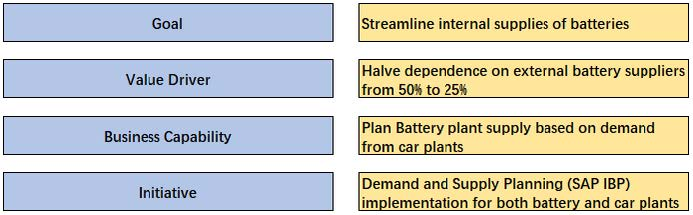 Which artifact from the SAP Reference Solution Architecture shows which data objects are exchanged between SAP application components in a given end-to-end scenario?
-
A
SAP Data Object Diagram, which is available from SAP API Business Accelerator Hub (api.sap.com)
-
B
SAP Data Flow Diagram, which is available from SAP API Business Accelerator Hub (api.sap.com)
-
C
SAP Data Component Diagram, which is available in SAP Signavio Process Explorer
Why would you recommend building SAP Side-by-Side Extensions to an S/4HANA system based on SAP BTP?
-
A
Extensions on SAP BTP technology can easily make use of S/4HANA eventing.
-
B
Extensions on SAP BTP can maintain SAP user and security context and allow the use of S/4HANA eventing.
-
C
Extensions should be built on SAP BTP because SAP BTP is the only option for building a consistent user experience based on SAP Fiori UX styles.
A custom web application developed with SAPUI5 and running on SAP Business Technology Platform uses large custom data objects deployed in a central data store (SAP HANA Cloud). The solution architect of the application is unsure about which tools to use for integration of this data from different SAP sources into the central data store and asks you, as the Enterprise Architect, for guidance. Under which conditions is a data-oriented integration approach (Data Integration) preferable to other integration styles?
-
A
The data objects are built with data from different SAP and non-SAP sources that change infrequently and are available from REST and Message APIs (event-driven systems).
-
B
The data objects are built with data from different SAP and non-SAP sources that can be structured and unstructured, change with high frequency, and need to be cleansed, correlated, and partly newly calculated.
-
C
The data objects are built with data from different SAP and non-SAP sources that can be structured and unstructured, change with high frequency, and need to be newly calculated.
While discussing the Smart Battery initiative in greater detail with the appropriate stakeholder, as the Chief Enterprise Architect of Wanderlust, you discover that several key areas, such as value proposition, cost structure, revenue streams, partners, and channels, have been worked upon in isolation and therefore do not align with each other. Which artifact would you recommend to bring all the above key dimensions together in a single view, to have a unified, consistent, and holistic perspective of the Smart Battery initiative?
-
A
-
B
Statement of Architecture Work
-
C
-
D
Green Elk & Company is the world's leading manufacturer of agricultural and forestry machinery. The former company slogan, "Elk always runs," has recently been changed to "Elk feeds the world." One of Green Elk's strategic goals is to increase its revenue in the emerging markets of China, India, and other parts of Asia by 80% within three years. This requires a new business model that caters to significantly smaller farms with limited budgets. You are the Chief Enterprise Architect, and the CIO asks you to assess the new business model for smaller farms with smaller budgets. Given the principle and statement, which of the following combinations of rationale and implication do you consider well-defined?
-
A
Principle: Use packaged solutions in a standard way.
Statement: Buy packaged solutions that support our business requirements and use them in a standard way.
Rationale: Process and solution will be simplified by using packaged software in a standard way.
Adherence to standards will allow better maintenance and lower the total cost of ownership. This will increase the capability to adopt technology innovation.
Implication: Reuse vendor and industry best practices, reference architectures, and pre-defined content. Apply guidelines, patterns, standards, and naming conventions. Use maximum possible solution standards and avoid custom developments wherever possible.
-
B
Principle: Use packaged solutions in a standard way.
Statement: Buy packaged solutions that support our business requirements and use them in a standard way.
Rationale: In cases where custom developments are required, adhere to defined best practices, standards, and guidelines (e.g., extensibility concept, side-by-side extensions). Reuse before buy, before build. Enable easier future transition to the cloud.
Implication: Process and solution will be simplified by using packaged software in a standard way.
Adherence to standards will allow better maintenance and lower the total cost of ownership. This will increase the capability to adopt technology innovation.
-
C
Principle: Use packaged solutions, in a standard way.
Statement: Buy packaged solutions that support our business requirements and use them in a standard way.
Rationale: Process and solution will be simplified by using packaged software in a standard way.
Adherence to standard will allow better maintenance and lower the total cost of ownership. Increase the capability to adopt technology innovation.
Implication: Deviations from standard require additional cost, not only during the implementation. Non-standard solutions block the potential of disruptive business models. Decreased overall cost and reduced complexity, leading to efficiencies due to adoption of standard.
-
D
Principle: Use packaged solutions in a standard way.
Statement: Buy packaged solutions that support our business requirements and use them in a standard way.
Rationale: Process and solution will be simplified by using packaged software in a standard way.
Adherence to standards will allow better maintenance and lower the total cost of ownership. This will increase the capability to adopt technology innovation.
Implication: In cases where custom developments are required, adhere to defined best practices, standards, and guidelines (e.g., extensibility concept, side-by-side extensions). Reuse before buy, before build. Enable easier transition to the cloud in the future.
Question 7
Multiple choice
Wanderlust's CIO asks you to evaluate the SAP Enterprise Architecture Framework. At Wanderlust GmbH, a non-SAP EA tool is used. How would you proceed with the request and why? Note: There are 2 correct answers to this question.
-
A
I tell the CIO that the SAP EA Framework cannot be used because Wanderlust GmbH uses a non-SAP EA tool. Therefore, further evaluation is not necessary.
-
B
I evaluate both the SAP EA Methodology and TOGAF ADM. I recommend the approach that fits best with Wanderlust's requirements.
-
C
I tell the CIO that the SAP EA Framework also encompasses architecture services and practices.
Based on a cost-benefit analysis, I consider using the services and practices that fit best with the project.
-
D
I check whether the SAP Reference Business Architecture and Reference Solution Architecture Content can help to either define the scope of the architecture work or describe a target architecture structure. If they do, I suggest using the Reference Architecture Content of SAP.
Question 8
Multiple choice
When creating an application architecture roadmap, the WHAT and WHERE are defined in a rather straightforward way, while the WHOM may differ by context. Multiple roadmap clusters may apply a variety of WHOM dimensions. For example, procurement vs. asset management. Which of the following definitions are correct? Note: There are 3 correct answers to this question.
-
A
Asset Classes / Vehicles, Production Machines, Office Equipment
-
B
Material Groups / Products, Raw Materials, Spare Parts / Direct Materials, Indirect Materials
-
C
Groups of Persons / Permanent Staff, Contracted Staff, Students / Business Expense / Operational Expenditure / Capital Expenditure
-
D
Working Model / Home Office, Headquarter, Affiliate
|