Single choice
What are metaclasses?
Reveal answer details Close answer details
Correct answerD
OMG · OMG-OCUP-100
Preview real exam questions, verified answers and available explanations before choosing a study plan.
|
Single choice
What are metaclasses? Reveal answer details Close answer detailsCorrect answerD
Single choice
How many of the three arrows outgoing from the diamond shape (as depicted in the exhibit) will be given values at one time in a well-defined activity diagram? 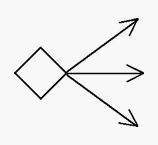 Reveal answer details Close answer detailsCorrect answerB
Single choice
How many of the three outgoing arrows from a round-cornered, solid-line rectangle (as depicted in the exhibit) will provide values at one time when the round-cornered rectangle finishes? 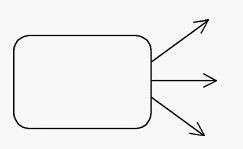 Reveal answer details Close answer detailsCorrect answerD
Single choice
What is the difference between the <<ementationClass>> type? Reveal answer details Close answer detailsCorrect answerD
Single choice
Which element in the diagram is the correct label for a lifeline? 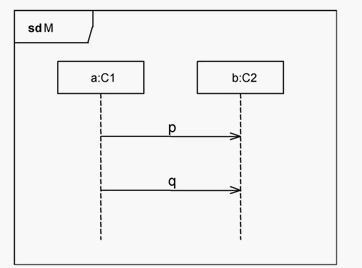 Reveal answer details Close answer detailsCorrect answerE
Single choice
In the exhibit, there is one element with the identifier b. 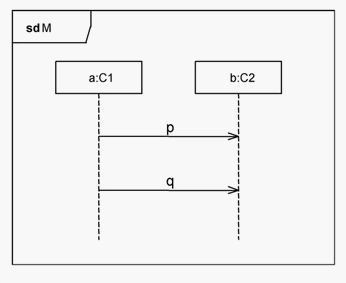 Reveal answer details Close answer detailsCorrect answerB
Single choice
What do shapes in activity diagrams with no labels inside represent? Reveal answer details Close answer detailsCorrect answerF
Single choice
What is true about lifelines? Reveal answer details Close answer detailsCorrect answerB
Single choice
In the exhibit, where is the execution occurrence in the sequence diagram named R? 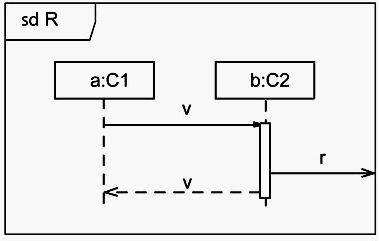 Reveal answer details Close answer detailsCorrect answerD
Multiple choice
A property is a feature that can be represented in what ways? (Choose two) Reveal answer details Close answer detailsCorrect answersB, C
Single choice
What is a selector of a lifeline? Reveal answer details Close answer detailsCorrect answerD
Single choice
In the exhibit, which relationship may have a condition attached to it? 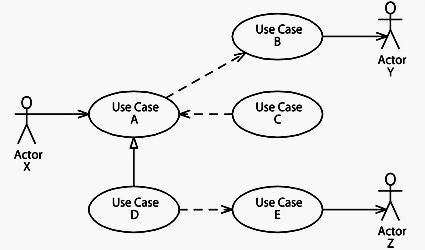 Reveal answer details Close answer detailsCorrect answerC
Multiple choice
Let us denote sending of p as !p and receiving p as ?p. Which traces define the interaction M in the exhibit? (Choose two) 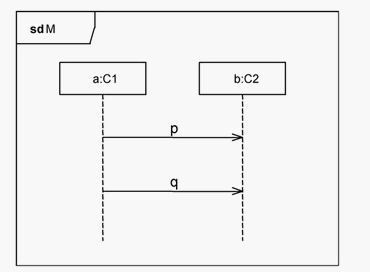 Reveal answer details Close answer detailsCorrect answersA, B
Single choice
Let us denote sending of p as !p and receiving p as ?p. Which trace defines the interaction N in the exhibit? 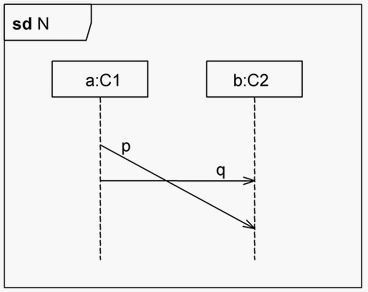 Reveal answer details Close answer detailsCorrect answerC
Multiple choice
What is true of the black diamond on the diagram? (Choose two)  Reveal answer details Close answer detailsCorrect answersB, D
Single choice
How many of the arrows in the exhibit will be given values when the round-cornered rectangle finishes executing? 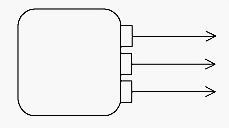 Reveal answer details Close answer detailsCorrect answerD
Single choice
In the exhibit, when Actor X initiates Use Case A, how many other actors must be involved? 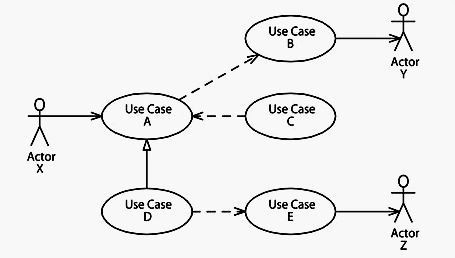 Reveal answer details Close answer detailsCorrect answerB
Single choice
What does OMG stand for? Reveal answer details Close answer detailsCorrect answerD
Single choice
How many arrows can go out of an input parameter node? Reveal answer details Close answer detailsCorrect answerD
Single choice
What does the arrow end of a dependency relationship indicate? Reveal answer details Close answer detailsCorrect answerE
Single choice
In the exhibit, which relationship may have extension points attached to it? 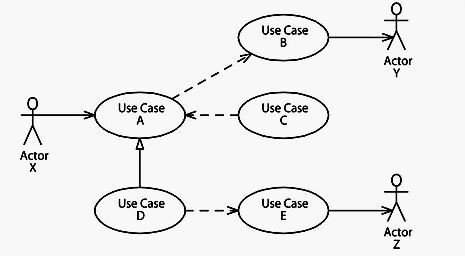 Reveal answer details Close answer detailsCorrect answerD
Single choice
Ten employees in a department can submit an expense form to have their expenses repaid. manager is required to approve the expense forms. Reveal answer details Close answer detailsCorrect answerC
Single choice
What is specified by a use case? Reveal answer details Close answer detailsCorrect answerB
Single choice
In the exhibit, what is an interaction? 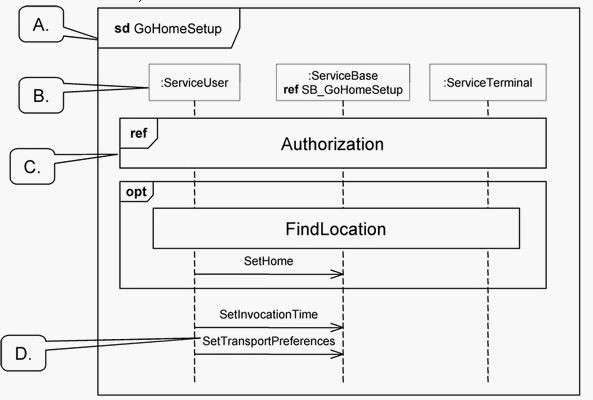 Reveal answer details Close answer detailsCorrect answerA
Multiple choice
What shapes are NOT likely to be found on a typical use case diagram? (Choose two) Reveal answer details Close answer detailsCorrect answersB, F
Multiple choice
What is true about a comment in UML 2.0? (Choose two) Reveal answer details Close answer detailsCorrect answersA, D |