What does an Event-Based Gateway depend on?
-
A
-
B
-
C
-
D
Reveal answer details
Close answer details
Correct answerC
ExplanationAn Event-Based Gateway routes flow based on which event occurs first, rather than evaluating data conditions. Therefore, the correct answer is C.
Which BPMN element always generates a token when triggered?
-
A
-
B
-
C
-
D
Reveal answer details
Close answer details
Correct answerC
ExplanationA Start Event generates a token that begins process execution. End Events consume tokens, and Intermediate Events either wait for or trigger behavior during execution. Therefore, the correct answer is C.
Given the following BPMN model: 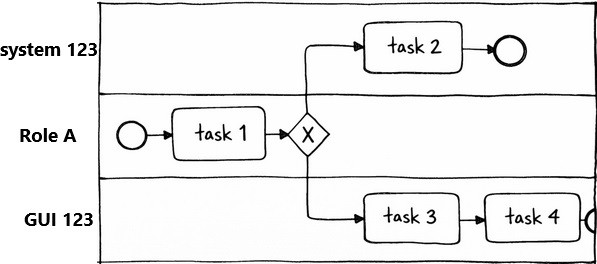 Is the concept of lanes applied correctly in this model?
-
A
No, lanes are only allowed outside pools.
-
B
No, lanes must always be used to indicate organizational units.
-
C
No, lanes must always be used to indicate systems but not GUIs.
-
D
Yes, lanes can be used as shown in the model.
Reveal answer details
Close answer details
Correct answerD
ExplanationIn the diagram, a singlePoolis partitioned intolaneslabeled:
"System 123"
"Role A"
"GUI 123"
In BPMN,lanes are flexible partitionsused to organize and categorize activities within a Pool. They may represent organizational units, roles, systems, applications, or any other logical grouping that helps clarify responsibilities.
Therefore:
A. "Lanes are only allowed outside pools" - incorrect; lanes existinsidepools.
B. "Lanes must always indicate organizational units" - too restrictive; they can also represent systems,
roles, etc.
C. "Lanes must always indicate systems but not GUIs" - also false; BPMN does not impose that limitation.
D. Yes, lanes can be used as shown in the model.- This matches BPMN's flexible lane semantics.
Which statement is true regarding the two diagram fragments? 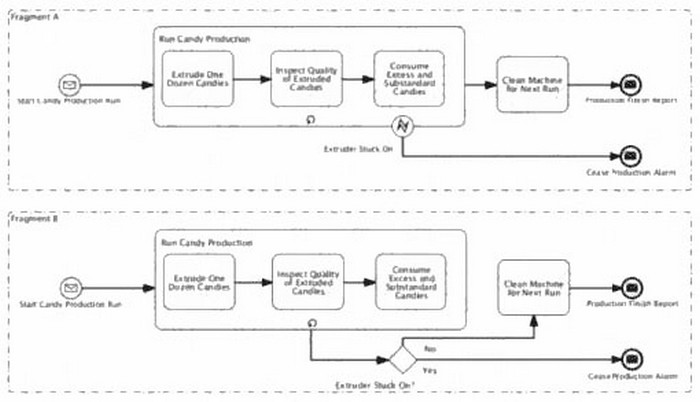
-
A
There is no difference between the two diagrams - Both are valid and imply the same execution semantics.
-
B
Fragment A is invalid because a Boundary Error Event is always Interrupting and always is shown with a double-ring circle, while Fragment B is valid.
-
C
In Fragment A, the machine is always cleaned while in Fragment B, the machine is only cleaned if the Run Candy Production Task ended without the Extruder Stuck On condition.
-
D
In Fragment A, the Candy Production Task is interrupted by the first Extruder Stuck On event while in Fragment B, the Extruder Stuck On? condition is checked only at the end of the last Consume Excess and Substandard Candies Task.
Reveal answer details
Close answer details
Correct answerD
ExplanationInFragment A,Run Candy Productionis a subprocess with aboundary eventlabeledExtruder Stuck Onattached to it.
According to BPMN 2.0:
A boundary event attached directly to an activity/subprocess is evaluatedwhile that activity is executing.
When it triggers (here, when the "Extruder Stuck On" condition occurs), itinterruptsthe subprocess (for an interrupting boundary event) and the normal internal flow stops. Control is redirected along the boundary-event's outgoing sequence flow (toward the alarm/handling path). So, in Fragment A, the first time the extruder gets stuck during the execution ofRun Candy Production, that subprocess is interrupted and the alternate flow (e.g., cease production alarm, possibly skipping remaining steps inside the subprocess) is taken.
InFragment B, the "Extruder Stuck On?" is modeled as anExclusive Gatewayafter the internal tasks (afterConsume Excess and Substandard Candies). That means: The condition ischecked only when the token reaches that gateway, i.e., after finishing the last internal task.
If "Yes", we follow the alarm/cease path; if "No", we continue to the normal completion/cleaning path.
This is exactly what optionDstates.
Options A and C say the fragments have the same or inverted behavior, which contradicts the execution semantics of boundary events vs. gateways.
Option B incorrectly assumes the boundary event is specifically an Error Event and misstates the validity of Fragment A. The fragment is valid BPMN; the key difference iswhen and howthe stuck-extruder condition is handled, captured correctly only by optionD.
Which elements of the Business Motivation Model (BMM) govern Courses of Action?
-
A
-
B
-
C
-
D
Reveal answer details
Close answer details
Correct answerA
ExplanationManagement documents without any External Links or URL: In theBusiness Motivation Model (BMM): Courses of Action(Strategies and Tactics) representhowthe organization intends to achieve its Ends (Goals and Objectives).
Directives(Business Policies and Business Rules)governandconstrainhow those Courses of Action are carried out.
So:
Directivesspecify what is allowed, required, or prohibited in implementing strategies and tactics. This is why BMM explicitly states thatDirectives govern Courses of Action.
Why others are incorrect: Objectives(B) are measurable targets (Ends), not governing elements. Internal Influencers(C) affect assessments and motivation but donotdirectly govern Courses of Action. Business Processes(D) are operational implementations, not governance elements in BMM terminology. Thus, the correct governing elements for Courses of Action in BMM areDirectives.
What is wrong with this BPMN diagram? 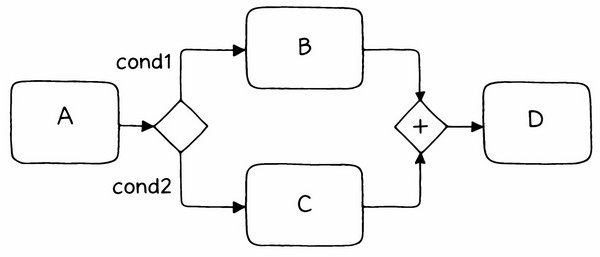
-
A
The gateways are interchanged.
-
B
The activity D can never be reached.
-
C
It is not deterministic if B or C follows A.
-
D
The condition expressions of the exclusive gateway are not marked correctly.
Reveal answer details
Close answer details
Correct answerB
ExplanationIn the given diagram: After activityA, there is anexclusive gateway(with conditionscond1andcond2), soeither B or Cis chosen-never both.
AfterBandC, their flows go into a gateway with aplus sign, which is aParallel Gateway (AND-join)in BPMN.
AParallel Joinwaits fora token from every incoming branchbefore it can release a token onward toD. But due to the earlier exclusive split,only oneof the two branches (B or C) ever receives a token. The other branch never activates, so the parallel join never gets all required tokens.
Consequences:
The join gateway willnever be satisfied, Therefore, the flownever proceeds to activity D.
So the defect is exactly what optionBsays: The activity D can never be reached.
That is the correct answer.
What is key to a consistent, proactive marketing strategy?
-
A
It is a philosophy that dedicates the resources of the firm to ensuring that the needs, wants, and demands of the customers are the focus of the firm.
-
B
It is a method that sets standards, obtains measurements of sales results related to the standards, and takes corrective actions when these are not achieved.
-
C
It is an aggregate approach to measure and deploy a set of marketing metrics that sales managers use to review for compliance with top-level sales objectives.
-
D
It is a measure of marketing success factors and key performance indicators to monitor customer behavior and improve sales and product development focus when these are not achieved.
Reveal answer details
Close answer details
Correct answerA
ExplanationWithin the Object Management Group (OMG) perspective-particularly referencing the principles found in Business Process Management (BPM) Business Motivation Model (BMM),, and Value-Driven Process Design -a consistent and proactive marketing strategy must be grounded in a customer#centric philosophy. This aligns directly with the foundational OMG principle thatall business processes must deliver value to customers and stakeholders.
Here's why Option A is the correct and OMG#aligned choice:
1. Customer Focus as the Strategic Anchor (BMM Alignment) OMG's Business Motivation Model (BMM) defines the organization's Ends (Goals, Objectives) and Means (Mission, Strategies). A proactive marketing strategy, from an OMG standpoint, must start with acustomer-focused mission and strategy, meaning that: Resources, processes, and capabilities are organized around customer needs. The marketing strategy anticipates customer demands, not just reacts to them. The organization's courses of action and directive
frameworks support value delivery.
This matches Option A exactly.
2. BPM Perspective: Processes Designed for Customer Value BPMN (Business Process Model and Notation) encourages modeling marketing processes asvalue-driven workflows, where the trigger of the process is usually rooted in customer needs, customer segments, or market insights.
A consistent, proactive marketing strategy requires: Predictive understanding of customer needs Alignment of processes to deliver satisfaction Continuous refinement driven by customer feedback loops This again reflects the philosophy described in Option A.
3. Why the Other Options Are Not Correct (Based on OMG BPM Principles) Option Bemphasizes sales results measurement and corrective actions. This describes an operational control process, not a proactive marketing strategy. It is reactive rather than proactive. Option Crefers to a top#down, compliance-oriented metrics review. This aligns withperformance management, not with strategy formation or proactive marketing. Option Dfocuses on KPIs and behavioral monitoring. While important, this is part oftactical execution and performance monitoring, not the overarching key to maintaining a proactive marketing strategy.
4. OMG Core Principle Supporting Option A OMG frameworks stress thatprocesses must originate from and be continuously aligned with customer value propositions. The marketing strategy becomes proactive only when the customer's needs, wants, and demands drive decisions and resource allocation.
Thus, Option A is the only answer aligned with OMG's structured, customer-centered view of organizational strategy and process management.
Which element describes the scenario "a human performer performs a task without the aid of any application"? 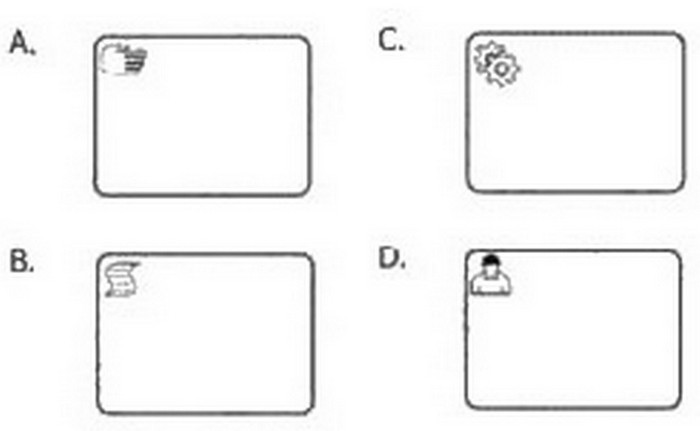
-
A
-
B
-
C
-
D
Reveal answer details
Close answer details
Correct answerA
ExplanationThe scenario says:"a human performer performs a task without the aid of any application." According to OMG BPMN 2.0.2 and related OMG material:
AUser Taskis "a typical workflow task in which a human performer performs the taskwith the assistance of a software application."omg.org AManual Taskis "a task that is expected to be performedwithout the aid of any business process execution engine or any application."Visual Paradigm+1
The icon inOption Acorresponds to theManual Taskmarker in BPMN. Options B, C, and D are markers for Script Task, Service Task, and User Task respectively, all of which involve either an engine or an application.
Because the description matches exactly the OMG definition of aManual Task, the correct choice among the icons provided isOption A.
Select the list of BPMN Activities:
-
A
-
B
-
C
-
D
Task, Sub-Process, Action
-
E
Task, Process, Sub-Process
Reveal answer details
Close answer details
Correct answerB
ExplanationIn BPMN,Activityis a generic term that covers: Task-an atomic unit of work.
Sub-Process- a compound activity that contains a process within it. AProcessisnotan Activity; it is a container of flow elements. "Action" is not a BPMN element at all. Therefore, the only correct list that consists solely of BPMN Activities is: Task, Sub-Process
So the correct answer isB.
Question 10
Single choice
The chief economist of an airline projects increasing costs for jet fuel and believes those costs will hurt the airline's business. This belief is modeled as which BMM noun concept?
-
A
-
B
-
C
-
D
Reveal answer details
Close answer details
Correct answerD
ExplanationIn BMM, the key nouns involved here are: Influencer-something that can impact the organization (e.g., "rising jet fuel prices"). Assessment-the organization'sevaluationorinterpretationof influencers (e.g., "this will hurt the airline's business").
Risk- a specific kind of negative potential impact identified by an assessment.
The scenario says:
"The chief economist... projects increasing costs for jet fuel andbelieves those costs will hurt the airline's business."
Theincreasing jet fuel coststhemselves are theInfluencer.
Thebelief about its impact("will hurt business") is theevaluation of that influencer, which is precisely a BMMAssessment.
So, this belief is modeled as:An assessment.
(Option A,Risk, is related but more specific; the question focuses on the belief/evaluation itself, which is
BMM'sAssessmentconcept.)
Question 11
Single choice
Which BPMN task type is executed automatically by a system without human intervention?
-
A
-
B
-
C
-
D
Reveal answer details
Close answer details
Correct answerC
ExplanationA Service Task represents automated execution using a service or application. Manual Tasks require human effort without system support, User Tasks involve human interaction with systems, and Script Tasks are executed by the engine but not via external services. Therefore, the correct answer is C.
Question 12
Single choice
In cost accounting, how are expenses such as electricity and water called?
-
A
-
B
-
C
-
D
Reveal answer details
Close answer details
Correct answerC
ExplanationIn cost accounting, expenses likeelectricity, water, heating, rent, and factory insuranceare typically categorized asoverhead costs(often calledindirect costsorindirect manufacturing costs). From aBusiness Process Management (BPM)andOMG value-chainview: These costssupportcore operational processes (production, service delivery) butcannot bedirectly tracedto a single product, unit, or customer.
In process modeling (e.g., usingBPMN), they are part of theresourcesandenvironmentneeded to perform activities, not attributed to one specific activity output.
Why the other options are incorrect:
A. Labor costs-Labor can bedirect(e.g., assembly worker) orindirect(e.g., supervisor), but electricity and
water are not labor.
B. Variable costs-Electricity and water canbehavevariably with activity level, but in cost accounting
terminology they are classified asoverhead, not as primary variable costs like direct materials.
D. Indirect materials costs-Indirect materials are items like lubricants, cleaning supplies, small tools.
Electricity and water areutilities, not materials.
So in standard cost accounting and in how OMG-aligned enterprise models group resource costs,electricity and water are treated as overhead costs.
Question 13
Single choice
Which definition applies to COBIT?
-
A
It is a set of rules that providers of IT solutions must comply with.
-
B
It is a set of regulations that govern IT privacy and security practices.
-
C
It is a set of industry standards that promote the use of IT technologies.
-
D
It is a set of best practices for IT management and control.
Reveal answer details
Close answer details
Correct answerD
ExplanationCOBIT (Control Objectives for Information and related Technology) is widely recognized as aframework of best practices for governing and managing enterprise IT. It provides a structured set of processes, control objectives, practices, and metrics that organizations can adopt to ensure that IT supports business goals, manages risks appropriately, and complies with relevant regulations. From the perspective of Object Management Group (OMG) Business Process Management and enterprise architecture: COBIT is used as a governance and control framework that sits above or alongside operational business processes modeled with BPMN.
It provides what must be controlled and measured in IT-related processes, while BPM and OMG standards describe how those processes are modeled, executed, and improved. COBIT defines domains and processes (e.g., plan and organize, acquire and implement, deliver and support, monitor and evaluate) which organizations can map to their BPMN-modeled IT and support processes, thereby aligning IT operations with business objectives.
Why the other options are incorrect: Option A - "a set of rules that providers of IT solutions must comply with": COBIT is not a mandatory rule set imposed on solution providers; it is a voluntary, best-practice framework adopted by organizations to
improve IT governance.
Option B - "a set of regulations": COBIT itself is not a law or regulation. Rather, it helps enterprises design controls and processes that support compliance with multiple regulations.
Option C - "a set of industry standards that promote the use of IT technologies": COBIT is not a technical standard promoting specific technologies; it is amanagement and control framework describing what good IT governance looks like.
Question 14
Single choice
What does a Parallel Gateway do in BPMN?
-
A
Selects one path based on conditions
-
B
-
C
Splits or joins multiple paths simultaneously
-
D
Reveal answer details
Close answer details
Correct answerC
ExplanationA Parallel Gateway (AND) is used to split execution into multiple concurrent paths or to synchronize multiple incoming paths. It does not evaluate conditions or wait for events. Therefore, the correct answer is
C.
Question 15
Single choice
Which BPMN element is used to attach exception handling to an activity?
-
A
-
B
-
C
-
D
Reveal answer details
Close answer details
Correct answerB
ExplanationA Boundary Event is attached to an activity and handles exceptions or interruptions during execution. It can be interrupting or non-interrupting. Therefore, the correct answer is B.
Question 16
Single choice
Michael Porter created a strategic thinking framework called Porter's Five Forces. Which is a set of those forces?
-
A
adjust value creation, improve associated activities, segment customer base, analyze product
performance, align business area to top two segments
-
B
elements of barriers to entry, threats of substitute products or services, suppliers' bargaining power, customers' bargaining power, and competitive rivalry
-
C
define organization's purpose, establish mission-consistent goals and objectives, develop resources to attain goals, set timeframe for the strategy, develop critical products and services
-
D
determine where an organization is going over the next year or more, how it is going to get there, how it will know if it got there or not, the cost of the value chain, and the risk involved
Reveal answer details
Close answer details
Correct answerB
ExplanationPorter's Five Forcesis a classicstrategic analysis frameworkfrequently referenced inbusiness architecture and BPMto understand the external environment that shapes processes and strategies.
The five forces are: Barriers to entry / Threat of new entrants-How easy is it for new competitors to enter the market? Threat of substitute products or services-Can customers switch to something different that satisfies the same need?
Bargaining power of suppliers-How much power do suppliers have over price, quality, and terms?
Bargaining power of customers (buyers)- How much power do customers have to push prices down or demand more value?
Competitive rivalry within the industry-Intensity of competition among current players. OMG'sBusiness Motivation Model (BMM)and enterprise strategy views use these kinds of external assessments to drive: Ends(goals, objectives).
Means(strategies, tactics).
Resultingbusiness processesmodeled in BPMN.
Why the other options are incorrect: A, C, and Dmix in elements ofstrategic planning steps,value chain analysis, orgoal setting, but none of them match the canonical list of the Five Forces.
Thus, the correct set of Porter's Five Forces is exactly what is listed inOption B.
Question 17
Single choice
What is a difference between a Choreography and a private Business Process?
-
A
The Choreography represents the set of Messages of a private Business Process.
-
B
The Activities of the Choreography are private Business Processes that are executed in a defined order.
-
C
The Choreography is a special kind of a private Business Process that describes the interaction with other participants.
-
D
The Activities in a private Business Process are internal to an organization, while those in a Choreography are interactions that represent a set of Message exchanges.
Reveal answer details
Close answer details
Correct answerD
ExplanationAccording to BPMN:
Aprivate (internal) Business Processmodels theinternal workflow of a single organization or participant. Its Activities are tasks, subprocesses, etc., performedinsidethat participant. Messages to other parties are shown only as message flows on the boundary, not as separate activities. AChoreographydiagram, in contrast, models theinteractions between independent participants. EachChoreography Activityrepresents
aset of message exchangesbetween two or more participants (e.g., "Place Order," "Send Invoice"), not the internal steps inside any one organization. Thus the essential difference is exactly what optionDstates: Private process activities = internal work; Choreography activities = inter-participant message interactions.
Options A, B, and C misrepresent the relationship; a Choreography is not a special private process, nor is it just "the set of messages" of one process. It is a separate diagram type with its own semantics in BPMN.
|