What are the following activities part of? Initial risk assessment
Risk mitigation and residual risk assessment Risk monitoring
-
A
-
B
-
C
-
D
Reveal answer details
Close answer details
Correct answerA
ExplanationThe following activities are part of Risk Management: Initial risk assessment Risk mitigation and residual risk assessment Risk monitoring Risk Management is the process of identifying, assessing, and responding to risks that may affect the achievement of the enterprise's objectives. Risk Management involves balancing positive and negative outcomes resulting from the realization of either opportunities or threats.
References:
The TOGAF?
Standard | The Open Group Website, Section 3.3.3 Risk Management.
What is an objective of the ADM Preliminary Phase?
-
A
To develop a vision of the business value to be delivered by the proposed enterprise architecture
-
B
To select and implement tools to support the Architecture Capability
-
C
To obtain approval for the Statement of Architecture Work
-
D
To create the initial version of the Architecture Roadmap
Reveal answer details
Close answer details
Correct answerB
ExplanationThe Preliminary Phase is the preparatory phase of the Architecture Development Method (ADM) cycle, which sets the context and direction for the architecture work. One of the objectives of this phase is to select and implement tools to support the Architecture Capability, which is the ability of an organization to perform enterprise architecture effectively and efficiently. Tools can include software applications, methods, techniques, standards, and frameworks that assist the architecture development and governance processes. The selection and implementation of tools should be based on the requirements and constraints of the organization, and the alignment with the Architecture Principles and the Architecture Vision3 References: 3: The TOGAF Standard, Version 9.2, Part II: Architecture Development Method (ADM), Chapter 6: Preliminary Phase : The TOGAF Standard, Version 9.2, Part VI: Architecture Capability Framework, Chapter 45: Establishing and Maintaining an Enterprise Architecture Capability : The TOGAF Standard, Version 9.2, Part VI: Architecture Capability Framework, Chapter 46: Tools for Architecture Development
Complete the following sentence. In the ADM documents which are under development and have not undergone any formal review and approval process are_______________.
-
A
-
B
-
C
-
D
Reveal answer details
Close answer details
Correct answerA
ExplanationIn the ADM documents which are under development and have not undergone any formal review and approval process are called "draft". This indicates that they are subject to change and refinement as the
architecture development progresses.
References:
The TOGAF?Standard | The Open Group Website,
Section 4.2.5 Architecture Deliverables.
Consider the following ADM phases objectives. 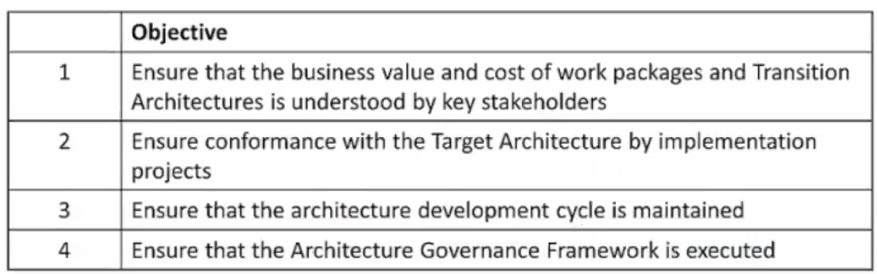 Which phase does each objective match?
-
A
-
B
-
C
-
D
Reveal answer details
Close answer details
Correct answerB
ExplanationAccording to the TOGAF Standard, Version 9.2, the ADM phases and their objectives are as follows1: Based on the above definitions, we can match each objective with the corresponding phase as follows:
References:
1: The TOGAF Standard, Version 9.2, Chapter
5: Architecture Development Method (ADM)
2: The TOGAF Standard, Version 9.2, Chapter
21: Architecture Change Management
3: The TOGAF Standard, Version 9.2, Chapter
20: Migration Planning
4: The TOGAF Standard, Version 9.2, Chapter
19: Implementation Governance
Please read this scenario prior to answering the question You are the Lead Enterprise Architect at a major agribusiness company. The company's main annual harvest is lentils, a highly valued food grown worldwide. The lentil parasite, broomrape, has been an increasing concern for many years and is now becoming resistant to chemical controls. In addition, changes in climate favor the propagation and growth of the parasite. As a result, the parasite cannot realistically be exterminated, and it has become pandemic, with lentil yields falling globally. The CEO appreciates the seriousness of the situation and has set out a change in direction that is effectively a new business for the company. There are opportunities for new products, and new markets.
The company will use the fields for another harvest and will cease to process third-party lentils. Thus, the target market will change, and the end-products will be different and more varied. This is a major decision and the CEO has stated a desire to repurpose rather than replace so as to manage the risks and limit the costs. The company has a mature Enterprise Architecture practice based in its headquarters and uses the TOGAF standard as the method and guiding framework. The practice has an established Architecture Capability, and uses iteration for architecture development. The CIO is the sponsor of the activity. The CIO has assigned the Enterprise Architecture team to this activity. At this stage there is no shared vision, or requirements. Refer to the scenario You have been asked to propose the best approach for architecture development to realize the CEO's change in direction for the company. Based on the TOGAF standard which of the following is the best answer?
-
A
You propose that the team focus on architecture definition, with emphasis on defining the change parameters to support this new business strategy that the CEO has identified. Once understood, the team will be in the best position to identify the requirements, drivers, issues, and constraints for the change. You would ensure that the architecture development addresses non-functional requirements to assure that the target architecture is robust and secure.
-
B
You propose that this engagement define the baseline Technology Architecture first in order to assess the current infrastructure capacity and capability for the company. Then the focus should be on transition planning and incremental architecture deployment.
This will identify requirements to ensure that the projects are sequenced in an optimal fashion so as to realize the change.
-
C
You propose that the priority is to understand and bring structure to the definition of the change. The team should focus iteration cycles on a baseline first approach to architecture development, and then transition planning. This will identify what needs to change in order to transition from the baseline to the target, and can be used to work out in detail what the shared vision is for the change.
-
D
You propose that the team focus its iteration cycles on architecture development by going through the architecture definition phases (B-D) with a baseline first approach.
This will support the change in direction as stated by the CEO. It will ensure that the change can be defined in a structured manner and address the requirements needed to realize the change.
Reveal answer details
Close answer details
Correct answerC
ExplanationBased on the TOGAF standard, this answer is the best approach for architecture development to realize the CEO's change in direction for the company. The reason is as follows: The scenario describes a major business transformation that requires a clear understanding of the current and future states of the enterprise, as well as the gaps and opportunities for change. Therefore, the priority is to understand and bring structure to the definition of the change, rather than focusing on the implementation details or the technology aspects. The team should use the TOGAF ADM as the method and guiding framework for architecture development, and adapt it to suit the specific needs and context of the enterprise. The team should also leverage the existing Architecture Capability and the Architecture Repository to reuse and integrate relevant architecture assets and resources.
The team should focus iteration cycles on a baseline first approach to architecture development, which means starting with the definition of the Baseline Architecture in each domain (Business, Data, Application, and Technology), and then defining the Target Architecture in each domain. This will help to identify the current and desired states of the enterprise, and to perform a gap analysis to determine what needs to change in order to achieve the business goals and objectives. The team should then focus on transition planning, which involves identifying and prioritizing the work packages, projects, and activities that will deliver the change. The team should also create an Architecture Roadmap and an Implementation and Migration Plan that will guide the execution and governance of the change. The team should use the Architecture Vision phase and the Requirements Management phase to work out in detail what the shared vision is for the change, and to capture and validate the stakeholder requirements and expectations. The team should also use the Architecture Governance framework to ensure the quality, consistency, and compliance of the architecture work.
References:
The TOGAF Standard, Version 9.2 - Architecture Development Method : The TOGAF Standard, Version 9.2 - Architecture Vision : The TOGAF Standard, Version 9.2 - Requirements Management : [The TOGAF Standard, Version 9.2 - Architecture Governance]
Refer to the table below: 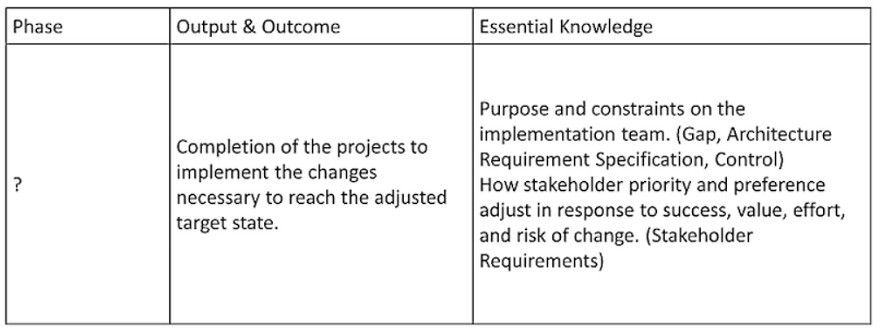 Which ADM Phase does this describe?
-
A
-
B
-
C
-
D
Reveal answer details
Close answer details
Correct answerB
ExplanationThe table describes the output, outcome, and essential knowledge of an ADM phase that oversees the implementation of changes necessary to reach the adjusted target state. This corresponds to Phase G, also known as Implementation Governance, which ensures that the architecture defined in earlier phases is realized, and it oversees the development and implementation of projects to align with this architecture.
The essential knowledge required during this phase includes understanding constraints on the implementation team and adjusting stakeholder priority and preference in response to success, value, effort, and risk of change.
References:
TOGAF Version 9.1 - 1
Which of the following supports the need to govern Enterprise Architecture?
-
A
The Architecture Project mandates the governance of the target architecture
-
B
The TOGAF standard cannot be used without executive governance
-
C
Best practice governance enables the organization to control value realization
-
D
The Stakeholders preferences may go beyond the architecture project scope and needs control
Reveal answer details
Close answer details
Correct answerC
ExplanationThis statement best supports the need to govern Enterprise Architecture. Best practice governance enables the organization to control value realization by ensuring that architectures are aligned with the enterprise's strategy and objectives, meet the quality and performance requirements, and deliver the expected benefits and outcomes. The Architecture Project does not mandate the governance of the target architecture, but rather follows the governance framework established by the enterprise. The TOGAF standard can be used without executive governance, but it is recommended that executive sponsorship and support are obtained for successful architecture development and transition. The Stakeholders preferences may go beyond the architecture project scope and need control, but this is not the primary reason for governing Enterprise Architecture.
References:
The TOGAF?Standard | The Open Group
Website, Section 3.3.6 Architecture Governance.
Which TOGAF concept describes a formal agreement between development partners to ensure deliverables meet agreed standards?
-
A
Architecture Requirements Specification
-
B
-
C
-
D
Request for Architecture Work
Reveal answer details
Close answer details
What is used to structure architectural information in an orderly way so that it can be processed to meet stakeholder needs?
-
A
-
B
An Architecture Framework
-
C
-
D
Reveal answer details
Close answer details
Correct answerC
ExplanationA content metamodel is a formal structure that defines the types of entities and relationships that are used to capture, store, filter, query, and represent architectural information in a way that supports consistency, completeness, and traceability 12. A stakeholder map is a tool that identifies and analyzes the key stakeholders and their interests, influence, and expectations in relation to the architecture 3. It is not used to structure architectural information, but rather to understand the stakeholder needs and concerns.
An architecture framework is a set of principles, guidelines, standards, and tools that provide a common structure and methodology for developing architectures 4. It is not used to structure architectural information, but rather to guide the architecture development process and ensure alignment with the business strategy and objectives.
An EA library is a repository that stores and manages the architecture artifacts, deliverables, and other relevant information produced and consumed during the architecture development and governance. It is not used to structure architectural information, but rather to provide access, security, and version control for the architecture content.
References:
1: The TOGAF Standard, Version 9.2 - Content Metamodel
2: TOGAF 9.2 Content Metamodel
3: The TOGAF Standard, Version 9.2 - Stakeholder Management
4: The TOGAF Standard, Version 9.2 - Architecture Framework : The TOGAF Standard, Version 9.2 - Architecture Repository
Question 10
Single choice
Which of the following is a responsibility of an Architecture Board?
-
A
Conducting assessments of the maturity level of architecture discipline within the organization
-
B
Allocating resources for architecture projects
-
C
Creating the Statement of Architecture Work
-
D
Establishing targets for re-use of components
Reveal answer details
Close answer details
Correct answerD
ExplanationAn Architecture Board is an executive-level group responsible for the review and maintenance of the strategic architecture and all of its sub-architectures 1. It is a key element in a successful Architecture Governance strategy 2. An Architecture Board is typically made responsible, and accountable, for achieving some or all of the following goals2: Therefore, the correct answer is option D, which captures one of the goals of an Architecture Board as stated in the TOGAF Standard, Version 9.22.
Option A is incorrect, because conducting assessments of the maturity level of architecture discipline within the organization is not a direct responsibility of an Architecture Board, but rather a part of the Architecture Capability Framework3.
Option B is incorrect, because allocating resources for architecture projects is not a direct responsibility of an Architecture Board, but rather a part of the Architecture Governance Framework4.
Option C is incorrect, because creating the Statement of Architecture Work is not a direct responsibility of an Architecture Board, but rather a part of the Architecture Development Method5.
References:
1: Architecture Board - The Open Group3
2: TOGAF Standard, Version 9.2 - Part VI: Architecture Governance Framework - Architecture Board
3: TOGAF Standard, Version 9.2 - Part VI: Architecture Governance Framework - Architecture Capability
Framework 4: TOGAF Standard, Version 9.2 - Part VI: Architecture Governance Framework - Architecture Governance
Framework 5: TOGAF Standard, Version 9.2 - Part II: Architecture Development Method - Phase A: Architecture Vision
Question 11
Single choice
What is a primary concern of Architecture Governance?
-
A
Business continuity planning
-
B
Compliance with architectural standards
-
C
Agile delivery frameworks
-
D
Reveal answer details
Close answer details
Question 12
Single choice
Please read this scenario prior to answering the question You have been appointed as Chief Enterprise Architect (CEA). reporting to the Chief Technical Officer (CTO), of a company established as a separate operating entity by a major automotive manufacturer. The mission of the company is to build a new industry leading unified technology and software platform for electric vehicles. The company uses the TOGAF Standard as the basis for its Enterprise Architecture (EA) framework, and architecture development follows the purpose-based EA Capability model as described in the TOGAF Series Guide: A Practitioners'Approach to Developing Enterprise Architecture Following the TOGAF?ADM. An end-to-end Target Architecture has been completed with a roadmap for change over a five-year period.
The new platform will be a cross-functional effort between hardware and software teams, with significant changes over the old platform. It is expected to be developed in several stages over three years. The EA team has inherited the architecture for the previous generation hardware and software automotive platform, some of which can be carried over to the new unified platform. The EA team has started to define the new platform, including defining which parts of the architecture to carry forward. Enough of the Business Architecture has been defined, so that work can commence on the Information Systems and Technology Architectures. Those need to be defined to support the core business services that the company plans to provide. The core services will feature an innovative approach with swarm data generated by vehicles, paving the way for autonomous driving in the future. The presentation and access to different variations of data that the company plans to offer through its platform pose an architecture challenge. The application portfolio and supporting infrastructure need to interact with various existing cloud services and data- Refer to the scenario You have been asked what approach should be taken to determine and organize the work to deliver the requested architectures? Based on the TOGAF standard which of the following is the best answer?
-
A
You would look outside the enterprise to research data models and application portfolios of leading big data businesses. You would develop just enough applications, data, and technology architecture to identify options. For each project this should include identification of candidate architecture and solution building blocks. You will identify solution providers, perform a readiness assessment, and assess the viability and fitness of the solution options. You will then document the draft Implementation and Migration plan.
-
B
You would refer to the end-to-end Target Architecture for guidance and direction. The first objective should be to identify projects, dependencies and synergies, then prioritize before initiating the projects.
You will develop high-level architecture descriptions. For each project you would estimate effort size, identify reference architectures, and candidate building blocks. You will identify the resource needs considering cost and value. You will document options, risks, and controls to enable viability analysis and trade-off with the stakeholders.
-
C
You will revisit ADM Phase A. identifying the stakeholders and creating a new Architecture Vision. You will update the Stakeholder map produced for the strategic architecture so it reflects the stakeholders who are now the most relevant to the projects that are to be developed. You would then ask the CTO to make some decisions about the Architecture Roadmap, and update the Implementation and Migration Plan to reflect the decisions.
-
D
You will research leading data businesses, developing high-level Target Data, Application and Technology Architectures. You would review the Architecture Vision in order to estimate the level of detail, time, and breadth of the ADM cycle phases that will be needed to develop the architecture. You will identify and cost major work packages, and then develop an Architecture Roadmap. You would then seek approval by the Architecture Board and initiate the project.
Reveal answer details
Close answer details
Correct answerB
ExplanationThe Target Architecture is a description of the future state of the architecture that addresses the business goals and drivers, and satisfies the stakeholder requirements and concerns. The Target Architecture is developed through the Architecture Development Method (ADM), which is the core process of the TOGAF standard that guides the development and management of the enterprise architecture. The Target Architecture is typically divided into four domains: Business, Data, Application, and Technology. The Target Architecture also includes a roadmap for change, which defines the Transition Architectures, the Capability Increments, and the work packages that enable the transition from the Baseline Architecture to the Target Architecture12.
The best answer is B, because it describes the approach that should be taken to determine and organize the work to deliver the requested architectures, which are the Information Systems and Technology Architectures. The answer covers the following steps: Refer to the end-to-end Target Architecture for guidance and direction. The end-to-end Target Architecture provides the overall vision, scope, and objectives of the architecture work, and the alignment with the business strategy and goals. The end-to-end Target Architecture also provides the high-level definitions and principles for the four architecture domains, and the roadmap for change that outlines the major milestones and deliverables.
Identify projects, dependencies and synergies, then prioritize before initiating the projects. Projects are the units of work that implement the architecture work packages, which are the sets of actions or tasks that are required to implement a specific part of the architecture. Dependencies are the relationships and constraints that affect the order or priority of the projects, such as logical, temporal, or resource dependencies. Synergies are the benefits or advantages that result from the combination or coordination of the projects, such as cost savings, efficiency gains, or innovation opportunities. Prioritization is the process of ranking the projects according to their importance, urgency, or value, and assigning resources and schedules accordingly.
Develop high-level architecture descriptions. High-level architecture descriptions are the outputs of the architecture development phases (B, C, and D) of the ADM cycle, which describe the Business, Data, Application, and Technology Architectures in terms of the Architecture Building Blocks (ABBs) and the Solution Building Blocks (SBBs), which are reusable components of business, IT, or architectural capability. High-level architecture descriptions also include the Architecture Views, which are representations of the system of interest from the perspective of one or more stakeholders and their concerns. For each project, estimate effort size, identify reference architectures, and candidate building blocks. Effort size is the measure of the amount of work, time, or resources required to complete a project.
Effort size can be estimated using various techniques, such as analogy, expert judgment, parametric, or bottom-up. Reference architectures are standardized architectures that provide a common framework and vocabulary for a specific domain or industry. Reference architectures can be used as a source of best practices, patterns, and models for the architecture development. Candidate building blocks are the potential ABBs or SBBs that can be used to implement the architecture. Candidate building blocks can be identified from the Architecture Repository, which is a collection of architecture assets, such as models, patterns, principles, standards, and guidelines.
Identify the resource needs considering cost and value. Resource needs are the specifications and criteria that define the acceptable level and quality of the resources required to complete the project, such as human, financial, physical, or technological resources. Resource needs can be identified by analyzing the scope, complexity, and dependencies of the project, and the availability, capability, and suitability of the resources. Cost and value are the factors that influence the allocation and utilization of the resources, such as the budget, the return on investment, the benefits, or the risks.
Document options, risks, and controls to enable viability analysis and trade-off with the stakeholders.
Options are the alternative ways of achieving the project objectives, such as different solutions, technologies, vendors, or approaches. Risks are the effects of uncertainty on the project objectives, such as threats or opportunities. Controls are the measures or actions that are taken to prevent, reduce, or mitigate the risks, such as policies, procedures, or standards. Viability analysis is the process of evaluating and comparing the options, risks, and controls, and determining the feasibility, suitability, and desirability of each option. Trade-off is the decision outcome that balances and reconciles the multiple, often conflicting, requirements and concerns of the stakeholders, and ensures alignment with the Architecture Vision and the Architecture Principles.
References:
1: The TOGAF Standard, Version 9.2, Part II: Architecture Development Method (ADM), Chapter
5: Introduction to the ADM
2: The TOGAF Standard, Version 9.2, Part IV: Architecture Content Framework, Chapter
36: Building Blocks : The TOGAF Standard, Version 9.2, Part II: Architecture Development Method (ADM), Chapter 18:
19: Phase B: Business Architecture : The TOGAF Standard, Version 9.2, Part II: Architecture Development Method (ADM), Chapter
20: Phase C: Information Systems Architectures : The TOGAF Standard, Version 9.2, Part II: Architecture Development Method (ADM), Chapter
21: Phase F: Migration Planning : The TOGAF Standard, Version 9.2, Part III: ADM Guidelines and Techniques, Chapter
23: Architecture Principles : The TOGAF Standard, Version 9.2, Part III: ADM Guidelines and Techniques, Chapter
30: Trade-Off Analysis : The TOGAF Standard, Version 9.2, Part VI: Architecture Capability Framework, Chapter
46: Tools for Architecture Development : The TOGAF Standard, Version 9.2, Part VI: Architecture Capability Framework, Chapter
47: Architecture Board : The TOGAF Standard, Version 9.2, Part VI: Architecture Capability Framework, Chapter
48: Architecture Compliance : The TOGAF Standard, Version 9.2, Part VI: Architecture Capability Framework, Chapter
49: Architecture Contract : The TOGAF Standard, Version 9.2, Part VI: Architecture Capability Framework, Chapter
50: Architecture Governance : The TOGAF Standard, Version 9.2, Part VI: Architecture Capability Framework, Chapter
51: Architecture Maturity Models : The TOGAF Standard, Version 9.2, Part VI: Architecture Capability Framework, Chapter
52: Architecture Skills Framework
Question 13
Single choice
Please read this scenario prior to answering the question You are serving as the Lead Architect for an Enterprise Architecture team within a leading multinational biotechnology company. The company works in three major industries, including healthcare, crop production, and agriculture. Your team works within the healthcare division. The healthcare division is developing a new vaccine, and has to demonstrate its effectiveness and safety in a set of clinical trials that satisfy the regulatory requirements of the relevant health authorities. The clinical trials are undertaken by its research laboratories at multiple facilities worldwide. In addition to internal research and development activities, the healthcare division is also involved in publicly funded collaborative research projects with industrial and academic partners. The Enterprise Architecture team has been engaged in an architecture project to develop a secure system that will allow the healthcare researchers to share information more easily about their clinical trials, and work more collaboratively across the organization and also with its partners. This system will also connect with external partners. The Enterprise Architecture team uses the TOGAF ADM with extensions required to support healthcare manufacturing practices and laboratory practices. Due to the highly sensitive nature of the information that is managed, special care has been taken to ensure that each architecture domain considers the security and privacy issues that are relevant. The Vice President for Worldwide Clinical Research is the sponsor of the Enterprise Architecture activity.
She has stated that disruptions must be minimized for the clinical trials, and that the rollout must be undertaken incrementally. Refer to the scenario You have been asked to recommend the approach to identify the work packages for an incremental rollout meeting the requirements. Based on the TOGAF standard which of the following is the best answer?
-
A
You recommend that the Solution Building Blocks from a Consolidated Gaps, Solutions and Dependencies Matrix be grouped into a set of work packages. Using the matrix as a planning tool, regroup the work packages to account for dependencies. Sequence the work packages into the Capability Increments needed to achieve the Target Architecture, so that the implementation team can schedule the rollout one region at a time to minimize disruption. Document the work packages for the Enterprise Architecture using a Transition Architecture State Evolution Table.
-
B
You recommend that a Consolidated Gaps. Solutions and Dependencies Matrix is used as a planning tool for creating work packages. For each gap classify whether the solution is either a new development, purchased solution, or based on an existing product. Group the similar solutions together to define the work packages. Regroup the work packages into a set of Capability Increments to transition to the Target Architecture considering the schedule for clinical trials, and document in an Architecture Definition Increments Table.
-
C
You recommend that an Implementation Factor Catalog is drawn up to indicate actions and constraints.
A Consolidated Gaps. Solutions and Dependencies Matrix should also be created. For each gap. identify a proposed solution and classify it as new development, purchased solution, or based on an existing product. Group similar activities together to form work packages. Identify dependencies between work packages factoring in the clinical trial schedules. Regroup the work packages into a set of Capability Increments scheduled into a series of Transition Architectures.
-
D
You recommend that the set of required Solution Building Blocks be determined by identifying those which need to be developed and which need to be procured. Eliminate any duplicates. Group the remaining Solution Building Blocks together to create the work packages using a CRUD (create, read, update, delete) matrix. Rank the work packages and select the most cost-effective options for inclusion in a series of Transition Architectures. Schedule the roll out of the work packages to be sequential across the geographic regions.
Reveal answer details
Close answer details
Correct answerB
ExplanationA Consolidated Gaps, Solutions and Dependencies Matrix is a technique that can be used to create work packages for an incremental rollout of the architecture. A work package is a set of actions or tasks that are required to implement a specific part of the architecture. A work package can be associated with one or more Architecture Building Blocks (ABBs) or Solution Building Blocks (SBBs), which are reusable components of business, IT, or architectural capability. A work package can also be associated with one or more Capability Increments, which are defined, discrete portions of the overall capability that deliver business value. A Capability Increment can be realized by one or more Transition Architectures, which are intermediate states of the architecture that enable the transition from the Baseline Architecture to the Target Architecture123.
The steps for creating work packages using this technique are: For each gap between the Baseline Architecture and the Target Architecture, identify a proposed solution and classify it as new development, purchased solution, or based on an existing product. A gap is a difference or deficiency in the current state of the architecture that needs to be addressed by the future state of the architecture. A solution is a way of resolving a gap by implementing one or more ABBs or SBBs.
Group similar solutions together to define the work packages. Similar solutions are those that have common characteristics, such as functionality, technology, vendor, or location.
Identify dependencies between work packages, such as logical, temporal, or resource dependencies.
Dependencies indicate the order or priority of the work packages, and the constraints or risks that may affect their implementation. Regroup the work packages into a set of Capability Increments to transition to the Target Architecture. Capability Increments should be defined based on the business value, effort, and risk associated with each work package, and the schedule and objectives of the clinical trials. Capability Increments should also be aligned with the Architecture Vision and the Architecture Principles. Document the work packages and the Capability Increments in an Architecture Definition Increments Table, which shows the mapping between the work packages, the ABBs, the SBBs, and the Capability Increments. The table also shows the dependencies, assumptions, and issues related to each work package and Capability Increment.
Therefore, the best answer is B, because it describes the approach to identify the work packages for an incremental rollout meeting the requirements, using the Consolidated Gaps, Solutions and Dependencies Matrix as a planning tool.
References:
1: The TOGAF Standard, Version 9.2, Part III: ADM Guidelines and Techniques, Chapter
30: Gap Analysis
2: The TOGAF Standard, Version 9.2, Part IV: Architecture Content Framework, Chapter
36: Building Blocks
3: The TOGAF Standard, Version 9.2, Part III: ADM Guidelines and Techniques, Chapter
31: Architecture Change Management : The TOGAF Standard, Version 9.2, Part II: Architecture Development Method (ADM), Chapter
23: Phase E: Opportunities and Solutions : The TOGAF Standard, Version 9.2, Part II: Architecture Development Method (ADM), Chapter
21: Phase F: Migration Planning : The TOGAF Standard, Version 9.2, Part II: Architecture Development Method (ADM), Chapter
18: Phase A: Architecture Vision : The TOGAF Standard, Version 9.2, Part III: ADM Guidelines and Techniques, Chapter
23: Architecture Principles
Question 14
Single choice
Which of the following is a responsibility of an Architecture Board?
-
A
Determining the scope of an architecture compliance review
-
B
Allocating resources for architecture projects
-
C
Conducting assessments of the maturity level of architecture discipline within the organization
-
D
Achieving consistency between sub-architectures
Reveal answer details
Close answer details
Correct answerD
ExplanationOne of the key responsibilities of an Architecture Board within the context of TOGAF is to achieve consistency between sub-architectures. This board is typically responsible for overseeing the development and maintenance of the enterprise architecture, ensuring that it aligns with the organization's overall strategy and objectives. They play a critical role in ensuring that all sub-architectures (like Business Architecture, Data Architecture, Application Architecture, and Technology Architecture) work together cohesively and support the overall enterprise architecture vision and strategy.
Question 15
Single choice
What are the four dimensions used to scope an architecture?
-
A
Business Data Application Technology
-
B
Strategy Segment Capability Budget
-
C
Breadth Depth Time Period Architecture Domains
-
D
Strategy Portfolio Project Solution Delivery
Reveal answer details
Close answer details
Correct answerC
ExplanationThe four dimensions used to scope an architecture are Breadth, Depth, Time Period, and Architecture Domains1, p. 8.
Breadth refers to the extent of the enterprise covered by the architecture, which can range from a specific business unit to the entire organization1, p. 8. Depth refers to the level of detail and completeness of the architecture, which can vary depending on the purpose, scope, and stakeholders of the architecture1, p. 8.
Time Period refers to the temporal aspects of the architecture, such as the current state, the target state, and the transition plan1, p. 8. Architecture Domains refers to the classification of the architecture into four domains: Business, Data, Application, and Technology1, p. 8. These four dimensions help define the scope and boundaries of the architecture and ensure that it meets the needs and expectations of the stakeholders.
References:
1: The Open Group (2018). The TOGAF?Standard, Version 9.2. 1
Question 16
Single choice
Consider the following statement: According to the TOGAF Standard a governed approach of a particular deliverable will ensure a system of continuous monitoring to check integrity changes decision-making and audit of all architecture-related activities Which deliverable is being referred to?
-
A
-
B
The Architecture Definition Document
-
C
-
D
The Statement of Architecture Work
Reveal answer details
Close answer details
Correct answerA
ExplanationAn Architecture Contract is a deliverable that specifies the responsibilities and obligations of the parties involved in the implementation and governance of an architecture. It ensures a system of continuous monitoring to check integrity changes decision-making and audit of all architecture-related activities.
References:
The TOGAF?Standard | The Open Group Website, Section 3.3.4 Architecture Contracts.
Question 17
Single choice
Which of the following is the ability to develop use and sustain the architecture of a particular enterprise using architecture to govern change?
-
A
-
B
-
C
-
D
An Enterprise Architecture
Reveal answer details
Close answer details
Correct answerA
ExplanationThe ability to develop, use, and sustain the architecture of a particular enterprise using architecture to govern change is an EA Capability. An EA Capability is a set of skills, processes, roles, responsibilities, tools, and techniques that enable an enterprise to successfully develop and maintain its Enterprise Architecture and achieve its desired outcomes. An EA Capability is part of an enterprise's overall capability portfolio and should be aligned with its strategy and objectives.
References:
The TOGAF?Standard | The Open Group Website, Section 3.2 Preliminary Phase.
Question 18
Single choice
What is the objective of Phase G: Implementation Governance in the ADM?
-
A
Develop a vision of the Target Architecture
-
B
Finalize Architecture Requirements
-
C
Ensure conformance of the implementation to the architecture
-
D
Identify transition architectures
Reveal answer details
Close answer details
Question 19
Single choice
What can architects present to stakeholders to extract hidden agendas, principles, and requirements that could impact the final Target Architecture?
-
A
Solutions and Applications
-
B
Alternatives and Trade-offs
-
C
Business Scenarios and Business Models
-
D
Architecture Views and Architecture Viewpoints
Reveal answer details
Close answer details
Correct answerD
ExplanationAccording to the TOGAF Standard, Version 9.2, an architecture view is a representation of a system from the perspective of a related set of concerns 1. It consists of one or more architecture models that demonstrate how the system addresses the stakeholder concerns 1.
An architecture viewpoint is a specification of the conventions for constructing and using an architecture view to address specific stakeholder concerns 1. It defines the perspective, scope, notation, and techniques for creating an architecture view of a system 1.
Architects can present architecture views and viewpoints to stakeholders to extract hidden agendas, principles, and requirements that could impact the final Target Architecture, because23:
References:
1: The TOGAF Standard, Version 9.2, Chapter
22: Architecture Views, Viewpoints, and Stakeholders
2: The TOGAF Standard, Version 9.2, Chapter
4: Introduction to Part II, Section 4.2: What is an Architecture Framework?
3: The TOGAF Standard, Version 9.2, Chapter
31: Architectural Artifacts, Section 31.1: Basic Concepts
|