Consider the following ADM phases objectives. Objective 1-Determine whether an incremental approach is required, and if so identify Transition Architectures that will deliver continuous business value 2-Generate the initial complete version of the Architecture Roadmap, based upon the gap analysis and candidate Architecture Roadmap components from Phases B, C, and D 3-Finalize the Architecture Roadmap and the supporting Implementation and Migration Plan 4-Ensure that the business value and cost of work packages and Transition Architectures is understood by key stakeholders Which phase does each objective match?
-
A
-
B
-
C
-
D
Reveal answer details
Close answer details
Correct answerB
ExplanationAccording to the TOGAF standard, the objectives of each ADM phase are as follows1: Phase E: Opportunities and Solutions oDetermine whether an incremental approach is required, and if so identify Transition Architectures that will deliver continuous business value oIdentify and group major work packages within the Architecture Roadmap oIdentify and group major implementation projects to realize the Architecture Roadmap oIdentify dependencies between increments and projects oEstimate cost, benefit, and risk at a high level for each increment and project oConduct initial prioritization and sequencing of the Architecture Roadmap and projects Phase F: Migration Planning
oGenerate the initial complete version of the Architecture Roadmap, based upon the gap analysis and candidate Architecture Roadmap components from Phases B, C, and D oConfirm the Transition Architectures with relevant stakeholders oCreate the Implementation and Migration Plan, including Transition Architectures, work packages, projects, and other activities oConfirm and agree the Architecture Roadmap and Implementation and Migration Plan with relevant stakeholders Phase G: Implementation Governance oFinalize the Architecture Roadmap and the supporting Implementation and Migration Plan oEnsure conformance with the Target Architecture by implementation projects oPerform appropriate Architecture Governance functions for the solution and any implementation-driven architecture Change Requests oEnsure that the architecture lifecycle is maintained oEnsure that the Architecture Governance Framework is executed Phase H: Architecture Change Management oEnsure that the business value and cost of work packages and Transition Architectures is understood by key stakeholders oManage risks and issues related to the Architecture Roadmap and Implementation and Migration Plan oMonitor the implementation projects and Transition Architectures oManage changes to the architecture baseline oManage changes to the Architecture Capability Therefore, the correct matching of the objectives and the phases is: G: Determine whether an incremental approach is required, and if so identify Transition Architectures that will deliver continuous business value
E: Generate the initial complete version of the Architecture Roadmap, based upon the gap analysis and candidate Architecture Roadmap components from Phases B, C, and D
F: Finalize the Architecture Roadmap and the supporting Implementation and Migration Plan
F: Ensure that the business value and cost of work packages and Transition Architectures is understood by key stakeholders
References:
1: The TOGAF Architecture Development Method
Consider the image showing basic architectural concepts. 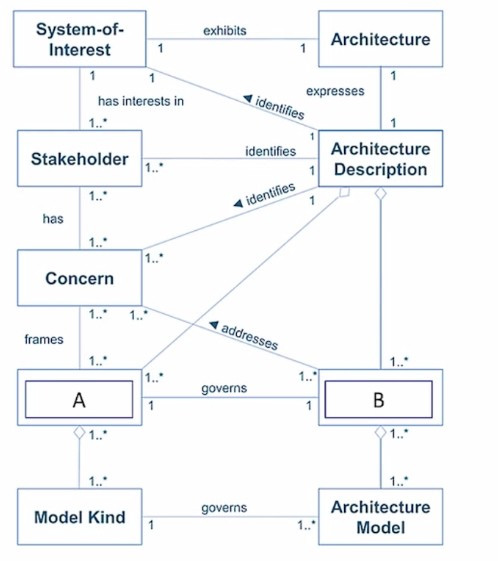
Complete the sentence: Item A ____________, while item B ____________.
-
A
is the set of concerns influencing the work product, is a work product influencing a collection of Architecture Views
-
B
defines how to construct and use an Architecture View, represents a system from a perspective of a related set of concerns
-
C
is an area of interest that stakeholders find important, is the context determining the influences on an Architecture Model
-
D
defines how to construct an Architecture View, is a form of abstraction to focus on particular concerns within a system
Reveal answer details
Close answer details
Correct answerB
ExplanationItem is an A Architecture Viewpoint. In TOGAF, an Architecture Viewpoint defines the conventions for constructing, interpreting, and using an Architecture View. It frames stakeholder concerns and governs the related views and model kinds used to express the architecture. Item is an B Architecture View. An Architecture View represents a system from the perspective of a related set of concerns. It is created according to an Architecture Viewpoint and is used to communicate architecture information to specific stakeholders. The diagram shows that concerns are framed by item A, and item A governs item B. It also shows that item B is connected to Architecture Models, which supports the interpretation that B is the Architecture View. This matches the standard TOGAF concept structure: stakeholders have concerns, concerns are framed by viewpoints, viewpoints govern views, and views are made up of architecture models. Therefore, item A is the Architecture Viewpoint, and item B is the Architecture View. The correct answer is B.
Please read this scenario prior to answering the question You are the Lead Enterprise Architect at a major agribusiness company. The company's main annual harvest is lentils, a highly valued food grown worldwide. The lentil parasite, broomrape, has been an increasing concern for many years and is now becoming resistant to chemical controls. In addition, changes in climate favor the propagation and growth of the parasite. As a result, the parasite cannot realistically be exterminated, and it has become pandemic, with lentil yields falling globally. The CEO appreciates the seriousness of the situation and has set out a change in direction that is effectively a new business for the company. There are opportunities for new products, and new markets.
The company will use the fields for another harvest and will cease to process third-party lentils. Thus, the target market will change, and the end-products will be different and more varied. This is a major decision and the CEO has stated a desire to repurpose rather than replace so as to manage the risks and limit the costs. The company has a mature Enterprise Architecture practice based in its headquarters and uses the TOGAF standard as the method and guiding framework. The practice has an established Architecture Capability, and uses iteration for architecture development. The CIO is the sponsor of the activity. The CIO has assigned the Enterprise Architecture team to this activity. At this stage there is no shared vision, or requirements. Refer to the scenario You have been asked to propose the best approach for architecture development to realize the CEO's change in direction for the company. Based on the TOGAF standard which of the following is the best answer?
-
A
You propose that the team focus on architecture definition, with emphasis on definingthe change parameters to support this new business strategy that the CEO hasidentified. Once understood, the team will be in the best position to identify therequirements, drivers, issues, and constraints for the change. You would ensure that thearchitecture development addresses non-functional requirements to assure that thetarget architecture is robust and secure.
-
B
You propose that this engagement define the baseline Technology Architecture first inorder to assess the current infrastructure capacity and capability for the company.
Thenthe focus should be on transition planning and incremental architecture deployment.This will identify requirements to ensure that the projects are sequenced in an optimalfashion so as to realize the change.
-
C
You propose that the priority is to understand and bring structure to the definition of thechange. The team should focus iteration cycles on a baseline first approach toarchitecture development, and then transition planning. This will identify what needs tochange in order to transition from the baseline to the target, and can be used to work outin detail what the shared vision is for the change.
-
D
You propose that the team focus its iteration cycles on architecture development bygoing through the architecture definition phases (B-D) with a baseline first approach.This will support the change in direction as stated by the CEO. It will ensure that thechange can be defined in a structured manner and address the requirements needed torealize the change.
Reveal answer details
Close answer details
Complete the sentence. ______ can be used to explain how generic solutions can be leveraged and specialized to meet the needs of an organization.
-
A
The Architecture Repository
-
B
-
C
-
D
Reveal answer details
Close answer details
Correct answerD
ExplanationComprehensive and Detailed In-Depth Explanation from Expert in Enterprise Architecture, guiding in TOGAF and ArchiMate: The Enterprise Continuum is a TOGAF concept that provides a logical classification mechanism for architecture and solution assets, ranging from: Generic, industry-wide solutions
To organization-specific architectures and implementations
It explains:
How generic architectures and solutions are adapted, specialized, and reused
The relationship between Foundation, Common Systems, Industry, and Organization-Specific assets
Why Option D is correct: The Enterprise Continuum explicitly describes how generic solutions are leveraged and specialized to meet enterprise-specific needs. Why the other options are incorrect: A. Architecture Repository: Stores assets but does not explain specialization.
B. Solutions Landscape: Describes deployed solutions, not classification or specialization.
C. TOGAF ADM: A development method, not a classification concept.
Please read this scenario prior to answering the question
You are employed as an Enterprise Architect within a multinational company. The company has been very successful and has been buying companies around the world. This has led to a growing number of manufacturing divisions in various locations with a complex supply chain.
The top management recently expressed concerns about the company ' s effectiveness because of its multiple data centers and duplicate applications. The EA team has been working on a project to solve this issue. An analysis shows that supply chain issues have led to not enough products being produced to meet all the customer demand.
A strategic architecture has been defined to help meet customer demand and manage the supply chain more effectively. The strategic architecture involves combining different Enterprise Resource Planning (ERP) applications that are currently used separately in the company ' s production sites.
Each division has finished the Architecture Definition documentation to address their own specific manufacturing needs. The Enterprise Architects have agreed an overall strategy for the migration. They have defined a set of work packages that address the gaps found. They have defined the intermediate architectural states between the Baseline and Target architecture to add a new ERP environment into the company.
Because of the risks posed by this change from the current environment, the architects have recommended that a phased approach should be taken to implement the target architecture with several stages of change. They have created a draft roadmap with the implementation process estimated to take over two years.
The company has an established Enterprise Architecture (EA) practice and follows the TOGAF Architecture Development Method. The company also uses various management frameworks such as business planning, project/portfolio management, and operations management. The EA program is sponsored by the Chief Information Officer (CIO). In your role as an Enterprise Architect within the EA team, you work closely with the important stakeholders from the various divisions within the company.
Refer to the scenario
You have been assigned to plan the next steps for the migration. Which approach will
you choose?
Based on the TOGAF standard which of the following is the best answer?
-
A
You finalize the Architecture Definition documentation with updates to reflectthe implementation approach. You ensure that Implementation and MigrationPlan is consistent with the chosen approach. You identify the resourcesneeded to undertake the development projects. You would then produce anImplementation Governance Model to manage the lessons learned beforefinishing the plan. You ensure that the lessons learned are applied to theImplementation and Migration Plan.
-
B
You estimate the business value for each project by applying the BusinessValue Assessment Technique to prioritize the migration projects and projectsteps. The assessment should focus on return on investment and criteria forevaluating performance to track the progress of the architecturetransformation. You would confirm and plan a series of Transition Architecturephases using a table of Architecture Definition Increments that lists theprojects. You then update the Implementation and Migration Plan.
-
C
You will focus on project selection. You make sure that the Implementation andMigration plan aligns with the other management frameworks in use in thecompany. Next, you assign a value to each work package, taking into accountthe resources available and how they fit into the overall strategy. Using thesework packages, you estimate resource requirements and timings. You thenselect which projects will be included in the Implementation and Migration Plan.
-
D
You conduct a series of Compliance Assessments to check that thearchitecture is being implemented as required by the contract. This is donenow to confirm that the implementation team is following the correctdevelopment process, and if not, so course correction is viable. This involvesusing monitoring tools and making sure that performance targets are beingachieved. If the targets are not met, you would then need to make adjustmentsto the performance requirements and update them in the Implementation andMigration Plan.
Reveal answer details
Close answer details
Correct answerB
ExplanationAt this stage in the scenario: A strategic architecture has been completed. All divisions have completed their Architecture Definition Documents.
Work packages have been defined.
Transition Architectures between Baseline and Target are already identified.
A draft roadmap exists for a multi-year phased migration.
You are now asked to plan the next steps for the migration, which aligns exactly with TOGAF ADM Phase F: Implementation and Migration Planning. In Phase F, TOGAF prescribes the following key activities: Evaluate and prioritize projects and work packages Determine business value, cost, risk, dependencies Confirm Transition Architectures and sequencing Update and finalize the Implementation & Migration Plan Option B is the ONLY answer that correctly follows these required TOGAF steps.
# Why
Option B is correct
Option B states: "Estimate the business value for each project by applying the Business Value Assessment Technique... to prioritize the migration projects."# This is a TOGAF-recommended technique specifically for Phase F to evaluate and prioritize transformations using value, risk, and ROI. "Confirm and plan a series of Transition Architecture phases... using a table of Architecture Definition Increments."# Exactly aligned with TOGAF: Transition Architectures were identified earlier.
In Phase F, they must be confirmed, sequenced, and documented.
"Update the Implementation and Migration Plan."# This is the required output of ADM Phase F.# At this point, the plan must be validated and finalized based on value and prioritization. Thus, Option B directly matches TOGAF's prescribed migration planning process.
# Why the other options are incorrect
A - Incorrect
Suggests finalizing Architecture Definition documentation-this was already completed by each division.
Introduces an "Implementation Governance Model," which is not a TOGAF artifact at this stage.
Focuses on lessons learned BEFORE execution, which is not appropriate for migration planning.
C - Incorrect
Focuses only on project selection and resource assignment.
Does not use TOGAF techniques for value/risk evaluation.
Does not reference Transition Architectures, which are central in the scenario.
Oversimplifies Implementation & Migration Planning to resource scheduling.
D - Incorrect
Compliance Assessments occur DURING execution, not before migration planning. At this stage, no implementation has started, so compliance reviews are premature. Adjusting performance requirements now has no alignment with TOGAF's ADM sequence.
Consider the following statements:
1. Groups of countries, governments, or governmental organizations (such as militaries) working together to create common or shareable deliverables or infrastructures 2. Partnerships and alliances of businesses working together, such as a consortium or supply chain What are those examples of according to the TOGAF Standard?
-
A
-
B
-
C
-
D
Reveal answer details
Close answer details
Correct answerA
ExplanationAccording to the TOGAF standard, the two statements provided refer to different scopes within which architecture can be developed: Groups of countries, governments, or governmental organizations working together typically align with broader, often international, scopes of architecture that transcend individual enterprise boundaries. Partnerships and alliances of businesses working together, such as a consortium or supply chain, refer to collaborative efforts that can define architecture at a scope involving multiple enterprises. In both cases, the term " Architectures Scopes " is appropriate because it reflects the varying levels and contexts in which architectures can be defined, ranging from single business units to collaborative inter-organizational efforts.
Complete the sentence. The purpose of creating a set of Architecture Principles is to:
-
A
-
B
enable an understanding of the culture and values of the enterprise
-
C
establish a common understanding of how to control the business in pursuit of strategic goals
-
D
agree a contract between sponsoring organization and the architects
Reveal answer details
Close answer details
Correct answerC
ExplanationComprehensive and Detailed In-Depth Explanation from Expert in Enterprise Architecture, guiding in TOGAF and ArchiMate: Architecture Principles are fundamental statements that define the rules and guidelines for architecture decision-making. They are designed to guide and constrain the development, implementation, and governance of architectures across the enterprise. The primary purpose of Architecture Principles is to: Establish a shared and consistent understanding of how the enterprise operates and makes decisions Guide architecture development in alignment with business strategy and objectives Provide a stable basis for governance, compliance, and trade-off decisions Ensure architecture supports long-term enterprise goals rather than short-term project optimization
Why Option C is correct: Architecture Principles establish a common understanding of how to control and guide the business in pursuit of strategic goals. They act as enduring rules that influence behavior, investment decisions, and architectural choices. Why the other options are incorrect: A. document likely impacts: Impact analysis is a separate activity and not the primary purpose of principles.
B. enable an understanding of the culture and values of the enterprise: While principles may reflect culture and values, this is a secondary effect, not their main purpose. D. agree a contract between sponsoring organization and the architects: This describes the role of an Architecture Contract, not Architecture Principles. References:
TOGAF Architecture Principles
TOGAF Architecture Content Framework
TOGAF Architecture Governance and Compliance Concepts
Which of the following is the ability to develop use and sustain the architecture of a particular enterprise using architecture to govern change?
-
A
-
B
-
C
-
D
An Enterprise Architecture
Reveal answer details
Close answer details
Correct answerA
ExplanationThe ability to develop, use, and sustain the architecture of a particular enterprise using architecture to govern change is an EA Capability. An EA Capability is a set of skills, processes, roles, responsibilities, tools, and techniques that enable an enterprise to successfully develop and maintain its Enterprise Architecture and achieve its desired outcomes. An EA Capability is part of an enterprise's overall capability
portfolio and should be aligned with its strategy and objectives.
References:
The TOGAF Standard | The Open Group Website, Section 3.2 Preliminary Phase.
Consider the following statement: According to the TOGAF Standard a governed approach of a particular deliverable will ensure a system of continuous monitoring to check integrity changes decision-making and audit of all architecture-related activities Which deliverable is being referred to?
-
A
-
B
The Architecture Definition Document
-
C
-
D
The Statement of Architecture Work
Reveal answer details
Close answer details
Correct answerA
ExplanationAn Architecture Contract is a deliverable that specifies the responsibilities and obligations of the parties involved in the implementation and governance of an architecture. It ensures a system of continuous monitoring to check integrity changes decision-making and audit of all architecture-related activities.
References:
The TOGAF Standard | The Open Group Website, Section 3.3.4 Architecture Contracts.
Question 10
Single choice
You are working as an Enterprise Architect within the Enterprise Architecture (EA) team at a healthcare and life sciences company. The EA team is developing a secure system for researchers to share clinical trial information easily across the organization and with external partners. Due to the highly sensitive nature of the information, each architecture domain must consider privacy and safety concerns. The healthcare division has been directed to minimize disruptions to clinical trials while introducing the new system gradually. How would you identify the work packages for introducing the new system?
Based on the TOGAF standard, which of the following is the best answer?
-
A
Use a Consolidated Gaps, Solutions, and Dependencies Matrix to create work packages and sequence them into Capability Increments. Document in a Transition Architecture State Evolution Table.
-
B
Identify Solution Building Blocks for development or procurement, then use a CRUD matrix to rank and select the most cost-effective work packages. Schedule the rollout sequentially across regions.
-
C
Use a Consolidated Gaps, Solutions, and Dependencies Matrix to classify each solution, group them into work packages, then regroup into Capability Increments. Document in an Architecture Definition Increments Table.
-
D
Draw up an Implementation Factor Catalog to indicate actions and constraints. Use a Consolidated Gaps, Solutions, and Dependencies Matrix, then group similar activities into work packages and identify dependencies.
Reveal answer details
Close answer details
Question 11
Single choice
Scenario You are working as an Enterprise Architect within a large manufacturing company. The company has
multiple divisions located worldwide. After a recent study, senior management is concerned about the impact of the company's multiple data centers and duplication of applications on business efficiency. To address this concern, a strategic
architecture has been defined; it will help improve the ability to meet customer demand and improve the
efficiency of operations. The strategic architecture involves the consolidation of multiple application programs that are currently used in different divisions and putting them all onto a cloud-based solution instead. Each division has completed the Architecture Definition documentation to meet its own specific operational requirements. The enterprise architects have analyzed the corporate changes and implementation constraints. A consolidated gap analysis has been completed. Based on its results, the architects have reviewed the requirements, dependencies, and interoperability requirements needed to integrate the cloud-based solution. The architects have completed the Business Transformation Readiness Assessment.
Based on all these factors, they have produced a risk assessment. They have also completed the draft Implementation and Migration Plan, the draft Architecture Roadmap, and the Capability Assessment deliverables. Due to the risks of changing from the current environment, the decision has been taken that a gradual approach is needed to implement the target architecture. It will likely take a few years to complete the whole implementation process. The company has a mature Enterprise Architecture (EA) practice and uses the TOGAF standard for its architecture development method. The EA practice is engaged throughout all the divisions, with implementation governance assigned to a business line. In addition to providing guidance on using architecture frameworks, including business planning, project/portfolio management, and operations management, the EA program is sponsored by the Chief Information Officer (CIO). You have been asked to decide on the next steps for the migration planning. Based on the TOGAF standard, which of the following is the best answer?
-
A
You update the Architecture Definition Document, which includes setting project objectives and documenting the final requirements. This will ensure that the architecture remains relevant and responsive to the needs of the enterprise. You then produce an Implementation Governance Model to manage the lessons learned prior to finalizing the Implementation and Migration Plan. You recommend that lessons learned be applied as changes to the architecture without review.
-
B
You conduct a series of Compliance Assessments to ensure that the architecture is being implemented according to the contract. The Compliance Assessment verifies that the implementation team is using the proper development methodology. It should include deployment of monitoring tools and ensure that performance targets are being met. If they are not met, then you would identify changes to performance requirements and update those in the Implementation and Migration Plan.
-
C
You examine how the Implementation and Migration Plan affects the other frameworks being used in the organization. You coordinate the planning with the business planning, project/portfolio management, and operations management frameworks. You assign a business value to each project, considering the available resources and how well they align with the strategy. You then update the architecture roadmap and the Implementation and Migration Plan.
-
D
You assess the business value for each project by applying the Business Value Assessment Technique. The assessment should focus on return on investment and performance evaluation criteria to prioritize the most progress of the architecture transformation. You confirm and plan a series of Transition Architecture phases using an Architecture Definition Increments Table. You document the lessons learned and generate the final Implementation and Migration Plan.
Reveal answer details
Close answer details
Question 12
Single choice
Complete the sentence. The “Statement” part of the recommended TOGAF template for Architecture Principles:
-
A
should be easy to remember
-
B
should highlight the requirements for carrying out the principle
-
C
should communicate the fundamental rule
-
D
should highlight the business benefits
Reveal answer details
Close answer details
Correct answerC
ExplanationComprehensive and Detailed In-Depth Explanation from Expert in Enterprise Architecture, guiding in TOGAF and ArchiMate: TOGAF defines a structured template for Architecture Principles, typically including: Name
Statement Rationale
Implications The Statement:
Clearly and succinctly expresses the fundamental rule or directive
Is normative and prescriptive Guides decision-making and behavior
Why Option C is correct: The Statement's purpose is to communicate the fundamental rule of the principle.
Why the other options are incorrect: A relates to naming, not the statement.
B describes implications, not the statement.
D describes the rationale, not the statement.
Question 13
Single choice
Please read this scenario prior to answering the question You are working as Chief Enterprise Architect at a large Internet company. The company has many divisions, ranging from cloud to logistics. The company has grown rapidly, expanding from initially selling physical books and media to a range of services including an online marketplace, live-streaming. eBooks. and cloud services. Overall management of the numerous divisions has become challenging. Recent high-profile projects have overrun on budget and under delivered, damaging the company's reputation, and adversely impacting its share price. There is a widely held view within the executive management that the organization structure has played a major role in these project failures. The company has an established Enterprise Architecture program based on the TOGAF standard, sponsored jointly by the Chief Executive Officer (CEO) and Chief Information Officer (CIO). The CEO has decided that the company needs to reorganize its divisions around artificial intelligence and machine learning with a focus on automation. The CEO has worked with the Enterprise Architects to create a strategic architecture for the reorganization, including an Architecture Vision, together with definitions for the four domain architectures. This sets out an ambitious vision of the future of the company over a three-year period. This includes a set of work packages and includes three distinct transformations. The CIO has made it clear that prior to the approval of the detailed Implementation and Migration plan, the EAteam will need to assess the risks associated with the proposed architecture. He has received concerns from key stakeholders across the company that the proposed reorganization may be too ambitious and there is doubt whether it can produce sufficient value to warrant the risks. Refer to the scenario You have been asked to recommend an approach to satisfy these concerns.
Based on the TOGAF Standard, which of the following is the best answer?
-
A
The Enterprise Architects should evaluate the organization's readiness to undergo change. This will allow the risks associated with the transformations to be identified, classified, and mitigated for. This should include identifying dependencies between the set of changes, including gaps and work packages. It will also identify improvement actions to be worked into the Implementation and Migration Plan. The business value, effort, and risk associated for each transformation should be determined.
-
B
The Enterprise Architects should bring together information about potential approaches and produce several alternative target transition architectures. They should then investigate the different architecture alternatives and discuss these with stakeholders using the Architecture Alternatives and Trade-offs technique. Once the target architecture has been selected, it should be analyzed using a state evolution table to determine the Transition Architectures. A value realization process should then be established to ensure that the concerns raised are addressed.
-
C
Establishing interoperability in alignment with the corporate operating model will ensure risks are minimized. The Enterprise Architects should apply an interoperability analysis to evaluate any potential issues across the architecture. This should include the development of a matrix showing the interoperability requirements. These can then be included within the transformation strategy embedded in the target transition architectures. The Enterprise Architects should then finalize the Architecture Roadmap and the Implementation and Migration Plan.
-
D
Before preparing the detailed Implementation and Migration plan, the Enterprise Architects should review and consolidate the gap analysis results from Phases B to This will identify the transformations required to achieve the proposed Target Architecture. The Enterprise Architects should then assess the readiness of the organization to undergo change and determine an overall direction to address and mitigate risks identified. The Transition Architecture should then be planned to use a state evolution table.
Reveal answer details
Close answer details
Correct answerD
ExplanationBusiness Transformation readiness assessment is initiated in Phase E, Completed in Phase F and monitored in Phase G. Understanding the readiness of the organization to accept change, identifying the issues, and then dealing with them in the Implementation and Migration Plans is key to successful architecture transformation in Phases E and F. This will be a joint effort between corporate (especially human resources) staff, lines of business, and IT planners.
Question 14
Single choice
Please read this scenario prior to answering the question You are working as an Enterprise Architect at a large supermarket. The company runs many retail stores, as well as an online grocery shop. Many of the stores used to remain open 24/7, but the number has decreased in recent years.
Instead, they now focus on fulfilling online orders during the night. The company has a mature Enterprise Architecture (EA) practice and uses the TOGAF standard for its architecture development method. The EA practice is involved in all aspects of the business, with oversight provided by an Architecture Board with representatives from different parts of the business. The EA program is sponsored by the Chief Information Officer (CIO). Each store uses a standard method to track sales and inventory. This involves sending accurate timely sales data to a central Al-based inventory management system that can predict demand, adjust stock levels and automate reordering.
The central inventory management system is housed at the company's central data center. The company has bought a major rival. The Chief Executive Officer believes that a merger will enable growth through combined offerings and cost savings. The decision has been taken to fully integrate the two organizations, including merging retail operations and systems. This means that duplicated systems will be replaced with one standard retail management system. Also, the company will reduce the number of applications that are used. The CIO expects significant savings will be achieved by implementing these changes across the newly merged company. One improvement that the rival has successfully implemented is the use of hand-held devices within stores, for both customers and staff. This has increased both customer and staff employee satisfaction due to the time savings this has brought. The CIO has given the go-ahead to roll out the devices in all stores but has stated that training on how to use the hand-held devices should be brief because there are a lot of employees, many of whom are part-time. The Request for Architecture Work to oversee the merger has been approved. The project has been scoped and you have been assigned to work on it. Your role includes managing the architecture for the retail stores. Refer to the scenario You have been asked to confirm the most relevant architecture principles for the transformation. Based on the TOGAF Standard, which of the following is the best answer? [Note: The sequence of the principles listed in each answer does not matter. You should assume the company follows the set of principles that are provided in the TOGAF Standard, ADM Techniques, Architecture Principles chapter. You may need to refer to section 2.6 located in ADM Techniques within the reference text to answer this question.]
-
A
Maximize Benefit to the Enterprise, Common Use Applications, Data is an Asset, Responsive Change Management, Technology Independence
-
B
Control Technical Diversity, Interoperability, Data is an Asset, Data is Shared, Business Continuity
-
C
Common Vocabulary and Data Definitions, Compliance with the Law, Requirements Based Change, Responsive Change Management, Data Security
-
D
Common Use Applications, Data is an Asset, Data is Accessible, Ease of Use, Business Continuity
Reveal answer details
Close answer details
Question 15
Single choice
Complete the sentence. The key purpose of Gap Analysis is to ________________.
-
A
establish quality parameters for the architecture
-
B
identify potential missing or overlapping functions
-
C
validate nonfunctional requirements
-
D
identify commercial building blocks to be purchased
-
E
determine the required service levels for the architecture
Reveal answer details
Close answer details
Correct answerB
ExplanationGap Analysis is a technique that compares the Baseline Architecture and the Target Architecture to identify the differences and gaps between them. The purpose of this technique is to determine the changes and additions that are required to achieve the desired future state of the architecture. One of the main aspects of Gap Analysis is to identify the functions that are missing or overlapping in the current and future architectures, and to plan how to address them. This helps to ensure that the architecture is complete, consistent, and aligned with the business objectives and requirements3
Question 16
Single choice
According to the TOGAF standard, what are the two levels of risk that should be monitored?
-
A
Technical and Financial level
-
B
Mitigated and Revised level
-
C
Operational and Strategic level
-
D
Initial and Residual level
Reveal answer details
Close answer details
Correct answerD
ExplanationComprehensive and Detailed In-Depth Explanation from Expert in Enterprise Architecture, guiding in TOGAF and ArchiMate: TOGAF adopts a formal risk management perspective aligned with widely accepted enterprise risk management practices. Within the ADM, risks are identified, analyzed, treated, and monitored throughout all phases, particularly during Architecture Governance and Implementation Governance. TOGAF explicitly distinguishes between:
Initial Risk:The level of risk identified before any mitigation actions are applied. This represents the inherent exposure associated with an architecture decision, solution, or implementation approach. Residual Risk:The level of risk that remains after mitigation measures have been applied. This residual risk must be explicitly accepted, monitored, or further treated by governance bodies. Why Option D is correct: TOGAF requires both Initial and Residual risks to be documented and monitored to ensure informed decision-making and effective governance throughout the ADM lifecycle. Why the other options are incorrect: A. Technical and Financial level: These are categories of risk, not the two monitoring levels defined by TOGAF.
B. Mitigated and Revised level: These terms are not used as formal risk levels in TOGAF. C. Operational and Strategic level: These describe business risk domains, not TOGAF-defined monitoring levels.
References:
TOGAF Risk Management
TOGAF Architecture Governance TOGAF ADM Guidelines and Techniques - Risk Management
Question 17
Single choice
Consider the following descriptions of deliverables consumed and produced across the TOGAF ADM cycle. General rules and guidelines, intended to be enduring and seldom amended, that inform and support the way in which an organization sets about fulfilling its mission. The joint agreements between development partners and sponsors on the deliverables, quality, and fitness-for-purpose of an architecture. A document that is sent from the sponsoring organization to the architecture organization to trigger the start of an architecture development cycle. A set of quantitative statements that outline what an implementation project must do in order to comply with the architecture. Which deliverables match these descriptions?
-
A
1 Architecture Principles -2 Architecture Contracts - 3 Request for Architecture Work - 4 Architecture Requirements Specification
-
B
1 Architecture Contracts - 2 Architecture Requirements Specification - 3 Architecture Vision - 4 Architecture Principles
-
C
1 Architecture Requirements Specification -2 Architecture Principles - 3 Architecture Vision - 4 Architecture Contracts
-
D
1 Architecture Principles -2 Architecture Contracts - 3 Architecture Requirements Specification-4 Request for Architecture Work
Reveal answer details
Close answer details
Correct answerA
ExplanationAccording to the TOGAF standard, the deliverables that match the descriptions are as follows: 1 Architecture Principles: These are general rules and guidelines, intended to be enduring and seldom amended, that inform and support the way in which an organization sets about fulfilling its mission 1. They reflect a level of consensus among the various elements of the enterprise, and form the basis for making future IT decisions 1. 2 Architecture Contracts: These are the joint agreements between development partners and sponsors on the deliverables, quality, and fitness-for-purpose of an architecture 2. They are used to ensure that the architecture is implemented and governed according to the agreed-upon specifications and standards 2. 3
Request for Architecture Work: This is a document that is sent from the sponsoring organization to the architecture organization to trigger the start of an architecture development cycle 3. It defines the scope, schedule, budget, deliverables, and stakeholders of the architecture project 3. 4 Architecture Requirements Specification: This is a set of quantitative statements that outline what an implementation project must do in order to comply with the architecture 4. It defines the requirements for each architecture domain, as well as the relationships and dependencies among them 4.
References:
1: Architecture Principles
2: Architecture Contracts
3: Request for Architecture Work 4:
Architecture Requirements Specification
Question 18
Single choice
Complete the sentence. Business Transformation Readiness Assessment is ________.
-
A
a way to put building blocks into context, thereby supporting re-usable solutions
-
B
widely used to validate an architecture that is being developed
-
C
a joint effort between corporate staff, lines of business, and IT planners
-
D
to ensure the active support of powerful stakeholders
Reveal answer details
Close answer details
Correct answerC
Explanationhttps://pubs.opengroup.org/togaf-standard/adm-techniques/chap08.html " 8.1 Introduction Understanding the readiness of the organization to accept change, identifying the issues, and then dealing with them in the Implementation and Migration Plans is key to successful architecture transformation in Phases E and F. This will be a joint effort between corporate (especially human resources) staff, lines of business, and IT planners. "
Question 19
Single choice
Full Scenario
You are employed as an Enterprise Architect within the Enterprise Architecture (EA) team at a clinical research and health technologies company. The company has multiple divisions. Your team works within the healthcare division. The healthcare division is always creating new products and needs to show the effectiveness and safety of the products. This happens in a set of clinical trials that satisfy the legal requirements of the relevant health authorities. The clinical trials are undertaken by the division's research laboratories at multiple facilities worldwide. At any time, there are many clinical trials happening. In addition to internal research and development activities, the healthcare division is also involved in publicly funded research projects with industrial and academic partners. Your team is working on an architecture project to develop a secure system that will allow the healthcare researchers to share information more easily about their clinical trials. It will make working together easier across the organization. This system will also allow secured collaboration with external partners. The EA team uses the TOGAF Architecture Development Method with adaptations required to support healthcare production methods and laboratory procedures. Due to the highly sensitive nature of the information that is managed, special care has been taken to ensure that each architecture domain considers the privacy and safety concerns. The EA team has been instructed to minimize disruptions to the trials and to gradually introduce the new system. The company has an established EA practice and has adopted the TOGAF standard for use in its architecture work. The EA practice is federated, which allows some interoperability and information sharing between the divisions yet permits partially independent activity. The Vice President of the healthcare division is the sponsor of the Enterprise Architecture activity for your EA team. Question:
As part of introducing the new system, how would you go about breaking down the project into work packages? Based on the TOGAF standard which of the following is the best answer?
-
A
Identify Solution Building Blocks needing development or procurement, eliminate duplicates, group with CRUD matrices, rank work packages, select cost-effective options, and schedule rollouts in Transition Architectures.
-
B
Create an Implementation Factor Catalog to indicate actions and constraints. Draw up a matrix with architecture domains and gaps. For each gap, classify solutions as new development, purchased, or existing product. Group similar activities into work packages, identify dependencies, and regroup them into Capability Increments scheduled across Transition Architectures.
-
C
Use a Consolidated Gaps, Solutions, and Dependencies Matrix as a planning tool; classify solutions, group similar ones, and regroup into Capability Increments documented in an Architecture Definition Increments Table.
-
D
Use Solution Building Blocks from a Consolidated Gaps, Solutions, and Dependencies Matrix and group into work packages, sequence them, and document rollout using a Transition Architecture State Evolution Table.
Reveal answer details
Close answer details
Correct answerB
ExplanationIn TOGAF, the process of breaking down an initiative into work packages must be grounded in a structured evaluation of gaps, solutions, dependencies, constraints, and implementation factors. Option B precisely follows this guidance. It begins by producing an Implementation Factor Catalog, which is a TOGAF artifact used to record business, technical, regulatory, organizational, and risk considerations that influence implementation. This is especially relevant in the scenario because clinical trials operate under strict regulatory controls, highly sensitive data, and complex coordination across multiple research sites. Next, Option B calls for creating a gap matrix comparing baseline and target architectures across domains. For each gap, TOGAF requires classification of solution approaches: new development, purchased solution, or reuse of existing components. This aligns directly with the Solutions Continuum and the practice of forming Solution Building Blocks. Grouping similar activities into work packages is also textbook ADM practice, ensuring traceability from architecture gaps into actionable implementation components. Furthermore, Option B incorporates dependencies analysis and restructures work packages into Capability Increments, which is the TOGAF-recommended method for incremental delivery and Transition Architectures. This matches the scenario ' s requirement for gradual rollout to minimize disruption to ongoing clinical trials. Thus, Option B fully reflects the TOGAF standard for structured work package definition.
Question 20
Single choice
Which of the following best summarizes the purpose of Enterprise Architecture?
-
A
Taking major improvement decisions.
-
B
Guiding effective change.
-
C
Controlling the bigger changes.
-
D
Governing the Stakeholders.
Reveal answer details
Close answer details
Correct answerB
ExplanationEA applies architecture principles and practices to analyze, design, plan, and implement enterprise analysis that supports digital transformation, IT growth, and the modernization of IT2. EA also helps organizations improve the efficiency, timeliness, and reliability of business information, as well as the alignment, agility, and adaptability of the architecture to the changing needs and requirements 3. Therefore, the best summary of the purpose of EA is to guide effective change.
References:
1: Enterprise architecture - Wikipedia
2: What is enterprise architecture? A framework for
transformation 3: 3 The Purpose of Enterprise Architecture - The Open Group
Question 21
Single choice
Scenario: You are working as an Enterprise Architect at a large company. The company runs a chain of home improvement stores, as well as a website for selling products. The website lets many brands work with the company. The stores open seven days a week and use a standard method to track sales and inventory. This involves sending accurate and timely sales data to a central inventory management system that can predict demand, adjust stock levels, and automate reordering. The website is supported by regional fulfillment centers and also uses the central inventory management system. The central inventory management system is housed at the company's central data center. The company has agreed to merge with a major competitor. The leadership teams of both organizations have said they are committed to a smooth transition for customers. All stores will keep their own brand names. They will combine the systems of the organizations, which includes merging retail operations and systems. Duplicated systems will be replaced with one standard retail management system. Additionally, they will reduce the number of applications being used. The CIO expects that these changes will lead to substantial cost savings for the newly merged company. An enterprise plan for both organizations has been created. The aim is to set priorities for the transition, especially in terms of information management and application development. It is crucial to make decisions that will create long-term value. The company has a mature Enterprise Architecture (EA) practice and uses the TOGAF standard for its architecture development method. The EA program is sponsored by the Chief Information Officer (CIO). The Request for Architecture Work to oversee the transition has been approved. The project has been scoped, and you have been assigned to work on it. You have been asked to confirm the most relevant architecture principles for the transition. Based on the TOGAF Standard, which of the following is the best answer?
-
A
Control Technical Diversity, Interoperability, Data is an Asset, Data is Shared, Business Continuity
-
B
Service Orientation, Compliance with the Law, Requirements Based Change, Responsive Change Management, Data Security
-
C
Common Use Applications, Data is an Asset, Common Vocabulary and Data Definitions, Maximize Benefit to the Enterprise, Business Continuity
-
D
Ease of Use, Common Use Applications, Data is an Asset, Technology Independence, Business Continuity
Reveal answer details
Close answer details
Question 22
Single choice
Complete the sentence A set of architecture principles that cover every situation perceived meets the recommended criteria of_______________
-
A
-
B
-
C
-
D
Reveal answer details
Close answer details
Correct answerD
ExplanationA set of architecture principles that cover every situation perceived meets the recommended criteria of completeness. Completeness is one of the six criteria that should be applied when developing or assessing architecture principles. Completeness means that there are no gaps or overlaps in the coverage of principles across all relevant aspects of the enterprise's architecture.
References:
The TOGAF Standard |
The Open Group Website, Section 3.3.7 Architecture Principles.
Question 23
Single choice
Which of the following describes a purpose of Architecture Principles?
-
A
To describe likely impacts resulting from successful deployment of the target architecture.
-
B
To establish a common understanding of how to control the business in pursuit of strategic objectives
-
C
To provide a better understanding about the enterprise's culture and values
-
D
To form a contract between sponsoring organization and the enterprise architects
Reveal answer details
Close answer details
Correct answerC
Explanationhttps://pubs.opengroup.org/togaf-standard/togaf-leaders-guide/togaf-leaders-guide_4.html
Question 24
Single choice
Which of the following is included as part of the practice of Architecture Governance?
-
A
Managing stakeholders, their concerns, and their requirements.
-
B
Creating and maintaining the Statement of Architecture Work throughout the ADM cycle.
-
C
Interacting with the CxO level on Enterprise Architecture.
-
D
Ensuring compliance with standards, and regulatory obligations.
Reveal answer details
Close answer details
Correct answerD
ExplanationArchitecture Governance in TOGAF is the practice of directing and controlling architecture work so that it remains aligned with enterprise standards, principles, policies, and regulatory obligations. One of its major purposes is to ensure that architecture development and implementation comply with approved standards and required controls. This includes architecture compliance reviews, governance checkpoints, dispensations, and monitoring conformance to agreed architecture contracts and principles. Option D is therefore the best answer because it directly describes a governance responsibility: ensuring compliance with standards and regulatory obligations. This is central to Architecture Governance. Option A is related to stakeholder management, which is important in architecture development, but it is not the core governance practice being asked for. Option B is incorrect because the Statement of Architecture Work is a project-related deliverable, not something maintained as the main function of Architecture Governance throughout the ADM. Option C may occur in executive engagement but does not define governance practice. Therefore, the correct answer is .D
Question 25
Single choice
In which section of the TOGAF template for Architecture Principles would a reader find the answer to the question of " How does this affect me"?
-
A
-
B
-
C
-
D
Reveal answer details
Close answer details
Correct answerA
Explanationhttps://pubs.opengroup.org/pocket-guides/togaf-pocket-guide/main/chap07.html Implications: Should highlight the requirements, both for the business and IT, for carrying out the principle - in terms of resources, costs, and activities/tasks. It will often be apparent that current systems, standards, or practices would be incongruent with the principle upon adoption. The impact on the business and the consequences of adopting a principle should be clearly stated. The reader should readily discern the answer to: "How does this affect me?". It is important not to oversimplify, trivialize, or judge the merit of the impact. Some of the implications will be identified as potential impacts only, and may be speculative rather than fully analyzed.
Question 26
Single choice
Complete the sentence. The "Statement" part of the recommended TOGAF template for Architecture Principles
-
A
should highlight the requirements for carrying out the principle
-
B
should highlight the business benefits
-
C
should be easy to remember
-
D
should clearly communicate the fundamental rule
Reveal answer details
Close answer details
Correct answerD
ExplanationIn TOGAF, when defining an architecture principle, one part of the standard template is the "Statement." The purpose of the Statement is to convey clearly and unambiguously the principle itself - not its rationale, implications, or how to apply it. The Statement should be phrased such that stakeholders can read it and immediately understand the core rule or guiding intent. It is not intended to describe the implementation or benefits or constraints, nor to be a mnemonic. Thus the Statement must clearly communicate the fundamental rule. The rationale, implications, and further explanation belong in other parts of the principle documentation, not in the Statement. This division helps maintain clarity, separation of concerns, and consistency in how principles are documented and governed.
Question 27
Single choice
Consider the description.
The typical contents of the assessment include: an overview of project progress and status and project architecture/design. Which form of assessment is described?
-
A
-
B
-
C
-
D
Reveal answer details
Close answer details
Correct answerD
ExplanationWithin the TOGAF framework, assessments are used to ensure that architecture work is conformant with governance parameters. A compliance assessment (sometimes called architecture compliance or compliance review) is the evaluation of a project's architectural artifacts-its design, architecture decisions, progress status-against the established architecture standards, principles, and constraints. The content of a compliance assessment typically includes reviewing the project status, the architectural design alignment, and identifying noncompliance issues or deviations. Because it focuses on how well the project matches the architecture, rather than on capabilities, organizational structure, or risk per se, the described contents correspond to a compliance assessment. The compliance assessment helps governance bodies enforce architectural consistency and correct deviations during implementation.
Question 28
Single choice
Please read this scenario prior to answering the question
You are employed as an Enterprise Architect at a company. The company manages large-scale farming operations with food production, processing, and distribution. The goal of the company is to maximize profit while satisfying the needs of consumers for its products. Its customers demand food that is produced sustainably, safely, and transparently, while reducing environmental impact.
The business is highly mechanized, and this mechanization has brought about a decrease in the number of workers needed, together with a focus on agricultural engineering to improve the efficiency of its farms, its processing facilities, and the overall enterprise. As part of this, the company has established an Enterprise Architecture (EA) practice based on the TOGAF standard, using it as the method and guiding framework. The Chief Information Officer (CIO) is the sponsor of EA practice.
The practice has adopted an iterative approach for its architecture development. This has enabled the decision makers to have valuable insights into the different aspects of the business.
In recent years there have been a series of bad harvests, and a major reduction in yields of the main crop produced by the company. This combined with an increase in costs for energy, feed, fuel, and fertilizer, had led to a significant decrease in profits. The rising costs and lower profits mean that the company is unable to take as much planned action on climate measures as it would like, such as reducing its carbon footprint. The Chief Executive Officer (CEO) has stated that big changes are needed to improve yields and profitability.
The outline strategy for change, includes new products, and new markets. The company will switch to a mix of crops rather than depend on a main crop and will allow use of its processing facilities by third parties. This is a major decision, and the CEO has stated a desire to repurpose and reuse rather than replace so as to manage the risks and limit the costs.
The CIO has assigned the EA team to manage this project. The CIO has stated that although the overall objective is known, the EA team are expected to define the scope, a shared vision, and the requirements.
Refer to the scenario
You have been asked to recommend the best approach for architecture development to realize the CEO ' s change in direction for the company.
Based on the TOGAF standard which of the following is the best answer?
-
A
The team should start on architecture definition and operate multiple ADMphases concurrently to support this change in direction. Once understood, theteam will identify the requirements, drivers, issues, and constraints for thechange. You would include non-functional requirements in the architecturedevelopment to make sure that the target architecture meets it compliance andregulatory requirements.
-
B
The team first needs to understand the problem and define the structure of thechange. It should start iteration cycles on a baseline first approach toarchitecture development, and then transition planning. This will identify thechange needed to transition from the baseline to the target and can be used towork out in detail what the agreed vision is for the change.
-
C
The team should start its iteration cycles of architecture development by goingthrough the architecture definition phases (B-D) with a baseline first approach. This will support the change in direction as stated by the CEO. It will ensurethat the change can be defined in a structured manner and address therequirements needed to realize the change.
-
D
The team should start by defining the baseline Technology Architecture in orderto assess the current infrastructure capacity and capability for the company.Then the focus should be on transition planning and incremental architecturedeployment. This will identify requirements to ensure that the projects aresequenced in an optimal way to realize the change.
Reveal answer details
Close answer details
Correct answerB
ExplanationThe scenario clearly states that: The overall objective is known, BUT the EA team is expected to define the scope, shared vision, and requirements, The company uses an iterative approach, The CEO wants repurpose and reuse rather than replace, This is a major strategic shift (new markets, new products, new crop mix).
According to the TOGAF standard, when the problem must be understood, and scope, vision, and requirements are not yet defined, the correct starting point is Phase A: Architecture Vision, using an iteration cycle. This is also consistent with the "baseline-first" approach recommended in the TOGAF Series Guides for situations where: the business direction is known but high-level, detailed impacts must be discovered, and the organization wants to reuse existing capabilities rather than replace them.
Option B is the only answer that: Begins by understanding the problem, Defines the structure of the change, Uses iteration cycles starting with a baseline-first approach, Leads into transition planning, Supports clarification of the shared vision and requirements, Fits the CIO's instruction to "define the scope, shared vision, and requirements."
This matches exactly what TOGAF prescribes in early-cycle Architecture Vision and initial iterations.
Question 29
Single choice
Which section of the TOGAF template for Architecture Principles should describe the relationship to other principles?
-
A
-
B
-
C
-
D
Reveal answer details
Close answer details
Correct answerD
ExplanationThe implications section of the TOGAF template for Architecture Principles should describe the relationship to other principles. Implications are statements that describe how a principle will impact other principles, as well as other aspects of the enterprise such as business processes, organizational structures, roles and responsibilities, standards, etc. Implications help to identify potential conflicts or synergies among principles and to assess their feasibility and applicability.
References:
The TOGAF Standard | The Open
Group Website, Section 3.3.7 Architecture Principles.
Question 30
Single choice
Consider the following statements.
1. All processes, decision-making, and mechanisms used will be established so as to minimize or avoid potential conflicts of interest. 2. More effective strategic decision-making will be made by C-Level executives and business leaders.
3. All actions implemented and their decision support will be available for inspection by authorized organization and provider parties. 4. Digital Transformation and operations will be more effective and efficient. Which statements highlight the value and necessity for Architecture Governance to be adopted within organizations?
-
A
-
B
-
C
-
D
Reveal answer details
Close answer details
Correct answerB
ExplanationStatements 1 and 3 highlight the value and necessity for Architecture Governance to be adopted within organizations. Architecture Governance is the practice and orientation by which Enterprise Architectures and other architectures are managed and controlled at an enterprise-wide level 12. It ensures that architectural decisions are aligned with the organization's strategy, objectives, and standards. Architecture Governance also involves establishing and maintaining processes, decision-making, and mechanisms to avoid or minimize potential conflicts of interest, such as between different stakeholders, business units, or projects 34. Moreover, Architecture Governance requires transparency and accountability for all actions implemented and their decision support, so that they can be inspected and evaluated by authorized parties, such as auditors, regulators, or customers 5. References:
- The TOGAF Standard, Version 9.2 - Architecture Governance - The Open Group
- Architecture Governance - The Open Group
- Tutorial: Governance in TOGAF's Architecture Development Method (ADM)
- Architecture Governance in TOGAF: Ensuring Effective Management and Compliance
- The TOGAF Standard, Version 9.2 - Definitions - The Open Group
- [Architecture Governance in TOGAF: Ensuring Alignment and Control]
Question 31
Single choice
Which ADM Phase includes creation of an Enterprise Architecture Capability?
-
A
-
B
-
C
-
D
Reveal answer details
Close answer details
Correct answerD
ExplanationThe Preliminary Phase is the phase in TOGAF where an organization establishes or enhances its Enterprise Architecture Capability. This includes defining governance structures, roles, responsibilities, processes, tools, and architectural principles. The objective is to prepare the organization to successfully execute the ADM. Phase A focuses on Architecture Vision for a specific initiative, not on creating the overall EA capability. Phase G deals with implementation governance, and Phase H focuses on architecture change management. None of these phases are responsible for establishing the EA practice itself. The Preliminary Phase answers foundational questions such as how architecture will be governed, who owns architecture decisions, how compliance will be enforced, and how architecture work will be integrated with other organizational processes. Therefore, creation of an Enterprise Architecture Capability clearly belongs to the Preliminary Phase.
|