What is an objective of the ADM Preliminary Phase?
-
A
To develop a vision of the business value to be delivered by the proposed enterprise architecture
-
B
To select and implement tools to support the Architecture Capability
-
C
To obtain approval for the Statement of Architecture Work
-
D
To create the initial version of the Architecture Roadmap
Reveal answer details
Close answer details
Correct answerB
ExplanationThe Preliminary Phase prepares the organization to perform architecture work. This includes defining and establishing the Architecture Capability, together with the supporting organization, governance, methods, skills, and tools. Selecting and implementing suitable tools therefore belongs to this preparation, before a specific architecture development cycle begins.
What is the role of an Architecture Board?
-
A
It conducts the assessments of the maturity level of architecture discipline within the organization.
-
B
It oversees implementation of the Architecture Governance strategy for the enterprise.
-
C
It creates the Statement of Architecture Work for an Enterprise Architecture project.
-
D
It determines the scope of an architecture compliance review.
Reveal answer details
Close answer details
Correct answerB
ExplanationAn Architecture Board provides oversight for the implementation of the enterprise's Architecture Governance strategy. It helps ensure that architecture decisions, compliance, and exceptions are handled through the established governance framework. Producing an individual project's work statement or performing one specific assessment is narrower than this oversight role.
Which of the following is a responsibility of an Architecture Board?
-
A
Determining the scope of an architecture compliance review
-
B
Allocating resources for architecture projects
-
C
Conducting assessments of the maturity level of architecture discipline within the organization
-
D
Achieving consistency between sub-architectures
Reveal answer details
Close answer details
Correct answerD
ExplanationAn Architecture Board provides governance across architecture work, including maintaining alignment among related architectural areas. Achieving consistency between sub-architectures prevents separately developed parts from conflicting and supports an integrated enterprise direction. Project resource allocation is a management responsibility rather than this board duty.
Which of the following describes how the Enterprise Continuum is used when developing an enterprise architecture?
-
A
To identify and understand business requirements
-
B
To coordinate with the other management frameworks in use
-
C
To describe how an architecture addresses stakeholder concerns
-
D
To classify architecture and solution assets
Reveal answer details
Close answer details
Correct answerD
ExplanationThe Enterprise Continuum supplies a classification framework for organizing both architecture assets and solution assets according to their degree of generality and enterprise specificity. This helps practitioners locate, understand, and reuse relevant material during development. It does not replace requirements analysis, stakeholder views, or coordination with unrelated management frameworks.
Before detailed domain architectures are developed, sponsors need a shared high-level direction and approval to begin the architecture work. Which Phase A activity meets this need?
-
A
Analyze baseline and target descriptions for every architecture domain.
-
B
Agree the scope, stakeholders, vision, value, and authorization for the work.
-
C
Group candidate changes into work packages and transition architectures.
-
D
Prioritize implementation projects and finalize the migration roadmap.
Reveal answer details
Close answer details
Correct answerB
ExplanationPhase A creates the shared Architecture Vision and secures authorization before detailed domain development begins. Agreeing the scope establishes the boundary, identifying stakeholders brings their concerns into the work, and clarifying vision and value builds sponsorship. Formal authorization then provides the mandate to proceed with the architecture effort.
Which of the following best describes the need for the ADM process to be governed?
-
A
To enable development of reference architectures
-
B
To verify that the method is being applied correctly
-
C
To enable a fast response to market changes
-
D
To permit the architecture domains to be integrated
Reveal answer details
Close answer details
Correct answerB
ExplanationGovernance provides oversight and control over how the ADM is used. Its essential purpose here is to verify that practitioners apply the method correctly, including any approved tailoring, and that the resulting work follows the established architecture process. Reference architectures, market responsiveness, and domain integration may be useful outcomes, but they do not define why the process itself requires governance.
Complete the sentence Business Transformation Readiness Assessment is_________________.
-
A
a joint effort between corporate staff lines of business and IT planners
-
B
to ensure the active support of powerful stakeholders
-
C
a way to put building blocks into context thereby supporting re-usable solutions
-
D
widely used to validate an architecture that is being developed
Reveal answer details
Close answer details
Correct answerA
ExplanationBusiness transformation readiness spans organizational and technical change, so it cannot be assessed by one planning group in isolation. It is a joint effort involving corporate staff, lines of business, and IT planners, combining their perspectives on the enterprise's ability to implement change. The result identifies readiness factors and actions rather than validating the architecture itself.
Complete the sentence. The purpose of creating a set of Architecture Principles is to
-
A
establish a common understanding of how to control the business in pursuit of strategic goals
-
B
-
C
enable an understanding of the culture and values of the enterprise
-
D
agree a contract between sponsoring organization and the architects
Reveal answer details
Close answer details
Correct answerA
ExplanationArchitecture Principles provide enduring rules that guide and constrain enterprise decisions. Establishing a common understanding of how to control the business in pursuit of strategic goals enables different decision-makers to act consistently. Impacts may be documented for each principle, but that is not the purpose of creating the set.
Complete the sentence. When considering agile development, Architecture to Support Portfolio will identify what products the Enterprise needs, the boundary of the products, and what constraints a product owner
has; this defines the Enterprise's
-
A
-
B
-
C
-
D
Reveal answer details
Close answer details
Correct answerD
ExplanationThe product set, each product's boundary, and the constraints placed on product ownership define how the enterprise organizes and operates its product-oriented work. Together these choices establish the operating model used to coordinate responsibilities and delivery. A backlog contains work items, while risk tolerance and business continuity address different concerns and do not define product boundaries.
Question 10
Single choice
Which of the following does the TOGAF standard describe as a package of functionality defined to meet business needs across an organization?
-
A
-
B
-
C
-
D
Reveal answer details
Close answer details
Correct answerD
ExplanationA building block is a package of functionality defined to meet business needs across an organization. It is a reusable architectural unit whose specification can be combined with other building blocks. An application can realize some functionality, but it is not the general architectural concept requested here.
Question 11
Single choice
After the Architecture Vision is approved, detailed baseline and target work is planned for business capabilities, applications and data, and the supporting platform. Which phase mapping is correct?
-
A
Phase B: technology; Phase C: business; Phase D: data and applications
-
B
Phase B: business; Phase C: data and applications; Phase D: technology
-
C
Phase B: data and applications; Phase C: technology; Phase D: business
-
D
Phase B: business; Phase C: technology; Phase D: data and applications
Reveal answer details
Close answer details
Correct answerB
ExplanationAfter Phase A establishes the Architecture Vision, Phase B develops the Business Architecture. Phase C develops the Data and Application Architectures, linking information and application support to business needs. Phase D then develops the Technology Architecture that supplies the platform and infrastructure needed by those applications.
Question 12
Single choice
Consider the graphic from the TOGAF Standard. 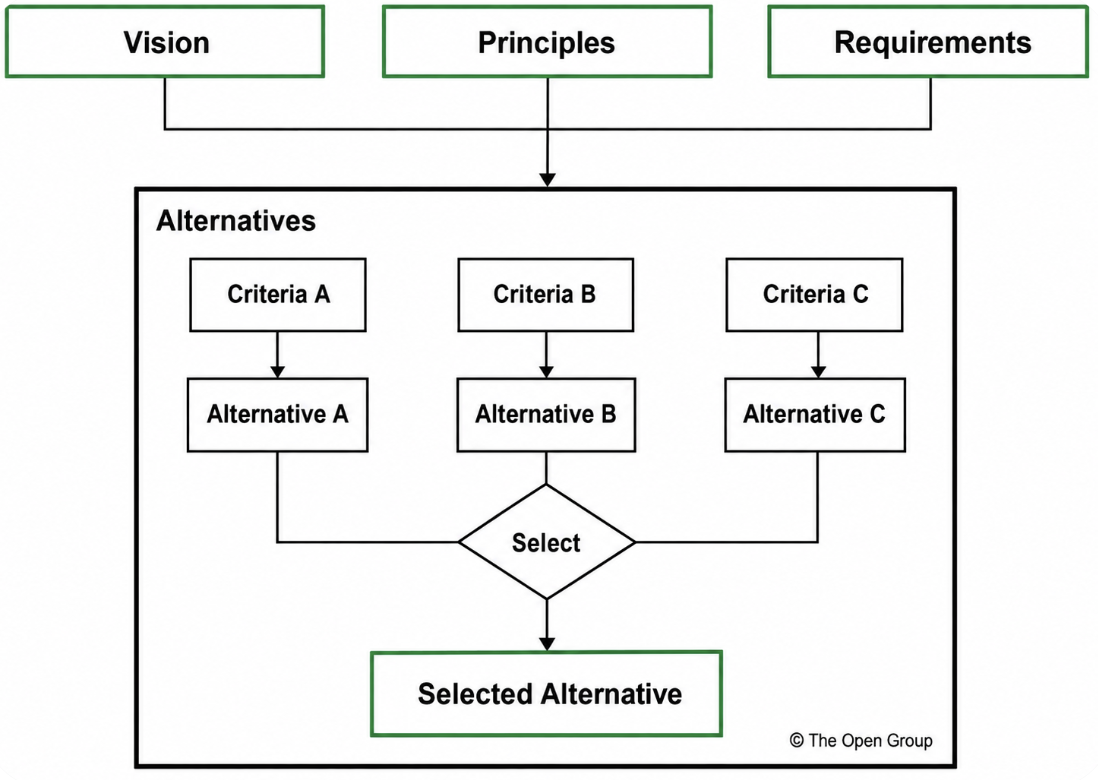 The graphic shows Vision, Principles, and Requirements feeding into a box labeled Alternatives. Inside that box, multiple alternatives are assessed against Criteria A, Criteria B, and Criteria C. A selection step then leads to a Selected Alternative. What does this illustrate?
-
A
The Architecture Trade-off method
-
B
Architecture Partitioning
-
C
The Business Scenario method
-
D
Reveal answer details
Close answer details
Correct answerA
ExplanationThe Architecture Trade-off method evaluates multiple alternatives against explicit criteria derived from the vision, principles, and requirements. Comparing each candidate in this structured way exposes its advantages and compromises, allowing one alternative to be selected as the basis for the Target Architecture.
Question 13
Single choice
Which statement about Requirements Management is most correct?
-
A
The purpose of Requirements Management is to process change requests
-
B
Stakeholder requirements are captured once in Phase A and managed throughout the ADM cycle
-
C
Requirements Management is a step of all ADM Phases
-
D
Requirements Management and stakeholder engagement are placed at the center of architecture development
Reveal answer details
Close answer details
Correct answerD
ExplanationRequirements evolve as architecture work discovers new information, and stakeholder concerns must remain connected to that work. Requirements Management and stakeholder engagement therefore sit at the center of architecture development and interact with all ADM phases. Requirements are not captured only once, and Requirements Management is a continuous process rather than merely one step repeated unchanged.
Question 14
Single choice
Consider the diagram showing a classification model for Architecture Landscapes. What are the items labelled A, B and C?
-
A
A-Corporate Capability, B-Portfolio Capability, C-Project Capability
-
B
A-Strategy Architecture, B-Tactic Architecture, C-Operational Architecture
-
C
A-Architecture Vision, B-Business Architecture, C-Architecture Development
-
D
A-Capability Architecture, B-Segment Architecture, C-Enterprise Strategic Architecture
Reveal answer details
Close answer details
Correct answerD
ExplanationThe classification moves across different breadths of architecture work. Capability Architecture addresses a particular capability, Segment Architecture covers a coherent segment or portfolio area, and Enterprise Strategic Architecture supplies the broad direction-setting perspective. These scopes correspond respectively to A, B, and C.
Question 15
Single choice
The_________________ensures that a project transitioning into implementation also smoothly transitions into appropriate Architecture Governance.
-
A
-
B
-
C
Implementation Governance Model
-
D
Reveal answer details
Close answer details
Correct answerC
ExplanationThe Implementation Governance Model defines how governance will operate as planned change moves into delivery. It establishes the oversight, responsibilities, controls, and compliance arrangements needed during implementation, allowing the project to transition smoothly into Architecture Governance. A migration plan schedules change, but does not by itself define this governance structure.
Question 16
Single choice
What component of the Architecture Repository represents architecture requirements agreed with the Architecture Board?
-
A
-
B
-
C
Architecture Requirements Repository
-
D
Reveal answer details
Close answer details
Correct answerC
ExplanationThe Architecture Requirements Repository holds the requirements applying to architecture work, including those agreed with the Architecture Board. This makes approved requirements available for management and traceability. The Governance Log records governance activity, while the Reference Library holds reusable reference material.
Question 17
Single choice
Which of the following best describes a purpose of the Gap Analysis technique?
-
A
To validate non-functional requirements
-
B
To establish quality metrics for the architecture
-
C
To determine service levels for the architecture
-
D
To identify missing functions
Reveal answer details
Close answer details
Correct answerD
ExplanationGap Analysis compares the Baseline and Target Architectures to expose what must change. A function needed in the target but absent from the baseline is a gap, so identifying missing functions is a direct purpose of the technique. Quality metrics, service levels, and requirement validation are separate concerns rather than the defining comparison.
Question 18
Single choice
According to the TOGAF Standard, what are the two levels of risk that should be monitored?
-
A
Initial and Residual level
-
B
Operational and Strategic level
-
C
Mitigated and Revised level
-
D
Technical and Financial level
Reveal answer details
Close answer details
Correct answerA
ExplanationInitial risk is the level assessed before mitigation measures are applied. Residual risk is the level remaining after those measures have changed the exposure. Monitoring both levels shows the starting position and the effectiveness of responses, while also identifying the risk the enterprise must continue to manage.
Question 19
Single choice
Purchasing a modeling tool has not created a sustainable architecture practice. Which design would establish an architecture capability?
-
A
Combine mandate, skilled roles, processes, governance, information, methods, and tools.
-
B
Combine temporary staffing, project schedules, models, and funding for one cycle.
-
C
Combine software licenses, vendor training, templates, and local project discretion.
-
D
Combine repositories, current-state diagrams, tool support, and informal reviews.
Reveal answer details
Close answer details
Correct answerA
ExplanationA sustainable architecture capability is an organizational ability, not merely possession of a modeling tool. It needs a mandate, skilled roles, repeatable processes, governance, usable information, agreed methods, and supporting tools working together. This combination provides authority, competence, control, and continuity beyond a single project or ADM cycle.
Question 20
Single choice
Consider the following statements about Architecture Partitioning: The TOGAF ADM requires a partitioning model for architecture development Architectures are partitioned when different teams need to work on different elements of the architecture at the same time Partitions can be used to facilitate architecture re-use. Which statements are correct?
-
A
-
B
-
C
-
D
Reveal answer details
Close answer details
Correct answerD
ExplanationStatement 2 is correct because architecture partitioning permits different teams to work concurrently on distinct elements with clear ownership. Statement 3 is correct because well-defined partitions can isolate reusable architectural material. Statement 1 is not correct: the ADM does not require one prescribed partitioning model.
Question 21
Single choice
Which statement correctly distinguishes parts of the TOGAF body of knowledge?
-
A
Fundamental Content provides essential concepts and the ADM; Series Guides support particular topics and contexts.
-
B
Series Guides define the mandatory ADM phases; Fundamental Content provides optional contextual advice.
-
C
The architecture framework is an enterprise target architecture; the ADM is its supporting publication.
-
D
The ADM is the complete body of knowledge; Series Guides are organization-specific architectures.
Reveal answer details
Close answer details
Correct answerA
ExplanationFundamental Content contains the essential concepts and core method, including the ADM, that establish the common architecture foundation. Series Guides provide supporting guidance for applying that foundation to particular topics, situations, and organizational contexts. They complement the core material rather than replacing or defining the mandatory phase structure.
Question 22
Single choice
Full Question:
Complete the sentence. The assets in the B and C are structured from generic to specific to provide a consistent language to ____________.
-
A
B = Architecture Building Blocks, C = Solution Building Blocks, manage the volume of architectural content
-
B
B = Business Architecture, C = Information Systems Solutions, define a taxonomy
-
C
B = Architectures, C = Solutions, make it easier to understand conflicts
-
D
B = Architecture Continuum, C = Solutions Continuum, communicate differences
Reveal answer details
Close answer details
Correct answerD
ExplanationThe Architecture Continuum organizes architectural assets from generic foundations toward organization-specific architectures. The Solutions Continuum applies the same progression to solution assets and implementations. Using these parallel structures provides consistent language for communicating differences in abstraction, specialization, and solution realization.
Question 23
Single choice
In which part of the ADM cycle do building block gaps become associated with work packages that will address the gaps?
-
A
-
B
-
C
-
D
Reveal answer details
Close answer details
Correct answerD
ExplanationPhases B, C, and D develop domain architectures and expose gaps between baseline and target states. Phase E then turns those findings into implementation possibilities by grouping the building block gaps with candidate work packages that can address them, forming the basis for an Architecture Roadmap.
Question 24
Single choice
Which of the following supports the need to govern Enterprise Architecture?
-
A
The Architecture Project mandates the governance of the target architecture
-
B
The TOGAF standard cannot be used without executive governance
-
C
Best practice governance enables the organization to control value realization
-
D
The Stakeholders preferences may go beyond the architecture project scope and needs control
Reveal answer details
Close answer details
Correct answerC
ExplanationEnterprise Architecture must be governed so that architectural investment produces the intended organizational value. Best-practice governance supplies decision rights, oversight, accountability, and compliance controls, enabling the organization to control value realization instead of merely producing architecture descriptions.
Question 25
Single choice
Refer to the Exhibit 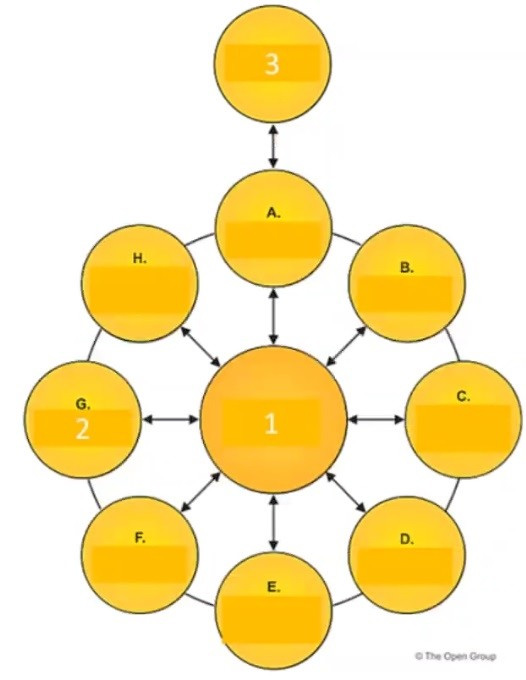 Consider the illustration showing an architecture development cycle Which description matches the phase of the ADM labeled as item 1?
-
A
Conducts implementation planning for the architecture defined in previous phases
-
B
Provides architectural oversight for the implementation
-
C
Operates the process of managing architecture requirements
-
D
Establishes procedures for managing change to the new architecture
Reveal answer details
Close answer details
Correct answerC
ExplanationItem 1 occupies the center of the ADM cycle and connects with every development phase, matching Requirements Management. This central process identifies, stores, analyzes, and tracks architecture requirements as phase outputs create new requirements or change existing ones. It therefore operates the process of managing requirements continuously rather than representing one implementation phase.
Question 26
Single choice
Domain gaps have been identified, and the organization now needs feasible increments between the current and target states. Which work is performed in Phase E?
-
A
Finalize project priorities by assessing value, cost, risk, and resources.
-
B
Group changes into work packages, identify transitions, and form an initial roadmap.
-
C
Monitor operational changes and decide whether to start a new ADM cycle.
-
D
Assess implementation conformity and resolve deviations from the approved architecture.
Reveal answer details
Close answer details
Correct answerB
ExplanationPhase E turns identified domain gaps and candidate changes into an implementable direction. It groups related changes into work packages, identifies useful intermediate Transition Architectures, and assembles an initial roadmap showing how movement toward the target can be staged. Phase F subsequently evaluates and prioritizes that material to finalize migration planning.
Question 27
Single choice
Which statement best summarizes the TOGAF Content Framework?
-
A
It shows the detailed relationships and interactions between information entities.
-
B
It is fixed and should not be changed or modified.
-
C
It is organized based on the phases of ADM.
-
D
It provides lifecycle management capabilities to create and manage architectures.
Reveal answer details
Close answer details
Correct answerA
ExplanationThe TOGAF Content Framework supplies a structured metamodel for architecture content. It identifies the information entities used in architecture work and shows their detailed relationships and interactions, enabling consistent organization of artifacts and deliverables. It is configurable rather than fixed, is not merely arranged by ADM phase, and does not itself provide repository lifecycle-management capabilities.
Question 28
Single choice
Consider the following ADM phases objectives. 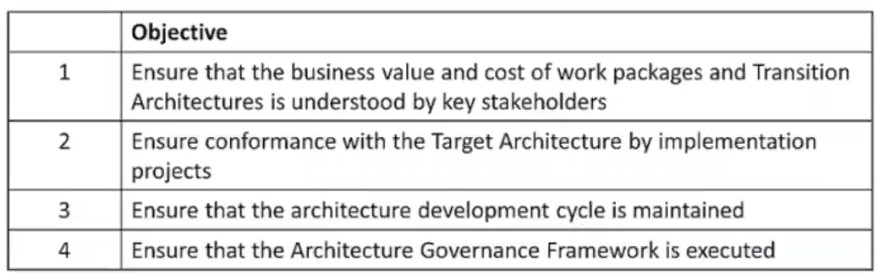 Which phase does each objective match?
-
A
-
B
-
C
-
D
Reveal answer details
Close answer details
Correct answerC
ExplanationUnderstanding the value and cost of work packages and Transition Architectures is a Phase F planning concern. Ensuring implementation projects conform to the Target Architecture belongs to Phase G. Maintaining the architecture development cycle and ensuring execution of the Architecture Governance Framework are both Phase H responsibilities. The complete mapping is 1F, 2G, 3H, and 4H.
|