What process turns a set of business capabilities into a structure that communicates the right amount of detail to different stakeholder groups?
-
A
-
B
-
C
-
D
Reveal answer details
Close answer details
Correct answerA
ExplanationLayering arranges capabilities at different levels of detail. A high layer can communicate a concise enterprise-wide view to senior stakeholders, while lower layers progressively expose more specific capabilities for audiences that need operational detail. The same capability structure can therefore support several stakeholder perspectives without losing its hierarchy.
When developing a Business Architecture, which of the following is recommended if an enterprise has existing Architecture Descriptions?
-
A
They should be reviewed, and work packages identified for portfolio planning.
-
B
They should be added to the Governance Repository within the Architecture Repository.
-
C
They should be used as the basis for the Baseline Description.
-
D
They should be used to validate the business principles.
Reveal answer details
Close answer details
Correct answerC
ExplanationExisting Architecture Descriptions contain knowledge of the current enterprise and should be reused as the basis for the Baseline Description. The architect reviews and adapts that material to the scope and required level of detail, avoiding unnecessary reconstruction while still producing a fit baseline for comparison.
"Manage Customer Relationships" has been decomposed into Receive Inquiry, Validate Request, Resolve Request, and Close Request. Why is this decomposition weak?
-
A
Child capabilities must be named for the departments that own them
-
B
The children are workflow steps rather than decomposed abilities
-
C
Every individual task must be added before the capability can be analyzed
-
D
The children should be reordered alphabetically to remove process sequence
Reveal answer details
Close answer details
Correct answerB
ExplanationA capability describes a stable ability the business possesses, independent of the order in which work occurs. Receive, Validate, Resolve, and Close describe sequential workflow steps, so they decompose a process rather than the ability to manage customer relationships. A sound capability decomposition would identify subordinate abilities, not task sequence or departmental ownership.
Complete the sentence. The four dimensions used to scope an architecture are:
-
A
Breadth, Depth, Time Period, Architecture Domains
-
B
Business, Data, Application, Technology
-
C
Strategy, Portfolio, Project, Solution Delivery
-
D
Strategy, Segment, Capability, Budget
Reveal answer details
Close answer details
Correct answerA
ExplanationArchitecture scope is framed by breadth, depth, time period, and architecture domains. Breadth determines the organizational extent, depth determines the required level of detail, time period establishes the planning horizon, and the domain dimension identifies which of the Business, Data, Application, and Technology areas are covered.
Which of the following best describes information mapping?
-
A
A technique to represent business information assets in use, or planned by the enterprise.
-
B
A technique to create a maturity model for information management.
-
C
A technique to construct a baseline description of the structure and interaction of information assets that support key business functions.
-
D
A technique to construct a high level description of the informational requirements of a business.
Reveal answer details
Close answer details
Correct answerA
ExplanationInformation mapping represents the business information assets that the enterprise currently uses or plans to use. It provides a business-oriented view of important information and its relationships without being limited to a maturity assessment or only a baseline technical structure supporting selected functions.
Which ADM Phases match the following purpose descriptions? 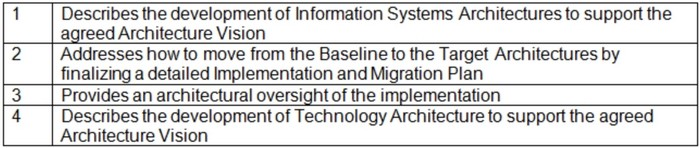
-
A
1 Phase D - 2 Phase B - 3 Phase G - 4 Phase A
-
B
1 Phase C - 2 Phase E - 1 Phase H - 4 Phase C
-
C
1 Phase C - 2 Phase F - 3 Phase H - 4 Phase B
-
D
1 Phase C - 2 Phase F - 3 Phase G- 4 Phase D
Reveal answer details
Close answer details
Correct answerD
ExplanationDescription 1 is Phase C because it develops Information Systems Architectures. Description 2 is Phase F because it finalizes the Implementation and Migration Plan. Description 3 is Phase G because it provides implementation oversight, while description 4 is Phase D because it develops the Technology Architecture.
Which of the following best describes a TOGAF business scenario?
-
A
-
B
A technique to elaborate an architecture effort.
-
C
A method to develop a business model.
-
D
A use-case providing detailed descriptions.
Reveal answer details
Close answer details
Correct answerB
ExplanationA TOGAF business scenario is a technique for elaborating an architecture effort. It develops a structured understanding of the business problem, operating environment, actors, desired outcomes, and resulting requirements. That information sharpens the architecture work rather than serving merely as a business case or detailed use-case.
Which of the following is guidance for creating value streams?
-
A
Start with customer-based value streams.
-
B
Identify the top-level value streams from components of capabilities.
-
C
Create an initial set of value streams that map one-to-one to existing capabilities.
-
D
Include operational levels of detail.
Reveal answer details
Close answer details
Correct answerA
ExplanationValue streams should begin with the value experienced by the customer rather than with the organization's existing internal structure. Starting with customer-based value streams preserves an end-to-end value perspective. Deriving them one-to-one from current capabilities would make the model reflect internal organization instead.
Which of the following best describes the relationship between business models and business architecture?
-
A
Business Architecture provides a conceptual summary view, whereas business models support in-depth analysis.
-
B
Business Architecture breaks a business model down into the core functional elements that describe how the business works.
-
C
Business models are useful for impact analysis, however Business Architecture is needed for scenario analysis.
-
D
Business model development is a prerequisite for a Business Architecture development.
Reveal answer details
Close answer details
Correct answerB
ExplanationA business model supplies a high-level rationale for how the business creates, delivers, and captures value. Business Architecture expands that view by breaking it into core functional elements, such as capabilities, value streams, organization, and information, that explain how the business works in a structured form.
Question 10
Single choice
Which statement best describes iteration and the ADM?
-
A
The ADM is sequential. Iteration is applied within phases.
-
B
The ADM is iterative between phases B to D, and between Phases E and F.
-
C
The ADM is iterative, over the whole process, between phases, and within phases.
-
D
The level of detail is defined once and applies to all iterations.
Reveal answer details
Close answer details
Correct answerC
ExplanationIteration in the ADM is not limited to one group of phases or to activity inside a phase. It can occur across the whole architecture development process, between phases as findings cause earlier or later work to be revisited, and within an individual phase as its outputs are refined.
Question 11
Single choice
What are the following activities part of?
- Initial risk assessment
- Risk mitigation and residual risk assessment
- Risk monitoring
-
A
-
B
-
C
-
D
Reveal answer details
Close answer details
Correct answerC
ExplanationRisk Management is a continuing cycle rather than a single assessment event. It begins by identifying and assessing risk, applies mitigation where needed, evaluates the residual risk that remains after treatment, and monitors risk as conditions change. The listed activities collectively describe that complete management cycle.
Question 12
Single choice
Which of the following best describes "value" in the context of Business Architecture?
-
A
The benefit of something.
-
B
A numerical quantity assigned to something.
-
C
The monetary worth of something.
-
D
The market price of something.
Reveal answer details
Close answer details
Correct answerA
ExplanationIn Business Architecture, value is the benefit, usefulness, or importance of something to a stakeholder. It is broader than financial valuation: a result can deliver value through improved service, reduced risk, convenience, or another desired outcome even when no numerical amount, market price, or monetary worth is assigned.
Question 13
Single choice
Consider the following extract of a model showing relationships between Business Architecture concepts: 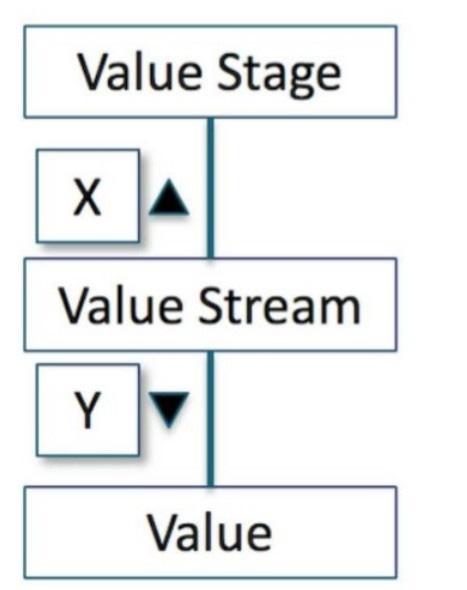 What is the relationship labeled X?
-
A
-
B
-
C
-
D
Reveal answer details
Close answer details
Correct answerB
ExplanationThe upward relationship connects Value Stream to Value Stage as a whole-to-part structure. A value stream consists of value stages, with each stage representing a meaningful step toward the value delivered to a stakeholder. The relationship is therefore "Consists of", not an exchange or creation relationship.
Question 14
Single choice
Consider the following Business Capability Example: 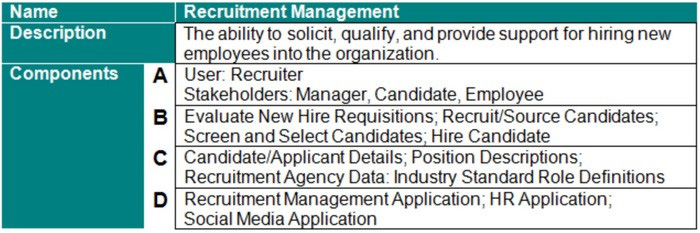 Which of the following are A and C?
-
A
-
B
-
C
-
D
Reveal answer details
Close answer details
Correct answerC
ExplanationComponent A lists the recruiter, manager, candidate, and employee, which identify the roles involved in Recruitment Management. Component C lists candidate details, position descriptions, agency data, and role definitions, which are information used or produced by the capability. Thus A is Roles and C is Information.
Question 15
Single choice
Which of the following best describes a business model?
-
A
A visual model for business process management.
-
B
A representation of business assets in use.
-
C
A description of the structure and interaction of business applications.
-
D
A high-level visual representation of the design of a business.
Reveal answer details
Close answer details
Correct answerD
ExplanationA business model gives a high-level visual representation of how a business is designed. It communicates the major elements through which the organization creates, delivers, and captures value. It is broader than a process model, an application interaction description, or an inventory of assets currently in use.
Question 16
Single choice
Consider the statement.
"It provides a sufficient view of the organization to manage complexity, support continuous change, and manage the risk of unanticipated consequences.' What concept does this describe?
-
A
-
B
-
C
-
D
A Business Capability Map
Reveal answer details
Close answer details
Correct answerA
ExplanationEnterprise Architecture provides a coherent description of the organization and the relationships among its important elements. That sufficient enterprise-wide view makes complexity manageable, supports coordinated continuous change, and reveals dependencies that could otherwise produce unanticipated consequences. A single map or metamodel covers only part of that purpose.
Question 17
Single choice
Requirements workshops are producing disconnected feature requests with no agreed business context. What is the best use of a business scenario?
-
A
Demonstrate a selected solution so stakeholders can approve its existing feature list
-
B
Test requirements through the scenario's need, participants, interactions, and outcomes
-
C
Create a fictional narrative that makes the requirements presentation more engaging
-
D
Record every requested feature without testing whether it contributes to the business need
Reveal answer details
Close answer details
Correct answerB
ExplanationA business scenario supplies the missing business context by linking a need to participants, their interactions, constraints, and intended outcomes. Testing each requirement against that structure reveals whether it contributes to the business result and exposes omissions or conflicts. It is not merely a narrative or a device for approving an existing feature list.
Question 18
Single choice
Which of the following best describes the purpose of Business Scenarios?
-
A
To guide decision making throughout the enterprise
-
B
To identify risk when implementing an architecture project
-
C
To catch errors in a project architecture early
-
D
To identify and understand requirements
Reveal answer details
Close answer details
Correct answerD
ExplanationBusiness Scenarios place a business problem in context by describing the need, relevant participants, interactions, constraints, and desired outcomes. Working through those elements helps stakeholders and architects identify requirements and understand why they are needed. The technique is therefore requirements-focused rather than a governance or risk-control mechanism.
Question 19
Single choice
Which of the following is a benefit of Value Stream Mapping?
-
A
It helps to identify value, duplication, and redundancy across the enterprise.
-
B
It helps to assess an organization's effectiveness at creating, capturing, and delivering value for different stakeholders.
-
C
It helps to ensure that investments and project initiatives are prioritized and funded at a level matching with their value.
-
D
It highlights the value of individual work packages needed to develop the business architecture.
Reveal answer details
Close answer details
Correct answerB
ExplanationValue Stream Mapping follows value creation, capture, and delivery across an end-to-end sequence of stages. Examining those stages reveals how effectively the organization produces value for different stakeholders. Its primary benefit is this assessment of value delivery effectiveness, not the valuation of individual work packages.
Question 20
Single choice
A service scenario includes a customer submitting a request, a portal validating fields, and an agent resolving exceptions. How should participation be modeled?
-
A
Model only the customer and agent because automated systems cannot be actors
-
B
Model all three as actors and state each contextual role and responsibility separately
-
C
Model customer, portal, and agent as roles that are identical to their named performers
-
D
List the three participant names without specifying what each is responsible for
Reveal answer details
Close answer details
Correct answerB
ExplanationParticipation includes each entity that performs behavior in the scenario: the customer submits, the portal validates, and the agent resolves exceptions. Each is therefore modeled as an actor. Their contextual roles and responsibilities must be stated separately because an actor identifies the performer, while a role describes how that performer participates in a particular context.
Question 21
Single choice
A roadmap item cannot be linked to a business goal, architecture requirement, affected business element, or identified gap. What does this indicate?
-
A
The item is justified once it appears on an approved roadmap
-
B
The item needs only a cost estimate because goals are outside architecture scope
-
C
Traceability is complete if the related requirement was approved at some earlier point
-
D
Traceability is incomplete, so justification and impact analysis are unreliable
Reveal answer details
Close answer details
Correct answerD
ExplanationA roadmap item needs traceable links to the goal it advances, the requirement it satisfies, the business elements it affects, or the gap it closes. Without those links, traceability is incomplete. Its justification cannot be demonstrated, and impact analysis cannot reliably determine why the item is needed or what would be affected by changing it.
Question 22
Single choice
What criteria for a good architecture principle Indicates that it is sufficiently definitive and precise to support consistent decision-making in complex situations?
-
A
-
B
-
C
-
D
Reveal answer details
Close answer details
Correct answerD
ExplanationRobustness means a principle is sufficiently definitive and precise to guide consistent decisions even in complex or disputed situations. A robust principle minimizes conflicting interpretations and remains useful when applied to practical choices. Completeness concerns coverage, consistency concerns compatibility, and stability concerns endurance over time.
Question 23
Single choice
Complete the following sentence: Presenting different ____ and ____ to stakeholders helps architects to extract hidden agendas, principles, and requirements that could impact the final Target Architecture.
-
A
Architecture Views, Architecture Viewpoints
-
B
Business Scenarios, Business Models
-
C
-
D
Reveal answer details
Close answer details
Correct answerD
ExplanationHidden concerns emerge when stakeholders must choose between alternatives and confront the associated trade-offs. Alternatives reveal which direction they prefer, while trade-offs reveal what benefits, costs, risks, or constraints they are willing to accept. That discussion surfaces agendas, principles, and requirements that can materially shape the final Target Architecture.
Question 24
Single choice
Which of the following is a benefit of information mapping?
-
A
It enables improved business process integration.
-
B
It provides a framework for effective business requirements analysis.
-
C
It highlights information requirements not addressed by a business architecture.
-
D
It provides a basis to support decision-making throughout the business.
Reveal answer details
Close answer details
Correct answerC
ExplanationInformation mapping relates the information needed by the business to the architecture elements that create, use, or manage it. Comparing those needs with the business architecture exposes information requirements for which no architectural support has been defined. Those gaps can then be addressed in subsequent architecture work.
|