In which pan of a business scenario are business capabilities and value streams modelled?
-
A
When identifying and documenting desired outcomes
-
B
When identifying the business and technology environment
-
C
When identifying the human actors
-
D
When identifying, documenting and ranking the problem
Reveal answer details
Close answer details
Correct answerB
ExplanationExplanation: This answer is based on the TOGAF Standard, Version 9.2 - Business Scenarios , which states that "The business and technology environment is a description of the current situation in terms of
business processes (including business capabilities), people (including skills), information (including data), applications (including software), infrastructure (including hardware), and governance (including standards)." Business capabilities and value streams are modeled when identifying the business and technology environment, as they provide a high-level view of what the business does or can do, and how it delivers value to its stakeholders. The other options are not correct, as they are not parts of a business scenario where business capabilities and value streams are modeled.
Consider the following table of techniques used w decompose a business architecture: 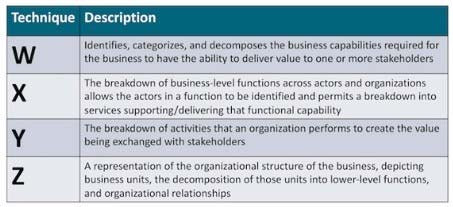 What is the technique marked W?
-
A
-
B
-
C
-
D
Business Capability Mapping
Reveal answer details
Close answer details
Correct answerD
ExplanationExplanation: This answer is based on the definition of business capability mapping as "a technique for the representation of an organization's business anchor model, independent of the organization's structure, processes, people, or domains" . Business capability mapping identifies, categorizes, and decomposes the business capabilities required for the business to have the ability to deliver value to one or more stakeholders. The other options are not correct, as they do not match the description of the technique marked W.
Consider the following business capability model. there cells of a model are given different colors to
represent desired maturity levels (Green (G)- level achieved, yellow (Y) =one level away, red (R) -two
more more levels away, purple (P)=missing capability): 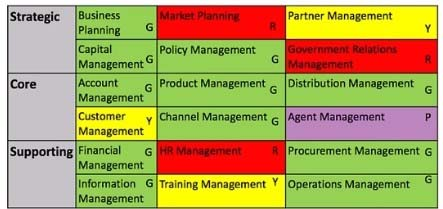 Which of the following best describes what this model shows?
-
A
Policy Management. Government Relations Management, and HR Management need immediate attention. Partner Management, Account Management, and Training Management have issues but are of tower priority. Agent Management is o now business capability that Goes not exist.
-
B
Market Planning. Government Relations Management and HR Management need immediate attention.
Partner Management, Customer Management, and Training Management have issues but are of lower priority.
Agent Management is a new business capabilitythat does not exist.
-
C
Customer Management, Training Management and Partner Management need immediate attention.
Market Planning. HR Management and Government Relations Management need attention. Agent Management exists as a new Corecapabilitybut has not yet been assessed.
-
D
The Strategic capabilities need more attention in three areas Market Planning, Government Relations Management, and Partner Management. Agent Management Is missing as a Coro capability. Training Management needs the most attention as a Supporting Capability.
Reveal answer details
Close answer details
Correct answerC
ExplanationExplanation: This answer is based on the color-coding of the business capability model, which indicates the desired maturity levels of each capability. Red cells mean that the capability is two or more levels away from the desired maturity level, yellow cells mean that the capability is one level away, green cells mean that the capability has achieved the desired maturity level, and purple cells mean that the capability is missing or not defined. According to this logic, the capabilities that need immediate attention are those that are red, which are Customer Management, Training Management and Partner Management. The capabilities that need attention are those that are yellow, which are Market Planning, HR Management and Government Relations Management. The capability that is missing as a Core capability is Agent Management, which ispurple. The rest of the capabilities are green, which means they have reached the desired maturity level.
Which of the following best describes what a business model is?
-
A
The rationale for how an organization, creates, deliveries and captures value.
-
B
The description of the structure and interaction of applications that provide Key business functions.
-
C
The representation of business assets in use, or planned by the enterprise.
-
D
A maturity model tor IT process management, continuous improvement and best practices.
Reveal answer details
Close answer details
Correct answerA
ExplanationExplanation: A business model is a plan that describes how a business intends to make money by providing value to its customers or clients. It defines the value proposition, the target market, the revenue streams, and the cost structure of the business. According to Investopedia 1, a business model is "a company's plan for making a profit. It identifies the products or services the business plans to sell, its identified target market, and any anticipated expenses
What fundamental business architecture concepts should be considered when creating an Architecture Vision?
-
A
Business use-cases, event diagrams, class models
-
B
Business capabilities. organization maps, value streams
-
C
Business data model, business roles, business processes
-
D
Information exchange matrix, class models, node connectivity diagrams
Reveal answer details
Close answer details
Correct answerB
ExplanationExplanation: This answer is based on the TOGAF Series Guide: Business Capabilities , which states that "The fundamental concepts that should be considered when creating an Architecture Vision are business capabilities, organization maps, and value streams." These concepts help to define and communicate the essence of what a business does or can do, how it is organized and structured, and how it delivers value to its stakeholders. The other options are not correct, as they are not fundamental business architecture concepts that should be considered when creating an Architecture Vision.
|