Scenario Please read this scenario prior to answering the Question You are serving as the Lead Architect for the enterprise architecture team at a multinational company. The company has grown rapidly by acquisition and has inherited numerous supply chain processes and related IT systems. Several supply chain processes have had problems related to the timing of purchases, which has led to excess inventory. The Vice President in charge of Supply Chain Management has made the decision to consolidate and reduce redundant processes and systems. The company will move to a "Just-in-time" supply chain management system so as to keep inventory costs low. The TOGAF standard is used for internal Enterprise Architecture activities. This project is using an iterative approach for executing the Architecture Development Method (ADM). At present, there are no particularly useful architectural assets in the Architecture Repository related to this initiative. All assets will need to be acquired, customized, or created.The company prefers to implement commercial off the shelf package applications with little customization. The CIO, who is the project sponsor, has stated that she is not concerned about preserving the existing supply chain management processes or systems. The architecture development project has completed Phase A and has started a number of iteration cycles to develop the Architecture. As a packaged application is being considered, the next iteration will include both the Business, Application and Data Architectures. Key stakeholder concerns that should be addressed by these architectures include: 1. What groups of people should be involved in supply chain management-related business processes? 2. What non-supply chain management applications will need to be integrated with the new supply chain management applications? 3. What data will need to be shared? Refer to the Scenario [Note: You may need to refer to Chapter 35 of the reference text in order to answer this question.] You have been asked to identify the most appropriate catalogs, matrices, and diagrams to support the next iteration of Architecture development. Based on TOGAF, which of the following is the best answer?
-
A
In the next iteration of Architecture development, you would describe the Baseline Business Architecture with a Value Chain diagram and a Baseline Business Process catalog. You would describe the Baseline Data Architecture with a Data diagram. You would describe the Baseline Application Architecture with an Environment and Location diagram.
-
B
In the next iteration of Architecture development, you would describe the Target Business Architecture with an Organization/Actor catalog, a Business Service/Function catalog and Data Lifecycle diagrams.
You would describe the Target Application Architecture with an Application Interaction matrix and Application Communications diagrams.
-
C
You would describe the Baseline Business Architecture with a Business Service/Function catalog, an Organization/Actor catalog and a Data Entity/Business Function matrix. You would describe the Baseline Data Architecture using a Data Entity/Data Component catalog. You would describe the Baseline Application Architecture with an Application/Function matrix.
-
D
You would describe the Target Business Architecture with a Business Service/Function catalog, and a Business Interaction matrix. You would describe the Target Data Architecture with a Data Entity/
Business Function matrix and an Application/Data matrix.
You would describe the Target Application Architecture with Application Communication diagrams and an Application Interaction matrix.
Reveal answer details
Close answer details
Correct answerB
ExplanationThe sponsor does not want to preserve existing processes or systems, reusable assets are absent, and a minimally customized package is preferred, so the next iteration should concentrate on the target. Organization/Actor and Business Service/Function catalogs identify participants and activities, Data Lifecycle diagrams cover shared information over time, and the Application Interaction matrix and communication diagrams describe required integrations.
Which of the following best describes TOGAF?
-
A
An abstract framework for the development of standards and processes for a business architecture
-
B
A collection of components organized to accomplish a specific set of functions
-
C
A process model, best practices and assets to aid production, use and maintenance of enterprise architectures
-
D
A reference model containing taxonomy defining terminology for an enterprise architecture, together with an associated graphic
-
E
A system development lifecycle method for software engineering
Reveal answer details
Close answer details
Correct answerC
ExplanationTOGAF supports enterprise architecture as a complete working framework rather than as one model or a software development lifecycle. It combines a process model with best practices and reusable assets that aid the production, use, and maintenance of enterprise architectures. This breadth covers both developing architecture and sustaining it as an organizational capability.
Complete the sentence. According to TOGAF, all the following are responsibilities of an Architecture Board, except ______________________.
-
A
Allocating resources for architecture projects
-
B
Decision making for changes in the architecture
-
C
Enforcing Architecture Compliance
-
D
Improving the maturity of the organization's architecture discipline
-
E
Production of governance materials
Reveal answer details
Close answer details
Correct answerA
ExplanationThe Architecture Board governs architecture through decisions, compliance enforcement, governance materials, and improvement of the architecture discipline. Allocating resources for architecture projects is a management and sponsorship responsibility rather than an architecture governance responsibility of the board. It is therefore the activity excluded from the board's listed duties.
Complete the sentence. The Standards Information Base is a repository area that ___________.
-
A
defines the parameters, structures, and processes to support governance of the Architecture Repository
-
B
describes the organization specific architecture framework and method
-
C
lists the set of specifications to which architectures must conform
-
D
provides a record of the governance activity across the enterprise
-
E
provides guidelines, templates, and patterns used to create new architectures
Reveal answer details
Close answer details
Correct answerC
ExplanationThe Standards Information Base lists the specifications and standards with which architectures must conform. This makes it the repository area used to identify applicable technical and organizational requirements. Governance records, framework descriptions, and reusable guidelines belong to other areas of the Architecture Repository.
Complete the sentence. In the TOGAF Architecture Content Framework, an artifact that is a list of things is known as a _________________.
-
A
-
B
-
C
-
D
-
E
Reveal answer details
Close answer details
Correct answerC
ExplanationWithin the Architecture Content Framework, a catalog is the artifact form used for a list of things, such as a structured inventory of relevant entities. A matrix emphasizes relationships between listed items, while a diagram presents information graphically. A deliverable is a reviewed package of work products and may contain catalogs, matrices, and diagrams.
In which ADM phase are the business principles, business goals and strategic drivers first validated?
-
A
-
B
-
C
-
D
-
E
Requirements Management Phase
Reveal answer details
Close answer details
Correct answerB
ExplanationPhase A develops the Architecture Vision and aligns the proposed architecture effort with enterprise direction. As part of establishing that alignment, it first validates the business principles, business goals, and strategic drivers that will guide the cycle. The Preliminary Phase establishes the broader capability and framework.
Complete the sentence. According to the TOGAF standard, an ___________ is a representation of a system from the perspective of a related set of _______________.
-
A
architecture view, stakeholders
-
B
architecture viewpoint, stakeholders
-
C
architecture viewpoint, architecture views
-
D
architecture view, requirements
-
E
architecture view, concerns
Reveal answer details
Close answer details
Correct answerE
ExplanationAn architecture view is the representation of a system produced to address a related set of concerns. A viewpoint supplies the conventions for constructing and using such a view; it is not the resulting representation. Stakeholders hold the concerns, but the definition relates the representation directly to the concerns being addressed.
Scenario: Please read this scenario prior to answering the question Your role is that of a consultant to the Lead Enterprise Architect in a company that speicializes in luxury electric cars and their powertrain components, and also produces battery-charging equipment. It has its own distribution network, its own showrooms, and sells directly to customers via the internet. The company has four manufacturing facilities, two in the North America, one in Europe, and one in Asia. A challenge that the company is facing to scale up the number of vehicles coming off the production line to meed customer demand, while maintaining quality. At the moment there are supply chain storages for key electronic components related to the autonomous drive system. In response the this, the research arm of the company has pioneered the development of a new self-driving platform. This new design uses common off-the-shelf components that will allow for a significant increase in overall vehicle production.
This new design is ready to go into production. The company has a mature Enterprise Architecture practice that is supported by a cross-functional Architecture Board. The TOGAF standard is used for developing the automated manufacturing process and systems used to design, manufacture and test the new design. The Chief Information Officer and the Chief Operating Officer co-sponsor the Enterprise Architecture program. As part of putting the new self-driving platform into production, adjustments to the automated assembly processes need to be made. A pilot architecture project at a single location has defined an updated approach for controlling the automated test systems used to perform final quality assurance. The Chief Engineer, sponsor of the activity, and the Architecture Board have approved the plan for immediate implementation at each plant. Architecture Contracts have been developed that detail the work needed to implement and deploy the new automated test system controller for each location. The Chief Engineer has expressed concern that a uniform process be employed at each location to ensure consistency and quality. Refer to the Scenario The Lead Enterprise Architect has asked you to recommend the best approach to address the Chief Engineer's concern. Based on the TOGAF standard, which of the following is the best answer?
-
A
You create an Architecture Contract to manage and govern the implementation and migration process.
If the contract is issued to an external party, you ensure that it is a fully enforceable legal contract. For internal development projects, you decide it is adequate to utilize a memorandum of understanding between the Architecture Board and the implementation organization.You recommend that if a deviation from the Architecture Contract is detected, the Architecture Board grant a dispensation to allow the implementation organization the ability to customize the process to meet their local needs.
-
B
You use the Architecture Contracts to manage the architecture governance processes for the project across the locations. You deploy monitoring tools to assess the performance of each completed drive assembly at each location and develop change requirements if necessary.You recommend that if a deviation from the contract is detected, the Architecture Board should modify the Architecture Contract to allow the implementation organization the ability to customize the process to meet their local needs.
As a result, you then issue a new Request for Architecture Work to implement the modified Architecture Definition.
-
C
You create an Architecture Contract to manage and govern the implementation and migration process at each location. For internal development projects, you issue a memorandum of understanding between the Architecture Board and the implementation organization. For contracts issued to an external party, you ensure that it is a fully enforceable legal contract.You ensure that the Architecture Board reviews all deviations from the Architecture Contract, and considers whether or not to grant a dispensation to allow the implementation organization to customize the process to meet their local needs.
-
D
You review the applicable Architecture Contract for each location, ensuring that it addresses the project objectives, effectiveness metrics, acceptance criteria, and risk management. In cases where the contract is issued to an external party, you ensure that it is a legally enforceable contract.You schedule compliance reviews at key points in the implementation process to ensure that the work is proceeding in accordance with the Architecture Definition. You ensure that the Architecture Board reviews all deviations from the Architecture Contract, and considers whether or not to grant a dispensation to allow the implementation organization to customize the process to meet their local needs.
Reveal answer details
Close answer details
Correct answerD
ExplanationThe contracts are already in place, so consistent deployment requires active governance rather than creating replacements. Review each applicable contract for objectives, effectiveness metrics, acceptance criteria, and risk management. Compliance reviews at key implementation points verify adherence to the Architecture Definition, and the Architecture Board must review deviations before deciding whether to grant a dispensation.
Within the Architecture Continuum, which of the following consists of generic components inter-relationships principles and guidelines?
-
A
Organization-Specific Architecture
-
B
-
C
-
D
Common Systems Architecture
-
E
Reveal answer details
Close answer details
Correct answerE
ExplanationFoundation Architecture occupies the most generic end of the Architecture Continuum. It provides broadly applicable components, their inter-relationships, principles, and guidelines that can be specialized for narrower contexts. Common Systems, Industry, and Organization-Specific Architectures progressively tailor architecture content for shared systems, a sector, or one enterprise.
Question 10
Single choice
Within the Architecture Repository, what does the class of information knows as the Architecture Capability include?
-
A
The organization specific architecture framework, including a method for architecture development and a metamodel for architecture content
-
B
A record of the governance activity across the enterprise
-
C
Parameters, structures, and processes to support governance of the repository
-
D
Specifications to which architecture must conform
-
E
Patterns, templates, and guidelines used to create new architectures.
Reveal answer details
Close answer details
Correct answerC
ExplanationArchitecture Capability concerns the arrangements that enable architecture work to be governed and sustained. Within the Architecture Repository, this includes the parameters, organizational structures, and processes used to support governance of the repository, rather than the architecture standards, reusable guidance, or governance history stored elsewhere.
Question 11
Single choice
Which of the following is an objective of Phase G, Implementation Governance?
-
A
Ensure that the enterprise's Architecture Capability meets current requirements
-
B
Establish the value realization process
-
C
Ensure that implementation projects conform with the Target Architecture
-
D
Prioritize the projects trough risk validation
-
E
Assess the performance of the architecture and make recommendation for change
Reveal answer details
Close answer details
Correct answerC
ExplanationPhase G provides Implementation Governance after the target architecture and migration direction have been defined. Its objective is to ensure that implementation projects conform with the Target Architecture, using governance to keep delivered solutions aligned with approved architectural direction. Assessing the architecture for later change belongs to ongoing change management rather than this implementation focus.
Question 12
Single choice
Scenario: Please read this scenario prior to answering the question The ABC company is the prime contractor for the Telesto Unmanned Spacecraft program. Over the course of this contract, the company has grown rapidly by acquisition and has inherited numerous different procurement processes and related IT systems. The company is moving aggressively to consolidate and reduce redundant procurement processes and systems. The CEO has announced that the company will seek to leverage higher volume discounts and lower related IT support costs by instituting a preferred supplier program. To achieve this goal, the company needs to define Baseline and Target Architectures. These architectures must address key stakeholders' concerns such as: 1. What groups of people should be involved in procurement-related business processes? 2. What current applications do those groups use? 3. Which procurement-related business processes are supported by zero, one, or many existing applications? 4. What are the overall lifetimes of the Request for Proposal and Purchase Order business objects? What non-procurement applications will need to be integrated with any new procurement applications? 5. What data will need to be shared? At present, there are no particularly useful architectural assets related to this initiative, so all assets need to be acquired and customized or created from scratch. The company prefers to implement existing package applications from systems vendors with little customization. The architecture development project has just completed its Architecture Context iteration cycle and is about to begin the Architecture Definition iteration cycle. The company is using TOGAF for its internal Enterprise Architecture activities. It uses an iterative approach for executing Architecture Development Method (ADM) projects. The architecture development project has just completed its Architecture Context iteration cycle and is about to begin the Architecture Definition iteration cycle. Refer to the Scenario. You are serving as the Lead Architect. You have been asked to identify the most appropriate architecture viewpoints for this situation. Based on TOGAF 9, which of the following is the best answer?
-
A
In the early iterations of the Architecture Definition:Describe the Baseline Business Architecture with a Baseline Business Process catalogDescribe the Baseline Application Architecture with a Technology Portfolio catalogDescribe the Baseline Data Architecture with a Data diagramIn the later iterations of the Architecture Definition:Describe the Target Business Architecture with an Actor/Process/Data catalogDescribe the Target Application Architecture with a System/ Technology matrixDescribe the Target Data Architecture with a Data Dissemination diagram
-
B
In the early iterations of the Architecture Definition:Describe the Target Business Architecture with a Business Service/Function catalog and a Business Interaction matrixDescribe the key business objects with Product Lifecycle diagramsDescribe the Target Application Architecture with Application Communication diagrams and an Application Interaction matrixDescribe the Target Data Architecture with a Data Entity/business Function matrix and a System/Data matrixIn the later iterations of the Architecture Definition:Describe the Baseline Business Architecture with a Business Service/Function catalog and a Business Interaction matrixDescribe the Baseline Application Architecture with a System/
Organization matrix and a System/function matrixDescribe the Baseline Data Architecture with a Data Entity/Data Component catalog
-
C
In the early iterations of the Architecture Definition:Describe the Target Business Architecture with a Business Service/Function catalog and an Organization/Actor catalogDescribe the key business objects with Data Lifecycle diagramsDescribe the Target Application Architecture with Application Communication diagrams and an Application Interaction matrixDescribe the Target Data Architecture with a System/Data matrixIn the later iterations of the Architecture Definition:Describe the Baseline Business Architecture with a Business Service/Function catalog and a Business Interaction matrixDescribe the Baseline Application Architecture with an Application and User Location diagram and a System/Function matrixDescribe the Baseline Data Architecture with a Data Entity/Data Component catalog
-
D
In the early iterations of the Architecture Definition:Describe the Baseline Business Architecture with an Organization/Actor catalogDescribe the Baseline Application Architecture with a System/Function matrixDescribe the Baseline Data Architecture using a Data Entity/Data Component catalogIn the later iterations of the Architecture Definition:Describe the Target Business Architecture with an Organization/
Actor catalogDescribe the Target Application Architecture using Application Communication diagrams and an Application Interaction matrixDescribe the Target Data Architecture with a System/Data matrix
Reveal answer details
Close answer details
Correct answerC
ExplanationBecause existing assets are not useful and packaged applications are preferred, early iterations should explore the target. Organization/Actor and Business Service/Function catalogs address participating people and processes; Data Lifecycle diagrams address business-object lifetimes; application communication and interaction views address integration; and the System/Data matrix addresses sharing. Later baseline views document existing users, locations, functions, and data components.
Question 13
Single choice
Complete the sentence. A gap analysis will enable the architect to do all of the following except _____.
-
A
identify building blocks that have been inadvertently omitted
-
B
identify building blocks that have been intentionally eliminated
-
C
identify building blocks to be carried over
-
D
identify new building blocks that are needed
-
E
identify potential vendors to provide new building blocks
Reveal answer details
Close answer details
Correct answerE
ExplanationGap analysis compares baseline and target building blocks to identify what is retained, removed, missing, or newly required. It can therefore expose both intentional and inadvertent differences between the two states. Selecting potential vendors is a sourcing activity performed after a need has been established; the comparison itself does not identify who should supply a new building block.
Question 14
Single choice
Scenario: Please read this scenario prior to answering the Question You are serving as the Lead Architect for the enterprise architecture team at the prime contractor for the Dreadnought Unmanned Aircraft System program. Over the course of this contract, the company has grown rapidly by acquisition and has inherited numerous different procurement processes and related IT systems. The decision has been made to consolidate and reduce redundant procurement processes and systems. The CEO has announced that the company will seek to leverage higher volume discounts and lower related IT support costs by instituting a preferred supplier program. TOGAF 9 Is used for internal Enterprise Architecture activities, with an iterative approach for executing Architecture Development Method (ADM) projects. At present, there are no particularly useful architectural assets related to this initiative, so all assets need to be acquired and customized or created from scratch. The company prefers to implement commercial off the shelf package applications with little customization. The CIO, who is the project sponsor, has stated that she is not concerned about preserving existing processes or systems. The architect-re development project has put in place Its Architecture Capability for this project and has started a number of iteration cycles to develop the Architecture. Some tasks to address concerns related to the Business Architecture have been completed. The next immediate task is to address the Information Systems Architectures. The Information Systems Architectures must address stakeholder concerns such as: 1. Which procurement-related business processes are supported by zero, one, or many existing applications? 2. What non-procurement applications will need to be integrated with any new procurement applications? 3. What data will need to be shared? Refer to the Scenario [Note: You may need to refer to TOGAF 9 Chapter 35 in order to answer this question.] You have been asked to identify the most appropriate catalogs, matrices, and diagrams for this situation. Based on TOGAF 9, which of the following is the best answer?
-
A
in the early iterations of Architecture development, you would describe the Baseline Application Architecture with a System/Function matrix, and describe the Baseline Data Architecture using a Data Entity/Data Component catalog. In the later Iterations of the Architecture Definition, you would describe the Target Application Architecture using Application Communication diagrams and an Application Interaction matrix, and describe the Target Data Architecture with a System/Data matrix.
-
B
In the early iterations of Architecture development, you would describe the Target Application Architecture with Application Communication diagrams and an Application Interaction matrix, and describe the Target Data Architecture with a System/Data matrix. In the later iterations of Architecture development, you would describe the Baseline Application Architecture with an Application and User Location diagram and a System/Function matrix, and describe the Baseline Data Architecture with a Data Entity/Data Component catalog.
-
C
In the early iterations of Architecture development, you would describe the Target Application Architecture with Application Communication diagrams and an Application Interaction matrix, and describe the Target Data Architecture with a Data Entity/Business Function matrix and a System/Data matrix. In the later iterations of Architecture development, you would describe the Baseline Application Architecture with a System/Function matrix, and describe the Baseline Data Architecture with a Data Entity/Data Component catalog.
-
D
In the early iterations of Architecture development, you would describe the Baseline Application Architecture with a Technology Portfolio catalog, and describe the Baseline Data Architecture with a Data diagram. In the later iterations of Architecture development, you would describe the Target Application Architecture with a System/Technology matrix, and describe the Target Data Architecture with a Data Dissemination diagram.
Reveal answer details
Close answer details
Correct answerC
ExplanationThe sponsor does not require preservation of existing systems, useful reusable assets are absent, and a minimally customized package is preferred. Early iterations should therefore describe target application communication and interaction, plus target data relationships through the Data Entity/Business Function and System/Data matrices. Later baseline views capture current system functions and data components needed for comparison and migration.
Question 15
Single choice
Scenario: Please read this scenario prior to answering the question The ABC company is an international agricultural company exporting bulbs, flowers and seeds worldwide.
It is headquartered in Rotterdam in the Netherlands, and has sales and distribution centers in over 60 countries worldwide. Several of these centers include administrative, manufacturing, and research facilities.
To achieve full integration of their research capabilities with their development centers located in various climate zones, the company wants to develop strong self-directed teams in each location. It also wants to define new business models that are profitable while reducing their impact on the environment. The management is deeply committed to ensuring that the company is a world leader in socially responsible seed development with a business strategy that focuses on profitability through environmentally friendly operating processes. The company international operations are subject to various legal and regulatory requirements. In areas such as genetically modified seeds, governmental controls are strictly enforced and compliance is critical.
Recently a competitor was heavily fined for violating the regulations in a country where it was developing pest-resistant seeds. The Governing Board is concerned, and as a result has approved the expenditure of resources to establish an Enterprise Architecture program. They have requested information about the status of projects that could impact regulatory compliance. They also want to enable the corporate legal staff and auditors to analyze proposed architectures to ensure that they are within the legal guidelines for a given location. In addition, the research organization should be able to see that the architecture is appropriate for its needs.
TOGAF 9 has been mandated as the guiding framework for the development and evolution of the Enterprise Architecture practice. Refer to the Scenario You have been appointed as the Lead Consultant. You have been asked to recommend an approach that would enable the development of an architecture that addresses the needs of all these parties. Based on TOGAF 9, which of the following is the best answer?
-
A
Depending on the nature of the architecture, a set of models should be created that can be used to ensure that the system will be compliant with the local regulations. Stakeholders should be able to view the models to see that their concerns have been properly addressed.
-
B
Each architecture activity should be developed using a consistent modeling approach that is uniform across all architecture projects. Each architecture should be defined based on this fixed set of models so that all concerned parties can examine the models to ensure that their issues and concerns have been addressed,
-
C
A stakeholder map should be developed that allows the architects to define groups of stakeholders sharing common concerns. A set of views should then be defined that addresses the concerns for each group-Architecture models can then be created for each view to address the stakeholders' concerns.
-
D
For those groups that have sufficient power and level of interest, a special report should be created that summarizes the key features of the architecture with respect to the particular location. Each of these reports should reflect the stakeholders' requirements.
Reveal answer details
Close answer details
Correct answerC
ExplanationThe parties have different responsibilities but overlapping concerns about legality, compliance, oversight, and research suitability. A stakeholder map first identifies and groups those sharing concerns. Views are then defined for each concern group, and appropriate architecture models populate each view. This preserves a common architecture while presenting relevant information to each audience.
Question 16
Single choice
An association of companies has defined a data model for sharing inventory and pricing information. Which of the following best describes where this model would fit in the Architecture Continuum?
-
A
-
B
Common Systems Architecture
-
C
-
D
Organization Specific Architecture
-
E
Product Line Architecture
Reveal answer details
Close answer details
Correct answerC
ExplanationA data model created by an association of companies captures concepts and exchange needs shared within a business sector. That sector-wide applicability places it in Industry Architecture. It is more specialized than a universal Foundation Architecture, yet it is not limited to one organization or merely to a common technical system used across unrelated industries.
Question 17
Single choice
Which section of the TOGAF template for Architecture Principles should highlight the business benefits for adhering to the principle?
-
A
-
B
-
C
-
D
Reveal answer details
Close answer details
Correct answerC
ExplanationThe Rationale section explains why an Architecture Principle is valuable and identifies the business benefits obtained by following it. The Statement expresses the rule itself, while Implications describe the practical consequences, resources, and changes associated with adopting the principle.
Question 18
Single choice
Which phase of the ADM ensures that implementation projects conform to the defined architecture?
-
A
-
B
-
C
-
D
-
E
Reveal answer details
Close answer details
Correct answerD
ExplanationPhase G is Implementation Governance, where implementation projects are governed against the defined architecture. Compliance reviews and Architecture Contracts help maintain conformance while solutions are delivered. Phase F plans migration, Phase D defines Technology Architecture, and Phase H manages changes after the architecture has been deployed.
Question 19
Single choice
Which of the following does TOGAF recommend for use in developing the Architecture Vision?
-
A
-
B
-
C
Business Transformation Readiness Assessment
-
D
Capability-based planning
-
E
Reveal answer details
Close answer details
Correct answerB
ExplanationBusiness scenarios help develop the Architecture Vision by clarifying the business problem, desired outcomes, environment, actors, and requirements. This creates a stakeholder-oriented account of what the proposed architecture must enable. The technique supports a coherent early vision before detailed domain architectures and migration planning are completed.
Question 20
Single choice
Which one of the following statements about TOGAF Building Blocks is true?
-
A
Building blocks at a functional level are known as Solutions Building Blocks
-
B
Solutions Building Blocks are selected in Phases A, B, C and D
-
C
The specification of a building block should be loosely coupled to its implementation
-
D
The gap analysis technique should be used to identify building blocks for re-use
Reveal answer details
Close answer details
Correct answerC
ExplanationA building block specification describes the required capability and interfaces without binding them unnecessarily to one realization. Keeping the specification loosely coupled to its implementation allows different implementations to satisfy the same architectural need and supports reuse. Functional building blocks are Architecture Building Blocks, while Solution Building Blocks represent implementations.
Question 21
Single choice
Scenario: Please read this scenario prior to answering the Question. The ABC Ltd. is a leading medical device manufacturer in the highly competitive market for Migraine Headache Pain Management (MHPM) devices. These tiny wireless devices are implanted in the brain and can deliver a precise electric shock when the wearable Pain Control Unit (PCU) detects an increase in stress induced by the onset of a migraine headache. This technology will be a breakthrough in the treatment of this condition, and several competitors are striving to be the first to introduce a product into the market. However, all of them must demonstrate the effectiveness and safety of their products in a set of clinical trials that will satisfy the regulatory requirements of the countries in the target markets. The Enterprise Architecture group at the company has been engaged in an architecture development project to create a secure networked collaboration system that will allow researchers at its product development laboratories worldwide to share information about their independent clinical trials. The Enterprise Architecture group is a mature organization that has been utilizing TOGAF for several years.
The company Architecture Development Method is strictly based on TOGAF 9 with extensions required to support current good manufacturing practices and good laboratory practices in their target markets. The project team has now completed the Business, Information Systems, and Technology Architecture phases and has produced a complete set of deliverables for each phase. Due to the highly sensitive nature of the information that is managed, special care was taken to ensure that each architecture domain included an examination of the security and privacy issues that are relevant for each domain. A corresponding Security Architecture has been defined. The Executive Vice President for Clinical Research is the sponsor of the Enterprise Architecture activity.
He has stated that the changes to the enterprise architecture for the new system will need to be rolled out on a geographic basis that will minimize disruptions to ongoing clinical trials. The work will need to be done in stages and rolled out in geographical regions. Refer to the Scenario You are serving as the Lead Architect for the project team. You have been asked to recommend the approach to identify the work packages that will be included in the Transition Architecture(s).
Based on TOGAF 9, which of the following is the best answer?
-
A
Create an Implementation Factor Assessment and Deduction Matrix and a Consolidated Gaps, Solutions and Dependencies Matrix. For each gap, identify a proposed solution and classify it as new development, purchased solution, or based on an existing product. Group similar solutions together to form work packages. Identify dependencies between work packages factoring in the clinical trial schedules. Regroup the packages into a set of Capability Increments scheduled into a series of Transition Architectures and documented in an Architecture Definition Increments Table.
-
B
Determine the set of Solution Building Blocks required by identifying which Solution Building Blocks need to be developed and which need to be procured. Eliminate any duplicate building blocks. Group the remaining Solution Building Blocks together to create the work packages using a CRUD matrix.
Rank the work packages in terms of cost and select the most cost-effective options for inclusion in a series of Transition Architectures.
Schedule the roll out of the work packages to be sequential across the geographic regions.
-
C
Use a Consolidated Gaps, Solutions and Dependencies Matrix as a planning tool. For each gap classify whether the solution is either a new development, purchased solution, or based on an existing product. Group the similar solutions together to define the work packages. Regroup the work packages into a set of Capability Increments to transition to the Target Architecture taking into account the schedule for clinical trials.
-
D
Group the Solution Building Blocks from a Consolidated Gaps, Solutions and Dependencies Matrix into a set of work packages. Using the matrix as a planning tool, regroup the work packages to account for dependencies. Sequence the work packages into the Capability Increments needed to achieve the Target Architecture. Schedule the rollout one region at a time. Document the progression of the enterprise architecture using an Enterprise Architecture State Evolution table.
Reveal answer details
Close answer details
Correct answerC
ExplanationThe completed domain architectures establish the gaps that implementation planning must address. A Consolidated Gaps, Solutions and Dependencies Matrix links each gap to its solution and records whether it requires new development, a purchase, or an existing product. Similar solutions can then define coherent work packages. Regrouping those packages into Capability Increments, while taking clinical-trial schedules into account, supports the required staged regional transition.
Question 22
Single choice
According to TOGAF, the recommended dimensions used to define the scope of an architecture include all the following, except:
-
A
-
B
-
C
-
D
-
E
Reveal answer details
Close answer details
Correct answerD
ExplanationTOGAF scopes architecture work along four recommended dimensions: Architecture Domains, Enterprise Focus, Level of Detail, and Time Period. Subject Matter is not a separate dimension in that scope model. The distinction matters because the dimensions establish the organizational breadth, architectural coverage, depth, and planning horizon of the engagement.
Question 23
Single choice
Complete the sentence. All of the following are parts of the conceptual structure of the TOGAF Architecture Governance Framework, except ______
-
A
-
B
-
C
-
D
-
E
Reveal answer details
Close answer details
Correct answerE
ExplanationThe conceptual Architecture Governance Framework includes content, context, process flow control, and a repository to support governed information. Vision is not one of those structural parts; an Architecture Vision is an architecture-cycle concept used to communicate proposed direction and value.
Question 24
Single choice
In which phase of the ADM cycle do building blocks become implementation-specific?
-
A
-
B
-
C
-
D
-
E
Reveal answer details
Close answer details
Correct answerE
ExplanationPhases B, C, and D define the domain architectures and identify their gaps at an architectural level. In Phase E, Opportunities and Solutions, those architectural building blocks are related to concrete solution approaches and work packages. This transition makes the building blocks implementation-specific enough to support roadmap and migration planning.
Question 25
Single choice
Which of the following describes a purpose of an Architecture Compliance review?
-
A
Identifying business transformation risks for an architecture project
-
B
Identifying where standards may require modification
-
C
Identifying relationships between management frameworks
-
D
Identifying stakeholders and their concerns
Reveal answer details
Close answer details
Correct answerB
ExplanationAn Architecture Compliance review checks an implementation against architectural expectations and can reveal that an existing standard is unsuitable, incomplete, or in need of revision. Identifying where standards may require modification therefore follows directly from examining actual conformance. Stakeholder identification and management-framework relationships belong to other architecture activities.
Question 26
Single choice
Which of the following describes a key objective of the Technology Architecture Phase?
-
A
To define the solution architecture needed to support the Application Architecture
-
B
To define technology components into a set of technology platforms
-
C
To define the Transition Architectures needed to achieve the Target Architecture
-
D
To develop a migration plan to deliver incremental capabilities
-
E
To select a set of technology products that will form the basis of a solution architecture
Reveal answer details
Close answer details
Correct answerB
ExplanationThe Technology Architecture phase structures the technology needed to support the enterprise architecture. Its objective includes defining technology components as coherent technology platforms, thereby turning individual technical capabilities into an organized platform view. Migration planning and product selection occur at a different level of the ADM work.
Question 27
Single choice
According to the TOGAF standard, what term describes an individual with an interest in a system?
-
A
-
B
-
C
-
D
Reveal answer details
Close answer details
Correct answerD
ExplanationA stakeholder is an individual, group, or organization with an interest in a system and concerns that the architecture may need to address. Sponsor and lead architect are particular roles that can be stakeholders, but neither term covers every interested individual. Consumer is also narrower because an interested party need not consume the system's output.
Question 28
Single choice
Scenario Please read this scenario prior to answering the Question You have been appointed as a consultant to the Chief Enterprise Architect of a multinational pharmaceutical corporation. The corporation includes 30 subsidiary companies with operations in over 60 countries and products sold in over 125 countries. It has major research and development sites in over 45 locations worldwide. The management team is deeply committed to ensuring that the corporation is a world leader in socially responsible pharmaceutical development with a business strategy that focuses on profitability through environmentally friendly operating processes as well as a commitment to disease eradication. The operations of the corporation are subject to legal and regulatory requirements for each country where they operate. The production of prescription pharmaceutical products has governmental controls that are strictly enforced and compliance is critical. Recently a competitor was heavily fined for violating the regulations in a country where it was conducting a clinical trial for a new regulated drug. The Governing Board is concerned about the risks posed in this complex global environment. As a result the Chief Executive Officer (CEO) has appointed a Chief Compliance Officer (CCO) to be responsible for overseeing and managing compliance issues for the corporation. The CCO reports directly to the CEO. The CCO has approved the expenditure of resources to establish an Enterprise Architecture program. He has requested to be informed about the status of projects that could impact regulatory compliance. He also wants the corporate legal staff and auditors to analyze all proposed architectures to ensure that they are within the legal guidelines for each country. In addition, the research organization should be able to see that the architecture is appropriate for its needs. TOGAF 9 has been mandated as the framework for the development and evolution of the Enterprise Architecture practice. The Preliminary Phase has been completed to establish the enterprise architecture capability for this project.
Refer to the Scenario You have been asked to recommend an approach that would enable the development of an architecture that addresses the needs of the Chief Compliance Officer, legal staff, auditors and the research organization. Based on TOGAF, which of the following is the best answer?
-
A
You recommend that a stakeholder map be developed. This will allow the architects to define groups of stakeholders that share common concerns. A set of views should be defined to address the concerns for each group of stakeholders.
Architecture models should then be created for each view to address the stakeholders' concerns.
-
B
You recommend that each project architecture activity is developed using a consistent modeling approach that is uniform across all architecture projects. Each architecture should be defined based on this fixed set of models so that all concerned parties can examine the models to ensure that their issues and concerns have been addressed.
-
C
You recommend that a special report be created for those groups that have sufficient power and level of interest. This report should summarize the key features of the architecture with respect to the particular location. Each of these reports should reflect the stakeholders' requirements.
-
D
You recommend that a set of models be created for each project architecture that can be used to ensure that the system will be compliant with the local regulations. Stakeholders should then view the models to verify that their concerns have been properly addressed.
Reveal answer details
Close answer details
Correct answerA
ExplanationThe compliance officer, legal staff, auditors, and research organization have different roles and concerns. A stakeholder map identifies these parties and allows those with common concerns to be grouped. Relevant viewpoints then guide the creation of views and architecture models tailored to each group, ensuring that regulatory, legal, audit, and research concerns are addressed.
Question 29
Single choice
Which of the following best describes the purpose of the Statement of Architecture Work?
-
A
It contains an assessment of the current architecture requirements
-
B
It defines the scope and approach to complete an architecture project
-
C
It is sent from the sponsor and triggers the start of an architecture development cycle
-
D
It provides a high-level aspirational view of the end architecture project
-
E
It provides a schedule for implementation of the target architecture
Reveal answer details
Close answer details
Correct answerB
ExplanationThe Statement of Architecture Work establishes what the architecture project will cover and how the work will be carried out. By defining the scope and approach, it provides an agreed basis for executing and governing the engagement. The Architecture Vision supplies the high-level aspirational direction, while detailed implementation scheduling is developed later in the ADM.
Question 30
Single choice
Please read this scenario prior to answering the question Your role is that of an Enterprise Architect in a multinational automotive and clean energy company. The company designs and manufactures electric vehicles, battery storage, and solar panels. The company has multiple manufacturing facilities, in North America, Europe, and in Asia. Most of the facilities are wholly owned by the company, but two in Asia are jointly owned with local partners. The company has a mature Enterprise Architecture practice that is supported by a cross-functional Architecture Board. The TOGAF standard is used for developing the automated manufacturing process and systems used to design, manufacture and test the new design. The Chief Information Officer and the Chief Operating Officer co-sponsor the Enterprise Architecture program. A challenge that the company is facing is to scale up the number of vehicles coming off the production lines to meet customer demand. At the moment there are supply chain shortages for key custom-designed electronic components used in the vehicles. In response to this, the research arm of the company has pioneered the development of a revised design using common off-the-shelf components that will allow for a significant increase in overall vehicle production. This new design is ready to go into production. As part of putting the new design into production, adjustments to the automated assembly processes need to be made. A pilot architecture project at a single location has defined an updated approach for controlling the automated systems used to perform final assembly and quality assurance. The Chief Engineer, sponsor of the activity, and the Architecture Board have approved the plan for immediate implementation at each plant. Architecture Contracts have been developed that detail the work needed to implement and deploy the new automated system controller for each location. The Chief Engineer has expressed concern that a uniform process be employed at each location to ensure consistency and quality. Refer to the Scenario You have been asked to recommend the best approach to address the Chief Engineer's concern. Based on the TOGAF Standard, Version 9.2, which of the following is the best answer?
-
A
You would use the Architecture Contracts to manage the architecture governance processes for the project across the locations. You would ensure that the quality of each completed vehicle at each location is assessed, and any local change requirements identified, if necessary. You recommend that if a deviation from the contract is detected, the Architecture Board should modify the Architecture Contract to allow the implementation organization the ability to customize the process to meet their local needs. As a result, you then issue a new Request for Architecture Work to implement the modified Architecture Definition.
-
B
You would review the Architecture Contract for each location, ensuring that it addresses the project objectives, effectiveness metrics, acceptance criteria, and risk management. Where applicable, you ensure that the contract is legally enforceable. You would schedule compliance reviews at key points in the assembly and quality assurance process to ensure that the work is proceeding in accordance with the Architecture Definition. All deviations from the contract should be reviewed by the Architecture Board, who would consider whether to grant a dispensation to allow the implementation organization to customize the process to meet their local needs.
-
C
You would create an Architecture Contract to manage and govern the implementation and migration process at each location. For wholly owned facilities, you issue a memorandum of understanding between the Architecture Board and the implementation organization. For facilities jointly owned by local partners, you would ensure that the contract is legally enforceable. You would then ensure that the Architecture Board reviews all deviations from the Architecture Contract, and considers whether or not to grant a dispensation to allow the implementation organization to customize the process to meet their local needs.
-
D
You would create an Architecture Contract to govern the update to the automated system controller at each location. For facilities managed by partners, you ensure that it is a fully enforceable legal contract, and you would schedule additional compliance reviews at key points in the assembly and quality assurance process. These additional reviews would be for an initial period until no deviations from the contract occur. You recommend that if a deviation from the Architecture Contract is detected, the Architecture Board grant a dispensation to allow the implementation organization the ability to customize the process to meet their local needs.
Reveal answer details
Close answer details
Correct answerB
ExplanationThe Architecture Contracts already exist, so each should be reviewed for project objectives, effectiveness metrics, acceptance criteria, risk management, and legal enforceability where applicable. Compliance reviews at key assembly and quality-assurance points verify conformity with the Architecture Definition. Deviations must be considered by the Architecture Board, which may grant a dispensation rather than permitting customization automatically.
Question 31
Single choice
Scenario: Please read this scenario prior to answering the Question You are the Lead Architect for a firm that manufactures ball bearings used in industrial equipment applications. They have manufacturing operations in several cities in the United States, Germany, and the United Kingdom. The firm has traditionally allowed each manufacturing plant to drive its own production planning systems.
Each plant has its own custom Materials Requirements Planning, Master Production Scheduling, Bill of Materials, and Shop Floor Control systems. "Just In Time" manufacturing techniques are used to minimize wastes caused by excessive inventory and work in process. The increasingly competitive business environment has compelled the firm to improve its business capability to be more responsive to the needs of industrial customers. To support this capability, the firm has decided to implement an Enterprise Resource Planning (ERP) solution that will enable it to better coordinate its manufacturing capacity to match the demands for its products across all plants. In addition, there are also new European regulations coming into force to which their manufacturing processes must conform in the next six months. As part of the implementation process, the Enterprise Architecture (EA) department has begun to implement an architecture process based on TOGAF 9. The CIO is the sponsor of the activity. The Chief Architect has directed that the program should include formal modeling using the Architecture Content Framework and the TOGAF Content Metamodel. This will enable support for the architecture tooling that the firm uses for its EA program. The Chief Architect has stated that in order to model the complex manufacturing process it will be necessary to model processes that are event-driven. Also, in order to consolidate applications across several data centers it will be necessary to model the location of IT assets. In particular, the end goal is to have the single ERP application running in a single data center. Currently the project is in the Preliminary Phase, and the architects are tailoring the Architecture Development Method (ADM) and Architecture Content Framework to fit into the corporate environment. Refer to the Scenario You have been asked to recommend a response to the Chief Architect's request to tailor the TOGAF Content Metamodel. Based on TOGAF 9, which of the following is the best answer?
-
A
You recommend that the architecture team incorporate the Process Modeling and Infrastructure Consolidation extensions into their tailored Content Metamodel. As the environment is process-centric this will enable them to model the manufacturing processes and store information to support regulatory compliance. It also includes views useful for managing the consolidation of applications into a single data center.
-
B
You recommend that the architecture team incorporate the Process Modeling and Governance extensions into their tailored Content Metamodel. This is suitable as this is a significant IT change that will impact its operational models. This will ensure that they include specific entities and attributes that will allow them to model the event-driven nature of the manufacturing processes more precisely.
-
C
You recommend that the architecture team incorporates the Governance and Motivation Extensions into their tailored Content Metamodel. This would allow modeling of the target milestones they want to achieve with this consolidation of application to a single data center. These extensions will also enable demonstration of regulatory compliance for the manufacturing process.
-
D
You recommend that the architecture team incorporates the Data and Services Extensions into their tailored Content Metamodel. This would allow modeling of the location of IT assets and ensure regulatory compliance for the manufacturing process. It will also allow for identification of redundant duplication of capability which will be needed for a successful consolidation to a single data center.
Reveal answer details
Close answer details
Correct answerA
ExplanationThe metamodel must cover two distinct needs. The Process Modeling extension represents the event-driven, process-centric manufacturing environment and records information supporting regulatory compliance. The Infrastructure Consolidation extension supplies structures and views for locating IT assets and planning consolidation of applications into a single data center. Together they directly fit the requested tailoring.
Question 32
Single choice
Which of the following best describes the purpose of an architecture compliance review?
-
A
To review the validity of a project's Architecture Vision
-
B
To review a project for compliance to external laws and regulations
-
C
To review a project against established architecture criteria and business objectives
-
D
To ensure that stakeholder concerns are being addressed by a project
Reveal answer details
Close answer details
Correct answerC
ExplanationAn architecture compliance review evaluates a project against established architecture criteria and the business objectives those criteria support. This determines whether implementation decisions conform to the approved architectural direction. It is not limited to the validity of the initial vision, external legal compliance, or the general identification of stakeholder concerns.
Question 33
Single choice
Which of the following best describes the purpose of the Business Scenarios technique?
-
A
To guide decision making throughput the enterprise
-
B
To catch errors in a project architecture early
-
C
To identify and understand requirements
-
D
To identify risk when implementing an architecture project
-
E
To highlight shortfalls between the baseline and target architectures
Reveal answer details
Close answer details
Correct answerC
ExplanationThe Business Scenarios technique connects a business problem, its environment, desired outcomes, and the people involved. Working through those elements helps architects identify and understand the requirements that the architecture must satisfy. It is therefore a requirements-discovery technique rather than a method devoted primarily to gaps, implementation risk, or error detection.
Question 34
Single choice
During a TOGAF ADM cycle, an architecture can be denoted as Version 1.0. What does this indicate?
-
A
A high-level outline architecture
-
B
A formally reviewed, detailed architecture
-
C
A formally reviewed, preliminary architecture
-
D
A draft, detailed architecture
Reveal answer details
Close answer details
Correct answerB
ExplanationVersion 1.0 denotes a detailed architecture that has completed formal review and approval. The combination matters: "detailed" identifies its level of development, while "formally reviewed" identifies its governance status. A preliminary or high-level architecture has not reached the same degree of elaboration, and a draft has not completed the required formal approval process.
Question 35
Single choice
Refer to the table below: 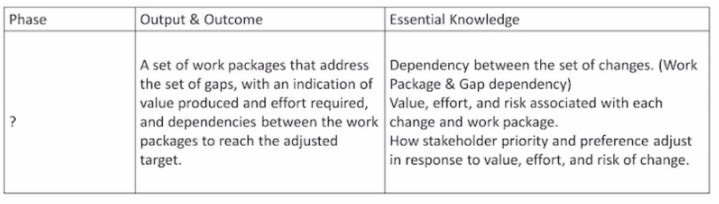 Which ADM Phase(s) does this describe?
-
A
-
B
-
C
-
D
Reveal answer details
Close answer details
Correct answerB
ExplanationThe described output is a set of work packages that closes identified gaps while accounting for value, effort, risk, dependencies, and stakeholder priorities. Phase E, Opportunities and Solutions, consolidates gaps and groups the required changes into candidate work packages, providing the foundation for an initial roadmap toward the adjusted target.
Question 36
Single choice
When considering the gap analysis technique, which of the following is an example of a business domain gap?
-
A
-
B
-
C
-
D
Reveal answer details
Close answer details
Correct answerB
ExplanationA business-domain gap concerns the enterprise's ability to achieve business outcomes, including the financial structure or performance needed to support the target state. A financial gap therefore belongs to the Business Architecture perspective. A data gap belongs to the Data domain, while skills and capabilities describe different kinds of organizational shortfall rather than the requested example.
Question 37
Single choice
Your role is that of an Enterprise Architect, reporting to the Chief Enterprise Architect, at a technology company. The company provides staff, as well as cloud-based services for many government agencies. The company uses the TOGAF standard as the method and guiding framework for its Enterprise Architecture (EA) practice. The Chief Technology Officer (CTO) is the sponsor of the activity. The practice uses an iterative approach for its architecture development. This has enabled the decision-makers to gain valuable insights into the different aspects of the business. The nature of the business is such that the data and the information stored on the company systems are the company's major asset and are highly confidential. The company employees work remotely and need constant access to the company systems, which is done by the public infrastructure. They use message encryption, secure internet connections using Virtual Private Networks (VPNs), and other standard security measures. The company has provided computer security awareness training for all its staff. The Chief Security Officer (CSO) has noted an increase in distributed denial-of-service (DDoS) attacks on companies with a similar profile. The CSO understands that even with thorough preparation, a major attack could stop employees from being able to do their jobs. This could lead to a large financial loss, damage to the company's reputation with customers, and employees being unable to work. A risk assessment has been completed, and the company has looked for cyber insurance that covers such attacks. The price for this insurance is very high. The CTO has decided not to get cyber insurance to cover such attacks. You have been asked to describe the steps you would take to strengthen the current architecture to improve data protection.
-
A
You would monitor for technology updates from your existing suppliers that could enhance the company's capabilities to detect, react, and recover from an IT security incident. You would prepare and run a disaster recovery planning exercise for an attack and analyze the performance of the current Enterprise Architecture. Using the findings, you would prepare a gap analysis of the current Enterprise Architecture. You would prepare change requests to address identified gaps. You would add the changes implemented to the Architecture Repository.
-
B
You would request an Architecture Compliance Review with the scope to examine the company's ability to respond to such attacks. You would identify the departments involved and have them nominate representatives. You would then tailor checklists to address the requirement for increased resilience. You would circulate to the nominated representatives for them to complete. You would then review the completed checklists, identifying and resolving issues. You would then determine and present your recommendations.
-
C
You would ensure that the company has in place up-to-date processes for managing change to the current Enterprise Architecture. Based on the scope of the concerns raised, you recommend that this be managed at the infrastructure level. Changes should be made to the baseline description of the Technology Architecture. The changes should be approved by the Architecture Board and implemented by change management techniques.
-
D
You would assess the business continuity requirements and analyze the current Enterprise Architecture for gaps. You would recommend changes to address the situation and create a change request. You would arrange a meeting of the Architecture Board to assess and approve the change request. Once approved, you would create a new Request for Architecture Work to begin an ADM cycle to implement the changes.
Reveal answer details
Close answer details
Correct answerD
ExplanationThe DDoS risk threatens availability and therefore business continuity, while the decision against insurance leaves the architecture response focused on mitigation and recovery. The current architecture should be analyzed for gaps against continuity requirements, and the required changes captured in a change request. Architecture Board approval then authorizes a new Request for Architecture Work and an ADM cycle to design and implement the changes.
Question 38
Single choice
Complete the sentence. Actions arising from the Business Transformation Readiness Assessment technique should be incorporated in the ___________
-
A
Architecture Requirements Specification
-
B
Implementation Governance Model
-
C
-
D
Implementation and Migration Plan
-
E
Reveal answer details
Close answer details
Correct answerD
ExplanationA Business Transformation Readiness Assessment identifies factors that affect the enterprise's ability to change, together with risks, gaps, and improvement actions. Those actions must become executable parts of migration planning, so they are incorporated into the Implementation and Migration Plan. This ensures readiness improvements are coordinated with work packages, projects, resources, and the transformation schedule.
Question 39
Single choice
According to TOGAF, which of the following steps in Phases B, C, and D occurs before development of the baseline or target architectures?
-
A
Conduct formal stakeholder review
-
B
Create Architecture Definition Document
-
C
Define Roadmap components
-
D
-
E
Select reference models, viewpoints and tools
Reveal answer details
Close answer details
Correct answerE
ExplanationBefore developing the Baseline and Target Architectures in Phases B, C, and D, the architecture team selects the relevant reference models, viewpoints, and tools. These choices establish how the domain will be described and how stakeholder concerns will be represented. Gap analysis requires the baseline and target descriptions, so it necessarily follows their development.
Question 40
Single choice
Complete the sentence. There are five criteria that distinguish a good set of principles: Understandable, Robust, Complete, Consistent and __________.
-
A
-
B
-
C
-
D
-
E
Reveal answer details
Close answer details
Correct answerE
ExplanationA good set of architecture principles must be stable enough to provide dependable guidance over time. Stability does not prevent justified change; it means principles should not shift with every short-term decision. Along with being understandable, robust, complete, and consistent, this durability makes the set useful for governance.
Question 41
Single choice
Scenario Please read this scenario prior to answering the Question
You are serving as the Lead Architect for an Enterprise Architecture project team within a multinational oil and gas corporation. It is organized into two major business groupings: 1. Upstream operations which include exploration for crude oil and natural gas and operating the infrastructure necessary to deliver oil and gas to the market.
2. Downstream operations which include the manufacturing, distribution and marketing activities for oil products and chemicals Safety is a priority for the company, with the aim to ensure id causes zero harm to people and the environment. The company has to satisfy the regulatory requirements of each of the countries it operates in. The downstream business generates a third of the company's profits worldwide and includes more than 30,000 petrol stations and various oil refineries. In some countries it also includes oil refining, a retail station network, lubricants manufacture and marketing, industrial fuel and lubricants sales. The practice for the downstream business has been to operate locally managed by local "operating companies". The Governing Board is concerned about the risk posed by operating in this complex global environment with a large part of the downstream business represented by local operating companies. As a result, the Chief Executive Officer (CEO) has appointed a Chief Compliance Officer (CEO) to be responsible for overseeing and managing compliance issues for the corporation. The CCO reports directly to the CEO. The CCO has approved the expenditure of resources to establish an Enterprise Architecture program, and has mandated the use of the TOGAF standard as the framework. He has requested to be informed about the status of downstream operations that could impact regulatory compliance. He also wants the corporate legal staff and auditors to analyze all proposed new downstream operations to ensure that they are within the legal guidelines for each country. In addition, the local operating companies should be able to see that the architecture is appropriate for their needs. The architecture project team has worked within the sponsor to complete a detailed Request for Architecture Work providing the high level project description. As the project commences the next phase, the necessary approvals from corporate and line management have been ..... Refer to the Scenario You have been asked to recommend an approach that would enable the development of an architecture that addresses the needs of the Chief Compliance Officer, legal staff, auditors and the local operating companies. Based on the TOGAF standard, which of the following is the best answer?
-
A
You recommend that a set of models be created for each project architecture that can be used to ensure that the system will be compliant with the local regulations. A formal review should be held with the stakeholders to verify that their concerns have been properly addressed by the models.
-
B
You recommend that an analysis of the stakeholders is undertaken, including development of a Stakeholder Map. This will allow the architectures to define groups of stakeholders who have common concerns. The concerns and relevant viewpoints should be defined for each group of stakeholders, and recorded in the Architecture Vision document.
-
C
You recommend that the ArchiMate modeling language is used to create a set of models that can be applied uniformly across all architecture projects. Each architecture should then be defined based on this fixed set of models. All concerned parties can then examine the models to ensure that their needs have been addressed.
-
D
You recommend that a Communications Plan be created to address the powerful and influential stakeholders. This plan should include a report that summarizes the key features of the architecture with respect to each location and reflect the stakeholders' requirements.
You will check with each stakeholder that their concerns are being addressed.
Reveal answer details
Close answer details
Correct answerB
ExplanationThe compliance officer, legal staff, auditors, and local operating companies have different authority, interests, and concerns. Stakeholder analysis and a Stakeholder Map identify these parties and allow people with common concerns to be grouped. Defining a relevant viewpoint for each group determines how its concerns will be represented, and recording this in the Architecture Vision establishes the engagement's agreed stakeholder context.
Question 42
Single choice
In which section of the TOGAF template for Architecture Principles would a reader find the answer to the question of ' How does this affect me"?
-
A
-
B
-
C
-
D
Reveal answer details
Close answer details
Correct answerA
ExplanationThe Implications section explains the practical consequences of adhering to an Architecture Principle, including effects on people, processes, organization, costs, and resources. It therefore addresses how the principle affects those who must apply it. The Rationale explains why the principle is beneficial, while the Statement states the rule.
Question 43
Single choice
Consider the following descriptions of deliverables consumed and produced across the TOGAF ADM cycle. - General rules and guidelines, intended to be enduring and seldom amended, that inform and support the way in which an organization sets about fulfilling its mission.
- The joint agreements between development partners and sponsors on the deliverables, quality, and fitness-for-purpose of an architecture.
- A document that is sent from the sponsoring organization to the architecture organization to trigger the start of an architecture development cycle.
- A set of quantitative statements that outline what an implementation project must do in order to comply with the architecture.
Which deliverables match these descriptions?
-
A
1 Architecture Contracts - 2 Architecture Requirements Specification - 3 Architecture Vision - 4 Architecture Principles
-
B
1 Architecture Principles - 2 Architecture Contracts - 3 Architecture Requirements Specification - 4 Request for Architecture Work
-
C
1 Architecture Principles - 2 Architecture Contracts - 3 Request for Architecture Work - 4 Architecture Requirements Specification
-
D
1 Architecture Requirements Specification - 2 Architecture Principles - 3 Architecture Vision - 4 Architecture Contracts
Reveal answer details
Close answer details
Correct answerC
ExplanationArchitecture Principles provide enduring rules and guidelines. Architecture Contracts define agreements between development partners and sponsors. A Request for Architecture Work triggers an ADM cycle, while the Architecture Requirements Specification states what an implementation must satisfy to comply with the architecture.
Question 44
Single choice
Consider the following ADM phases objectives. 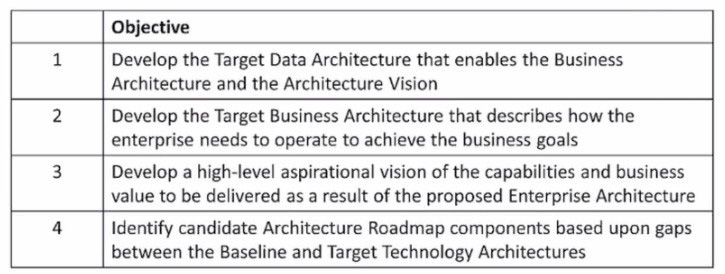 Which phase does each objective match?
-
A
-
B
-
C
-
D
Reveal answer details
Close answer details
Correct answerA
ExplanationObjective 1 belongs to Phase C because that phase develops the Target Data Architecture. Objective 2 maps to Phase B, which develops the Target Business Architecture. Objective 3 is Phase A because it establishes the aspirational Architecture Vision. Objective 4 maps to Phase D, where Technology Architecture gaps contribute candidate roadmap components. Thus the sequence is 1C-2B-3A-4D.
Question 45
Single choice
Which one of the following is the most generic artifact in the Architecture Continuum?
-
A
Common Systems Architecture
-
B
-
C
-
D
Organization Specific Architecture
-
E
Product Line Architecture
Reveal answer details
Close answer details
Correct answerB
ExplanationFoundation Architecture is the most generic point in the Architecture Continuum. It contains broadly applicable concepts, standards, and building blocks that can serve many enterprises. Common Systems, Industry, and Organization-Specific Architectures progressively add specialization for narrower contexts.
Question 46
Single choice
Which of the following best describes how TOGAF defines an enterprise?
-
A
Any collection of organizations that has a common set of goals
-
B
Any corporation with more than 10,000 employees
-
C
Any organization involved in commerce
-
D
Any organization whose stock is traded
-
E
Any set of organizations based at the same geographic location
Reveal answer details
Close answer details
Correct answerA
ExplanationAn enterprise is defined by coordinated purpose: it can be any collection of organizations that shares a common set of goals. The collection may be a single organization, multiple units, or collaborating organizations. Employee count, commercial activity, stock-market status, and geographic co-location are not required boundaries when common goals establish the enterprise scope.
Question 47
Single choice
Which of the following best describes the purpose of the Business Transformation Readiness Assessment technique?
-
A
To determine if the organization is ready to undergo change
-
B
To determine if the stakeholders support the implementation plan
-
C
To ensure that there are adequate trained engineers to develop the solution
-
D
To ensure that there is sufficient funding to execute the transformation
-
E
To plan the migration steps needed to achieve the transformation
Reveal answer details
Close answer details
Correct answerA
ExplanationBusiness Transformation Readiness Assessment determines whether the organization is ready to undergo the intended change. It examines readiness as the decisive condition for transformation, rather than treating one factor such as funding, engineering capacity, or stakeholder support as the entire assessment. Migration sequencing is subsequent planning, not the purpose of the readiness technique.
Question 48
Single choice
In which Phase of the TOGAF ADM is the focus the creation of an Implementation and Migration Plan in co-operation with the portfolio and project managers?
-
A
-
B
-
C
-
D
-
E
Reveal answer details
Close answer details
Correct answerA
ExplanationPhase F, Migration Planning, develops the detailed Implementation and Migration Plan in cooperation with portfolio and project managers. It considers priorities, resources, value, and dependencies so architecture work can be integrated with organizational planning. Phase E identifies opportunities and solutions and prepares the earlier roadmap and planning inputs.
Question 49
Single choice
In the Solutions Continuum, which of the following is the correct order of solutions ranging from generic solution to enterprise specific solution?
-
A
Foundation, Common Systems, Industry, Organization-Specific
-
B
Industry, Foundation, Common Systems, Organization-Specific
-
C
Organization-Specific, Industry, Common Systems, Foundation
-
D
Organization-Specific, Industry, Foundation, Common Systems
Reveal answer details
Close answer details
Correct answerA
ExplanationThe Solutions Continuum moves from broadly reusable solutions toward solutions tailored to one enterprise. Foundation solutions are the most generic, Common Systems solutions address widely shared needs, Industry solutions add sector-specific characteristics, and Organization-Specific solutions apply the greatest enterprise specialization. That progression gives the required order.
Question 50
Single choice
Which one of the following is an objective of the Preliminary Phase of the ADM?
-
A
To define the Baseline Architecture for this cycle of the ADM
-
B
To define the application systems for the Target Architecture
-
C
To define the framework and methodologies to be used
-
D
To define the relevant stakeholders and their concerns
-
E
To define and prioritize work packages
Reveal answer details
Close answer details
Correct answerC
ExplanationThe Preliminary Phase prepares the organization to undertake architecture work. A central objective is selecting and defining the framework and methodologies that will govern how the ADM is tailored and applied. Baseline and Target Architectures, stakeholder analysis, and work-package priorities are developed within later cycle activities.
Question 51
Single choice
Which one of the following is the most relevant model for use in Phase C, Application Architecture?
-
A
-
B
The Integrated Information Infrastructure Reference Model
-
C
The Resource-Event-Agent model
-
D
-
E
The TOGAF Technical Reference Model
Reveal answer details
Close answer details
Correct answerB
ExplanationPhase C Application Architecture examines the applications and their interactions in support of information use. The Integrated Information Infrastructure Reference Model is relevant because it provides a reference structure for application components involved in integrated information infrastructure. The TOGAF Technical Reference Model is oriented toward technology services rather than the application focus stated here.
Question 52
Single choice
According to TOGAF, which of the following types of architecture has major characteristics that include open system standards and general building blocks?
-
A
Common Systems Architecture
-
B
-
C
-
D
Organization-Specific Architecture
Reveal answer details
Close answer details
Correct answerB
ExplanationFoundation Architecture occupies the most general level of the Architecture Continuum. It supplies broadly applicable capabilities, open system standards, and generic building blocks that can support many kinds of organizations. More specialized architectures refine that foundation for common systems, industries, or a particular organization.
Question 53
Single choice
Complete the sentence. The major information areas managed by a governance repository should include
____________________.
-
A
Catalogs, Matrices and Diagrams
-
B
Capability, Segment and Transition Architectures
-
C
Audit Information, Process Status and Reference Data
-
D
Common Systems Solutions, Organization-Specific Solutions and Industry Solutions
-
E
Artifacts, Best Practices and Standards
Reveal answer details
Close answer details
Correct answerC
ExplanationA governance repository must support oversight and controlled decision-making. Audit Information records governance activity, Process Status tracks where governed work stands, and Reference Data supplies the stable information used by governance processes. Together, these are the major managed information areas described for the repository.
Question 54
Single choice
Which ADM phase establishes the connection between the architecture organization and the implementation organization through the Architecture Contract?
-
A
-
B
-
C
-
D
-
E
Reveal answer details
Close answer details
Correct answerC
ExplanationPhase G is Implementation Governance, where the Architecture Contract establishes the working connection between the architecture organization and the implementation organization. The contract sets expectations for conformance and oversight during implementation. This allows the architecture to be governed as delivery proceeds and deviations arise.
Question 55
Single choice
Which one of the following statements best describes why the ADM should be adapted?
-
A
To align it closer to the business
-
B
To make the use more realistic
-
C
To move through the cycle faster
-
D
To suit the specific needs of the enterprise
Reveal answer details
Close answer details
Correct answerD
ExplanationThe ADM is a general method intended for use by different enterprises, each with its own scope, governance, maturity, processes, and constraints. It should therefore be adapted to suit the specific needs of the enterprise. Faster execution or closer business alignment may result from appropriate tailoring, but neither is the fundamental reason adaptation is required.
Question 56
Single choice
According to TOGAF, which of the following terms describes people who have key roles in, or concerns about, a system?
-
A
-
B
-
C
-
D
-
E
Reveal answer details
Close answer details
Correct answerE
ExplanationA stakeholder is a person, group, or organization with a key role in a system or with concerns about it. The term is broader than a sponsor, lead architect, executive, or consumer because each of those may be one particular kind of stakeholder. The defining feature is the person's role, interest, or concern regarding the system.
Question 57
Single choice
Complete the sentence. According to TOGAF, a view is used to describe how the _____ of a stakeholder are being met.
-
A
-
B
-
C
-
D
-
E
Reveal answer details
Close answer details
Correct answerA
ExplanationA view presents an architecture in a form that addresses particular stakeholder concerns. The stakeholder's interests determine what needs to be represented, while the view supplies the relevant architectural representation. Therefore, concerns are what the view is intended to show as being addressed.
Question 58
Single choice
Which of the following best describes the purpose of a business scenario?
-
A
To define and plan an enterprise architecture transformation based on Capability-Based Planning
-
B
To develop a set of general rules and guidelines for the architecture being developed
-
C
To develop a set of security guidelines for the architecture being developed
-
D
To help identify and understand the business requirements that an architecture must address
-
E
To identify and mitigate the risks when implementing an architecture project
Reveal answer details
Close answer details
Correct answerD
ExplanationA business scenario turns a business problem or opportunity into a structured description of participants, processes, environment, and desired results. This structure helps stakeholders and architects identify and understand the business requirements the architecture must address. It supports requirements discovery rather than defining general principles, security guidance, or migration risk controls.
Question 59
Single choice
Which of the following describes a purpose of Architecture Principles?
-
A
To describe likely impacts resulting from successful deployment of the target architecture.
-
B
To form a contract between sponsoring organization and the enterprise architects
-
C
To establish a common understanding of how to control the business in pursuit of strategic objectives
-
D
To provide a better understanding about the enterprise's culture and values
Reveal answer details
Close answer details
Correct answerD
ExplanationArchitecture Principles express enduring guidance that reflects how the enterprise thinks and makes architecture decisions. Developing and applying them exposes the organization's beliefs, priorities, culture, and values, creating a better shared understanding of those characteristics. They are not an implementation-impact statement or a project contract.
Question 60
Single choice
Complete the sentence. As the architecture evolves, the assets in the Solutions Continuum progress towards a (n) _____
-
A
Common Systems Architecture
-
B
Industry Specific Architecture
-
C
-
D
Organization Specific Solution
-
E
Technology Neutral Implementation
Reveal answer details
Close answer details
Correct answerD
ExplanationThe Solutions Continuum represents increasing specialization of solution assets. As solutions evolve, they move from generic Foundation and Common Systems material through industry-oriented solutions and ultimately toward an Organization Specific Solution. That endpoint reflects the enterprise's own requirements and context rather than a technology-neutral or broadly reusable implementation.
Question 61
Single choice
Which of the following best describes the TOGAF Technical Reference Model?
-
A
It is a detailed data model that can be tailored to specific industries
-
B
It is an example of a Common Systems Architecture
-
C
It is a fundamental architecture upon which more specific architectures can be based
-
D
It is a model of application components and application services software, including brokering applications
Reveal answer details
Close answer details
Correct answerC
ExplanationThe TOGAF Technical Reference Model is a fundamental architecture that provides a broadly applicable technical foundation. More specific architectures can be based on and specialized from that foundation. It is not an industry data model, a Common Systems Architecture, or merely a detailed model of application components and brokering software.
Question 62
Single choice
Which of the following does the TOGAF document define as architectural work product that describes an aspect of the architecture?
-
A
Application Platform Interface
-
B
-
C
-
D
-
E
Reveal answer details
Close answer details
Correct answerB
ExplanationAn artifact is an architectural work product that describes an aspect of an architecture. It can take the form of a catalog, matrix, or diagram and may be included within a deliverable. This distinguishes the descriptive content itself from the formally reviewed and contractually specified package that may contain it.
Question 63
Single choice
Complete the sentence. The Requirements Management process is used to______.
-
A
develop requirements for Transition Architectures that deliver business value
-
B
dispose of, address and prioritize architecture requirements
-
C
organize architecture requirements throughout the ADM cycle
-
D
review business requirements
-
E
validate requirements between ADM phases
Reveal answer details
Close answer details
Correct answerC
ExplanationRequirements Management is a continuous process that operates across the ADM rather than belonging to only one phase. It organizes architecture requirements throughout the cycle so that requirements can be identified, maintained, traced, and supplied to the phases that use them. A single review, validation, or prioritization activity covers only part of that lifecycle role.
Question 64
Single choice
Which one of the following lists the main components within the TOGAF Architecture Repository?
-
A
OrganizationalMetamodel, Architecture Capability, Architecture Landscape, Best Practices, Reference
Library, Compliance Strategy.
-
B
ArchitectureMetamodel, Organizational Capability Model, Application Landscape, SIB, Reference
Library, Governance Model.
-
C
BusinessMetamodel, Architecture Capability, Architecture Landscape, SIB, Reference Library,
Governance Log.
-
D
ArchitectureMetamodel, Architecture Capability, Architecture Landscape, SIB, Reference Library,
Governance Log.
Reveal answer details
Close answer details
Correct answerD
ExplanationThe repository structure includes the Architecture Metamodel, Architecture Capability, Architecture Landscape, Standards Information Base (SIB), Reference Library, and Governance Log. Together these cover content structure, organizational ability, deployed architecture, applicable standards, reusable reference material, and records of governance activity.
|