Which of the following protocols are not supported in Data ONTAP 8.0.1 simultaneously with FCoE using the Unified Target Adapter?
-
A
-
B
-
C
-
D
-
E
Reveal answer details
Close answer details
Correct answerE
ExplanationDOT 8.0.1 first allowed both FCoE and traditional Ethernet protocols using the same Unified Target Adapter (UTA). http://www.cosonok.com/2012/02/netapp-ns0-502-study-notes-part-34-san.html
A company is deploying several applications over Fibre Channel. The volume on the storage system has fractional reserve set to zero and SnapShot reserve set to zero. The volume will host three 100-GB LUNs. The customer will not be taking Snapshot copies. All other settings are using default values. What is the minimum volume size required?
-
A
-
B
-
C
-
D
Reveal answer details
Close answer details
Correct answerB
ExplanationWith no reserves set and no snapshots being taken, using default options, the LUNs will each consume 100GB of the volume. https://library.netapp.com/ecmdocs/ECMP1196979/html/man1/na_lun.1.html
lun create -s size -t ostype [ -o noreserve ] [ -e space_alloc ] lun_path By default, the LUN is space-reserved. To manage space usage manually, -o noreserve can be specified. Using this option will create a LUN without any space being reserved. Provisioning threshold events can be enabled by specifying -e space_alloc option. This option has to be used in conjunction with -o noreserve.
A company has five Windows servers that are dual-attached, four Linux servers that are single-attached, and ten dual-attached Solaris servers. The company wants a highly available architecture. A dual controller FAS3100 series with all onboard FC ports connected to the fabric is being proposed. What is the total number of FC ports and what type of fabric should be deployed from the choices shown?
-
A
single fabric with 38 ports total
-
B
dual fabrics with 38 ports total
-
C
dual fabrics with 42 ports total
-
D
single fabric with 42 ports total
Reveal answer details
Close answer details
Correct answerC
ExplanationBest practice calls for dual fabric. This would also be the most cost effective approach at this size. 5 x dual-port HBAs for Windows = 10 ports split across two fabrics 4 x single-port HBAs for Linux = 4 ports on any fabric. 10 x dual-port HBAs for Solaris = 20 ports split across two fabrics. Each FAS3100 has 4 onboard FC ports, for a total of 8 ports split across two fabrics. 34 initiator ports and 8 target ports totalling 42.
Which command do you use to see the rate of change between two successive Snapshot copies in a flexible volume in Data ONTAP?
-
A
-
B
-
C
-
D
Reveal answer details
Close answer details
Correct answerC
Explanationsnap delta [ vol_name [ snapshot-name ] [ snap_shot-name ]] Displays the rate of change of data between snapshots. When used without any arguments it displays the rate of change of data between snapshots for all volumes in the system, or all aggregates in the case of snap delta -A. If a volume is specified, the rate of change of data is displayed for that particular volume.
The query can be made more specific by specifying the beginning and ending snapshots to display the rate of change between them for a specific volume. If no ending snapshot is listed, the rate of change of data between the beginning snapshot and the Active File System is displayed. http://backdrift.org/man/netapp/man1/na_snap.1.html
Question 5
Multiple choice
You are about to replace a failed Brocade Fibre Channel switch. Which three steps do you take prior to connecting the switch in the SAN? (Choose three.)
-
A
Force the new switch to be the principle switch.
-
B
Change the domain ID of the replacement switch to the domain ID of the failed switch.
-
C
Clear all zoning configurations on the replacement switch.
-
D
Change the core PID format of the replacement switch to the core PID format of the failed switch.
-
E
Preload the zoning information from the fabric onto the new switch.
Reveal answer details
Close answer details
Correct answersB, C, D
ExplanationSteps prior to replacing a failed Brocade FC Switch: Change the domain ID of the replacement switch to the domain ID of the failed switch.
Clear all zoning configuration on the replacement switch.
Change the core PID format of the replacement switch to the core PID format of the failed switch.  When hard zoning (domain ID plus port) is in use and a host HBA is replaced, no changes need to be made provided the new HBA is connected to the same port. http://www.cosonok.com/2012_02_01_archive.html
Which row of items should you look up in the IMT (Interoperability Matrix Tool) when designing a NetApp Storage Solution for a customer?
-
A
Host OS & patches, FC WWPN, Volume Manager, File System version
-
B
Host OS, iSCSI IQN, Volume Manager, Clustering
-
C
Host OS & patches, HBA driver, Volume Manager, File System, Clustering
-
D
Host OS, HBA driver, Host Memory & CPU Speed, File System, Clustering
Reveal answer details
Close answer details
Correct answerC
ExplanationWhen designing a NetApp storage solution for a customer, check the row in the IMT for Host OS & patches
HBA driver
Volume Manager
File System
Clustering  http://www.cosonok.com/2012_02_01_archive.html
Before installing Snap Drive, which task must you complete to have a configuration that meets best practices?
-
A
change the administrator path on the server
-
B
establish an SnapDrive service account
-
C
-
D
enable a CIFS license on the NetApp applicance
Reveal answer details
Close answer details
Correct answerB
ExplanationEnter an account that can be used as a service account for the SnapDrive services. This account must be a member of the Built-In Administrators group. http://www.sysadmintutorials.com/tutorials/netapp/installing-netapp-snapdrive-for-windows/
A 100-GB thinly provisioned LUN is allocated to a Windows host and then 100 GB of data is written into the LUN. The current capacity utilization on the disk array as well as the host is 100%. 50 GB of data is deleted from the LUN. Space reclaimer has NOT been run. What is the current capacity utilization on both the host and the disk array?
-
A
50% on the host, 100% on the disk array
-
B
100% on the host, 50% on the disk array
-
C
50% on the host, 50% on the disk array
-
D
100% on the host, 100% on the disk array
Reveal answer details
Close answer details
Correct answerA
ExplanationExplanation: while the host will see the space freed up by the deletion, the thin-provisioned LUN is not going to shrink on the volume until space reclamation is run. NetApp thin provisioning is designed to allow you to present more logical storage to hosts or users than you actually have in your physical storage pool. Instead of allocating space upfront, storage space is dynamically allocated to each volume or LUN as data is written. In most configurations, free space is also released back to your common storage pool when data in the volume or LUN is deleted (and is not being held by any Snapshot copies). https://communities.netapp.com/docs/DOC-8122 From a storage system perspective, the percentage used of a LUN will always increase and never decrease unless space reclamation is run. http://netappsky.com/wp-content/uploads/2010/09/Lun_Provisioning.pdf
Which command on a NetApp storage controller will display the average latency time on a per LUN basis every five seconds?
-
A
-
B
-
C
-
D
Reveal answer details
Close answer details
Correct answerD
Explanationlun stats -i interval [ -c count ] [ -o ] [ -a | lun_path ] The -i option will report per LUN performance statistics at the per second interval given.
The default output format for -i is as follows: Read Write Read Write Average Queue Lun
Ops Ops kB kB Latency Length
#### #### ##### ##### ##.## ###.## lun_path http://backdrift.org/man/netapp/man1/na_lun.1.html
Question 10
Multiple choice
When assessing a current storage solution it is critical to document the current existing NetApp storage system configuration. Which four factors should be considered when documenting this existing configuration? (Choose four.)
-
A
Ethernet switch firmware version
-
B
-
C
-
D
-
E
-
F
-
G
Reveal answer details
Close answer details
Correct answersB, D, F, G
ExplanationWhen documenting the existing configuration, factors that should be considered include: disk ownership settings
igroups being used
protocols in use
Snapshot configuration http://www.cosonok.com/2012/02/netapp-ns0-502-study-notes-part-14-san.html
Question 11
Single choice
When booting your NetApp storage system for the first time the system fails to boot. What should you do first to address this problem?
-
A
You turn off your storage system and disk shelves, and then turn on the disk shelves. You then check the quick reference card that came with the disk shelf for information about LED responses.
-
B
You re-download the boot image to the compact flash card, then reboot the system.
-
C
You look for a description of the problem on the LCD and console. You then follow the instructions, if provided, on the LCD and console.
-
D
You verify disk shelf compatibility and check the disk shelf IDs to verify that the disk shelf 1 (for DS14 series) must be connected to your system.
Reveal answer details
Close answer details
Correct answerC
ExplanationPower on order: Network Switches. Disk Shelves
Any Tape Backup Devices
NetApp Controller Heads.  If a NetApp storage system fails on its first boot; check for a description of the problem on the LCD and console, and follow the instructions. http://www.cosonok.com/2012/02/netapp-ns0-502-study-notes-part-34-san.html
Question 12
Single choice
A user wants to access a FCP VMFS datastore created on a NetApp LUN using a properly configured ESX 3.5 system with a new ESX 4.0 system.
Without making changes to the LUN or igroup attributes, what setting should be used for the SATP (Storage Array Type Plugin)?
-
A
-
B
-
C
The LUN has to be changed to ALUA before accessing from ESX 4.0
-
D
Reveal answer details
Close answer details
Correct answerB
Explanationhttp://www.cosonok.com/2012/02/netapp-ns0-502-study-notes-part-34-san.html Because the question requests that you not change the igroup attributes, the igroup is implicitly a non-ALUA igroup. So the ESX4.x system must use VMW_SATP_DEFAULT_AA. That is the best answer here. Note: the best practice contradicts this: http://kb.vmware.com/selfservice/microsites/search.do?language=en_US&cmd=displayKC&externalId=1010713
https://kb.netapp.com/support/index?page=content&id=3011171 In ESX/ESXi 4.x, MRU is the default policy for all NetApp storage devices in ALUA mode. However, for the ESX/ESXi 3.x release, the default policy for the NetApp devices is Fixed. 3. X and ESX 4. X hosts, the following solutions exist: Initiators for ESX 3.X should placed into a dedicated igroup: ALUA should not be enabled.
The ESX 3.X hosts should continue using the Fixed policy.
Initiators for ESX 4.X should placed into a dedicated igroup.
ALUA should be enabled.
The ESX 4.X hosts should continue using the MRU or RR path selection policy as described above.
Question 13
Multiple choice
For which two purposes would the use of VLAN's be beneficial? (Choose two.)
-
A
to isolate iSCSI traffic from LAN/WAN traffic
-
B
to separate LAN from WAN traffic
-
C
to isolate management traffic from other IP traffic
-
D
to isolate UDP from TCP traffic in the IP network
-
E
to isolate SSH traffic from other IP traffic
Reveal answer details
Close answer details
Correct answersA, C
ExplanationVLANs are a standard layer 2 mechanism for segmenting and effectively isolating application traffic. Data on one VLAN cannot be seen or accessed by data traversing another VLAN, they are effectively separate streams. Common best practices are to isolate IP storage traffic from other protocols, for performance and security.
It is also beneficial to isolate management traffic to a restricted VLAN. https://devcentral.f5.com/articles/virtualization-how-to-isolate-application-traffic#.UiyA6zAgZBU
Question 14
Single choice
Which Ethernet topologies for iSCSI does NetApp highly recommend?
-
A
WAN without VLANs implemented
-
B
LAN without VLANs implemented
-
C
LAN with VLANs implemented
-
D
Reveal answer details
Close answer details
Correct answerC
ExplanationNetApp recommended Ethernet topology for iSCSI: LAN with VLANs implemented. http://www.cosonok.com/2012/02/netapp-ns0-502-study-notes-part-14-san.html
Question 15
Single choice
Which statement is NOT true regarding NetApp Snapshots of VMware ESX datastores?
-
A
A NetApp Snapshot captures the entire FlexVol including information NOT associated with VMDKs.
-
B
For VMDKs on VMFS datastores, to restore a specific VMDK requires a copy from the NetApp Snapshot to the datastore.
-
C
NetApp Snapshots can be employed to backup VMFS, NFS, or RDM datastores.
-
D
NetApp Snapshots are instantaneous, so they always produce an application consistent image
Reveal answer details
Close answer details
Correct answerD
ExplanationIn order to capture an application consistent (i.e. quiesced) image, software like SnapManager or the Virtual Storage Console must be employed to coordinate the snapshot procedure with the application. So snapshots are not ALWAYS application consistent.
Question 16
Single choice
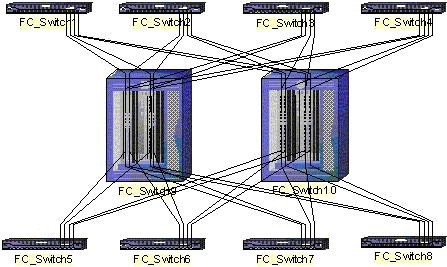 What is the illustrated FC switch topology?
-
A
-
B
-
C
-
D
Reveal answer details
Close answer details
Correct answerB
ExplanationFC_Switch1 - 9 are edge switches. FC_Switch 9-10 are core edge switches. http://www.filibeto.org/sun/lib/nonsun/brocade/53-0000231-05.pdf
Question 17
Multiple choice
Which two tools can be used to verify the WWNN and WWPNs from the commandline interface? (Choose two.)
-
A
-
B
-
C
-
D
Reveal answer details
Close answer details
Correct answersB, C
Explanationsanlun fcp show adapter : UNIX CLI NetApp host utility command to verify WWNN and WWPNs esxcfg-info : VMware ESX CLI command to verify WWNN and WWPNs http://www.cosonok.com/2012_02_01_archive.html
Question 18
Single choice
A dual controller FAS3100 series is connected to a dual fabric with two active target ports per fabric in a single-image cfmode, and uses a single portset. What is the total number of paths for all ten LUNs on a single host with one connection to each fabric?
-
A
-
B
-
C
-
D
-
E
Reveal answer details
Close answer details
Correct answerD
Explanationcfmode single-image All LUNs in the active/active configuration are available on all ports in the active/active configuration by default. As a result, there are more paths to LUNs stored on the active/active configuration because any port on each node can provide access to both local and partner LUNs. Each LUN has two paths per fabric from each initiator port. 4 paths x 10 LUNs = 40 paths total. http://hd.kvsconsulting.us/netappdoc/733docs/html/ontap/bsag/GUID-31DC026F-2B78-425A-BA55-487782F9909A.html
Question 19
Single choice
Which native GUI switch tool is used to manage Brocade switches and directors?
-
A
-
B
Enterprise Fabric Services
-
C
-
D
Reveal answer details
Close answer details
Correct answerD
ExplanationBrocade® Web Tools, an intuitive and easy-to-use interface, enables IT organizations to monitor and manage single Brocade Fabric OS® (FOS)-based switches. http://www.brocade.com/downloads/documents/data_sheets/product_data_sheets/WebTools_DS_10.pdf
Question 20
Single choice
What is the default VSAN for FC ports on the Cisco Nexus switch?
-
A
-
B
-
C
-
D
-
E
Reveal answer details
Close answer details
Correct answerA
ExplanationThe factory settings for switches in the Cisco MDS 9000 Family have only the default VSAN 1 enabled. We recommend that you do not use VSAN 1 as your production environment VSAN. If no VSANs are configured, all devices in the fabric are considered part of the default VSAN. By default, all ports are assigned to the default VSAN. http://www.cisco.com/en/US/products/ps5989/products_configuration_guide_chapter09186a0080662ce3.html#wp1094457
Question 21
Single choice
Which command do you use to collect information about the firmware version running a Cisco FC switch?
-
A
-
B
-
C
-
D
Reveal answer details
Close answer details
Correct answerD
Explanationshow version - To display information about the currently loaded software along with hardware and device information
http://www.cisco.com/en/US/docs/ios/fundamentals/command/reference/cf_s4.html#wp1499591
Question 22
Multiple choice
What information needs to be included in a cabinet diagram? (Choose three.)
-
A
NetApp storage system login information
-
B
physical location of the rack in the data center
-
C
storage controller configuration information
-
D
rack identifying information
-
E
location in the rack of NetApp storage controllers and storage shelves
Reveal answer details
Close answer details
Correct answersB, D, E
ExplanationCabinet diagram information: Physical location of the rack in the datacenter.
Rack identifying information.
Location in the rack of NetApp storage controllers and storage shelves.
Switch placement.
Storage shelf connectivity.  http://www.cosonok.com/2012/02/netapp-ns0-502-study-notes-part-24-san.html
|