After issuing the aggr split aggr0/plex0 aggrNew command ____________.
-
A
there is a new plex called aggrNew
-
B
there are two new plexes, plex0 and plexNew
-
C
there is a new mirrored aggregate called aggrNew
-
D
there are two unmirrored aggregates, aggr0 and aggrNew
-
E
flexible volumes are evenly split between aggr0 and aggrNew
Reveal answer details
Close answer details
Correct answerD
ExplanationExplanation:
https://library.netapp.com/ecmdocs/ECMP1196890/html/man1/na_aggr.1.html
aggr split aggrname/
plexname new_aggrname
Removes plexname from a mirrored aggregate and creates a new unmirrored aggregate named new_aggrname that contains the plex. The original mirrored aggregate becomes unmirrored. The plex to be split from the original aggregate must be functional (not partial), but it could be inactive, resyncing, or out-ofdate. Aggr split can therefore be used to gain access to a plex that is not up to date with respect to its partner plex, if its partner plex is currently failed. If the aggregate in which plexname resides is embedded in a traditional volume, aggr split behaves identically to vol split. The new aggregate is embedded in a new traditional volume of the same name. The aggregate in which plexname resides must contain exactly one flexible volume, aggr split will by default rename the flexible volume image in the split-off plex to be the same as the new aggregate. If the original aggregate is restricted at the time of the split, the resulting aggregate will also be restricted. If the restricted aggregate is hosting flexible volumes, they are not renamed at the time of the split. Flexible volumes will be renamed later, when the name conflict is detected while bringing an aggregate online. Flexible volumes in the aggregate that is brought online first keep their names. That aggregate can be either the original aggregate, or the aggregate resulting from the split. When the other aggregate is brought online later, flexible volumes in that aggregate will be renamed. If the plex of an aggregate embedded within a traditional volume is offline at the time of the split, the resulting aggregate will be offline. When splitting a plex from an aggregate that hosts flexible volumes, if that plex is offline, but the aggregate is online, the resulting aggregate will come online, and its flexible volumes will be renamed. It is not allowed to split a plex from an offline aggregate. A split mirror can be joined back together via the -v option to aggr mirror.
A NearStore license increases the amount of concurrent replication streams.
-
A
-
B
Reveal answer details
Close answer details
If the security style is set to UNIX, CIFS client file access is determined by ___________.
-
A
-
B
the last client to set permissions
-
C
the mapped UNIX UID/GID of the CIFS client and the UNIX file permissions
-
D
This is not allowed: A CIFS client cannot access files in a path set to a security style of UNIX
Reveal answer details
Close answer details
Correct answerC
ExplanationExplanation:
https://library.netapp.com/ecmdocs/ECMP1196993/html/GUID-09C7812F-E6EA-47C6-AB79-EAB803E7A8EB.html For Data ONTAP to obtain the UID and GIDs for a CIFS user, it must first determine the user's UNIX-style name. It does this through user mapping.
Question 4
Multiple choice
Which two Volume SnapMirror (VSM) relationship are supported? (Choose two)
-
A
Data ONTAP 8.0.2 64-bit -->Data ONTAP 8.1 64-bit
-
B
Data ONTAP 8.0.2 32-bit --> Data ONTAP 8.0.2 64-bit
-
C
Data ONTAP 7.3.2 32-bit --> Data ONTAP 8.1 64-bit
-
D
Data ONTAP 7.3.2 32-bit --> Data ONTAP 8.0.2 64-bit
Reveal answer details
Close answer details
Correct answersA, C
ExplanationVolume SnapMirror Interoperability Matrix. 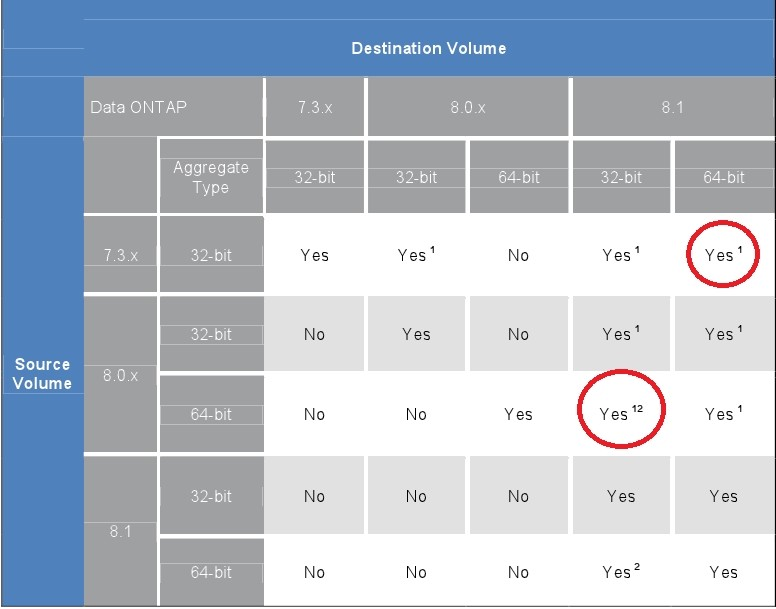 References:
SnappMirror Async Overview and Best Practices guide. 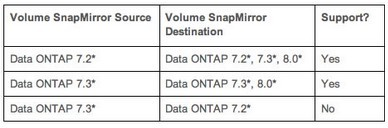
The quota resize command only affects existing /etc/quotas file target entries, not new quota entries.
-
A
-
B
Reveal answer details
Close answer details
Correct answerA
ExplanationExplanation:
http://backdrift.org/man/netapp/man1/na_quota.1.html
quota resize volumeAdjustscurrentlyactivequotasinthespecifiedvolumetoreflectchangesinthe/etc/quotasfile.Forinstance,ifyoueditanentryin/etc/quotastoincreaseauser'squota,quotaresizewillcausethechangetotakeeffect.Thevolumenamemaybeomittedifthesystemhasonlyonevolume.quotaresizecanbeusedonlywhenquotasarealreadyon.Becauseitdoesnotrescanthefilesystemtocomputeusage,quotaresizeisfasterthanturningquotasoffandthenonagain.quotaresizewillapplyallupdatedentriesin/etc/quotas;however,itwillgenerallyignorenewlyaddedentries.Anewlyaddedentrywillonlytake
effect if the corresponding user or group has an active quota as a result of updating a file subject to default quotas.
In a Fiber Channel configuration, the host's HBA is referred to as the ___________, and the storage system's HBA to as the _____________.
-
A
-
B
-
C
-
D
Reveal answer details
Close answer details
Which NetApp Virtual Storage Tier component works at the host level?
-
A
-
B
-
C
-
D
-
E
Reveal answer details
Close answer details
Correct answerC
ExplanationExplanation:
http://www.netapp.com/us/system/pdf-reader.aspx?m=ds-3366.pdf&cc=us
Flash Accel utilizes server- based flash storage as cache for the host.
In an active/active configuration in takeover mode, the surviving controller interfaces will reflect the identity of the ________.
-
A
-
B
failed partner interfaces only
-
C
local and failed partner interfaces
-
D
interfaces as defined in the /etc/rc file
Reveal answer details
Close answer details
Correct answerD
ExplanationExplanation:
In takeover mode, this network interface assumes the identity of the network interface on the partner
http://www.wafl.co.uk/tag/ifconfig/#sthash.3rsjaDZD.dpuf For the partner interface configuration to be persistent across reboots, you must include the ifconfig command in the /etc/rc file
http://hd.kvsconsulting.us/netappdoc/801docs/html/ontap/nag/GUID-525FCF4E-109D-4E6F-9256-C6E56438CA9A.html
What does it signify if the disks are "not owned" in a FAS2020 system?
-
A
The disks are mailbox disks.
-
B
The disks are spare disks.
-
C
The disks are data disks.
-
D
Reveal answer details
Close answer details
Correct answerD
ExplanationExplanation:
Disks must be assigned to an aggregate to be used as raid group members or spares. Unassigned disks are displayed as "not owned".
Question 10
Single choice
Five minutes ago, you performed a single file SnapRestore on a large NFS file. 40% of your NFS users are now complaining about getting "stale file handles" for the file. Which is the most likely cause of this problem, and the best procedure to correct it?
-
A
This might be due to an NFS storage system and client mismatch. Check to see that these users have the same version of the NFS client that existed at the time the snapshot was taken.
-
B
NFS users why try to access a reverted file without first reopening it might get a "stale file handle" error message. Have the users try to reopen the file and see if the problem is resolved.
-
C
After a single file SnapRestore, NFS users have to reboot their systems. Have them reboot their systems.
-
D
These users are on a different subnet from the others. Start troubleshooting by checking their subnet.
Reveal answer details
Close answer details
Correct answerB
ExplanationExplanation:
https://library.netapp.com/ecmdocs/ECMP1196991/html/GUID-35C9A4BA-02BA-4965-A366-698C1299E29D.html Reverting a file to a selected Snapshot copy Using snap restore to revert a single file to a selected Snapshot copy is practical when the file is so large that you cannot copy the previous file version from the Snapshot copy to the active file system. Before you begin Ensure that you notify the network users before reverting a file so that they know that the current data in the file will be replaced by that of the selected Snapshot copy. Note: NFS users who try to access a reverted file without first reopening it might get a stale file handle error message after the volume reversion.
Question 11
Multiple choice
Which three tools present statistics from the Data ONTAP counter manager? (Choose three)
-
A
-
B
-
C
-
D
Reveal answer details
Close answer details
Correct answersA, B, D
ExplanationSection: OnTap Administration
Explanation:
https://library.netapp.com/ecmdocs/ECMP1196890/html/man1/na_stats.1.html
https://communities.netapp.com/servlet/JiveServlet/previewBody/18684-102-5-34635/TR4090PerformanceAdvisorFeatures%26Diagnosis.pdf
https://communities.netapp.com/groups/chris-kranz-hardware-pro/blog/2009/04/01/performance-stats-withoutperfstat-or-ops-mgr Note in the diagram below how the performance tools integration with Data OnTap. statit and sysstat interface directly with the performance counters while the other tools - including stats, a command line tool
-integrate with the Counter Manager. 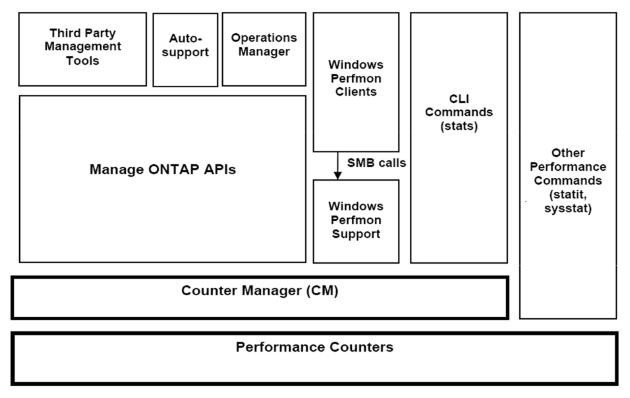
Question 12
Single choice
Which command displays the statistics for Ethernet network interfaces?
-
A
-
B
-
C
-
D
Reveal answer details
Close answer details
Correct answerB
ExplanationExplanation:
https://library.netapp.com/ecmdocs/ECMP1196890/html/man1/na_ifstat.1.html
ifstat - display device-level statistics for network interfaces
Question 13
Single choice
What is the correct format for the scheduling component of a SnapVault schedule?
-
A
cnt[@day_list][@hour_list]
-
B
-
C
-
D
List of dates in ISO Date format
Reveal answer details
Close answer details
Correct answerA
ExplanationExplanation:
https://library.netapp.com/ecmdocs/ECMP1196979/html/man1/na_snapvault.1.html
http://www.geekyfacts.com/index.php?option=com_content&view=article&id=64:snapvaultsnapvaultsnapsched
[ -f ] [ -x ] [ -o options ] [ volname [ snapname [ schedule ]]] schedule is cnt[@day_list][@hour_list] or cnt
[@hour_list][@day_list] In the schedule, cnt tells SnapVault how many of the snapshots to keep for primaries and for non-SnapLock secondary volumes. The snapshots will be numbered newest to oldest from 0 to cnt-1. When creating a new snapshot, SnapVault will delete the oldest snapshots, increment by one the number on the remaining snapshots and then create a new number 0 snapshot. If a snapshot is missing from the sequence (e.g. sv.0, sv.1, and sv.3 exist but sv.2 does not), only snapshots that need to be renumbered to make room for the new sv.0 snapshot will be renumbered. In the example, sv.0 and sv.1 would be renamed to sv.1 and sv.2, but sv.3 would remain unchanged. The cnt in the schedule is interpreted differently for SnapVault secondary SnapLock volumes. For SnapLock secondary volumes, snapshots are created with a name that includes an encoded date and time of when the snapshot is created. These snapshots are never renamed and they are never automatically deleted. These snapshots may be deleted using snap delete after the retention period of the snapshot has expired. If cnt is 0, no snapshots will be taken. If cnt is any non-zero value, snapshots will be taken and no snapshots will be automatically deleted. If specified, the day_list specifies which days of the week the snapshot should be created. The day_list is a comma-separated list of the first three letters of the day: mon, tue, wed, thu, fri, sat, sun. The names are not case sensitive. Day ranges such as mon-fri can also be given. The default day_list is mon-sun, i.e. every day. If specified, the hour_list specifies which hours of the day the snapshot should be created, on each scheduled day. The hour_list is a comma-separated list of the hours during the day, where hours are integers from 0 to 23. Hour ranges such as 8-17 are allowed. Also, step values are allowed in conjuction with ranges. For example, 0-23/2 means "every two hours". The default hour_list is 0, i.e. midnight on the morning of each scheduled day.
Question 14
Multiple choice
Which two operations can be performed with the SnapDrive for windows graphical user interface?
-
A
-
B
-
C
-
D
Reveal answer details
Close answer details
Correct answersB, D
ExplanationExplanation:
https://library.netapp.com/ecm/ecm_download_file/ECMM1278920 What SnapDrive does
SnapDrive software integrates with the Windows Volume Manager so that NetApp filers can serve as virtual storage devices for application data in Windows 2000 Server and Windows Server 2003 environments. SnapDrive is dependent on the virtual disk service. The virtual disk service must be started on the host prior to installing SnapDrive. SnapDrive manages virtual disks (LUNs) on a NetApp filer, making these virtual disks available as local disks on Windows hosts. This allows Windows hosts to interact with the virtual disks just as if they belonged to a directly attached redundant array of independent disks (RAID). SnapDrive provides the following additional features: It enables online storage configuration, virtual disk expansion, and streamlined management. It integrates NetApp Snapshot technology, which creates point-in-time images of data stored on virtual disks.
It works in conjunction with SnapMirror® software to facilitate disaster recovery from either asynchronously or synchronously mirrored destination volumes.
Question 15
Multiple choice
Which three attributes would you specify when creating a LUN? (Choose three)
-
A
The host operating system of the system attached to LUN.
-
B
The version of Data ONTAP
-
C
-
D
Reveal answer details
Close answer details
Correct answersA, C, D
ExplanationExplanation:
https://library.netapp.com/ecmdocs/ECMP1196979/html/man1/na_lun.1.html The usage for lun create is shown below. Options not in brackets are mandatory. lun create -s size -t ostype [ -o noreserve ] [ -e space_alloc ] lun_path This usage of the lun create command should be employed to create a new LUN of given size, with initially zero contents. The LUN is created at the lun_path given. No file should already exist at the given lun_path. The directory specified in the lun_path must be a qtree root directory. The size is specified in bytes. Optionally, a number followed by a one-character multiplier suffix can be used: c (1), w (2), b (512), k (1024), m (k*k), g (k*m), t (m*m). The size of the created LUN could be larger than the size specified, in order to get an integral number of cylinders while reporting the geometry using
SAN protocols. The size of the LUN actually created is reported if it is different from that specified in the command. The mandatory ostype argument is one of: solaris (the LUN will be used to store a Solaris raw disk in a singleslice partition), windows (the LUN will be used to store a raw disk device in a single-partition Windows disk using the MBR (Master Boot Record) partitioning style), hpux (the LUN will be used to store HP-UX data), aix (the LUN will be used to store AIX data), vld (the LUN contains a SnapManager VLD), linux (the LUN will be used to store a Linux raw disk without any partition table), netware (the LUN will be used to store NetWare data), vmware (the LUN will be used to store VMware data), windows_gpt (the LUN will be used to store Windows data using the GPT (GUID Partition Type) partitioning style), windows_2008 (the LUN will be used to store Windows data for Windows 2008 systems), openvms (the LUN will be used to store Open-VMS data), xen (the LUN will be used to store Xen data), hyper_v (the LUN will be used to store Hyper-V data), solaris_efi (the LUN will be used to store Solaris_EFI data). By default, the LUN is space-reserved. To manage space usage manually, -o noreserve can be specified.
Using this option will create a LUN without any space being reserved. Provisioning threshold events can be enabled by specifying -e space_alloc option. This option has to be used in conjunction with -o noreserve.
Question 16
Single choice
What is the maximum distance between a standard clustered pair at 2Bbps?
-
A
-
B
-
C
-
D
Reveal answer details
Close answer details
Question 17
Single choice
You can avoid data corruption when you issue the cf forcetakeover -d command if the remote node is
________.
-
A
-
B
-
C
powered on and accessible
-
D
powered off and inaccessible
Reveal answer details
Close answer details
Question 18
Single choice
When using SnapRestore to restore a single LUN, the LUN must be ___________.
-
A
-
B
mapped to a Windows server
-
C
-
D
taken offline or unmapped
Reveal answer details
Close answer details
Correct answerD
ExplanationExplanation:
https://library.netapp.com/ecmdocs/ECMP1196995/html/GUID-577EDC41-FEA0-4987-8F04-55E736962FD1.html Always unmount the LUN before you run the snap restore command on a volume containing the LUN or before you run a single file SnapRestore of the LUN. For a single file SnapRestore, you must also take the
LUN offline.
Question 19
Single choice
Which command shares out the directory /vol/vol2/home using the share name "netapp"?
-
A
cifs shares -add /vol/vol2 netapp
-
B
cifs shares -add /vol/vol2/home/netapp
-
C
cifs shares -add netapp vol/vol2
-
D
cifs shares -add netapp /vol/vol2/home
Reveal answer details
Close answer details
Correct answerD
ExplanationExplanation:
https://library.netapp.com/ecmdocs/ECMP1196890/html/man1/na_cifs_shares.1.html
cifs shares -add
sharename path
Question 20
Single choice
To configure a storage system as a member of a Windows active directory domain, the time on the storage system must be set to be within plus or minus five minutes of the time on the domain controller.
-
A
-
B
Reveal answer details
Close answer details
Question 21
Single choice
To collect per client NFS statistics on a storage system, the option nfs.per_client_stats.enable must be set on.
-
A
-
B
Reveal answer details
Close answer details
Correct answerA
ExplanationExplanation:
https://library.netapp.com/ecmdocs/ECMP1196979/html/man1/na_options.1.htmlnfs.per_client_stats.enableEnables/disablesthecollectionanddisplayofperclientNFSstatistics,asdescribedinna_nfsstat(1).Validvaluesforthisoptionareonoroff.Thedefaultvalueforthisoptionisoff.
Question 22
Multiple choice
Which two statements apply to an entry in the /etc/exports file regarding exporting directories/qtrees and volumes? (Choose two.)
-
A
Each volume must be exported separately.
-
B
Exports are accessible only to hosts with names.
-
C
User names used in an export must be resolvable.
-
D
Exports can access multiple paths on the same volume.
Reveal answer details
Close answer details
Correct answersA, D
ExplanationExplanation:
https://library.netapp.com/ecmdocs/ECMP1196890/html/man5/na_exports.5.html IP addresses and wildcards can be used when specifying host targets in exports. User names are not valid exports options, save for the anon option which utilizes a local system UID or user name (i.e. no user name mapping or resolution is performed.) The highest level in the filesystem that can be specified for an export is the volume level. Implicitly this means that each volume must be exported separately. An export provides access to paths below the export, implying that multiple paths on the same volume can be exported from an export.
Question 23
Multiple choice
Which three statements are true when using SnapRestore? (Choose three.)
-
A
The volume must be online.
-
B
SnapRestore must be licensed before you can use it.
-
C
The snap restore enable on option must be enabled.
-
D
The volume to be reverted must not be a SnapMirror destination mirror.
Reveal answer details
Close answer details
Question 24
Single choice
For OSSV sources, the qtree is the basic unit of SnapVault backups.
-
A
-
B
Reveal answer details
Close answer details
Correct answerB
ExplanationExplanation:
https://library.netapp.com/ecmdocs/ECMP1196991/html/GUID-06C70D3B-9A06-4D20-B140-EB147B941BDA.html The data structures that are backed up and restored through SnapVault depend on the primary system. On systems running Data ONTAP, the qtree is the basic unit of SnapVault backup and restore. SnapVault backs up specified qtrees on the primary system to associated qtrees on the SnapVault secondary system.
If necessary, data is restored from the secondary qtrees back to their associated primary qtrees.
On open systems storage platforms, the directory is the basic unit of SnapVault backup. SnapVault backs up specified directories from the native system to specified qtrees in the SnapVault secondary system.
If necessary SnapVault can restore an entire directory or a specified file to the open systems platform. The destination system uses a slightly more disk space and directories than the source system.
Question 25
Single choice
UNIX allows file access based on___________.
-
A
NT ACLs and UNIX permissions.
-
B
-
C
GID or UID and UNIX permissions.
-
D
Reveal answer details
Close answer details
Correct answerC
ExplanationExplanation:
http://hd.kvsconsulting.us/netappdoc/801docs/html/ontap/smg/GUID-866DD79D-D2A6-4FBA-B0BDA63560FECEFF.html In OnTap 8.0, when UNIX security style is selected, only UNIX security objects can be used. The correct answer is GID, UID and UNIX permissions.
Basic UNIX permissions are organized into three classes: user, group, and others. UNIX operating systems identify users with a numerical value: a user identifier, also known as a UID or User ID. Each user is a member of a group of the same name as the user. Like UIDs, groups (GIDs) are also specified using a numerical value.
Question 26
Multiple choice
Which two commands on the storage system allow you to gather detailed statistics about network interfaces, including basic information about network connections? (Choose two.)
-
A
-
B
-
C
-
D
Reveal answer details
Close answer details
Correct answersA, C
ExplanationExplanation:
ifstat -a provides detailed statistics (multiple pages) about all network interfaces. netstat -i provides a list of connections and open network sockets (listeners). netdiag -n will perform a diagnostic but does not provide detailed statistics about networking. sysstat 1 will provide performance statistics but not detailed statistics about networking.
Question 27
Single choice
Which command disables client access to Snapshot copies on a volume called flexvoll?
-
A
cifs shares change flxvoll nosnap
-
B
-
C
vol options flexvoll nonsnapdir on
-
D
vol options flexvoll snapdir off
-
E
vol options flexvoll snapdir on
Reveal answer details
Close answer details
Correct answerC
ExplanationExplanation:
https://library.netapp.com/ecmdocs/ECMP1196979/html/man1/na_vol.1.html
vol options nosnapdir [on|off]
If this option is on, it disables the visible .snapshot directory that is normally present at client mount points, and turns off access to all other .snapshot directories in the volume. The default setting is off.
Question 28
Single choice
Which OSSV tool would you use to perform an OSSV unattended installation?
-
A
-
B
-
C
-
D
Reveal answer details
Close answer details
Correct answerC
ExplanationExplanation:
The reference for this questionis an old version of a TR. It is likely that this question will be removed from the NSO-155 exam.
The svconfigpackager is a binary in the OSSV client which can be used to create an unattended installation package using an answer file.
Question 29
Multiple choice
To determine the version of Data ONTAP in which a bug has been fixed, use the NOW site _______ utility. (Choose two.)
-
A
-
B
-
C
-
D
-
E
System Configuration Guide
Reveal answer details
Close answer details
Correct answersB, D
ExplanationExplanation:
This question is out of date, but its still on the exam as of Sept2013! NOW has been replaced with support.netapp.com. You should be very familiar with what AutoSupport does. Also if you have done any research, you know that the System Configuration Guide is an invaluable tool that you will use regularly. Neither of those are related to bugs. Bugs Online (BOL) is located at http://support.netapp.com/NOW/cgi-bin/bol/ Bugs Online provides a suite of tools to help manage and resolve your bug issues. The Release Bug Advisor is located at
http://support.netapp.com/NOW/cgi-bin/relrec There is also a Version Comparison tool available at
https://communities.netapp.com/docs/DOC-8168/diff?secondVersionNumber=8
|