Which of the following NFPA Standards governs wiring for fire alarm systems?
-
A
-
B
-
C
-
D
Reveal answer details
Close answer details
Correct answerA
ExplanationNFPA 70, National Electrical Code (NEC), is the NFPA standard that governs wiring of a fire alarm system.
NFPA 70 covers the general requirements for the design, installation, and inspection of electrical wiring and equipment, including fire alarm circuits anddevices. NFPA 70 does not cover the performance of a fire alarm system, which is addressed by NFPA 72, National Fire Alarm and Signaling Code. NFPA 72 covers the application, installation, location, performance, inspection, testing, and maintenance of fire alarm systems and their components. NFPA 73, NFPA 75, and NFPA 76 are other NFPA standards that are related to fire alarm systems, but they do not specifically govern wiring. NFPA 73 covers the electrical inspection of existing dwellings. NFPA 75 covers the protection of information technology equipment.
NFPA 76 covers the fire protection of telecommunications facilities.
References:
NFPA 72 FAQs
National Fire Alarm and Signaling Code?- NFPA TECHNICAL SERVICES DEPARTMENT BULLETIN - NEMA
The principle fuels used in a modern grain dryer are natural gas, vaporized liquid propane, and
-
A
-
B
-
C
-
D
Reveal answer details
Close answer details
Correct answerD
ExplanationFuel oil is a liquid fuel derived from petroleum that can be used in grain dryers as an alternative to natural gas or propane. Fuel oil is typically classified into six grades, from No. 1 to No. 6, based on their viscosity, sulfur content, and boiling point. No. 2 fuel oil is the most common grade used for heating purposes, including grain drying. Fuel oil has a higher energy density and lower cost than natural gas or propane, but it also produces more emissions and requires more storage and handling
References:
Best Fuel for Grain Drying Equipment - Crown Oil Preventing Grain Dryer Fires: Tips For Startup, Cleaning, Shutdown
What gas is liberated when magnesium shavings or chips come in contact with water?
-
A
-
B
-
C
-
D
Reveal answer details
Close answer details
Correct answerD
ExplanationWhen magnesium shavings or chips come in contact with water, they react to produce magnesium hydroxide and hydrogen gas. The chemical equation for the reaction is: 2 Mg (s) + 2 H2O (l)2 Mg (OH)2 (aq) + H2 (g). This displacement reaction is characterized by effervescence, a vigorous reaction, and the formation of a white precipitate of magnesium hydroxide.
References:
Reactions of Group 2 Elements with Water - Chemistry LibreTexts1 Magnesium (Mg) and water -
Lenntech
When evaluating the hydraulic properties of water for fire protection system, what is the measurement of a fluid's resistance to flow?
-
A
-
B
-
C
-
D
Reveal answer details
Close answer details
Correct answerB
ExplanationThe measurement of a fluid's resistance to flow is calledviscosity.Viscosity is the property of a fluid that describes how easily it can deform or move when subjected to a shear stress, such as the force exerted by a pipe wall or a pump 1. A fluid with high viscosity, such as honey, resists flow and requires more pressure to overcome the friction between its layers.A fluid with low viscosity, such as water, flows easily and has less frictional resistance2.Viscosity affects the hydraulic properties of water for fire protection systems, such as the flow rate, pressure loss, and pump power. Viscosity is usually expressed in units of pascal-second (Pa s) or centipoise (cP) for liquids, and is dependent on the temperature and composition of the fluid.
References:
Viscosity | Definition, Facts, Formula, Units, & Examples Viscosity ?The Physics Hypertextbook
Fire Pump Types | NFPA
[12.4: Viscosity and Laminar Flow
Poiseuille's Law]
In a large-scale test organized by the Fire Protection Research Foundation (FPRF) to study the interaction between sprinklers, roof vents, and draft curtains, what factor made the test results difficult to interpret for use in field applications?
-
A
External environmental forces on the test building
-
B
The number of vents used during the tests
-
C
The use of an exhaust to an abatement system
-
D
The controlled nature of the tests
Reveal answer details
Close answer details
Correct answerC
ExplanationThe use of an exhaust to an abatement system during the large-scale tests made the test results difficult to interpret for use in field applications. The exhaust system was used to reduce the environmental impact of the tests, but it also altered the natural buoyancy-driven flow of the smoke and heat through the vents and draft curtains. This created a pressure difference between the inside and outside of the test building, which affected the performance of the sprinklers, vents, and draft curtains. Therefore, the test results may not accurately reflect the conditions that would occur in real buildings without an exhaust system.
References:
Fire Protection Handbook, 20th Edition, Volume 1, Chapter 8, Section 8.3.11
Sprinkler,
Smoke and Heat Vent, Draft Curtain Interaction: Large Scale Experiments and Modeling.
For combustion to take place, a combustible material, an oxidizing agent, and an ignition source are required. The exception is
-
A
-
B
-
C
-
D
Reveal answer details
Close answer details
Correct answerB
ExplanationSpontaneous combustion is the exception to the requirement of a combustible material, an oxidizing agent, and an ignition source for combustion to take place. Spontaneous combustion is a phenomenon in which a material can ignite without any external heat or flame, due to a chemical reaction within the material that generates enough heat to reach the ignition temperature. Spontaneous combustion can occur in certain materials that are prone to self-heating, such as oily rags, hay, coal, and compost. Spontaneous combustion is a type of smoldering combustion, which is a slow, low-temperature, flameless form of combustion.
References:
Fire Protection Handbook, 20th Edition, Volume 1, Chapter 2, Section 2.2.1.11 NFPA 921: Guide for Fire and Explosion Investigations, 2021 Edition, Section 4.3.12
OSHA requires fire fighter training in hazardous materials, respiratory protection, and
-
A
emergency communications.
-
B
-
C
-
D
emergency medical services.
Reveal answer details
Close answer details
Correct answerB
ExplanationOSHA requires fire fighter training in hazardous materials, respiratory protection, and communicable diseases. According to OSHA standards, fire fighters must receive annual training in hazardous materials and infectious diseases, and initial and periodic training in respiratory protection. These topics are essential for fire fighters to protect themselves and others from exposure to harmful substances and pathogens.
References:
OSHA training requirements for volunteer fire company personnel;What are the
Current OSHA/PESH Training Requirement for Firefighters: A Review;Training requirements for firefighters;Training Requirements in OSHA Standards
Panic hardware devices are designed to facilitate the release of the latching device on a door with a pressure note xceeding _______
-
A
5 pounds (2.3 kg.) is applied in the direction of exit travel.
-
B
10 pounds (4.5 kg.) is applied in the direction of exit travel.
-
C
15 pounds (6.8 kg.) is applied in the direction of exit travel.
-
D
20 pounds (9.1 kg.) is applied in the direction of exit travel.
Reveal answer details
Close answer details
Correct answerC
ExplanationPanic hardware devices are designed to facilitate the release of the latching device on a door with a pressure not exceeding 15 pounds (6.8 kg.) is applied in the direction of exit travel. This is the maximum force allowed by the codes and standards that regulate the use and installation of panic hardware, such as NFPA 101, NFPA 80, and ANSI/BHMAA156.3. The purpose of this requirement is to ensure that the doors can be easily opened by anyone in an emergency situation, without prior knowledge or special effort.
References:
Codes to Know for Panic Hardware - Facilitiesnet;Panic and emergency escape
hardware | ASSA ABLOY | ASSA ABLOY
NFPA 101, Life Safety Code, 2023 Edition, Chapter 7, Section 7.2.1.7.2
NFPA 80, Standard for Fire Doors and Other Opening Protectives, 2023 Edition, Chapter 6,
Section 6.1.3.5.1
ANSI/BHMA A156.3, Standard for Exit Devices, 2014 Edition, Section 4.1.1.
Which type of fire alarm system transmits signals that are permanently recorded at a constantly attended supervising station located either at the protected premises or at another location of the property owner?
-
A
-
B
-
C
-
D
Reveal answer details
Close answer details
Correct answerA
ExplanationA proprietary fire alarm system is a type of fire alarm system that transmits signals that are permanently recorded at a constantly attended supervising station located either at the protected premises or at another location of the property owner. A proprietary fire alarm system is owned and operated by the property owner or the owner's agent. A proprietary fire alarm system is intended to provide fire alarm service to a single property or a campus of related properties. References:
NFPA 72: National Fire Alarm and Signaling Code, 2019 Edition, Section 3.3.105.11
Fire Protection Handbook, 20th Edition, Volume 1, Chapter 7, Section 7.2.1.12
Question 10
Single choice
In 1979, the phenomenon of convergence cluster formation in human fire behavior was identified in which of the following?
-
A
High-rise apartment building
-
B
-
C
-
D
Reveal answer details
Close answer details
Correct answerD
ExplanationThe phenomenon of convergence cluster formation in human fire behavior was identified in 1979 in a university dormitory fire. This phenomenon refers to the tendency of people to gather in groups near familiar exits or locations during a fire, rather than seeking alternative escape routes. This can result in congestion, delay, and increased risk of injury or death. The university dormitory fire occurred at the Providence College in Rhode Island, where 10 students died and 40 were injured. The fire started in a trash chute and spread to the upper floors. Many students tried to escape through the main stairwell, which became blocked by smoke and flames. Some students jumped from the windows, while others remained trapped in their rooms. The fire revealed the lack of fire safety education, fire drills, and fire protection systems in the dormitory.
References:
Human Behavior in Fire Emergencies Human Behavior in Fire: Understanding Human Behavior for Better Fire Safety Design Providence College Dormitory Fire
Question 11
Single choice
The types of overspray collectors associated with spray booths can be categorized into venturi scrubbers, waterfall scrubbers, dry filter, and
-
A
-
B
-
C
-
D
Reveal answer details
Close answer details
Correct answerA
ExplanationThe types of overspray collectors associated with spray booths can be categorized into venturi scrubbers, waterfall scrubbers, dry filter, and cartridge filter. Venturi scrubbers use a high-velocity water spray to capture the overspray particles in a turbulent zone. Waterfall scrubbers use a curtain of water flowing over a perforated plate to wash down the overspray. Dry filter collectors use a series of filters, such as paper, fiberglass, or synthetic media, to trap the overspray. Cartridge filter collectors use pleated cartridges with high surface area and efficiency to capture the overspray. These collectors also have a self-cleaning mechanism that uses compressed air to dislodge the overspray from the cartridges.
References:
Spray Booth Filters: Types and Selection;Spray Booths and Paint Finishing Operations;Spray
Booth Filters: Types and Selection;Spray Booth Filters: Types and Selection;Spray Booth Filters: Types
and Selection
Question 12
Single choice
Potassium bicarbonate is a dry chemical agent considered to be twice as effective as
-
A
-
B
-
C
-
D
Reveal answer details
Close answer details
Correct answerA
ExplanationPotassium bicarbonate is a dry chemical agent that is considered to be twice as effective as sodium bicarbonate in fire suppression, especially for Class B fires involving flammable liquids and gases. This is because potassium bicarbonate has a higher melting pointand a lower decomposition temperature than sodium bicarbonate, which allows it to form a more stable and insulating layer on the burning surface.Potassium bicarbonate also has a lower pH and a higher specific gravity than sodium bicarbonate, which enhances its penetration and dispersion abilities.
References:
Dry Chemical Agents - Purple-K Powder is Purple - Chemguard;Evaluation of Dry Chemical
Fire Extinguishing Standards - NFPA;Potassium bicarbonate - Wikipedia.
Question 13
Single choice
For standpipe systems containing 11/2 - 21/2 in. (40 - 65 mm) hose connection outlets without preconnected hose, a pressure regulating device is required when pressure exceeds
-
A
-
B
-
C
-
D
Reveal answer details
Close answer details
Correct answerD
Explanation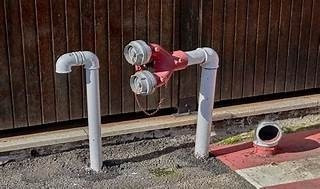 Standpipe
Explore
175 psi (1207 kPa).
For standpipe systems containing 11/2 - 21/2 in. (40 - 65 mm) hose connection outlets without preconnected hose, a pressure regulating device is required when the pressure exceeds 175 psi (1207 kPa), according to NFPA 14, Standard for the Installation of Standpipe and Hose Systems, 2019 edition.
This requirement applies to Class I and Class III standpipe systems, which are intended for use by fire department personnel or trained occupants. A pressure regulating device is a device that automatically reduces and controls the pressure of the water flowing through the hose connection outlet to a predetermined value.This device helps to prevent excessive pressure that could damage the hose, nozzle, or fittings, or cause difficulty in handling the hose stream
References:
NFPA 14: Standard for the Installation of Standpipe and Hose Systems1 Standpipe System Design and Calculations | NFPA | NFPA2 ENGINE COMPANY STANDPIPE OPERATIONS:PRESSURE-
REGULATING DEVICES3
Question 14
Single choice
What is the maximum allowable sound pressure level (SPL) for a fire alarm system?
-
A
-
B
-
C
-
D
Reveal answer details
Close answer details
Correct answerC
ExplanationAccording to NFPA 72, the maximum sound pressure level (SPL) for a fire alarm system is 110 dBA at the minimum hearing distance from the audible appliance1.However, this limit can be exceeded if the sound pressure level measured 2 000 mm above floor level is not more than 100 dBA2. Sound pressure level is a measure of the intensity of sound at a given point in space, expressed in decibels (dB). The higher the SPL, the louder the sound.For comparison, a normal conversation is about 60 dB, a jet engine is about 140 dB, and a gunshot is about 160 dB3.
References:
Sound Pressure Levels - NFPA;NFPA fire alarm
sound level - EntirelySafe.com;Subsection 907.5 - Occupant notification systems - Casetext;How Loud Is a Fire Alarm In Decibels (dB)? With Noise Comparison Chart;The Ontario Building Code | Audibility of Alarm
Systems.
Question 15
Single choice
The Class of an unstable reactive gas that readily undergoes violent chemical change at elevated temperatures and pressures is
-
A
-
B
-
C
-
D
Reveal answer details
Close answer details
Correct answerC
ExplanationClass 3 unstable reactive gas is defined as a material that in itself is capable of detonation or explosive decomposition or reaction at normal temperatures and pressures with a strong initiating source or if heated under confinement. This class of gas readily undergoes violent chemical change at elevated temperatures and pressures.
References:
NFPA 55: Compressed Gases and Cryogenic Fluids Code, 2016 Edition, Section
3.3.51.14.3;International Fire Code, 2015 Edition, Appendix E, Section E102.1.1
Question 16
Single choice
NFPA 750 defines a low-pressure water mist system as one that operates at or below
-
A
-
B
-
C
-
D
Reveal answer details
Close answer details
Correct answerC
ExplanationAccording to NFPA 750-2019, a low-pressure water mist system is one that operates at or below 175 psi (11.9 bar) at the nozzle inlet. This is the maximum pressure limit for this classification of water mist systems.
References:
NFPA 750-2019: Standard on Water Mist Fire Protection Systems, Section 3.3.17.11 and
Section 4.2.12.
|