A consultant is reviewing a customers Pre-delivery Questionnaire. The customer wants to deploy their cluster with ESXi as the hypervisor with vSphere Distributed Switch.
The customer will be using Cisco Nexus 9k as their switch choice In the kick-off call, it is confirmed that the customer has a business requirement to use LACP in their environment. What should the consultant ensure that the customer configures on the port-channel interface before deployment?
-
A
-
B
no lacp graceful-convergence
-
C
service unsupported-transceiver
-
D
no lacp suspend-individual
Reveal answer details
Close answer details
Correct answerD
ExplanationGiven that the customer is using a Cisco Nexus 9k switch and wants to deploy ESXi with a vSphere Distributed Switch while using LACP, the consultant should ensure that the customer configures: no lacp suspend-individual: This command ensures that LACP doesn't suspend the individual port if it does not receive LACP PDUs from the other side, which is crucial in environments where continuous connectivity is required for all member links of the port-channel to maintain uninterrupted network services. References:
Nutanix Bible (https://www.nutanixbible.com)
, where it discusses ESXi configurations and switch settings. Cisco Nexus configuration guides, referred through Nutanix's training materials, which recommend settings for optimal integration with Nutanix environments.
A consultant is setting up Prism Central to manage multiple Nutanix clusters. The customer requires til redundancy and tre aby to manage up to 12,500 VMs. Which deployment option should the consultant use to meet the requirements?
-
A
Maximum CPU and memory allowed for the server hosting the Prism Central VM
-
B
Prism Central cluster mode
-
C
Prism Central Scale-out deployment
-
D
Large Prism Central VM with the maximum CPU and memory allowed
Reveal answer details
Close answer details
Correct answerC
ExplanationTo meet the customer's requirements for high availability and the ability to manage up to 12,500 VMs, the consultant should use Prism Central Scale-out deployment. This deployment mode allows Prism Central to be scaled out across multiple instances, significantly enhancing both performance and resilience, ensuring that the management and operations of a large number of VMs can be handled efficiently and without a single point of failure.
References:
Nutanix Bible, Nutanix University NCS-Core 6.8 learning materials
An administrator needs to configure snapshots for DR scenarios. The databases get refreshed on Friday nights regularly. The search service application re-indexes the new application on Saturday nights regularly. The remaining front-end and middle tier VMs are static but do get minor version updates weekly. The administrator needs to have 2 weeks of daily snapshots for all the VMs in an app group and 2 weeks application consist local snapshots only on Fridays, Saturdays and Sundays on the same group of VMs. Which two options should the administrator use to configure snapshots?
-
A
Create a schedule in a protection domain for all applicable VMs to snap daily with application consistency enabled with 6 days of retention and with no application consistency and 14 days local retention.
-
B
Create two consistency groups in a protection domain, one for front-end and middle tier apps with no application consistency, one for database and Search apps with application consistency, and apply the correct schedule to both groups.
-
C
Create one protection domain for all VMs in an application group with scheduled daily non-application consistent snapshots and another protection domain for all VMs in an application group with scheduled Friday. Saturday, Sunday application consistent snapshots.
-
D
Create a protection domain for all VMs
Reveal answer details
Close answer details
Correct answerC
ExplanationTo meet the requirement of having two weeks of daily snapshots and application-consistent snapshots on specific days (Friday, Saturday, Sunday), the best approach is to use two separate protection domains.
This setup allows for greater flexibility in managing retention policies and ensuring application consistency.
One protection domain will handle daily snapshots without application consistency for regular backups, and the other will handle application-consistent snapshots for critical times when databases and applications are updated, ensuring data integrity during these operations. References:
Nutanix Bible: Data Protection and DR
Nutanix University: Creating and Managing Protection Domains
An administrator receives reports about a Nutanix environment. The investigation finds the following; 1. VMs are experiencing very high latency
2. Each node is equipped with a single SSD, utilized at 95%
3. Each node is equipped with three HDDs, utilized at 40% Why are the guest VMs experiencing high latency?
-
A
CVMs are overwhelmed by disk balancing operations.
-
B
All VM write operations are going to HDD.
-
C
All VM read operations are coming from HDD.
-
D
VMs are unable to perform write operations.
Reveal answer details
Close answer details
Correct answerC
Explanationhttps://next.nutanix.com/prism-infrastructure-management-26/disk-space-usage-high-alert-in-prism-38199
An administrator needs to migrate workloads from a Nutanix cluster running VMware ESXi to Nutanix AHV.
The migration process needs to be completed in multiple VM groups and support roll back in case any problems are found during user acceptance testing. Which action should the administrator perform?
-
A
Use Cross Hypervisor DR to replicate VMs from ESXi to AHV
-
B
-
C
Use Nutanix one-click cluster conversion from ESXi to AHV
-
D
Use storage live migration
Reveal answer details
Close answer details
Correct answerC
Explanationhttps://next.nutanix.com/installation-configuration-23/convert-existing-nutanix-vmware-cluster-to-nutanix-only-37600
A consultant is showing the Prism Element Web Console to a customer and wants to check that cluster health is OK. During validation, the Health menu raises critical alerts about components using default passwords. The cluster is based on ESXi as hypervisor, where Prism Central and Nutanix Files are deployed.
Passwords have already been changed for a few components, but some of them have been left by default. How can the consultant check and handle that situation?
-
A
Activate Cluster lockdown in Prism Element.
-
B
Check accounts and passwords in Local User Management in the vCenter.
-
C
Check NCC results and review the associated KB.
-
D
Deploy and connect the cluster to Prism Security Central.
Reveal answer details
Close answer details
Correct answerC
ExplanationTo address critical alerts about components using default passwords in the Prism Element Web Console: Check NCC results and review the associated KB: The Nutanix Cluster Check (NCC) tool can identify security vulnerabilities, including default password usage. Reviewing the results and associated knowledge base articles provides specific guidance on changing these passwords to secure the environment. References:
Nutanix Bible (https://www.nutanixbible.com)
, specifically sections on cluster health checks and security practices. Nutanix University: NCS-Core 6.8 Training (https://university.nutanix.com)
, which includes instruction on using NCC for cluster validation and security enhancements.
Which subnet is reserved for internal connectivity within a Nutanix Cluster?
-
A
-
B
-
C
-
D
Reveal answer details
Close answer details
Correct answerA
ExplanationWithin a Nutanix cluster, the subnet 192.168.5.0/24 is typically reserved for internal connectivity. This subnet is used for the internal communication between Nutanix Controller VMs (CVMs) and other cluster components. It ensures isolated and efficient network traffic management that is crucial for cluster operations. References:
Nutanix Network Configuration Guide: Nutanix Networking Guide
Nutanix Best Practices for Network Configuration: Nutanix Community
Question 8
Multiple choice
An administrator needs to deploy an application with a large amount of data connected via Nutanix Volumes. Which two actions should the administrator take when designing the Volume Group? (Choose two.)
-
A
Use multiple subnets for iSCSI traffic
-
B
Enable RSS (Receive Side Scaling)
-
C
Enable thick provisioning on the Volume Group(s)
-
D
Distribute workload across multiple virtual disks
Reveal answer details
Close answer details
Question 9
Multiple choice
An administrator needs to replace the self-signed certificate on a cluster. Which two requirements must be met as part of the process? (Choose two.)
-
A
The cluster administrator must restart the interface gateway.
-
B
The signed, intermediate and root certificates are chained.
-
C
The existing certificate must be deleted prior to replacement.
-
D
The imported files for the custom certificate must be PEM encoded.
Reveal answer details
Close answer details
Correct answersB, D
Explanationhttps://portal.nutanix.com/page/documents/details?targetId=Prism-Central-Guide-Prism-v55:mul-security-ssl-certificate-pc-t.html
Question 10
Single choice
A new Nutanix customer suspects that network traffic is going over the 1G interfaces instead of the 10G interfaces. How should a consultant confirm that the traffic is only traversing the 10G interfaces?
-
A
Look in Prism Element under Network.
-
B
Run the allssh manage_ovs show interfaces command.
-
C
Run the iconfig command on the CLI of each CVM.
-
D
Run the allssh manage ovs show uplinks command.
Reveal answer details
Close answer details
Correct answerB
ExplanationTo confirm that network traffic is traversing the 10G interfaces and not the 1G interfaces in a Nutanix environment, the consultant should run the allssh manage_ovs show interfaces command. This command allows for the inspection of all interface configurations and their current operational status across the cluster, effectively confirming which interfaces are actively managing traffic.
References:
Nutanix Bible, Nutanix University NCS-Core 6.8 learning materials
Question 11
Single choice
A customer has a mail server and needs Nutanix to send email notifications about errors that might occur in Prism. The following information is included under SMTP Server Settings 1. IP Address of mail server
2. Port Security Mode
3. From email address What should the consultant set up before arriving onsite?
-
A
SMTP server to allow emails from all IPs in customer network
-
B
SMTP server to allow emails from Cluster VIP and CVM IP addresses
-
C
SMTP to allow emails from Cluster VIP
-
D
SMTP server to allow emails from Host IP addresses
Reveal answer details
Close answer details
Correct answerB
ExplanationBefore arriving onsite, the consultant should set up the SMTP server to allow emails from both the Cluster Virtual IP Address (VIP) and the Controller Virtual Machine (CVM) IP addresses. This setup ensures that Prism can successfully send email notifications through the customer's mail server about any errors or notifications generated by the Nutanix environment, as both the Cluster VIP and CVM IPs are sources from which Prism sends alerts.
References:
Nutanix Bible, Nutanix University NCS-Core 6.8 learning materials
Question 12
Multiple choice
An administrator manages the following two Nutanix AOS 5.15 cluster environment: 1. Corp-cluster-01
2. Corp-cluster-02 The VM images must be available only on Corp-cluster-01, but cannot be checked out to cluster Corp-cluster-02. The images also cannot be checked out to any other clusters that are registered with Prism Central in the future. Which two configuration settings must the administrator choose when creating the image placement policy that satisfies the stated requirements? (Choose two.)
-
A
Create an image placement policy that identifies cluster Corp-cluster-01 as the target cluster
-
B
Set the policy enforcement to Soft.
-
C
Set the policy enforcement to Hard.
-
D
Create an image placement policy that identifies cluster Corp-cluster-02 as the target cluster.
Reveal answer details
Close answer details
Correct answersA, C
ExplanationRef:
https://next.nutanix.com/community-blog-40/nutanix-just-made-ahv-image-management-painless-33144
Question 13
Single choice
The following critical Availability Alert displays in prism Central: Availability Zone configured in Protection Policy PP-BCA-1HR is not accessible. The protection Policy PP-BCA-1HR includes a business critical application with a 1-hour snapshot frequency. What is causing this issue?
-
A
There is a scheduled outage for the Availability Zone referenced in Protection Policy PP-BCA-1HR.
-
B
Workloads included in PP-BCA-1HR are no longer within their intended RPO.
-
C
Prism Central in the Availability Zone for PP-BCA-1HR is unavailable.
-
D
NearSync replication between the Availability Zones has fallen out of scope.
Reveal answer details
Close answer details
Correct answerB
ExplanationThe alert for Protection Policy PP-BCA-1HR indicating critical availability issues is most likely due to the workloads included in the policy no longer meeting their intended Recovery Point Objective (RPO). A 1- hour snapshot frequency implies a stringent RPO, which if not maintained, could result in data loss beyond acceptable business limits. This scenario typically generates a critical alert in Prism Central, especially when the snapshots required to meet the RPO are not completed as scheduled due to any number of issues such as resource constraints or network issues.
References:
Nutanix Prism User Guide, Nutanix Data Protection Best Practices.
Question 14
Multiple choice
An administrator is currently using both 10g uplink with LACP and balance-tcp. A single VM should not be allowed to use more than a single 10G uplink, and both uplinks should be utilized. Which two command should be used to configure the bond? (choose two)
-
A
Ovs-vsctl set port br0-up bond_mode=balance-slb
-
B
Ovs-vsctl set port br0-up bond_mode=balance-tcp
-
C
Ovs-vsctl set port br0-up bond_mode=active-backup
-
D
Ovs-vsctl set port br0-up other_config: bond-rebalance-interval=30000
Reveal answer details
Close answer details
Correct answersA, D
ExplanationFor a configuration where a single VM should not exceed the bandwidth of a single 10G uplink and both uplinks need to be utilized, the correct bonding mode is balance-slb (Source Load Balancing). This mode allows both uplinks to be utilized while ensuring that a single VM will not exceed the capacity of one uplink, as traffic from each VM or "source" is assigned to one of the links in the bond. The other_config: bond-rebalance-interval=30000 command is used to set the interval at which the bonding driver will rebalance the assignment of sources to links in the bond. This helps in maintaining optimal distribution of load across the links as network conditions change. References:
Nutanix Bible: Network Configuration
Nutanix University: Advanced Network Configuration
Question 15
Single choice
A consultant needs to image nodes that cannot be discovered with the Foundation VM The nodes are connected to a flat stitch and are already part of a Nutanix cluster. What course of action would result in Foundation success?
-
A
Use the customer's top of rack switch.
-
B
-
C
Bare metal image the nodes.
-
D
Change the physical connections.
Reveal answer details
Close answer details
Correct answerC
ExplanationIf nodes cannot be discovered using the Foundation VM and they are already part of a Nutanix cluster, the best course of action is to bare metal image the nodes. This process involves re-imaging the nodes from scratch, which can resolve discovery and communication issues that may be caused by existing configurations or errors within the cluster's networking setup.
References:
Nutanix Bible, Nutanix University NCS-Core 6.8 learning materials
Question 16
Single choice
An administrator is responsible for the following Nutanix Enterprise Cloud environment: 1. A central datacenter with a 20-node cluster with 1.5PB of storage
2. Five remote sites each with a 4-node cluster with 200TB storage The remote sites are connected to the datacenter via 1GB links with an average latency of 6 ms RTT. What is the minimum RPO the administrator can achieve for this environment?
-
A
-
B
-
C
-
D
Reveal answer details
Close answer details
Correct answerB
Explanationhttps://support-portal.nutanix.com/page/documents/details?targetId=Web-Console-Guide-Prism-v5_10:wc-protection-domain-wc-c.html
Question 17
Single choice
An existing Nutanix customer has several clusters in production and is adding a new cluster. The customer wants to create an AHV cluster that has already been racked and powered on remotely, with the factory
image, using Prism Central. Which step should the consultant take next?
-
A
Build the cluster with the Foundation Applet
-
B
Build the cluster with the Foundation VM.
-
C
Bare metal image the nodes with the Foundation VM.
-
D
Build the cluster with Foundation Central.
Reveal answer details
Close answer details
Correct answerD
ExplanationFor adding a new cluster to an existing set of production clusters using AHV and wanting to manage the setup remotely via Prism Central, the most appropriate and efficient method is to use Foundation Central.
Foundation Central allows for the remote deployment and configuration of Nutanix clusters through Prism Central, facilitating the foundation process without needing physical access or separate foundational utilities like the Foundation VM or Applet. It uses the factory image on the nodes and is designed to streamline cluster expansions and deployments in enterprise environments.
References:
Nutanix Foundation Central User Guide, Nutanix Prism Central documentation.
Question 18
Single choice
Before deploying a new 3-node cluster, a consultant wants to know which VLAN ID to use during Foundation. Where can the consultant find this information?
-
A
-
B
-
C
-
D
Reveal answer details
Close answer details
Correct answerC
ExplanationTo find the correct VLAN ID to use during the Foundation of a new 3-node cluster, the consultant should refer to the: Deployment Questionnaire: This document typically contains detailed pre-engagement information gathered from the customer, including network specifications such as VLAN IDs. It provides the necessary context and configurations needed for a successful deployment. References:
Nutanix Bible (https://www.nutanixbible.com)
, where the importance of pre-deployment planning and documentation is highlighted. Nutanix University: NCS-Core 6.8 Training (https://university.nutanix.com)
, which covers the process of gathering and using deployment information.
Question 19
Single choice
A consultant is completing final network failover testing on a recently deployed AHV cluster. The cluster consists of the following: 1. Three nodes
2. Two uplinks connected to two switches
3. Supported SFPs The consultant removed one SFP+ out of each node. Two of the nodes (Hostl I Host2) failed over to the backup NIC correctly without any interruption but have lost communication with the third node (Host 3) hypervisor/CVM. Inserting the original SFP+ back into the problematic node allowed the network to be connected and the two healthy nodes could communicate successfully again. manage_ovs showjnterfaces output manage_ovs showjinterfaces output: name mode link speed cthO 10000 True 10000 ethl 10000 False None eth2 10000 True 10000 eth3 10000 False None manage_ovs show.uplinks output: Bridge: brO Bond: brO-up bond_mode: active-backup interfaces: ethl ethO lacp: off lacp-fa I 1 back: false lacp_speed: slow What should the consultant validate first?
-
A
Validate NIC card on node is seated properly.
-
B
Validate that the correct interfaces are included in the bridge.
-
C
Validate the customer has configured all their switch ports identically.
-
D
Validate the SFP+ is fully plugged into the node and switch.
Reveal answer details
Close answer details
Correct answerD
ExplanationGiven the symptoms where two nodes correctly failover but lose communication with the third node after an SFP+ is removed, the first action should be to: Validate the SFP+ is fully plugged into the node and switch: This is critical because a loose or partially connected SFP+ can cause intermittent network issues, which seems to be the problem based on the scenario described. References:
Nutanix Bible (https://www.nutanixbible.com)
, particularly the network troubleshooting sections. Nutanix Field Installation Guide, which provides detailed steps on how to ensure hardware components like SFPs are correctly installed.
Question 20
Single choice
Refer to the exhibit. 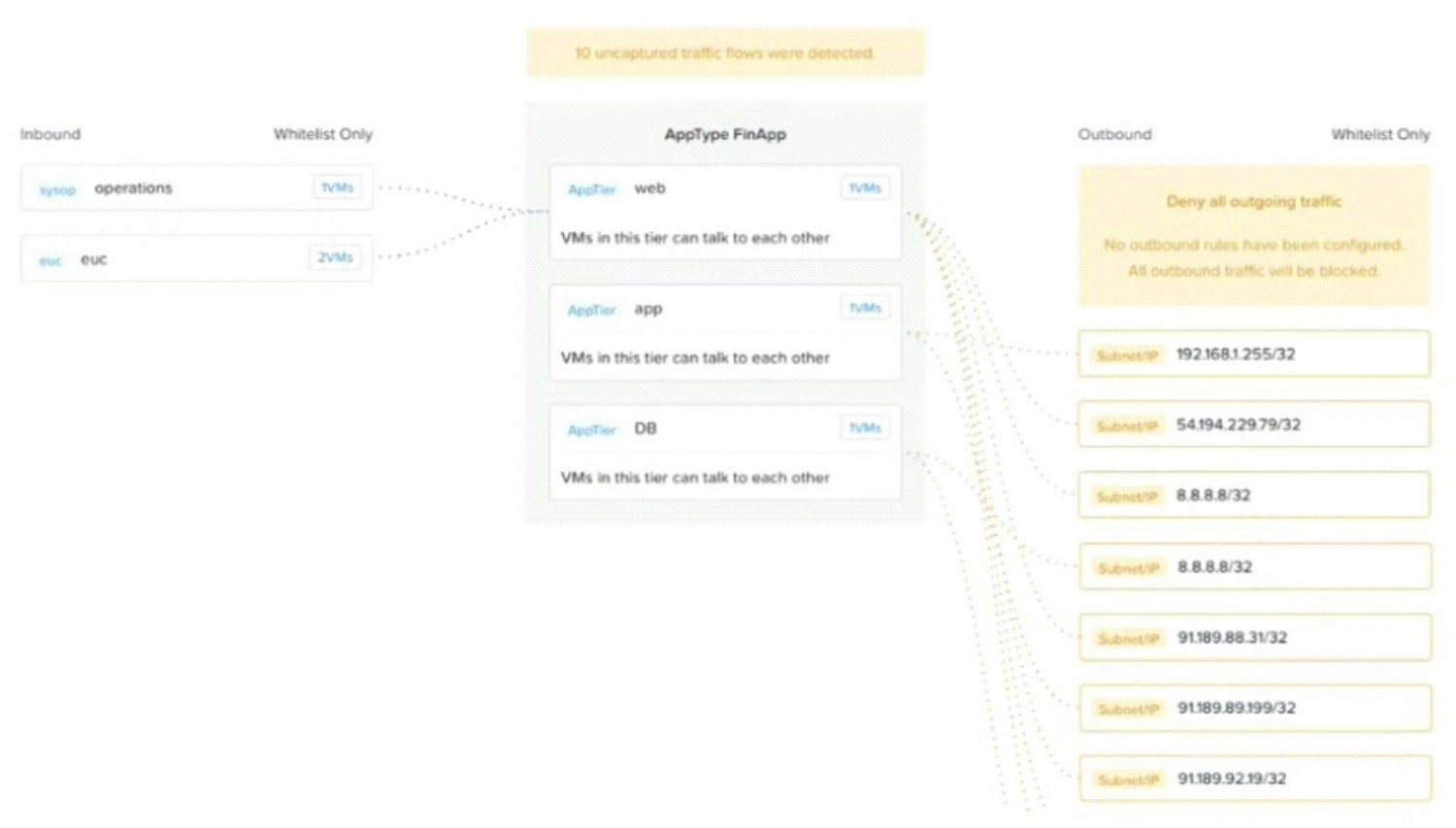 An administrator creates a security policy that isolates their financial application from accessing the Internet.
When viewing the policy in Prism Central, several connections from the application are outbound to the Internet. What is causing this issue with the policy?
-
A
The 0.0.0.0 address was not specified in the outbound rule.
-
B
The blocked connections are illustrated for information only.
-
C
The Activate box was not checked in the rule, so it is not enforcing.
-
D
The policy has been left in monitor mode instead of enforcing mode.
Reveal answer details
Close answer details
Correct answerD
Explanationhttps://portal.nutanix.com/page/documents/details?targetId=Prism-Central-Guide-Prism-v510:mul-security-policy-management-pc-c.html
Question 21
Single choice
An administrator is updating disk firmware using LCM and receives the following message: "there have been 10 or more cluster services restarts within 15 minutes in the Controller VM" The message appears as each drive is upgraded. What is the reason this message is being generated?
-
A
A node has been rebalanced
-
B
A drive has been reformatted
-
C
-
D
Reveal answer details
Close answer details
Correct answerC
ExplanationRef:
https://portal.nutanix.com/page/documents/kbs/details?targetId=kA032000000TT8DCAW
Question 22
Single choice
A customer wants to use NIC teaming on an ESXi host using a vSphere Standard Switch configured with the Route based on physical NIC load load balancing option. The customer does not see the option when editing the Teaming and Failover settings for the switch. How should the consultant resolve this issue?
-
A
Change the load balancing option on the switch.
-
B
Add a vSphere Distributed Switch
-
C
Add another physical NIC to the team.
-
D
Install a vCenter server to manage the switch
Reveal answer details
Close answer details
Correct answerD
ExplanationFor a customer to use NIC teaming with the "Route based on physical NIC load" load balancing option on an ESXi host using a vSphere Standard Switch, they need vCenter Server. This specific load balancing method is not available on a vSphere Standard Switch without vCenter management, as it requires vSphere Distributed Switch capabilities that are managed via vCenter Server. By installing a vCenter server, the customer can upgrade from vSphere Standard to Distributed Switches and access more advanced features including the desired NIC teaming option.
References:
VMware vSphere Documentation, Nutanix Bible.
Question 23
Single choice
During the Foundation imaging process, nodes are successfully imaged, but the cluster creation fails. Which log should the consultant review to determine the cause?
-
A
-
B
-
C
-
D
Reveal answer details
Close answer details
Correct answerB
ExplanationDuring the Nutanix Foundation process, if imaging succeeds but cluster creation fails, the foundation.out log is the primary resource for investigating issues related to cluster creation. This log file contains detailed information about the steps undertaken by the Foundation process, including any errors or issues encountered during the cluster creation phase, making it invaluable for diagnosing problems that prevent successful cluster configuration. References:
Nutanix Bible (https://www.nutanixbible.com)
, particularly the sections on troubleshooting with logs. Nutanix University: NCS-Core 6.8 Training (https://university.nutanix.com)
, where log file analysis is discussed in the context of deployment troubleshooting.
Question 24
Multiple choice
An administrator needs to relocate an AHV cluster to a new datacenter during a maintenance window. The cluster will use the same IPs in the new datacenter. Which two steps should be taken to prepare for this task? (Choose two.)
-
A
Stop all Nutanix Files clusters
-
B
Relocate the linked LDAP servers
-
C
Shut down all user VMs in the cluster
-
D
Reconfigure IPMI for the new datacenter
Reveal answer details
Close answer details
Correct answersA, C
ExplanationRef:
https://next.nutanix.com/installation-configuration-23/physical-relocation-of-nutanix-clusters-38403
Question 25
Single choice
An organizations Nutanix Cluster is based on VMware vSphere. The cluster is configured to download software updates automatically. The administration needs to verify and eventually upgrade VMware hypervisor via Prism Ul. After logging in to Prism, the administrator receives the message shown: No available versions for upgrade What is causing the current state?
-
A
VMware support has expired, so downloads are not available.
-
B
vSphere binaries need to be manually uploaded.
-
C
The environment is running the latest vSphere version, so no update is required.
-
D
The cluster is unable to connect to reIease-api.nutanix-ccm:8D.
Reveal answer details
Close answer details
Correct answerC
Explanationhttps://portal.nutanix.com/page/documents/details?targetId=Web-Console-Guide-Prism-v510:upg-hypervisor-upgrade-esxi-c.html
Question 26
Single choice
As a consultant concludes the project for deploying a new cluster, the customer expresses plans to repeat the process in-house for one of the company's dark site locations. What three items can the consultant deliver in closing to help ensure customer's success in deploying and supporting Nutanix clusters?
-
A
1. Creating an account for access to Nutanix Support Portal
2. External USB drive
3. Offline NCC bundle
-
B
1. A trial license activation code for Prism Starter
2. Creating an account for access to Nutanix Support Portal.
3. Guide for dark site deployments using Nutanix standards
-
C
1. Generating cluster licenses
2. What are binaries and where can they be downloaded
3. Creating an account for accessing the Nutanix Support Portal
-
D
1. External USB drive
2. Access to Nutanix FTP
3. Encrypted key required for accessing clusters
Reveal answer details
Close answer details
Correct answerB
ExplanationAs the consultant concludes the project, to assist the customer with repeating the deployment process at a dark site, the best items to deliver would be: A trial license activation code for Prism Starter, which will allow the customer to begin using the Nutanix cluster immediately without initial extra costs. Creating an account for access to the Nutanix Support Portal, ensuring the customer can access support and documentation as needed for troubleshooting and learning. A guide for dark site deployments using Nutanix standards, which will provide step-by-step instructions tailored to the specific challenges of deploying in a location with no direct internet connectivity.
These resources are critical for enabling the customer to independently deploy and manage Nutanix clusters under the unique constraints of a dark site. References:
Nutanix Deployment Guide, Nutanix Support Portal Documentation.
Question 27
Single choice
A customer recently set up Async Replication between Site A and Site B. The customer wants to conduct a planned failover and clicks Activate on Site B. The customer then runs the following command on Site A: ncli pd deactivate_and__destroy_vms name=<protection_domain_name> What does this do to the customer environment?
-
A
VMs get deleted from Site B and the protection domain is now Active.
-
B
VMs are powered off on Site A and must be manually powered on at Site B.
-
C
VMs get deleted from Site A and the protection domain is no longer active.
-
D
Customer must then manually power off VMs at Site A and power them on at Site B.
Reveal answer details
Close answer details
Correct answerC
ExplanationThe command ncli pd deactivate_and__destroy_vms name=<protection_domain_name> is a critical operation in managing Nutanix environments, particularly in scenarios involving disaster recovery and replication. This command deactivates the protection domain and deletes all VMs associated with that protection domain from the source site (Site A in this case). This operation is generally part of a planned migration or failover process where the VMs are intended to be run from the remote site (Site B).
After this operation, the protection domain at Site A is no longer active, meaning it has been effectively removed along with its associated VMs, thus clearing the way for Site B to take over operations without conflict from the original site.
References:
This action and its implications are covered under Nutanix disaster recovery and high availability strategies, detailed in both the Nutanix Bible and official Nutanix NCS-Core training materials, which discuss the management of protection domains and replication processes. (https://portal.nutanix.com/page/documents/details?targetId=Web-Console-Guide-Prism-v5_10:wc-protection-domain-failback-disaster.html)
Question 28
Single choice
An administrator is implementing a VDI solution. The workload will be a series of persistent desktops in a dedicated storage container within a four-node cluster. Storage optimizations should be set on the dedicated storage container to give optimal performance including during a node failure event. Which storage optimizations should the administrator set to meet the requirements?
-
A
Compression, Deduplication, and Erasure Coding
-
B
Deduplication and Erasure Coding
-
C
Compression and Deduplication
-
D
Reveal answer details
Close answer details
Question 29
Single choice
A guest VM is reported to have poor storage performance. It has an I/O profile of 80% read. 20% write, and the HDDs form more than 50% of the read source. What should an administrator do to resolve this issue?
-
A
-
B
-
C
-
D
Reveal answer details
Close answer details
Correct answerA
Explanationhttps://portal.nutanix.com/page/documents/solutions/details?targetId=BP-2126-SAS-on-Nutanix:BP-2126-SAS-on-Nutanix
Question 30
Single choice
Refer to the exhibit. 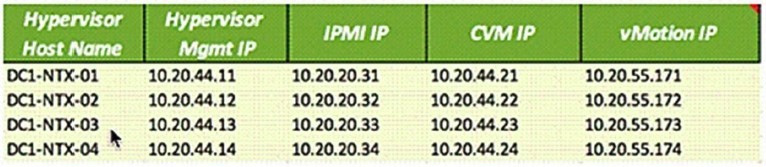 A consultant is deploying a cluster using the customer-provided IP addressing information. Which option in Foundation must be configured to ensure connectivity during the deployment?
-
A
-
B
-
C
-
D
Reveal answer details
Close answer details
Correct answerB
ExplanationDuring the deployment of a cluster using the Nutanix Foundation, ensuring all IP ranges are correctly configured is crucial for successful connectivity and deployment. "Range Autofill" is a feature in Foundation that automatically populates IP address fields based on the first IP provided, ensuring consistency and correctness across multiple nodes being deployed simultaneously. This feature helps avoid manual entry errors and ensures all nodes are configured with appropriate IP addresses that fall within the specified range.
References:
Nutanix University (https://university.nutanix.com/)
Question 31
Single choice
A consultant has deployed a new Nutanix AHV cluster with Foundation. The customer requests separating the management and production traffic in the CVM. Which feature should the consultant configure?
-
A
-
B
-
C
-
D
Reveal answer details
Close answer details
Correct answerD
ExplanationTo separate management and production traffic within a Nutanix AHV cluster, VLAN Tagging is the appropriate feature to configure. VLAN Tagging allows different types of traffic to be segregated onto different network segments over the same physical infrastructure, effectively isolating management traffic from production traffic at the network level. This setup enhances security and performance by reducing the possibility of network congestion affecting critical management operations. References:
Nutanix Bible (https://www.nutanixbible.com)
, specifically the sections on networking and VLANs. Nutanix University: NCS-Core 6.8 Training (https://university.nutanix.com)
, which covers advanced network configurations including VLAN Tagging.
Question 32
Single choice
A customer buys ultimate licensing and wants to use the built-in Nutanix software encryption on their new AHV cluster. The customer needs to create three storage containers and asks the consultant to complete the process as fast as possible. In which order should the cluster be deployed?
-
A
Create Cluster -> Install License Key -> Encrypt Cluster -> Create Storage Containers
-
B
Create Cluster -> Install License Key -> Create Storage Containers -> Encrypt Cluster
-
C
Create Cluster -> Encrypt Cluster -> Install License Key -> Create Storage Containers
-
D
Create Cluster -> Create Storage Containers -> Encrypt Cluster -> Install License Key
Reveal answer details
Close answer details
Correct answerA
ExplanationThe optimal sequence for deploying a Nutanix AHV cluster with built-in software encryption involves the following steps: Create Cluster: Establish the cluster foundation, which sets up the basic network and cluster configurations.
Install License Key: The ultimate licensing must be applied before enabling encryption because the feature depends on this license. Encrypt Cluster: Once the cluster is created and licensed, enable encryption to secure the data at rest. This step should be done before creating storage containers to ensure that all data written to the containers is encrypted from the outset. Create Storage Containers: Finally, create the storage containers. With encryption already enabled, any data written to these containers will be automatically encrypted. References:
Nutanix Bible (https://www.nutanixbible.com)
, specifically the sections on licensing and data encryption. Nutanix University: NCS-Core 6.8 Training (https://university.nutanix.com)
, covering deployment and configuration best practices.
Question 33
Single choice
An administrator is concerned that Prism will be inaccessible if Active Directory is unable to process logins. Which method should the administrator use to access the cluster in the event of this type of outage?
-
A
Manage the cluster by using the "nutanix" user on the Prism leader CVM
-
B
Create and use an emergency local account on the cluster
-
C
Deploy an Active Directory server locally on the cluster
-
D
Manage the cluster remotely by downloading ncli to a remote workstation
Reveal answer details
Close answer details
Correct answerB
ExplanationIn the event of an Active Directory outage that prevents login to Prism, the recommended approach is to have a contingency plan that allows for local management of the cluster. Option B, "Create and use an emergency local account on the cluster," is the correct choice. This approach ensures that administrators can still access and manage the cluster even if external authentication services are down. An emergency local account provides a direct, reliable means to access Prism and perform necessary administrative tasks without depending on external systems. This is a critical backup strategy for maintaining access control and managing the cluster during outages. References:
This method is in line with best practices for system availability and disaster recovery, ensuring
administrators retain access to manage and troubleshoot without interruption, as detailed in Nutanix's documentation and security configuration guidelines.
Question 34
Single choice
A customer recently bought services from their consultant to re-configure an existing Cluster for a new use case. The data on the cluster is not important. The customer does not know the CVM usernames and passwords. Which Foundation tool should the consultant use to resolve this issue?
-
A
Foundation VM - Auto Discovery
-
B
Foundation Applet(CVM) - Auto Discovery
-
C
Foundation VM - Bare Metal
-
D
Foundation Applet(CVM) - Bare Metal
Reveal answer details
Close answer details
Correct answerC
ExplanationFor re-configuring an existing cluster for a new use case where data preservation is not a concern, and there is a lack of CVM credentials: Foundation VM - Bare Metal: This tool allows for a complete re-installation of the Nutanix software from scratch, which is ideal in scenarios where existing configurations and data are no longer needed, and access credentials are unknown or lost. References:
Nutanix Bible (https://www.nutanixbible.com)
, especially sections on cluster reconfiguration and Foundation tools. Nutanix University: NCS-Core 6.8 Training (https://university.nutanix.com)
, where cluster deployment and reconfiguration scenarios are extensively covered.
Question 35
Single choice
How should a consultant verify that a Nutanix cluster can tolerate a single-node failure?
-
A
[root@cvm~]# ncli cluster get-domain-fault-tolerance-status type=node
-
B
nutanix@cvm~$ ncli cluster get-domain-fault-tolerance-status type=node
-
C
[root@avh~]# ncli cluster fault-tolerance-status type=node
-
D
nutanix@cvm~$ ncli cluster status type=node
Reveal answer details
Close answer details
Correct answerB
ExplanationTo verify that a Nutanix cluster can tolerate a single-node failure, the consultant should use the command nutanix@cvm~$ ncli cluster get-domain-fault-tolerance-status type=node . This command is executed from the Controller Virtual Machine (CVM) and checks the cluster's fault tolerance status specifically for node failures, providing insights into how the cluster's data resiliency and redundancy configurations are holding up against potential single-node failures.
References:
Nutanix CLI Guide, Nutanix Fault Tolerance
Documentation.
Question 36
Single choice
For several days, an administrator notices the following alerts: 1. CVM NIC Speed Low Warning Alerts
2. Warning Alerts of CVM NIC not performing at optimal speed
3. CVM is disconnected from the network Critical Alert
4. Network Visualization page shows excessive dropped packets on CVM/Host Which steps should be taken to determine which problem should be addressed first?
-
A
Access the Hardware Page to verify resources are available Analyze ail CVM Speed Alerts in the Alerts/Events page Analyze output for the network and interface properties and connectivity issues
-
B
Verify Host/CVM connectivity on the Network Visualization page
Use to verify the bridge and bond configuration Review alerts/events page for the CVM disconnected error
-
C
Review Alerts page for NIC speed alerts and alert timing Analyze the genesis.out log file for process failures Assess the NIC properties in the Network Visualization>; Host Properties page
-
D
Restart networking services on the CVM Determine the current configuration of the affected CVM via output Access the Alerts/Events page for the CVM network connection failures
Reveal answer details
Close answer details
Correct answerB
ExplanationRef:
https://portal.nutanix.com/page/documents/kbs/details?targetId=kA00e000000CuaDCAS
Question 37
Single choice
From a hypervisor, which IP address should the consultant use to connect to the locally tossed on?
-
A
-
B
-
C
-
D
Reveal answer details
Close answer details
Correct answerA
ExplanationWhen configuring network settings for a hypervisor or accessing local services hosted on it, the IP address must be reachable from the network configuration you are currently using. Given the generic nature of the options, the correct choice typically depends on the subnet used for management purposes, which often uses a standard private address. "192.168.5.254" is a common choice for local network configurations and is likely set up as the gateway or a primary network interface on the hypervisor. References:
Nutanix University - NCS-Core 6.8 Learning Path The Nutanix Bible, Network Configuration chapter (https://www.nutanixbible.com/)
Question 38
Single choice
A customer has HE servers with DiscoverOS and wants to install a Nutanix cluster. Which method should a consultant use to meet the requirements?
-
A
Manually create the cluster.
-
B
Create the cluster using CVM Foundation.
-
C
Image the bare metal nodes.
-
D
Create the cluster using Crash cart.
Reveal answer details
Close answer details
Correct answerC
ExplanationWhen installing a Nutanix cluster on hardware servers pre-loaded with an existing operating system such as DiscoverOS, the best approach is to re-image the bare metal nodes. This process involves using the Nutanix Foundation tool to install the required Nutanix software (such as AOS and Hypervisor) onto the nodes, replacing any pre-existing software. This ensures that the hardware is properly configured and optimized for the Nutanix environment.
References:
Nutanix University - NCS-Core 6.8 Learning Path The Nutanix Bible, Foundation chapter (https://www.nutanixbible.com/)
Question 39
Single choice
In a Nutanix cluster, a Protection Domain contains 50 entities that are replicated to a remote Single Node Replication Target. The current schedule configuration is as follows: 1. Repeat every 6 hours
2. Local Retention Policy 1
3. Remote Retention Policy 8
4. Starting time 12 am At 8 am on Monday, the administrator discovers that a protected VM is corrupted. The latest good state was Sunday 2 pm. The administrator needs to maintain current protection. Which strategy should the administrator use to meet these requirements?
-
A
From the Remote site, activate the Protection Domain, then re-protect the entity.
-
B
From the Remote site, restore the VM from the local snapshot by selecting the correct snapshot
-
C
From the local site, retrieve the correct remote snapshot, then restore the VM locally.
-
D
From the local site, restore the VM from the local snapshot by selecting the correct snapshot.
Reveal answer details
Close answer details
Question 40
Single choice
The consultant is deploying a 20-node AHV cluster, as part of a Nutanix Files deployment. How many FSVMs can the consultant deploy in this environment?
-
A
-
B
-
C
-
D
Reveal answer details
Close answer details
Correct answerA
ExplanationIn a Nutanix Files deployment within a 20-node AHV cluster, the consultant can deploy a maximum of 16 FSVMs (File Server Virtual Machines). This limitation is based on Nutanix's best practices and design considerations for scalability and performance. The number of FSVMs that can be effectively managed and maintained without degrading the performance of the file-serving operations or the underlying storage infrastructure dictates this maximum. References:
Nutanix Certified Services - Core (NCS-Core) Learning Documents Nutanix Bible: (https://www.nutanixbible.com)
Nutanix University Videos: (https://www.youtube.com/playlist?list=PLAHgaS9IrJecs_AcQT3Y7vSsKT2mjz3Iu)
Question 41
Single choice
A Nutanix cluster is deployed with the following configuration: 1. Three four-node blocks (A, B, and C)
2. All Flash Redundancy Factor 2 What is the effect of simultaneous disk failures on two nodes located in block A?
-
A
VMs are migrated off of the nodes with disk failures.
-
B
Each node with a failed disk is marked as degraded.
-
C
VM read and write operations continue normally.
-
D
VMs on the nodes with failed disks are unable to write data
Reveal answer details
Close answer details
Correct answerC
ExplanationRef:
https://next.nutanix.com/how-it-works-22/redundancy-factor-vs-replication-factor-37486
Question 42
Single choice
A consultant is deploying a new Nutanix cluster. The nodes have the following network interfaces. 1. 2x 10G NICS
2. 2x 25G NICS The consultant is using the default virtual switch configurations for AHV. After creating 10 VMs, the consultant observes inconsistent network speeds from the VMs on the AHV host. What should the consultant do to resolve this issue?
-
A
Configure load balancing on the virtual switch for both 106 and 25G interfaces.
-
B
Configure a separate virtual switch with 10G NICs on vs o and 256 NICs on vs.
-
C
Configure Active/Backup for both the 10G and 25G interfaces.
-
D
Configure all network interfaces with LACP on the same virtual switch.
Reveal answer details
Close answer details
Correct answerD
ExplanationTo resolve inconsistent network speeds from the VMs on an AHV host equipped with both 10G and 25G NICs, the consultant should configure all network interfaces with Link Aggregation Control Protocol (LACP) on the same virtual switch. This configuration will allow for better load balancing and bandwidth aggregation across multiple network interfaces, improving overall network throughput and reducing bottlenecks.
References:
Nutanix University - NCS-Core 6.8 Learning Path The Nutanix Bible, Networking chapter (https://www.nutanixbible.com/)
Question 43
Single choice
A CEO asks the IT administrator to provide a list of required resources to protect current workloads and the two new SQL servers from a disaster. The Nutanix environment is managed by Prism Central. Which option explains how to meet the CEO's request?
-
A
In Capacity Runway, select Optimize Resources and select all VMs that must be protected.
-
B
Create a new project and assign the VMs to it to get compute and storage requirements.
-
C
Create a new scenario based on a new cluster based on a VM Profile and select Recommend.
-
D
Create a new Recovery policy by selecting the VM that needs to be protected and get hardware requirements.
Reveal answer details
Close answer details
Correct answerD
ExplanationIn a Nutanix environment managed by Prism Central, protecting workloads and SQL servers from a disaster involves creating a recovery policy. A recovery policy in Nutanix is a set of rules that define how data is protected and recovered in the event of a disaster.
Creating a new recovery policy involves selecting the virtual machines (VMs) that need to be protected and specifying the hardware requirements for the recovery environment. This includes the compute and storage resources needed to run the protected VMs in the recovery site.
Once the recovery policy is created, Nutanix's built-in data protection and disaster recovery capabilities can ensure that the protected VMs can be quickly and efficiently recovered in the event of a disaster. This includes capabilities such as efficient snapshot, cloning, and replication capabilities to provide a higher level of protection at a lower cost.
Therefore, to meet the CEO's request, the IT administrator should create a new Recovery policy by selecting the VM that needs to be protected and get hardware requirements. References:
Designing, Optimizing and Scaling Microsoft SQL Server - Nutanix Nutanix Data Disaster Recovery - Protect Apps & Data | Nutanix
Recommendations For Leap And Supported Service-level ... - Nutanix Cloud Disaster Recovery Services | Nutanix
Nutanix High Availability and Data Protection
Question 44
Single choice
A consultant is not able to run the As-Built Tool for a technical reason. What action should the consultant take to gather information and provide customer documentation?
-
A
Manually create documentation using As-Built document template.
-
B
Use RVTools for vSphere and Hyper-V deployments.
-
C
Create a support case on behalf of a customer.
-
D
Access portal.nutanix.com, search Software Documentation.
Reveal answer details
Close answer details
Correct answerA
ExplanationIf the As-Built Tool cannot be run due to technical reasons, the next best action for the consultant is to manually create documentation using an As-Built document template. This approach ensures that documentation is still provided to the customer detailing the setup, configuration, and operational state of their environment, which is crucial for ongoing management and future audits. This method is proactive and ensures customer needs are met despite technical setbacks.
References:
Nutanix Technical Documentation Guidelines, Best Practices in Nutanix System
Documentation.
Question 45
Single choice
A consultant creates three storage containers (container-1, container-2, container-3). The customer requires that only container-1, which will be utilized as an NFS datastore, be presented to external hosts. However, users are able to mount all three containers. What is causing this problem?
-
A
Compression was turned on for all containers.
-
B
A Container-level whitelist entry was configured.
-
C
Deduplication was turned on for all containers.
-
D
A Global whitelist entry was configured.
Reveal answer details
Close answer details
Correct answerD
ExplanationThe issue where users can mount all three storage containers despite the intention to restrict access to just container-1 typically stems from a Global whitelist entry. A global whitelist allows all entities to access all containers unless more specific restrictions are applied at the container level. To correct this, specific whitelist entries need to be configured for each container to define and restrict access appropriately.
References:
Nutanix NCS-Core 6.8 training resources, the Nutanix Bible, and Nutanix technical documentation on storage container management.
Question 46
Single choice
An administrator receives a notification that storage in a Nutanix cluster is unavailable. The cluster consists of five nodes and is configured with a Fault-Tolerance level of 1 (FT-1). Upon investigation, the administrator finds the following: 1. All AHV hosts are powered on and the CVMs are running
2. Nodes A, B, and C are connected to one top of rack switch
3. Nodes D and E are connected to a second top of rack switch
4. The cluster status command run on Node A shows that CVM services on nodes D and E are down Which issue is causing the storage outage?
-
A
The default gateway for the CVMs and AHV hosts is down.
-
B
The switch connecting Nodes D and E is down.
-
C
The genesis process is down on both Nodes D and E.
-
D
Nodes D and E are in maintenance mode.
Reveal answer details
Close answer details
Correct answerB
Explanationhttps://hyperhci.com/2020/07/29/nutanix-cluster-services-down-troubleshooting/
|