The alert details mention a specific external network. Attempts to assign new Floating IPs to VMs fail, but existing Floating IPs continue to work. What is the cause of this alert?
-
A
A firewall is blocking communication between Prism Central and the VPC's virtual router.
-
B
The VPC's connection to the external network is down.
-
C
A firewall is blocking communication between Prism Central and the VPC's virtual router.
-
D
There are no more available IP addresses in the address pool configured for Floating IPs in that external network.
Reveal answer details
Close answer details
Correct answerD
ExplanationExisting Floating IPs still working means the external network path is not generally down. New Floating IP assignments failing for that external network points to the configured pool having no available IP addresses left for additional allocations.
While configuring a new security policy in a Nutanix microsegmentation environment, an administrator wants the policy to remain flexible even if virtual machines change subnets or obtain new IP addresses. Which configuration approach should the administrator use when defining the policy scope?
-
A
Configure the policy only on specific VLAN IDs.
-
B
Use VM categories to define the secured and allowed entities.
-
C
Apply the policy after setting static routes for each VM.
-
D
Assign IP addresses manually to all VMs included in the policy.
Reveal answer details
Close answer details
Correct answerB
ExplanationVM categories define the secured and allowed entities independently of current IP addressing. Because the policy follows category membership, it remains valid when VMs move subnets or receive new addresses.
When setting up a Network Function VM for Service Insertion, an administrator needs to configure the vNICs that will be used for redirecting traffic. What is the correct configuration for the vNICs on the Network Function VM?
-
A
Two specific Network Function vNICs must be created, one for inbound traffic and the other for outbound traffic.
-
B
A single vNIC of type Network Function is required, which handles both ingress and egress traffic.
-
C
Two Network Function vNICs are required that must be assigned static IP addresses from a managed IPAM network.
-
D
Two standard vNICs are required, one for ingress and one for egress and must be on a trunked VLAN.
Reveal answer details
Close answer details
Correct answerA
ExplanationService Insertion redirects traffic through a Network Function VM by using dedicated Network Function vNICs for each direction. Creating one specific vNIC for inbound traffic and another for outbound traffic provides the required traffic steering points.
An administrator plans to upgrade the Network Controller in a Flow Virtual Networking deployment. The environment includes multiple AHV clusters managed by Prism Central. Which prerequisite must be verified before upgrading the Network Controller?
-
A
Flow Network Security must be upgraded to the target release before upgrading the Network Controller.
-
B
Each cluster must be running the Flow Network Security version specified as compatible with the target Network Controller release.
-
C
Each cluster must be running AHV versions compatible with the target Network Controller release.
-
D
Network Controller Prism Element upgrades must be applied before before Network Controller Prism Central upgrades can be applied.
Reveal answer details
Close answer details
Correct answerC
ExplanationBefore upgrading Network Controller, the cluster foundation it manages must be compatible with the target release. In this deployment that means checking AHV on every managed cluster; Flow Network Security or Prism Element sequencing is not the stated prerequisite.
Set routing advertisement for a tenant overlay network so upstream routers learn that the tenant prefix exists; which object should be added?
-
A
Floating IP entries for every workload in the tenant network
-
B
Guest operating system routes on each VM in the subnet
-
C
An Externally Routable Prefix for the tenant network
-
D
A security policy that permits warehouse application traffic
Reveal answer details
Close answer details
Correct answerC
ExplanationAn Externally Routable Prefix tells the upstream routing domain that the tenant network prefix exists and can be advertised. Floating IPs and guest routes do not provide the same network-level advertisement for the overlay tenant prefix.
During a night-shift contractor rollout, a help desk VDI policy grants access based on an AD group. Two users receive the dynamic ADGroup category after login, but one contractor is blocked and the category is absent from that desktop. What should the administrator verify first?
-
A
Whether the desktop has a Floating IP assigned
-
B
Whether the affected contractor matches the mapped AD group and identity data
-
C
Whether the VDI security policy is configured as a Transit VPC
-
D
Whether the desktop subnet has an Externally Routable Prefix
Reveal answer details
Close answer details
Correct answerB
ExplanationThe missing dynamic ADGroup category points first to identity matching, not subnet or routing configuration. Verifying that the affected contractor matches the mapped AD group and identity data checks whether Prism Central can assign the category that the VDI policy uses for access.
Category creation issue blocks a SecOps user who can create and enforce Flow Network Security policies while grouping VMs for a launch policy; what is the most likely cause?
-
A
The user must first place the new policy in Monitor mode.
-
B
The policy scope must be changed from cluster to VPC.
-
C
The user lacks category-management privileges such as Flow Admin.
-
D
The policy must be cloned before new categories can be created.
Reveal answer details
Close answer details
Correct answerC
ExplanationCreating and enforcing security policies is separate from managing the categories used to group VMs. If category creation fails, the likely gap is missing category-management privilege, such as Flow Admin capability.
Question 8
Multiple choice
Flow Network Security Next-Gen is supported in which two environments? (Choose two.)
-
A
On-Premises Overlay Networks
-
B
-
C
-
D
On-Premises VLAN Basic Networks
Reveal answer details
Close answer details
Correct answersA, C
ExplanationFlow Network Security Next-Gen is supported for overlay network environments in both deployment types named here: On-Premises Overlay Networks and NC2 Overlay Networks. The VLAN network options describe different network types and are not the supported pair.
How can the administrator discover the root cause of the issue?
-
A
Confirm that Inter-VM connectivity is enabled within the VM networking settings and that VMs in the Database tier are configured correctly to accept inbound traffic.
-
B
Check if traffic isolation has been configured on the Database tier and ensure that there is no policy preventing App tier communication with the Database tier.
-
C
Check the security policies again to ensure that the rule allowing port 3306 from Web - > Database is
applied and active, then check the policy enforcement mode to ensure it is in Enforcement Mode.
-
D
Verify that the port 3306 is open on the external gateway and that SNAT is not being applied for internal communication.
Reveal answer details
Close answer details
Correct answerC
ExplanationRoot-cause checks should start where the database flow is controlled: the security policy rule that allows port 3306 from Web to Database and the policy's Enforcement Mode. If that rule is inactive or not applied, MySQL traffic can fail even when other networking settings are normal.
Question 10
Multiple choice
An administrator has observed the following message: Which two statements most accurately describe the security hitlog captured above? (Choose two.)
-
A
This is a security hit log on the rule name "Production-External-WebTier".
-
B
The source ip address is 10.38.174.5 and source port is TCP/123.
-
C
86.108.190.23 is sending a packet on UDP 123.
-
D
10.38.174.57 is sending a packet destined to UDP 123.
Reveal answer details
Close answer details
Correct answersB, D
ExplanationA security hitlog is read from its flow tuple: source address and source port identify the sender side, while the destination field and service port identify what the packet is trying to reach. Here that supports 10.38.174.5 with TCP/123 and 10.38.174.57 as traffic destined to UDP 123.
Question 11
Single choice
Enable Flow Virtual Networking for a development AHV cluster managed by Prism Central; which prerequisite should be completed first?
-
A
Convert all existing VLAN subnets to overlay subnets.
-
B
Deploy a third-party firewall Network Function VM.
-
C
Create a static route for every planned overlay subnet.
-
D
Activate Network Controller for the Prism Central environment.
Reveal answer details
Close answer details
Correct answerD
ExplanationFlow Virtual Networking depends on the Network Controller being active in the Prism Central environment. Overlay subnet conversion, firewall deployment, or static route planning comes after the controller prerequisite is in place.
Question 12
Single choice
Configure a Flow Network Security policy for a payment application where web VMs may reach app VMs on TCP 8443 and app VMs may reach database VMs on TCP 1521; which configuration should be used?
-
A
One VLAN per tier with physical switch ACLs for the two ports
-
B
A global policy that permits traffic and relies on guest firewalls
-
C
Floating IP assignments on the web and app VMs
-
D
Category values for each tier with inter-tier rules for the required services
Reveal answer details
Close answer details
Correct answerD
ExplanationTiered application rules should follow workload identity and required services. Category values identify the web, app, and database tiers, and inter-tier rules then permit only the needed TCP 8443 and TCP 1521 communication.
Question 13
Single choice
To protect only the backup-facing vNIC of a dual-homed reporting VM, which Flow Network Security scope should be used?
-
A
An entity group combining the VM category and the subnet category for that vNIC
-
B
The VM category alone, because policies automatically choose one vNIC
-
C
The subnet category for both connected subnets
-
D
A VPC-wide policy applied to every vNIC in the VPC
Reveal answer details
Close answer details
Correct answerA
ExplanationA dual-homed VM needs policy scope narrow enough to select only the backup-facing interface. An entity group combining the VM category with the subnet category for that vNIC identifies that specific attachment, while a VM-only or VPC-wide scope would cover more interfaces than intended.
Question 14
Single choice
A SecOps engineer identifies a single VM as a malware suspect and must contain it quickly without redesigning the application policy set. Which policy should be used?
-
A
-
B
-
C
-
D
Reveal answer details
Close answer details
Correct answerB
ExplanationA Quarantine Policy is designed for rapid containment of a suspect VM. It can isolate the affected workload quickly without redesigning the broader application policy set or changing shared service definitions.
Question 15
Single choice
Exhibit: 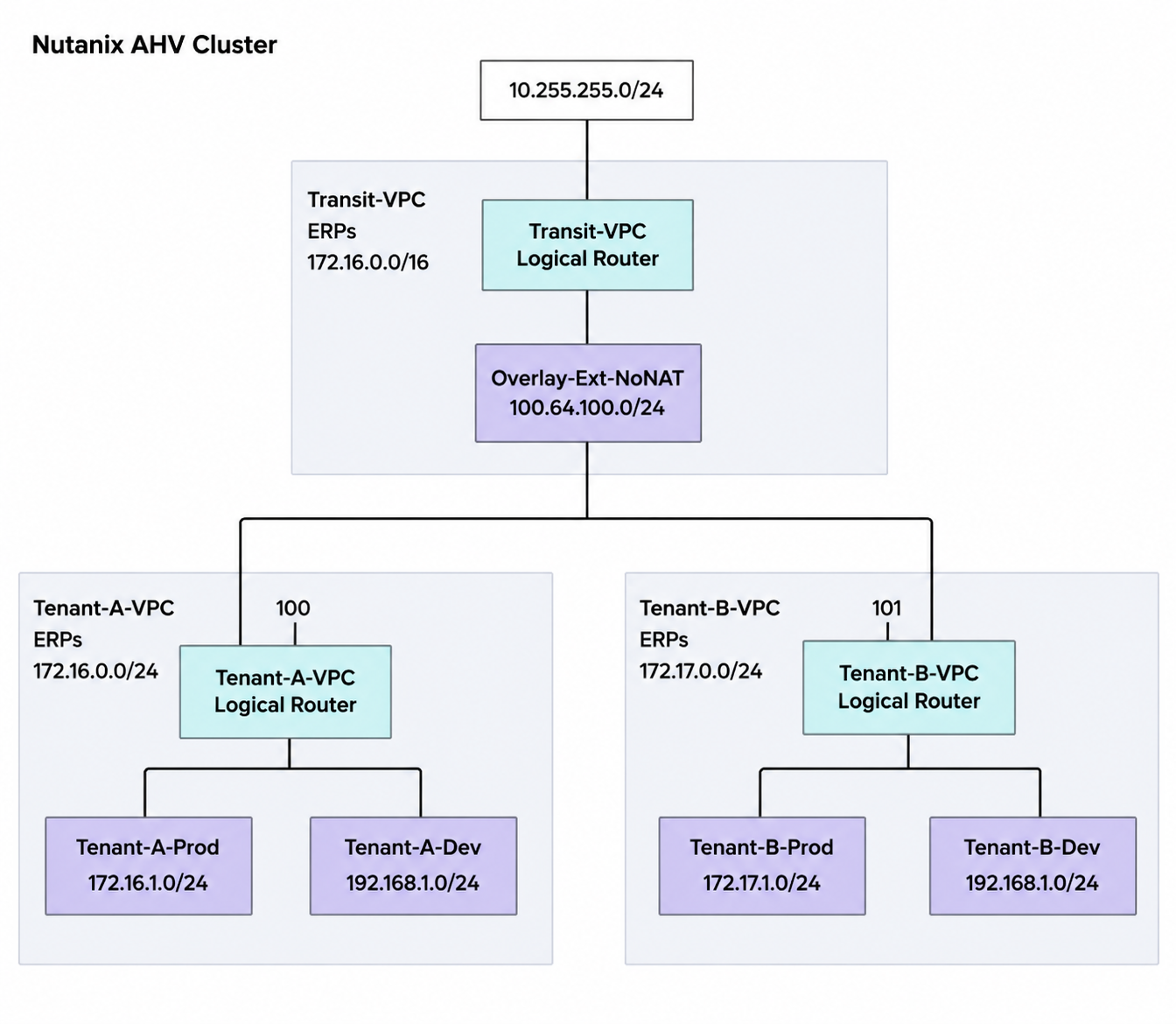 An administrator has just added a new VPC for Tenant-B... However, users are reporting that they are unable to access external resources from VMs created in the Tenant-B-Prod subnet. What should be done to correct the problem?
-
A
Update the ERPs for Tenant-B-VPC.
-
B
Add a Network Policy in Tenant-B-VPC.
-
C
Add a Network Policy in Transit-VPC.
-
D
Update the ERPs for Transit-VPC.
Reveal answer details
Close answer details
Correct answerA
ExplanationExternal Resource Policies control which external resources a VPC can reach. Since the problem affects VMs in Tenant-B-Prod after adding Tenant-B-VPC, updating the ERPs for Tenant-B-VPC addresses the missing allowed external access instead of changing Transit-VPC policy behavior.
Question 16
Single choice
An administrator needs to delegate the management of security policies to a dedicated SecOps team. To enforce the principle of least privilege, the administrator assigns the predefined Flow Policy Author role to a user on the team. The user confirms they can create, monitor, and enforce security policies. However, when attempting to build a new application security policy for a set of newly deployed VMs, the user reports they are unable to create a new category to group these VMs. The option is not available in the Prism Central UI. Which statement explains this behavior?
-
A
The Flow Policy Author role must be cloned into a custom role before it can be used.
-
B
The user's role must be assigned with a scope for the specific projects they manage.
-
C
The user is missing the Flow Admin role, which is required for category management.
-
D
The Flow Policy Author role can only apply policies to existing categories by design.
Reveal answer details
Close answer details
Correct answerC
ExplanationFlow Policy Author lets the user create, monitor, and enforce security policies, but category management is a higher administrative function. Creating a new category requires Flow Admin privileges, so the UI hides that action when the user only has the policy author role.
Question 17
Single choice
Before changing routing for an IPsec VPN tunnel that is up while large overlay packets fragment and application performance is poor, which adjustment should be made?
-
A
Lower the guest VM MTU to account for tunnel overhead.
-
B
Disable Geneve encapsulation on the VPC.
-
C
Move the VPN gateway to a NAT external network only.
-
D
Remove all externally routable prefixes from the VPC.
Reveal answer details
Close answer details
Correct answerA
ExplanationIPsec adds tunnel headers, reducing the payload size that can pass without fragmentation. Lowering the guest VM MTU makes workloads send smaller packets that account for tunnel overhead, which addresses fragmentation before changing routes for a tunnel that is already up.
Question 18
Single choice
Which step is required before placing the Flow Network Security software bundle on a local web server?
-
A
Perform an inventory on the Nutanix cluster before transferring any bundle files to the web server.
-
B
Extract the downloaded bundle using 7zip and upload it directly to Prism Central.
-
C
Enable Direct Upload in Life Cycle Manager so the bundles can be transferred automatically to the Nutanix cluster.
-
D
Set up a local web server and download both the required software LCM bundle and compatibility bundle.
Reveal answer details
Close answer details
Correct answerD
ExplanationBefore placing Flow Network Security bundle files on a local web server, the offline LCM content must be prepared: set up the local web server and download both the required software LCM bundle and the compatibility bundle.
Question 19
Single choice
An administrator is building a new VPC in Prism Central to isolate a test environment. The administrator plans to connect it to an external network later, but they want to complete the initial creation first. Which configuration items are the minimum required to successfully create the VPC?
-
A
VPC name and one External Access VLAN
-
B
VPC name and Transit VPC toggle switch
-
C
VPC name and one Overlay Subnet
-
D
VPC name and cluster selection
Reveal answer details
Close answer details
Correct answerD
ExplanationA VPC can be created before external connectivity or overlay subnets are added. The minimum creation inputs are the VPC name and the cluster selection that places the VPC on the Nutanix environment. External VLANs and subnets can be configured later.
Question 20
Single choice
BGP adjacency issue appears after an HA gateway is added to a VPC, and the upstream router still lists only the original peer; what is the likely missing configuration?
-
A
The upstream hold timer must be shortened.
-
B
The new gateway must reuse the original peer IP address.
-
C
A peering session must be defined for the added gateway.
-
D
ICMP must be allowed between the two gateway nodes.
Reveal answer details
Close answer details
Correct answerC
ExplanationAdding an HA gateway introduces another device that must form its own BGP relationship with the upstream router. If only the original peer is configured, a peering session must be defined for the added gateway.
Question 21
Single choice
In a Nutanix deployment, when is the Network Controller automatically enabled?
-
A
When the Small Prism Central deployment is scaled out to three PCVM's
-
B
When the Network Controller is manually configured from the Prism Central settings page
-
C
When the Network Controller is enabled on a Hyper-V cluster
-
D
When the X-Large Prism Central deployment is installed or upgraded
Reveal answer details
Close answer details
Correct answerD
ExplanationNetwork Controller auto-enablement is tied to the X-Large Prism Central deployment path. Installing or upgrading an X-Large deployment enables it automatically; scaling a Small deployment, manual configuration, or a Hyper-V-specific choice does not match that trigger.
|