An administrator needs to verify whether the cluster is protected currently from potential data loss due to a component failure.
From the Prism Element Home dashboard, how should the administrator accomplish this task?
-
A
Select the gear icon and then select Pulse.
-
B
Click on Home and then Alerts.
-
C
Look at the Data Resiliency Status widget.
-
D
Navigate to the Health dashboard.
Reveal answer details
Close answer details
Correct answerC
ExplanationLook at the Data Resiliency Status widget is the appropriate focus because The Data Resiliency Status widget summarizes whether the cluster can withstand a component failure without data loss. Look at the Data Resiliency Status widget maps the scenario to virtual machine operations, which is the boundary that determines where the administrator should act in a Nutanix environment. Look at the Data Resiliency Status widget keeps the operation in a supported path with predictable cluster behavior when multiple nodes, services, workloads, or management views are involved. Look at the Data Resiliency Status widget should be remembered as a functional match: identify the requested outcome, then choose the Nutanix component that owns that outcome. Select the gear icon and then select Pulse should be ruled out because the behavior under discussion belongs to Look at the Data Resiliency Status widget. Click on Home and then Alerts points to a separate concern, so comparing it with Look at the Data Resiliency Status widget helps isolate the actual administrative function. Navigate to the Health dashboard can matter in a different workflow, while Look at the Data Resiliency Status widget is tied to the outcome requested here. Look at the Data Resiliency Status widget is also a useful study anchor because it links the scenario wording to a real administrative action instead of to a term that only shares the same general topic.
What is the benefit of configuring user-defined Alert Policies in Prism Central?
-
A
It customizes alert thresholds.
-
B
It restricts network access for administrators.
-
C
It automates VM migrations.
-
D
It reduces the frequency of system updates.
Reveal answer details
Close answer details
Correct answerA
ExplanationIt customizes alert thresholds is the appropriate focus because User-defined alert policies let administrators tune thresholds and conditions so alerts match operational requirements. It customizes alert thresholds maps the scenario to logical storage behavior, which is the boundary that determines where the administrator should act in a Nutanix environment. It customizes alert thresholds keeps the operation in a supported path with predictable cluster behavior when multiple nodes, services, workloads, or management views are involved. It customizes alert thresholds should be remembered as a functional match: identify the requested outcome, then choose the Nutanix component that owns that outcome. It restricts network access for administrators is a neighboring term, but It customizes alert thresholds carries the responsibility that satisfies the requirement. It automates VM migrations should be ruled out because the behavior under discussion belongs to It customizes alert thresholds. It reduces the frequency of system updates points to a separate concern, so comparing it with It customizes alert thresholds helps isolate the actual administrative function. It customizes alert thresholds is also a useful study anchor because it links the scenario wording to a real administrative action instead of to a term that only shares the same general topic.
When is deduplication recommended?
-
A
-
B
-
C
-
D
Reveal answer details
Close answer details
Correct answerC
ExplanationFull clone VMs is the appropriate focus because Full clone virtual machines are suitable for deduplication when their operating system and application blocks share substantial common data. Full clone VMs maps the scenario to planned maintenance safety, which is the boundary that determines where the administrator should act in a Nutanix environment. Full clone VMs keeps the operation in a supported path with predictable cluster behavior when multiple nodes, services, workloads, or management views are involved. Full clone VMs should be remembered as a functional match: identify the requested outcome, then choose the Nutanix component that owns that outcome. Server workloads points to a separate concern, so comparing it with Full clone VMs helps isolate the actual administrative function. Linked Clone VMs can matter in a different workflow, while Full clone VMs is tied to the outcome requested here. Cold data is a neighboring term, but Full clone VMs carries the responsibility that satisfies the requirement. Full clone VMs is also a useful study anchor because it links the scenario wording to a real administrative action instead of to a term that only shares the same general topic.
After logging into Prism Element, an administrator sees a red heart as shown in the exhibit. 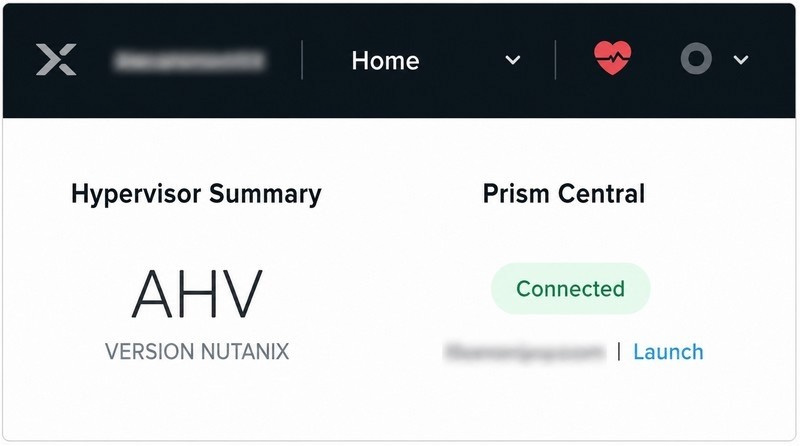 Which dashboard will help the administrator isolate the cause of the issue?
-
A
-
B
-
C
-
D
Reveal answer details
Close answer details
Correct answerC
ExplanationAlerts is the appropriate focus because The Alerts dashboard is the place to isolate the active condition behind a red health indicator and review what is currently firing. Alerts maps the scenario to planned maintenance safety, which is the boundary that determines where the administrator should act in a Nutanix environment. Alerts keeps the operation in a supported path with predictable cluster behavior when multiple nodes, services, workloads, or management views are involved. Alerts should be remembered as a functional match: identify the requested outcome, then choose the Nutanix component that owns that outcome. Health points to a separate concern, so comparing it with Alerts helps isolate the actual administrative function. Tasks can matter in a different workflow, while Alerts is tied to the outcome requested here.
Analysis is a neighboring term, but Alerts carries the responsibility that satisfies the requirement. Alerts is also a useful study anchor because it links the scenario wording to a real administrative action instead of to a term that only shares the same general topic.
An administrator needs to remove several old VM snapshots.
From which Prism Element dashboard should the administrator complete this task?
-
A
-
B
-
C
-
D
Reveal answer details
Close answer details
Correct answerC
ExplanationVM is the appropriate focus because The VM dashboard is where administrators manage virtual-machine snapshots and remove old ones. VM maps the scenario to logical storage behavior, which is the boundary that determines where the administrator should act in a Nutanix environment. VM keeps the operation in a supported path with predictable cluster behavior when multiple nodes, services, workloads, or management views are involved. VM should be remembered as a functional match: identify the requested outcome, then choose the Nutanix component that owns that outcome. Tasks is a neighboring term, but VM carries the responsibility that satisfies the requirement. Settings should be ruled out because the behavior under discussion belongs to VM. Storage points to a separate concern, so comparing it with VM helps isolate the actual administrative function. VM is also a useful study anchor because it links the scenario wording to a real administrative action instead of to a term that only shares the same general topic.
Shared storage for Windows Server Failover Clustering (WSFC) is a use case for which Nutanix Unified Storage solution?
-
A
-
B
-
C
-
D
Reveal answer details
Close answer details
Correct answerA
ExplanationVolumes is the appropriate focus because Nutanix Volumes provides block storage over iSCSI, which is the shared-disk style required by Windows Server Failover Clustering. Volumes maps the scenario to alert policy control, which is the boundary that determines where the administrator should act in a Nutanix environment. Volumes keeps the operation in a supported path with predictable cluster behavior when multiple nodes, services, workloads, or management views are involved. Volumes should be remembered as a functional match: identify the requested outcome, then choose the Nutanix component that owns that outcome. Files points to a separate concern, so comparing it with Volumes helps isolate the actual administrative function. FT1 can matter in a different workflow, while Volumes is tied to the outcome requested here. RF2 is a neighboring term, but Volumes carries the responsibility that satisfies the requirement. Volumes is also a useful study anchor because it links the scenario wording to a real administrative action instead of to a term that only shares the same general topic.
What role does a Replication Factor of 2 or 3 play in ensuring data integrity and recovery?
-
A
It limits the scope of hardware failures during recovery operations.
-
B
It ensures that multiple copies of data are available for recovery.
-
C
It accelerates data transfer to remote backup sites.
-
D
It reduces the need for offsite backup solutions.
Reveal answer details
Close answer details
Correct answerB
ExplanationIt ensures that multiple copies of data are available for recovery is the appropriate focus because Replication factor protects integrity by keeping multiple copies of data available for recovery after a component failure. It ensures that multiple copies of data are available for recovery maps the scenario to health dashboard interpretation, which is the boundary that determines where the administrator should act in a Nutanix environment. It ensures that multiple copies of data are available for recovery keeps the operation in a supported path with predictable cluster behavior when multiple nodes, services, workloads, or management views are involved. It ensures that multiple copies of data are available for recovery should be remembered as a functional match: identify the requested outcome, then choose the Nutanix component that owns that outcome. It limits the scope of hardware failures during recovery operations is a neighboring term, but It ensures that multiple copies of data are available for recovery carries the responsibility that satisfies the requirement. It accelerates data transfer to remote backup sites should be ruled out because the behavior under discussion belongs to It ensures that multiple copies of data are available for recovery. It reduces the need for offsite backup solutions points to a separate concern, so comparing it with It ensures that multiple copies of data are available for recovery helps isolate the actual administrative function. It ensures that multiple copies of data are available for recovery is also a useful study anchor because it links the scenario wording to a real administrative action instead of to a term that only shares the same general topic.
Which bridge does the Controller VM use by default to communicate with the AHV host it runs on?
-
A
-
B
-
C
-
D
Reveal answer details
Close answer details
Correct answerD
Explanationbridge0 is the appropriate focus because bridge0 is the bridge identified for default Controller VM to AHV host communication in the provided answer set. bridge0 maps the scenario to planned maintenance safety, which is the boundary that determines where the administrator should act in a Nutanix environment. bridge0 keeps the operation in a supported path with predictable cluster behavior when multiple nodes, services, workloads, or management views are involved. bridge0 should be remembered as a functional match: identify the requested outcome, then choose the Nutanix component that owns that outcome. vs0 points to a separate concern, so comparing it with bridge0 helps isolate the actual administrative function. virbro can matter in a different workflow, while bridge0 is tied to the outcome requested here. br0 is a neighboring term, but bridge0 carries the responsibility that satisfies the requirement. bridge0 is also a useful study anchor because it links the scenario wording to a real administrative action instead of to a term that only shares the same general topic.
An administrator is conducting updates in a Nutanix cluster and is being prompted for handling non-migratable VMs. Which VM type is non-migratable?
-
A
-
B
-
C
-
D
VMs O VMs with attached Volume Groups
Reveal answer details
Close answer details
Correct answerD
ExplanationVMs with attached Volume Groups is the appropriate focus because Virtual machines with attached volume groups cannot be migrated normally during update handling because the block attachment constrains movement. VMs with attached Volume Groups maps the scenario to virtual machine operations, which is the boundary that determines where the administrator should act in a Nutanix environment. VMs with attached Volume Groups keeps the operation in a supported path with predictable cluster behavior when multiple nodes, services, workloads, or management views are involved. VMs with attached Volume Groups should be remembered as a functional match: identify the requested outcome, then choose the Nutanix component that owns that outcome. VMs without NGT should be ruled out because the behavior under discussion belongs to VMs with attached Volume Groups. VMs marked as an Agent points to a separate concern, so comparing it with VMs with attached Volume Groups helps isolate the actual administrative function. Memory Overcommitted can matter in a different workflow, while VMs with attached Volume Groups is tied to the outcome requested here. VMs with attached Volume Groups is also a useful study anchor because it links the scenario wording to a real administrative action instead of to a term that only shares the same general topic.
Question 10
Single choice
A Veeam Backup appliance, which uses iSCSI, must be deployed into an AHV-based cluster. What must be configured to allow Veeam to connect to the Nutanix cluster?
-
A
-
B
-
C
-
D
Reveal answer details
Close answer details
Correct answerA
ExplanationNetwork Segmentation is the appropriate focus because Network Segmentation is required so iSCSI traffic from a backup appliance can reach the Nutanix cluster over the intended network path. Network Segmentation maps the scenario to virtual networking design, which is the boundary that determines where the administrator should act in a Nutanix environment. Network Segmentation keeps the operation in a supported path with predictable cluster behavior when multiple nodes, services, workloads, or management views are involved. Network Segmentation should be remembered as a functional match: identify the requested outcome, then choose the Nutanix component that owns that outcome. Nutanix Objects can matter in a different workflow, while Network Segmentation is tied to the outcome requested here. Prism Central is a neighboring term, but Network Segmentation carries the responsibility that satisfies the requirement. Data Services IP should be ruled out because the behavior under discussion belongs to Network Segmentation. Network Segmentation is also a useful study anchor because it links the scenario wording to a real administrative action instead of to a term that only shares the same general topic.
Question 11
Single choice
An administrator needs to implement a disaster recovery plan. The company has two sites, each with its own Nutanix AHV cluster. Latency between the sites is 30ms. Which built-in functionality in Prism Element could the administrator use to enable disaster recovery between the two clusters?
-
A
-
B
-
C
-
D
Reveal answer details
Close answer details
Correct answerD
ExplanationMetro Cluster is the appropriate focus because Metro Cluster is the built-in synchronous disaster recovery style that links two sites for rapid recovery when the latency profile is acceptable. Metro Cluster maps the scenario to storage resiliency design, which is the boundary that determines where the administrator should act in a Nutanix environment. Metro Cluster keeps the operation in a supported path with predictable cluster behavior when multiple nodes, services, workloads, or management views are involved.
Metro Cluster should be remembered as a functional match: identify the requested outcome, then choose the Nutanix component that owns that outcome. Recovery Plan can matter in a different workflow, while Metro Cluster is tied to the outcome requested here. Protection Policies is a neighboring term, but Metro Cluster carries the responsibility that satisfies the requirement. Data Protection should be ruled out because the behavior under discussion belongs to Metro Cluster. Metro Cluster is also a useful study anchor because it links the scenario wording to a real administrative action instead of to a term that only shares the same general topic.
Question 12
Single choice
An administrator is reviewing a Nutanix cluster and needs to understand whether the current licensing supports the intended operational features. Where should the administrator focus?
-
A
The cluster license level
-
B
The guest operating system version
-
C
-
D
The event retention interval
Reveal answer details
Close answer details
Correct answerA
ExplanationThe cluster license level is the appropriate focus because The cluster license level determines whether the intended operational features are entitled and available. The cluster license level maps the scenario to storage resiliency design, which is the boundary that determines where the administrator should act in a Nutanix environment. The cluster license level keeps the operation in a supported path with predictable cluster behavior when multiple nodes, services, workloads, or management views are involved. The cluster license level should be remembered as a functional match: identify the requested outcome, then choose the Nutanix component that owns that outcome. The guest operating system version can matter in a different workflow, while The cluster license level is tied to the outcome requested here. The VM power state list is a neighboring term, but The cluster license level carries the responsibility that satisfies the requirement. The event retention interval should be ruled out because the behavior under discussion belongs to The cluster license level. The cluster license level is also a useful study anchor because it links the scenario wording to a real administrative action instead of to a term that only shares the same general topic.
Question 13
Single choice
An administrator wants to collect log files that have been requested by Nutanix Support.
From which Prism Element dashboard can this be accomplished?
-
A
-
B
-
C
-
D
Reveal answer details
Close answer details
Correct answerA
ExplanationSettings is the appropriate focus because Settings is the Prism Element area that exposes cluster support workflows such as collecting log bundles requested by support. Settings maps the scenario to logical storage behavior, which is the boundary that determines where the administrator should act in a Nutanix environment. Settings keeps the operation in a supported path with predictable cluster behavior when multiple nodes, services, workloads, or management views are involved. Settings should be remembered as a functional match: identify the requested outcome, then choose the Nutanix component that owns that outcome. Alerts is a neighboring term, but Settings carries the responsibility that satisfies the requirement. Health should be ruled out because the behavior under discussion belongs to Settings. Analysis points to a separate concern, so comparing it with Settings helps isolate the actual administrative function. Settings is also a useful study anchor because it links the scenario wording to a real administrative action instead of to a term that only shares the same general topic.
Question 14
Single choice
An administrator has spent time correcting specific issues that have been identified by NCC Health Checks in Prism Element. How can just the checks that previously did not pass be executed again to confirm they are all resolved?
-
A
Run LCM Pre-Upgrade to trigger NCC Checks.
-
B
Run ncc health checks run_all.
-
C
Select Run Check for each check worked.
-
D
Select Only Failed And Warning Checks.
Reveal answer details
Close answer details
Correct answerD
ExplanationSelect Only Failed And Warning Checks is the appropriate focus because Only Failed And Warning Checks reruns the checks that previously reported problems, allowing a focused confirmation pass after remediation. Select Only Failed And Warning Checks maps the scenario to software inventory handling, which is the boundary that determines where the administrator should act in a Nutanix environment. Select Only Failed And Warning Checks keeps the operation in a supported path with predictable cluster behavior when multiple nodes, services, workloads, or management views are involved. Select Only Failed And Warning Checks should be remembered as a functional match: identify the requested outcome, then choose the Nutanix component that owns that outcome. Run LCM Pre-Upgrade to trigger NCC Checks should be ruled out because the behavior under discussion belongs to Select Only Failed And Warning Checks. Run ncc health checks run_all points to a separate concern, so comparing it with Select Only Failed And Warning Checks helps isolate the actual administrative function. Select Run Check for each check worked can matter in a different workflow, while Select Only Failed And Warning Checks is tied to the outcome requested here. Select Only Failed And Warning Checks is also a useful study anchor because it links the scenario wording to a real administrative action instead of to a term that only shares the same general topic.
|